From Surf Wiki (app.surf) — the open knowledge base
Saratov
City in Saratov Oblast, Russia

City in Saratov Oblast, Russia
| Field | Value |
|---|---|
| en_name | Saratov |
| ru_name | Саратов |
| image_skyline | Saratov Montage (2016).png |
| image_caption | Top upper left: (Church of the Intercession of the Most Holy Theotokos) in Saratov, Top lower left: Top right: Saratov Conservatory, Middle left: , Middle right: Schmidt Mill, Bottom: A twilight view of and the Volga |
| coordinates | |
| map_label_position | right |
| image_coa | Coat of Arms of Saratov.svg |
| image_flag | Flag of Saratov.svg |
| pushpin_map | Russia Saratov Oblast#European Russia#Europe |
| federal_subject | Saratov Oblast |
| federal_subject_ref | |
| adm_city_jur | city of oblast significance of Saratov |
| adm_city_jur_ref | |
| adm_ctr_of1 | Saratov Oblast |
| adm_ctr_of1_ref | |
| adm_ctr_of2 | Saratovsky District |
| adm_ctr_of2_ref | |
| inhabloc_cat | City |
| inhabloc_cat_ref | |
| urban_okrug_jur | Saratov Urban Okrug |
| urban_okrug_jur_ref | |
| mun_admctr_of1 | Saratov Urban Okrug |
| mun_admctr_of1_ref | |
| mun_admctr_of2 | Saratovsky Municipal District |
| mun_admctr_of2_ref | |
| leader_title | |
| leader_title_ref | |
| leader_name | |
| leader_name_ref | |
| representative_body | City Duma |
| representative_body_ref | |
| pop_2010census | 837900 |
| pop_2010census_rank | 16th |
| pop_2010census_ref | |
| pop_latest | 886165 |
| pop_latest_date | 2025 |
| pop_latest_ref | |
| established_date | ca. 1590 |
| established_date_ref | |
| current_cat_date | 1708 |
| current_cat_date_ref | |
| postal_codes | 410000–410005, 410007–410010, 410012, 410015, 410017–410019, 410022, 410023, 410025, 410028–410031, 410033–410042, 410047–410056, 410059, 410060, 410062–410065, 410068, 410069, 410071, 410074, 410076, 410078, 410080, 410082, 410086, 410700, 410880, 410890, 410899, 410960–410965, 410999 |
| dialing_codes | 8452 |
| website | http://www.saratovmer.ru |
Saratov ( , ; , ) is the largest city and administrative center of Saratov Oblast, Russia, and a major port on the Volga River. Saratov had a population of 901,361, making it the 17th-largest city in Russia by population. Saratov is 389 km north of Volgograd, 442 km south of Samara, and 858 km southeast of Moscow.
The city stands near the site of Uvek, a city of the Golden Horde. Tsar Feodor I of Russia likely developed Saratov as a fortress to secure Russia's southeastern border. Saratov developed as a shipping port along the Volga and was historically important to the Volga Germans, who settled in large numbers in the city before they were expelled before and during World War II.
Saratov is home to a number of cultural and educational institutions, including the Saratov Drama Theater, Saratov Conservatory, Radishchev Art Museum, Saratov State Technical University, and Saratov State University.
Etymology
The name Saratov may have been derived from, Sarı Taw (Сары Тау), meaning "Yellow Mountain" in the Tatar language. Another version of the name originates from the words, Sar Atau, which means [the] "Boggy Island".
History
Flag of Russia.svg Russian Empire 1721–1917
Flag of Russia.svg Russian Republic 1917–1918
Flag of Russia.svg Russian Democratic Federal Republic 1918 Flag of the Russian Soviet Federative Socialist Republic (1954–1991).svg Russian Soviet Federative Socialist Republic 1918–1922
Flag of the Soviet Union.svg Union of Soviet Socialist Republics 1922–1991
Russia Russian Federation 1991–present Uvek, a city of the Golden Horde, stood near the site of the modern city of Saratov from the mid-13th century until its destruction by Tamerlane in 1395. While the exact date of the foundation of modern Saratov is unknown, plausible theories date it to ca. 1590, during the reign (1584–1598) of Tsar Fyodor Ivanovich, who constructed several settlements along the Volga River in order to secure the southeastern boundary of his state. Town status was granted to it in 1708.
By the 1800s, Saratov had grown to become an important shipping port on the Volga. The Ryazan-Ural Railroad reached Saratov in 1870. In 1896, the line crossed the Volga and continued its eastward expansion. A unique train-ferry, owned by the Ryazan-Ural railroad, provided the connection across the river between the two ends of the railroad for 39 years, before the construction of a railway bridge in 1935.
During January 1915, with World War I dominating the Russian national agenda, Saratov became the destination for deportation convoys of ethnic Germans, Jews, Hungarians, Austrians and Slavs whose presence closer to the western front was perceived as a potential security risk to the state.

During World War II, Saratov was a station on the north–south Volzhskaya Rokada, a specially designated military railroad supplying troops, ammunition and supplies to Stalingrad. In 1942-1943 the city was bombed by German aircraft. The main target was the Kirov oil refinery, which was heavily bombarded, seriously damaging the installation and destroying 80% of its plant and temporarily interrupting its work. The Luftwaffe was able to destroy all the fuel stock at bases in Saratov and eliminate the oil plant in the city.
Until the end of the Soviet Union in 1991, the Soviet authorities designated Saratov a "closed city"; off-limits to all foreigners due to its military importance as the site of a vital facility manufacturing military aircraft.
German community
Saratov played a prominent role in the history of the Volga Germans. In July 1763 Catherine II published an edict in which she promised that German settlers would remain German and enjoy a great deal of autonomy, even if they moved to the Volga region. Many Germans did so. There, the continued with their German language, their own education, their churches (for the Catholics the Diocese of Tiraspol was later founded and seated in Saratov), their publications, etc.
However, after more than a century living in that region, the living conditions of the Germans began to change. Catherine II had died in 1796, and the government began to apply an aggressive Russification policy, which meant that from 1878 (when Alexander II was Emperor of Russia) some groups of Volga Germans began to emigrate to the United States, Canada, Brazil and Argentina. Those who could not leave or who remained in the hope conditions would improve suffered greatly. Hostilities did not stop even after the confiscation of their assets. On 22 June 1941, Nazi Germany began a war against the Soviet Union. On 28 August 1941, dictator Stalin had the Presidium of the Supreme Soviet of the USSR pass a decree ‘On the resettlement of Germans residing in the Volga region’. The approximately 400,000 remaining Volga Germans were accused of collective collaboration, deported to Siberia and Central Asia, and forced into labour camps of the ‘Labour Army’ (Трудармия); thousands of them died. Most Russian Germans (men and women) were ‘conscripted’ between October 1942 and December 1943.
In 1964, they were officially cleared of the accusation of collaboration, albeit with restrictions. (1964 marked the end of the Khrushchev era, which had begun in 1953 after Stalin's death. The Thaw period lasted from about 1956 to October 1964).
The freedom of travel granted on 3 November 1972 allowed a return to the Volga, but explicitly not to the settlement inhabited before the deportation. This only became possible after the Dissolution of the Soviet Union.
Today only a few reminders remain of the once prominent place for Volga Germans. The Roman Catholic St. Klemens Cathedral, which had been built by the Volga Germans on the main street of Saratov, the then called "German Street" (, ), has its steeples removed and was converted into the Pioneer Cinema by order of the Soviet government (religion was prohibited). The old German Street, the pedestrian street of Saratov, was renamed Kirov Prospect in reference to the Bolshevik leader Sergei Kirov. On April 18, 2022, Kirov Prospect was officially renamed by decree of the city mayor to Stolypin Prospect.
Administrative and municipal status
The consisted of 6 districts; , , , , ,
Saratov is the administrative center of the oblast and, within the framework of administrative divisions, it also serves as the administrative center of Saratovsky District, even though it is not a part of it. As an administrative division, it is incorporated separately as the city of oblast significance of Saratov—an administrative unit with the status equal to that of the districts. As a municipal division, the city of oblast significance of Saratov is incorporated as Saratov Urban Okrug.
Geography
Climate
Saratov has a moderately continental climate with warm summers, relatively dry climate and an abundance of sunny days. The warmest month is July with daily mean temperature near +23 C; the coldest is February, at -8 C.
Summers are hot and in Saratov daytime temperatures of +30 C or higher are commonplace, up to +40.9 C during a heat wave in 2010.
Snow and ice are dominant during the winter season. Days well above freezing and nights below -25 C both occur in the winter. | Jan record high C = 8.1 | Feb record high C = 8.4 | Mar record high C = 18.8 | Apr record high C = 31.1 | May record high C = 34.1 | Jun record high C = 39.2 | Jul record high C = 40.8 | Aug record high C = 40.7 | Sep record high C = 36.7 | Oct record high C = 25.5 | Nov record high C = 17.1 | Dec record high C = 11.7 | year record high C = 40.8 | Jan record low C = -37.3 | Feb record low C = -34.8 | Mar record low C = -26.8 | Apr record low C = -17.8 | May record low C = -3.8 | Jun record low C = 2.1 | Jul record low C = 6.4 | Aug record low C = 4.3 | Sep record low C = -2.9 | Oct record low C = -12.6 | Nov record low C = -23.8 | Dec record low C = -33.4 | year record low C = -37.3
Economy and infrastructure

Saratov Oblast is highly industrialized, due in part to the richness in natural and industrial resources of the area. The oblast is also one of the more important and largest cultural and scientific centers in Russia. Saratov possesses six institutes of the Russian Academy of Sciences, twenty-one research institutes, nineteen project institutes, as well as the Saratov State University, the Saratov State Socio-Economic University, the Saratov State Technical University, and many scientific and technological laboratories attached to some of the city's large industrial enterprises.
Transportation
Saratov is served by the Saratov Gagarin Airport (opened in August 20, 2019, replacing Saratov Tsentralny Airport). The airport serves flights to both international and domestic destinations. Saratov West is a general aviation airfield. The aerospace manufacturing industry was served by the Saratov South airport. Nearby Engels-2 (air base) is the main base for Russian strategic Tu-95 and Tu-160 bombers. Motorways link Saratov directly to Volgograd, Samara, and Voronezh. The railways also play an important role. The Privolzhskaya Railway is headquartered in Saratov. The Volga itself is an important inland waterway. Buses and trolleybuses form the backbone of public transport in the city.
Saratov has a tram network, which opened in 1908. Currently, there are two depots, while a third was closed in 2001. The rolling stock currently consists of 71-605, 71-619, 71-608 and a number of refurbished Tatra T3, renamed to MTTE and MTTCh.
A trolleybus network is also present in the city. On July 2, 2021, an intercity route over the Volga was opened, linking to the trolleybus network of Engels. Trolza 5265 in Saratov.jpg|Trolza-5275 low-floor trolleybus Тролза Оптима 1272 в Саратове.jpg|Trolza-5275 low-entry trolleybus Saratov trams 1002+1004.jpg|KTM-19 trams
City budget
Information about revenues and expenditures of the city budget for the period 2007–2017.
| Balance, billion rubles | 0.23 | 0.20 | −0.72 | −0.58 | −0.84 | −0.52 | −1.02 | −0.68 | −0.71 | −0.40 | −0.57 |
|---|
Demographics
|1897 | 137000 |1926 | 212395 |1939 | 372002 |1959 | 584092 |1970 | 757330 |1979 | 855702 |1989 | 904643 |2002 | 873055 |2010 | 837900 |2021 | 901361
Saratov has a population of 901,361 within city limits and roughly 1.2 million in the urban agglomeration. More than 90% of the city's population are ethnic Russians. Among the remainder are Tatars, Kazakhs, Armenians, Azerbaijanis, Ukrainians and others.
In the 2021 Census, the following ethnic groups were listed:
| Ethnic group | Population | Percentage |
|---|---|---|
| Russians | 686,699 | 92.8% |
| Tatars | 10,291 | 1.3% |
| Kazakhs | 7,354 | 1.0% |
| Armenians | 6,456 | 0.9% |
| Azerbaijanis | 4,198 | 0.6% |
| Ukrainians | 3,392 | 0.5% |
| Others | 40,262 | 3.8% |
|}
Education
Saratov is host to a number of colleges and universities. These include the Saratov State University (1909), Saratov State Technical University, Saratov State Medical University, Saratov State Academy of Law and Saratov State Agrarian University. In 2014 a newly renovated campus for the Saratov Regional College of Art was opened.
Culture


.jpg)
One of the city's most prominent landmarks is the 19th century neo-Gothic Conservatory. When it was built in 1912, the Conservatory was Russia's third such institution (after Moscow and St. Petersburg). At the time, Saratov, with a population of 240,000, was the third-largest city in Russia. The main building of the conservatory had been built in 1902 by architect Alexander Yulyevich Yagn, and originally it housed a music school. Before the opening of the conservatory in 1912, the building was reconstructed by the architect Semyon Akimovich Kallistratov. When Saratov Conservatory opened in September 1912, it immediately had 1,000 students ready to begin their studies.
Another landmark is the Soothe My Sorrows Church, built at the beginning of the 20th century.
The Saratov Drama Theater was founded in 1802, making it one of Russia's oldest. It is ranked as one of Russia's National Theaters. In Soviet times, the theater was renamed in honor of Karl Marx, but now carries the name of Ivan Slonov (1882–1945), an actor, theatrical director and educator, born in the city. The full name in Russian is The I. A. Slonov Saratov State Academic Theater (Саратовский государственный академический театр драмы имени И. А. Слонова).
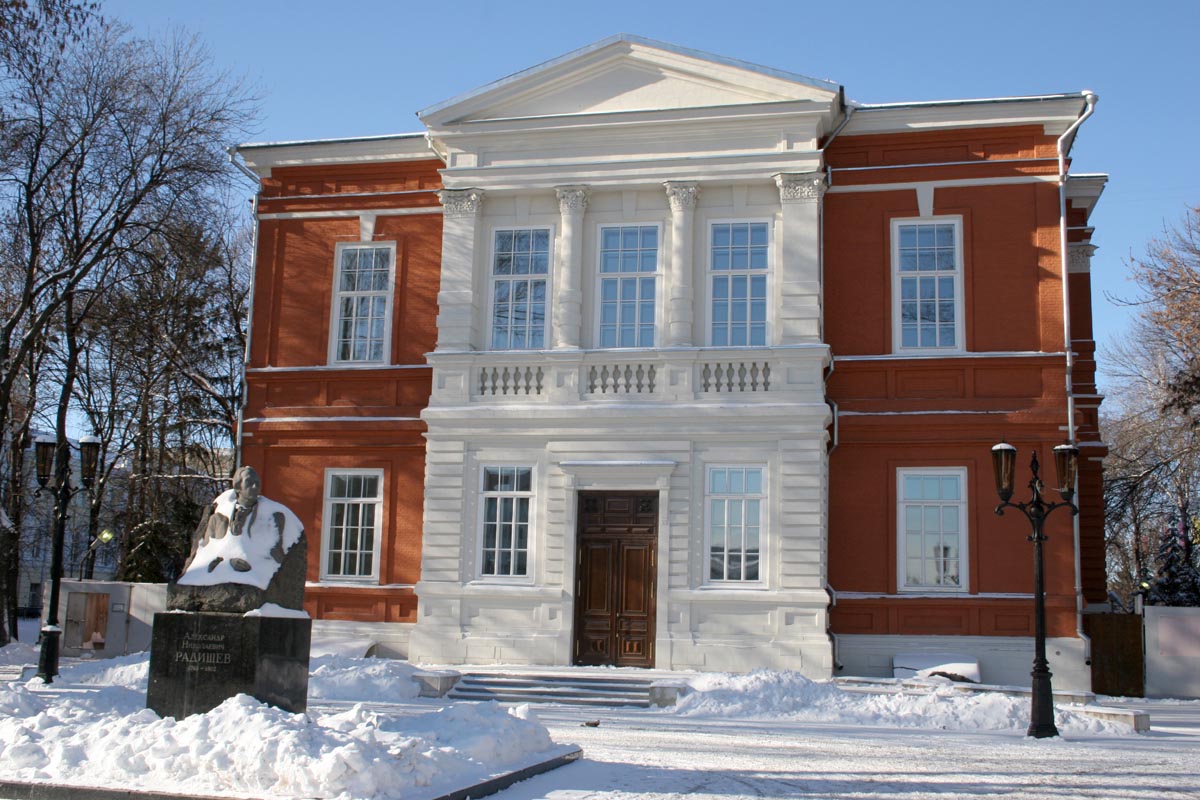
Saratov is noted for several art museums, including the Radishchev Art Museum, named for Alexander Radishchev, Fedin Art Museum, named after Russian novelist Konstantin Fedin, Saratov Local History Museum, Chernyshevsky Estate Museum, named for Nikolay Chernyshevsky, and some others. The Radishchev Art Museum contains more than 20,000 exhibits, including ancient Russian icons, works by Camille Corot, Auguste Rodin, as well as works by some of the finest Russian painters (e.g. Ivan Kramskoy, Vasily Polenov, Ilya Repin, Ivan Shishkin, Aleksandra Ekster, Pavel Kuznetsov, Aristarkh Lentulov, Robert Falk, Pyotr Konchalovsky, Martiros Saryan, Fyodor Rokotov).
Sports
Several sports clubs are active in the city:
| Club | Sport | Founded | Current league | League | |
|---|---|---|---|---|---|
| Rank | Stadium | ||||
| Kristall Saratov | Ice Hockey | 1955 | Higher Hockey League | 2nd | Kristall Sports Palace |
| Sokol Saratov | Football | 1930 | Russian Football National League | 2nd | Lokomotiv Stadium |
| Avtodor Saratov | Basketball | 1960 | VTB United League | 1st | Kristall Sports Palace |
| Universal Saratov | Bandy | 1953 | Bandy Supreme League | 2nd | Dynamo Stadium |
| Proton Saratov | Volleyball | 1988 | Volleyball Superleague | 1st |
Twin towns – sister cities
Saratov is twinned with:
- USA Carrboro, United States
- USA Dallas, United States (ties suspended in 2022)
- BUL Dobrich, Bulgaria
- CHN Wuhan, China
Notable people
Main article: List of people from Saratov

.jpg)

_06.jpg)

- Roman Abramovich (born 1966), businessman and politician
- Boris Andreyev, actor
- Oleg Antonov, aircraft designer
- Boris Babochkin, actor, director
- Denis Bakurskiy, former Russian professional football player
- Rachel Bluwstein, poet
- Alexey Bogolyubov, painter
- Nikolai Bondarenko, politician
- Viktor Borisov-Musatov, painter
- Nikolay Chernyshevsky, philosopher
- Gavrila Derzhavin, poet
- Irina Dryagina, World War II pilot and scientist
- Katia Elizarova, model
- Konstantin Fedin, writer
- Nikolai Grandkovsky, painter
- Joseph Hakobyan, engineer
- Lev Igorev, painter
- Anastasia Karpova, pop singer
- Lev Kassil, writer
- Kombinaciya, female pop band
- Pavel Kuznetsov (1878–1968), painter and graphic artist
- Eduard Limonov, writer and politician
- Konstantin Lokhanov (born 1998), Russian junior world champion and Olympic sabre fencer living in the United States
- Konstantin Paustovsky, writer
- Kuzma Petrov-Vodkin, painter
- Lev Pitaevskii, theoretical physicist
- Natalia Pogonina, chess player, women Grandmaster (WGM)
- Jean-Victor Poncelet, French engineer and mathematician (POW)
- Alexander Radishchev, writer
- Lidiya Ruslanova, Russian folk singer
- Sweeney Schriner, Russian-born Canadian ice hockey player
- Nikolay Semyonov, Nobel Prize-winning chemist
- Ellen Sheidlin, photoblogger and painter
- Fyodor Shekhtel, architect
- Leonid Sobinov, operatic tenor
- Pyotr Stolypin, statesman
- Vladimir Stoupel, Russian-born French pianist and conductor
- Elvira T, singer and songwriter
- Oleg Tabakov, actor
- Evgeny Tomashevsky, chess Grandmaster and former World number 15
- Valeriya, pop singer
- Nikolai Vavilov, biologist and geneticist, died in a Saratov jail
- Mikhail Vrubel, painter
- Oleg Yankovsky, actor
- Zedd, music producer and DJ, born in Saratov and moved to Germany.
- Nikolay Zinin, chemist
References
Sources
References
- Law #78-ZSO
- Charter of Saratov, Article 22
- Official website of Saratov. [http://saratovmer.ru/administraciya/contact/1 Mikhail Aleksandrovich Isayev] {{Webarchive. link. (June 3, 2018 , Head of Saratov {{in lang). ru
- {{ru-pop-ref. 2010Census
- https://rosstat.gov.ru/storage/mediabank/%D0%A1hisl_MO_01-01-2025.xlsx{{Dead link. (June 2025)
- "Saratov". [[Oxford University Press]].
- {{Cite American Heritage Dictionary. Saratov
- {{Cite Merriam-Webster. Saratov
- link
- (2003). "Энциклопедия Города России". Большая Российская Энциклопедия.
- [http://ruzgd.ru/is_t-s_lin.shtml Тамбовско-Саратовская линия] {{Webarchive. link. (February 5, 2010 (in Russian))
- [[:de:Sergej G. Nelipovic. Sergej G.]]: "Die Politik Russlands gegenüber den Deutschen 1914–1918." In: Eisfeld, Alfred et al. [Hrsg.] ''Deutsche in Russland und in der Sowjetunion 1914–1941''. Lit Verlag, Berlin 2007.
- [http://ruzgd.ru/rokada.shtml «Волжская рокада». Линия Иловля - Саратов - Сызрань - Ульяновск - Свияжск] {{Webarchive. link. (February 24, 2021 (in Russian))
- [https://www.bpb.de/themen/migration-integration/russlanddeutsche/252006/von-der-anwerbung-unter-katharina-ii-bis-1917/ ''Von der Anwerbung unter Katharina II. bis 1917''] (2017)
- "Der Erlass vom 3. November 1972 "Über die Aufhebung der Einschränkungen in der Wahl des Wohnsitzes…"".
- [[Russia Beyond]]: [https://de.rbth.com/lifestyle/85876-wie-leben-russlanddeutsche-heute-wolga ''Wie leben die Russlanddeutschen heute an den Ufern der Wolga?''] (7 February 2022)
- Charter of Saratov Oblast, Article 10
- {{OKATO reference. 63 243
- {{OKATO reference. 63 401
- Law #21-ZSO
- Law #79-ZSO
- "Saratov Climate".
- "World Meteorological Organization".
- "Saratov, Tramway — Vehicle Statistics".
- "Chronology: Saratov".
- "БЮДЖЕТ ГОРОДА".
- "Национальный состав населения". Территориальный органФедеральной службы государственной статистики по Саратовской области.
- "БОЛЬШАЯ САРАТОВСКАЯ ЭНЦИКЛОПЕДИЯ : Храмы Саратова : Иконы Божией Матери "Утоли моя печали"".
- "Информация о команде "Универсал" Саратов - Реестр - Федерация хоккея с мячом России". Rusbandy.ru.
- "Информация о стадионе "Динамо", Саратов - Реестр - Федерация хоккея с мячом России". Rusbandy.ru.
- "Побратимские связи". Saratov.
- (March 4, 2022). "Dallas formally condemns invasion of Ukraine, suspends ties with Russian sister city Saratov".
This article was imported from Wikipedia and is available under the Creative Commons Attribution-ShareAlike 4.0 License. Content has been adapted to SurfDoc format. Original contributors can be found on the article history page.
Ask Mako anything about Saratov — get instant answers, deeper analysis, and related topics.
Research with MakoFree with your Surf account
Create a free account to save articles, ask Mako questions, and organize your research.
Sign up freeThis content may have been generated or modified by AI. CloudSurf Software LLC is not responsible for the accuracy, completeness, or reliability of AI-generated content. Always verify important information from primary sources.
Report