From Surf Wiki (app.surf) — the open knowledge base
Saprolite
Chemically weathered rock
Chemically weathered rock
Saprolite is a chemically weathered rock. Saprolites form in the lower zones of soil profiles and represent deep weathering of the bedrock surface. In most outcrops, its color comes from ferric compounds. Deeply weathered profiles are widespread on the continental landmasses between latitudes 35°N and 35°S.
Conditions for the formation of deeply weathered regolith include a topographically moderate relief flat enough to prevent erosion and to allow leaching of the products of chemical weathering. A second condition is long periods of tectonic stability; tectonic activity and climate change can cause erosion. The third condition is humid tropical to temperate climate.
Poorly weathered saprolite grit aquifers are capable of producing groundwater, often suitable for livestock. Deep weathering causes the formation of many secondary and supergene ores: bauxite, iron ores, saprolitic gold, supergene copper, uranium, and heavy minerals in residual accumulations.
Definition, description and locations
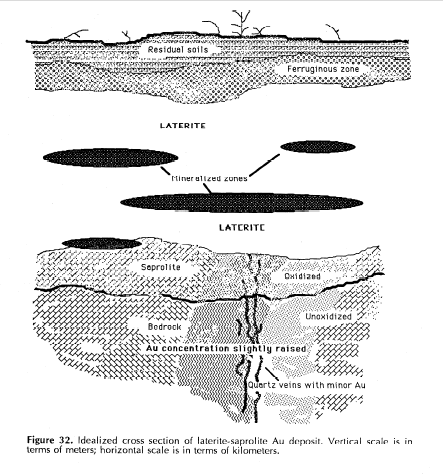
Saprolite (from Greek σαπρος (sapros) = putrid + λιθος (lithos) = rock) is a chemically weathered rock (literally, it means "rotten rock"). More intense weathering results in a continuous transition from saprolite to laterite.
Saprolites form in the lower zones of soil horizons In lateritic regoliths – regoliths are the loose layer of rocks that rest on the bedrock – saprolite may be overlain by upper horizons of residual laterite; most of the original profile is preserved by residual soils or transported overburden. Weathering formed thin kaolinitic [Al2Si2O5(OH)4] saprolites 1,000 to 500 million years ago; thick kaolinitic saprolites 200 to 66 million years ago; and medium-thick immature saprolites 5 million years ago in Sweden. The general structure of kaolinite has silicate [Si2O5] sheets bonded to aluminium hydroxide [Al2(OH)4] layers.
Iron compounds are the primary coloring agents in saprolites. At most outcrops the color comes from ferric compounds; the color relates to the mineralogy and particle size. Submicron-sized goethite [FeO(OH)] is yellow; coarse goethite is brown. Sub-micron-sized hematite [Fe2O3] is red; coarse hematite is gray to black.
Regoliths vary from a few meters to over 150 m thick, depending on the age of the land surface, tectonic activity, climate, climate history and the composition of the bedrock. Deeply weathered regoliths are widespread in the inter-tropical belt, particularly on the continental landmasses between latitudes 35°N and 35°S.
Formation
The regolith of a region is the product of its long weathering history; leaching and dispersion are dominant during the initial phase of weathering under humid conditions. Conditions for the formation of deeply weathered regolith include a topographically moderate relief flat enough to allow leaching of the products of chemical weathering. A second condition is long periods of tectonic stability; tectonic activity and climate change partially erode the regolith. Weathering rates of 20 m per million years suggest that deep regoliths require several million years to develop. The third condition is a humid tropical to temperate climate; higher temperatures enable reactions to occur more rapidly. Deep weathering can occur in cooler climates but over longer periods.
Sulfides are some of the most unstable minerals in humid, oxidizing environments; many cadmium, cobalt, copper, molybdenum, nickel and zinc sulfides are easily leached to deep in the profile. Carbonates are highly soluble, especially in acidic environments; the elements hosted by them – calcium, magnesium, manganese and strontium – are strongly leached. Serpentinite – oxidized and hydrolized low-silicon, iron- and magnesium-rich oxide igneous rocks – are progressively weathered through this zone. Ferromagnesian minerals are the principal hosts for nickel, cobalt, copper, and zinc in sulfide-poor mafic and ultramafic rocks and are retained higher in the profile than sulfide-hosted metals. They are leached from the upper horizons and reprecipitate with secondary iron-manganese oxides in the mid- to lower saprolite.
Uses
Aquifers in Western Australia are of saprolite grit. Poorly weathered saprolite grit aquifers are capable of producing groundwater, often suitable for livestock. Yields depend on the texture of the materials and their depth from which the aquifer is derived.
The distributions of gold and calcium carbonate or calcium magnesium carbonates are closely correlated and documented in the southern Yilgarn craton, Western Australia, in the top 1 to of the soil profile and locally as deep as 5 m. The gold-carbonate association is also apparent in the Gawler craton, South Australia. Supergene enrichment occurs near the surface and involves water circulation with its resulting oxidation and chemical weathering. Deep weathering causes the formation of many secondary and supergene ores – bauxite, iron ores, saprolitic gold, supergene copper, uranium and heavy minerals in residual accumulations.
References
References
- (1997). "Palaeosurfaces and associated saprolites in southern Sweden". Geological Society, London, Special Publications.
- Hurst, Vernon J.. (February 1977). "Visual estimation of iron in saprolite". Geological Society of America.
- George, Richard J.. (January 1992). "Hydraulic properties of groundwater systems in the saprolite and sediments of the wheatbelt, Western Australia". Elsevier B.V..
This article was imported from Wikipedia and is available under the Creative Commons Attribution-ShareAlike 4.0 License. Content has been adapted to SurfDoc format. Original contributors can be found on the article history page.
Ask Mako anything about Saprolite — get instant answers, deeper analysis, and related topics.
Research with MakoFree with your Surf account
Create a free account to save articles, ask Mako questions, and organize your research.
Sign up freeThis content may have been generated or modified by AI. CloudSurf Software LLC is not responsible for the accuracy, completeness, or reliability of AI-generated content. Always verify important information from primary sources.
Report