From Surf Wiki (app.surf) — the open knowledge base
San Juanico Bridge
Third longest bridge in the Philippines, connecting Leyte and Samar
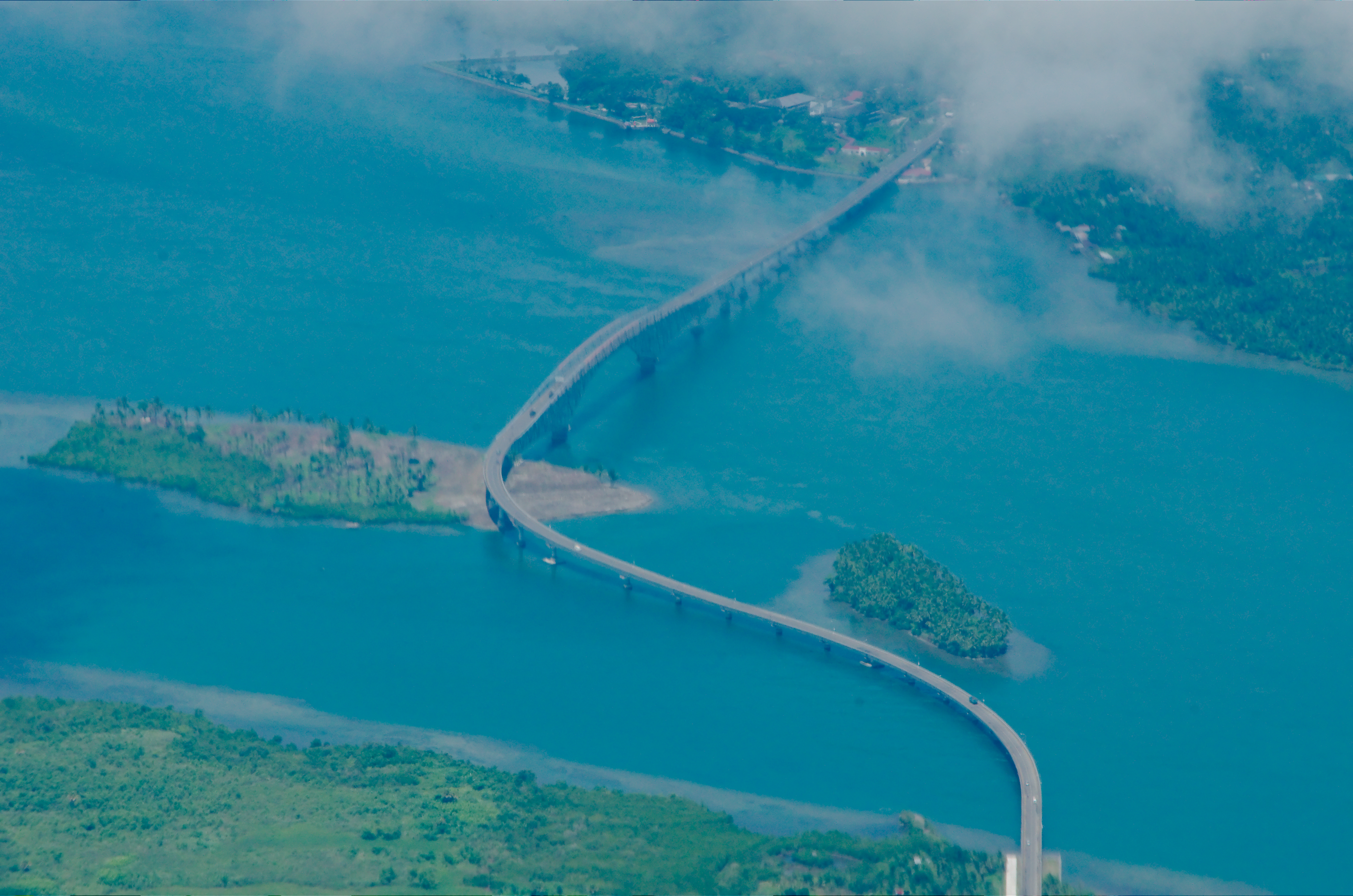
Third longest bridge in the Philippines, connecting Leyte and Samar
| Field | Value |
|---|---|
| bridge_name | San Juanico Bridge |
| image_size | 300px |
| caption | The bridge in 2022 |
| carries | 2 lanes of ; pedestrian sidewalks |
| crosses | San Juanico Strait |
| locale | Santa Rita, Samar |
| and Tacloban City | |
| maint | Department of Public Works and Highways |
| design | Arch-shaped truss bridge |
| mainspan | 192 m |
| number_spans | 43 |
| length | 2164 m |
| width | 14 m |
| builder | Construction and Development Corporation of the Philippines |
| begin | 1969 |
| complete | 1973 |
| cost | US$22 million |
| () | |
| open | |
| coordinates | |
| other_name | Philippine-Japan Friendship Highway bridge; formerly Marcos Bridge |
San Juanico Bridge main span close-up (Tacloban, Leyte; 09-08-2022).jpg and Tacloban City ()
The San Juanico Bridge (; ) is part of the Pan-Philippine Highway and stretches from Samar to Leyte across the San Juanico Strait in the Philippines. It is located by the Municipality of Santa Rita, Samar, and the City of Tacloban. Its longest length is a steel girder viaduct built on reinforced concrete piers, and its main span is of an arch-shaped truss design. Constructed during the administration of President Ferdinand Marcos through Japanese Official Development Assistance loans, it has a total length of 2.16 km—the third longest bridge spanning a body of seawater in the Philippines after the Cebu–Cordova Link Expressway and Panguil Bay Bridge. It was also the longest bridge in the Philippines upon its opening in 1973, surpassed in 1976 by Candaba Viaduct of North Luzon Expressway (NLEX), another bridge that connects from one province to another, connecting the provinces of Pampanga and Bulacan.
The bridge has helped bolster economic activity in Samar and Leyte and has become an iconic tourist attraction.
History
Development
Inception
The "Philippine-Japan Friendship Highway Bridge" was part of a large bundle of high-visibility foreign-loan-funded infrastructure launched by then-Philippine President Ferdinand Marcos' administration during the 1969 presidential election campaign.
At the time the project was conceived, there was not yet much traffic between the islands of Leyte and Samar because they were relatively underdeveloped, and as a result, the construction of the bridge was not seen as economically viable, but was nonetheless funded by foreign loans that would charge interest.
Financing
The Philippine-Japan Friendship Highway project started out in the mid-1960s with a single US$25 million Japan Export-Import Bank loan meant for the purchase of equipment for road development. However, the Philippine government requested its expansion to incorporate a bridge between Leyte and Samar, and various sea traffic projects such as roll-on/roll-off ferries.
The cost of the construction was US$22 million (about in the 1970s), which was acquired through Official Development Assistance loans from Japan's Overseas Technical Cooperation Agency (OTCA), the predecessor of today's Japan International Cooperation Agency (JICA). This was the first Official Development Assistance from Japan to the Philippines through JICA.
Contract awarding
Through the Ministry of Public Highways, the Philippine government contracted the San Juanico Bridge project to the Construction and Development Corporation of the Philippines (CDCP; now the Philippine National Construction Corporation), a company founded by close Marcos associate Rodolfo Cuenca.
Construction
_-_Flickr.jpg)
Construction of the bridge commenced during 1969 presidential campaign. It was finally completed four years later, in 1973, and was inaugurated on 2 July, coinciding with the birthday of then-First Lady Imelda Marcos, a native of Leyte.
The bridge's design reflected the aesthetic of other infrastructure projects associated with what has been called the Marcoses' "edifice complex"—described by architectural historian Gerard Lico as "an obsession and compulsion to build edifices as a hallmark of greatness".
Post-construction
.jpg)
According to former National Economic and Development Authority deputy director Ruperto Alonzo, the project was initially criticised as a white elephant that was "a possession that is useless and expensive to maintain or difficult to dispose of", because its average daily traffic was too low to justify the cost of its construction. As a result, its construction has been associated with what has been called the Marcoses' "edifice complex".
In the years after the bridge's construction, economic activity in Samar and Leyte has finally caught up with the bridge's intended function, and has become an iconic tourist attraction.
The bridge was slightly damaged by Typhoon Haiyan, locally known as Super Typhoon Yolanda, in November 2013 but was quickly repaired and reopened within the month.
The Samar provincial government proposed a project to install LED lights in the bridge, with timed lighting effects for select occasions as an effort to boost tourism between Leyte and Samar islands. The project dubbed as the San Juanico Bridge Lighting Project was approved by the Tourism Infrastructure and Enterprise Zone Authority in January 2018. The implementation of the lighting project has experienced delays. The groundbreaking for the project took place on 26 July 2019, with completion projected for December 2019 or January 2020. The completion of the project however has been delayed. The bridge was successfully lit up for the first time on 20 October 2022.
In May 2025, the DPWH imposed a 3-ton axle load limit on the San Juanico Bridge due to structural concerns. RORO routes were used as alternatives. Pedestrians were banned from crossing the bridge and would be ferried by light vehicles instead. The partial closure prompted the declaration of states of emergency in Samar Province on May 20 and in Tacloban on May 29, and fuel shortages in parts of Samar Island. On May 21, Department of Public Works and Highways secretary Manuel Bonoan announced plans to build a longer bridge measuring 2.6 kilometers near the San Juanico Bridge that would be funded through official development assistance from Japan. The National Disaster Risk Reduction and Management Council estimated that repairs on the bridge would cost approximately P7 billion, while monthly economic losses from its partial closure could reach up to P600 million. On June 5, President Bongbong Marcos declared a state of calamity in Eastern Visayas due to the repairs. The bridge was reopened to vehicles with a weight not exceeding 15 tons in December 2025.
Features
.jpg)
The San Juanico Bridge connects the islands of Leyte and Samar by linking the city of Tacloban in Leyte to the town of Santa Rita in Samar. It passes over the San Juanico Strait. The road infrastructure is the third longest bridge spanning a body of seawater in the Philippines after the Cebu–Cordova Link Expressway and the Panguil Bay Bridge, measuring 2164 m in total length. It has 43 steel spans with the primary span measuring 192 m.
The bridge's abutments are founded on steel H-piles while its piers are rock seated pedestals built using the Prepakt method, having single cylindrical shafts and tapered cantilevered copings.
The bridge is part of the Pan–Philippine Highway (commonly known as the Maharlika Highway), a network of roads, bridges, and sea routes that connect the islands of Luzon, Samar, Leyte, and Mindanao in the country. The highway was proposed in 1965, and constructed as part to serve as the country's backbone of transportation.
Economic significance
.jpg)
Nicknamed the "Bridge of Love", San Juanico is considered a major tourist destination of the locale especially the city of Tacloban. Tourists riding buses and jeepneys are allowed to alight in the middle of the bridge. Group tours are also organized. Boat tours have also been organized to give tourists a view of the bridge while at sea.
The San Juanico Bridge also serves as an important role for both the tourism and economies of the islands of Samar and Leyte by linking them which also relies on their respective agriculture industries.
In popular culture
Martial Law slang
Main article: Torture methods used by the Marcos dictatorship
During martial law in the Philippines under then-president Ferdinand Marcos, military personnel who conducted tortures referred to one particular method of torture as "the San Juanico Bridge". It involved a person being beaten while the victim's head and feet lay on separate beds and the body is suspended as though to form a bridge.
Film and literature
Filipino actor and stunt performer Dante Varona jumped from the San Juanico Bridge without a harness in the 1981 movie Hari ng Stunt.
The short story "The Bridge" by Yvette Tan is based on one of the urban legends surrounding the San Juanico Bridge. The story won an award for fiction from the Philippine Graphic.
Urban legends
There are a number of urban legends associated with the bridge's construction. The most popular one involves a woman overseeing the project who follows a fortune teller's advice and orders workers to mix children's blood with the bridge's foundation. A river fairy curses the woman and causes the woman to grow foul-smelling scales on her legs.
Incidents
- On 22 September 2002, a barge rammed into a concrete foundation of the bridge causing ₱25-million in damage. Then, in October, a portion of the bridge slid down by at least 10 centimeters after a metal support for its concrete foundation gave way, which was attributed by Engineer Jimmy Chan to "material fatigue".
References
References
- "Detailed Bridge Inventory".
- (7 January 2014). "ASEAN Dialogues: Former Philippines Premier Virata Looks Back on Decades of Working with Japan".
- Meniano, Sarwell. (27 July 2019). "Gov't Breaks Ground for San Juanico Bridge Lighting Project". Philippine News Agency.
- Landingin, Roel R.. (13 February 2008). "7 in 10 ODA Projects Fail to Deliver Touted Benefits".
- (2005). "Fifty Years of Japan ODA: A Critical Review for ODA Reform: Reality of Aid Asia-Pacific 2005 Report". IBON Books.
- Sabornido, Lyza R.. (17 September 2014). "10 Facts You Should Know about San Juanico Bridge in Samar and Leyte".
- Guia, Jhaypee. (13 July 2012). "Go Across the San Juanico Bridge". Vigattin Tourism.
- Ricardo, Manapat. (1991). "Some Are Smarter Than Others: The History Of Marcos' Crony Capitalism". Aletheia Publications.
- (13 March 2018). "San Juanico Bridge, a symbol of love".
- "60 Years of Japan – Philippines Cooperation". Japan International Cooperation Agency.
- "PNCC Projects: San Juanico Bridge".
- "It Takes a Village to Loot a Nation: Cronyism and Corruption".
- (25 March 2018). "San Juanico, Eastern Visayas' Iconic Bridge, to Be Lit up By End of 2018". TIEZA.
- Santos, Roselle. (n.d.). "Book Review: Edifice Complex: Power, Myth, and the Marcos State Architecture by Gerard Lico: Philippine Art, Culture and Antiquities".
- Afinidad-Bernardo, Deni Rose M.. (2016). "Edifice Complex". Philstar Global NewsLab.
- "Edifice Complex: Building on the Backs of the Filipino People".
- Mijares, Primitivo. (1976). "The Conjugal Dictatorship of Ferdinand Marcos and Imelda Marcos". Union Square Publishing.
- Fensome, Alex. (11 November 2013). "Filipinos' Nervous Wait as Toll Soars". [[Stuff Limited]].
- (2013). "Protection Assessment: Super Typhoon Haiyan (Yolanda)". United Nations High Commissioner for Refugees.
- Meniano, Sarwell. (28 August 2018). "Detailed Technical Review Delays San Juanico Bridge Lighting Project". Philippine News Agency.
- Tabao, Golda Meir T.. (2 August 2019). "Groundbreaking of San Juanico Bridge Lighting Project Signals Start of Construction". Philippine Information Agency.
- Amazona, Roel. (7 October 2020). "San Juanico Bridge Lighting Project Completion Moved to December". Philippine News Agency.
- Meniano, Sarwell. (20 August 2021). "San Juanico Bridge Rehab Delays Lighting Project". Philippine News Agency.
- Reyes, Ronald. (2022-10-20). "San Juanico gets glow up with lights, sound project".
- [https://mb.com.ph/2025/05/15/3-ton-load-limit-imposed-on-san-juanico-bridge-by-dpwh 3-ton load limit imposed on San Juanico Bridge by DPWH]. ''Manila Bulletin''. Retrieved May 15, 2025.
- [https://www.sunstar.com.ph/tacloban/marcos-orders-temporary-use-of-roros-strict-weight-limits-at-san-juanico-bridge Marcos orders temporary use of RoRos]. ''SunStar Tacloban''. Retrieved May 15, 2025.
- Mangaluz, Jean. (18 May 2025). "Pedestrians barred from crossing San Juanico bridge over safety concerns". [[The Philippine Star]].
- (May 21, 2025). "Samar Province under state of emergency due to San Juanico repair". [[GMA News]].
- (May 29, 2025). "Tacloban under state of emergency due to San Juanico Bridge crisis". [[Philippine News Agency]].
- (May 22, 2025). "Weight limits on San Juanico Bridge disrupt Samar fuel supply". [[ABS-CBN]].
- (May 21, 2025). "Gov't to build new bridge near San Juanico - DPWH chief". [[GMA News]].
- (May 30, 2025). "NDRRMC: San Juanico Bridge rehab costs P7B, monthly loss at P600M chief". [[Manila Standard]].
- (June 10, 2025). "Marcos declares state of calamity in Eastern Visayas over San Juanico bridge fix". [[GMA News]].
- (12 December 2025). "San Juanico Bridge binuksan sa mga sasakyang di lalagpas sa 15 tonelada". ABS-CBN News.
- (n.d.). "DPWH 2005 Annual Report". Department of Public Works and Highways.
- (23 June 2025). "Tourism ad on San Juanico Bridge irritates VP Sara". The Philippine Star.
- (2013). "Tacloban: A Fast Rising Highly Urbanized City". Regional Division VIII of the National Statistical Coordination Board (NSCB).
- (14 June 1989). "Imelda's place revisited: Tacloban parks better than Cebu's". Manila Standard.
- (24 May 2025). "San Juanico Bridge load limit may cause P600-M losses, tourism slump". Philippine Daily Inquirer.
- (19 October 2020). "Lighting project at San Juanico Bridge projected to result in mushrooming of business locators". Leyte Samar Daily News.
- Laber, Jeri. (30 October 1976). "Philippines Torture". [[The New York Times]].
- Pedroso, Kate. (21 September 2014). "'San Juanico Bridge,' other tortures detailed". The Philippine Daily Inquirer.
- Hapal, Don Kevin. (23 February 2016). "Worse than death: Torture methods during martial law". Rappler.
- Robles, Raissa. (2016). "Marcos Martial Law: Never Again: A brief history of torture and atrocity under the New Society". Filipinos for A Better Philippines, Inc..
- (7 August 2014). "They Are Not Stuntmen Like Dante Varona". Leyte-Samar Daily News.
- Albano, Lou. (8 October 2009). "Q&A with Palanca Awardee Yvette Tan".
- Casocot, Ian Rosales. (14 August 2009). "Yvette Tan's Waking the Dead".
- Piccio, Belle. (27 October 2015). "Urban Legend: The Bloody Secret of the Longest Bridge in the Philippines".
- Virgino, Clarisse Yvette. (26 September 2018). "The Tale of the 'Padugo'". [[The Manila Times]].
- Desacada, Miriam Garcia. (31 October 2002). "Metal Support in San Juanico's Pier Gives Way". Philstar Global.
This article was imported from Wikipedia and is available under the Creative Commons Attribution-ShareAlike 4.0 License. Content has been adapted to SurfDoc format. Original contributors can be found on the article history page.
Ask Mako anything about San Juanico Bridge — get instant answers, deeper analysis, and related topics.
Research with MakoFree with your Surf account
Create a free account to save articles, ask Mako questions, and organize your research.
Sign up freeThis content may have been generated or modified by AI. CloudSurf Software LLC is not responsible for the accuracy, completeness, or reliability of AI-generated content. Always verify important information from primary sources.
Report