From Surf Wiki (app.surf) — the open knowledge base
San Francisco volcanic field
Part of the San Francisco Peaks in northern Arizona
Part of the San Francisco Peaks in northern Arizona
| Field | Value |
|---|---|
| name | San Francisco volcano field |
| age | ~6 Ma |
| photo | Black Point Lava Flow, Arizona.jpg |
| photo_size | 275px |
| photo_caption | Satellite image of Black Point lava flow |
| type | Volcano field |
| rock | |
| area | 5,000 km2 |
| location | just north of Flagstaff, Arizona |
| highest | Humphreys Peak |
| coordinates | |
| region | Arizona |
| country | United States |
| length | 50 mi |
The San Francisco volcanic field is an area of volcanoes in northern Arizona, north of Flagstaff, US. The field covers 1,800 square miles (4,700 km2) of the southern boundary of the Colorado Plateau. The field contains over 600 volcanoes ranging in age from nearly 6 million years old to less than 1,000 years (Miocene to Holocene), of which Sunset Crater is the youngest. The highest peak in the field is Humphreys Peak, at Flagstaff's northern perimeter: the peak is Arizona's highest at 12,633 feet (3,851.5 m) and is a part of the San Francisco Peaks, an active stratovolcano complex.
Description
The first volcanoes in the San Francisco Volcanic Field began to erupt about 6 million years ago, in an area where the town of Williams, Arizona is now. Subsequently, a several-mile-wide belt of successively younger eruptions migrated eastward, to the area of modern Flagstaff, Arizona, and beyond toward the valley of the Little Colorado River. Today, this belt of volcanoes extends about 50 mi from west to east.
Most volcanoes are located near boundaries of the Earth's tectonic plates, but Arizona is well within the interior of the North American Plate. Some geologists suggest that there is a site of localized melting fixed deep within the Earth’s mantle beneath northern Arizona. As the North American Plate moves slowly westward over a stationary source of magma, eruptions produce volcanoes that are strung out progressively eastward. By looking at seismic waves and studying elements and isotopes within rocks from the region, scientists now believe that the layers of molten material in the mantle circulate beneath the Colorado Plateau. Warm material from the asthenosphere is able to invade the lithosphere. The influx of hotter asthenospheric material below the crust provides the heat necessary for volcanism.
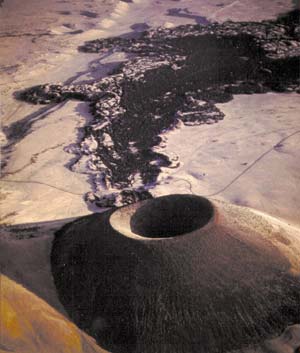
Most of the more than 600 volcanoes in the San Francisco Volcanic Field are monogenetic basalt cinder cones. The cinder cones are relatively small, usually less than 1000 ft tall, and formed within months to years. They are built when gas-charged frothy blobs of basalt magma are erupted as a lava fountain. During flight, these lava blobs cool and fall back to the ground as dark volcanic rock containing cavities created by trapped gas bubbles. If small, these fragments of rock are called “cinders” and, if larger, “bombs.” As the fragments accumulate, they build a cone-shaped hill. Once sufficient gas pressure has been released from the supply of magma, lava oozes quietly out to form a lava flow. This lava typically squeezes out from the base of the cone and tends to flow away for a substantial distance because of its low viscosity. SP Crater, 25 mi north of Flagstaff, is an excellent example of a cinder cone, and its associated lava flow extends for 4.3 mi to the north of the cone. Several zones of concentrated eruptive activity have been identified – the more silicic volcanic centers appear to have begun with basaltic activity and then evolved to more silicic compositions.
San Francisco Mountain is the only stratovolcano in the San Francisco Volcanic Field. Stratovolcanoes have moderately steep slopes and form by the accumulation of layer upon layer of andesite lava flows, cinders, and ash, interspersed with deposits from volcanic mudflows at lower elevations. San Francisco Mountain was built by eruptions between about 1 and 0.4 million years ago. Since then, much of the mountain has been removed to create the “Inner Basin.” The missing material may have been removed quickly and explosively by an eruption similar to the 1980 eruption of Mount St. Helens, Washington, or it may have been removed slowly and incrementally by a combination of large landslides, water erosion, and glacial scouring.
The San Francisco Volcanic Field also includes several lava domes, formed by highly-viscous dacite and rhyolite magmas. These magmas are so viscous that they tend to pile up and form very steep-sided bulbous domes at the site of eruption. Domes can be active for decades or sometimes centuries. Mount Elden, at the eastern outskirts of Flagstaff, is an excellent example of an exogenous dacite dome and consists of several overlapping lobes of lava. Sugarloaf Peak, at the entrance to San Francisco Mountain’s Inner Basin, is a rhyolite lava dome.
Future
Although there has been no eruption for nearly 1,000 years, it is likely that eruptions will occur again in the San Francisco Volcanic Field. With an average interval of several thousand years between past periods of volcanic activity, it is impossible to forecast when the next eruption will occur. USGS scientists believe that the most probable sites of future eruptions are in the eastern part of the field and that the eruptions are likely to be small. These future eruptions may provide spectacular volcanic displays but should pose little hazard because of their small size and the relative remoteness of the area.
Visitation and usage

Popular tourist and hiking destinations in the volcanic field include the Kendrick Mountain Wilderness, 20 miles northwest of Flagstaff; and Sunset Crater. Sunset Crater has a hiking trail along an ʻaʻā lava flow to its base.
Areas of the volcanic field have been used by NASA for testing techniques for exploration in a simulated extraterrestrial terrain environment. NASA has also conducted the Desert Research and Technology Studies (DRATS) tests here.
Notable vents
| Name | Elevation | Location | Last eruption | meters | feet | Coordinates | ||||||
|---|---|---|---|---|---|---|---|---|---|---|---|---|
| Antelope Hill | 7008 ft | {{coord | 35.5507292 | N | 111.6836090 | W | region:US-AZ_type:mountain | format=dms | name=Antelope Hill}} | ~650,000 years ago | ||
| Bill Williams Mountain | 9259 ft | 2.8 million years ago | ||||||||||
| Colton Crater (Crater 160) | 6791 ft | - | ||||||||||
| Double Crater | 8007 ft | unknown | ||||||||||
| Mount Elden | 9301 ft | ~500,000 years ago | ||||||||||
| Kendrick Peak | 10425 ft | 1.4 million years ago | ||||||||||
| Merriam Crater | 6813 ft | data-sort-value-0020000 | 20,000 years ago | |||||||||
| O'Leary Peak | 8919 ft | Pleistocene | ||||||||||
| San Francisco Peaks | 12633 ft | ~400,000 years ago | ||||||||||
| Sitgreaves Mountain | 9388 ft | 1.9 million years ago | ||||||||||
| SP Crater (SP Mountain) | 7021 ft | 5,500 years ago | ||||||||||
| Strawberry Crater | 6526 ft | ~50,000 years ago | ||||||||||
| Sunset Crater | 8042 ft | 950 ± 40 years | ||||||||||
| Sugarloaf Peak | 9287 ft | ~80,000 years ago |
References
References
- (1987). "Geological Society of America Centennial Field Guide".
- (October 6, 2023). "Geology and History of San Francisco Volcanic Field". USGS.
- (April 16, 2001). "The San Francisco Volcanic Field, Arizona". U.S. Geological Survey.
- (1986). "Migration of volcanism in the San Francisco volcanic field, Arizona". Geological Society of America Bulletin.
- "Hikes and Trails". National Park Service.
- Allison, Lee. (June 14, 2009). "Robot recon underway in Black Point lava field". Arizona Geology.
- Wood, Charles A.. (1993). "Volcanoes of North America". [[Cambridge University Press]].
- "Crater 160, Arizona". Volcano World.
- {{cite gnis
- "SP Mountain, Arizona". Volcano World.
- "A Geologic Field Guide to S P Mountain and its Lava Flow, San Francisco Volcanic Field, Arizona". USGS.
- "Sunset Crater". [[Smithsonian Institution]].
This article was imported from Wikipedia and is available under the Creative Commons Attribution-ShareAlike 4.0 License. Content has been adapted to SurfDoc format. Original contributors can be found on the article history page.
Ask Mako anything about San Francisco volcanic field — get instant answers, deeper analysis, and related topics.
Research with MakoFree with your Surf account
Create a free account to save articles, ask Mako questions, and organize your research.
Sign up freeThis content may have been generated or modified by AI. CloudSurf Software LLC is not responsible for the accuracy, completeness, or reliability of AI-generated content. Always verify important information from primary sources.
Report