From Surf Wiki (app.surf) — the open knowledge base
Same-sex marriage in Brazil
none
none
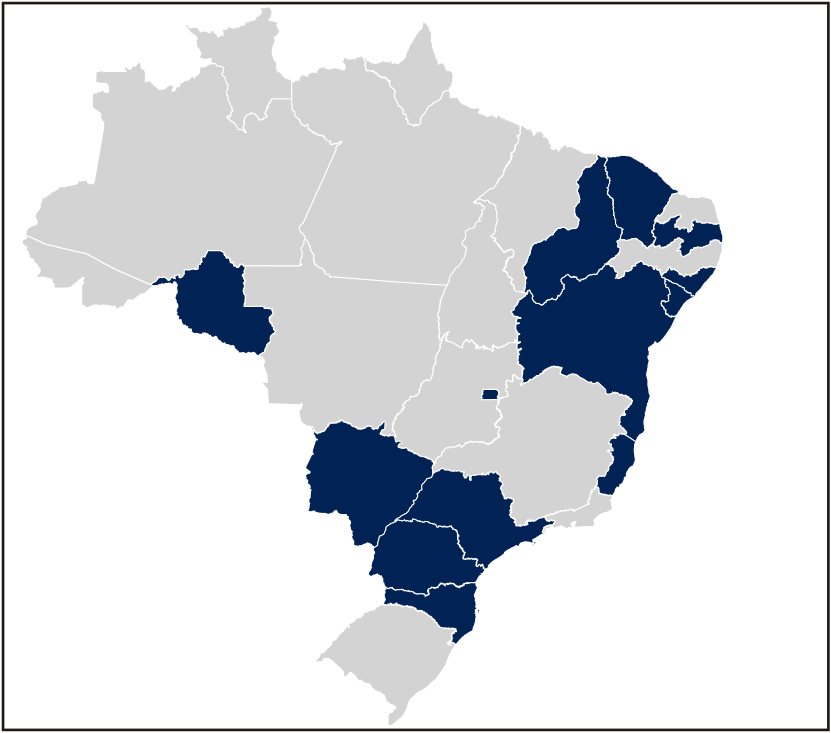
Same-sex marriage has been legal in Brazil since 16 May 2013, following a decision by the National Justice Council ordering notaries of every state to license and perform same-sex marriages. On 14 May 2013, the National Justice Council legalized same-sex marriage nationwide, ruling 14–1 that notaries are obliged to license and perform same-sex marriages and convert any existing civil unions into marriages if the couples so wish. President of the Supreme Federal Court Joaquim Barbosa stated that notaries could not continue to refuse to "license and perform a civil marriage or the conversion of a stable union into a marriage between two people of the same sex". The ruling was published on 15 May and took effect the following day. Before nationwide legalisation, the states of Alagoas, Bahia, Ceará, Espírito Santo, Mato Grosso, Mato Grosso do Sul, Paraíba, Paraná, Piauí, Rondônia, Santa Catarina, São Paulo, and Sergipe, as well as the Federal District and the city of Santa Rita do Sapucaí, had already legalized same-sex marriages. In Rio de Janeiro, same-sex couples could also marry but only if local judges approved their requests. Polling suggests that a majority of Brazilians support the legal recognition of same-sex marriage. Brazil was the second country in South America, after Argentina, and the twelfth in the world to legalize same-sex marriage.
Same-sex unions had already been legally recognized in Brazil in the form of stable unions following a ruling by the Supreme Federal Court on 5 May 2011. These unions are granted most of the rights of marriage. The ruling was published on 12 May and took effect on 13 May 2011.
Stable unions
The first case of legal recognition of a same-sex union in Brazil occurred in 2004 for a dual Brazilian-English couple. The couple's relationship was recognized in the form of a common-law marriage—which at the time was only available to opposite-sex couples. The couple had lived together for fourteen years in the city of Curitiba.
In 2010, the Ministry of Foreign Affairs authorized Brazilian diplomats to request a diplomatic or service passport and stay visa for same-sex partners. The decision, which applies to both same-sex and opposite-sex partners, was communicated internally to embassies and consulates in over 200 countries. According to the Foreign Ministry, the measure requires employees to register their same-sex partners in order to secure their right to reside abroad. With the issuance of diplomatic passports, it is now easier for partners to obtain residence permits. Also in 2010, the state-owned Infraero (Brazilian Company of Airport Infrastructure) began recognizing stable unions between same-sex couples for the purpose of granting benefits. To be eligible for these benefits, the union must be registered with a public notary.
Stable unions (, ) have been recognized in Brazil since 13 May 2011, after the Supreme Federal Court had ruled in ADI 4277 and ADPF 132 on 5 May that same-sex couples must be allowed to legally register their relationships. The decision was approved 10–0; one judge abstained because he had previously spoken publicly in favor of same-sex unions when he was attorney general. The ruling resulted in stable unions for same-sex couples having the same financial and legal rights enjoyed by those in opposite-sex relationships. Stable unions of same-sex couples are guaranteed similar rights as marriages, including adoption, welfare benefits, pension, inheritance tax, income tax, social security, health benefits, immigration, joint property ownership, hospital and prison visitation, in vitro fertilisation and surrogacy. The ruling was issued in response to two lawsuits: one filed by the Rio de Janeiro State Government in 2008 and another filed in 2009 by the Public Prosecutor's Office. Same-sex couples can officially register their relationships as a stable union by providing evidence such as a shared bank account, cohabitation at the same address, or other indicators of a committed partnership. On 17 June 2011, a judge in Goiânia annulled the stable union of Liorcino Mendes and Odilio Torres, and ordered all notaries in Goiânia to stop issuing stable union licenses. The judge, who was also a church pastor of the Assembleias de Deus, argued that recognizing same-sex unions was "unconstitutional". On 21 June, another judge annulled his decision. Concerned, the couple registered another stable union in Rio de Janeiro.
On 7 June 2013, the Brazilian Air Force recognized the stable union of a sergeant and his partner after the sergeant presented a notarized deed documenting their relationship. The Air Force did not comment on the decision and could not confirm whether it was the first same-sex union officially recognized by the branch. On 8 August 2013, Judge Elio Siqueira of the Regional Federal Court of the 5th region ruled on appeal that the Brazilian Army must recognize the stable union—performed in January 2012 in Pernambuco—of a service member and his same-sex partner, and must also grant the partner a military spousal pension. This marked the first time a state-recognized same-sex union was officially acknowledged by the Army.
Same-sex marriage
Background and summary
Marriage in Brazil is governed at the federal level rather than by state law, and involves the issuing of a marriage license by a notary. In May 2011, the Supreme Federal Court ruled that the present law allowed for same-sex couples to formalize their relationships in the form of stable unions. On 25 October, the Superior Court of Justice ruled that two women could legally marry. Differently from the U.S. Supreme Court's stare decisis, the Superior Court decision only applied to the plaintiff couple, but would serve as legal precedent in similar cases. The court overturned two lower court rulings against the couple, and held that the Constitution of Brazil guarantees same-sex couples the right to marry and that the Civil Code does not prohibit the marriage of two people of the same sex. Using this decision as precedent, many states amended their directives for issuing marriage certificates to allow same-sex marriages and require notaries who preside over marriage licenses and perform marriages to provide such services to same-sex couples.
Article 226 of the Constitution establishes that marriage is a civil matter and that a "stable union between a man and a woman is recognized as a family entity, and the law shall facilitate the conversion of such entity into marriage". Additionally, it states:
- }}}}
2013 National Justice Council ruling
On 14 May 2013, the National Justice Council ruling 14–1 that notaries must license and perform same-sex marriages and convert existing stable unions into marriages if the couples so desire. President of the Supreme Federal Court Joaquim Barbosa stated that notaries could not continue to refuse to "license and perform a civil marriage or the conversion of a stable union into a marriage between two people of the same sex." The ruling took effect on 16 May 2013.
On 21 May 2013, the Social Christian Party (PSC) filed an appeal with the Supreme Federal Court against the National Justice Council's decision. The party alleged that the Council had overstepped its authority, arguing that the legalization of same-sex marriage was a matter exclusively reserved for the National Congress. The appeal did not result in a stay of the Council's decision. On 30 May 2013, the Supreme Federal Court rejected the appeal on procedural grounds, stating that the PSC had used the incorrect legal instrument to appeal. The court held that the Council's decision could only be challenged through a "direct action for unconstitutionality" (ação direta de inconstitucionalidade) rather than an action for injunction (mandado de segurança). On 6 June 2013, the PSC refiled the appeal. Subsequently, on 28 August 2013, the Office of the Attorney General (Procuradoria Geral da República), along with the Cabinet of Brazil under President Dilma Rousseff, submitted an opinion in support of same-sex marriage to the Supreme Court. Given that the Council's ruling was issued by its president—who also served as Chief Justice of the Supreme Federal Court—it is unlikely the Court would overturn the decision. As of 2023, the PSC's appeal had not yet proceeded to oral arguments.
Proposals in the National Congress
The legal recognition of same-sex marriages in Brazil was achieved through the judicial system; Brazil has yet to pass a national same-sex marriage law. In October 2013, a parliamentary committee recommended a measure to ensure that religious institutions would not be obligated to solemnize same-sex marriages. The proposal would have allowed such institutions to refuse to officiate at marriages "[that] violate [their] values, doctrines, and beliefs". It was expected to be submitted to the National Congress pending approval by a constitutional committee, but no further action was taken before the 2014 elections. In March 2017, the Constitution and Justice Commission of the Brazilian Senate preliminarily approved a bill to align the Civil Code with the National Justice Council's ruling. The bill aimed to recognize stable unions between two people of the same sex and allow the conversion of such unions into marriage. It proposed replacing the definition of a family entity from "a stable union between a man and a woman" to "a stable union between two people", and included a provision explicitly stating that marriage may be performed between two people. The commission gave final approval to the bill on 3 May. However, it was not advanced by either the Senate or the Chamber of Deputies prior to the 2018 elections.
On 13 November 2024, the Human Rights Committee of the Chamber of Deputies approved a bill to codify same-sex marriage into federal civil law. The text of the bill was originally authored by former Congressman Clodovil Hernandes and was introduced by Congresswoman Erika Hilton.
State and district laws
]]
Prior to nationwide legalisation in 2013, marriage licenses were granted to same-sex couples in some individual cases, often through the decision of a judge. On 27 June 2011, a judge in the state of São Paulo converted a same-sex stable union into a marriage. The couple held a wedding ceremony the following day. That day, another same-sex stable union was converted into a marriage by Judge Jennifer Antunes de Souza from the 4th Family Court of Brasília. On 29 May 2012, four out of six notary offices in Porto Alegre agreed to convert stable unions into marriages, and on 31 May 2012 a civil partnership contracted by two men in England was recognized and converted into a marriage. On 28 June 2012, 28 same-sex couples were legally married in a mass wedding ceremony in Belém.
Following the 2011 Supreme Federal Court ruling on stable unions and the Superior Court of Justice ruling that a lesbian couple could legally marry, several states altered their marriage procedures, enabling same-sex couples to marry in a manner that is bureaucratically identical to opposite-sex couples. The first state to do so was Alagoas. On 6 December 2011, its General Judicial Inspectorate (Corregedoria Geral da Justiça)—a supervisory body within the state court system responsible for overseeing the proper functioning of the judiciary's administrative and auxiliary services, particularly in first-instance courts (i.e. trial courts) and registry services (such as marriages and births)—ordered the state civil registry to issue marriage licences to same-sex couples. The decision took effect upon publication on 7 December 2011.
Alagoas was followed by the neighboring state of Sergipe on 5 July 2012, when its General Judicial Inspectorate issued a provision legalizing same-sex marriage. On 11 July, the city of Santa Rita do Sapucaí also began issuing marriage licenses to same-sex couples following the decision of a judge. On 15 August 2012, the General Judicial Inspectorate of Espírito Santo similarly issued a circular letter obliging its civil registry to address same-sex marriages in the same manner as opposite-sex marriages, making it the third Brazilian state to legalize same-sex marriage. They were followed by Bahia on 26 November, the Federal District on 1 December, and Piauí on 15 December 2012. On 18 December 2012, the General Judicial Inspectorate of São Paulo also updated its marriage provisions to include same-sex couples in a manner equal to opposite-sex couples. The new provisions entered into effect 60 days later (i.e. 16 February 2013). Other states followed suit, including Ceará on 15 March, Paraná on 26 March, Mato Grosso do Sul on 2 April, Rondônia on 26 April, Paraíba and Santa Catarina on 29 April, and Mato Grosso on 13 May.
The situation was different in Rio de Janeiro; on 17 April 2013 Judge Valmir de Oliveira Silva of the Justice Tribunal of Rio de Janeiro ruled that same-sex couples could marry in the state, but only if local judges approved their requests. According to the ruling, couples were required to submit their requests to civil registry officers, who had 15 days to issue a decision. If the request was approved, the marriage could proceed; if denied, the marriage would not be authorized.
Native Brazilians
While many Indigenous cultures historically practiced polygamy, there are no records of same-sex marriages being performed in these cultures in the way they are commonly defined in Western legal systems. However, many Indigenous communities recognize identities and relationships that may be placed on the LGBT spectrum. Among these are two-spirit individuals—people who embody both masculine and feminine qualities. In some cultures, two-spirit individuals assigned male at birth wear women's clothing and engage in household and artistic work associated with the feminine sphere. Historically, this identity sometimes allowed for unions between two people of the same biological sex. Anthropologist Darcy Ribeiro reported such two-spirit people, known as noǥaligijegi, among the Kadiwéu. They wear women's clothing, take care of the family, and marry cisgender men. The Tupinambá refer to them as tibira. One tibira, the Tibira do Maranhão, was executed in 1614 by the French on charges of sodomy. The Tupinambá also recognize two-spirit people who are born female but perform men's activities such as hunting. They marry women and adopt similar roles as men in the home. Similar individuals occupying a third gender role are also found among the Ticuna, the Karajá and the Krahô.
Statistics
In 2018, 9,520 same-sex couples married in Brazil; 59.7% of these marriages were performed in the Southeast Region, 15.1% in the Northeast Region, 14.4% in the South Region, 7.4% in the Central-West Region and 3.4% in the North Region. By state, most marriages were performed in São Paulo (4,100), followed by Minas Gerais (737), Rio de Janeiro (723), Rio Grande do Sul (480), Paraná (458), Santa Catarina (429), Pernambuco (391), Ceará (330), Bahia (288), the Federal District (274), Goiás (218), Pará (201), Mato Grosso do Sul (166), Espírito Santo (129), Rio Grande do Norte (114), Paraíba (105), Alagoas (95), Amazonas (49), Mato Grosso (46), Piauí (45), Sergipe (43), Maranhão (26), Rondônia (24), Acre and Tocantins (18), Amapá (8) and Roraima (5).
2018 saw a significant rise in marriages, particularly in the later months of the year, with November seeing a 68% rise compared to 2017. Figures for 2020 are lower than previous years because of the restrictions in place due to the COVID-19 pandemic.
| Year | Same-sex marriages | Opposite-sex | |||||||||||||||||
|---|---|---|---|---|---|---|---|---|---|---|---|---|---|---|---|---|---|---|---|
| marriages | Total | ||||||||||||||||||
| marriages | % same-sex | Female | Male | Total | 2013 | 2014 | 2015 | 2016 | 2017 | 2018 | 2019 | 2020 | 2021 | 2022 | 2023 | 2024 | |||
| 1,926 | 1,775 | 3,701 | 1,048,776 | 1,052,477 | 0.35% | ||||||||||||||
| 2,440 | 2,414 | 4,854 | 1,101,586 | 1,106,440 | 0.44% | ||||||||||||||
| 2,986 | 2,628 | 5,614 | 1,131,707 | 1,137,321 | 0.49% | ||||||||||||||
| 2,943 | 2,411 | 5,354 | 1,090,181 | 1,095,535 | 0.49% | ||||||||||||||
| 3,387 | 2,500 | 5,887 | 1,064,489 | 1,070,376 | 0.55% | ||||||||||||||
| 5,562 | 3,958 | 9,520 | 1,043,947 | 1,053,467 | 0.90% | ||||||||||||||
| 5,349 | 3,707 | 9,056 | 1,015,620 | 1,024,676 | 0.88% | ||||||||||||||
| 3,864 | 2,569 | 6,433 | 750,746 | 757,179 | 0.85% | ||||||||||||||
| 5,602 | 3,600 | 9,202 | 923,300 | 932,502 | 0.99% | ||||||||||||||
| 6,632 | 4,390 | 11,022 | 959,019 | 970,041 | 1.1% | ||||||||||||||
| 7,023 | 4,175 | 11,198 | 929,601 | 940,799 | 1.2% | ||||||||||||||
| 7,876 | 4,311 | 12,187 | 936,738 | 948,925 | 1.3% |
Religious performance
Most major religious organisations in Brazil do not perform or bless same-sex marriages in their places of worship. The largest Christian denomination in Brazil is the Catholic Church, which opposes same-sex marriage and does not allow its priests to officiate at marriages of same-sex couples. The Church campaigned heavily against legalization, decrying the 2011 ruling that legalized stable unions, and calling for protests against the 2013 ruling legalizing same-sex marriage. The Episcopal Conference of Brazil stated: "Same sex unions cannot simply be equated to marriage or family, which are based on matrimonial consent, in the spirit of complementarity and reciprocity between a man and a woman, open to the procreation and education of children." In April 2013, it excommunicated Father Roberto Francisco Daniel, a supporter of same-sex marriage in Bauru, over "grave statements counter to the dogma of Catholic faith and morality." In December 2023, the Holy See published Fiducia supplicans, a declaration allowing Catholic priests to bless couples who are not considered to be married according to church teaching, including the blessing of same-sex couples. Reactions were mixed. The Archbishop of Porto Alegre, Jaime Spengler, stated, "I ask a very simple question, which guides me and also guides my actions: are they people? If they are people, they deserve our respect too. And when they come to us asking for a blessing, I imagine that they are also looking for a word of comfort, of hope and perhaps even the desire to cope with their own situation. We can't deny that!" The Diocese of Petrópolis issued a statement that "[t]hese people, with these conditions and dispositions, can receive a prayer from the priest, an invocation of God's mercy and help so that they can live according to God's will. This should be an opportunity to proclaim the kerygma to them. Blessings to groups who intend to justify an irregular situation, objectively contrary to Christian morality and the true nature of marriage, which would cause confusion and scandal among the faithful, are therefore forbidden." The Bishop of Formosa, Adair José Guimarães, said he would not offer blessings to same-sex couples, following consultation with the local clergy and lay people that "applying the resolution would bring incomprehension and scandal".
Pentecostal and Evangelical groups have been vocally opposed to the legalization of same-sex unions. In June 2013, the Assembleias de Deus, led by Pastor Silas Malafaia, organized a rally against the National Justice Council ruling in Brasília. "This is a historic day... We are here in support of the family made up of a man and a woman. We will not allow this country to sink into immorality", said one pastor who attended the march. Around 40,000 people attended the protest according to the organizers; police counted 6,000 attendees. "Satan will not destroy our family values", added Malafaia, who also organized a similar demonstration in Rio de Janeiro the previous month.
In 2011, the Evangelical Church of the Lutheran Confession in Brazil released a pastoral letter accepting the Supreme Court's decision to allow same-sex stable unions, although religious same-sex marriages are not allowed in the denomination. The ruling was also welcomed by some Baptist groups. Some smaller religious denominations support and solemnise same-sex marriages. In June 2018, the Anglican Episcopal Church of Brazil officially changed its canons to permit same-sex marriages. The move was approved by its synod by 57 votes to 3. The Church joined other Anglican provinces, including the American, Scottish and Canadian branches of the Anglican Communion, in performing same-sex weddings. The first same-sex marriage in an Anglican church occurred in São Paulo on 24 November 2018. Several same-sex marriages have also been conducted in Umbanda and Candomblé ceremonies. An Umbanda priestess in Rio de Janeiro said in 2011 that "in umbanda this is accepted. It's fine. … We carry out marriages of love." Some Jewish groups also solemnise same-sex marriages.
Public opinion
.png)
According to a Pew Research Center survey conducted between 4 November 2013 and 14 February 2014, 45% of Brazilians supported same-sex marriage, while 48% were opposed. A September–October 2016 survey by the Varkey Foundation found that 59% of 18–21-year-olds supported same-sex marriage in Brazil.
According to the Brazilian Institute of Public Opinion and Statistics, support for equal marital rights for same-sex couples in Brazil stood at 49% in 2017, with 38% opposing. Support was higher among women, young people, people with higher educational levels and Brazilians living in the southern region of the country. The 2017 AmericasBarometer showed that 52% of Brazilians supported same-sex marriage. A May 2021 Ipsos poll showed that 55% of respondents supported same-sex marriage, 14% favored other forms of legal recognition, while 18% were opposed to all legal recognition for same-sex couples, and 13% were undecided.
The 2023 Latinobarómetro estimated that support for same-sex marriage had decreased to 47%, while opposition had increased to 49%. According to a Pew Research Center survey conducted in spring 2023, 52% of Brazilians supported same-sex marriage, while 40% were opposed. A June 2023 Ipsos poll showed that 51% of respondents supported same-sex marriage, 15% favored other forms of legal recognition, while 14% were opposed to all legal recognition for same-sex couples, and 20% were undecided. The survey also showed that 69% of Brazilians believed same-sex couples should receive the same adoption rights as opposite-sex couples, and 71% said that same-sex couples were just as likely as other parents to be successful in raising children. A July 2025 Ipsos poll showed that 47% of Brazilians opposed same-sex marriage, while 36% supported and the remainder were undecided or had refused to answer.
Notes
References
References
- (2013-05-14). "CNJ obriga cartórios a celebrar casamento entre homossexuais". Estadao.com.br.
- "Brazil judicial panel clears way for gay marriage".
- Brocchetto, Marilia. (15 May 2013). "Brazilian judicial council: Notaries must recognize same-sex marriage - CNN.com". CNN.
- "Brazil Clears Way For Gay Marriage".
- (14 May 2013). "G1 - Decisão do CNJ obriga cartórios a fazer casamento homossexual - notícias em Política". Política.
- "Jornal do Brasil".
- Romero, Simon. (14 May 2013). "Brazilian Court Council Removes a Barrier to Same-Sex Marriage". [[The New York Times]].
- (15 May 2013). "country with most Catholics effectively legalizes gay marriage". [[DailyKos]].
- "DIÁRIO DA JUSTIÇA CONSELHO NACIONAL DE JUSTIÇA Edição nº 89/2013".
- Oliveira, Mariana. (15 May 2013). "Regra que obriga cartórios a fazer casamento gay vale a partir do dia 16".
- (21 December 2012). "Brazil's most populous state to allow same-sex marriage". Washington Blade.
- (10 October 2012). "Bahia legaliza casamento entre pessoas do mesmo sexo (Bahia legalizes marriage between people of the same sex". A Tarde.
- "PROVIMENTO Nº 18 /2013 – CGJ/MT". Corregedoria-Geral de Justiça do Estado de Mato Grosso.
- (21 December 2012). "Brazil: Court ruling means all gay couples can legally marry in the state of São Paulo". Pink News.
- (21 December 2012). "São Paulo court guarantees same-sex marriages". Gay Star News.
- (28 July 2012). "G1 - Após liberação da Justiça, Santa Rita do Sapucaí tem 1º casamento gay - notícias em Sul de Minas". Sul de Minas.
- (11 July 2012). "G1 - Casamento homossexual é liberado pela Justiça em cidade no Sul de MG - notícias em Sul de Minas". Sul de Minas.
- Lyons, John. (6 May 2011). "Brazil Top Court Grants Equal Rights to Same-Sex Unions".
- (17 April 2013). "Rio de Janeiro state legalizes gay marriage".
- "União civil entre pessoas do mesmo sexo (Lesbian, Gay, Bisexual and Transgender [LGBT] civil unions in Brazil)".
- "ADI 4277". Supremo Tribunal Federal.
- (18 April 2010). "Primeiro casal gay a registrar união no país completa 20 anos". Journal Comunicacao.
- (14 July 2010). "Itamaraty reconhece os parceiros Gays de diplomatas brasileiros".
- (6 October 2010). "Infraero reconhece os cônjuges de seus empregados Homossexuais".
- (6 May 2011). "Casais gays conquistam 112 direitos com decisão do STF".
- (6 May 2011). "Same-sex unions recognized by Brazil's high court".
- "Goiás judge annuls first gay union after Supreme Court's decision".
- Passarinho, Nathalia. (19 June 2011). "Juiz anula contrato de união estável entre homossexuais".
- "Homosexual union will go back to Supreme Court".
- "Judge accused of insubordination that annulled gay union is pastor of Assembleia de Deus".
- "Beatriz cancels decision by Jerônymo Villas Boas".
- (26 June 2011). "Juiz de Goiás que anulou união de casal gay nega ser homofóbico".
- (7 June 2013). "FAB reconhece como dependente marido de sargento homossexual ("FAB recognizes husband of homosexual Sergeant as dependent")".
- Guerra, Raphael. (2013-08-08). "Justiça é favorável à união gay no Exército ("Justice is in favor of gay unions in the Army")". [[Diário de Pernambuco]].
- (8 August 2013). "Justiça manda Exército reconhecer companheiro de sargento gay ("Judge mandates Army recognizes gay partnership of sergeant")". [[Tribuna de Alagoas]].
- (25 October 2011). "STJ reconhece casamento entre pessoas do mesmo sexo". ConJur.
- (25 October 2011). "STJ autoriza casamento gay para casal de gaúchas". g1.
- "STJ autoriza, pela 1ª vez, casamento gay". Folha de São Paulo.
- "Constitution of the Federative Republic of Brazil, 3nd Edition". Biblioteca Digital da Câmara dos Deputados.
- ""Mundu sa Turusu" Waá: Ũbêuwa mayé míra itá uikú arãma purãga iké braziu upé". CNJ.
- "Judges clear the way for gay marriage throughout Brazil". Gay Star News.
- (21 May 2013). "EBC - PSC recorre ao Supremo contra decisão sobre casamento gay". EBC.
- (2013-05-30). "Ministro do STF arquiva aусo do PSC contra casamento gay". O POVO.
- Oliveira, Mariana. (28 May 2013). "Ministro rejeita pedido de suspensão de casamento gay em cartório".
- Oliveira, Mariana. (6 June 2013). "PSC entra com nova ação no STF contra casamento gay em cartório".
- "EBC".
- (28 August 2013). "Procuradoria encaminha para o STF parecer favorável ao casamento gay". O Globo.
- "Manifestação AGU - ADI 4966 - CASAMENTO HOMOAFETIVO - GOVERNO DILMA".
- Rodas, Sérgio. (28 November 2018). "Proibir casamento gay afrontaria decisão do STF, avaliam especialistas". Consultor Jurídico.
- Viapiana, Tabata. (23 May 2023). "Number of same-sex marriages in Brazil quadrupled in the 10 years since legalization".
- (18 October 2013). "Brazil: proposal would allow churches to decline same-sex marriages". Catholic World News.
- "Projeto de Lei do Senado n° 612, de 2011 - Pesquisas - Senado Federal".
- (8 March 2017). "Comisión de Senado brasileño aprueba reglamentar como ley el matrimonio gay". El Espectador.
- "Aprovado na CCJ projeto que legaliza casamento homossexual".
- "Projeto de Lei do Senado nº 612, de 2011 (Texto final da Comissão)".
- (4 May 2017). "Comissão no Senado aprova projeto para legalizar casamento gay".
- (13 November 2024). "Comissão de Direitos Humanos da Câmara aprova projeto que assegura união homoafetiva". O Globo.
- (21 November 2024). "Comissão de Direitos Humanos aprova projeto que assegura em lei o direito à união homoafetiva". Agência Câmara de Notícias.
- {{in lang. pt [http://www.noticiasbr.com.br/primeiro-casamento-civil-gay-do-brasil-e-realizado-em-sao-paulo-7583.html Primeiro casamento civil gay do Brasil é realizado em São Paulo] {{Webarchive. link. (16 August 2017)
- (28 June 2011). "Juíza converte união estável gay em casamento".
- (29 May 2012). "Casais gays encontram facilidade para casar no RS". Zero Hora.
- "Reconhecido casamento entre homens registrado no exterior". Notícias JusBrasil.
- (28 June 2012). "Pará faz primeiro casamento civil comunitário gay". Diario Online.
- "Alagoas regulamenta o casamento civil entre gays em todos os cartórios do estado - Brasil em Política no A Capa". UOL.
- (7 December 2011). "PROVIMENTO Nº 40, DE 06 DE DEZEMBRO DE 2011". JusBrazil.
- "PROVIMENTO Nº 40, DE 06 DE DEZEMBRO DE 2011". CORREGEDORIA-GERAL DA JUSTIÇA DE ALAGOAS.
- (5 July 2012). "Marriage open to gay couples in Sergipe".
- (12 July 2012). "Casamento entre pessoas do mesmo sexo é liberado pela Justiça em Santa Rita do Sapucaí".
- (15 August 2012). "Espírito Santo's legalization of gay marriage".
- "Provimento Conjunto trata de união homoafetiva". Tribunal de Justiça do Estado da Bahia (official web site of the state supreme court).
- (27 November 2012). "Bahia já pode oficializar casamento homoafetivo". Bahia24/7.
- Sobreira, Soraya. (1 December 2012). "Para a lei, já não há mais diferença". Journal de Brasilia.
- (15 December 2012). "Corregedoria do TJ regulamenta casamento gay no Piauí". Diario de Teresina.
- (17 December 2012). "provimento N° 24/2012 – CGJ/PI". Piauí, Diário da Justiça.
- (18 December 2013). "Tribunal divulga norma que regulamenta casamento gay em SP". Globo.com.
- (8 March 2013). "Justiça do Ceará autoriza casamento gay". Mixbrasil.uol.com.
- (8 March 2013). "Corregadoria geral da Justiça Provimento N.º 02/2013". Estado do Ceará, Diário da Justiça Eletrônico.
- Carvalho, Joyce. (4 April 2013). "Casamento gay está valendo em todo o Paraná". Parana-Online.
- (4 April 2013). "Paraná e Mato Grosso do Sul autorizam casamento gay". Athos.
- Modesto, Luiz. (26 March 2013). "Justiça do Paraná autoriza casamentos homoafetivos. Cartórios já estão cientes e não podem se negar a realizar uniões".
- (3 April 2013). "CGJ-PR divulga instrução sobre procedimentos de habilitação para casamentos homossexuais, instrução normativa Nº 2/2013". Promad.com.br.
- "Tribunal de Justiça autoriza casamento gay em Mato Grosso do Sul".
- "Provimento Nº 80, de 25 de marco de 2013". Diário de Justiça do Estado do Mato Grosso do Sul.
- (26 April 2013). "Casamento entre pessoas do mesmo sexo é autorizado em Rondônia".
- (26 April 2013). "Casamento entre pessoas do mesmo sexo é autorizado em Rondônia". Orodoniense.
- (27 April 2013). "Casamento entre pessoas do mesmo sexo é autorizado em Rondônia". UmOutroolhar.
- (29 April 2013). "CGJ autoriza casamento entre pessoas do mesmo sexo em SC". Globo.
- (29 April 2013). "Paraíba passa a ser o 13º Estado brasileiro a consentir o casamento homoafetivo".
- (29 April 2013). "ATOS DA CORREGEDORIA-GERAL". Diario do Justica Electronico.
- (29 April 2013). "Paraíba autoriza casamento gay". Mix Brasil.
- (19 April 2013). "Rio de Janeiro facilita casamento gay em todo estado; uniões ainda passam por aval de juiz". Acapa.
- (May 2002). "Dicionário da Língua Kadiwéu". Sociedade Internacional de Lingüística.
- Rafael Fernandes, Estevão. (July 2016). "Homossexualidade indígena no Brasil: Um roteiro histórico-bibliográfico". Aceno.
- Picq, Manuela. (June 2019). "Decolonizing Indigenous Sexualities: Between Erasure and Resurgence - Oxford Handbooks". Oxford Handbook of Global LGBT and Sexual Diversity Politics.
- Quaino, Lilian. (30 November 2015). "Casamentos gays aumentam 31,2% em 2014 no Brasil, diz IBGE".
- "Estatísticas do Registro Civil 2018, Tabelas, Casamentos".
- (26 December 2018). "Efeito Bolsonaro: casamento LGBT cresce 65% em novembro na comparação com 2017".
- "Sistema de Estatísticas Vitais, Tabelas, Casamentos".
- (15 November 2017). "Change to marriage law must include protections for religious freedom". Catholic.org.au.
- (11 November 2011). "Brazil: The Supreme Court Has Authorized the First Civil Homosexual Marriage". FSSPX News.
- (17 May 2013). "Brazilian Bishops Decry Same-Sex Marriage Decision". Naharnet.
- Zaimov, Stoyan. (1 May 2013). "Catholic Church Excommunicates Brazilian Priest for Pro-Gay View". The Christian Post.
- Flynn, JD. (2023-12-22). "Is the 'false narrative' narrative a false narrative?".
- Coppen, Luke. (19 December 2023). "'Fiducia supplicans': Who's saying what?". The Pillar.
- Campos Lima, Eduardo. (12 January 2024). "So far, Latin America largely sits out furor over ‘Fiducia Supplicans’". Crux.
- (6 June 2013). "Brazil's Evangelicals launch new gay marriage protest". Yahoo!.
- (10 June 2013). "Evangelicals In Brazil Rise In Power With Consequences For Catholics, Gays". HuffPost.
- "IECLB publica carta pastoral sobre homossexualidade".
- Guiame. (2017-04-13). "IECLB publica carta pastoral sobre homossexualidade, Notícias Gospel". Guiame.
- Cavallera, Renato. (25 May 2011). "Aliança batista aprova o reconhecimento da união gay no Brasil e afirma que é uma "boa nova"". noticias.gospelmais.com.br.
- [http://www.anglicannews.org/news/2018/06/brazils-anglican-church-changes-its-canons-to-permit-same-sex-marriage.aspx Brazil's Anglican Church changes its canons to permit same-sex marriage] {{Webarchive. link. (13 October 2018 , Anglican News, 4 June 2018)
- [https://www.episcopalnewsservice.org/2018/06/04/brazils-anglican-church-changes-its-canons-to-permit-same-sex-marriage/ Brazil's Anglican Church changes its canons to permit same-sex marriage] {{Webarchive. link. (19 June 2018 , Episcopal News Service, 4 June 2018)
- Reis, Vivan. (24 November 2018). "Igreja Anglicana realiza primeiro casamento gay de SP". G1 Globo.
- (27 February 2017). "Casal gay celebra casamento umbandista em bloco no centro de São Paulo". GI São Paulo.
- Miller, Victor. (30 January 2021). "Umbanda celebrates gay marriage in Cuiabá". Scruff gayblog.
- CartaCapital. (22 September 2017). "Homossexualidade e candomblé".
- Barnes, Taylor. (23 June 2011). "Brazil gays celebrate first mass wedding". [[Public Radio International]].
- Gilban, Marcus. (13 March 2018). "Lesbian Couple's Jewish Wedding Goes Viral In Brazil". Forward.
- (13 November 2014). "Social Attitudes on Moral Issues in Latin America - Pew Research Center". Pew Research Center's Religion & Public Life Project.
- (13 November 2014). "Appendix A: Methodology". Pew Research Center's Religion & Public Life Project.
- (January 2017). "What The World's Young People Think And Feel". Varkey Foundation.
- "Project".
- "CULTURA POLÍTICA DE LA DEMOCRACIA EN LA REPÚBLICA DOMINICANA Y EN LAS AMÉRICAS, 2016/17".
- (9 June 2021). "LGBT+ Pride 2021 Global Survey pointa to a generation gap around gender identity and sexual attraction". Ipsos.
- "Latinobarómetro 2023, Acuerdo/Desacuerdo: Opinión sobre el matrimonio entre personas del mismo sexo". Latinobarometer.
- Roberto de Toledo, José. "Jovens, mulheres e esquerda formam maioria que apoia casamento gay no país".
- "Pesquisa Ipsos: 51% dos brasileiros apoiam legalização do casamento entre pessoas do mesmo sexo".
- (2025-07-28). "Ipsos-Ipec: após três anos, rejeição a casamento homoafetivo supera apoio".
This article was imported from Wikipedia and is available under the Creative Commons Attribution-ShareAlike 4.0 License. Content has been adapted to SurfDoc format. Original contributors can be found on the article history page.
Ask Mako anything about Same-sex marriage in Brazil — get instant answers, deeper analysis, and related topics.
Research with MakoFree with your Surf account
Create a free account to save articles, ask Mako questions, and organize your research.
Sign up freeThis content may have been generated or modified by AI. CloudSurf Software LLC is not responsible for the accuracy, completeness, or reliability of AI-generated content. Always verify important information from primary sources.
Report