From Surf Wiki (app.surf) — the open knowledge base
Same-sex marriage
Marriage of persons of the same sex or gender
Marriage of persons of the same sex or gender
Same-sex marriage, also known as gay marriage or same-gender marriage, is the marriage of two people of the same legal sex or gender. marriage between same-sex couples is legally performed and recognized in 38 countries, with a total population of 1.5 billion people (20% of the world's population). The most recent jurisdiction to legalize same-sex marriage is Thailand.
Same-sex marriage is legally recognized in a majority of the world's developed countries and across much of the Western world. Most jurisdictions which allow same-sex marriage also grant adoption rights to those couples, though some do not. Some countries, such as Nigeria and Russia, restrict advocacy for same-sex marriage. A few of these are among the 35 countries (as of 2023) that constitutionally define marriage to prevent marriage between couples of the same sex, with most of those provisions enacted in recent decades as a preventative measure.
In Europe, there are records of marriage between men dating back to the first century. Michael McConnell and Jack Baker are the first same-sex couple in modern recorded historyStoryCorps Archive (September 12, 2017).
- Michael McConnell (75) and husband Jack Baker (75) talk with friend Lisa Vecoli (55) about having the first same-sex marriage legally recognized by a U.S. civil government in 1971, why they chose to get married, and what the response to their marriage was like.
- JB describes the decades-long (46-year) process from the denial of their marriage license in 1971 until a second request that same year in Blue Earth County, Minnesota, was "declared to be in all respects valid" by Order of Gregory J. Anderson, Judge of District Court. known to obtain a marriage license,Newsletter, "Hidden Treasures from the Stacks", The National Archives at Kansas City, p. 6 (September 2013).
- Available online. have their marriage solemnized, which occurred on September 3, 1971, in Minnesota,Source: Blue Earth County
- Certificate 434960: Minnesota Official Marriage System :* Applicants: James Michael McConnell and Pat Lyn McConnell :* Date of Marriage: September 3, 1971
- Certified Copy: Marriage Certificate and have it legally recognized by any form of government."The September 3, 1971 marriage of James Michael McConnell and Pat Lyn McConnell, a/k/a Richard John Baker, has never been dissolved or annulled by judicial decree and no grounds currently exist on which to invalidate the marriage."
- Sources: CONCLUSIONS OF LAW by Assistant Chief Judge Gregory Anderson, Fifth Judicial District, (page 4);
- Copy: Minnesota Judicial Branch , File Number 07-CV-16-4559, "Findings of Fact, Conclusions of Law and Order for Partial Summary Judgment" from Blue Earth County District Court in re James Michael McConnell et al. v. Blue Earth County et al. (September 18, 2018);
- Available online from U of M Libraries;
- McConnell Files, "America’s First Gay Marriage" (binder #4), Tretter Collection in GLBT Studies, U of M Libraries. The first law providing for marriage equality between same-sex and opposite-sex couples was passed in the continental Netherlands in 2000 and took effect on 1 April 2001. The application of marriage law equally to same-sex and opposite-sex couples has varied by jurisdiction, and has come about through legislative change to marriage law, court rulings based on constitutional guarantees of equality, recognition that marriage of same-sex couples is allowed by existing marriage law, and by direct popular vote, such as through referendums and initiatives. The most prominent supporters of same-sex marriage are the world's major medical and scientific communities, human rights and civil rights organizations, and some progressive religious groups, while its most prominent opponents are from conservative religious groups (some of which nonetheless support same-sex civil unions providing legal protections for same-sex couples). Polls consistently show continually rising support for the recognition of same-sex marriage in all developed democracies and in many developing countries.
Scientific studies show that the financial, psychological, and physical well-being of gay people is enhanced by marriage, and that the children of same-sex parents benefit from being raised by married same-sex couples within a marital union that is recognized by law and supported by societal institutions. At the same time, no harm is done to the institution of marriage among heterosexuals. Social science research indicates that the exclusion of same-sex couples from marriage stigmatizes and invites public discrimination against gay and lesbian people, with research repudiating the notion that either civilization or viable social orders depend upon restricting marriage to heterosexuals.Multiple sources:
- Same-sex marriage can provide those in committed same-sex relationships with relevant government services and make financial demands on them comparable to that required of those in opposite-sex marriages, and also gives them legal protections such as inheritance and hospital visitation rights. Opposition is often based on religious teachings, such as the view that marriage is meant to be between men and women, and that procreation is the natural goal of marriage. Other forms of opposition are based on claims such as that homosexuality is unnatural and abnormal, that the recognition of same-sex unions will promote homosexuality in society, and that children are better off when raised by opposite-sex couples. These claims are refuted by scientific studies, which show that homosexuality is a natural and normal variation in human sexuality, that sexual orientation is not a choice, and that children of same-sex couples fare just as well as the children of opposite-sex couples.Multiple sources:
Terminology
Alternative terms
Some proponents of the legal recognition of same-sex marriage—such as Marriage Equality USA (founded in 1998), Freedom to Marry (founded in 2003), Canadians for Equal Marriage, and Marriage for All Japan—used the terms marriage equality and equal marriage to signal that their goal was for same-sex marriage to be recognized on equal ground with opposite-sex marriage. The Associated Press recommends the use of same-sex marriage over gay marriage. A further move to more inclusive language has been the shift from same-sex relationship to same-gender relationship, and similarly to same-gender marriage to not restrict individuals within the relationship by sexual orientation, as gender identity is a spectrum and noting that historical terms excluded members of the LGBTQ+ community and were forms of bisexual or transgender erasure.
Use of the term ''marriage''
Anthropologists have struggled to determine a definition of marriage that absorbs commonalities of the social construct across cultures around the world. Many proposed definitions have been criticized for failing to recognize the existence of same-sex marriage in some cultures, including those of more than 30 African peoples, such as the Kikuyu and Nuer.
With several countries revising their marriage laws to recognize same-sex couples in the 21st century, all major English dictionaries have revised their definition of the word marriage to either drop gender specifications or supplement them with secondary definitions to include gender-neutral language or explicit recognition of same-sex unions. The Oxford English Dictionary has recognized same-sex marriage since 2000.
Opponents of same-sex marriage who want marriage to be restricted to pairings of a man and a woman, such as the Church of Jesus Christ of Latter-day Saints, the Catholic Church, and the Southern Baptist Convention, use the term traditional marriage to mean opposite-sex marriage.
History
Main article: History of same-sex unions
Ancient
A reference to marriage between same-sex couples appears in the Sifra, which was written in the 3rd century CE. The Book of Leviticus prohibited homosexual relations, and the Hebrews were warned not to "follow the acts of the land of Egypt or the acts of the land of Canaan" (Lev. 18:22, 20:13). The Sifra clarifies what these ambiguous "acts" were, and that they included marriage between same-sex couples: "A man would marry a man and a woman a woman, a man would marry a woman and her daughter, and a woman would be married to two men."
A few scholars believe that in the early Roman Empire some male couples were celebrating traditional marriage rites in the presence of friends. Male–male weddings are reported by sources that mock them; the feelings of the participants are not recorded. Various ancient sources state that the emperor Nero celebrated two public weddings with males, once taking the role of the bride (with a freedman Pythagoras), and once the groom (with Sporus); there may have been a third in which he was the bride. In the early 3rd century AD, the emperor Elagabalus is reported to have been the bride in a wedding to his male partner. Other mature men at his court had husbands, or said they had husbands in imitation of the emperor. Roman law did not recognize marriage between males, but one of the grounds for disapproval expressed in Juvenal's satire is that celebrating the rites would lead to expectations for such marriages to be registered officially. As the empire was becoming Christianized in the 4th century, legal prohibitions against marriage between males began to appear.
In 17th century China, writer Li Yu and scholar-bureaucrat Shen Defu wrote about a system of male marriages in the Fujian region. The older man in the union would play the masculine role as a qixiong or "adoptive older brother", paying a "bride price" to the family of the younger man—it was said virgins fetched higher prices—who became the qidi, or "adoptive younger brother". Li Yu described the ceremony, "They do not skip the three cups of tea or the six wedding rituals- it is just like a proper marriage with a formal wedding."
Contemporary
Michael McConnell and Jack Baker are the first same sex couple in modern recorded history known to obtain a marriage license, have their marriage solemnized, which occurred on September 3, 1971, in Minnesota, and have it legally recognized by any form of government. Historians variously trace the beginning of the modern movement in support of same-sex marriage to anywhere from around the 1980s to the 1990s. During the 1980s in the United States, the AIDS epidemic led to increased attention on the legal aspects of same-sex relationships. Andrew Sullivan made the first case for same sex marriage in a major American journal in 1989, published in The New Republic.
In 1989, Denmark became the first country to legally recognize a relationship for same-sex couples, establishing registered partnerships, which gave those in same-sex relationships "most rights of married heterosexuals, but not the right to adopt or obtain joint custody of a child". In 2001, the continental Netherlands became the first country to broaden marriage laws to include same-sex couples. Since then, same-sex marriage has been established by law in 38 other countries, including most of the Americas and Western Europe. Yet its spread has been uneven — South Africa is the only country in Africa to take the step; Taiwan and Thailand are the only ones in Asia.
Timeline
Main article: Timeline of same-sex marriage
The summary table below lists the jurisdictions which have legalized same-sex marriage, in chronological order. As of 2025, 38 states have legalized in some capacity.
Dates are when marriages between same-sex couples began to be officially certified, or when local laws were passed if marriages were already legal under higher authority.
| 2001 | 2002 | 2003 | 2004 | 2005 | 2006 | 2007 | 2008 | 2009 | 2010 | 2011 | 2012 | 2013 | 2014 | 2015 | 2016 | 2017 | 2018 | 2019 | 2020 | 2021 | 2022 | 2023 | 2024 | 2025 |
|---|---|---|---|---|---|---|---|---|---|---|---|---|---|---|---|---|---|---|---|---|---|---|---|---|
| Netherlands **Netherlands** (1 April) | ||||||||||||||||||||||||
| South Africa **South Africa** (30 November) |
Same-sex marriage around the world
Main article: Legal status of same-sex marriage, Same-sex union legislation, Recognition of same-sex unions by country
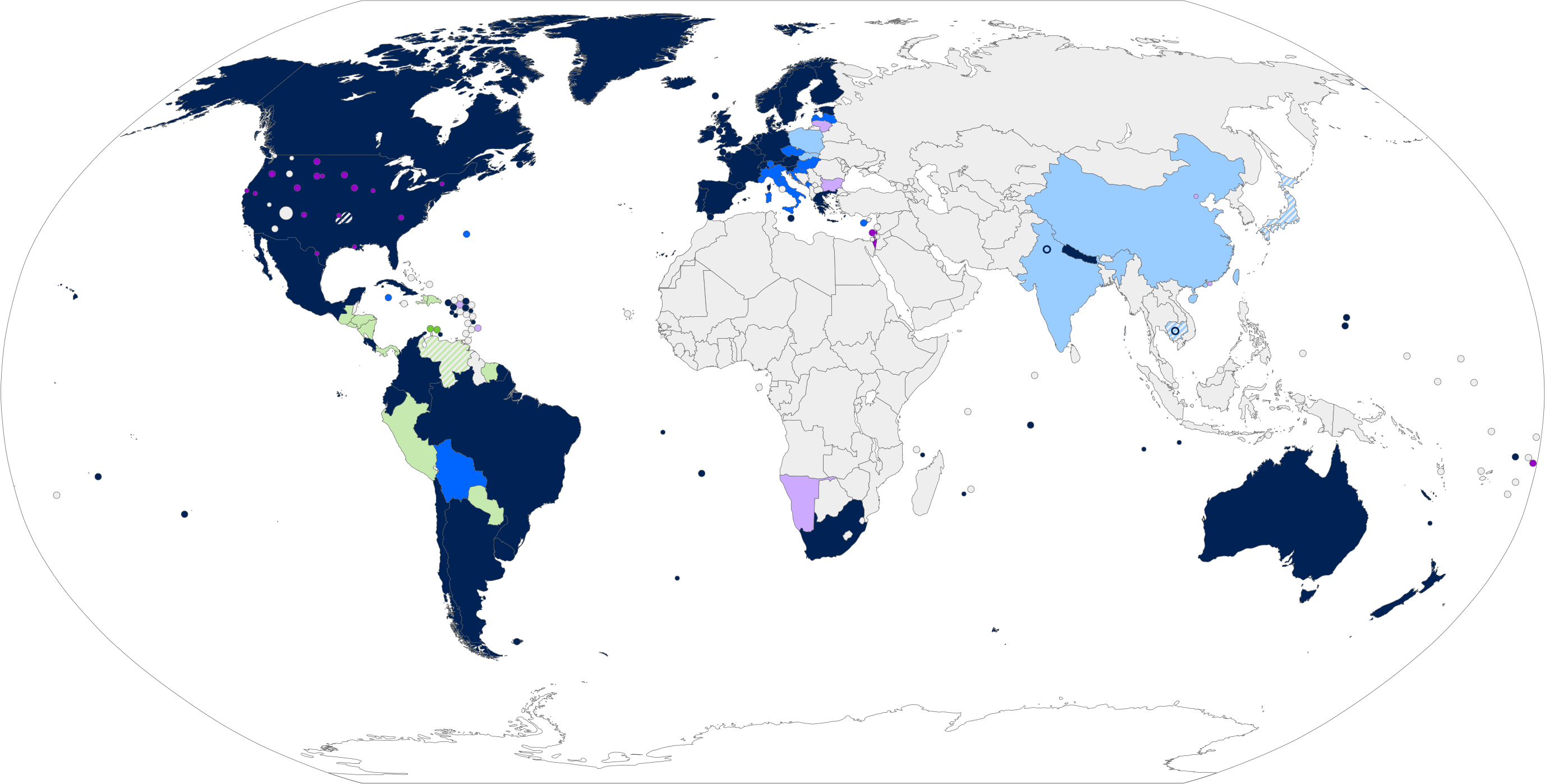
Same-sex marriage is legally performed and recognized in 38 countries: Andorra, Argentina, Australia, Austria, Belgium, Brazil, Canada, Chile, Colombia, Costa Rica, Cuba, Denmark, Ecuador, Estonia, Finland, France, Germany, Greece, Iceland, Ireland, Liechtenstein, Luxembourg, Malta, Mexico, the Netherlands, New Zealand, Norway, Portugal, Slovenia, South Africa, Spain, Sweden, Switzerland, Taiwan, Thailand, the United Kingdom, the United States, and Uruguay. Same-sex marriage performed remotely or abroad is recognized with full marital rights by Israel.
-- ]]
Same-sex marriage is under consideration by the legislature or the courts in El Salvador, Italy, Japan, Nepal, and Venezuela.
Civil unions are being considered in a number of countries, including Kosovo, Peru, the Philippines and Poland.
On 12 March 2015, the European Parliament passed a non-binding resolution encouraging EU institutions and member states to "[reflect] on the recognition of same-sex marriage or same-sex civil union as a political, social and human and civil rights issue".
In response to the international spread of same-sex marriage, a number of countries have enacted preventative constitutional bans, with the most recent being Mali in 2023, and Gabon in 2024. In other countries, such restrictions and limitations are effected through legislation. Even before same-sex marriage was first legislated, some countries had constitutions that specified that marriage was between a man and a woman.

]]
International court rulings
European Court of Human Rights
In 2010, the European Court of Human Rights (ECHR) ruled in Schalk and Kopf v Austria, a case involving an Austrian same-sex couple who were denied the right to marry. The court found, by a vote of 4 to 3, that their human rights had not been violated. The court further stated that same-sex unions are not protected under art. 12 of ECHR ("Right to marry"), which exclusively protects the right to marry of opposite-sex couples (without regard if the sex of the partners is the result of birth or of sex change), but they are protected under art. 8 of ECHR ("Right to respect for private and family life") and art. 14 ("Prohibition of discrimination").
Article 12 of the European Convention on Human Rights states that: "Men and women of marriageable age have the right to marry and to found a family, according to the national laws governing the exercise of this right", not limiting marriage to those in a heterosexual relationship. However, the ECHR stated in Schalk and Kopf v Austria that this provision was intended to limit marriage to heterosexual relationships, as it used the term "men and women" instead of "everyone". Nevertheless, the court accepted and is considering cases concerning same-sex marriage recognition, e.g. Andersen v Poland. In 2021, the court ruled in Fedotova and Others v. Russia—followed by later judgements concerning other member states—that countries must provide some sort of legal recognition to same-sex couples, although not necessarily marriage.
European Union
On 25 November 2025, the European Court of Justice established that all EU Member States must recognize same-sex marriages legally performed in other EU countries. The key provisions of the ruling are:
- Member States are required to recognize a marriage lawfully contracted in another Member State where at least one spouse is an EU citizen exercising their right to freedom of movement and residence.
- This recognition is mandatory for the purpose of exercising rights conferred by EU law, such as residency, tax benefits, inheritance, and social security.
- If a Member State provides a procedure for recognizing foreign marriages (e.g., transcription into a civil register), it must apply that procedure equally to same-sex couples. It cannot refuse transcription solely because domestic law does not permit same-sex marriage. However, the ruling does not require Member States to legalize same-sex marriage within their own domestic legal systems. It only mandates the recognition of marriages validly concluded elsewhere in the EU. The following EU countries, which previously did not recognize same sex marriages are directly affected by this ruling: Bulgaria, Croatia, Cyprus, Czechia, Hungary, Italy, Latvia, Lithuania, Poland, Romania and Slovakia.
Previously, on 5 June 2018, the European Court of Justice ruled, in Coman and Others v General Inspectorate for Immigration and Ministry of the Interior, that, under the specific conditions of the couple in question, married same-sex couples have the same residency rights as other married couples in an EU country, even if that country does not permit or recognize same-sex marriage. However, the ruling was not implemented in Romania and on 14 September 2021 the European Parliament passed a resolution calling on the European Commission to ensure that the ruling is respected across the EU.
Inter-American Court of Human Rights

On 8 January 2018, the Inter-American Court of Human Rights (IACHR) issued an advisory opinion that states party to the American Convention on Human Rights should grant same-sex couples accession to all existing domestic legal systems of family registration, including marriage, along with all rights that derive from marriage. The Court recommended that governments issue temporary decrees recognizing same-sex marriage until new legislation is brought in. They also said that it was inadmissible and discriminatory for a separate legal provision to be established (such as civil unions) instead of same-sex marriage.
Other arrangements
Civil unions
Main article: Civil union
Civil union, civil partnership, domestic partnership, registered partnership, unregistered partnership, and unregistered cohabitation statuses offer varying legal benefits of marriage. As of , countries that have an alternative form of legal recognition other than marriage on a national level are: Bolivia, Croatia, Cyprus, the Czech Republic, Hungary, Italy, Latvia, Lithuania, Monaco, Montenegro and San Marino. Same-sex marriage performed remotely or abroad is recognized with full marital rights by Israel. Additionally, various jurisdictions in Cambodia, Japan and the Philippines offer same-sex couples varying levels of benefits, which include hospital visitation rights and others.
Additionally, eighteen countries that have legally recognized same-sex marriage also have an alternative form of recognition for same-sex couples, usually available to heterosexual couples as well: Argentina, Australia, Austria, Belgium, Brazil, Chile, Colombia, Ecuador, France, Greece, Luxembourg, Malta, the Netherlands, Portugal, South Africa, Spain, the United Kingdom and Uruguay.
They are also available in parts of the United States (Arizona, California, Colorado, Hawaii, Illinois, New Jersey, Nevada and Oregon) and Canada.
Non-sexual same-sex marriage
Kenya
Main article: LGBT rights in Kenya
Female same-sex marriage is practiced among the Gikuyu, Nandi, Kamba, Kipsigis, and to a lesser extent neighboring peoples. About 5–10% of women are in such marriages. However, this is not seen as homosexual, but is instead a way for families without sons to keep their inheritance within the family.
Nigeria
Main article: Recognition of same-sex unions in Nigeria
Among the Igbo people and probably other peoples in the south of the country, there are circumstances where a marriage between women is considered appropriate, such as when a woman has no child and her husband dies, and she takes a wife to perpetuate her inheritance and family lineage.
Religion and same-sex marriage
Christianity

Some progressive Christian denominations allow local churches to decide whether to bless same-sex marriages. Some international networks of inclusive churches support blessings, such the Association of Welcoming and Affirming Baptists, Ecumenical Catholic Church, Metropolitan Community Church, Reconciling Ministries Network (Methodist), and the Covenant Network (Pentecostal).
Judaism
The three main international progressive Jewish organizations adopted resolutions supporting same-sex marriage: Reconstructionist Judaism in 2004, the World Council of Synagogues (Masorti Judaism) in 2012, and the World Union for Progressive Judaism (Reform Judaism) in 2013.
Studies
The American Anthropological Association stated on 26 February 2004:
Research findings from 1998 to 2015 from the University of Virginia, Michigan State University, Florida State University, the University of Amsterdam, the New York State Psychiatric Institute, Stanford University, the University of California-San Francisco, the University of California-Los Angeles, Tufts University, Boston Medical Center, the Committee on Psychosocial Aspects of Child and Family Health, and independent researchers also support the findings of this study.
The overall socio-economic and health effects of legal access to same-sex marriage around the world have been summarized by Badgett and co-authors. The review found that sexual minority individuals took-up legal marriage when it became available to them (but at lower rates than different-sex couples). There is instead no evidence that same-sex marriage legalization affected different-sex marriages. On the health side, same-sex marriage legalization increased health insurance coverage for individuals in same-sex couples (in the US), and it led to improvements in sexual health among men who have sex with men, while there is mixed evidence on mental health effects among sexual minorities. In addition, the study found mixed evidence on a range of downstream social outcomes such as attitudes toward LGBTQ+ people and employment choices of sexual minorities.
Health
, the data of current psychological and other social science studies on same-sex marriage in comparison to mixed-sex marriage indicate that same-sex and mixed-sex relationships do not differ in their essential psychosocial dimensions; that a parent's sexual orientation is unrelated to their ability to provide a healthy and nurturing family environment; and that marriage bestows substantial psychological, social, and health benefits. Same-sex parents and carers and their children are likely to benefit in numerous ways from legal recognition of their families, and providing such recognition through marriage will bestow greater benefit than civil unions or domestic partnerships. Studies in the United States have correlated legalization of same-sex marriage to lower rates of HIV infection, psychiatric disorders, and suicide rate in the LGBT population.
Issues
While few societies have recognized same-sex unions as marriages, the historical and anthropological record reveals a large range of attitudes towards same-sex unions ranging from praise, through full acceptance and integration, sympathetic toleration, indifference, prohibition and discrimination, to persecution and physical annihilation. Opponents of same-sex marriages have argued that same-sex marriage, while doing good for the couples that participate in them and the children they are raising, undermines a right of children to be raised by their biological mother and father. Some supporters of same-sex marriages take the view that the government should have no role in regulating personal relationships, while others argue that same-sex marriages would provide social benefits to same-sex couples. The debate regarding same-sex marriages includes debate based upon social viewpoints as well as debate based on majority rules, religious convictions, economic arguments, health-related concerns, and a variety of other issues.
Parenting
Main article: LGBT parenting, Same-sex marriage and the family

Scientific literature indicates that parents' financial, psychological and physical well-being is enhanced by marriage and that children benefit from being raised by two parents within a legally recognized union (either a mixed-sex or same-sex union). As a result, professional scientific associations have argued for same-sex marriage to be legally recognized as it will be beneficial to the children of same-sex parents or carers.
Scientific research has been generally consistent in showing that lesbian and gay parents are as fit and capable as heterosexual parents, and their children are as psychologically healthy and well-adjusted as children reared by heterosexual parents. According to scientific literature reviews, there is no evidence to the contrary.
Compared to heterosexual couples, same-sex couples have a greater need for adoption or assisted reproductive technology to become parents. Lesbian couples often use artificial insemination to achieve pregnancy, and reciprocal in vitro fertilization (where one woman provides the egg and the other gestates the child) is becoming more popular in the 2020s, although many couples cannot afford it. Surrogacy is an option for wealthier gay male couples, but the cost is prohibitive. Other same-sex couples adopt children or raise the children from earlier opposite-sex relationships.
Adoption
Main article: LGBT adoption

]] All states that allow same-sex marriage also allow the joint adoption of children by those couples with the exception of Ecuador and a third of states in Mexico, though such restrictions have been ruled unconstitutional in Mexico. In addition, Bolivia, Croatia and Israel, which do not recognize same-sex marriage, nonetheless permit joint adoption by same-sex couples. Some additional states do not recognize same-sex marriage but allow stepchild adoption by couples in civil unions, namely the Czech Republic and San Marino.
Transgender and intersex people
The legal status of same-sex marriage may have implications for the marriages of couples in which one or both parties are transgender, depending on how sex is defined within a jurisdiction. Transgender and intersex individuals may be prohibited from marrying partners of the "opposite" sex or permitted to marry partners of the "same" sex due to legal distinctions. In any legal jurisdiction where marriages are defined without distinction of a requirement of a male and female, these complications do not occur. In addition, some legal jurisdictions recognize a legal and official change of gender, which would allow a transgender male or female to be legally married in accordance with an adopted gender identity.
In the United Kingdom, the Gender Recognition Act 2004 allows a person who has lived in their chosen gender for at least two years to receive a gender recognition certificate officially recognizing their new gender. Because in the United Kingdom marriages were until recently only for mixed-sex couples and civil partnerships are only for same-sex couples, a person had to dissolve their civil partnership before obtaining a gender recognition certificate, and the same was formerly true for marriages in England and Wales, and still is in other territories. Such people are then free to enter or re-enter civil partnerships or marriages in accordance with their newly recognized gender identity. In Austria, a similar provision requiring transsexual people to divorce before having their legal sex marker corrected was found to be unconstitutional in 2006. In Quebec, prior to the legalization of same-sex marriage, only unmarried people could apply for legal change of gender. With the advent of same-sex marriage, this restriction was dropped. A similar provision including sterilization also existed in Sweden, but was phased out in 2013. In the United States, transgender and intersex marriages was subject to legal complications. As definitions and enforcement of marriage are defined by the states, these complications vary from state to state, as some of them prohibit legal changes of gender.
Divorce
Main article: Divorce of same-sex couples
In the United States before the case of Obergefell v. Hodges, couples in same-sex marriages could only obtain a divorce in jurisdictions that recognized same-sex marriages, with some exceptions.
Judicial and legislative
Main article: Conflict of marriage laws#Same-sex marriage
There are differing positions regarding the manner in which same-sex marriage has been introduced into democratic jurisdictions. A "majority rules" position holds that same-sex marriage is valid, or void and illegal, based upon whether it has been accepted by a simple majority of voters or of their elected representatives.
In contrast, a civil rights view holds that the institution can be validly created through the ruling of an impartial judiciary carefully examining the questioning and finding that the right to marry regardless of the gender of the participants is guaranteed under the civil rights laws of the jurisdiction.
Public opinion

]]
Numerous polls and studies on the issue have been conducted. A trend of increasing support for same-sex marriage has been revealed across many countries of the world, often driven in large part by a generational difference in support. Polling that was conducted in developed democracies in this century shows a majority of people in support of same-sex marriage. Support for same-sex marriage has increased across every age group, political ideology, religion, gender, race and region of various developed countries in the world.
Various detailed polls and studies on same-sex marriage that were conducted in several countries show that support for same-sex marriage significantly increases with higher levels of education and is also significantly stronger among younger generations, with a clear trend of continually increasing support.
;Greater support with youth Pew Research polling results from 32 countries found 21 with statistically higher support for same-sex marriage among those under 35 than among those over 35 in 2022–2023. Countries with the greatest absolute difference are placed to the left in the following chart. Countries without a significant generational difference are placed to the right.
A 2016 survey by the Varkey Foundation found similarly high support of same-sex marriage (63%) among 18–21-year-olds in an online survey of 18 countries around the world.
(The sampling error is approx. 4% for Nigeria and 3% for the other countries. Because of legal constraints, the question on same-sex marriage was not asked in the survey countries of Russia and Indonesia.)
Notes
References
Bibliography
References
- VERPOEST, LIEN. (2017). "The End of Rhetorics: LGBT policies in Russia and the European Union". Studia Diplomatica.
- Williams, CA., ''Roman Homosexuality: Second Edition'', Oxford University Press, 2009, p. 280, p. 284.
- (June 26, 2015). "Same-Sex Marriage: Landmark Decisions and Precedents". The New York Times.
- Baume, Matt. (March 1, 2019). "Meet the Gay Men Whose 1971 Marriage Was Finally Recognized".
- Michael McConnell, with Jack Baker, as told to Gail Langer Karwoski, "[https://www.upress.umn.edu/book-division/books/the-wedding-heard-around-the-world The Wedding Heard Heard 'Round the World: America's First Gay Marriage] {{Webarchive. link. (August 26, 2015 ". University of Minnesota Press (2016). Reprint, "With A New Epilogue" (2020).)
- Winter, Caroline. (December 4, 2014). "In 14 years, same-sex marriage has spread round the world". Bloomberg.
- (26 September 2013). "Same-sex Oklahoma couple marries legally under tribal law". KOCO.
- (19 June 2022). "Clela Rorex, former Boulder County Clerk who issued first same-sex marriage license in 1975 dies at 78".
- [https://www.nytimes.com/2005/07/05/national/05church.html NYTimes.com] {{Webarchive. link. (1 May 2011 "United Church of Christ Backs Same-Sex Marriage")
- (17 May 2015). "French Protestant church authorises gay marriages".
- (16 September 2021). "Same-sex civil unions 'good and helpful to many', says Pope Francis".
- Molly Ball, 2024 May 13, ''Wall Street Journal'', [https://www.msn.com/en-us/news/politics/how-20-years-of-same-sex-marriage-changed-america/ar-BB1mhZ6p How 20 Years of Same-Sex Marriage Changed America]
- "Brief of Amici Curiae American Anthropological Association et al., supporting plaintiffs-appellees and urging affirmance – Appeal from United States District Court for the Northern District of California Civil Case No. 09-CV-2292 VRW (Honorable Vaughn R. Walker)".
- Handbook of Gay, Lesbian, Bisexual, and Transgender Administration and Policy — Page 13, Wallace Swan – 2004
- [http://www.scborromeo.org/ccc/p3s2c2a6.htm#2357 Catechism of the Catholic Church, § 2357-9] {{Webarchive. link. (9 December 2020 ; cf. Catechism of the Catholic Church, 2351, 2391, 2396)
- "Marriage Equality". Garden State Equality.
- "Marriage 101". [[Freedom to Marry]].
- Pratt, Patricia. (29 May 2012). "Albany area real estate and the Marriage Equality Act". Albany Examiner.
- (13 December 2012). "Vote on Illinois marriage equality bill coming in January: sponsors". Chicago Phoenix.
- Mulholland, Helene. (27 September 2012). "Ed Miliband calls for gay marriage equality". The Guardian.
- Ring, Trudy. (20 December 2012). "Newt Gingrich: Marriage Equality Inevitable, OK". The Advocate.
- APStylebook. (12 February 2019). "The term same-sex marriage is preferred over gay marriage. In places where it's legal, same-sex marriage is no different from other marriages, so the term should be used only when germane and needed to distinguish from marriages between heterosexual couples. #APStyleChat".
- (24 February 2021). "One in 10 LGBT Americans Married to Same-Sex Spouse".
- Yin, Karen. (8 March 2016). "When Bisexual People Marry".
- (2024). "Same-Gender Couples, Counseling of". [[Sage Publishing]].
- (2006). "Defending same-sex marriage". [[Praeger Publishers]].
- Fedorak, Shirley A.. (2008). "Anthropology matters!". [[University of Toronto Press]].
- Gough, Kathleen E.. (Jan–Jun 1959). "The Nayars and the Definition of Marriage". The Journal of the Royal Anthropological Institute of Great Britain and Ireland.
- (2001). "Boy-wives and female husbands : studies of African homosexualities". St. Martin's.
- (Spring 2001). "Revisiting "Woman-Woman Marriage": Notes on Gikuyu Women". [[NWSA Journal]].
- (24 May 2004). "Dictionaries take lead in redefining modern marriage". [[The Washington Times]].
- "Webster Makes It Official: Definition of Marriage Has Changed". [[American Bar Association]].
- Redman, Daniel. (7 April 2009). "Noah Webster Gives His Blessing: Dictionaries recognize same-sex marriage—who knew?". [[Slate (magazine).
- (13 August 2008). "The Divine Institution of Marriage". [[The Church of Jesus Christ of Latter-day Saints]].
- Rabbi Joel Roth. [https://www.rabbinicalassembly.org/sites/default/files/assets/public/halakhah/teshuvot/19912000/roth_homosexual.pdf Homosexuality] {{Webarchive. link. (24 August 2017 ''rabbinicalassembly.org'' 1992.)
- Martial 1.24 and 12.42; Juvenal 2.117–42. Williams, ''Roman Homosexuality'', pp. 28, 280; Karen K. Hersh, ''The Roman Wedding: Ritual and Meaning in Antiquity'' (Cambridge University Press, 2010), p. 36; [[Caroline Vout]], ''Power and Eroticism in Imperial Rome'' (Cambridge University Press, 2007), pp. 151ff.
- [[Suetonius]], [[Tacitus]], [[Dio Cassius]], and [[Aurelius Victor]] are the sources cited by Williams, ''Roman Homosexuality'', p. 279.
- Williams, ''Roman Homosexuality'', pp. 278–279, citing Dio Cassius and [[Aelius Lampridius]].
- Williams, ''Roman Homosexuality'', p. 280.
- Hinsch, Bret. (1990). "Passions of the cut sleeve: the male homosexual tradition in China". University of California Press.
- (March–April 2013). "How Same-Sex Marriage Came to Be".
- Hari, Johann. (Spring 2009). "Andrew Sullivan: Thinking. Out. Loud.". Intelligent Life.
- Sullivan, Andrew. (9 November 2012). "Here Comes the Groom". Slate.
- Rule, Sheila. (2 October 1989). "Rights for Gay Couples in Denmark". [[The New York Times]].
- (26 May 2009). "Same-sex marriage around the world". CBC News.
- (28 April 2021). "The Dutch went first in 2001; who has same-sex marriage now?".
- "'I'm proud of Thailand': Couples to tie the knot in mass weddings as same-sex marriage become legal".
- (16 February 2024). "This map shows you where same-sex marriage is legal around the world – and there's a long way to go".
- "Marriage Equality Around the World".
- (2018). "Information for couples marrying outside the Rabbinate".
- (6 January 2020). "Sala de lo Constitucional resolvería demanda sobre matrimonio igualitario en los primeros tres messes de 2020". elsalvador.com.
- (18 August 2021). "Bukele busca que se apruebe el aborto terapéutico y la unión homosexual". El Observador.
- (9 March 2023). "Diritti: matrimonio "egualitario". Opinioni a confronto: Scalfarotto vs Bonaldi vs Centinaio".
- (10 March 2023). "Da Zaia a Centinaio: la Lega ora cambia sui diritti lgbt (e c'entra "l'effetto Francesca")".
- (6 March 2023). "Japan opposition party submits bill for same-sex marriage". [[Kyodo News]].
- "Why are district courts not registering same-sex marriage?".
- Raut, Swechhya. (2024-07-10). "Nepal: Same-sex couples face hurdles on road to recognition". DW.
- "Nepal hosts international meet on LGBTIQ+ rights".
- Ghimire, Binod. (2023-12-03). "How court laid the ground for same-sex marriage in Nepal". The Kathmandu Post.
- Dhakal, Manisha. (20 June 2024). "The Long Road to Lasting Marriage Equality in Nepal". APCOM.
- (24 February 2022). "Diputada plantea iniciativa para el matrimonio civil igualitario en la Asamblea Nacional".
- (26 April 2024). "Kosovo promises to introduce same-sex unions in May".
- (23 October 2021). "Presentan proyecto de ley sobre el matrimonio igualitario entre personas del mismo sexo". elcomercio.pe.
- "CHR issues position paper on civil partnership bills, advocating for equal rights and protections for couples".
- (18 October 2024). "Poland introduces bill to legalise same-sex civil unions".
- Duffy, Nick. (13 March 2015). "UKIP and Tories abstain on EU motion to recognise same-sex marriage".
- "Texts adopted – Thursday, 12 March 2015 – Annual report on human rights and democracy in the world 2013 and the EU policy on the matter". European Parliament.
- "HUDOC – European Court of Human Rights".
- Buyse, Antoine. (24 June 2010). "Strasbourg court rules that states are not obliged to allow gay marriage". The Guardian.
- Avram, Marieta. (2016). "Drept civil Familia". Editura Hamangiu.
- "European Convention on Human Rights". European Court of Human Rights.
- "HUDOC - European Court of Human Rights".
- (April 2023). "Fedotova and Others v. Russia : Dawn of a new era for European LGBTQ families?". Maastricht Journal of European and Comparative Law.
- (2025-11-25). "Judgment of the Court in Case C-713/23 {{!}} Wojewoda Mazowiecki".
- (1 January 2022). "Civil marriages in the EU: national and cross-border rules - Your Europe". Your Europe.
- (5 June 2018). "EU court backs residency rights for gay couple in Romania".
- (5 June 2018). "Same-sex spouses have EU residence rights, top court rules – BBC". BBC News.
- "Texts adopted – LGBTIQ rights in the EU – Tuesday, 14 September 2021".
- (14 September 2021). "MEPs condemn failure to respect rights of same-sex partners in EU". The Guardian.
- (25 January 2018). "Major Advance for Marriage Equality and Gender Identity Rights in Latin America". Sfbaytimes.com.
- Towle, Andy. (13 November 2008). "NYC Protest and Civil Rights March Opposing Proposition 8". [[Towleroad]].
- Pearson, Mary. "Where is Gay Marriage Legal?". christiangays.com.
- Williams, Steve. "Which Countries Have Legalized Gay Marriage?". Care2.com (news.bbc.co.uk as source).
- "Loi du 9 juillet 2004 relative aux effets légaux de certains partenariats. – Legilux".
- (12 March 2007). "Loi n° 99-944 du 15 novembre 1999 relative au pacte civil de solidarité".
- "WETTEN, DECRETEN, ORDONNANTIES EN VERORDENINGEN LOIS, DECRETS, ORDONNANCES ET REGLEMENTS".
- "Civil Partnership Act 2004".
- "Same-Sex Marriage, Civil Unions and Domestic Partnerships". National Conference of State Legislatures.
- Ramstack, Tom. (11 January 2010). "Congress Considers Outcome of D.C. Gay Marriage Legislation". AHN.
- ''Gender and Language in Sub-Saharan Africa,'' 2013:35
- Igwe, Leo. (19 June 2009). "Tradition of same gender marriage in Igboland".
- Jeffrey S. Siker, ''Homosexuality and Religion: An Encyclopedia'', Greenwood Publishing Group, USA, 2007, p. 147
- Ecumenical Catholic Church, [https://ecumenicalcatholicchurch.org/en/doctrinas/ Doctrines], ecumenicalcatholicchurch.org, Mexico, accessed August 16, 2025
- Emily McAvan, [https://www.sbs.com.au/voices/article/the-jewish-case-for-marriage-equality-in-australia/3csmnyivn The Jewish case for marriage equality in Australia], sbs.com.au, January 23, 2017
- American Anthropological Association. (2004). "Statement on Marriage and the Family".
- (26 June 2015). "Same-sex marriage and children's well-being: Research roundup". Journalist's Resource.
- (2024). "A review of the effects of legal access to same-sex marriage". Journal of Policy Analysis and Management.
- Herek, Gregory M. "Legal recognition of same-sex relationships in the United States: A social science perspective." ''American Psychologist,'' Vol 61(6), September 2006, pp. 607–21.
- Elaine Justice. "Study Links Gay Marriage Bans to Rise in HIV infections". Emory University.
- Peng, Handie. "The Effect of Same-Sex Marriage Laws on Public Health and Welfare". Userwww.service.emory.edu.
- Hasin, Deborah. "Lesbian, gay, bisexual individuals risk psychiatric disorders from discriminatory policies". [[Columbia University Mailman School of Public Health]].
- Mustanski, Brian. (22 March 2010). "New study suggests bans on gay marriage hurt mental health of LGB people". [[Psychology Today]].
- (2017). "Difference-in-Differences Analysis of the Association Between State Same-Sex Marriage Policies and Adolescent Suicide Attempts". JAMA Pediatrics.
- (20 February 2017). "Same-Sex Marriage Legalization Linked to Reduction in Suicide Attempts Among High School Students".
- Laurie, Timothy. (3 June 2015). "Bigotry or biology: the hard choice for an opponent of marriage equality". The Drum.
- Blankenhorn, David. (19 September 2008). "Protecting marriage to protect children". Los Angeles Times.
- "See discussion of prenuptial and postmarital agreements at Findlaw". Family.findlaw.com.
- "Brief of the American Psychological Association, The California Psychological Association, the American Psychiatric Association, and the American Association for Marriage and Family Therapy as amici curiae in support of plaintiff-appellees – Appeal from United States District Court for the Northern District of California Civil Case No. 09-CV-2292 VRW (Honorable Vaughn R. Walker)".
- (2006). "Marriage of Same-Sex Couples – 2006 Position Statement Canadian Psychological Association".
- (July 2006). "The effects of marriage, civil union, and domestic partnership laws on the health and well-being of children". [[Pediatrics (journal).
- Lamb, Michael. "Expert Affidavit for U.S. District Court (D. Mass. 2009)". Gay & Lesbian Advocates & Defenders.
- (22 March 2013). "Pediatricians: Gay Marriage Good for Kids' Health". news.discovery.com.
- "Elizabeth Short, Damien W. Riggs, Amaryll Perlesz, Rhonda Brown, Graeme Kane: Lesbian, Gay, Bisexual and Transgender (LGBT) Parented Families – A Literature Review prepared for The Australian Psychological Society".
- "Brief of the American Psychological Association, The California Psychological Association, The American Psychiatric Association, and The American Association of Marriage and Family Therapy as Amici Curiae in Support of Plaintiff-Appellees". [[United States Court of Appeals for the Ninth Circuit]].
- (2006). "The Effects of Marriage, Civil Union, and Domestic Partnership Laws on the Health and Well-being of Children". Pediatrics.
- Herek, GM. (September 2006). "Legal recognition of same-sex relationships in the United States: a social science perspective". The American Psychologist.
- (February 2010). "How Does the Gender of Parents Matter?". Journal of Marriage and Family.
- "Brief presented to the Legislative House of Commons Committee on Bill C38 by the Canadian Psychological Association – 2 June 2005.".
- (February 2023). "LGBTQ-parent families: Diversity, intersectionality, and social context". Current Opinion in Psychology.
- (December 2021). "Social Support in the Transition to Parenthood Among Lesbian, Gay, and Bisexual Persons: A Systematic Review". Sexuality Research and Social Policy.
- Bockting, Walter, Autumn Benner, and Eli Coleman. "Gay and Bisexual Identity Development Among Female-to-Male Transsexuals in North America: Emergence of a Transgender Sexuality." ''Archives of Sexual Behavior'' 38.5 (October 2009): 688–701. Academic Search Premier. EBSCO. 29 September 2009
- (5 July 2006). "Austria gets first same-sex marriage". 365gay.com.
- (11 January 2013). "Sweden ends forced sterilization of trans".
- Deborah, Anthony. (Spring 2012). "CAUGHT IN THE MIDDLE: TRANSSEXUAL MARRIAGE AND THE DISCONNECT BETWEEN SEX AND LEGAL SEX.". Texas Journal of Women & the Law.
- Schwartz, John. (18 September 2009). "U.S. Defends Marriage Law". The New York Times.
- "Movement Advancement Project {{!}} Equality Maps".
- Matthew S. Coleman. (16 September 2015). "Obergefell v. Hodges". Einhorn Harris.
- Leff, Lisa. (4 December 2008). "Poll: Calif. gay marriage ban driven by religion". USA Today.
- Mirchandani, Rajesh. (12 November 2008). "Divisions persist over gay marriage ban". BBC News.
- For ease of comparison, only 'yes' and 'no' responses are counted. For old polling data, support figures have been adjusted upward @1%/year.
- Newport, Frank. (20 May 2011). "For First Time, Majority of Americans Favor Legal Gay Marriage". [[The Gallup Organization.
- "Public Opinion: Nationally". australianmarriageequality.com.
- "Gay Life in Estonia". globalgayz.com.
- Jowit, Juliette. (12 June 2012). "Gay marriage gets ministerial approval". [[The Guardian]].
- (24 February 2011). "Most Irish people support gay marriage, poll says". PinkNews.
- "How people in 24 countries view same-sex marriage".
- "What the world's young people think and feel.".
- "Who supports equal rights for same-sex couples?".
- (Jun 2, 2015). "Age is decisive factor when it comes to supporting same-sex marriage: LAPOP".
This article was imported from Wikipedia and is available under the Creative Commons Attribution-ShareAlike 4.0 License. Content has been adapted to SurfDoc format. Original contributors can be found on the article history page.
Ask Mako anything about Same-sex marriage — get instant answers, deeper analysis, and related topics.
Research with MakoFree with your Surf account
Create a free account to save articles, ask Mako questions, and organize your research.
Sign up freeThis content may have been generated or modified by AI. CloudSurf Software LLC is not responsible for the accuracy, completeness, or reliability of AI-generated content. Always verify important information from primary sources.
Report