From Surf Wiki (app.surf) — the open knowledge base
Samarkand Region
Region of Uzbekistan

Region of Uzbekistan
| Field | Value |
|---|---|
| name | Samarkand Region |
| native_name | Самарқанд вилояти / Samarqand viloyati |
| settlement_type | Region |
| image_skyline | Provincia de Samarcanda 2.jpg |
| image_caption | 'Welcome to Samarkand' |
| image_map | Samarqand Viloyati in Uzbekistan.svg |
| map_caption | Samarkand in Uzbekistan |
| coordinates | |
| subdivision_type | Country |
| subdivision_name | Uzbekistan |
| blank_name_sec1 | Districts |
| blank_info_sec1 | 14 |
| blank1_name_sec1 | Cities |
| blank1_info_sec1 | 11 |
| blank2_name_sec1 | Townships |
| blank3_name_sec1 | Villages |
| established_title | Established |
| established_date | 1938 |
| seat | Samarkand |
| seat_type | Capital |
| leader_title | Hokim |
| leader_name | Adiz Muzaffarovich Boboyev |
| area_total_km2 | 16773 |
| timezone1 | East |
| utc_offset1 | +5 |
| timezone1_DST | not observed |
| utc_offset1_DST | +5 |
| population_total | 4031324 |
| population_as_of | 2022 |
| population_density_km2 | auto |
| elevation_m | 577 |
| iso_code | UZ-SA |
| website |
Samarkand Region is the most populous region of Uzbekistan.
Samarkand Region was established on 15 January 1938, and is divided into 14 administrative districts and two district-level cities. Other major towns include Bulungʻur, Juma, Ishtixon, Kattakurgan, Urgut, and Oqtosh.
The climate is a typically arid continental climate.
Samarkand is the second-largest center for economy, science, and culture in Uzbekistan, after Tashkent. The region's UNESCO World Heritage Site architectural monuments make Samarkand the largest center for international tourism in the country. Samarkand Region also has significant natural resources, including construction materials such as marble, granite, limestone, carbonate, and chalk. The region's major agricultural activities are cotton and cereal growing, winemaking and sericulture. Metal processing (spare parts for automobiles and combines), food processing, textiles, and ceramics are the area's most active industries.
The region has a well-developed transport infrastructure, with over 400 km of railways and 4,100 km of surfaced roads. The telecommunication infrastructure is also well developed.
Administrative divisions
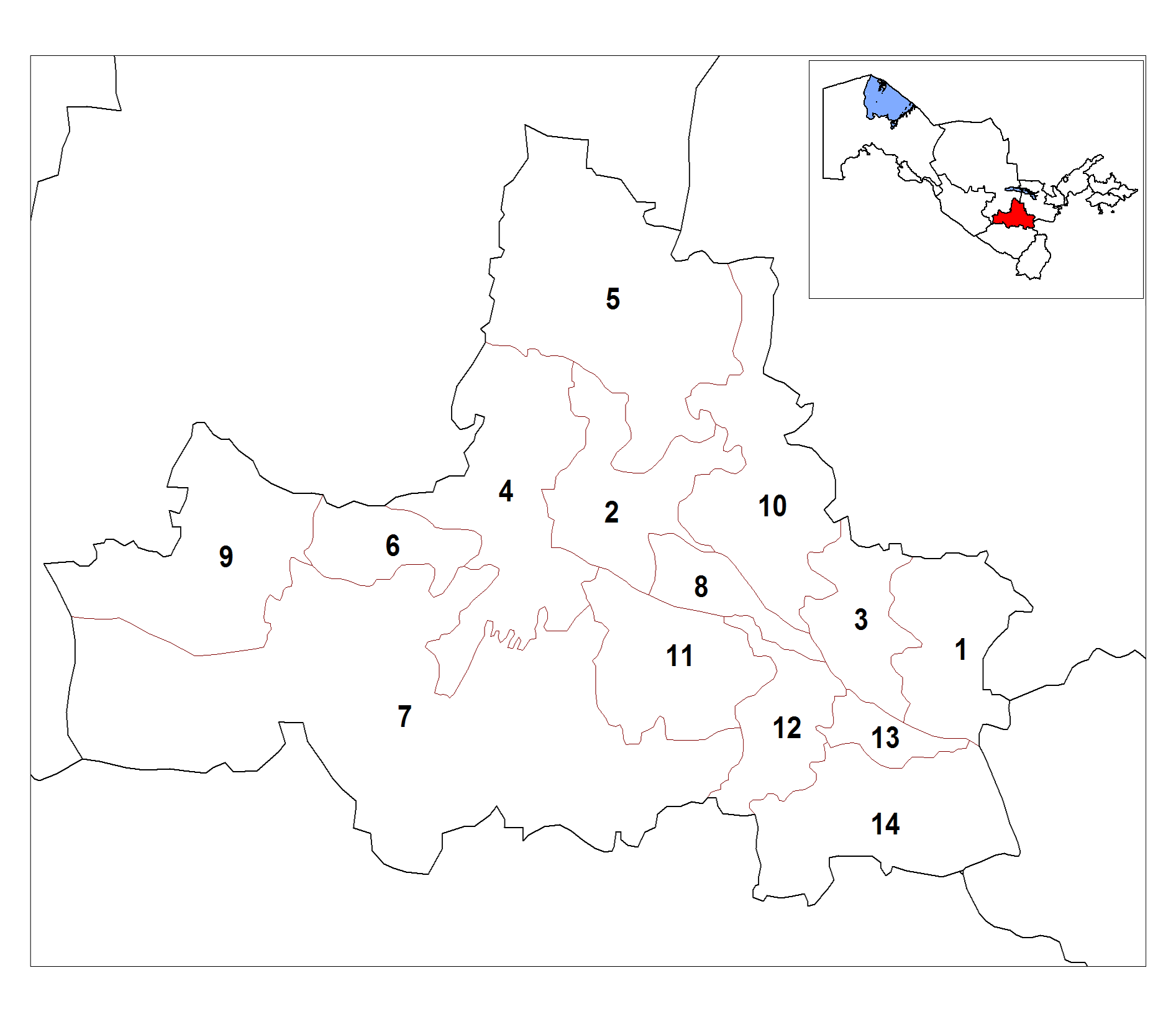
The Samarkand Region consists of 14 districts (listed below) and two district-level cities: Samarkand (Samarqand) and Kattakurgan (Kattaqoʻrgʻon).
| District name | District capital | |||
|---|---|---|---|---|
| 1 | ||||
| 2 | ||||
| 3 | ||||
| 4 | ||||
| 5 | ||||
| 6 | ||||
| 7 | ||||
| 8 | ||||
| 9 | ||||
| 10 | ||||
| 11 | ||||
| 12 | ||||
| 13 | ||||
| 14 |
There are 11 cities (Samarkand, Kattakurgan, Bulungʻur, Jomboy, Ishtixon, Oqtosh, Payariq, Chelak, Juma, Nurobod, Urgut) and 88 urban-type settlements in the Samarkand Region.
Notes
References
References
- "O'zbekistonda eng ko'p aholi qaysi viloyatda yashaydi?".
- [http://www.samarqand.uz/eng/information_about_the_samarkand_region/ Information about the Samarkand Region] {{webarchive. link. (2007-10-08 , ''[http://www.samarqand.uz www.samarqand.uz] {{Webarchive). link. (2009-06-05 '', accessed on 2007-07-21.)
- "Urban and rural population by district". Samarkand regional department of statistics.
- (July 2021). "Oʻzbekiston Respublikasining maʼmuriy-hududiy boʻlinishi". The State Committee of the Republic of Uzbekistan on statistics.
- (July 2020). "Classification system of territorial units of the Republic of Uzbekistan". The State Committee of the Republic of Uzbekistan on statistics.
This article was imported from Wikipedia and is available under the Creative Commons Attribution-ShareAlike 4.0 License. Content has been adapted to SurfDoc format. Original contributors can be found on the article history page.
Ask Mako anything about Samarkand Region — get instant answers, deeper analysis, and related topics.
Research with MakoFree with your Surf account
Create a free account to save articles, ask Mako questions, and organize your research.
Sign up freeThis content may have been generated or modified by AI. CloudSurf Software LLC is not responsible for the accuracy, completeness, or reliability of AI-generated content. Always verify important information from primary sources.
Report