From Surf Wiki (app.surf) — the open knowledge base
Saka
Historical group of nomadic Iranian peoples
.jpg)
Historical group of nomadic Iranian peoples
| Field | Value | |||||||||
|---|---|---|---|---|---|---|---|---|---|---|
| name | Sakas | |||||||||
| overlay_image | Map of the Saka realm.png | |||||||||
| width | 300 | |||||||||
| float | center | |||||||||
| border | none | |||||||||
| nodiv | 1 | |||||||||
| mini | 1 | |||||||||
| relief | yes | |||||||||
| {{Annotation | 125 | 50 | [[Sakas | <span class | "mw-no-invert" style="color:#4F311CFF"SAKAS]] | text-align=center | font-weight=bold | font-style=normal | font-size=7 | color=#000000}} |
| {{Annotation | 162 | 41 | [[Pazyryk culture | <span class | "mw-no-invert" style="color:#4F311CFF"*Pazyryk | |||||
| culture*]] | text-align=center | font-weight=bold | font-style=normal | font-size=6 | color=#000000}} | |||||
| {{Annotation | 145 | 78 | [[Kingdom of Khotan | <span class | "mw-no-invert" style="color:#4F311CFF"*Khotan*]] | text-align=center | font-weight=bold | font-style=normal | font-size=6 | color=#000000}} |
| {{Annotation | 253 | 58 | [[Upper Xiajiadian culture | <span class | "mw-no-invert" style="color:#4F311CFF"***Upper | |||||
| Xiajiadian***]] | text-align=center | font-weight=bold | font-style=normal | font-size=6.5 | color=#000000}} | |||||
| {{Annotation | 190 | 30 | [[Uyuk culture | <span class | "mw-no-invert" style="color:#4F311CFF"***Uyuk | |||||
| culture***]] | text-align=center | font-weight=bold | font-style=normal | font-size=6.5 | color=#000000}} | |||||
| {{Annotation | 170 | 23 | [[Tagar culture | <span class | "mw-no-invert" style="color:#4F311CFF"***Tagar | |||||
| culture***]] | text-align=center | font-weight=bold | font-style=normal | font-size=6.5 | color=#000000}} | |||||
| {{Annotation | 103 | 60 | [[Massagetae | <span class | "mw-no-invert" style="color:#4F311CFF"***Massagetae***]] | text-align=center | font-weight=bold | font-style=normal | font-size=6 | color=#000000}} |
| {{Annotation | 103 | 73 | [[Kangju | <span class | "mw-no-invert" style="color:#4F311CFF"***Kangju***]] | text-align=center | font-weight=bold | font-style=normal | font-size=6 | color=#000000}} |
| {{Annotation | 175 | 62 | [[Subeshi culture | <span class | "mw-no-invert" style="color:#4F311CFF"***Subeshi | |||||
| culture***]] | text-align=center | font-weight=bold | font-style=normal | font-size=6 | color=#000000}} | |||||
| {{Annotation | 225 | 73 | [[Ordos culture | <span class | "mw-no-invert" style="color:#4F311CFF"***Ordos***]] | text-align=center | font-weight=bold | font-style=normal | font-size=6 | color=#000000}} |
| {{Annotation | 212 | 116 | [[Dian Kingdom | <span class | "mw-no-invert" style="color:#4F311CFF"***Dian***]] | text-align=center | font-weight=bold | font-style=normal | font-size=6 | color=#000000}} |
| {{Annotation | 215 | 80 | [[Majiayuan | <span class | "mw-no-invert" style="color:#4F311CFF"***Majia- | |||||
| yuan***]] | text-align=center | font-weight=bold | font-style=normal | font-size=6 | color=#000000}} | |||||
| {{Annotation | 125 | 50 | [[Sakas | <span class | "mw-no-invert" style="color:#4F311CFF"SAKAS]] | text-align=center | font-weight=bold | font-style=normal | font-size=7 | color=#000000}} |
| {{Annotation | 110 | 30 | [[Sargat culture | <span class | "mw-no-invert" style="color:#4F311CFF"***Sargat | |||||
| culture***]] | text-align=center | font-weight=bold | font-style=normal | font-size=6 | color=#000000}} | |||||
| {{Annotation | 50 | 40 | [[Sauromatian culture | <span class | "mw-no-invert" style="color:#4F311CFF"***Sauromatian | |||||
| culture***]] | text-align=center | font-weight=bold | font-style=normal | font-size=6 | color=#000000}} | |||||
| {{Annotation | 90 | 35 | [[Itkul culture | <span class | "mw-no-invert" style="color:#4F311CFF"***Itkul | |||||
| culture***]] | text-align=center | font-weight=bold | font-style=normal | font-size=6 | color=#000000}} | |||||
| {{Annotation | 135 | 32 | [[Tasmola culture | <span class | "mw-no-invert" style="color:#4F311CFF"***Tasmola | |||||
| culture***]] | text-align=center | font-weight=bold | font-style=normal | font-size=6 | color=#000000}} | |||||
| {{Annotation | 82 | 67 | [[Dahae | <span class | "mw-no-invert" style="color:#4F311CFF"***Dahae***]] | text-align=center | font-weight=bold | font-style=normal | font-size=6 | color=#000000}} |
| {{Annotation | 100 | 90 | [[Indo-Scythians | <span class | "mw-no-invert" style="color:#4F311CFF"***Indo- | |||||
| Scythians***]] | text-align=center | font-weight=bold | font-style=normal | font-size=6 | color=#000000}} | |||||
| {{Annotation | 120 | 113 | [[Western Satraps | <span class | "mw-no-invert" style="color:#4F311CFF"***Western | |||||
| Satraps***]] | text-align=center | font-weight=bold | font-style=normal | font-size=6 | color=#000000}} | |||||
| {{Annotation | 130 | 97 | [[Northern Satraps | <span class | "mw-no-invert" style="color:#4F311CFF"***Northern | |||||
| Satraps***]] | text-align=center | font-weight=bold | font-style=normal | font-size=6 | color=#000000}} | |||||
| mapcaption | ||||||||||
| region | Central Asia, South Siberia, South Asia | |||||||||
| dates | 9th century BC to 5th century AD | |||||||||
| precededby | Andronovo culture, Seima-Turbino phenomenon, Karakol culture, Karasuk culture, Deer stones culture | |||||||||
| followedby | Xiongnu, Kushan Empire, Gupta Empire |
For the land of the Saka under the Sassanid dynasty, see [Sistan
Not to be confused with the [ Sakha, the endonym of the Yakut people of Siberia. For other uses, see Saka (disambiguation).}} |Continental Asia
The Saka were a group of nomadic Eastern Iranian peoples who lived in the Eurasian Steppe and the Tarim Basin from the 9th century BC to the 5th century AD. The Saka were closely related to the Scythians, and both groups formed parts of the wider Scythian cultures. However, both groups have differing specific geographical and cultural traits. The Saka languages formed part of the Scythian phylum, a branch of the Eastern Iranian languages.
Derived from the earlier Andronovo, Sintashta and Srubnaya cultures, the Saka were later influenced by the Bactria-Margiana Archaeological Culture and Iron-Age East Asian genetic influx. The ancient Persians, ancient Greeks, and ancient Babylonians respectively used the names "Saka," "Scythian," and "Cimmerian" for all the steppe nomads. However, the name "Saka" is used specifically for the ancient nomads of the eastern steppe, while "Scythian" is used for the related group of nomads living in the western steppe.
Prominent archaeological remains of the Sakas include Arzhan, Tunnug, the Pazyryk burials, the Issyk kurgan, Saka Kurgan tombs, the Barrows of Tasmola and possibly Tillya Tepe. In the 2nd century BC, many Sakas were driven by the Yuezhi from the steppe into Sogdia and Bactria and then into the northwest of the Indian subcontinent, where they became known as the Indo-Scythians. Other Sakas invaded the Parthian Empire, eventually settling in Sistan, while others may have migrated to the Dian Kingdom in Yunnan, China. In the Tarim Basin and Taklamakan Desert of today's Xinjiang Uyghur Autonomous Region, they settled in Khotan, Yarkand, Kashgar and other places.
Name
Etymology
Derived from an Iranian verbal root ira, "go, roam" and thus meaning "nomad" was the term peo, from which came the names:
- Old Persian: {{script|Xpeo|{{small|𐎿𐎣𐎠}}}} peo, used by the ancient Persians to designate all nomads of the Eurasian steppe, including the Pontic Scythians
- Ancient Greek: {{script|Grek|Σάκαι}} grc
- Latin: {{script|Latn|Sacae}}
- Sanskrit: शक sa
- Old Chinese: 塞 och
Although the Scythians, Saka and Cimmerians were closely related nomadic Iranic peoples, and the ancient Babylonians, ancient Persians and ancient Greeks respectively used the names "Cimmerian," "Saka," and "Scythian" for all the steppe nomads, and early modern historians such as Edward Gibbon used the term Scythian to refer to a variety of nomadic and semi-nomadic peoples across the Eurasian Steppe. The name "Scythian" in contemporary modern scholarship generally refers to the nomadic Iranic people who, from the 7th century BC to the 3rd century BC, dominated the steppe and forest-steppe zones to the north of the Black Sea, Crimea, the Kuban valley, as well as the Taman and Kerch peninsulas,*: "In modern scholarship the name 'Sakas' is reserved for the ancient tribes of northern and eastern Central Asia and Eastern Turkestan to distinguish them from the related Massagetae of the Aral region and the Scythians of the Pontic steppes. These tribes spoke Iranian languages, and their chief occupation was nomadic pastoralism."
- : "The Scythians lived in the Early Iron Age, and inhabited the northern areas of the Black Sea (Pontic) steppes. Though the 'Scythian period' in the history of Eastern Europe lasted little more than 400 years, from the 7th to the 3rd centuries BC, the impression these horsemen made upon the history of their times was such that a thousand years after they had ceased to exist as a sovereign people, their heartland and the territories which they dominated far beyond it continued to be known as 'greater Scythia'."
- : "From the end of the 7th century B.C. to the 4th century B.C. the Central- Eurasian steppes were inhabited by two large groups of kin Iranian-speaking tribes – the Scythians and Sarmatians [...] "[I]t may be confidently stated that from the end of the 7th century to the 3rd century B.C. the Scythians occupied the steppe expanses of the north Black Sea area, from the Don in the east to the Danube in the West."
- : "Scythians, a nomadic people of Iranian origin who flourished in the steppe lands north of the Black Sea during the 7th–4th centuries BC (Figure 1). For related groups in Central Asia and India, see [...]"
- : "During the first half of the first millennium B.C., c. 3,000 to 2,500 years ago, the southern part of Eastern Europe was occupied mainly by peoples of Iranian stock [...] The main Iranian-speaking peoples of the region at that period were the Scyths and the Sarmatians [...] [T]he population of ancient Scythia was far from being homogeneous, nor were the Scyths themselves a homogeneous people. The country called after them was ruled by their principal tribe, the "Royal Scyths" (Her. iv. 20), who were of Iranian stock and called themselves "Skolotoi" (iv. 6); they were nomads who lived in the steppe east of the Dnieper up to the Don, and in the Crimean steppe [...] The eastern neighbours of the "Royal Scyths," the Sauromatians, were also Iranian; their country extended over the steppe east of the Don and the Volga."
- : "The name 'Scythian' is met in the classical authors and has been taken to refer to an ethnic group or people, also mentioned in Near Eastern texts, who inhabited the northern Black Sea region."
- : "Ordinary Greek (and later Latin) usage could designate as Scythian any northern barbarian from the general area of the Eurasian steppe, the virtually treeless corridor of drought-resistant perennial grassland extending from the Danube to Manchuria. Herodotus seeks greater precision, and this essay is focussed on his Scythians, who belong to the North Pontic steppe [...] These true Scyths seems to be those whom he calls Royal Scyths, that is, the group who claimed hegemony [...] apparently warrior-pastoralists. It is generally agreed, from what we know of their names, that these were people of Iranian stock [...]"
- : "When we speak of Scythians, we refer to those Scytho-Siberians who inhabited the Kuban Valley, the Taman and Kerch peninsulas, Crimea, the northern and northeastern littoral of the Black Sea, and the steppe and lower forest steppe regions now shared between Ukraine and Russia, from the seventh century down to the first century B.C [...] They almost certainly spoke an Iranian language [...]"
- : "The first historical steppe nomads, the Scythians, inhabited the steppe north of the Black Sea from about the eight century B.C."
- while the name "Saka" is used specifically for their eastern members who inhabited the northern and eastern Eurasian Steppe and the Tarim Basin.
Identification
The name peo was used by the ancient Persian to refer to all the Iranian nomadic tribes living to the north of their empire, including both those who lived between the Caspian Sea and the Hungry steppe, and those who lived to the north of the Danube and the Black Sea.
The Achaemenid inscriptions initially listed a single group of peo. However, following Darius I's campaign of 520 to 518 BC against the Asian nomads, they were differentiated into two groups, both living in Central Asia to the east of the Caspian Sea:
- the peo ({{script|Xpeo|{{small|𐎿𐎣𐎠 𐏐 𐎫𐎡𐎥𐎼𐎧𐎢𐎭𐎠}}}}) – "peo who wear pointed caps," who were also known as the la.
- the peo ({{script|Xpeo|{{small|𐎿𐎣𐎠 𐏐 𐏃𐎢𐎶𐎺𐎼𐎥𐎠}}}}) – interpreted as "peo who lay hauma (around the fire)", which can be interpreted as "Saka who revere hauma."
A third name was added after the Darius's campaign north of the Danube:
- the peo ({{script|Xpeo|{{small|𐎿𐎣𐎠 𐏐 𐎫𐎹𐎡𐎹 𐏐 𐎱𐎼𐎭𐎼𐎹}}}}) – "the peo who live beyond the (Black) Sea," who were the Pontic Scythians of the East European steppes
An additional term is found in two inscriptions elsewhere:
- the peo ({{script|Xpeo|{{small|𐎿𐎣𐎡𐎲𐎡𐏁 𐏐 𐎫𐎹𐎡𐎹 𐏐 𐎱𐎼 𐏐 𐎿𐎢𐎥𐎭𐎶}}}}) – "Saka who are beyond Sogdia", a term was used by Darius for the people who formed the north-eastern limits of his empire at the opposite end to the satrapy of Kush (the Ethiopians). These peo have been suggested to have been the same people as the peo
Moreover, Darius the Great's Suez Inscriptions mention two groups of Saka:
- the egy ({{huge|{{script|Egyp|𓐠𓎼𓄖𓈉}}}}) – "peo of the Marshes"
- the egy ({{huge|{{script|Egyp|𓋴𓎝𓎡𓇿𓈉}}}}) – "peo of the Land"
The scholar David Bivar had tentatively identified the egy with the peo, and John Manuel Cook had tentatively identified the egy with the peo. More recently, the scholar Rüdiger Schmitt has suggested that the egy and the egy might have collectively designated the peo/Massagetae.
The Achaemenid king Xerxes I listed the Saka coupled with the peo ({{script|Xpeo|{{small|𐎭𐏃𐎠}}}}) people of Central Asia, who might possibly have been identical with the peo.
Modern terminology
Although the ancient Persians, ancient Greeks, and ancient Babylonians respectively used the names "Saka," "Scythian," and "Cimmerian" for all the steppe nomads, modern scholars now use the term Saka to refer specifically to Iranian peoples who inhabited the northern and eastern Eurasian Steppe and the Tarim Basin; and while the Cimmerians were often described by contemporaries as culturally Scythian, they may have differed ethnically from the Scythians proper, to whom the Cimmerians were related, and who also displaced and replaced the Cimmerians.
Location
The peo and peo both lived in the steppe and highland areas located in northern Central Asia and to the east of the Caspian Sea.
The peo/Massagetae more specifically lived around Chorasmia and in the lowlands of Central Asia located to the east of the Caspian Sea and the south-east of the Aral Sea, in the Kyzylkum Desert and the Ustyurt Plateau, most especially between the Araxes and Iaxartes rivers. The peo/Massagetae could also be found in the Caspian Steppe. The imprecise description of where the Massagetae lived by ancient authors has however led modern scholars to ascribe to them various locations, such as the Oxus delta, the Iaxartes delta, between the Caspian and Aral seas or further to the north or northeast, but without basing these suggestions on any conclusive arguments. Other locations assigned to the Massagetae include the area corresponding to modern-day Turkmenistan.
The peo lived around the Pamir Mountains and the Ferghana Valley.
The peo, who may have been identical with the peo, lived on the north-east border of the Achaemenid Empire on the Iaxartes river.
Some other Saka groups lived to the east of the Pamir Mountains and to the north of the Iaxartes river, as well as in the regions corresponding to modern-day Qirghizia, Tian Shan, Altai, Tuva, Mongolia, Xinjiang, and Kazakhstan.
The och, that is the Saka who were in contact with the Chinese, inhabited the Ili and Chu valleys of modern Kyrgyzstan and Kazakhstan, which was called the "land of the och", i.e. "land of the Saka", in the Book of Han.
History
Origins
The Scythian/Saka cultures emerged on the Eurasian Steppe at the dawn of the Iron Age in the early 1st millennium BC. Their origin has long been a source of debate among archaeologists. The Pontic–Caspian steppe was initially thought to have been their place of origin, until the Soviet archaeologist Aleksey Terenozhkin suggested a Central Asian origin.
Archaeological evidence now suggests that the origins of Scythian culture, characterized by its kurgans (a type of burial mound) and its Animal style of the 1st millennium BC, are to be found among Eastern Scythians rather than their Western counterparts: eastern kurgans are older than western ones (such as the Altai kurgan Arzhan 1 in Tuva), and elements of the Animal style are first attested in areas of the Yenisei river and modern-day China in the 10th century BC. Genetic evidence corroborates archaeological findings, suggesting an initial eastwards expansion of Western Steppe Herders towards the Altai region and Western Mongolia, spreading Iranian languages, and subsequent contact episodes with local Siberian and Eastern Asian populations, giving rise to the initial (Eastern) Scythian material cultures (Saka). It was, however, also found that the various later Scythian sub-groups of the Eurasian Steppe had local origins; different Scythian groups arose locally through cultural adaption, rather than via migration patterns from East-to-West or West-to-East.
The Sakas spoke a language belonging to the Iranian branch of the Indo-European languages. The Pazyryk burials of the Pazyryk culture in the Ukok Plateau in the 4th and 3rd centuries BC are thought to be of Saka chieftains. These burials show striking similarities with the earlier Tarim mummies at Gumugou. The Issyk kurgan of south-eastern Kazakhstan, and the Ordos culture of the Ordos Plateau has also been connected with the Saka. It has been suggested that the ruling elite of the Xiongnu was of Saka origin, or at least significantly influenced by their Eastern Iranian neighbours. Some scholars contend that in the 8th century BC, a Saka raid from the Altai may be "connected" with a raid on Zhou China.
Early history
The Saka are attested in historical and archaeological records dating to around the 8th century BC.
The Saka tribe of the Massagetae/peo rose to power in the 8th to 7th centuries BC, when they migrated from the east into Central Asia, from where they expelled the Scythians, another nomadic Iranian tribe to whom they were closely related, after which they came to occupy large areas of the region beginning in the 6th century BC. The Massagetae forcing the Early Scythians to the west across the Araxes river and into the Caucasian and Pontic steppes started a significant movement of the nomadic peoples of the Eurasian Steppe, following which the Scythians displaced the Cimmerians and the Agathyrsi, who were also nomadic Iranian peoples closely related to the Massagetae and the Scythians, conquered their territories, and invaded Western Asia, where their presence had an important role in the history of the ancient civilisations of Mesopotamia, Anatolia, Egypt, and Iran.
During the 7th century BC itself, Saka presence started appearing in the Tarim Basin region.
According to the ancient Greek historian Diodorus Siculus, the Parthians rebelled against the Medes during the reign of Cyaxares, after which the Parthians put their country and capital city under the protection of the Sakas. This was followed by a long war opposing the Medes to the Saka, the latter of whom were led by the queen Zarinaea. At the end of this war, the Parthians accepted Median rule, and the Saka and the Medes made peace.
According to the Greek historian Ctesias, once the Persian Achaemenid Empire's founder, Cyrus, had overthrown his grandfather the Median king Astyages, the Bactrians accepted him as the heir of Astyages and submitted to him, after which he founded the city of Cyropolis on the Iaxartes river as well as seven fortresses to protect the northern frontier of his empire against the Saka. Cyrus then attacked the peo, initially defeated them and captured their king, Amorges. After this, Amorges's queen, Sparethra, defeated Cyrus with a large army of both men and women warriors and captured Parmises, the brother-in-law of Cyrus and the brother of his wife Amytis, as well as Parmises's three sons, whom Sparethra exchanged in return for her husband, after which Cyrus and Amorges became allies, and Amorges helped Cyrus conquer Lydia.
Cyrus, accompanied by the peo of his ally Amorges, later carried out a campaign against the Massagetae/peo in 530 BC. According to Herodotus, Cyrus captured a Massagetaean camp by ruse, after which the Massagetae queen Tomyris led the tribe's main force against the Persians, defeated them, and placed the severed head of Cyrus in a sack full of blood. Some versions of the records of the death of Cyrus named the Derbices, rather than the Massagetae, as the tribe against whom Cyrus died in battle, because the Derbices were a member tribe of the Massagetae confederation or identical with the whole of the Massagetae. After Cyrus had been mortally wounded by the Derbices/Massagetae, Amorges and his peo army helped the Persian soldiers defeat them. Cyrus told his sons to respect their own mother as well as Amorges above everyone else before dying.
Possibly shortly before the 520s BC, the Saka expanded into the valleys of the Ili and Chu in eastern Central Asia. Around 30 Saka tombs in the form of kurgans (burial mounds) have also been found in the Tian Shan area dated to between 550 and 250 BC.
Darius I waged wars against the eastern Sakas during a campaign of 520 to 518 BC where, according to his inscription at Behistun, he conquered the Massagetae/peo, captured their king Skunxa, and replaced him with a ruler who was loyal to Achaemenid rule. The territories of the Saka were absorbed into the Achaemenid Empire as part of Chorasmia that included much of the territory between the Oxus and the Iaxartes rivers, and the Saka then supplied the Achaemenid army with a large number of mounted bowmen. According to Polyaenus, Darius fought against three armies led by three kings, respectively named Sacesphares, Amorges or Homarges, and Thamyris, with Polyaenus's account being based on accurate Persian historical records. After Darius's administrative reforms of the Achaemenid Empire, the peo were included within the same tax district as the Medes.
During the period of Achaemenid rule, Central Asia was in contact with Saka populations who were themselves in contact with China.
After Alexander the Great conquered the Achaemenid Empire, the Saka resisted his incursions into Central Asia.
At least by the late 2nd century BC, the Sakas had founded states in the Tarim Basin.
Kingdoms in the Tarim Basin
Kingdom of Khotan
Main article: Kingdom of Khotan
The Kingdom of Khotan was a Saka city state on the southern edge of the Tarim Basin. As a consequence of the Han–Xiongnu War spanning from 133 BC to 89 AD, the Tarim Basin (now Xinjiang, Northwest China), including Khotan and Kashgar, fell under Han Chinese influence, beginning with the reign of Emperor Wu of Han (r. 141–87 BC).
Obv: Kharosthi legend, "Of the great king of kings, king of Khotan, Gurgamoya.
Rev: Chinese legend: "Twenty-four grain copper coin". British Museum]]
Archaeological evidence and documents from Khotan and other sites in the Tarim Basin provided information on the language spoken by the Saka. The official language of Khotan was initially Gandhari Prakrit written in Kharosthi, and coins from Khotan dated to the 1st century bear dual inscriptions in Chinese and Gandhari Prakrit, indicating links of Khotan to both India and China. Surviving documents however suggest that an Iranian language was used by the people of the kingdom for a long time. Third-century AD documents in Prakrit from nearby Shanshan record the title for the king of Khotan as hinajha (i.e. "generalissimo"), a distinctively Iranian-based word equivalent to the Sanskrit title senapati, yet nearly identical to the Khotanese Saka hīnāysa attested in later Khotanese documents. This, along with the fact that the king's recorded regnal periods were given as the Khotanese kṣuṇa, "implies an established connection between the Iranian inhabitants and the royal power," according to the Professor of Iranian Studies Ronald E. Emmerick. He contended that Khotanese-Saka-language royal rescripts of Khotan dated to the 10th century "makes it likely that the ruler of Khotan was a speaker of Iranian." Furthermore, he argued that the early form of the name of Khotan, hvatana, is connected semantically with the name Saka.
The region once again came under Chinese suzerainty with the campaigns of conquest by Emperor Taizong of Tang (r. 626–649). From the late eighth to ninth centuries, the region changed hands between the rival Tang and Tibetan Empires. However, by the early 11th century the region fell to the Muslim Turkic peoples of the Kara-Khanid Khanate, which led to both the Turkification of the region as well as its conversion from Buddhism to Islam.
Later Khotanese-Saka-language documents, ranging from medical texts to Buddhist literature, have been found in Khotan and Tumshuq (northeast of Kashgar). Similar documents in the Khotanese-Saka language dating mostly to the 10th century have been found in the Dunhuang manuscripts.
Although the ancient Chinese had called Khotan Yutian (于闐), another more native Iranian name occasionally used was Jusadanna (瞿薩旦那), derived from Indo-Iranian Gostan and Gostana, the names of the town and region around it, respectively.
Shule Kingdom
Main article: Shule Kingdom
Much like the neighboring people of the Kingdom of Khotan, the people of Kashgar, the capital of Shule, spoke Saka, one of the Eastern Iranian languages. According to the Book of Han, the Saka split and formed several states in the region. These Saka states may include two states to the northwest of Kashgar, Tumshuq to its northeast, and Tushkurgan south in the Pamirs. Kashgar also conquered other states such as Yarkand and Kucha during the Han dynasty, but in its later history, Kashgar was controlled by various empires, including Tang China, before it became part of the Turkic Kara-Khanid Khanate in the 10th century. In the 11th century, according to Mahmud al-Kashgari, some non-Turkic languages like Kanchaki and Sogdian were still used in some areas in the vicinity of Kashgar, and Kanchaki is thought to belong to the Saka language group. It is believed that the Tarim Basin was linguistically Turkified before the 11th century ended.
Southern migrations
.jpg)
The Saka were pushed out of the Ili and Chu River valleys by the Yuezhi. An account of the movement of these people is given in Sima Qian's Records of the Grand Historian. The Yuehzhi, who originally lived between Tängri Tagh (Tian Shan) and Dunhuang of Gansu, China, were assaulted and forced to flee from the Hexi Corridor of Gansu by the forces of the Xiongnu ruler Modu Chanyu, who conquered the area in 177–176 BC. In turn the Yuehzhi were responsible for attacking and pushing the Sai (i.e. Saka) west into Sogdiana, where, between 140 and 130 BC, the latter crossed the Syr Darya into Bactria. The Saka also moved southwards toward the Pamirs and northern India, where they settled in Kashmir, and eastward, to settle in some of the oasis-states of Tarim Basin sites, like Yanqi (焉耆, Karasahr) and Qiuci (龜茲, Kucha). The Yuehzhi, themselves under attacks from another nomadic tribe, the Wusun, in 133–132 BC, moved, again, from the Ili and Chu valleys, and occupied the country of Daxia, (大夏, "Bactria").

The ancient Greco-Roman geographer Strabo noted that the four tribes that took down the Bactrians in the Greek and Roman account – the Asioi, Pasianoi, Tokharoi and Sakaraulai – came from land north of the Syr Darya where the Ili and Chu valleys are located. Identification of these four tribes varies, but Sakaraulai may indicate an ancient Saka tribe, the Tokharoi is possibly the Yuezhi, and while the Asioi had been proposed to be groups such as the Wusun or Alans.
René Grousset wrote of the migration of the Saka: "the Saka, under pressure from the Yueh-chih [Yuezhi], overran Sogdiana and then Bactria, there taking the place of the Greeks." Then, "Thrust back in the south by the Yueh-chih," the Saka occupied "the Saka country, Sakastana, whence the modern Persian Seistan."
Iaroslav Lebedynsky and Victor H. Mair speculate that some Sakas may also have migrated to the area of Yunnan in southern China following their expulsion by the Yuezhi. Excavations of the prehistoric art of the Dian Kingdom of Yunnan have revealed hunting scenes of Caucasoid horsemen in Central Asian clothing. The scenes depicted on these drums sometimes represent these horsemen practising hunting. Animal scenes of felines attacking oxen are also at times reminiscent of Scythian art both in theme and in composition. Migrations of the 2nd and 1st century BC have left traces in Sogdia and Bactria, but they cannot firmly be attributed to the Saka, similarly with the sites of Sirkap and Taxila in ancient India. The rich graves at Tillya Tepe in Afghanistan are seen as part of a population affected by the Saka.
The Shakya clan of India, to which Gautama Buddha, called Śākyamuni "Sage of the Shakyas", belonged, were also likely Sakas, as Michael Witzel and Christopher I. Beckwith have alleged. The scholar Bryan Levman however criticised this hypothesis for resting on slim to no evidence, and maintains that the Shakyas were a population native to the north-east Gangetic plain who were unrelated to Iranic Sakas.
Indo-Scythians
Main article: Indo-Scythians

The region in modern Afghanistan and Iran where the Saka moved to became known as "land of the Saka" or Sakastan. This is attested in a contemporary Kharosthi inscription found on the Mathura lion capital belonging to the Saka kingdom of the Indo-Scythians (200 BC – 400 AD) in northern India, roughly the same time the Chinese record that the Saka had invaded and settled the country of Jibin 罽賓 (i.e. Kashmir, of modern-day India and Pakistan). In the Persian language of contemporary Iran the territory of Drangiana was called Sakastāna, in Armenian as Sakastan, with similar equivalents in Pahlavi, Greek, Sogdian, Syriac, Arabic, and the Middle Persian tongue used in Turfan, Xinjiang, China. The Sakas also captured Gandhara and Taxila, and migrated to North India. The most famous Indo-Scythian king was Maues. An Indo-Scythian kingdom was established in Mathura (200 BC – 400 AD). Weer Rajendra Rishi, an Indian linguist, identified linguistic affinities between Indian and Central Asian languages, which further lends credence to the possibility of historical Sakan influence in North India. According to historian Michael Mitchiner, the Abhira tribe were a Saka people cited in the Gunda inscription of the Western Satrap Rudrasimha I dated to AD 181.
File:Map_of_the_Indo-Scythians.png|The Indo-Scythians ruled in northwestern South Asia from circa 100 BC File:Map_of_the_Northern_Satraps_(Northern_Sakas).jpg|The Northern Satraps ruled in northern India until their replacement by the Kushans circa 150 AD File:Map_of_the_Western_Satraps.png|The Western Satraps was a Saka dynasty which ruled in western India until circa 400 AD
Historiography
.png)
Persians referred to all northern nomads as Sakas. Herodotus (IV.64) describes them as Scythians, although they figure under a different name:
Strabo
In the 1st century BC, the Greek-Roman geographer Strabo gave an extensive description of the peoples of the eastern steppe, whom he located in Central Asia beyond Bactria and Sogdiana.
Strabo went on to list the names of the various tribes he believed to be "Scythian", and in so doing almost certainly conflated them with unrelated tribes of eastern Central Asia. These tribes included the Saka.
Between them and Hyrcania and Parthia and extending as far as the Arians is a great waterless desert, which they traversed by long marches and then overran Hyrcania, Nesaea, and the plains of the Parthians. And these people agreed to pay tribute, and the tribute was to allow the invaders at certain appointed times to overrun the country and carry off booty. But when the invaders overran their country more than the agreement allowed, war ensued, and in turn their quarrels were composed and new wars were begun. Such is the life of the other nomads also, who are always attacking their neighbors and then in turn settling their differences.|Strabo, Geography, 11.8.1; transl. 1903 by H. C. Hamilton & W. Falconer.}}
Indian sources
Main article: Indo-Scythians
The Sakas receive numerous mentions in Indian texts, including the Purāṇas, the Manusmṛiti, the Rāmāyaṇa, the Mahābhārata, and the Mahābhāṣya of Patanjali.
Language
Main article: Saka language
Modern scholarly consensus is that the Eastern Iranian language, ancestral to the Pamir languages in Central Asia and the medieval Saka language of Xinjiang, was one of the Scythian languages. Evidence of the Middle Iranian "Scytho-Khotanese" language survives in Northwest China, where Khotanese-Saka-language documents, ranging from medical texts to Buddhist texts, have been found primarily in Khotan and Tumshuq (northeast of Kashgar). They largely predate the Islamization of Xinjiang under the Turkic-speaking Kara-Khanid Khanate. Similar documents, the Dunhuang manuscripts, were discovered written in the Khotanese Saka language and date mostly from the tenth century.
Attestations of the Saka language show that it was an Eastern Iranian language. The linguistic heartland of Saka was the Kingdom of Khotan, which had two varieties, corresponding to the major settlements at Khotan (now called Hotan) and Tumshuq (now titled Tumxuk). Tumshuqese and Khotanese varieties of Saka contain many borrowings from the Middle Indo-Aryan languages, but also share features with the modern Eastern Iranian languages Wakhi and Pashto.
It is suggested by some that the Pashto language may have originated in the Badakhshan region and is connected to a Saka language akin to Khotanese. In fact major linguist Georg Morgenstierne has described Pashto as a Saka dialect and many others have observed the similarities between Pashto and other Saka languages as well, suggesting that the original Pashto speakers might have been a Saka group. Furthermore, Pashto and Ossetian, another Saka-descending language, share cognates in their vocabulary which other Eastern Iranian languages lack. Cheung suggests a common isogloss between Pashto and Ossetian which he explains by an undocumented Saka dialect being spoken close to reconstructed Old Pashto which was likely spoken north of the Oxus at that time.
The Issyk inscription, a short fragment on a silver cup found in the Issyk kurgan in Kazakhstan is believed to be the earliest example of Saka, constituting one of very few autochthonous epigraphic traces of that language. The inscription is in a variant of Kharosthi. Harmatta suggests that the inscriptions are a variant of the Kharosthi language, while Christopher Baumer has said that they closely resemble the Old Turkic runic alphabet. From Khotanese Saka, Harmatta translates the inscription as: "The vessel should hold wine of grapes, added cooked food, so much, to the mortal, then added cooked fresh butter on".
Linguistic evidence suggest the Wakhi language is descended from Saka languages. According to the Indo-Europeanist Martin Kümmel, Wakhi may be classified as a Western Saka dialect; the other attested Saka dialects, Khotanese and Tumshuqese, would then be classified as Eastern Saka.
Genetics
The earliest studies could only analyze segments of mtDNA, thus providing only broad correlations of affinity to modern West Eurasian or East Eurasian populations. For example, in a 2002 study the mitochondrial DNA of Saka period male and female skeletal remains from a double inhumation kurgan at the Beral site in Kazakhstan was analysed. The two individuals were found to be not closely related. The HV1 mitochondrial sequence of the male was similar to the Anderson sequence which is most frequent in European populations. The HV1 sequence of the female suggested a greater likelihood of Asian origins.
More recent studies have been able to type for specific mtDNA lineages. For example, a 2004 study examined the HV1 sequence obtained from a male "Scytho-Siberian" at the Kizil site in the Altai Republic. It belonged to the N1a maternal lineage, a geographically West Eurasian lineage. Another study by the same team, again of mtDNA from two Scytho-Siberian skeletons found in the Altai Republic, showed that they had been typical males "of mixed Euro-Mongoloid origin". One of the individuals was found to carry the F2a maternal lineage, and the other the D lineage, both of which are characteristic of East Eurasian populations.
.jpg)
These early studies have been elaborated by an increasing number of studies by Russian and western scholars. Conclusions are (i) an early, Bronze Age mixing of both west and east Eurasian lineages, with western lineages being found far to the east, but not vice versa; (ii) an apparent reversal by Iron Age times, with an increasing presence of East Eurasian mtDNA lineages in the Western steppe; (iii) the possible role of migrations from the south, the Balkano-Danubian and Iranian regions, toward the steppe.
Unterländer, et al. (2017) found genetic evidence that the modern-day descendants of Eastern Scythians are found "almost exclusively" among modern-day Siberian Turkic speakers, suggesting that future studies could determine the extent to which the Eastern Scythians were involved in the early formation of Turkic-speaking populations.
Haplogroups
Ancient Y-DNA data was finally provided by Keyser et al. in 2009. They studied the haplotypes and haplogroups of 26 ancient human specimens from the Krasnoyarsk area in Siberia dated from between the middle of the 2nd millennium BC and the 4th century AD (Scythian and Sarmatian timeframe). Nearly all subjects belonged to haplogroup R-M17. The authors suggest that their data shows that between the Bronze and the Iron Ages the constellation of populations known variously as Scythians, Andronovians, etc. were blue- (or green-) eyed, fair-skinned and light-haired people who might have played a role in the early development of the Tarim Basin civilisation. Moreover, this study found that they were genetically more closely related to modern populations in eastern Europe than those of central and southern Asia. The ubiquity and dominance of the R1a Y-DNA lineage contrasted markedly with the diversity seen in the mtDNA profiles.
In May 2018, a genetic study published in Nature examined the remains of twenty-eight Inner Asian Sakas buried between ca. 900 BC to AD 1, compromising eight Sakas of southern Siberia (Tagar culture), eight Sakas of the central steppe (Tasmola culture), and twelve Sakas of the Tian Shan. The six samples of Y-DNA extracted from the Tian Shan Saka belonged to the West Eurasian haplogroups R (four samples), R1 and R1a1. Four samples of Y-DNA extracted from central Steppe sakas belonged to haplogroup R1 and R1a, while one individual belonged to haplogroup E1b1b.
The samples of mtDNA extracted from the Tian Shan Saka belonged to C4, H4d, T2a1, U5a1d2b, H2a, U5a1a1, HV6 (two samples), D4j8 (two samples), W1c and G2a1.
According to Tikhonov, et al. (2019), the Eastern Scythians and the Xiongnu "possibly bore proto-Turkic elements", based on a continuation of maternal and paternal haplogroups.
Autosomal DNA

A 2018 study detected significant genetic differences between analyzed Inner Asian Saka-associated samples and Scythian samples of the Pannonian Basin, as well as between different Saka subgroups of southern Siberia, the central steppe and the Tian Shan. While Scythians (or "Hungarian Saka") harbored exclusively ancestry associated with Western Steppe Herders, Inner Asian Saka displayed additional Neolithic Iranian (BMAC) and Southern Siberian hunter-gatherer (represented through a proxy of modern Altaians) components in varying degrees. Tian Shan Sakas were found to be of about 70% Western Steppe Herder (WSH) ancestry, 25% Southern Siberian Hunter-Gatherer ancestry and 5% Iranian Neolithic ancestry. The Iranian Neolithic ancestry was probably from the Bactria–Margiana Archaeological Complex. Sakas of the Tasmola culture were found to be of about 56% WSH ancestry and 44% Southern Siberian Hunter-Gather ancestry. The peoples of the Tagar culture had about 83.5% WSH ancestry, 9% Ancient North Eurasian (ANE) ancestry and 7.5% Southern Siberian Hunter-Gatherer ancestry. The study suggested that the Inner Asian Saka were the source of West Eurasian ancestry among the Xiongnu, and that the Huns probably emerged through minor male-driven geneflow into the Saka through westward migrations by the Xiongnu. A genetic study published in 2020 in Cell, modeled the ancestry of several Saka groups as a combination of Sintashta (Western Steppe Herders) and Baikal EBA ancestry (Western Baikal early Bronze Age hunter-gatherers, a profile consisting of about 80% Ancient Northeast Asian and 20% Ancient North Eurasian ancestries), with varying degrees of an additional Neolithic Iranian (BMAC) component. Specifically, Central Sakas of the Tasmola culture were found to be of about 43% Sintashta ancestry, 50% Baikal_EBA ancestry and 7% BMAC ancestry. Tagar Sakas (Tagar culture) were found to have an elevated Sintashta proportion (69% Sintashta, 24% Baikal_EBA, and 7% BMAC), while Tian Shan Sakas had an elevated BMAC proportion at 24% (50% Sintashta, 26% Baikal_EBA, and 24% BMAC). The eastern Uyuk Sakas (Arzhan culture) had 50% Sintashta, 44% Baikal_EBA, and 6% BMAC ancestry. The Pazyryk Sakas had elevated Baikal_EBA ancestry, with a nearly non-existent BMAC component (32% Sintashta, 68% Baikal_EBA, and ~0% BMAC). Two other genetic studies published in 2021 and 2022 found that the Saka originated from a shared WSH-like (Srubnaya, Sintashta, and Andronovo culture) background with additional BMAC and East Eurasian-like ancestry. The Eastern ancestry among the Saka can also be represented by Lake Baikal (Shamanka_EBA-like) groups. The spread of Saka-like ancestry can be linked with the dispersal of Eastern Iranian languages (such as Khotanese).
A later different Eastern influx is evident in three outlier samples of the Tasmola culture (Tasmola Birlik) and one of the Pazyryk culture (Pazyryk Berel), which displayed c. 70-83% additional Ancient Northeast Asian ancestry represented by the Neolithic Devil's Gate Cave specimen, suggesting them to be recent migrants from further East. The same additional Eastern ancestry is found among the later groups of Huns (Hun Berel 300CE, Hun elite 350CE), and the Karakaba remains (830CE). At the same time, western Sarmatian-like and minor additional BMAC-like ancestry spread eastwards, with a Saka-associated sample from southeastern Kazakhstan (Konyr Tobe 300CE) displaying around 85% Sarmatian and 15% BMAC ancestry. Sarmatians are modeled to derive primarily from the preceding Western Steppe Herders of the Pontic–Caspian steppe.[[File:Central Asian haplogroups through time.png|thumb|left|upright=1.5|The Sakas represent a unique period of West-East admixture along the Altai line during the Iron Age, which has been a defining characteristic of Central Asian populations until modern times.]]The most closely related modern population to the Saka (and other Eastern Scytho-Sarmatian groups) are the Bashkirs, a Turkic people which display genetic continuity to Bronze and Iron Age Central Asians. There is also increasing evidence for genetic affinities between the Eastern Scythians (such as the Pazyryk culture) and Turkic-speaking groups, which formed via admixture events during the Iron Age between local Saka groups and geneflow from the Eastern Steppe, but also Uralic and Paleo-Siberian peoples. The admixture with West Eurasian sources was found to be "in accordance with the linguistically documented language borrowing in Turkic languages".
East–West migrations and cultural transmission
Genetic data across Eurasia suggest that the Scythian cultural phenomenon was accompanied by some degree of migration from east to west, starting in the area of the Altai region. In particular, the Classical Scythians of the western Eurasian steppe were not direct descendants of the local Bronze Age populations, but partly resulted from this east–west spread. This also suggests that Scythoïd cultural characteristics were not simply the result of the transfer of material culture, but were also accompanied by human migrations of Saka populations from the east.
The region between the Caspian Sea and of the Southern Urals originally had populations of Srubnaya (1900 BC–1200 BCE) and Andronovo (c. 2000–1150 BCE) ancestry, but, starting with the Iron Age (c.1000 BCE) became a region of intense ethnic and cultural interaction between European and Asian components. From the 7th century BCE, Early Saka nomads started to settle in the Southern Urals, coming from Central Asia, the Altai-Sayan region, and Central and Northern Kazakhstan. The Itkul culture (7th-5th century BCE) is one of these Early Saka cultures, based in the eastern foothills of the Urals, which was assimilated into the Sauromatian and Early Sarmatian cultures. Circa 600 BCE, groups from the Saka Tasmola culture settled in the southern Urals. Circa 500 BCE, other groups from the area of Ancient Khorezm settled in the western part of the southern Urals, who also assimilated into the Early Sarmatians. As a result, a large-scale integrated union of nomads from Central Asia formed in the area in the 5th–4th century BCE, with fairly uniformized cultural practices. This cultural complex, with notable foreign elements, corresponds to the royal burials of Filippovka kurgan, and define the "Prokhorovka period" of the Early Sarmatians.
File:Filippovka, individuals on a dagger blade, Kurgan 4, Burial 2.jpg|Warriors with daggers and bows. Dagger blade decoration from Kurgan 4, Burial 2, Filippovka kurgans, Late Sauromatian-Early Sarmatian, 5th-4th century BCE. File:Taksai-1_Barrow_6_lady_(reconstruction,_detail).jpg|"Golden Lady " from the Taksai kurgans, c. 500 BCE.
Archaeology

The spectacular grave-goods from Arzhan, and others in Tuva, have been dated from about 800 BC onward, and the kurgans of Shilikty in eastern Kazakhstan circa 700 BC, and are associated with the Early Sakas. Burials at Pazyryk in the Altay Mountains have included some spectacularly preserved Sakas of the "Pazyryk culture" – including the Ice Maiden of the 5th century BC.
Arzhan 1 kurgan ({{circa|800 BC}})
Main article: Arzhan culture
Arzhan-1 was excavated by M. P. Gryaznov in the 1970s, establishing the origins of Scythian culture in the region in the 10th to 8th centuries BC: Arzhan-1 was carbon-dated to circa 800 BC. Many of the styles of the artifacts found in Arzhan 1 (such as the animal style images of deer, boar, and panther) soon propagated to the west, probably following a migration mouvement from the east to the west in the 9th to 7th centuries BC, and ultimately reaching European Scythia and influencing artistic styles there.
File:Аржаан-1.JPG|Arzhan-1, dated to circa 800 BC, partly looted in Antiquity File:Arzhan animal ring.jpg|Curled-up feline animal from Arzhan-1, circa 800 BC.
Shilikty/ Baigetobe kurgan ({{circa|700 BC}})
Main article: Shilikty
Shilikty is an archaeological site in eastern Kazakhstan with numerous 8-6th century BC Early Saka kurgans. Carbon-14 dating suggests date of 730-690 BC for the kurgans, and a broad contemporaneity with the Arzhan-2 kurgan in Tuva.
The Kurgans contained vast quantities of precious golden jewelry. Remains of a "golden man" (similar to the Issyk kurgan golden man) were found in 2003, with 4262 gold finds.
Arzhan 2 ({{circa|650 BC}})

Arzhan-2 was an undisturbed burial. Archaeologists found a royal couple, sixteen murdered attendants, and 9,300 objects. 5,700 of these artifacts were made of gold, weighing a Siberian record-breaking twenty kilograms. The male, who researchers guess was some sort of king, wore a golden torc, a jacket decorated with 2,500 golden panther figurines, a gold-encrusted dagger on a belt, trousers sewn with golden beads, and gold-cuffed boots. The woman wore a red cloak that was also covered in 2,500 golden panther figurines, as well as a golden-hilted iron dagger, a gold comb, and a wooden ladle with a golden handle.
File:Arzhan deer.jpg|"Animal style" deer, (7-6th century BC) Tuva. File:6. Pectorale burial mound Arzhan (VIII. - VII. B. C.) Tuva.JPG|Pectoral plate, from burial mound Arzhan (7-6th century BC) Tuva. File:8. Akinak (dagger) bural mound Arzhan (VIII.-VII. B.C.) Tuva.JPG|Akinak (dagger) burial mound Arzhan (7-6th century BC) Tuva.
Eleke Sazy Burial Complex ({{circa|800-400 BC}})
;_gold_with_turquoise_and_lapis_lazuli_inlays;_Kurgan_4,_group_II,_Eleke_Sazy,_Tarbagatai_mountains,_Kazakhstan;_8th_to_6th_century_BC.jpg)
In 2020, archaeologists excavated multiple burial mounds in the Eleke Sazy Valley in East Kazakhstan. Here, a large number of gold artifacts were found. These artifacts included golf harness fittings, pendants, chains, appliqués, and more – most of which are in the Animal Style of the Scythian-Saka era dating back to the 5th–4th centuries BC.
Berel burial mound ({{circa|350–300 BC}})
Near the selo of Berel in the Katonkaragay District of eastern Kazakhstan () excavations of ancient burial mounds have revealed artefacts the sophistication of which are encouraging a revaluation of the nomadic cultures of the 3rd and 4th centuries BC.
File:31. Catlike predator with protomas of two elk burial mound Berel (IV.-III. B.C.) Kazakhstan.JPG|Catlike predator with protomas of two elk, burial mound Berel (4th-3rd centuries BC) Kazakhstan, Pazyryk culture. File:1. Deer in Griffin's beak, burial mound Berel (IV-III. B.C.) Kazakstan.JPG|Deer in Griffin's beak, burial mound Berel (4th-3rd centuries BC) Kazakhstan. File:12. Tigergriffin arthor work based on Scytian- saka animal style burial mound Berel (V. - III. B.C.) Kazakstan.JPG|Tigergriffin arthor work based on Scytian- saka animal style, burial mound Berel (5th-3rd centuries BC) Kazakhstan. File:28. Griffins burial mound Berel (V.-III. B.C.) Kazakhstan.JPG|Griffins, burial mound Berel (5th-3rd centuries BC) Kazakhstan. File:34. Frontal decoration (harness) burial mound Berel (IV.-III. B.C.) Kazakhstan.JPG|Frontal decoration (harness), burial mound Berel (4th-3rd centuries BC) Kazakhstan, Pazyryk culture.
Pazyryk culture ({{circa|300 BC}})
Main article: Pazyryk culture
Saka burials documented by modern archaeologists include the kurgans at Pazyryk in the Ulagan (Red) district of the Altai Republic, south of Novosibirsk in the Altai Mountains of southern Siberia (near Mongolia). Archaeologists have extrapolated the Pazyryk culture from these finds: five large burial mounds and several smaller ones between 1925 and 1949, one opened in 1947 by Russian archaeologist Sergei Rudenko. The burial mounds concealed chambers of larch-logs covered over with large cairns of boulders and stones.
The Pazyryk culture flourished between the 7th and 3rd century BC in the area associated with the Sacae.
Ordinary Pazyryk graves contain only common utensils, but in one, among other treasures, archaeologists found the famous Pazyryk Carpet, the oldest surviving wool-pile oriental rug. Another striking find, a 3-metre-high four-wheel funerary chariot, survived well-preserved from the 5th to 4th century BC.
Southern Siberian kurgans excavated in the 18th century
Main article: Siberian Collection of Peter the Great
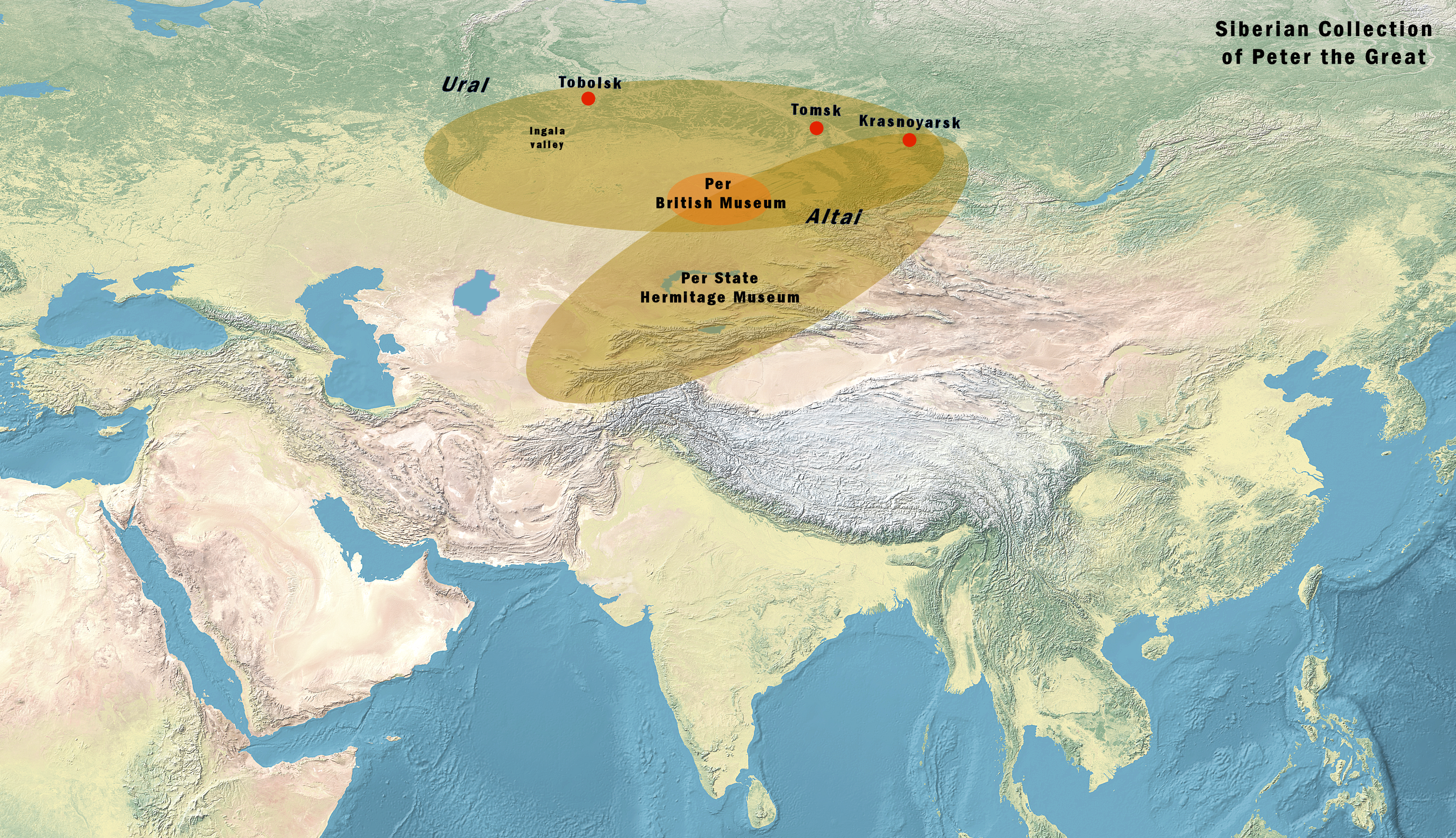
During the 18th century and the Russian expansion into Siberia, many Saka kurgans were plundered, sometimes by independent grave-robbers or sometimes officially at the instigation of Peter the Great, but usually without any archaeological records being taken. Only the general location where they were excavated is known, between modern Kazakhstan and the Altai Mountains.
Many of these artefacts were part of the archaeological presents sent by , Governor of Siberia based in Tobolsk, to Peter the Great in Saint-Petersburg in 1716. They are now located in the Hermitage Museum in Saint-Petersburg, and form the Siberian Collection of Peter the Great. Their estimated datation ranges from the 7th century BC to the 1st century BC, depending on the artefacts.
File:Siberian Collection of Peter the Great An aigrette. State Hermitage. Inv. Si 1727 1-131.jpg|Aigrette, 4th-3rd century BC. Siberian Collection of Peter the Great. Steppes horseman hunting.jpg|Boar hunter (Hermitage Museum), 2nd-1st century BC. File:Ингальская долина-3.jpg|Belt plaque from the Siberian collection of Peter the Great, probably Ingala Valley File:Siberian gold, Siberian Collection of Peter the Great.jpg|Siberian gold, Siberian Collection of Peter the Great
Tillia Tepe treasure (2nd-1st century BC)
Main article: Tillia Tepe
A site found in 1968 in Tillia Tepe (literally "the golden hill") in northern Afghanistan (former Bactria) near Shebergan consisted of the graves of five women and one man with extremely rich jewelry, dated to around the 1st century BC, and probably related to that of Saka tribes normally living slightly to the north. Altogether the graves yielded several thousands of pieces of fine jewelry, usually made from combinations of gold, turquoise and lapis-lazuli.
A high degree of cultural syncretism pervades the findings, however. Hellenistic cultural and artistic influences appear in many of the forms and human depictions (from amorini to rings with the depiction of Athena and her name inscribed in Greek), attributable to the existence of the Seleucid empire and Greco-Bactrian kingdom in the same area until around 140 BC, and the continued existence of the Indo-Greek kingdom in the northwestern Indian sub-continent until the beginning of our era. This testifies to the richness of cultural influences in the area of Bactria at that time.
Culture
Gender roles
Recently, evidence confirmed by the full-genomic analysis of a Scythian child's remains found in a coffin made of a larch trunk, which was discovered in Saryg-Bulun in Central Tuva, revealed that the individual, previously thought to be male because it had items that were associated with the belief that Scythian society was male-dominated, was actually female. Along with the leather skirt, the burial also contained a leather headdress painted with red pigment, a coat sewn from jerboa fur, a leather belt with bronze ornaments and buckles, a leather quiver with arrows with painted ornaments on the shafts, a fully-preserved battle pick, and a bow. These items provide valuable insights into the material culture and lifestyle of the Scythians, including their hunting and warfare practices, and their use of animal hides for clothing.
Art
The art of the Saka was of a similar styles as other Iranian peoples of the steppes, which is referred to collectively as Scythian art. In 2001, the discovery of an undisturbed royal Scythian burial-barrow at Arzhan illustrated Scythian animal-style gold that lacks the direct influence of Greek styles. Forty-four pounds of gold weighed down the royal couple in this burial, discovered near Kyzyl, capital of the Siberian republic of Tuva.
Ancient influences from and to Central Asia became identifiable in China following contacts of metropolitan China with nomadic western and northwestern border territories from the 8th century BC. The Chinese adopted the Scythian-style animal art of the steppes (descriptions of animals locked in combat), particularly the rectangular belt-plaques made of gold or bronze, and created their own versions in jade and steatite.
Following their expulsion by the Yuezhi, some Saka may also have migrated to the area of Yunnan in southern China. Saka warriors could also have served as mercenaries for the various kingdoms of ancient China. Excavations of the prehistoric art of the Dian civilisation of Yunnan have revealed hunting scenes of Caucasoid horsemen in Central Asian clothing.
Saka influences have been identified as far as Korea and Japan. Various Korean artifacts, such as the royal crowns of the kingdom of Silla, are said to be of "Scythian" design. Similar crowns, brought through contacts with the continent, can also be found in Kofun era Japan.
Clothing

Similar to other eastern Iranian peoples represented on the reliefs of the Apadana at Persepolis, Sakas are depicted as wearing long trousers, which cover the uppers of their boots. Over their shoulders they trail a type of long mantle, with one diagonal edge in back. One particular tribe of Sakas (the Saka tigraxaudā) wore pointed caps. Herodotus in his description of the Persian army mentions the Sakas as wearing trousers and tall pointed caps.

Men and women wore long trousers, often adorned with metal plaques and often embroidered or adorned with felt frs; trousers could have been wider or tight fitting depending on the area. Materials used depended on the wealth, climate and necessity.
Herodotus says Sakas had "high caps tapering to a point and stiffly upright." Asian Saka headgear is clearly visible on the Persepolis Apadana staircase bas-relief – high pointed hat with flaps over ears and the nape of the neck. From China to the Danube delta, men seemed to have worn a variety of soft headgear – either conical like the one described by Herodotus, or rounder, more like a Phrygian cap.
Saka women dressed in much the same fashion as men. A Pazyryk burial, discovered in the 1990s, contained the skeletons of a man and a woman, each with weapons, arrowheads, and an axe. Clothing was sewn from plain-weave wool, hemp cloth, silk fabrics, felt, leather and hides.

Pazyryk findings give the most almost fully preserved garments and clothing worn by the Scythian/Saka peoples. Ancient Persian bas-reliefs, inscriptions from Apadana and Behistun and archaeological findings give visual representations of these garments.
Based on the Pazyryk findings (can be seen also in the south Siberian, Uralic and Kazakhstan rock drawings) some caps were topped with zoomorphic wooden sculptures firmly attached to a cap and forming an integral part of the headgear, similar to the surviving nomad helmets from northern China. Men and warrior women wore tunics, often embroidered, adorned with felt applique work, or metal (golden) plaques.
Persepolis Apadana again serves a good starting point to observe the tunics of the Sakas. They appear to be a sewn, long-sleeved garment that extended to the knees and was girded with a belt, while the owner's weapons were fastened to the belt (sword or dagger, gorytos, battle-axe, whetstone etc.). Based on numerous archeological findings, men and warrior women wore long-sleeved tunics that were always belted, often with richly ornamented belts. The Kazakhstan Saka (e.g. Issyk Golden Man/Maiden) wore shorter and closer-fitting tunics than the Pontic steppe Scythians. Some Pazyryk culture Saka wore short belted tunic with a lapel on the right side, with upright collar, 'puffed' sleeves narrowing at the wrist and bound in narrow cuffs of a color different from the rest of the tunic.
Men and women wore coats: e.g. Pazyryk Saka had many varieties, from fur to felt. They could have worn a riding coat that later was known as a Median robe or Kantus. Long sleeved, and open, it seems that on the Persepolis Apadana Skudrian delegation is perhaps shown wearing such coat. The Pazyryk felt tapestry shows a rider wearing a billowing cloak.
Tattoos
Men and women of eastern saka are known to have been extensively tattooed. The men in the Pazyryk burials had extensive tattoos in the Siberian animal style.{{cite web|url=http://www.hermitagemuseum.org/html_En/03/hm3_2_7.html |archive-url=https://web.archive.org/web/20070622035146/http://www.hermitagemuseum.org/html_En/03/hm3_2_7.html}} A Pazyryk chief in burial mound 2, had his body covered in animal style tattoos, but not his face. Parts of the body had deteriorated, but much of the tattooing was still clearly visible. Subsequent investigation using reflected infrared photography revealed that all five bodies discovered in the Pazyryk kurgans were tattooed. No instruments specifically designed for tattooing were found, but the Pazyryks had extremely fine needles with which they did miniature embroidery, and these were probably used for tattooing. The chief was elaborately decorated with an interlocking series of striking designs representing a variety of fantastic beasts. The best preserved tattoos were images of a donkey, a mountain ram, two highly stylized deer with long antlers and an imaginary carnivore on the right arm. Two monsters resembling griffins decorate the chest, and on the left arm are three partially obliterated images which seem to represent two deer and a mountain goat. On the front of the right leg a fish extends from the foot to the knee. A monster crawls over the right foot, and on the inside of the shin is a series of four running rams which touch each other to form a single design. The left leg also bears tattoos, but these designs could not be clearly distinguished. In addition, the chief's back was tattooed with a series of small circles in line with the vertebral column. The Siberian Ice Maiden is also known for her extensive tattoos.
File:Pazyryk-2 tattoos.png|Tattoos of the Pazyryk-2 chief. File:Pazyryk tatoo design with zoomorphic symbols, 4th century BCE.jpg|Tattoos of the chief's right arm, with zoomorphic symbols. File:Pazyryk-2 man, back and left arm (circa 300 BCE).jpg|Tattoos of the chief's back and left arm. File:Tatoo motif on the arm of the Siberian Ice Maiden.png|Tattoo motif on the arm of the Siberian Ice Maiden.
Warfare
A skull from an Iron Age cemetery in South Siberia shows evidence of scalping. It lends physical evidence to the practice of scalp taking by the Scythians living there.
Later depictions of "Sakas" in China (1st–3rd century AD)
Numerous depictions of foreigners of Saka appearance appear in China around the Eastern Han period (25–220 AD), sometimes as far east as Shandong. They may have appeared in relation with the conflicts against the Scythoïd Xirong in the west or the Donghu people in the North, or the Kushans in the area of Xinjiang. They were generally called "Hu" by the Chinese.
File:Mingqi (Chinese funerary statuette) of a young western man, with scythian type caftan and conical hat reminiscent of early 3rd century CE Kushans. Later Han 3rd century CE. Guimet Museum (MA 4660).jpg|Mingqi (Chinese funerary statuette) of a young Central Asian man, with Saka-type caftan and conical hat reminiscent of early 3rd century AD Kushans. Later Han, 3rd century AD. Guimet Museum (MA 4660). File:Hu and Han war narratives. Eastern Han Dynasty (151–153 CE). Tsangshan Han tomb in Linyi city.png|Eastern Han tombs sometimes have depiction of battles between Hu barbarians, with bows and arrows and wearing pointed hats (left), against Han troops. Eastern Han Dynasty (151–153 AD). Tsangshan Han tomb in Linyi city. Also visible in Yinan tombs. File:Han monumental statues of Barbarian (山东发现的汉代大型胡人石雕像).png|General appearance of the numerous Scythoïd Hu monumental statues from Shandong, featuring people with a high nose, deep eyes and a pointed hat. Eastern Han period. File:Yinan battle scene, 2nd century CE, Eastern Han (Hu attack).png|Yinan tombs relief, depicting an attack by Hu barbarians with pointed hats, bow and arrows. 2nd century AD, Eastern Han. File:Hu statue columns from Wu Baizhuang 吳白莊 Han period tomb in Linyi, Shandong.jpg|Hu statue from Wu Baizhuang tomb (吳白莊), Han dynasty period, Linyi, Shandong. File:Hu statue with lion column from Wu Baizhuang 吳白莊 Han period tomb in Linyi, Shandong.jpg|Hu statue from Wu Baizhuang tomb (吳白莊), Han dynasty period, Linyi, Shandong. File:Foreigner hunting, circa 500 BCE, Gansu Museum.jpg|Man hunting, circa 500 BC, Gansu Museum.
References
Explanatory notes
Citations
Bibliography
- Akiner, Shirin (28 October 2013). Cultural Change & Continuity in Central Asia. Routledge. . .
- Bailey, H. W. 1958. "Languages of the Saka". Handbuch der Orientalistik, I. Abt., 4. Bd., I. Absch., Leiden-Köln. 1958.
- Bailey, H. W. (1979). Dictionary of Khotan Saka. Cambridge University Press. 1979. 1st Paperback edition 2010. .
- Beckwith, Christopher (1987). The Tibetan Empire in Central Asia. Princeton, NJ: Princeton University Press. .
- Bernard, P. (1994). "The Greek Kingdoms of Central Asia". In Harmatta, János. History of civilizations of Central Asia, Volume II. The development of sedentary and nomadic civilizations: 700 B.C. to A.D. 250. Paris: UNESCO. pp. 96–126. .
- Chang, Chun-shu (2007). The Rise of the Chinese Empire: Volume II; Frontier, Immigration, & Empire in Han China, 130 B.C. – A.D. 157. Ann Arbor: University of Michigan Press, .
- Davis-Kimball, Jeannine. 2002. Warrior Women: An Archaeologist's Search for History's Hidden Heroines. Warner Books, New York. 1st Trade printing, 2003. (pbk).
- Bulletin of the Asia Institute: The Archaeology and Art of Central Asia. Studies From the Former Soviet Union. New Series. Edited by B. A. Litvinskii and Carol Altman Bromberg. Translation directed by Mary Fleming Zirin. Vol. 8, (1994), pp. 37–46.
- Emmerick, R. E. (2003). "Iranian Settlement East of the Pamirs", in Ehsan Yarshater (ed), The Cambridge History of Iran, Vol III: The Seleucid, Parthian, and Sasanian Periods, Part 1 (reprint edition) Cambridge: Cambridge University Press, pp 265–266.
- Fraser, Antonia (1989). The Warrior Queens Knopf.
- Hill, John E. (2004). The Peoples of the West from the Weilue 魏略 by Yu Huan 魚豢*: A Third Century Chinese Account Composed between 239 and 265 CE.* Draft annotated English translation.
- Hill, John E. (2009). Through the Jade Gate to Rome: A Study of the Silk Routes during the Later Han Dynasty, 1st to 2nd centuries CE. John E. Hill. BookSurge, Charleston, South Carolina. .
- Loewe, Michael. (1986). "The Former Han Dynasty," in The Cambridge History of China: Volume I: the Ch'in and Han Empires, 221 B.C. – A.D. 220, 103–222. Edited by Denis Twitchett and Michael Loewe. Cambridge: Cambridge University Press. .
- Millward, James A. (2007). Eurasian Crossroads: A History of Xinjiang (illustrated ed.). Columbia University Press. .
- Pulleyblank, Edwin G. (1970). "The Wu-sun and Sakas and the Yüeh-chih Migration." Bulletin of the School of Oriental and African Studies 33 (1970), pp. 154–160.
- Puri, B. N. (1994). "The Sakas and Indo-Parthians." In: History of civilizations of Central Asia, Volume II. The development of sedentary and nomadic civilizations: 700 B.C. to A.D. 250. Harmatta, János, ed., 1994. Paris: UNESCO Publishing, pp. 191–207.
- Sulimirski, Tadeusz (1970). The Sarmatians. Volume 73 of Ancient peoples and places. New York: Praeger. pp. 113–114. "The evidence of both the ancient authors and the archaeological remains point to a massive migration of Sacian (Sakas)/Massagetan tribes from the Syr Daria Delta (Central Asia) by the middle of the second century B.C. Some of the Syr Darian tribes; they also invaded North India."
- Theobald, Ulrich. (26 November 2011). "Chinese History – Sai 塞 The Saka People or Soghdians." ChinaKnowledge.de. Accessed 2 September 2016.
- Thomas, F. W. (1906). "Sakastana." Journal of the Royal Asiatic Society (1906), pp. 181–216.
- Torday, Laszlo. (1997). Mounted Archers: The Beginnings of Central Asian History. Durham: The Durham Academic Press, .
- Tremblay, Xavier (2007). "The Spread of Buddhism in Serindia: Buddhism Among Iranians, Tocharians and Turks before the 13th Century", in The Spread of Buddhism, eds Ann Heirman and Stephan Peter Bumbacker, Leiden: Koninklijke Brill.
- Wechsler, Howard J.; Twitchett, Dennis C. (1979). Denis C. Twitchett; John K. Fairbank, eds. The Cambridge History of China, Volume 3: Sui and T'ang China, 589–906, Part I. Cambridge University Press. pp. 225–227. .
- Xue, Zongzheng (薛宗正). (1992). History of the Turks (突厥史). Beijing: Zhongguo shehui kexue chubanshe. ; OCLC 28622013.
- Yu, Taishan (1998). A Study of Saka History. Sino-Platonic Papers No. 80. July 1998. Dept. of Asian and Middle Eastern Studies, University of Pennsylvania.
- Yu, Taishan (2000). A Hypothesis about the Source of the Sai Tribes. Sino-Platonic Papers No. 106. September 2000. Dept. of Asian and Middle Eastern Studies, University of Pennsylvania.
- Yü, Ying-shih (1986). "Han Foreign Relations," in The Cambridge History of China: Volume I: the Ch'in and Han Empires, 221 B.C. – A.D. 220, 377–462. Edited by Denis Twitchett and Michael Loewe. Cambridge: Cambridge University Press. .
References
- (1995). "Nomads of the Eurasian Steppes in the Early Iron Age". Zinat Press.
- (2002). "Atlas of World History". Oxford University Press.
- (2021). "The European Handbook of Central Asian Studies". BoD – Books on Demand.
- (1997). "Atlas of world history". New York : Barnes & Noble Books.
- (2017). "Rethinking Prehistoric Central Asia: Shepherds, Farmers, and Nomads". Routledge.
- (2002). "Early Buddhist art of China and Central Asia". Brill.
- {{harvnb. Beckwith. 2009
- {{harvnb. Dandamayev. 1994
- {{harvnb. Unterländer. Palstra. Lazaridis. Pilipenko. 2017: "During the first millennium BC, nomadic people spread over the Eurasian Steppe from the Altai Mountains over the northern Black Sea area as far as the Carpathian Basin... Greek and Persian historians of the 1st millennium BCE chronicle the existence of the Massagetae and Sauromatians, and later, the Sarmatians and Sacae: cultures possessing artefacts similar to those found in classical Scythian monuments, such as weapons, horse harnesses and a distinctive 'Animal Style' artistic tradition. Accordingly, these groups are often assigned to the Scythian culture..."
- Gnecchi-Ruscone, Guido Alberto. (26 March 2021). "Ancient genomic time transect from the Central Asian Steppe unravels the history of the Scythians". Science Advances.
- (April 2022). "Bronze and Iron Age population movements underlie Xinjiang population history". Science.
- {{harvnb. David. McNiven. 2018: "Horse-riding nomadism has been referred to as the culture of 'Early Nomads'. This term encompasses different ethnic groups (such as Scythians, Saka, Massagetae, and Yuezhi)..."
- {{harvnb. Diakonoff. 1985: the Persians called "Saka" all the northern nomads, just as the Greeks called them "Scythians", and the Babylonians "Cimmerians".
- (2007). "Chronology of Key Barrows Belonging to Different Stages of the Scythian Period in Tuva (Arzhan-1 and Arzhan-2 Barrows)". Radiocarbon.
- (1 September 2018). "Tunnug 1 (Arzhan 0) – an early Scythian kurgan in Tuva Republic, Russia". Archaeological Research in Asia.
- (2001). "Dendrochronology and Radiocarbon Dating Methods in Archaeological Studies of Scythian Sites". Radiocarbon.
- (2013). "Radiocarbon and Tree-Ring Dates of the Bes-Shatyr #3 Saka Kurgan in the Semirechiye, Kazakhstan". Radiocarbon.
- (1 October 2016). "Dromos Burials of Tasmola Culture in Central Kazakhstan". The Anthropologist.
- Benjamin, Craig. (March 2003). "The Yuezhi Migration and Sogdia". Ērān ud Anērān Webfestschrift Marshak.
- "Chinese History – Sai 塞 The Saka People or Soghdians".
- {{harvnb. Beckwith. 2009
- Szemerényi, Oswald. (1980). "Four old Iranian ethnic names: Scythian – Skudra – Sogdian – Saka". [[:de:Verlag der Österreichischen Akademie der Wissenschaften.
- West, Stephanie. (2002). "Brill's Companion to Herodotus". [[Brill Publishers.
- Guang-da, Zhang. (1999). "History of Civilizations of Central Asia Volume III: The crossroads of civilizations: AD 250 to 750". UNESCO.
- H. W. Bailey. (7 February 1985). "Indo-Scythian Studies: Being Khotanese Texts". Cambridge University Press.
- Callieri, Pierfrancesco. (2016). "SAKAS: IN AFGHANISTAN".
- Jacobson, Esther. (1995). "The art of the Scythians: the interpenetration of cultures at the edge of the Hellenic world". Brill.
- Kramrisch, Stella. "Central Asian Arts: Nomadic Cultures".
- Schmitt, Rüdiger. (2003). "HAUMAVARGĀ".
- {{harvnb. Olbrycht. 2021: "Apparently the Dahai represented an entity not identical with the other better known groups of the Sakai, i.e. the Sakai (Sakā) tigrakhaudā (Massagetai, roaming in Turkmenistan), and Sakai (Sakā) Haumavargā (in Transoxania and beyond the Syr Daryā)."
- Schmitt, Rüdiger. (2003). "HAUMAVARGĀ".
- (1989). "The Culture and Social Institutions of Ancient Iran". [[Cambridge University Press]].
- Briant, Pierre. (29 July 2006). "From Cyrus to Alexander: A History of the Persian Empire". [[Eisenbrauns]].
- Bivar, A. D. H.. (1983). "The Cambridge History of Iran". [[Cambridge University Press]].
- (1994). "History of Civilizations of Central Asia". [[UNESCO]].
- Zadneprovskiy, Y. A.. (1994). "History of Civilizations of Central Asia". [[UNESCO]].
- L. T. Yablonsky. (15 June 2010). "ARCHAEOLOGY – Volume I". EOLSS.
- Tokhtas'ev, Sergei R.. (1991). "Cimmerians".
- (16 March 2015). "Global Connections: Volume 1, To 1500: Politics, Exchange, and Social Life in World History". Cambridge University Press.
- (28 February 2023). "Жазба Және Археологиялық Деректер Негізінде Савромат-Сармат Тайпаларының Шығу Тегі". BULLETIN Series Historical and Socio-political Sciences.
- {{harvnb. Krzewińska. 2018
- {{harvnb. Unterländer. Palstra. Lazaridis. Pilipenko. 2017 "The origin of the widespread Scythian culture has long been debated in Eurasian archaeology. The northern Black Sea steppe was originally considered the homeland and centre of the Scythians until Terenozhkin formulated the hypothesis of a Central Asian origin. On the other hand, evidence supporting an east Eurasian origin includes the kurgan Arzhan 1 in Tuva, which is considered the earliest Scythian kurgan. Dating of additional burial sites situated in east and west Eurasia confirmed eastern kurgans as older than their western counterparts. Additionally, elements of the characteristic 'Animal Style' dated to the tenth century BCE were found in the region of the Yenisei river and modern-day China, supporting the early presence of Scythian culture in the East."
- (22 July 2019). "Shifts in the Genetic Landscape of the Western Eurasian Steppe Associated with the Beginning and End of the Scythian Dominance". Current Biology.
- {{harvnb. Järve. 2019. "The Early Iron Age nomadic Scythians have been described as a confederation of tribes of different origins, based on ancient DNA evidence [1, 2, 3]. All samples of this study also possessed at least one additional eastern component, one of which was nearly at 100% in modern Nganasans (orange) and the other in modern Han Chinese (yellow; Figure S2). The eastern components were present in variable proportions in the samples of this study."
- (7 May 2020). "Early nomads of the Eastern Steppe and their tentative connections in the West". Evolutionary Human Sciences.
- {{harvnb. de Laet. Herrmann. 1996
- {{harvnb. Kuzmina. 2008
- {{harvnb. Kuzmina. 2007
- {{harvnb. Harmatta. 1996
- (7 May 2020). "Early nomads of the Eastern Steppe and their tentative connections in the West". Evolutionary Human Sciences.
- McNeill, William H.. "The Steppe – Scythian successes".
- According to Donald N. Wilber's book ''Persepolis, The Archaeology of Parsa, Seat of the Persian Kings'', the group depicted in this panel is "the Saka tigrakhauda (Pointed-hat Scythians). All are armed and wear the appropriate headgear. They are accompanied by a horse, and offer a bracelet and folded coats and trousers, apparently copies of their own costumes."
- J. P. mallory. "Bronze Age Languages of the Tarim Basin". Penn Museum.
- Schmitt, Rüdiger. (2000). "ZARINAIA".
- Mayor, Adrienne. (2014). "The Amazons: Lives and Legends of Warrior Women across the Ancient World". [[Princeton University Press]].
- Gera, Deborah Levine. (2018). "Warrior Women: The Anonymous Tractatus De Mulieribus". [[Brill Publishers.
- Mayor, Adrienne. (2014). "The Amazons: Lives and Legends of Warrior Women across the Ancient World". [[Princeton University Press]].
- Kuhrt, Amélie. (2013). "The Persian Empire: A Corpus of Sources from the Achaemenid Period". [[Routledge]].
- Schmitt, Rüdiger. (1989). "AMORGES".
- Shahbazi, A. Shapur. (1989). "DARIUS iii. Darius I the Great".
- Cunliffe, Barry. (24 September 2015). "By Steppe, Desert, and Ocean: The Birth of Eurasia". Oxford University Press.
- {{harvnb. Dandamayev. 1994
- De Jong, Albert. (1997). "Traditions of the Magi: Zoroastrianism in Greek and Latin Literature". [[BRILL]].
- {{harvnb. Francfort. 1988. en. kurgans II and V of Pazyryk and of Xinyuan and Alagou in Xinjiang).
- {{harvnb. Sinor. 1990
- Loewe, Michael. (1986). "The Former Han Dynasty," in ''The Cambridge History of China: Volume I: The Ch'in and Han Empires, 221 B.C. – A.D. 220'', 103–222. Edited by Denis Twitchett and Michael Loewe. Cambridge: Cambridge University Press, pp 197–198. {{ISBN. 978-0-521-24327-8.
- Yü, Ying-shih. (1986). "Han Foreign Relations," in ''The Cambridge History of China: Volume I: The Ch'in and Han Empires, 221 B.C. – A.D. 220'', 377–462. Edited by Denis Twitchett and Michael Loewe. Cambridge: Cambridge University Press, pp 410–411. {{ISBN. 978-0-521-24327-8.
- Windfuhr, Gernot. (2013). "Iranian Languages". Routledge.
- Emmerick, R. E.. (14 April 1983). "The Cambridge History of Iran, Vol III: The Seleucid, Parthian, and Sasanian Periods, Part 1". Cambridge University Press; Reissue edition.
- Xue, Zongzheng (薛宗正). (1992). History of the Turks (突厥史). Beijing: Zhongguo shehui kexue chubanshe, p. 596-598. {{ISBN. 978-7-5004-0432-3; OCLC 28622013
- Beckwith, Christopher. (1987). The Tibetan Empire in Central Asia. Princeton, NJ: Princeton University Press, pp 36, 146. {{ISBN. 0-691-05494-0.
- Wechsler, Howard J.; Twitchett, Dennis C. (1979). Denis C. Twitchett; John K. Fairbank, eds. ''The Cambridge History of China, Volume 3: Sui and T'ang China, 589–906, Part I''. Cambridge University Press. pp. 225–227. {{ISBN. 978-0-521-21446-9.
- Hansen, Valerie. (2005). "The Tribute Trade with Khotan in Light of Materials Found at the Dunhuang Library Cave". Bulletin of the Asia Institute.
- Ulrich Theobald. (16 October 2011). "[http://www.chinaknowledge.de/History/Altera/citystates.html#yutian City-states Along the Silk Road]." ''ChinaKnowledge.de''. Accessed 2 September 2016.
- Xavier Tremblay, "The Spread of Buddhism in Serindia: Buddhism Among Iranians, Tocharians and Turks before the 13th Century", in ''The Spread of Buddhism'', eds Ann Heirman and Stephan Peter Bumbacker, Leiden: Koninklijke Brill, 2007, p. 77.
- Lurje, Pavel. (2009). "YARKAND".
- Whitfield 2004, p. 47.
- Wechsler, Howard J.; Twitchett, Dennis C. (1979). Denis C. Twitchett; John K. Fairbank, eds. The Cambridge History of China, Volume 3: Sui and T'ang China, 589–906, Part I. Cambridge University Press. pp. 225–228. {{ISBN. 978-0-521-21446-9.
- (2010). "Islamic Central Asia: An Anthology of Historical Sources". Indiana University Press.
- (1996). "History of Civilizations of Central Asia: The crossroads of civilizations, A.D. 250 to 750". UNESCO.
- Akiner. (28 October 2013). "Cultural Change & Continuity In". Routledge.
- (2022). "Splendeurs des oasis d'Ouzbékistan". Louvre Editions.
- {{harvnb. Baumer. 2012
- (2000). "''The Tarim Mummies: Ancient China and the Mystery of the Earliest Peoples from the West''". Thames & Hudson. London.
- Torday, Laszlo. (1997). ''Mounted Archers: The Beginnings of Central Asian History''. Durham: The Durham Academic Press, pp. 80–81, {{ISBN. 978-1-900838-03-0.
- Yü, Ying-shih. (1986). "Han Foreign Relations," in ''The Cambridge History of China: Volume I: the Ch'in and Han Empires, 221 BC – A.D. 220'', 377–462. Edited by Denis Twitchett and Michael Loewe. Cambridge: Cambridge University Press, pp. 377–388, 391, {{ISBN. 978-0-521-24327-8.
- Chang, Chun-shu. (2007). The Rise of the Chinese Empire: Volume II; Frontier, Immigration, & Empire in Han China, 130 BC – AD 157. Ann Arbor: University of Michigan Press, pp. 5–8 {{ISBN. 978-0-472-11534-1.
- {{harvnb. Di Cosmo. 2002
- {{harvnb. Di Cosmo. 2004
- {{harvnb. Di Cosmo. 2002
- Yu Taishan (June 2010), "The Earliest Tocharians in China" in Victor H. Mair (ed), ''Sino-Platonic Papers'', Chinese Academy of Social Sciences, University of Pennsylvania Department of East Asian Languages and Civilizations, pp. 13–14, 21–22.
- Benjamin, Craig. "The Yuezhi Migration and Sogdia".
- {{harvnb. Yu. 2010: "The Daxia 大夏 people in the valley of the Amu Darya came from the valleys of the rivers Ili and Chu. From the {{transliteration. en. Geography of Strabo one can infer that the four tribes of the Asii and others came from these valleys (the so-called "land of the Sai 塞" in the {{transliteration. zh. Hanshu 漢書, ch. 96A). "
- Bernard, P. (1994). "The Greek Kingdoms of Central Asia". In Harmatta, János. ''History of Civilizations of Central Asia, Volume II. The development of sedentary and nomadic civilizations: 700 B.C. to A.D. 250''. Paris: UNESCO. pp. 96–126. {{ISBN. 92-3-102846-4.
- Grousset, Rene. (1970). "The Empire of the Steppes". Rutgers University Press.
- {{harvnb. Baumer. 2012
- (2012). "Possible Iranian Origins for the Śākyas and Aspects of Buddhism". Journal of the Oxford Centre for Buddhist Studies.
- Beckwith, Christopher I.. (2015). "Greek Buddha: Pyrrho's Encounter with Early Buddhism in Central Asia". Princeton University Press.
- (2014). "Cultural Remnants of the Indigenous Peoples in the Buddhist Scriptures". Buddhist Studies Review.
- (2007). "Nomad Migration in Central Asia (in After Alexander: Central Asia before Islam)". Proceedings of the British Academy.
- Foundation, Encyclopaedia Iranica. "Welcome to Encyclopaedia Iranica".
- "Also a Saka according to this source".
- Sulimirski, Tadeusz. (1970). "The Sarmatians". Praeger.
- Bivar, A. D. H.. "KUSHAN DYNASTY i. Dynastic History".
- Rishi, Weer Rajendra. (1982). "India & Russia: linguistic & cultural affinity". Roma.
- Mitchiner, Michael. (1978). "The ancient & classical world, 600 B.C.-A.D. 650". Hawkins Publications; distributed by B. A. Seaby.
- "Strabo, Geography, 11.8.1". Perseus.tufts.edu.
- Kuz'mina, Elena E. (2007). ''The Origin of the Indo Iranians''. Edited by J.P. Mallory. Leiden, Boston: Brill, pp 381–382. {{ISBN. 978-90-04-16054-5.
- Hansen, Valerie. (2005). "The Tribute Trade with Khotan in Light of Materials Found at the Dunhuang Library Cave". Bulletin of the Asia Institute.
- Sarah Iles Johnston, Religions of the Ancient World: A Guide, Harvard University Press, 2004. pg 197
- Edward A Allworth,''Central Asia: A Historical Overview'', Duke University Press, 1994. pp 86.
- Litvinsky, Boris Abramovich. (1999). "Religions and religious movements". Motilal Banarsidass.
- "Encolypedia Iranica, AFGHANISTAN vi. Pastö".
- (1946). "Indo-Iranica". Iran Society.
- Becka. Jiriltitle=A Study in Pashto Stress. Academia. (1969)
- Cheung, Jonny. (2007). "Etymological Dictionary of the Iranian Verb". (Leiden Indo-European Etymological Dictionary Series).
- Cheung, Jonny. "Etymological dictionary of the Iranian verb". (Leiden Indo-European Etymological Dictionary Series)year=2007.
- (18 April 2018). "History of Central Asia, The: 4-volume set". Bloomsbury Publishing.
- (1984). "The History of Ancient Iran". C.H.Beck.
- (1982). "The culture of the Sakas in ancient Iranian Khotan". Caravan Books.
- (2013). "Iranian Languages". Routeledge.
- (2001). "Early Contacts Between Uralic and Indo-European: Linguistic and Archaeological Considerations: Papers Presented at an International Symposium Held at the Tvärminne Research Station of the University of Helsinki, 8–10 January, 1999". Suomalais-Ugrilainen Seura.
- (2014). "Question of (Re)classification of Eastern Iranian Languages". Linguistica Brunensia.
- Clisson, I.. (2002). "Genetic analysis of human remains from a double inhumation in a frozen kurgan in Kazakhstan (Berel site, early 3rd century BC).". International Journal of Legal Medicine.
- Ricaut F.. (2004). "Genetic Analysis of a Scytho-Siberian Skeleton and Its Implications for Ancient Central Asian Migrations". Human Biology.
- Ricaut, F.. (2004). "Genetic Analysis and Ethnic Affinities From Two Scytho-Siberian Skeletons". American Journal of Physical Anthropology.
- (2016). "Legal bid fails to rebury remains of 2,500 year old tattooed 'ice princess'". The Siberian Times.
- (2012). "Tracing the Origin of the East-West Population Admixture in the Altai Region (Central Asia)". PLOS ONE.
- {{harvnb. Unterländer. 2017
- (September 2009). "Ancient DNA provides new insights into the history of south Siberian Kurgan people". Human Genetics.
- (May 2018). "137 ancient human genomes from across the Eurasian steppes". Nature.
- {{harvnb. Tikhonov. Gurkan. Peler. Dyakonov. 2019
- (2020). "АНТРОПОЛОГИЧЕСКАЯ РЕКОНСТРУКЦИЯ ВНЕШНЕГО ОБЛИКА "ЦАРЯ" И "ЦАРИЦЫ" РАННЕСКИФСКОГО ПОГРЕБАЛЬНО-ПОМИНАЛЬНОГО КОМПЛЕКСА АРЖАН-2". Вестник археологии, антропологии и этнографии.
- (May 2018). "137 ancient human genomes from across the Eurasian steppes". Nature.
- (April 2022). "Bronze and Iron Age population movements underlie Xinjiang population history". Science.
- (28 July 2021). "Genetic Continuity of Bronze Age Ancestry with Increased Steppe-Related Ancestry in Late Iron Age Uzbekistan". Molecular Biology and Evolution.
- Gnecchi-Ruscone, Guido Alberto. (26 March 2021). "Ancient genomic time transect from the Central Asian Steppe unravels the history of the Scythians". Science Advances.
- (9 November 2012). "Tracing the Origin of the East-West Population Admixture in the Altai Region (Central Asia)". PLOS ONE.
- Maróti, Zoltán. (2022-07-11). "The genetic origin of Huns, Avars, and conquering Hungarians". Current Biology.
- (2019). "On The Genetic Continuity of the Iron Age Pazyryk Culture: Geographic Distributions of the Paternal and Maternal Lineages from the Ak-Alakha-1 Burial". International Journal of Human Genetics.
- (25 August 2022). "The Genetic Echo of the Tarim Mummies in Modern Central Asians". Molecular Biology and Evolution.
- Gurkan, Cemal. (8 January 2019). "On The Genetic Continuity of the Iron Age Pazyryk Culture: Geographic Distributions of the Paternal and Maternal Lineages from the Ak-Alakha-1 Burial". International Journal of Human Genetics.
- (January 2023). "Extensive ethnolinguistic diversity at the crossroads of North China and South Siberia reflects multiple sources of genetic diversity". Journal of Systematics and Evolution.
- (July 2019). "Shifts in the Genetic Landscape of the Western Eurasian Steppe Associated with the Beginning and End of the Scythian Dominance". Current Biology.
- (22 July 2019). "Shifts in the Genetic Landscape of the Western Eurasian Steppe Associated with the Beginning and End of the Scythian Dominance". Current Biology.
- (2010). "New Excavations of the Early Nomadic Burial Ground at Filippovka (Southern Ural Region, Russia)". American Journal of Archaeology.
- (2017). "Reconstruction of Female Costume From the Elite Burial Ground Taksay-I: a View of the Archaeology.". Povolzhskaya Arkheologiya (The Volga River Region Archaeology).
- (23 July 2017). "Golden Man from Shilikty and Golden Woman from Taksai". Nur-sultan - National Museum of the Republic of Kazakhstan.
- Alekseev A.Yu. et al., ''"Chronology of Eurasian Scythian Antiquities Born by New Archaeological and 14C Data"'', © 2001 by the Arizona Board of Regents on behalf of the University of Arizona, ''Radiocarbon'', Vol .43, No 2B, 2001, p 1085-1107 Fig.6
- (2023). "The Saka 'Animal Style' in Context: Material, Technology, Form and Use". Arts.
- (2002). "Images du combat contre le sanglier en Asie centrale (3 ème au 1 er millénaire av. J.-C.)". Bulletin of the Asia Institute.
- (2004). "Impact of the Environment on Human Migration in Eurasia". Kluwer Academic.
- (2004). "Impact of the Environment on Human Migration in Eurasia". Kluwer Academic.
- (2004). "Impact of the Environment on Human Migration in Eurasia". Kluwer Academic.
- (2005). ""Roter Altai, gib dein Echo!" Festschrift für Erika Taube zum 65. Geburtstag". Leipziger Universitätsverlag.
- (1 January 2013). "Royal Mound Baygetobe from the Burial Ground Shilikty". International Journal of Social, Behavioral, Educational, Economic, Business and Industrial Engineering.
- (March 2016). "Calendar Age of the Baigetobe Kurgan from the Iron Age Saka Cemetery in Shilikty Valley, Kazakhstan". Radiocarbon.
- (2002). "Images du combat contre le sanglier en Asie centrale (3 ème au 1 er millénaire av. J.-C.)". Bulletin of the Asia Institute.
- (2016). "THE "GOLDEN PEOPLE" OF KAZAKHSTAN". World Science.
- (2005). "Impact of the Environment on Human Migration in Eurasia". Springer Netherlands.
- Man, John. (2020). "Empire of Horses: The First Nomadic Civilization and the Making of China". Pegasus Books.
- "850 gold artefacts belonging to the Scythian-Saka era found in Kazakhstan".
- "Wikimapia - Let's describe the whole world!".
- (12 March 2012). "Artifacts Show Sophistication of Ancient Nomads". [[The New York Times]].
- Dr. Aaron Ralby. (2013). "Atlas of Military History". Parragon.
- Сергей Иванович Руденко (Sergei I. Rudenko). (1970). "Frozen Tombs of Siberia: The Pazyryk Burials of Iron Age Horsemen". University of California Press.
- "Chariot". Hermitage Museum.
- (1 January 2017). "Scythians: warriors of ancient Siberia". British Museum.
- (July 2018). "Presenting the Warrior Iron Age Scythian Materials and Gender Identity at the British Museum American Journal of Archaeology". American Journal of Archaeology.
- (July 2018). "Presenting the Warrior Iron Age Scythian Materials and Gender Identity at the British Museum, American Journal of Archaeology".
- (19 August 2019). "Museum notice".
- (21 January 2021). "Masters of the Steppe: The Impact of the Scythians and Later Nomad Societies of Eurasia: Proceedings of a conference held at the British Museum, 27-29 October 2017". Archaeopress Publishing Ltd.
- (21 January 2021). "Masters of the Steppe: The Impact of the Scythians and Later Nomad Societies of Eurasia: Proceedings of a conference held at the British Museum, 27-29 October 2017". Archaeopress Publishing Ltd.
- (1 January 2017). "Scythians: warriors of ancient Siberia". British Museum.
- New Kilunovskaya, M. E., Semenov, V. A., Busova, V. S., Mustafin, Kh. Kh., Alborova, I. E., & Matzvai, A. D. (2018). The Unique Burial of a Child of Early Scythian Time at the Cemetery of Saryg-Bulun (Tuva). Archaeology, Ethnology and Anthropology of Eurasia, 46(3), 379–406.
- Mallory and Mair, ''The Tarim Mummies: Ancient China and the Mystery of the Earliest Peoples from the West'', 2000
- "Les Saces", Iaroslav Lebedynsky, p.73 {{ISBN. 2-87772-337-2
- Crowns similar to the Scythian ones discovered in [[Tillia Tepe]] "appear later, during the 5th and 6th century at the eastern edge of the Asia continent, in the [[tumulus]] tombs of the Kingdom of Silla, in South-East Korea. "Afghanistan, les trésors retrouvés", 2006, p282, {{ISBN. 978-2-7118-5218-5
- "金冠塚古墳 – Sgkohun.world.coocan.jp".
- (2013). "A Contextual Explanation for "Foreign" or "Steppic" Factors Exhibited in Burials at the Majiayuan Cemetery and the Opening of the Tianshan Mountain Corridor". Asian Archaeology.
- "Clothing v. In Pre-Islamic Eastern Iran". Encyclopaedia Iranica.
- "Metropolitan Museum of Art".
- (19 December 2019). "The Cultures of Ancient Xinjiang, Western China: Crossroads of the Silk Roads". Archaeopress Publishing Ltd.
- Yi-Chang, Youngsoo. (2016). "The Study on the Scythian Costume III -Focaused on the Scythian of the Pazyryk region in Altai-". Korea Institute of Science and Technology.
- link. (12 October 2012 Retrieved 27 June 2012)
- (Autumn 2013). "From wooden attendants to terracotta warriors". Neue Zürcher Zeitung.
- (January 2023). "Sino-Western Cultural Exchange as Seen through the Archaeology of the First Emperor's Necropolis". Journal of Chinese History.
- (April 2017). "China and the steppe: reception and resistance". Antiquity.
- (1 January 2017). "Scythians: warriors of ancient Siberia". British Museum.
- (2005). "Tattooed Mummies From The Large Pazyryk Mounds: New findings". Archaeology, Ethnology and Anthropology of Eurasia.
- (1 January 2017). "Scythians: warriors of ancient Siberia". British Museum.
- (2012). "Siberian Princess reveals her 2,500 year old tattoos". The Siberian Times.
- (1 January 2017). "Scythians: warriors of ancient Siberia". British Museum.
- (2002). "Prehistoric Old World Scalping: New Cases from the Cemetery of Aymyrlyg, South Siberia". American Journal of Archaeology.
- (2021). "Tadjikistan: au pays des fleuves d'or". Musée Guimet, Editions Snoeck.
- (2019). "Stone Reliefs of the Han Tombs in Shandong Province: Relationship Between Motifs and Composition". Advances in Social Science, Education and Humanities Research.
- (2017). "山东发现的汉代大型胡人石雕像再研究". 美术研究 (Art Research).
- (2019). "Stone Reliefs of the Han Tombs in Shandong Province: Relationship Between Motifs and Composition". Advances in Social Science, Education and Humanities Research.
- (2023). "The hybrid origin of the dragon-wrapped column in Han dynasty China". Journal of Asian Architecture and Building Engineering.
- "线刻射猎纹骨管".


This article was imported from Wikipedia and is available under the Creative Commons Attribution-ShareAlike 4.0 License. Content has been adapted to SurfDoc format. Original contributors can be found on the article history page.
Ask Mako anything about Saka — get instant answers, deeper analysis, and related topics.
Research with MakoFree with your Surf account
Create a free account to save articles, ask Mako questions, and organize your research.
Sign up freeThis content may have been generated or modified by AI. CloudSurf Software LLC is not responsible for the accuracy, completeness, or reliability of AI-generated content. Always verify important information from primary sources.
Report