From Surf Wiki (app.surf) — the open knowledge base
Saguenay flood
1996 flash flood that hit Saguenay-Lac-Saint-Jean region of Quebec, Canada
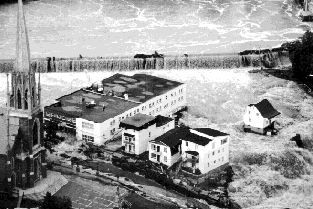
1996 flash flood that hit Saguenay-Lac-Saint-Jean region of Quebec, Canada
| Field | Value |
|---|---|
| image | Maison Blanche Saguenay.jpg |
| caption | The "little white house" at Saguenay, in 2008. |
The Saguenay flood () was a series of flash floods on July 19 and 20, 1996 that hit the Saguenay–Lac-Saint-Jean region of Quebec, Canada. It was the biggest overland flood in 20th-century Canadian history.
History
Problems started after two weeks of constant rain, which severely engorged soils, rivers and reservoirs. The Saguenay region is a geological graben, which increased the effect of the sudden massive rains of July 19, 1996. In two days, rainfall accumulated that was "equivalent to the volume of water that tumbles over Niagara Falls in four weeks."{{cite magazine |url=http://www.canadiangeographic.ca/magazine/ma97/feature_saguenay_floods.asp |title=The Saguenay flood: After the deluge |magazine=Canadian Geographic |issue=2, March/April |year=1997 |archive-url=https://web.archive.org/web/20101206152731/http://canadiangeographic.ca/magazine/ma97/feature_saguenay_floods.asp |archive-date=2010-12-06

Over 8 ft of water flooded parts of Chicoutimi and La Baie, completely levelling an entire neighbourhood. Estimates reach in damages, a cost made greater by the disaster's occurrence at the height of the tourist season. Post-flood enquiries discovered that the network of dikes and dams protecting the city of Chicoutimi was poorly maintained. In the end, 488 homes were destroyed, 1,230 damaged, 16,000 people evacuated, and 10 people died. An additional 2 people died in the mudslides produced by the incredible rain.
Legacy
A small white house (referred to in French as La petite maison blanche, "The little white house") stood nearly unharmed in Chicoutimi while torrents of water rushed in on every side, and it became the symbol of surviving the flood. It was owned by Jeanne d'Arc Lavoie-Genest. With its foundation still highly exposed after the flooding, it has been preserved in Saguenay (the city name has changed) as a historical park and museum commemorating the flood.
An unexpected effect of the flood was to cover the heavily contaminated sediments at the bottom of the Saguenay and Ha! Ha! Rivers with 10 to of new, relatively clean sediments. Because of this, research has shown that the old sediments are no longer a threat to ecosystems and the river will not have to be dredged and treated to control contamination.
The Ha! Ha! Pyramid was created to memorialise the flood.
References
References
- (2006-02-14). "Saguenay Flood – July 1996". [[Library and Archives Canada]].
- "Musée de la Petite Maison Blanche". Musée de la Petite Maison Blanche.
- (2002-09-03). "Projet de recherche". [[Université Laval]].
This article was imported from Wikipedia and is available under the Creative Commons Attribution-ShareAlike 4.0 License. Content has been adapted to SurfDoc format. Original contributors can be found on the article history page.
Ask Mako anything about Saguenay flood — get instant answers, deeper analysis, and related topics.
Research with MakoFree with your Surf account
Create a free account to save articles, ask Mako questions, and organize your research.
Sign up freeThis content may have been generated or modified by AI. CloudSurf Software LLC is not responsible for the accuracy, completeness, or reliability of AI-generated content. Always verify important information from primary sources.
Report