From Surf Wiki (app.surf) — the open knowledge base
Sagaing Region
Region of Myanmar

Region of Myanmar
| Field | Value |
|---|---|
| name | Sagaing Region |
| native_name | စစ်ကိုင်းတိုင်းဒေသကြီး |
| native_name_lang | my |
| settlement_type | Region |
| translit_lang1 | Myanma |
| translit_lang1_type | Burmese |
| translit_lang1_info | cac kuing: tuing: desa. kri: |
| image_skyline | Sagaing, Myanmar.jpg |
| image_flag | Flag of Sagaing Region (2019).svg |
| image_blank_emblem | Logo of Sagaing Region Government.svg |
| blank_emblem_size | 90px |
| blank_emblem_type | Seal |
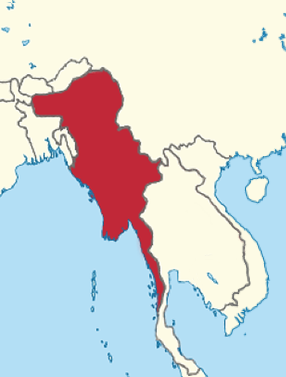
| image_map | Sagaing Region in Myanmar.svg |
| mapsize | 200px |
| map_caption | Location of Sagaing Region in Myanmar |
| pushpin_map | |
| coordinates | |
| subdivision_type | Country |
| subdivision_name | Myanmar |
| subdivision_type1 | Region |
| subdivision_name1 | Upper |
| seat_type | Capital |
| seat | Monywa |
| leader_title | Chief Minister |
| leader_name | Myat Kyaw |
| leader_title1 | Cabinet |
| leader_name1 | Sagaing Region Government |
| leader_title3 | Judiciary |
| leader_name3 | Sagaing Region High Court |
| unit_pref | Metric |
| area_total_km2 | 93704.5 |
| area_rank | 2nd |
| elevation_max_ft | 12602 |
| elevation_max_point | Mount Saramati |
| population_total | 5,325,347 |
| population_as_of | [2014](2014-burma-census) |
| population_footnotes | |
| population_density_km2 | auto |
| population_rank | 5th |
| population_demonym | Sagainggese |
| demographics_type1 | Demographics |
| demographics1_footnotes | tags -- |
| demographics1_title1 | Ethnicities |
| timezone1 | MST |
| utc_offset1 | +06:30 |
| iso_code | MM-01 |
| website | |
| leader_title2 | Legislature |
| leader_name2 | Sagaing Region Hluttaw |
| demographics1_info1 | |
| demographics1_title2 | Religions |
| demographics1_info2 | Buddhism 92.2% |
| Christianity 6.5% | |
| Islam 1.1% | |
| Hinduism 0.1% | |
| Animism 0.1% | |
| blank_name_sec2 | HDI (2017) |
| blank_info_sec2 | 0.547 |
| · 9th |
Christianity 6.5% Islam 1.1% Hinduism 0.1% Animism 0.1% · 9th
Sagaing Region (, ; formerly Sagaing Division) is an administrative region of Myanmar, located in the north-western part of the country between latitude 21° 30' north and longitude 94° 97' east. It is bordered by Chin State and India's Nagaland, Manipur, and Arunachal Pradesh states to the west and north, Kachin State, Shan State, and Mandalay Region to the east and Mandalay Region and Magway Region to the south. The Ayeyarwady River forms a greater part of its eastern and also southern boundary. Sagaing Region has an area of 93,527 km2, making it the second-largest subdivision of Myanmar. In 1996, it had a population of over 5,300,000, while its population in 2012 was 6,600,000. The urban population 2012 was 1,230,000, and the rural population was 5,360,000. The namesake of Sagaing Region is Sagaing but the administrative capital and largest city is Monywa.
History
1st to 13th centuries
The Pyu were the first in recorded history to populate the area of Sagaing Region by the first century CE. The Burmans first migrated into Upper Myanmar by the ninth century CE. The area came under the Pagan Kingdom certainly by the middle of the 11th century when the King Anawrahta (r. 1044–1077) founded the Pagan Empire, which encompasses the modern day Myanmar.

13th to 19th centuries
.png)
After the fall of Pagan in 1287, the northwestern parts of Upper Myanmar came under the Sagaing Kingdom (1315–1364) ruled by Burmanized Shan kings. The area was ruled by the kings of Ava from 1364 to 1555 and the kings of Taungoo from 1555 to 1752. Konbaung Dynasty (1752–1885), founded by king Alaungpaya in Shwebo, became the last Burmese dynasty before the British conquest of Upper Burma in 1885. The area became Sagaing Division after the Burmese independence in January 1948.
Modern era
In the aftermath of the 2021 Myanmar coup d'état, Sagaing Region, which is part of the Bamar homeland, emerged as a stronghold of resistance against military rule. Myanmar Armed Forces has engaged in significant military offensives throughout the region to quell resistance and intimidate local villagers. Sagaing Region has since become the site of several high-profile massacres by military forces, including the 2022 Let Yet Kone massacre and the 2023 Tar Taing massacre.
In March 2025, a 7.7–7.9 earthquake struck close to the capital city of Sagaing. Significant damage was recorded within the city and throughout the entire region.
Administrative divisions
As of 2022, Sagaing Region consists of 13 districts and 1 Self-Administered Zone, divided into 34 townships with 198 wards and villages. The major cities are Sagaing, Shwebo, Monywa, Ye U, Katha, Kale, Tamu, Mawlaik and Hkamti. Mingun with its famous bell is located near Sagaing but can be reached across the Ayeyarwady from Mandalay.
| Hkamti District | |||||||||||||
|---|---|---|---|---|---|---|---|---|---|---|---|---|---|
| [[File:Hkamti district in Sagaing region 2022.svg | 150px]] | Homalin District | |||||||||||
| [[File:Homalin district in Sagaing region.svg | 150px]] | Kale District | |||||||||||
| [[File:Kale district in Sagaing region.svg | 150px]] | Kanbalu District | |||||||||||
| [[File:Kanbalu district in Sagaing region.svg | 150px]] | Katha District | |||||||||||
| [[File:Katha district in Sagaing region.svg | 150px]] | Kawlin District | |||||||||||
| [[File:Kawlin district in Sagaing region.svg | 150px]] | Mawlaik District | |||||||||||
| [[File:Mawlaik district in Sagaing region.svg | 150px]] | Monywa District | |||||||||||
| [[File:Monywa district in Sagaing region.svg | 150px]] | Naga Self-Administered Zone | |||||||||||
| [[File:Naga SAZ in Sagaing region.svg | 150px]] | Sagaing District | |||||||||||
| [[File:Sagaing district in Sagaing region.svg | 150px]] | Shwebo District | |||||||||||
| [[File:Shwebo district in Sagaing region 2022.svg | 150px]] | Tamu District | |||||||||||
| [[File:Tamu district in Sagaing region.svg | 150px]] | Ye-U District | |||||||||||
| [[File:YeU district in Sagaing region.svg | 150px]] | Yinmabin District | |||||||||||
| [[File:Yinmabin district in Sagaing region.svg | 150px]] | ||||||||||||
| Hkamti Township | |||||||||||||
| Homalin Township | |||||||||||||
| Kale TownshipKalewa TownshipMingin Township | |||||||||||||
| Kanbalu TownshipKyunhla Township | |||||||||||||
| Banmauk TownshipHtigyaing TownshipIndaw TownshipKatha Township | |||||||||||||
| Kawlin TownshipPinlebu TownshipWuntho Township | |||||||||||||
| Mawlaik TownshipPaungbyin Township | |||||||||||||
| Ayadaw TownshipBudalin TownshipChaung-U TownshipMonywa Township | |||||||||||||
| Lahe TownshipLeshi TownshipNanyun Township | |||||||||||||
| Myaung TownshipMyinmu TownshipSagaing Township | |||||||||||||
| Khin-U TownshipShwebo TownshipWetlet Township | |||||||||||||
| Tamu Township | |||||||||||||
| Tabayin TownshipTaze TownshipYe-U Township | |||||||||||||
| Kani TownshipPale TownshipSalingyi TownshipYinmabin Township |
In August 2010, three former townships of Hkamti District were transferred, in accordance with the 2008 constitution, to a new administrative unit, the Naga Self-Administered Zone.
Government
Executive
Main article: Sagaing Region Government
Sagaing Region is currently under the control of a military junta known as the State Administration Council (SAC), led by General Min Aung Hlaing. This regime seized power following a coup on February 1, 2021, overthrowing the elected civilian government led by Aung San Suu Kyi and the National League for Democracy (NLD). Since then, the country has been under an extended state of emergency and faces an ongoing civil war between the junta, pro-democracy forces, and various ethnic armed groups.
Legislature
Main article: Sagaing Region Hluttaw
Judiciary
Demographics
|1973 | 3,119,054 |1983 | 3,862,172 |2014 | 5,325,347 In 2014, Sagaing Region had a population of 5.3 million people.
Ethnic makeup
Smaller ethnic groups native to the Region include the Kadu and Ganang, who live in the upper Mu River valley and Meza River valley. There are also an unknown number of Catholic Bayingyi people (at least 3,000), the descendants of 16th and 17th century Portuguese adventurers and mercenaries, who live in their ancestral villages on the expansive plains of the Mu river valley.
After the 2014 Census in Myanmar, the Burmese government indefinitely withheld release of detailed ethnicity data, citing concerns around political and social concerns surrounding the issue of ethnicity in Myanmar. In 2022, researchers published an analysis of the General Administration Department's nationwide 2018-2019 township reports to tabulate the ethnic makeup of the region.
Religion
According to the 2014 Myanmar Census, Buddhists, who make up 92.2% of Sagaing Region's population, form the largest religious community there. Minority religious communities include Christians (6.6%), Muslims (1.1%), and Hindus (0.1%) who collectively comprise the remainder of Sagaing Region's population. 0.1% of the population listed no religion, other religions, or were otherwise not enumerated.
According to the State Sangha Maha Nayaka Committee’s 2016 statistics, 55,041 Buddhist monks were registered in Sagaing Region, comprising 10.3% of Myanmar's total Sangha membership, which includes both novice samanera and fully-ordained bhikkhu. The majority of monks belong to the Thudhamma Nikaya (83.8%), followed by Shwegyin Nikaya (16.1%), with the remainder of monks belonging to other small monastic orders. 9,915 thilashin were registered in Sagaing Region, comprising 16.4% of Myanmar's total thilashin community.
Ecology
There are a number of protected areas in Sagaing Region, among them are Alaungdaw Kathapa National Park, Chatthin Wildlife Sanctuary, Mahamyaing Wildlife Sanctuary, and Htamanthi Wildlife Sanctuary in Homalin Township.
Transport

Hemmed in by two great rivers of Myanmar, the Irrawaddy and the Chindwin, river transport is a common way to move people and cargo. Much of the inland Sagaing Region relies on roads and rail in poor condition.
Economy
Agriculture is the chief occupation. The leading crop is rice, which occupies most of the arable ground. Other crops include wheat, sesame, peanut, pulses, cotton, and tobacco. The region being next to India, depends on the export import business from India. It is the gateway to India for Myanmar. Sagaing is Myanmar's leading producer of wheat, contributing more than 80% of the country's total production. Important minerals include gold, coal, salt and small amounts of petroleum. Industry includes textiles, copper refining, gold smelting, and a diesel engine plant. The Region has many rice mills, edible oil mills, saw mills, cotton mills, and mechanized weaving factories. Local industry includes earthen pots, silverware, bronze-wares, iron-wares and lacquerware.
Forestry is important in the wetter upper regions along the Chindwin River, with teak and other hardwoods extracted. As in other parts of the country, reforestation is not effective enough to maintain sustainable forestry. Since the 2021 Myanmar coup d'état, illegal logging of teak and tamalan trees has surged in Sagaing Region, predominantly in key contested battlegrounds, including Kani, Yinmabin, Kantbalu, Indaw and Banmauk townships. Both the Burmese military and resistance groups have profited from the illegal logging trade. Smugglers transport the wood to India in order to circumvent economic sanctions, and use the Myanma Timber Enterprise to license the wood as being sourced from permitted areas.
Education
Educational opportunities in Myanmar are extremely limited outside the main cities of Yangon and Mandalay. According to official statistics, less than 10% of primary school students in Sagaing Region reach high school.
| AY 2002–2003 | Primary | Middle | High |
|---|---|---|---|
| Schools | 3854 | 190 | 84 |
| Teachers | 16,100 | 5000 | 1600 |
| Students | 550,000 | 140,000 | 49,000 |
Sagaing Region has three national "professional" universities in the Monywa University of Economics, Sagaing University of Education and the Sagaing Institute of Education. Monywa University is the main liberal arts university in the region. Sagaing Institute of Education also known Sagaing University of Education is the one of two senior universities of education in Myanmar.
Healthcare
The general state of healthcare in Myanmar is poor. The military government spends anywhere from 0.5% to 3% of the country's GDP on health care, consistently ranking among the lowest in the world. Although healthcare is nominally free, in reality, patients have to pay for medicine and treatment, even in public clinics and hospitals. Public hospitals lack many of the basic facilities and equipment. Moreover, the healthcare infrastructure outside of Yangon and Mandalay is extremely poor. In 2003, Sagaing Region had less than a quarter of the number of hospital beds counted in Yangon Region, with a similar size of population.
| 2002–2003 | # Hospitals | # Beds |
|---|---|---|
| Specialist hospitals | 0 | 0 |
| General hospitals with specialist services | 2 | 400 |
| General hospitals | 38 | 1168 |
| Health clinics | 48 | 768 |
| **Total** | **88** | **2336** |
References
References
- (29 May 2015). "The 2014 Myanmar Population and Housing Census - The Union Report - Census Report Volume 2 [EN/MY]". Department of Population Ministry of Immigration and Population.
- "The 2014 Myanmar Population and Housing Census- The Union Report: Religion". Department of Population Ministry of Labour, Immigration and Population MYANMAR.
- "Sub-national HDI - Area Database - Global Data Lab".
- http://www.mrtv3.net.mm/newpaper/68newsm.pdf{{Dead link. (July 2025)
- "ပြည်ထောင်စုသမ္မတ မြန်မာနိုင်ငံတော် စစ်ကိုင်းတိုင်းဒေသကြီး အစိုးရအဖွဲ့ရုံး".
- Ko Ko Thett. (30 August 2018). "Ask a Local: Ko Ko Thett, Sagaing, Myanmar".
- (14 June 2023). "Conflict in Upper Myanmar reaches outskirts of Sagaing capital". Myanmar Now.
- Maung Shwe Wah. (2023-03-11). "In Myanmar's heartland, new horrors from a junta struggling for control".
- (2022-11-23). "The Tabayin School Attack".
- [http://www.burmalibrary.org/docs6/MIMU001_A3_SD%20&%20Township%20Overview.pdf "Myanmar States/Divisions & Townships Overview Map"] Myanmar Information Management Unit (MIMU)
- (2010-08-20). "တိုင်းခုနစ်တိုင်းကို တိုင်းဒေသကြီးများအဖြစ် လည်းကောင်း၊ ကိုယ်ပိုင်အုပ်ချုပ်ခွင့်ရ တိုင်းနှင့် ကိုယ်ပိုင်အုပ်ချုပ်ခွင့်ရ ဒေသများ ရုံးစိုက်ရာ မြို့များကို လည်းကောင်း ပြည်ထောင်စုနယ်မြေတွင် ခရိုင်နှင့်မြို့နယ်များကို လည်းကောင်း သတ်မှတ်ကြေညာ". [[Weekly Eleven.
- {{lang. my. ပြည်ထောင်စုသမ္မတမြန်မာနိုင်ငံတော် ဖွဲ့စည်းပုံအခြေခံဥပဒေ (၂၀၀၈ ခုနှစ်). 2008 Constitution PDF] {{webarchive. link. (2011-05-01)
- (2022-11-22). "Deciphering Myanmar's Ethnic Landscape: A Brief Historical and Ethnic Description of Myanmar's Administrative Units". International IDEA.
- (2022-11-22). "Deciphering Myanmar's Ethnic Landscape: A Brief Historical and Ethnic Description of Myanmar's Administrative Units". International IDEA.
- "PoneYate ethnic population dashboard".
- (2022-11-22). "Deciphering Myanmar's Ethnic Landscape: A Brief Historical and Ethnic Description of Myanmar's Administrative Units". International IDEA.
- Department of Population Ministry of Labour, Immigration and Population MYANMAR. (July 2016). "The 2014 Myanmar Population and Housing Census Census Report Volume 2-C". Department of Population Ministry of Labour, Immigration and Population MYANMAR.
- (July 2016). "The 2014 Myanmar Population and Housing Census Census Report Volume 2-C". Department of Population Ministry of Labour, Immigration and Population.
- (2016). "The Account of Wazo Monks and Nuns in 1377 (2016 year)".
- Aung, Myint (2001) "Ecology and Social Organization of a Tropical Deer (''Cervus Eldi Thamin'')" ''Journal of Mammalogy'' 82(3): pp. 836–847, {{doi. 10.1644/1545-1542(2001)082<0836:EASOOA>2.0.CO;2
- [http://www.birdlife.org/datazone/sites/index.html?action=SitHTMDetails.asp&sid=16314&m=0 "Mahamyaing Wildlife Sanctuary"] BirdLife IBA Factsheet
- Brockelman, Warren Y. ''et al.'' (2009) "Chapter 20: Census of Eastern Hoolock Gibbons (''Hoolock leuconedys'') in Mahamyaing Wildlife Sanctuary, Sagaing Region, Myanmar" pp. 435–451 ''In'' Lappan, Susan and Whittaker, Danielle (eds.) (2009) ''The Gibbons: New Perspectives on Small Ape Socioecology and Population Biology'' Springer, New York, {{ISBN. 978-0-387-88603-9, {{doi. 10.1007/978-0-387-88604-6_20
- [http://www.birdlife.org/datazone/species/index.html?action=SitHTMDetails.asp&sid=16275&m=0 "Htamanthi Wildlife Sanctuary"] BirdLife IBA Factsheet
- Frontier. (2023-03-27). "'No one can stop it': Illegal logging surges in Myanmar's conflict zones".
- (2023-03-07). "From Taiwan to Turkey and beyond: How Deforestation Inc exposed the teak trade from Myanmar".
- "Education statistics by level and by State and Division". Myanmar Central Statistical Organization.
- (2007-01-17). "PPI: Almost Half of All World Health Spending is in the United States".
- Yasmin Anwar. (2007-06-28). "Burma junta faulted for rampant diseases". UC Berkeley News.
- "Hospitals and Dispensaries by State and Division". Myanmar Central Statistical Organization.
This article was imported from Wikipedia and is available under the Creative Commons Attribution-ShareAlike 4.0 License. Content has been adapted to SurfDoc format. Original contributors can be found on the article history page.
Ask Mako anything about Sagaing Region — get instant answers, deeper analysis, and related topics.
Research with MakoFree with your Surf account
Create a free account to save articles, ask Mako questions, and organize your research.
Sign up freeThis content may have been generated or modified by AI. CloudSurf Software LLC is not responsible for the accuracy, completeness, or reliability of AI-generated content. Always verify important information from primary sources.
Report