From Surf Wiki (app.surf) — the open knowledge base
Saddle-node bifurcation
Local bifurcation in which two fixed points of a dynamical system collide and anni
Local bifurcation in which two fixed points of a dynamical system collide and anni
In the mathematical area of bifurcation theory a saddle-node bifurcation, tangential bifurcation or fold bifurcation is a local bifurcation in which two fixed points (or equilibria) of a dynamical system collide and annihilate each other. The term 'saddle-node bifurcation' is most often used in reference to continuous dynamical systems. In discrete dynamical systems, the same bifurcation is often instead called a fold bifurcation. Another name is blue sky bifurcation in reference to the sudden creation of two fixed points.
If the phase space is one-dimensional, one of the equilibrium points is unstable (the saddle), while the other is stable (the node).
Saddle-node bifurcations may be associated with hysteresis loops and catastrophes.
Normal form
A typical example of a differential equation with a saddle-node bifurcation is:
:\frac{dx}{dt}=r+x^2.
Here x is the state variable and r is the bifurcation parameter.
- If r there are two equilibrium points, a stable equilibrium point at -\sqrt{-r} and an unstable one at +\sqrt{-r}.
- At r=0 (the bifurcation point) there is exactly one equilibrium point. At this point the fixed point is no longer hyperbolic. In this case the fixed point is called a saddle-node fixed point.
- If r0 there are no equilibrium points.
In fact, this is a normal form of a saddle-node bifurcation. A scalar differential equation \tfrac{dx}{dt} = f(r,x) which has a fixed point at x = 0 for r = 0 with \tfrac{\partial f}{\partial x}(0,0) = 0 is locally topologically equivalent to \frac{dx}{dt} = r \pm x^2 , provided it satisfies \tfrac{\partial^2! f}{\partial x^2}(0,0) \ne 0 and \tfrac{\partial f}{\partial r}(0,0) \ne 0 . The first condition is the nondegeneracy condition and the second condition is the transversality condition.
Example in two dimensions
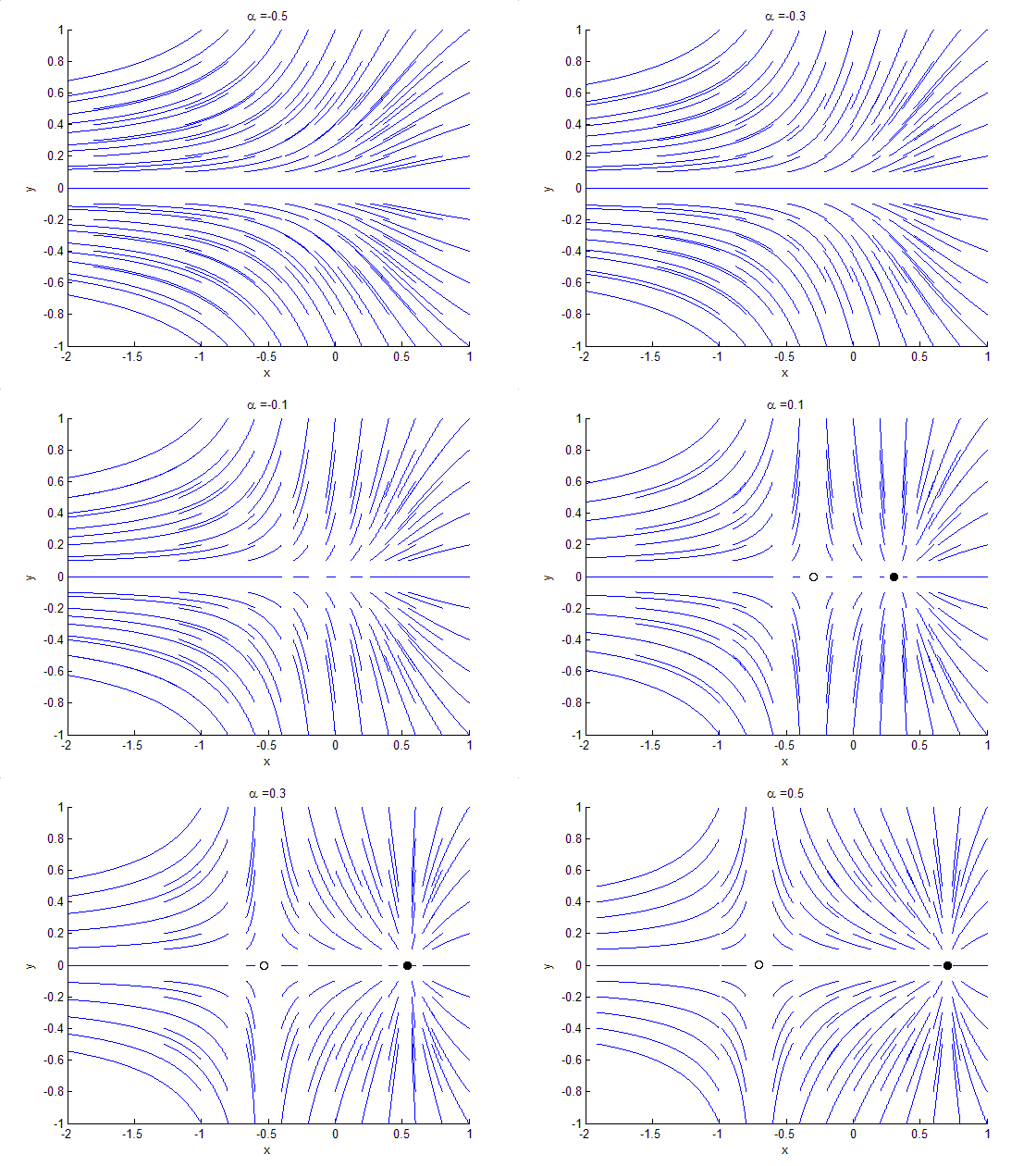
An example of a saddle-node bifurcation in two dimensions occurs in the two-dimensional dynamical system:
: \frac {dx} {dt} = \alpha - x^2 : \frac {dy} {dt} = - y.
As can be seen by the animation obtained by plotting phase portraits by varying the parameter \alpha ,
- When \alpha is negative, there are no equilibrium points.
- When \alpha = 0, there is a saddle-node point.
- When \alpha is positive, there are two equilibrium points: that is, one saddle point and one node (either an attractor or a repellor).
Other examples are in modelling biological switches. Recently, it was shown that under certain conditions, the Einstein field equations of General Relativity have the same form as a fold bifurcation. A non-autonomous version of the saddle-node bifurcation (i.e. the parameter is time-dependent) has also been studied.
Notes
References
References
- (2015). "Computational techniques in mathematical modelling of biological switches".
- (2018). "Einstein's field equations as a fold bifurcation". Journal of Geometry and Physics.
- (2019-08-01). "Time-dependent saddle–node bifurcation: Breaking time and the point of no return in a non-autonomous model of critical transitions". Physica D: Nonlinear Phenomena.
This article was imported from Wikipedia and is available under the Creative Commons Attribution-ShareAlike 4.0 License. Content has been adapted to SurfDoc format. Original contributors can be found on the article history page.
Ask Mako anything about Saddle-node bifurcation — get instant answers, deeper analysis, and related topics.
Research with MakoFree with your Surf account
Create a free account to save articles, ask Mako questions, and organize your research.
Sign up freeThis content may have been generated or modified by AI. CloudSurf Software LLC is not responsible for the accuracy, completeness, or reliability of AI-generated content. Always verify important information from primary sources.
Report