From Surf Wiki (app.surf) — the open knowledge base
Royal Air Force
Air and space warfare force of the United Kingdom
Air and space warfare force of the United Kingdom
| Field | Value | ||||||||
|---|---|---|---|---|---|---|---|---|---|
| unit_name | Royal Air Force | ||||||||
| image | {{ubl | [[File:RAF-Badge.svg | frameless]] | Badge of the RAF | |||||
| frameless | Logo of the RAF<ref>{{Cite web | date | December 2005 | title=4.1 The Royal Air Force logotype | url=https://www.whatdotheyknow.com/request/forces_branding/response/132711/attach/4/Page%2027%20RAF%20Branding%20Guidelines.jpg?cookie_passthrough=1 | archive-url=https://archive.today/20240924182503/https://www.whatdotheyknow.com/request/forces_branding/response/132711/attach/4/Page%2027%20RAF%20Branding%20Guidelines.jpg?cookie_passthrough=1 | archive-date=24 September 2024 | series=Royal Air Force brand guidelines | publisher=Ministry of Defence}}}} |
| image_size | 200px | ||||||||
| start_date | |||||||||
| country | United Kingdom United Kingdom | ||||||||
| type | Air and space force | ||||||||
| role | Aerial and space warfare | ||||||||
| size | {{ubl | ||||||||
| 30,437 active personnel<ref name | qsps | ||||||||
| 3,001 reserve personnel<ref name | qsps / | ||||||||
| 1,363 other personnel<ref name | qsps / | ||||||||
| 670 aircraft<ref>{{Cite web | url | https://assets.publishing.service.gov.uk/media/67b897abba253db298782c46/UK_armed_forces_equipment_and_formations_2024.xlsx | title=UK armed forces equipment and formations 2024 | website=UK Government | access-date=27 February 2012}} | ||||
| command_structure | Flag of the Ministry of Defence (United Kingdom).svg British Armed Forces | ||||||||
| garrison | Whitehall, London | ||||||||
| garrison_label | Air Staff Offices | ||||||||
| motto | |||||||||
| (Through Adversity to the Stars) | |||||||||
| colours | Air force blue and gold | ||||||||
| colours_label | Colours | ||||||||
| march | Quick: "Royal Air Force March Past" | ||||||||
| Slow: "Saeculum" | |||||||||
| anniversaries | 1 April | ||||||||
| battles | {{collapsible list | ||||||||
| titlestyle | background:transparent;text-align:left;font-weight:normal; | ||||||||
| title | *See list* | ||||||||
| website | |||||||||
| <!-- Commanders --> | commander1 | Royal standard of the United Kingdom.svg King Charles III | |||||||
| commander1_label | Head of the Armed Forces | ||||||||
| commander2 | Flag of the British Secretary of State for Defence.svg Rt Hon John Healey MP | ||||||||
| commander2_label | Secretary of State for Defence | ||||||||
| commander3 | UK-Air-OF9-Flag.svg Air Chief Marshal Sir Harvey Smyth | ||||||||
| commander3_label | Chief of the Air Staff | ||||||||
| commander4 | UK-Air-OF8-Flag.svg Air Marshal Paul Lloyd | ||||||||
| commander4_label | Deputy Chief of the Air Staff | ||||||||
| commander5 | UK-Air-OF8-Flag.svg Air Marshal Allan Marshall | ||||||||
| commander5_label | Air and Space Commander | ||||||||
| commander6 | [[File:British RAF OR-9b (2023).svg | 25px]] Warrant Officer Murugesvaran Subramaniam | |||||||
| commander6_label | Warrant Officer of the Royal Air Force | ||||||||
| <!-- Insignia --> | identification_symbol | [[File:RAF roundel.svg | 80px]] [[File:RAF Lowvis Army roundel.svg | 80px]] | |||||
| identification_symbol_label | Roundel | ||||||||
| identification_symbol_2 | [[File:RAF-Finflash-Noncombat.svg | 80px]] [[File:Fin flash of the United Kingdom Low Visibility.svg | 80px]] | ||||||
| identification_symbol_2_label | Fin flash | ||||||||
| identification_symbol_3 | [[File:Air Force Ensign of the United Kingdom.svg | 164px]] | |||||||
| identification_symbol_3_label | Ensign | ||||||||
| identification_symbol_4 | [[File:Royal Banner RAF (King Charles III's).svg | 164px]] | |||||||
| identification_symbol_4_label | King's Colour | ||||||||
| <!-- Aircraft --> | aircraft_attack | Protector RG1 | |||||||
| aircraft_electronic | StormShroud | ||||||||
| aircraft_fighter | Typhoon FGR4 | ||||||||
| F-35 Lightning II | |||||||||
| aircraft_helicopter | Chinook HC5/6/6A | ||||||||
| aircraft_helicopter_trainer | Juno HT1 | ||||||||
| Jupiter HT1 | |||||||||
| aircraft_patrol | Poseidon MRA1 | ||||||||
| aircraft_recon | Airseeker R1 | ||||||||
| Shadow R1/1A | |||||||||
| aircraft_trainer | Hawk T1/2 | ||||||||
| Texan T1 | |||||||||
| Phenom T1 | |||||||||
| Typhoon T3 | |||||||||
| Viking T1 | |||||||||
| Prefect T1 | |||||||||
| Tutor T1 | |||||||||
| aircraft_transport | Voyager KC2/3 | ||||||||
| Atlas C1 | |||||||||
| C-17 Globemaster | |||||||||
| Envoy IV CC1 | |||||||||
| aircraft_tanker | Voyager KC2/3 |
|30,437 active personnel | 3,001 reserve personnel | 1,363 other personnel | 670 aircraft (Through Adversity to the Stars)
Slow: "Saeculum" | F-35 Lightning II Jupiter HT1 Shadow R1/1A Texan T1 Phenom T1 Typhoon T3 Viking T1 Prefect T1 Tutor T1 Atlas C1 C-17 Globemaster Envoy IV CC1
The Royal Air Force (RAF) is the air and space force of the United Kingdom, British Overseas Territories and Crown Dependencies. It was formed towards the end of the First World War on 1 April 1918 through the merger of the Royal Flying Corps (RFC) and the Royal Naval Air Service (RNAS). Following the Allied victory over the Central Powers in 1918, the RAF emerged as the largest air force in the world. Since its formation, the RAF has played a significant role in British military history. In particular, during the Second World War, the RAF defeated the German Luftwaffe's efforts to establish air superiority over England during the Battle of Britain, and played a key role in the Combined Bomber Offensive alongside the USAAF.
The RAF's mission is to support the objectives of the British Ministry of Defence (MOD), which are to "provide the capabilities needed to ensure the security and defence of the United Kingdom and overseas territories, including against terrorism; to support the Government's foreign policy objectives particularly in promoting international peace and security". The RAF describes its mission statement as "... [to provide] an agile, adaptable and capable Air Force that, person for person, is second to none, and that makes a decisive air power contribution in support of the UK Defence Mission". The mission statement is supported by the RAF's definition of air power, which guides its strategy. Air power is defined as "the ability to project power from the air and space to influence the behaviour of people or the course of events".
Today, the Royal Air Force maintains an operational fleet of various types of aircraft, described by the RAF as being "leading-edge" in terms of technology. This largely consists of fixed-wing aircraft, including those in the following roles: fighter and strike, airborne early warning and control, intelligence, surveillance, target acquisition, and reconnaissance (ISTAR), signals intelligence (SIGINT), maritime patrol, air-to-air refueling (AAR) and strategic & tactical transport. The majority of the RAF's rotary-wing aircraft form part of the tri-service Joint Aviation Command in support of ground forces. Most of the RAF's aircraft and personnel are based in the UK, with many others serving on global operations (principally over Iraq and Syria) or at long-established overseas bases (Ascension Island, Cyprus, Gibraltar, and the Falkland Islands). Although the RAF is the principal British air power arm, the Royal Navy's Fleet Air Arm and the British Army's Army Air Corps also operate armed aircraft.
History
Main article: History of the Royal Air Force
Air Force (Constitution) Act 1917 | use_new_UK-LEG = | UK-LEG_title = Air Force (Constitution) Act 1917
Origins
The Royal Air Force was formed towards the end of the First World War on 1 April 1918 by merging the Royal Flying Corps (RFC) and the Royal Naval Air Service (RNAS). This made it the second independent air force in the world after the Finnish Air Force (established 6 March 1918).
The merger was initially recommended by a report issued on 17 August 1917 by the South African statesman and general Jan Smuts, with significant contributions from Lieutenant General David Henderson. The Smuts Report informed the creation of the Air Force (Constitution) Act, which made provision for the creation of an independent Air Force. This was passed by Parliament on 23 November 1917, and received Royal Assent on 29 November 1917. On 7 March 1918, King George V issued a royal decree naming the new service the 'Royal Air Force'. At the time of its formation, the RAF was the largest air force in the world. Its first headquarters were the former Hotel Cecil on the Strand in London.
After the war, the size of RAF was drastically cut, and its inter-war years were relatively quiet. The RAF was put in charge of British military activity in Iraq, and carried out minor actions in other parts of the British Empire, including establishing bases to protect Singapore and Malaya. The RAF's naval aviation branch, the Fleet Air Arm, was founded in 1924 but handed over to Admiralty control on 24 May 1939. In 1925, the RAF carried out its first independent operation, conducting a successful air campaign against rebelling Mahsud tribesmen during Pink's War.
The RAF was among the earliest and keenest advocates of the doctrine of strategic bombing, informed by Britain's experience of German air attacks in the First World War. Starting in the early 1920s, strategic bombing saw significant technical and tactical development in the RAF, and ultimately became Britain's main offensive airpower strategy during the Second World War.
Second World War
The Royal Air Force underwent rapid expansion prior to and during the Second World War. Under the British Commonwealth Air Training Plan of December 1939, the air forces of British Commonwealth countries trained and formed "Article XV squadrons" for service with RAF formations. Many individual personnel from these countries, and exiles from occupied Europe, also served with RAF squadrons. By the end of the war the Royal Canadian Air Force had contributed more than 30 squadrons to serve in RAF formations, similarly, approximately a quarter of Bomber Command's personnel were Canadian. Additionally, the Royal Australian Air Force represented around nine per cent of all RAF personnel who served in the European and Mediterranean theatres.
During the Battle of Britain in 1940, the RAF defended the skies over Britain against the numerically superior German Luftwaffe. In what is perhaps the most prolonged and complicated air campaign in history, the Battle of Britain contributed significantly to the delay and subsequent indefinite postponement of Operation Sea Lion, Hitler's plans for an invasion of the UK. In the House of Commons on 20 August, prompted by the ongoing efforts of the RAF, Prime Minister Winston Churchill made a speech to the nation, where he said "Never in the field of human conflict was so much owed by so many to so few".
The largest RAF effort during the war was the strategic bombing campaign against Germany by Bomber Command. While RAF bombing of Germany began almost immediately upon the outbreak of war at first it was ineffectual; it was only later, particularly under the leadership of Air Chief Marshal Harris, that these attacks became increasingly devastating, from early 1943 onward, as new technology and greater numbers of superior aircraft became available. The RAF adopted night-time area bombing on German cities such as Hamburg and Dresden. Night time area bombing constituted the great bulk of the RAF's bombing campaign, mainly due to Harris, but it also developed precision bombing techniques for specific operations, such as the infamous "Dambusters" raid by No. 617 Squadron, or the Amiens prison raid known as Operation Jericho.
Cold War era
Following victory in the Second World War, the RAF underwent significant re-organisation, as technological advances in air warfare saw the arrival of jet fighters and bombers. During the early stages of the Cold War, one of the first major operations undertaken by the RAF was the Berlin Airlift, codenamed Operation Plainfire. Between 26 June 1948 and the lifting of the Soviet blockade of the city on 12 May 1949, the RAF provided 17% of the total supplies delivered, using Avro Yorks, Douglas Dakotas flying to Gatow Airport and Short Sunderlands flying to Lake Havel. The RAF saw its first post-war engagements in the 1948 Arab–Israeli War: during the withdrawal of the former Mandatory Palestine in May 1948 where British Supermarine Spitfire FR.18s shot down four Royal Egyptian Air Force Spitfire LF.9s after the REAF mistakenly attacked RAF Ramat David airbase; and during encounters with the Israeli Air Force which saw the loss of a single de Havilland Mosquito PR.34 in November 1948 and four Spitfire FR.18s and a single Hawker Tempest F.6 in January 1949.
Before Britain developed its own nuclear weapons, the RAF was provided with American nuclear weapons under Project E. However, following the development of its own arsenal, the British Government elected on 16 February 1960 to share the country's nuclear deterrent between the RAF and submarines of the Royal Navy, first deciding to concentrate solely on the air force's V bomber fleet. These were initially armed with nuclear gravity bombs, later being equipped with the Blue Steel missile. Following the development of the Royal Navy's Polaris submarines, the strategic nuclear deterrent passed to the navy's submarines on 30 June 1969. With the introduction of Polaris, the RAF's strategic nuclear role was reduced to a tactical one, using WE.177 gravity bombs. This tactical role was continued by the V bombers into the 1980s and until 1998 by the Panavia Tornado GR1.
For much of the Cold War the primary role of the RAF was the defence of Western Europe against potential attack by the Soviet Union, with many squadrons based in West Germany. The main RAF bases in RAF(G) were RAF Brüggen, RAF Gutersloh, RAF Laarbruch and RAF Wildenrath – the only air defence base in RAF(G). With the decline of the British Empire, global operations were scaled back, and RAF Far East Air Force was disbanded on 31 October 1971. Despite this, the RAF fought in many battles in the Cold War period. In June 1948, the RAF commenced Operation Firedog against Malayan pro-independence fighters during the Malayan Emergency. Operations continued for the next 12 years until 1960 with aircraft flying out of RAF Tengah and RAF Butterworth. The RAF played a minor role in the Korean War, with flying boats taking part. From 1953 to 1956 the RAF Avro Lincoln squadrons carried out anti-Mau Mau operations in Kenya using its base at RAF Eastleigh. The Suez Crisis in 1956 saw a large RAF role, with aircraft operating from RAF Akrotiri and RAF Nicosia on Cyprus and RAF Luqa and RAF Hal Far on Malta as part of Operation Musketeer. The RAF suffered its most recent loss to an enemy aircraft during the Suez Crisis, when an English Electric Canberra PR7 was shot down over Syria.
In 1957, the RAF participated heavily during the Jebel Akhdar War in Oman, operating both de Havilland Venom and Avro Shackleton aircraft. The RAF made 1,635 raids, dropping 1,094 tons and firing 900 rockets at the interior of Oman between July and December 1958, targeting insurgents, mountain top villages and water channels in a war that remained under low profile. The Konfrontasi against Indonesia in the early 1960s did see use of RAF aircraft, but due to a combination of deft diplomacy and selective ignoring of certain events by both sides, it never developed into a full-scale war. The RAF played a large role in the Aden Emergency between 1963 and 1967. Hawker Hunter FGA.9s based at RAF Khormaksar, Aden, were regularly called in by the British Army as close air support to carry out strikes on rebel positions. The Radfan Campaign (Operation Nutcracker) in early 1964 was successful in suppressing the revolt in Radfa, however it did nothing to end the insurgency with the British withdrawing from Aden in November 1967.
One of the largest actions undertaken by the RAF during the Cold War was the air campaign during the 1982 Falklands War, in which the RAF operated alongside the Fleet Air Arm. During the war, RAF aircraft were deployed in the mid-Atlantic at RAF Ascension Island and a detachment from No. 1 Squadron was deployed with the Royal Navy, operating from the aircraft carrier HMS Hermes. RAF pilots also flew missions using the Royal Navy's Sea Harriers in the air-to-air combat role, in particular Flight Lieutenant Dave Morgan the highest scoring pilot of the war. Following a British victory, the RAF remained in the South Atlantic to provide air defence to the Falkland Islands, with the McDonnell Douglas Phantom FGR2 based at RAF Mount Pleasant which was built in 1984.
Post-Cold War
With the end of the Cold War and the collapse of the Soviet Union, the RAF's focus returned to expeditionary air power. Since 1990, the RAF has been involved in several large-scale operations, including the 1991 Gulf War, the 1999 Kosovo War, the 2001 War in Afghanistan, the 2003 invasion and war in Iraq, the 2011 intervention in Libya and from 2014 onwards has been involved in the war against the Islamic State.
The RAF began conducting Remotely-piloted Air System (RPAS) operations in 2004, with No. 1115 Flight carrying out missions in Afghanistan and Iraq with the General Atomics MQ-1 Predator. Initially embedded with the United States Air Force, the RAF formed its own RPAS squadron in 2007 when No. 39 Squadron was stood up as a General Atomics MQ-9A Reaper unit at Creech AFB, Nevada.
The RAF's 90th anniversary was commemorated on 1 April 2008 by a flypast of the RAF's Aerobatic Display Team the Red Arrows and four Eurofighter Typhoons along the River Thames, in a straight line from just south of London City Airport Tower Bridge, the London Eye, the RAF Memorial and (at 13.00) the Ministry of Defence building.
Four major defence reviews have been conducted since the end of the Cold War: the 1990 Options for Change, the 1998 Strategic Defence Review, the 2003 Delivering Security in a Changing World and the 2010 Strategic Defence and Security Review (SDSR). All four defence reviews have resulted in steady reductions in manpower and numbers of aircraft, especially combat aircraft such as fast-jets. As part of the latest 2010 Strategic Defence and Security Review, the BAE Systems Nimrod MRA4 maritime patrol aircraft was cancelled due to over spending and missing deadlines. Other reductions saw total manpower reduced by 5,000 personnel to a trained strength of 33,000 and the early retirement of the Joint Force Harrier aircraft, the BAE Harrier GR7/GR9.
In recent years, fighter aircraft on Quick Reaction Alert (QRA) have been increasingly required to scramble in response to Russian Air Force aircraft approaching British airspace. On 24 January 2014, in the Houses of Parliament, Conservative MP and Minister of State for the Armed Forces, Andrew Robathan, announced that the RAF's QRA force had been scrambled almost thirty times in the last three years: eleven times during 2010, ten times during 2011 and eight times during 2012. RAF Coningsby in Lincolnshire and RAF Lossiemouth in Moray both provide QRA aircraft, and scramble their Typhoons within minutes to meet or intercept aircraft which give cause for concern. Lossiemouth generally covers the northern sector of UK airspace, while Coningsby covers the southern sector. Typhoon pilot Flight Lieutenant Noel Rees describes how QRA duty works. "At the start of the scaled QRA response, civilian air traffic controllers might see on their screens an aircraft behaving erratically, not responding to their radio calls, or note that it's transmitting a distress signal through its transponder. Rather than scramble Typhoons at the first hint of something abnormal, a controller has the option to put them on a higher level of alert, 'a call to cockpit'. In this scenario the pilot races to the hardened aircraft shelter and does everything short of starting his engines".
On 4 October 2015, a final stand-down saw the end of more than 70 years of RAF Search and Rescue provision in the UK. The RAF and Royal Navy's Westland Sea King fleets, after over 30 years of service, were retired. A civilian contractor, Bristow Helicopters, took over responsibility for UK Search and Rescue, under a Private Finance Initiative with newly purchased Sikorsky S-92 and AgustaWestland AW189 aircraft. The new contract means that all UK SAR coverage is now provided by Bristow aircraft.
In 2018, the RAF's vision of a future constellation of imagery satellites was initiated through the launch of the Carbonite-2 technology demonstrator. The 100 kg Carbonite-2 uses commercial off-the-shelf (COTS) components to deliver high-quality imagery and 3D video footage from space. The Royal Air Force celebrated its 100th anniversary on 1 April 2018. It marked the occasion on 10 July 2018 with a flypast over London consisting of 103 aircraft.
Between March 2020 and 2022, the RAF assisted with the response efforts to the COVID-19 pandemic in the United Kingdom as part of Operation Rescript. This saw the service provide repatriation flights and aeromedical evacuations of COVID-19 patients, drivers and call-handlers to support ambulance services and medics to assist with the staffing of hospitals, testing units and vaccination centres. Under Operation Broadshare, the RAF has also been involved with COVID-19 relief operations overseas, repatriating stranded nationals and delivering medical supplies and vaccines to British Overseas Territories and military installations.
The UK's 20-year long operations in Afghanistan came to an end in August 2021, seeing the largest airlift since the Berlin Blockade take place. As part of Operation Pitting, the RAF helped evacuate over 15,000 people in two weeks. Between April and May 2023, the RAF helped evacuate over 2,300 people from Sudan due to the 2023 Sudan conflict as part of Operation Polarbear.
In April 2024, Typhoon FGR4s operating from RAF Akrotiri, Cyprus, engaged and destroyed Iranian drones over Iraqi and Syrian airspace during Iran's strikes against Israel.
On 26 and 27 March 2025, RAF Puma helicopters marked their retirement from service with a flypast of locations with a historical link to Puma including RAF Odiham, Andover, Middle Wallop Flying Station, MOD Boscombe Down, Thiepval Barracks, PJHQ, RAF Halton, RAF High Wycombe, RAF Benson, RAF Cosford, RAF Shawbury as well as other places across the UK.
In June 2025, pro-Palestinian activists broke into Brize Norton Royal Air Force base in Oxfordshire, vandalising and tampering with aircraft. Such actions constitute a national security risk. The ensuing arrests garnered media attention, and the group Palestine Action, which claimed responsibility for the break-in, was later proscribed as a terrorist organisation by the UK government. In addition, a decision was made to begin a 'security review' of military bases across the United Kingdom.
Structure
Main article: Structure of the Royal Air Force
Senior leadership

The professional head and highest-ranking officer of the Royal Air Force is the Chief of the Air Staff. He reports to the Chief of the Defence Staff, who is the professional head of the British Armed Forces. The incumbent Chief of the Air Staff is Air Chief Marshal Sir Harvey Smyth who was appointed in 2025.
The management of the RAF is the responsibility of the Air Force Board, a sub-committee of the Defence Council which is part of the Ministry of Defence and the body legally responsible for the defence of the United Kingdom and its overseas territories. The Chief of the Air Staff chairs the Air Force Board Standing Committee which decides on the policy and actions required for the RAF to meet the requirements of the Defence Council and His Majesty's Government.
The Chief of the Air Staff is supported by several other senior commanders:
| Title | Rank | NATO rank scale |
|---|---|---|
| Chief of the Air Staff | Air Chief Marshal | OF-9 |
| Air and Space Commander | Air Marshal | OF-8 |
| Deputy Chief of the Air Staff | Air Marshal | OF-8 |
| Air Officer Northern Ireland | Air Marshal | OF-8 |
| Assistant Chief of the Air Staff | Air Vice-Marshal | OF-7 |
| Director People | Air Vice-Marshal | OF-7 |
| Director Digital | Civilian}} | |
| Director of Resources | Civilian}} | |
| Director of Legal Services | Air Vice-Marshal | OF-7 |
| Air Officer Scotland | Air Commodore | OF-6 |
| Air Officer Wales | Air Commodore | OF-6 |
| Chaplain-in-Chief | Revd (Air Vice-Marshal) | OF-7 |
| Warrant Officer of the Royal Air Force | Warrant Officer | OR-9 |
| Non-Executive Directors | Civilian (x5)}} |
Air Command
Administrative and operational command of the RAF is delegated by the Air Force Board to Headquarters Air Command, based at RAF High Wycombe in Buckinghamshire. Air Command was formed on 1 April 2007 by combining RAF Strike Command and RAF Personnel and Training Command, resulting in a single command covering the whole RAF, led by the chief of the air staff. Through its subordinate groups, Air Command oversees the whole spectrum of RAF aircraft and operations.
United Kingdom Space Command (UKSC), established 1 April 2021 under the command of Air Vice-Marshal Paul Godfrey is a joint command, but sits "under the Royal Air Force." Godfrey is of equal rank to the commanders of 1, 2, 11, and 22 Groups. The new command has "responsibility for not just operations, but also generating, training and growing the force, and also owning the money and putting all the programmatic rigour into delivering new ..capabilities."
Groups
Main article: List of Royal Air Force groups
Groups are the subdivisions of operational commands and are responsible for certain types of capabilities or for operations in limited geographical areas. There are five groups subordinate to Air Command, of which four are functional and one is geographically focused:
No. 1 Group (Air Combat)
No. 1 Group is responsible for combat aircraft (comprising the Lightning Force and Typhoon Force) and the RAF's intelligence, surveillance, target acquisition, and reconnaissance (ISTAR) capabilities. It oversees stations at RAF Coningsby and RAF Waddington in Lincolnshire, RAF Lossiemouth in Moray and RAF Marham in Norfolk. The group's Eurofighter Typhoon FGR4 aircraft protect UK and NATO airspace by providing a continuous Quick Reaction Alert capability.
No. 2 Group (Air Combat Support)
No. 2 Group controls the Air Mobility Force which provides strategic and tactical airlift, air-to-air refuelling and command support air transport (CSAT). The group is also responsible for the RAF Medical Services, RAF Support Force, consisting of the RAF's engineering, logistics, intelligence, signals, musical and mountain rescue assets, RAF's Combat and Readiness Force, comprising the RAF Regiment, and the Air Security Force, comprising RAF Police. It oversees stations at RAF Benson and RAF Brize Norton in Oxfordshire, RAF Henlow in Bedfordshire, RAF Honington in Suffolk, RAF Odiham in Hampshire and RAF Northolt in West London.
No. 11 Group (Multi-domain operations)
No. 11 Group is responsible for integrating operations across the air, cyber and space domains whilst responding to new and evolving threats. It includes the RAF's Battlespace Management Force which controls the UK Air Surveillance and Control System (ASACS). The group oversees stations at RAF Boulmer in Northumberland, RAF Fylingdales in North Yorkshire and RAF Spadeadam in Cumbria.
No. 22 Group (Training)
No. 22 Group is responsible for the supply of qualified and skilled personnel to the RAF and provides flying and non-flying training to all three British armed services. It is the end-user of the UK Military Flying Training System which is provided by civilian contractor Ascent Flight Training. The group oversees stations at RAF College Cranwell in Lincolnshire, RAF Cosford and RAF Shawbury in Shropshire, RAF Halton in Buckinghamshire, MOD St Athan in the Vale of Glamorgan, RAF St Mawgan in Cornwall and RAF Valley on Anglesey. The No. 22 Group also manages the Royal Air Force Air Cadets.
Stations
Main article: Royal Air Force station
An RAF station is ordinarily subordinate to a group and is commanded by a group captain. Each station typically hosts several flying and non-flying squadrons or units which are supported by administrative and support wings.
United Kingdom
Front-line flying operations are focused at eight stations:
- RAF Coningsby, RAF Marham and RAF Lossiemouth (Air Combat)
- RAF Waddington (ISTAR)
- RAF Brize Norton and RAF Northolt (Air Transport)
- RAF Benson and RAF Odiham (Support Helicopter Force operating under Joint Aviation Command)
Flying training takes places at RAF Barkston Heath, RAF College Cranwell, RAF Shawbury and RAF Valley, each forming part of the UK Military Flying Training System which is dedicated to training aircrew for all three UK armed services. Specialist ground crew training is focused at RAF Cosford, RAF St Mawgan and MOD St. Athan.
Operations are supported by numerous other flying and non-flying stations, with activity focussed at RAF Honington which coordinates Force Protection and RAF Leeming & RAF Wittering which have a support enabler role.
A Control and Reporting Centre (CRC) at RAF Boulmer is tasked with compiling a Recognised Air Picture of UK air space and providing tactical control of the Quick Reaction Alert Force. In order to achieve this Boulmer is supported by a network of eight Remote Radar Heads (RRHs) spread the length of the UK.
Overseas
The UK operates permanent military airfields (known as Permanent Joint Operating Bases) in four British Overseas Territories. These bases contribute to the physical defence and maintenance of sovereignty of the British Overseas Territories and enable the UK to conduct expeditionary military operations. Although command and oversight of the bases is provided by Strategic Command, the airfield elements are known as RAF stations.
- RAF Akrotiri (Sovereign Base Areas of Akrotiri and Dhekelia, Cyprus)
- RAF Ascension Island (Saint Helena, Ascension and Tristan da Cuhna)
- RAF Mount Pleasant (Falkland Islands)
- RAF Gibraltar (Gibraltar)
Four RAF squadrons are based overseas. No. 17 Test and Evaluation Squadron is based at Edwards Air Force Base, California, in the United States and works in close cooperation with the U.S. Air Force in the development of the Lockheed Martin F-35B Lightning. No. 80 Squadron is part of the Australia, Canada and United Kingdom Reprogramming Laboratory (ACURL) at Eglin Air Force Base, Florida, and is tasked with compiling and testing the Mission Data File Sets (MDFS) for the F-35. No. 84 Squadron is located at RAF Akrotiri in a search and rescue role. No. 230 Squadron are based at Medicina Lines, Brunei.
Squadrons
Main article: List of Royal Air Force aircraft squadrons
A flying squadron is an aircraft unit which carries out the primary tasks of the RAF. RAF squadrons are somewhat analogous to the regiments of the British Army in that they have histories and traditions going back to their formation, regardless of where they are based or which aircraft they are operating. They can be awarded standards and battle honours for meritorious service. Most flying squadrons are commanded by a wing commander and, for a fast-jet squadron, have a complement of around twelve aircraft.
Flights
Independent flights are so designated because they are explicitly smaller in size than a squadron. Many independent flights are, or have been, front-line flying units. For example, No. 1435 Flight carries out air defence duties for the Falkland Islands, with four Eurofighter Typhoon fighters based at RAF Mount Pleasant.
Support wings and units
Support capabilities are provided by several specialist wings and other units.
- Air and Space Warfare Centre (RAF Waddington)
- Airborne Delivery Wing (RAF Brize Norton)
- Mobile Meteorological Unit (RAF Waddington)
- Tactical Communications Wing (RAF Leeming)
- Tactical Medical Wing (RAF Brize Norton)
- Tactical Supply Wing (MOD Stafford)
- No. 1 Air Control Centre (RAF Boulmer)
- No. 1 Air Mobility Wing (RAF Brize Norton)
- No. 1 Intelligence, Surveillance and Reconnaissance Wing (RAF Waddington)
- No. 42 (Expeditionary Support) Wing (RAF Wittering)
- No. 85 (Expeditionary Logistics) Wing (RAF Wittering)
- No. 90 Signals Unit (RAF Leeming)
Expeditionary Air Wings
Main article: Expeditionary Air Wing
Command, control, and support for overseas operations is typically provided through Expeditionary Air Wings (EAWs). Each wing is brought together as and when required and comprises the deployable elements of its home station as well as other support elements from throughout the RAF.
- No. 34 Expeditionary Air Wing (RAF Waddington) – ISTAR operations
- No. 38 Expeditionary Air Wing (RAF Brize Norton) – air transport operations
- No. 121 Expeditionary Air Wing (RAF Coningsby) – multi-role operations
- No. 135 Expeditionary Air Wing (RAF Leeming) – fighter operations
- No. 138 Expeditionary Air Wing (RAF Marham) – fighter operations
- No. 140 Expeditionary Air Wing (RAF Lossiemouth) – fighter operations
Several Expeditionary Air Wings are based overseas:
- No. 901 Expeditionary Air Wing (Al Udeid Air Base, Qatar) – Communication and information systems support
- No. 902 Expeditionary Air Wing (Middle East) – Helicopter support
- No. 903 Expeditionary Air Wing (RAF Akrotiri, Cyprus) – Supports Operation Shader
- No. 905 Expeditionary Air Wing (RAF Mount Pleasant, Falklands Islands) – Protection of British Overseas Territories in the South Atlantic
- No. 906 Expeditionary Air Wing (Middle East) – Air transport support
Training schools
Main article: List of Royal Air Force schools
Flying training
The RAF Schools consist of the squadrons and support apparatus that train new aircrew to join front-line squadrons. The schools separate individual streams, but group together units with similar responsibility or that operate the same aircraft type. Some schools operate with only one squadron, and have an overall training throughput which is relatively small; some, like No. 3 Flying Training School, have responsibility for all Elementary Flying Training (EFT) in the RAF, and all RAF aircrew will pass through its squadrons when they start their flying careers. No. 2 Flying Training School and No. 6 Flying Training School do not have a front-line training responsibility – their job is to group the University Air Squadrons and the Volunteer Gliding Squadrons together. The commanding officer of No. 2 FTS holds the only full-time flying appointment for a Group Captain in the RAF, and is a reservist.
- Central Flying School (RAF Cranwell) – standardises flying training across the air force and ensures standards and safety are maintained.
- No. 1 Flying Training School (RAF Shawbury) – basic and advanced helicopter training.
- No. 2 Flying Training School (RAF Syerston) – gliding training provided by Volunteer Gliding Squadrons based at airfields throughout the UK.
- No. 3 Flying Training School (RAF Cranwell) – Elementary Flying Training (EFT) for RAF, Fleet Air Arm and Army Air Corps crews, also operates from RAF Wittering and RAF Barkston Heath.
- No. 4 Flying Training School (RAF Valley) – Basic Fast Jet Training (BFJT) and Advanced Fast Jet Training (AFJT).
- No. 6 Flying Training School (RAF Cranwell) – Initial training provided by University Air Squadrons and Air Experience Flights based at airfields throughout the UK.
Non-flying training
The British military operate a number of joint training organisations, with Air Command leading the provision of technical training through the Defence College of Technical Training (DCTT). It provides training in aeronautical engineering, electro and mechanical engineering, and communication and information systems.
- No. 1 School of Technical Training is based at RAF Cosford and provides RAF personnel with mechanical, avionics, weapons and survival equipment training. Also based at Cosford is the Aerosystems Engineer and Management Training School. Both are part of the Defence School of Aeronautical Engineering.
- No. 4 School of Technical Training is part of the Defence School of Electronic and Mechanical Engineering (DSEME) and is based at MOD St Athan. It provides training to non-aircraft ground engineering technicians.
- No. 1 Radio School and the Aerial Erectors School are based at Cosford and RAF Digby respectively and are part of the Defence School of Communications and Information Systems.
Specialist training and education
The Royal Air Force operates several units and centres for the provision of non-generic training and education. These include the Royal Air Force Leadership Centre and the RAF Centre for Air Power Studies, both based at RAF Cranwell, and the Air Warfare Centre, based at RAF Waddington and RAF Cranwell. Non-commissioned officer training and developmental courses occur at RAF Halton and officer courses occur at the Joint Services Command and Staff College at Shrivenham.
Personnel
At its height in 1944 during the Second World War, more than 1,100,000 personnel were serving in the RAF. The longest-lived founding member of the RAF was Henry Allingham, who died on 18 July 2009 aged 113.
As of 1 January 2015, the RAF numbered some 34,200 Regular and 1,940 Royal Auxiliary Air Force personnel, giving a combined component strength of 36,140 personnel. In addition to the active elements of the RAF, (Regular and Royal Auxiliary Air Force), all ex-Regular personnel remain liable to be recalled for duty in a time of need, this is known as the Regular Reserve. In 2007, there were 33,980 RAF Regular Reserves, of which 7,950 served under a fixed-term reserve contract. Publications since April 2013 no-longer report the entire strength of the Regular Reserve, instead they only give a figure for Regular Reserves who serve under a fixed-term reserve contract. They had a strength of 7,120 personnel in 2014.
Figures provided by the International Institute for Strategic Studies from 2012 showed that RAF pilots achieve a relatively high number of flying hours per year when compared with other major NATO allies such as France and Germany. RAF pilots achieve 210 to 290 flying hours per year. French and German Air Force pilots achieved 180 and 150 flying hours across their fleets respectively.
Officers
Officers hold a commission from the sovereign, which provides the legal authority for them to issue orders to subordinates. The commission of a regular officer is granted after successfully completing the 24-week-long Initial Officer Training course at the RAF College, Cranwell, Lincolnshire.
To emphasise the merger of both military and naval aviation when the RAF was formed, many of the titles of officers were deliberately chosen to be of a naval character, such as flight lieutenant, wing commander, group captain, and air commodore.
In 1952, officers served in one of fourteen branches: Catering; Chaplains; Dental; Education; Equipment; Fighter Control; General Duties (i.e. aircrew); Legal; Medical; Physical Fitness; Provost; RAF Regiment; Secretarial; and Technical. All except General Duties and the RAF Regiment were open to women.
Other ranks
Other ranks attend the Recruit Training Squadron at RAF Halton for basic training. The titles and insignia of other ranks in the RAF were based on that of the Army, with some alterations in terminology. Over the years, this structure has seen significant changes: for example, there was once a separate system for those in technical trades, and the ranks of chief technician and junior technician continue to be held only by personnel in technical trades. RAF other ranks fall into four categories: warrant officers, senior non-commissioned officers, junior non-commissioned officers and airmen. All warrant officers in the RAF are equal in terms of rank, but the most senior non-commissioned appointment is known as the Warrant Officer of the Royal Air Force.
From 1952, trades for RAF airmen and airwomen were grouped into 23 trade groups: Accounting and Secretarial; Air Traffic Control and Fire Services; Aircraft Engineering; Airfield Construction; Armament Engineering; Catering; Dental; Electrical and Instrument Engineering; General Duties (i.e. aircrew); General Engineering; General Service; Ground Signalling; Marine Craft; Mechanical Transport; Medical; Music; Photography; Police; Radar Operating; Radio Engineering; RAF Regiment; Safety and Surface; and Supply. All were open to women except Air Traffic Control and Fire Services, Airfield Construction, General Duties, Marine Craft and the RAF Regiment
Ranks
Main article: RAF officer ranks, RAF other ranks
Aircraft
Air combat
Typhoon
.jpg)
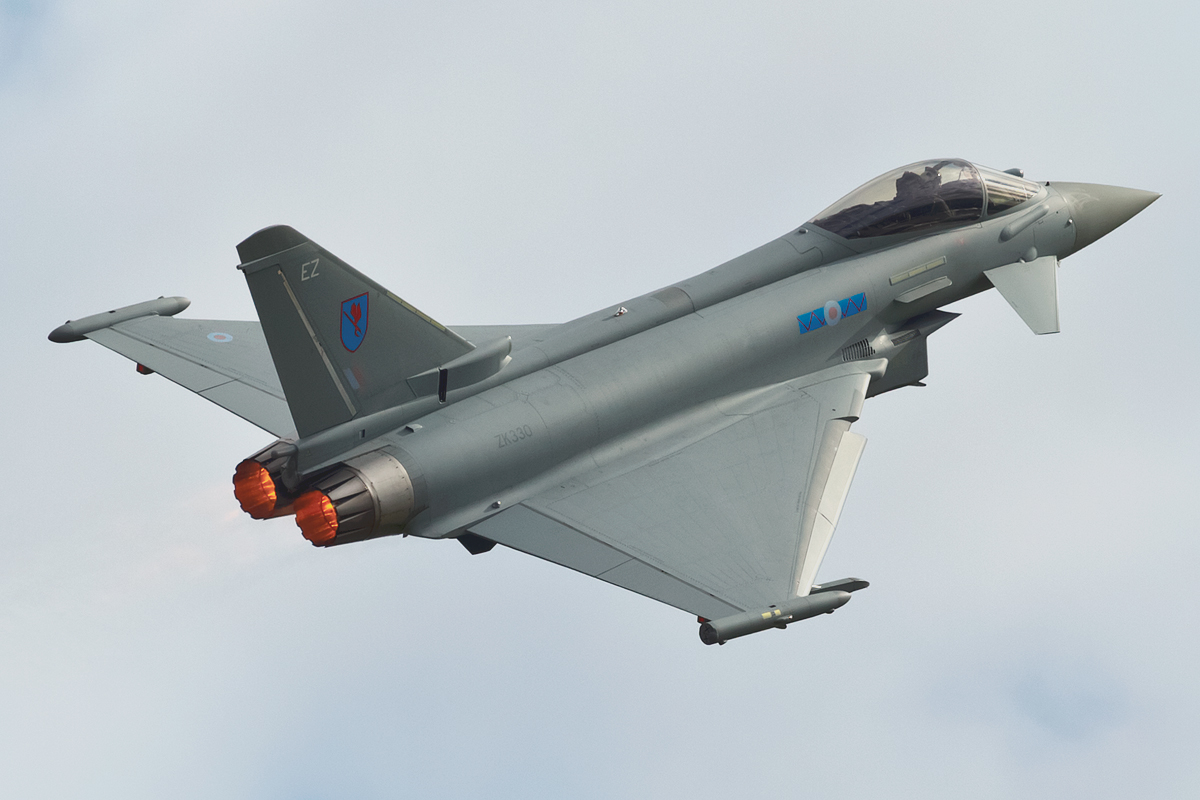
The Eurofighter Typhoon FGR4 is the RAF's primary multi-role air defence and ground attack fighter aircraft, following the retirement of the Panavia Tornado F3 in late March 2011. With the completion of 'Project Centurion' upgrades, the Typhoon FGR4 took over ground attack duties from the Panavia Tornado GR4, which was retired on 1 April 2019. The Typhoon is tasked with defending UK airspace, while also frequently deploying in support of NATO air defence missions in the Baltic (Operation Azotize), Black Sea (Operation Biloxi), Iceland (Icelandic Air Policing) and Poland (Operation Chessman).
The RAF has seven front-line Typhoon squadrons, plus an Operational Conversion Unit (OCU), and Operational Evaluation Unit (OEU); No. 3 (Fighter) Squadron, No. XI (F) Squadron, No. 12 Squadron (joint RAF / Qatar Air Force), No. 29 Squadron (OCU), and No. 41 Test and Evaluation Squadron (OEU) based at RAF Coningsby; with No. 1 (F) Squadron, No. II (Army Cooperation) Squadron, No. 6 Squadron, and No. IX (Bomber) Squadron based at RAF Lossiemouth. Additionally, four Typhoons (Faith, Hope, Charity, and Desperation) are based at RAF Mount Pleasant on the Falkland Islands, forming No. 1435 Flight, where they provide air defence. It was originally suggested that an eighth front-line Typhoon squadron could be formed, however, the 2021 Defence Command Paper announced the retirement of 24 Tranche 1 Typhoons by 2025, and a commitment to seven front-line squadrons. On 31 March 2025, the majority of Tranche 1 Typhoons were withdrawn from use, with the last four remaining as part of No. 1435 Flight until 2027.
The Typhoon made its combat debut in support of Operation Ellamy in 2011, and has been supporting Operation Shader since December 2015. Typhoons have also been supporting Operation Poseidon Archer since January 2024. The Typhoon made its first air-to-air kill in December 2021, shooting down a small hostile drone near Al-Tanf base, Syria, with an ASRAAM.
Lightning
The Lockheed Martin F-35 Lightning is a single-seat, single-engine, all-weather stealth multirole combat aircraft. It is intended to perform both air superiority and strike missions while also providing electronic warfare and intelligence, surveillance, and reconnaissance capabilities. The F-35B, with the ability to perform short take-offs and vertical-landings (STOVL), is jointly operated by the RAF and the naval Fleet Air Arm (FAA), who regularly operate from the Royal Navy's two Queen Elizabeth-class aircraft carriers. The F-35A is currently on order to allow the RAF to participate in NATO's nuclear mission. Originally a total of 138 F-35B Lightnings were planned, however the 2021 Defence Command Paper amended this to a commitment to increase the fleet beyond the current order of 48. In June 2025, the second phase procurement plan was announced, with the purchase of 12 F-35As and 17 F-35Bs, taking the fleet up to 75 jets ordered. By August 2025, 40 F-35Bs had been delivered to the RAF (though one crashed in November 2021). The F-35B has an out of service date (OSD) of 2069.
The first RAF squadron to operate the F-35B was No. 17 Test and Evaluation Squadron at Edwards AFB, California, accepting its first aircraft in 2014. No. 617 (The Dambusters) Squadron officially reformed on 18 April 2018 as the first operational RAF Lightning squadron. The first four aircraft arrived at RAF Marham from the United States in June 2018, with a further five arriving in August 2018. The Lightning was declared combat ready in January 2019. The second UK based F-35B squadron to be formed was No. 207 Squadron on 1 August 2019 as the OCU for both RAF and Royal Navy pilots. The second front line F-35B squadron to be formed was 809 Naval Air Squadron (FAA) on 8 December 2023, and is crewed by a mix of Royal Navy and RAF personnel, as are the other F-35B squadrons.
At the 2025 NATO Summit at The Hague, Prime Minister Keir Starmer announced that the RAF will acquire at least twelve nuclear capable F-35As. This marks the return of a nuclear role for the RAF for the first time since 1998, when the UK retired the WE.177 bombs from service. According to the MoD, the F-35As will be based at RAF Marham and will help the stand-up of a third front line F-35 Lightning squadron. The OCU, No. 207 Squadron, will conduct day-to-day operations with the F-35A in a training role, due to their increased flight time and decreased maintenance requirements. The aircraft are planned for delivery by 2030.
Intelligence, surveillance, target acquisition, and reconnaissance (ISTAR)
Shadow
Eight Shadows, six Shadow R1+ and two Shadow R2 are operated by No. 14 Squadron from RAF Waddington, these aircraft are King Air 350CERs that have been specially converted for the ISTAR role. Four Shadow R1s were originally ordered in 2007 due to an Urgent Operational Requirement, and began the conversion process to the ISTAR role in 2009.
Protector
The General Atomics Protector RG1 was officially introduced into RAF service on 17 Jun 2025 with 31 Squadron, with operational flying beginning in late 2025, replacing the legacy MQ-9A Reapers of XIII Squadron. On 5 October 2015, it was announced that the Scavenger programme had been replaced by "Protector", a new requirement for at least 20 unmanned aerial vehicles. On 7 October 2015, it was revealed that Protector would be a certifiable derivative of the MQ-9B SkyGuardian with enhanced range and endurance. In 2016, it was indicated that at least sixteen aircraft would be purchased with a maximum of up to twenty-six. In July 2018, a General Atomics US civil-registered SkyGuardian was flown from North Dakota to RAF Fairford for the Royal International Air Tattoo where it was given RAF markings. In July 2020, the Ministry of Defence signed a contract for three Protectors with an option on an additional thirteen aircraft. The 2021 Defence Command Paper confirmed the order for 16 Protectors, despite the fact that the 2015 SDSR originally laid out plans for more than 20. The first Protector RG1 (PR009) was delivered to RAF Waddington in September 2023. No. 31 Squadron was reformed as the first Protector squadron on 11 October 2023, having been earmarked for the role in 2018. As of June 2025, ten Protector UAVs were in service with the remaining 6 aircraft to be delivered by the end of the year.
RC-135W Rivet Joint
Three Boeing RC-135W Rivet Joints replaced the Hawker Siddeley Nimrod R1 fleet in the signals intelligence role under the Airseeker Programme and are flown by No. 51 Squadron. The Nimrod fleet was retired in 2011, following which the RAF co-manned aircraft of the US Air Force until the three RC-135s entered RAF service between 2014 and 2017. The aircraft were Boeing KC-135R Stratotanker tankers converted to RC-135W standard in the most complex combined Foreign Military Sales case and co-operative support arrangement that the UK had undertaken with the United States Air Force since the Second World War.
The Rivet Joint received its first operational deployment in August 2014, when it was deployed to the Middle East to fly missions over Iraq and Syria as part of Operation Shader. The RC-135W's OSD is 2035.
Wedgetail
The RAF is expecting to take initial delivery in end of 2025 of three E-7 Wedgetail Airborne Warning and Control Systems (AWACS) aircraft that will be designated Wedgetail AEW1 and operated by 8 Squadron at RAF Lossiemouth, with expected in-service date of early 2026. Wedgetail provides crucial Airborne Early Warning and Control (AEW&C) capabilities. It generates high-resolution radar data and shares it in real-time through advanced communication links.
Other ISTAR Units
Based at RAF Waddington, No. 54 Squadron and No. 56 Squadron act as the OCU and OEU for the ISTAR fleet respectively.
File:RC-135W Rivet Joint MOD 45159809.jpg|RC-135W Rivet Joint File:Shadow R1 5(AC) Sqdn RAF Waddington this morning.jpg|Shadow R1 File:RIAT 2018 - Static display IMGP2662 (28679706407).jpg|Protector RG1
Maritime patrol
Poseidon MRA1
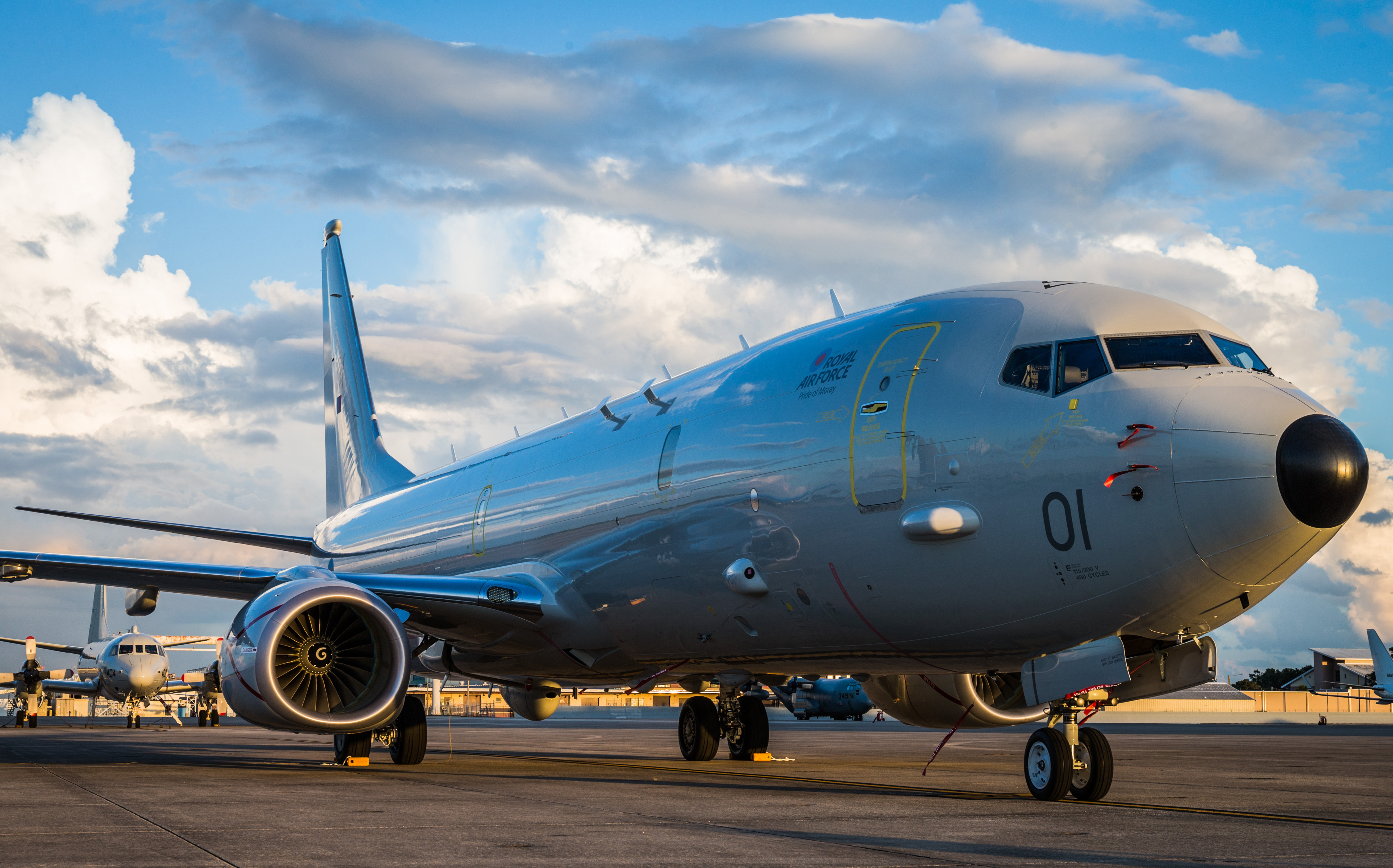
Nine Boeing Poseidon MRA1 were ordered by the British government in November 2015 in its Strategic Defence and Security Review for surveillance, anti-submarine and anti-surface ship warfare, filling a capability gap in maritime patrol that had been left since the cancellation of the BAE Systems Nimrod MRA4 programme in the 2010 SDSR. On 13 July 2017, it was announced that No. 120 Squadron and No. 201 Squadron, both former Nimrod MR2 squadrons, would operate the Poseidon and be based at RAF Lossiemouth. No. 120 Squadron was stood up on 1 April 2018, with No. 201 Squadron reforming on 7 August 2021. No. 54 Squadron was the OCU for the Poseidon fleet between 2020 and 2023. No. 42 (Torpedo Bomber) Squadron has been the OCU for the Poseidon since September 2023.
The first production Poseidon MRA1 ZP801 made its initial flight on 13 July 2019. ZP801 arrived at Kinloss Barracks, the former home of the Nimrod, on 4 February 2020, filling a decade long gap in maritime capability. The Poseidon was declared combat ready in April 2020. The Poseidon carried out its first operational mission on 3 August 2020, when the Russian warship Vasily Bykov was tracked. A Poseidon MRA1 arrived at RAF Lossiemouth for the first time in October 2020. The ninth, and final Poseidon arrived at RAF Lossiemouth on 11 January 2022.
Air mobility
C-17A Globemaster III
No. 99 Squadron operate eight Boeing C-17A Globemaster III in the heavy strategic airlift role from RAF Brize Norton, Oxfordshire. Four C-17A were originally leased from Boeing in 2000, These four were subsequently purchased outright, followed by a fifth delivered on 7 April 2008 and a sixth delivered on 11 June 2008. The MOD said there was "a stated departmental requirement for eight" C-17s and a seventh was subsequently ordered, to be delivered in December 2010. In February 2012 the purchase of an eighth C-17 was confirmed; the aircraft arrived at RAF Brize Norton in May 2012.. As with all US Foreign Military Sales, the aircraft retains its US designation rather than getting a UK style designation.
Atlas C.1
The Airbus Atlas C1 (A400M) replaced the RAF's fleet of C-130 Hercules, initially replacing the C1/C3 (C-130K) which were withdrawn from use on 28 October 2013, having originally entered service in 1967. Based at RAF Brize Norton, the Atlas fleet is operated by No. 30 Squadron and No. LXX Squadron. The first Atlas C1 (ZM400) was delivered to the RAF in November 2014. Originally, twenty-five A400Ms were ordered in the initial batch; the total initial purchase then dropped to twenty-two. The final aircraft in the initial order of 22 aircraft was delivered in May 2023. In February 2023, the Chief of the Air Staff indicated that up to six additional aircraft were planned for delivery by 2030. The C-130J Hercules was retired from RAF service on 30 June 2023.
No. XXIV Squadron acts as the Air Mobility OCU (AMOCU) for the Globemaster and Atlas, while No. 206 Squadron is the OEU.
Voyager KC2/3
Air transport tasks are also carried out by the Airbus Voyager KC2/3, flown by No. 10 Squadron and No. 101 Squadron. The first Voyager (ZZ330) arrived in the UK for testing at MOD Boscombe Down in April 2011, and entered service in April 2012. The Voyager received approval from the MOD on 16 May 2013 to begin air-to-air refuelling flights and made its first operational tanker flight on 20 May 2013 as part of a training sortie with Tornado GR4s. By 21 May 2013, the Voyager fleet had carried over 50,000 passengers and carried over 3,000 tons of cargo. A total of fourteen Voyagers form the fleet, with nine allocated to sole RAF use (three KC2s and six KC3s). As the Voyagers lack a refuelling boom, the RAF has requested a memorandum of understanding (MoU) with the USAF allowing the UK access to tankers equipped with refuelling booms for its RC-135W Rivet Joint .
Envoy CC1
Two Dassault Falcon 900XLs were procured in early 2022 to replace the RAF's fleet of four BAe 146s (two CC2s and two C3s) in the Command Support Air Transport role. Known as the Envoy IV CC1 in British service, the aircraft are based at RAF Northolt and are operated by a mixed civilian and No. 32 (The Royal) Squadron crew. This arrangement will remain until 2026 when the fleet will be placed on the military register.
File:C17 Transport Aircraft Taking Off from RAF Brize Norton MOD 45156519.jpg|C-17A Globemaster III File:RAF A400M Lands at RAF Brize Norton.jpg|Atlas C1 (A400M) File:Royal Air Force, ZZ330, Airbus KC2 Voyager (42524680970).jpg|Voyager KC2 (A330 MRTT) File:G-ZAHS, Envoy IV CC1 (Dassault Falcon 900LX) of 32 Sqn RAF at RAF Northolt, in its 'Global Britain' livery - 2022-12-06-1247-01.jpg|Envoy IV CC1
Helicopters

RAF helicopters support the British Army by moving troops and equipment to and around the battlefield. Helicopters are also used in a variety of other roles, including in support of RAF ground units and heavy-lift support for the Royal Marines. The support helicopters are organised into the tri-service Joint Aviation Command (JAC), along with helicopters from the British Army and Royal Navy. No. 22 Squadron, based at RAF Benson, is the OEU for JAC.
Chinook HC5/HC6/HC6A
The large twin-rotor Boeing Chinook is the RAF's heavy-lift support helicopter. Originally ordered in 1978, with subsequent orders in 1995, 2011, and 2018 (yet to be finalised), the Chinook is operated by No. 7 Squadron, No. 18 (B) Squadron and No. 27 Squadron at RAF Odiham and No. 28 (AC) Squadron (Support Helicopter OCU) at RAF Benson. Since being first delivered in 1980, the Chinook has been involved in numerous operations: the Falklands War (1982); Operation Granby (1991); Operation Engadine (1999); Operation Barras (2000); Operation Herrick (2002–2014); Operation Telic (2003–2011); Operation Ruman (2017); and Operation Newcombe (2018–2022). The 54-strong fleet of Chinooks currently has an OSD in the 2040s.
Training aircraft
Main article: UK Military Flying Training System
The UK's military flying training has been privatised through a public-private partnership, known as the UK Military Flying Training System (UKMFTS). Training is provided by Ascent Flight Training, a consortium of Lockheed Martin and Babcock International. New aircraft were procured to reduce the training gap between the older generation Grob Tutor T1, Short Tucano T1 and Beechcraft King Air T1 aircraft, and the RAF's modern front-line aircraft, including advanced systems and glass cockpits. UKMFTS also relies far more on synthetic training to prepare aircrew for the front line, where advanced synthetic training is commonplace.
Initial training
The Grob Tutor T1 equips fifteen University Air Squadrons, which provide university students an opportunity to undertake an RAF training syllabus, which includes first solo, as well as air navigation, aerobatics and formation flying. These units are co-located with Air Experience Flights, which share the same aircraft and facilities and provide air experience flying to the Air Training Corps and Combined Cadet Force. The Tutor is also flown by No. 16 Squadron and No. 115 Squadron based at RAF Wittering.
Volunteer Gliding Squadrons also provide air experience flying to cadets using the Grob Viking T1 conventional glider. Due to an airworthiness issue in April 2014, the Viking fleet and the Grob Vigilant T1 fleet were grounded for a two-year period, although Viking operations have subsequently resumed. The Vigilant was unexpectedly withdrawn from service in May 2018, a year earlier than planned. A contract tender was initiated in February 2018 to replace this capability from 2022 onwards.
Elementary training
The Grob Prefect T1 was introduced to RAF service in 2016 as its elementary trainer. The 23-strong fleet is based at RAF Cranwell and RAF Barkston Heath in Lincolnshire where they are operated by No. 57 Squadron. On completion of elementary training, aircrew are then streamed to either fast jet, multi-engine, or rotary training.
Basic fast jet training
Basic fast jet training is provided on the Beechcraft Texan T1, which replaced the Short Tucano T1 in November 2019. The Texan is a tandem-seat turboprop aircraft, featuring a digital glass cockpit. It is operated by No. 72 (F) Squadron based at RAF Valley in Anglesey which provides lead-in training for RAF and Royal Navy fighter pilots prior to advanced training on the BAE Hawk T2. The first two Texans were delivered in February 2018 and by December 2018 ten aircraft had arrived at RAF Valley. Four additional Texans were delivered on 3 November 2020.
Advanced fast jet training
The BAE Hawk T2 is flown by No. IV Squadron and No. XXV (F) Squadron based at RAF Valley. The latter provides initial Advanced Fast Jet Training (AFJT), while pilots who graduate on to the former squadron learn tactical and weapons training. After advanced training aircrew go on to an Operational Conversion Unit (OCU) where they are trained to fly either the Typhoon FGR4 (No. 29 Squadron at RAF Coningsby) or F-35B Lightning (No. 207 Squadron at RAF Marham) in preparation for service with a front-line squadron. The OCUs use operational aircraft alongside simulators and ground training, although in the case of the Typhoon a two-seater training variant exists which is designated the Typhoon T3.
On 15 October 2020, it was announced a joint RAF-Qatari Air Force Hawk squadron (similar to No. 12 Squadron) would be formed in the future. On 1 April 2021, it was further elaborated that this squadron would be stood up in September 2021 at RAF Leeming, North Yorkshire. The Joint Hawk Training Squadron received its first two Hawk Mk.167s at RAF Leeming on 1 September 2021. On 24 November 2021, the Joint Hawk Training Squadron became 11 Squadron QEAF when it reformed at RAF Leeming.
Multi-engine training
Multi-Engine aircrew, weapon systems officer (WSO) and weapon systems operator (WSOp) students are trained on the Embraer Phenom T1. It is operated by No. 45 Squadron based at RAF Cranwell. Multi-engine aircrew then go to their Operational Conversion Unit or front-line squadron.
File:Royal Air Force Grob G-103A Viking TX1 Lofting-1.jpg|Viking T1 File:Grob G 115E EA-3.JPG|Tutor T1 File:EGVA - Grob G120TP Prefect T1 - Royal Air Force - ZM307 (48385816261).jpg|Prefect T1 File:Hawker Beechcraft T-6C Texan II N2824B (35871033230).jpg|Texan T1 File:RAF BAE Systems Hawk T2 Lofting-1.jpg|Hawk T2 File:EGVA - Embraer 500 Phenom 100 - Royal Air Force - ZM335 (48385967192).jpg|Phenom T1 File:Eurofighter Typhoon T.3 ‘ZK382 - BG’ (30750294326).jpg|Typhoon T3
Rotary Training
No. 1 Flying Training School (No. 1 FTS) (formerly the Defence Helicopter Flying School) is based at RAF Shawbury in Shropshire and provides basic helicopter pilot training for all UK armed forces. It flies twenty-nine Airbus Juno HT1. No. 1 FTS comprises two main elements, 2 Maritime Air Wing (2 MAW) and No. 9 Regiment. 2 MAW includes No. 660 Squadron of the Army Air Corps (AAC) and 705 Naval Air Squadron and provide basic helicopter flying training. No. 9 Regiment comprises No. 60 Squadron of the RAF and No. 670 Squadron of the AAC in the advanced helicopter flying training. No. 202 Squadron is also part of No. 1 FTS and operates the Airbus Jupiter HT1 at RAF Valley.
File:2019 Royal International Air Tattoo 1P4A8375 (48387276351).jpg|Juno HT1 File:H-145 Jupiter - RIAT 2018 (41932985800).jpg|Jupiter HT1
Future aircraft

In July 2014, the House of Commons Defence Select Committee released a report on the RAF future force structure that envisaged a mixture of unmanned and manned platforms, including further F-35, Protector RG1, a service life extension for the Typhoon (which would otherwise end its service in 2030) or a possible new manned aircraft. In July 2018, at the Farnborough Airshow, the Defence Secretary announced a £2bn investment for BAE Systems, MBDA and Leonardo to develop a new British 6th Generation Fighter to replace Typhoon in 2035 under Project Tempest.
On 22 March 2019, the defence secretary announced the UK had signed a $1.98 billion deal to procure five Boeing E-7 Wedgetails to replace the ageing Boeing E-3D Sentry AEW1 fleet in the Airborne Early Warning and Control (AEW&C) role. As of May 2020, the first E-7 is expected to enter RAF service in 2023 with the final aircraft arriving in late 2025 or early 2026. In December 2020, it was announced that the Wedgetail AEW1 will be based at RAF Lossiemouth. The 2021 Defence Command Paper cut the Wedgetail order down to three aircraft. The Sentry AEW1s were officially withdrawn on 28 September 2021. This left a prolonged capability gap since, by 2025, the in-service date for Wedgetail had slipped into 2026.
In March 2021, the Defence and Security Industrial Strategy paper was published which announced the aim to procure a New Medium Helicopter (NMH) in order to replace the Puma HC2, Griffin HAR2 (in RAF service) and the AAC's Bell 212 AH1 and Eurocopter Dauphin AH1. In May 2022, the MoD announced the beginning of the NMH competition, with the aim to acquire up to 44 helicopters. By November 2022, four companies qualified for the MoD's requirements: Airbus (H175M); Boeing (MH-139 Grey Wolf); Leonardo (AW149); and Sikorsky / Lockheed Martin (S-70 Black Hawk). The Minister of State for Defence Procurement opened bidding for the competition, between Airbus Helicopters UK, Leonardo Helicopters UK and Lockheed Martin UK, in February 2024.
Symbols, flags, emblems and uniform

Following the tradition of the other British armed services, the RAF has adopted symbols to represent it, use as rallying devices for members and promote esprit de corps. British aircraft in the early stages of the First World War carried the Union Flag as an identifying feature; however, this was easily confused with Germany's Iron Cross motif. In October 1914, therefore, the French system of three concentric rings was adopted, with the colours reversed to a red disc surrounded by a white ring and an outer blue ring. The relative sizes of the rings have changed over the years and during the Second World War an outer yellow ring was added to the fuselage roundel. Aircraft serving in the Far East during the Second World War had the red disc removed to prevent confusion with Japanese aircraft. Since the 1970s, camouflaged aircraft carry low-visibility roundels, either red and blue on dark camouflage, or washed-out pink and light blue on light colours. Most non-camouflaged training and transport aircraft retain the traditional red-white-blue roundel.
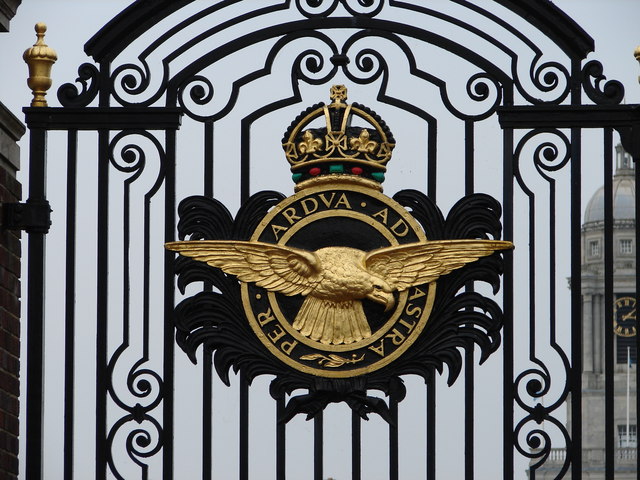
The RAF's motto is Per Ardua ad Astra and is usually translated from Latin as "Through Adversity to the Stars", but the RAF's official translation is "Through Struggle to the Stars". The choice of motto is attributed to a junior officer named J S Yule, in response to a request for suggestions from a commander of the Royal Flying Corps, Colonel Sykes.
The badge of the Royal Air Force was first used in August 1918. In heraldic terms, it is: "In front of a circle inscribed with the motto Per Ardua ad Astra and ensigned by the Imperial Crown an eagle volant and affronté head lowered and to the sinister". Although there have been debates among airmen over the years about whether the bird was originally meant to be an albatross or an eagle, the consensus is that it was always an eagle.
Ceremonial functions and display
Red Arrows
Main article: Red Arrows
The Red Arrows, officially known as the Royal Air Force Aerobatic Team, is the aerobatics display team of the Royal Air Force based at RAF Waddington. The team was formed in late 1964 as an all-RAF team, replacing a number of unofficial teams that had been sponsored by RAF commands. The Red Arrows badge shows the aircraft in their trademark Diamond Nine formation, with the motto Éclat, a French word meaning "brilliance" or "excellence".

Initially, they were equipped with seven Folland Gnat trainers inherited from the RAF Yellowjacks display team. This aircraft was chosen because it was less expensive to operate than front-line fighters. In their first season, they flew at sixty-five shows across Europe. In 1966, the team was increased to nine members, enabling them to develop their Diamond Nine formation. In late 1979, they switched to the BAE Hawk trainer. The Red Arrows have performed over 4,700 displays in fifty-six countries worldwide.
Battle of Britain Memorial Flight
The Battle of Britain Memorial Flight (BBMF) is a Royal Air Force unit providing that operates historic aircraft from WW2 era for ceremonial and commemoration purposes. Formed in 1957, BBMF comprises Spitfire and Hurricane fighters to represent the main types that fought in the Battle of Britain, but also an Avro Lancaster to commemorate Bomber Command and a Dakota to commemorate airborne forces contribution. The aircraft are regularly seen at events commemorating the Second World War and upon British State occasions, notably Trooping the Colour, Royal Weddings, key Royal Birthdays and Jubilee ceremonies.
King's Colour Squadron, Royal Air Force Regiment
The King's Colour Squadron is the unit of the Royal Air Force charged with the safe-keeping of the King's Colour for the Royal Air Force in the United Kingdom and the only dedicated Ceremonial drill unit of the RAF. Since its formation, it has been formed exclusively by Officers and Gunners of No. 63 Squadron RAF Regiment. KCS, as its known, is task with representing the UK and RAF at State and Ceremonial events (such as Remembrance Day at the Cenotaph, opening of Parliament and repatriation ceremonies). They also mount a guard a Buckingham Palace, Windsor Castle and the Tower of London, in place of the Army's Brigade of Guards each year.
Royal Air Force Music
Main article: Royal Air Force Music Services
Headquarters Royal Air Force Music Services, located at RAF Northolt, supports professional musicians who perform at events around the globe in support of the RAF. The Central Band of the Royal Air Force was established in 1920. Other bands include the Band of the Royal Air Force College, the Band of the Royal Air Force Regiment and the Band of the Royal Auxiliary Air Force.
Trooping the Colour
Main article: Trooping the Colour
The Royal Air Force, and its predecessor, the Royal Flying Corps, has provided the flypast for Trooping the Colour since 1913. The RFC performed its first flypast for King George V's Official Birthday over Laffin's Plain, Aldershot.
Footnotes
RAF ranks
Other notes
References
Sources
- Connolly, Corvin J. Marshal of the Royal Air Force Sir John Cotesworth Slessor and the Anglo-American Air Power Alliance, 1940–1945 (Texas A&M Press, 2001).
- Cox, Jafna L. "A splendid training ground: the importance to the Royal Air Force of its role in Iraq, 1919–32." Journal of Imperial and Commonwealth History 13.2 (1985): 157–184.
- Davis, Richard B. Bombing the European Axis Powers. A Historical Digest of the Combined Bomber Offensive 1939–1945 (Air University Press, 2006) online
- Gooderson, Ian. Air Power at the Battlefront: Allied Close Air Support in Europe 1943–45 (Routledge, 2013).
- Heaton, Colin D., and Anne-Marie Lewis. Night Fighters: Luftwaffe and RAF Air Combat Over Europe, 1939–1945 (Naval Institute Press, 2008).
- Hoffman, Bruce. British Air Power in Peripheral Conflict, 1919–1976 (RAND, 1989) online , with bibliography
- Lee, David. Eastward: a history of the Royal Air Force in the Far East, 1945–1972 (Seven Hills Books, 1984).
- Lee, David. Flight from the Middle East: A History of the Royal Air Force in the Arabian Peninsula and Adjacent Territories, 1945–1972 (HM Stationery Office, 1980).
- Maiolo, Joseph. Cry Havoc: How the arms race drove the world to war, 1931–1941 (2010)
- Miller, Russell. Boom: The Life of Viscount Trenchard, Father of the Royal Air Force (Weidenfeld, 2016)
- Philpott, Ian, ed. Royal Air Force History: Royal Air Force – an Encyclopaedia of the Inter-War Years (2 vol 2008)
- Rawlings, John D.R. The History of the Royal Air Force (1984) well illustrated.
- Richards, Denis, and David Pilgrim. Royal Air Force, 1939–1945: The fight at odds (1954), the official history.
- Ritchie, Sebastian. "The RAF, Small Wars and Insurgencies: Later Colonial Operations, 1945–1975" (2011)
- Saunders, Hilary. Per Ardua: The Rise of British Air Power, 1911–1939 (Oxford UP, 1945).
- Sinnott, Colin S. The RAF and Aircraft Design: Air Staff Operational Requirements 1923-1939 (Routledge, 2014).
- Smith, Malcolm. British Air Strategy Between the Wars (Oxford, The Clarendon Press, 1984).
- Smith, Gordon Scott. RAF War Plans and British Foreign Policy 1935–1940 (MIT Dept. of Political Science, 1966). online
- Werrell, Kenneth P. "The strategic bombing of Germany in World War II: Costs and accomplishments." Journal of American History 73.3 (1986): 702–713. online
References
- (December 2005). "4.1 The Royal Air Force logotype". [[Ministry of Defence (United Kingdom).
- "Our History". Royal Air Force.
- "Quarterly service personnel statistics 1 October 2024". Ministry of Defence.
- "UK armed forces equipment and formations 2024".
- "New official RAF Slow March". Royal Air Force.
- (2 May 2025). "StormShroud arrival marks the future of UK Air Combat Power". Royal Air Force.
- "Royal Air Force".
- (2011). "RAF Timeline 1918–1929". Royal Air Force.
- link. (1 January 2016 By David E. Omissi, Published 1 January 1990, Retrieved 1 February 2014. Page 8.)
- [https://www.bbc.co.uk/history/ww2peopleswar/timeline/factfiles/nonflash/a6649248.shtml BBC: Fact File: The RAF] {{Webarchive. link. (21 April 2015, retrieved 1 February 2014)
- "RAF in the bombing offensive against Germany". Royal Air Force.
- (2011). "Role of the RAF". Royal Air Force.
- (2011). "Role of Air Power". Royal Air Force.
- (31 January 2012). "Military Aircraft".
- [http://www.raf.mod.uk/careers/life-in-the-raf/our-hi-tech-gear/ Royal Air Force: Our high-tech gear] {{Webarchive. link. (3 February 2014, retrieved 1 February 2014)
- Keskinen, Kalevi, Partonen, Kyösti & Stenman, Kari: Suomen ilmavoimat I 1918–1927. Tietoteos, 2005. ISBN 952-99432-2-9.
- (2018-04-01). "The Royal Air Force's 100th Birthday and its founder – Jan Smuts". The Observation Post.
- "Sir David Henderson". Centre for First World War Studies, [[University of Birmingham]].
- (1 April 2018). "The birth of the Royal Air Force".
- Cox, Sebastian. (2018-04-01). "The birth of the Royal Air Force – History of government".
- Dickens, Peter. (April 2018). "The Royal Air Force's 100th Birthday and its founder – Jan Smuts".
- "Plaque: RAF Memorial". London Remembers.
- "History of Fleet Air Arm Officers Association, FAAOA".
- "History The Small Wars". Royal Air Force.
- Robertson, Scot. (1998). "The Development of Royal Air Force Strategic Bombing Doctrine between the Wars: A Revolution in Military Affairs?". Air and Space Power.
- (March 1995). "British and American Approaches to Strategic Bombing: Their Origins and Implementation in the World War II Combined Bomber Offensive". Journal of Strategic Studies.
- (21 May 2006). "RCAF.com : Archives : RCAF History : The War Years".
- "Explore: 'The Angry Sky'". ww2australia.gov.au.
- (March 2009). "The Few". The Churchill Centre.
- (2013). "The Bombing War". Penguin.
- [[Paul Brickhill]], ''The Dambusters''
- (2004). "Attack on Amiens Prison, 18th February 1944". RAF.
- (2011). "RAF Timeline 1945–1949". Royal Air Force.
- Aloni 2001, p. 10.
- "Israel v the RAF".
- Aloni 2001, pp. 18, 22.
- (2011). "RAF Timeline 1960–1969". Royal Air Force.
- Burnell, Brian. [http://nuclear-weapons.info/images/1984.PNG "Weapon detail and No. 15 Squadron data for 1984."] {{Webarchive. link. (10 October 2017 ''nuclear-weapons.info''. Retrieved 19 January 2011.)
- [http://www.mod.uk/NR/rdonlyres/65F3D7AC-4340-4119-93A2-20825848E50E/0/sdr1998_complete.pdf "Strategic Defence Review 1998: Full Report."] {{webarchive. link. (26 October 2012 ''Ministry of Defence,'' 1998, p. 24.)
- "Air of Authority – A History of RAF Organisation – Overseas Commands – Iraq, India and the Far East".
- "Operation Firedog : air support in the Malayan Emergency, 1948–1960". Imperial war Museum.
- "Seletar's Sunderlands". RAF Seletar.
- (20 August 2014). "Flight Lieutenant Jack Sherburn: Pilot awarded a DFC for his gallantry against the Mau Mau who went on to serve in Suez and fly with Yuri Gagarin". The Independent.
- "Suez Crisis". Britain's small wars.
- "Accident English Electric Canberra PR.7 WH799, 06 Nov 1956".
- (8 September 2016). "Britain's secret wars | Ian Cobain".
- Peterson, J. E.. (2013). "Oman's Insurgencies: The Sultanate's Struggle for Supremacy". Saqi.
- (12 August 1966). "Confrontation Ends". Straits Times.
- Ritchie 2011, p. 87.
- Ritchie 2011, pp. 86–87, 89, 92.
- Ashworth 1989, p. 26.
- Evans 1998, pp. 74–75.
- (15 June 1982). "Argentine Aircraft Lost – Falklands War 1982". Naval-history.net.
- (22 September 2009). "RAF Typhoons arrive for Falkland Islands mission – 9/22/2009". Flight Global.
- [http://www.raf.mod.uk/organisation/ExpeditionaryAirForce.cfm Royal Air Force: Expeditionary Air Force] {{webarchive. link. (14 February 2014 , raf.mod.uk)
- (17 January 2016). "Gulf War 25th anniversary special: a quick look at the RAF Tornado's reconnaissance missions over Iraq". Aviationist.
- (25 April 2000). "RAF 'nearly ran out of bombs' in Kosovo". The Guardian.
- ''Tornados Bound for Kandahar'', [[Air Forces Monthly]], August 2008 issue, p. 8.
- "903 Expeditionary Air Wing". Royal Air Force (RAF).
- (22 April 2011). "MOD rushes new transport plane into service for operations". The Telegraph.
- Grzeszczyk, Sian. (26 September 2022). "Eight years of Operation Shader: The UK's mission against IS".
- (8 November 2007). "Reaper Takes to the Air".
- Hoyle, Craig. (16 June 2008). "UK cheers the Reaper UAV".
- (1 April 2008). "90th Anniversary Flypast in London". RAF News Archives.
- "BBC Media Player".
- "Flypast marks RAF's anniversary". BBC News.
- (August 2021). "Lots of Losers in U.K. Defense Review". DefenseNews.
- Wilkinson, Tom. (24 November 2010). "Last Harrier jet leaves Ark Royal". Independent.
- [http://www.flightglobal.com/news/articles/picture-raf-typhoons-intercept-russian-bombers-363985/ RAF Typhoons intercept Russian bombers] {{Webarchive. link. (19 February 2014 (flightglobal.com), 27 October 2011)
- [https://publications.parliament.uk/pa/cm201213/cmhansrd/cm130124/text/130124w0001.htm Hansard] {{Webarchive. link. (14 June 2018 (publications.parliament.uk), 24 January 2014)
- UK Ministry of Defence press release 20 September 2012
- "Farewell to RAF UK Search & Rescue".
- Allison, George. (1 March 2018). "Royal Air Force surveillance satellite launched into space". UK Defence Journal.
- Corfield, Gareth. (1 March 2018). "Brit military boffins buy airtime on HD eye-in-the-sky video satellite". The Register.
- "RAF100".
- (10 July 2018). "RAF marks 100 years with day of centrepiece celebrations".
- "RAF100 Parade & Flypast 2018".
- (12 June 2020). "COVID Support Force: the MOD's contribution to the coronavirus response".
- (8 March 2021). "Tactical Medical Wing Personnel Support NHS During Coronavirus Pandemic".
- (16 July 2020). "Fighting an invisible enemy at home and overseas".
- (29 August 2021). "Afghanistan: British ambassador home as last UK troops leave".
- "Afghanistan: Operation Pitting".
- (4 May 2023). "Sudan: Final UK evacuation flight leaves the country".
- Haynes, Deborah. (15 May 2023). "UK will be left 'dangerously exposed' when it cuts fleet of special forces aircraft, sources say".
- (14 April 2024). "RAF fighter jets shot down Iran drones, Rishi Sunak says".
- (2025-03-26). "Three RAF helicopters to perform farewell flypast over Northern Ireland". BelfastTelegraph.co.uk.
- Newton, Simon. (2025-03-26). "RAF bids a fond farewell to its Pumas as they take part in goodbye flypast".
- (2025-07-24). "More than 100 arrests over Palestine Action ban protests". BBC News.
- (2025-07-23). "Palestine Action to be banned after RAF base break in". BBC News.
- "Three groups to be proscribed".
- (12 March 2020). "Air Command senior, as of September 2018". Ministry of Defence.
- "Chief of the Air Staff".
- "Senior Commanders".
- "RAF High Wycombe".
- (23 February 2021). "Q&A: Air Vice-Marshal Harv Smyth talks UK Space Command". Airforce Technology.
- (2 February 2021). "UK Space Command at RAF High Wycombe – Air Commodore Paul Godfrey to lead". Bucks Free Press.
- "No. 1 Group".
- "No. 2 Group".
- "No. 11 Group".
- "No 22 Group".
- "Royal Air Force".
- "RAF Stations".
- "Quick Reaction Alert".
- (12 December 2012). "Permanent Joint Operating Bases (PJOBs)". Ministry of Defence.
- (17 March 2014). "House of Commons – Hansard Written Answers for 17 March 2014 : Column 493W".
- (17 April 2024). "The return of 80 Squadrons for the RAF and the Royal Australian Air Force". Royal Air Force.
- Cacoyannis, Xenia Zubova Sofie. (4 April 2023). "Start of a new era at RAF Akrotiri as Pumas replace Griffin helicopters in Cyprus".
- (24 May 2023). "RAF Benson – Last week, on the 18th May, 230 Squadron officially re-mustered in Brunei marking its return to South East Asia... {{!}} Facebook".
- "RAF Station organisation". Armed forces.
- "History of 1435 Squadron". [[Ministry of Defence (United Kingdom).
- Stone, Trevor. (2017). "Sustaining Air Power: Royal Air Force Logistics since 1918". Fonthill Media.
- "Number 34 Expeditionary Air Wing". RAF.
- (27 October 2017). "A Special Thank You For RAF Personnel Involved in Op Ruman". Forces Network.
- "RAF Mareham". RAF.
- "No 83 Expeditionary Air Group".
- (23 February 2013). "Robert Smith-Barry: The man who taught the world to fly". BBC.
- "Welcome to RAF Shawbury". RAF.
- "Royal Air Force".
- "New Gliding School Launches for Air Cadets". Air Cadets.
- "Elementary Flying Training". Royal Navy.
- "RAF Cranwell". Royal Air Force.
- "RAF Valley". Royal Air Force.
- "6 Flying Training School".
- "Defence College of Technical Training". RAF.
- "RAF – Defence College of Technical Training".
- "RAF Cosford".
- "MOD St Athan".
- here, RAF Details. "RAF – DSCIS".
- "Royal Air Force Centre for Air Power Studies". Air Power Studies.
- "Air Warfare Centre". armedforces.co.uk.
- (16 September 2010). "Defence Review: inside the college that trains the top brass". Telegraph.
- (3 June 2006). "Fly-past for Britain's oldest man". BBC News.
- [https://www.gov.uk/government/uploads/system/uploads/attachment_data/file/402652/MPR_January_2015.pdf gov.uk MoD – regular personnel] {{Webarchive. link. (2 April 2015 , table 2-page 8. 1 January 2015.)
- [https://www.gov.uk/government/uploads/system/uploads/attachment_data/file/402633/quarterly_personnel_report_jan15.pdf gov.uk MoD – quarterly personnel report] {{Webarchive. link. (21 April 2016 , table 4-page 9. 1 January 2015.)
- [http://www.dasa.mod.uk/publications/personnel/military/reserves-and-cadets-strengths/2012-04-01/2012-revised.pdf dasa.mod – reserves and cadet strengths] {{Webarchive. link. (3 December 2013 , table 4-page 6. April 2012.)
- [https://www.gov.uk/government/uploads/system/uploads/attachment_data/file/314795/uk_reserve_force_cadets_2014.pdf gov.uk MoD – reserves and cadet strengths] {{Webarchive. link. (8 March 2016 , table 4-page 13. See note 2. April 2014.)
- [https://www.gov.uk/government/uploads/system/uploads/attachment_data/file/314795/uk_reserve_force_cadets_2014.pdf gov.uk MoD – reserves and cadet strengths] {{Webarchive. link. (8 March 2016 , table 4-page 13. April 2014.)
- [[#IISS2012. IISS 2012]], p. 171
- [[#IISS2012. IISS 2012]], pp. 111–120
- (9 August 2016). "RAF IOT Breakdown".
- "Commissioned ranks of the Royal Air Force 1919–present". Air of Authority – A history of RAF Organisation.
- G. H. Chaffe (ed.), ''Careers Encyclopædia'', Avon Press: London, 1952.
- "Recruit training". RAF.
- "Warrant Officer of the Royal Air Force". Royal Air Force.
- "Typhoon FGR4". Royal Air Force.
- Jennings, Gareth. (22 September 2014). "RAF Lossiemouth undertakes first QRA North scramble". IHS Jane's Defence Weekly.
- Hoyle, Craig. (22 March 2011). "UK retires last Tornado F3 fighters". Flight Global.
- Hoyle, Craig. (8 November 2018). "The UK Royal Air Force is advancing with preparations to mark the departure from service of its last Panavia Tornado GR4 strike aircraft next March". Flight Global.
- Lake, Jon. (4 February 2019). "RAF Typhoons replace Tornados in Operation 'Shader' armed with Brimstone for first time". Jane's 360.
- Jennings, Gareth. (6 July 2018). "RAF receives first 'Centurion' Typhoons ahead of Tornado retirement". Jane's 360.
- (13 November 2019). "Royal Air Force jets to patrol Icelandic skies for NATO". Royal Air Force.
- (26 March 2025). "Op Chessman - RAF Typhoons arrive in Poland for Enhanced Air Policing mission".
- "Typhoon aircraft relocate to RAF Lossiemouth". [[HM Government]].
- A referenced to aircraft of the [[Hal Far Fighter Flight RAF]] which defended Malta in the Second World War
- "RAF Mount Pleasant – 1435 Flight". Royal Air Force.
- Warnes, Alan. (June 2020). "Reaching for the stars: UK combat air". [[Key Publishing]].
- (22 March 2021). "Defence in a competitive age". [[Ministry of Defence (United Kingdom).
- (23 March 2021). "The UK's integrated review and Defence Command Paper". Janes.
- (1 April 2025). "UK retires Tranche 1 Eurofighters". Janes.
- (12 January 2024). "Air strikes against Houthi military targets in Yemen: 11 January 2024".
- Newdick, Thomas. (17 December 2021). "British Typhoon Fighter Downed A Drone Over Syria For Its First Air-To-Air Kill".
- "Lightning F-35B".
- (2 August 2012). "UK Tornado fleet to retire in 2019, says BAE". Flightglobal.com.
- (25 March 2013). "BBC News – RAF Marham base for Joint Strike Fighter". BBC.
- Corfield, Gareth. (19 May 2017). "Blighty's buying another 17 F-35s, confirms the American government".
- Allison, George. (19 August 2025). "Britain takes delivery of 40th F-35B Lightning jet".
- (17 November 2021). "HMS Queen Elizabeth: British F-35 crashes in Mediterranean".
- Chalk, Alex. (9 January 2023). "Letter dated 9th January from Secretary of State to Chair regarding F-35 Update".
- "17(R) Squadron". Royal Air Force.
- (2018-04-18). "RAF's legendary Dambusters squadron reforms to fly F-35 Lightning jets | Royal Air Force". Raf.mod.uk.
- Taz Ali. (7 June 2018). "F-35 Lightning fighter jets arrive at RAF Marham | Latest Norfolk and Suffolk News – Eastern Daily Press". Edp24.co.uk.
- (4 August 2018). "Further five F-35 fighter jets land at new RAF Marham home".
- "First F-35 jets ready to battle for Britain".
- (5 July 2017). "Identity of F-35 Lightning Training Squadron Announced". Royal Air Force.
- (17 July 2019). "Second Lightning Fight Jet Squadron Arrives In UK".
- (8 December 2023). "Immortals return: 809 Squadron rises from the ashes to operate the F-35B".
- (2025-06-25). "UK to purchase nuclear-carrying F-35A fighter jets".
- "RAF F-35A marks a significant step in delivering a more lethal Integrated Force and joining NATO Nuclear Mission".
- Allison, George. (26 June 2025). "New British nuclear strike jet can't be refuelled by RAF".
- "Shadow R1". Royal Air Force.
- (27 November 2015). "UK To Acquire Two More Beechcraft King Air 350-Derived Shadow R.1".
- (13 January 2009). "UK converts King Air 350s into ISTAR platforms". defence-solutions.co.uk.
- (26 June 2025). "Protector RG1 UAV has officially entered RAF service – European Security & Defence".
- Jennings, Gareth. (2 October 2023). "GA-ASI delivers first Protector UAV to UK".
- (5 October 2015). "'Protector' UAV fleet to replace RAF Reapers".
- (7 October 2015). "MoD reveals Reaper derivative will be chosen for Protector".
- Stevenson, Beth. (2016-11-18). "US approves sale of up to 26 Protector UAVs to UK | News". Flight Global.
- . (15 July 2020). ["MOD signs £65 million contract for Protector aircraft"](https://www.gov.uk/government/news/mod-signs-65-million-contract-for-protector-aircraft). *UK Ministry of Defence*.
- (15 July 2020). "UK orders first three Protector drones from General Atomics". Defence News.
- (23 October 2023). "First Protector aircraft has arrived at RAF Waddington". Royal Air Force.
- Jennings, Gareth. (12 October 2023). "RAF reconstitutes 31 Squadron as new Protector unit".
- (12 July 2018). "RAF announces new Typhoon, Protector squadrons". IHS Janes.
- (16 June 2025). "Protector Enters Service with Royal Air Force".
- "RC-135W Rivet Joint". Royal Air Force.
- (28 June 2011). "Nimrod R1 aircraft in final flight for RAF". BBC News.
- Ministry of Defence. (22 December 2010). "Rivet Joint joins Future Force 2020". Mod.uk.
- (16 November 2014). "Iraq: 'Secret' Surveillance Flights Revealed". Sky News.
- (26 October 2021). "UK and US extend Rivet Joint support until 2035". Royal Air Force.
- Hoyle, Craig. "UK pushes delayed Wedgetail service entry target into 2026".
- "Wedgetail AEW Mk1".
- "54 Squadron". Royal Air Force.
- "56 Squadron". Royal Air Force.
- Allison, George. (22 August 2018). "RAF announce that the P-8A Maritime Patrol Aircraft will be 'Poseidon MRA Mk1' in UK service".
- (23 November 2015). "Defence review: Main developments at a glance". BBC News.
- (13 July 2017). "Defence Secretary announces new Maritime Patrol Aircraft squadrons". Ministry of Defence.
- (22 October 2021). "RAF 201 Squadron reclaims standard from Guernsey".
- Chorley, Dan. (13 October 2020). "RAF Poseidon MRA1 arrives at RAF Lossiemouth for the first time". Royal Air Force.
- (1 November 2023). "Number 42 Squadron reforms at RAF Lossiemouth". Royal Air Force.
- (13 July 2019). "Poseidon, The UK'S New Maritime Patrol Aircraft, Takes to the Skies". Royal Air Force.
- (4 February 2020). "New Poseidon Maritime Patrol Aircraft lands in UK for first time". Royal Air Force.
- (3 April 2020). "RAF Declare Poseidon an Initial Operating Capability". Royal Air Force.
- (7 August 2020). "First Operation for RAF Poseidon tracking Russian Warship". Royal Air Force.
- Allison, George. (11 January 2022). "Final P-8 Poseidon Maritime Patrol Aircraft arrives in Scotland".
- Gribben, Roland. (31 July 2000). "MoD 'embarrassed' at cost of Boeing C-17 lease deal". The Telegraph.
- (22 July 2004). "Review turns up the heat on eurofighter".
- (11 June 2008). "Boeing Delivers 6th C-17 to Royal Air Force".
- (17 November 2010). "Boeing Delivers UK Royal Air Force's 7th C-17 Globemaster III". Indian Defence Review.
- (8 February 2012). "UK to buy eighth C-17 transport". Flight International.
- (24 May 2012). "New RAF C-17 aircraft touches down in the UK". Ministry of Defence.
- "C-130J Hercules". Royal Air Force.
- "Atlas C.1 (A400M)". Royal Air Force.
- (27 November 2014). "First UK A400M Atlas delivered to the RAF". Ministry of Defence.
- "MOD signs contracts and agreements for new RAF aircraft and weapons". Ministry of Defence.
- (21 July 2017). "Hercules Aircraft: Written question – 4690".
- Dunlop, Tom. (22 May 2023). "New Atlas transport aircraft delivered to UK".
- (1 February 2023). "Oral evidence: Work of the Chief of the Air Staff, HC 1108".
- (8 June 2023). "Number 47 Squadron Mark the End of an Era with a Royal Parade".
- "XXIV Squadron". Royal Air Force.
- "206 Squadron". Royal Air Force.
- "Voyager". Royal Air Force.
- (19 April 2011). "Voyager, biggest plane in RAF history, arrives in UK". BBC News.
- (9 April 2012). "Airbus Military's A330 MRTT begins its service career with the UK Royal Air Force". Airbus.
- Hoyle, Craig. (21 May 2013). "RAF Voyager launches tanker operations with Tornado". Flight International.
- (2019). "Military Aircraft Markings". Crécy Publishing Ltd..
- (5 July 2013). "RAF, USAF Work on Rivet Joint Refueling Deal.". Aviationweek.com.
- (8 February 2022). "DE&S procure new aircraft to enhance UK's international presence".
- (18 May 2022). "Latest aircraft into RAF fleet to be named Envoy IV".
- (28 November 2023). "Centreline Extend CSAT Contract with Ministry of Defence".
- (1 July 1998). "Strategic Defence Review". Ministry of Defence.
- (14 May 2020). "22 Squadron Re-Forms At RAF Benson". Royal Air Force.
- Baldwin, Harriett. (7 December 2017). "Chinook Helicopters: Written question – 116751".
- (9 February 1978). "Boeing Unit to Make Helicopters for U. K. In $200 Million Job". The Wall Street Journal.
- (10 March 1995). "Company News; Boeing and Westland Split British Helicopter Order". The New York Times.
- (16 June 2014). "RAF flying high in new Chinook helicopters". Ministry of Defence.
- (19 October 2018). "United Kingdom – H-47 Chinook (Extended Range) Helicopters and Accessories". United States Defense Security Cooperation Agency.
- "Chinook". Royal Air Force.
- (22 November 2020). "Chinook arrival with Royal Air Force remembered". Royal Air Force.
- (24 March 2020). "RAF Squadrons Receive Battle Honours from Her Majesty The Queen". Royal Air Force.
- "Hurricane Irma Relief". Royal Air Force.
- Tanguy, Jean-Marc. (June 2020). "Airlifters in Africa". Key Publishing Ltd..
- (10 December 2015). "Final new-build Chinook HC6s delivered to UK RAF".
- Baldwin, Harriett. (7 December 2017). "Chinook Helicopters: Written question – 116751". UK Parliament.
- "Ascent Flight Training".
- (2 February 2016). "UKMFTS Fixed Wing Aircraft Service Provision Contract Awarded".
- "Tutor T1".
- (11 May 2018). "RAF grounds its training gliders over safety fears". The Times.
- "Fixed-wing Light Aircraft Training System – Contracts Finder". Contractsfinder.service.gov.uk.
- "Prefect T1".
- (April 2018). "First T-6C Texan IIs arrive at Valley". Air Forces Monthly.
- Cone, Allen. (22 February 2019). "Britain tests Texan T1 training aircraft for first time".
- (3 November 2020). "Four new Texan aircraft arrive at RAF Valley".
- "XXV (F) SQUADRON". Royal Air Force.
- "Operational conversion". RAF.
- "Second joint RAF & Qatari air force squadron intended for UK". Royal Air Force.
- (1 April 2021). "Royal Air Force and Qatar Emiri Air Force Expand Defence Partnership". Royal Air Force.
- (2 September 2021). "RAF Leeming welcomes first Qatari Hawks". Royal Air Force.
- (24 November 2021). "New Joint Hawk Squadron unveiled during Reformation Event at RAF Leeming". Royal Air Force.
- "Phenom T1".
- Dufton, Lieutenant Colonel Jon. (2018). "Foreword". Aries.
- (11 July 2018). "202 Sqn Jupiter HT1 positioning for RAF100 flypast". 202 Squadron Association.
- (29 July 2014). "UK sets out post-2030 combat aviation force structure". Janes.
- Callum Jones. "RAF unveils £2bn plan for new Tempest fighter jet (and it has lasers) | News". The Times.
- (22 March 2019). "Wedgetail To Be RAF'S New Early Warning Aircraft". Royal Air Force.
- Quin, Jeremy. (11 May 2020). "AWACS: Written question – 41916".
- (18 December 2020). "RAF surveillance fleet to be based in Moray". Royal Air Force.
- Jennings, Gareth. (28 September 2021). "UK retires Sentry AEW1".
- Hoyle, Craig. (6 May 2025). "UK pushes delayed Wedgetail service entry target into 2026".
- (26 March 2021). "Defence and Security Industrial Strategy: A strategic approach to the UK's defence and security industrial sectors (CP 410)". Ministry of Defence.
- (3 November 2022). "UK's New Medium Helicopter (NMH) programme".
- Jennings, Gareth. (2 November 2022). "UK downselects New Medium Helicopter contenders".
- (27 February 2024). "Future UK military helicopter reaches next competition stage".
- Robertson 1967, p 89
- "The RAF Roundel". RAF.
- Air Ministry Orders A.666/49, 15 September 1949
- (2011). "Frequently Asked Questions". Royal Air Force.
- "The Royal Air Force Motto". RAF.
- W/C F.H. Hitchins. "It's an albatross, it's an eagle ... it's an eagle". Forces.gc.ca.
- "Team History". Royal Air Force Arrows.
- "Red Arrows". Royal Air Force.
- "Battle of Britain Memorial Flight".
- "King's Colour Squadron".
- "Central Band of the Royal Air Force".
- "RAF – The Band of the Royal Auxiliary Air Force".
- (4 September 2005). "Trooping the Colour (The Queen's Birthday Parade)".


This article was imported from Wikipedia and is available under the Creative Commons Attribution-ShareAlike 4.0 License. Content has been adapted to SurfDoc format. Original contributors can be found on the article history page.
Ask Mako anything about Royal Air Force — get instant answers, deeper analysis, and related topics.
Research with MakoFree with your Surf account
Create a free account to save articles, ask Mako questions, and organize your research.
Sign up freeThis content may have been generated or modified by AI. CloudSurf Software LLC is not responsible for the accuracy, completeness, or reliability of AI-generated content. Always verify important information from primary sources.
Report