From Surf Wiki (app.surf) — the open knowledge base
Roman candle (firework)
Firework that ejects stars or exploding shells
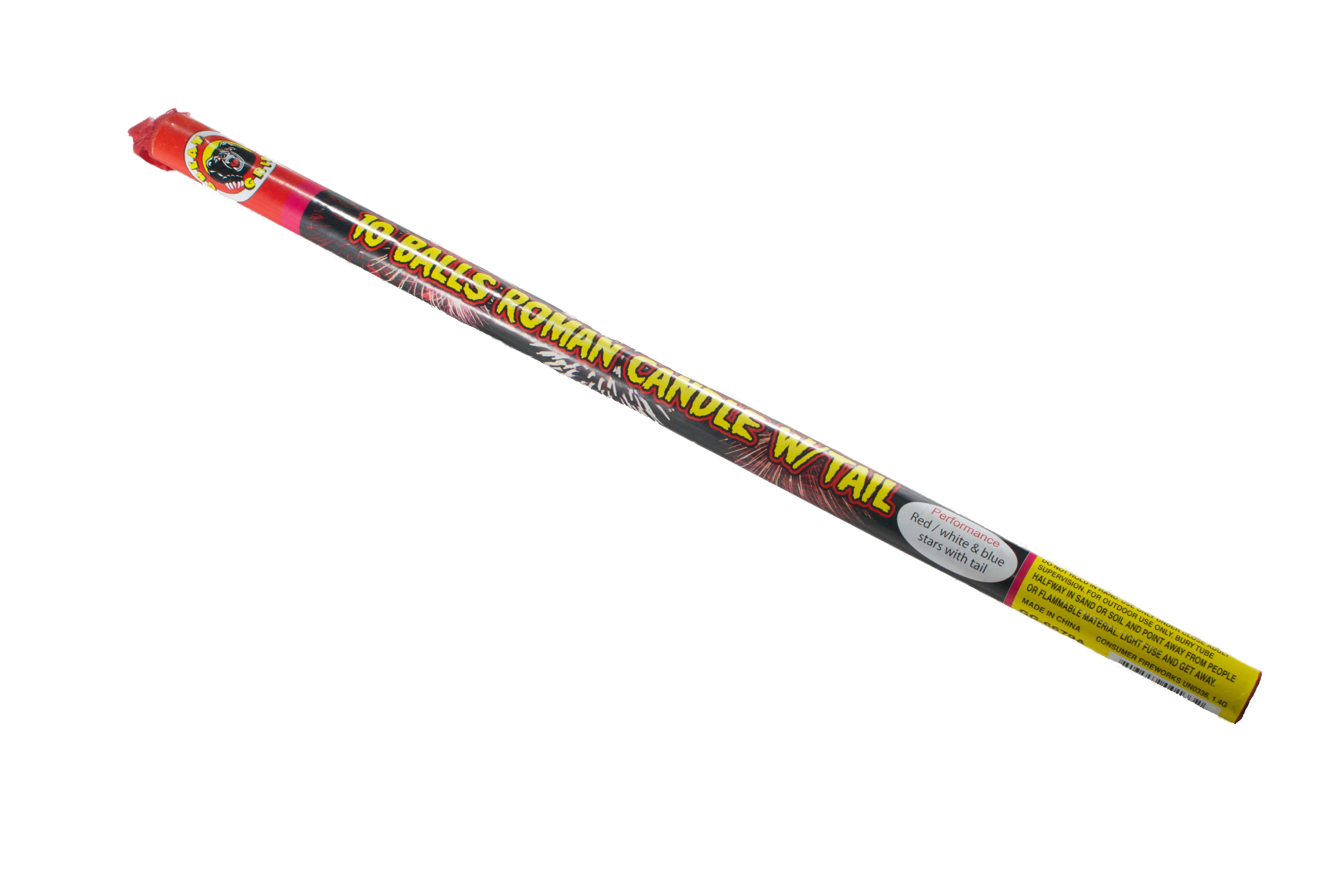
Firework that ejects stars or exploding shells
A Roman candle is a traditional type of firework that ejects one or more stars or exploding shells. Roman candles come in a variety of sizes, from 6 mm diameter for consumers, up to 8 cm diameter in professional fireworks displays.
Roman candles are banned in some countries as they have a tendency to malfunction. They are banned in Finland and the Netherlands, and illegal to possess or set off in the U.S. states of California, Delaware, Florida, Maryland, Massachusetts, Minnesota, New Jersey, New York, North Carolina, Oregon, and Rhode Island.
Construction and ignition
Roman candles are fireworks constructed with bentonite, lifting charge, pyrotechnic star, black powder, and delay charge. The device is ignited from the top, which should be pointed into the sky, away from people. The delay powder is packed tightly in the tube, so that the flame cannot reach around the sides of the plug of delay composition. It therefore burns slowly; as it is consumed, the flame moves down through the tube. When the flame reaches the topmost pyrotechnic star, the star is ignited. Because the star fits loosely in the tube, the fire spreads around it and ignites the lift charge. The lift charge burns quickly, propelling the star out of the tube. In doing so it also ignites the layer of delay powder beneath it, and the process repeats. There are several variations on this:
- Many Chinese Roman candles use clay instead of delay powder and run a length of fuse down the inside of the candle to time the lifts.
- Larger Roman candles (three-inch diameter or more) usually add more lift to the highest layers and less to the lower layers in order to cause the stars to lift to the same altitude. This is due to the shorter length of tube available for accelerating the higher stars (see firearms internal ballistics).
- Some very large Roman candles load comet shells instead of stars.
Star colors and chemistry
The stars of Roman candles can be found in a variety of colors. Colors are manipulated by adding compounds which, when ignited, release visible light and other radiation. For example, when potassium perchlorate (KClO4) is used as an oxidizer, chemical reactions involving the dissociated elements of the perchlorate—potassium and chlorine ions—create barium compounds which emit green light (especially BaCl2). The potassium compounds formed by this reaction emit mostly near-infrared light, and so they do not affect the color of the star in a significant way. This reaction occurs at temperatures exceeding 2500 °C (4500 °F), at which the ions in KCl dissociate into free K+ and Cl−. Alternatively, SrCO3 can be added to the candle to produce a red or pink star, but, because it does not oxidize, more oxidizers and fuels must be added to sustain combustion. During combustion, various strontium compounds (especially Sr(OH)2) emit red light, most of which is between 506 and 722 nm in wavelength.
References
References
- Kosanke, K. L.. (2003). "“Impossible” and Horrific Roman Candle Accident". Selected Pyrotechnic Publication of K.L. and B.J Kosanke.
- "Finland".
- (2020-07-08). "Verboden vuurwerk vanaf 2020".
- (June 28, 2022). "Person Cited After Roman Candle Starts Small Fire In Woodland". [[KOVR]].
- (June 24, 2022). "Check out Delaware's fireworks laws before you light up your July 4th celebration". [[Delaware News Journal]].
- (2013-07-01). "Officials urge caution when fireworks are part of the celebration". Orlando Sentinel.
- (Sep 2016). "Law Enforcement Guide to Fireworks Identification".
- (July 3, 2022). "Massachusetts State Police seize more fireworks, charge 4 people ahead of Fourth of July". [[Boston Herald]].
- (July 2, 2022). "For those who don't enjoy fireworks, some tips for this holiday weekend".
- (Jun 29, 2017). "Christie legalizes some fireworks in time for your 4th of July celebration". NJ Star-Ledger.
- (June 29, 2022). "Fireworks in NYS: What's allowed and what's not?".
- "Fireworks: What's legal & illegal in NC".
- (June 27, 2022). "Fire Marshal about Oregon fireworks: "Keep it legal, keep it safe."".
- "Fireworks Laws".
- (2000). "The chemistry of fireworks". Royal Society of Chemistry.
This article was imported from Wikipedia and is available under the Creative Commons Attribution-ShareAlike 4.0 License. Content has been adapted to SurfDoc format. Original contributors can be found on the article history page.
Ask Mako anything about Roman candle (firework) — get instant answers, deeper analysis, and related topics.
Research with MakoFree with your Surf account
Create a free account to save articles, ask Mako questions, and organize your research.
Sign up freeThis content may have been generated or modified by AI. CloudSurf Software LLC is not responsible for the accuracy, completeness, or reliability of AI-generated content. Always verify important information from primary sources.
Report