From Surf Wiki (app.surf) — the open knowledge base
Rochester, New York
City in New York, United States
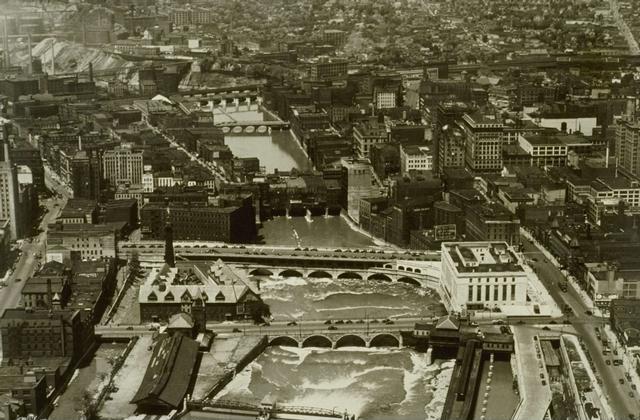
City in New York, United States
| Field | Value |
|---|---|
| name | Rochester, New York |
| settlement_type | City |
| image_skyline | {{multiple image |
| total_width | 280 |
| border | infobox |
| perrow | 1/2/2/2/1 |
| caption_align | center |
| image1 | Downtown Rochester, NY HDR by patrickashley.jpg |
| caption1 | Downtown Rochester |
| image2 | RushRheesLibraryOnTheEveOfGraduation.jpg |
| caption2 | University of Rochester |
| image3 | 2. Grove Place.jpg |
| caption3 | Grove Place |
| image4 | Building on George Eastman House Grounds 03.jpg |
| caption4 | George Eastman Museum |
| image5 | Memorial Art Gallery main entrance.JPG |
| caption5 | Memorial Art Gallery |
| image6 | External view of Museum of Play.jpg |
| caption6 | The Strong National Museum of Play |
| image7 | 1874 Gate House.jpg |
| caption7 | Mount Hope Cemetery |
| image_flag | Flag of Rochester, New York.svg |
| flag_size | 110px |
| image_seal | Seal of Rochester, New York.svg |
| seal_size | 88px |
| image_blank_emblem | Logo of Rochester, New York.svg |
| blank_emblem_type | Logo |
| blank_emblem_size | 80px |
| nicknames | "The Flour City", "The Flower City", "The World's Image Center" |
| named_for | Nathaniel Rochester |
| mapframe | yes |
| mapframe-zoom | 10 |
| mapframe-point | none |
| pushpin_map | New York#USA |
| pushpin_relief | yes |
| coordinates | |
| subdivision_type | Country |
| subdivision_name | United States |
| subdivision_type1 | State |
| subdivision_name1 | New York |
| subdivision_type2 | Region |
| subdivision_name2 | Western New York; Genesee Valley; Finger Lakes Region |
| subdivision_type3 | Metro |
| subdivision_name3 | Rochester metropolitan area |
| subdivision_type4 | County |
| subdivision_name4 | Monroe |
| established_title | Founded |
| established_date | |
| established_title2 | Incorporated (village) |
| established_date2 | (as Rochesterville) |
| established_title3 | Incorporated (city) |
| established_date3 | |
| government_type | Strong mayor-council |
| leader_title | Mayor |
| leader_name | Malik Evans (D) |
| leader_title1 | City council |
| leader_name1 | {{Collapsible list |
| title | List |
| frame_style | border:none; padding: 0; |
| title_style | |
| list_style | text-align:left;display:none; |
| 1 | At-Large Members |
| 2 | President: |
| 3 | • Miguel Meléndez (D) |
| 4 | East District - Vice President: |
| 5 | • Mary Lupien (D) |
| 6 | Other At-Large: |
| 7 | • Wilie Lightfoot (D) |
| 8 | • Mitchell D. Gruber (D) |
| 9 | • Stanley Martin (D) |
| 10 | • Kim Smith (D) |
| 11 | Northeast District: |
| 12 | • Michael A. Patterson (D) |
| 13 | South District: |
| 14 | • LaShay Harris (D) |
| 15 | Northwest District: |
| 16 | • Bridget Monroe (D) |
| unit_pref | Imperial |
| area_footnotes | |
| area_total_km2 | 96.27 |
| area_total_sq_mi | 37.17 |
| area_land_km2 | 92.62 |
| area_land_sq_mi | 35.76 |
| area_water_km2 | 3.65 |
| area_water_sq_mi | 1.41 |
| area_water_percent | 3.6 |
| elevation_max_m | 214 |
| elevation_max_ft | 702 |
| elevation_min_m | 70 |
| elevation_min_ft | 230 |
| population_total | 211328 |
| population_as_of | [2020](2020-united-states-census) |
| population_density_km2 | 2281.62 |
| population_density_sq_mi | 5909.45 |
| population_urban | 704,327 (US: 62nd) |
| population_density_urban_km2 | 931.9 |
| population_density_urban_sq_mi | 2,413.5 |
| population_metro | 1,067,486 (US: 52nd) |
| population_demonym | Rochesterian |
| postal_code_type | ZIP codes |
| postal_code | 146xx (14604=downtown) |
| area_code | 585 |
| area_code_type | Area code |
| website | |
| utc_offset | −05:00 |
| timezone_DST | EDT |
| utc_offset_DST | −04:00 |
| blank_name | FIPS code |
| blank_info | 36-63000 |
| blank1_name | GNIS feature ID |
| blank1_info | 979426 |
| population_rank | US: 116th NY: 4th |
| timezone1 | EST |
| mapframe-zoom = 10 | mapframe-point = none
Rochester is a city in and the county seat of Monroe County, New York, United States. It is the fourth-most populous city in New York, with a population of 211,328 at the 2020 census. The Rochester metropolitan area in Western New York has an estimated 1.06 million residents and is the 54th-largest metropolitan area in the U.S. Throughout its history, Rochester has acquired several nicknames based on local industries; it has been known as "the Flour City" and "the Flower City" for its dual role in flour production and floriculture, and as the "World's Image Center" for its association with film, optics, and photography.
The city was one of the United States' first boomtowns, initially due to the fertile Genesee River valley which gave rise to numerous flour mills, and then as a manufacturing center, which spurred further rapid population growth. Rochester has also played a key part in US history as a hub for social and political movements, especially abolitionism, and the women's rights movement.
Rochester is the birthplace and/or home of many notable companies including Eastman Kodak, Xerox, Bausch & Lomb, Wegmans, Constellation Brands, Gannett, Paychex, and Western Union. In part due to their influence, the region became a global center for science, technology, and research and development. This has been aided by the presence of several internationally renowned universities, notably the University of Rochester and Rochester Institute of Technology (RIT), and their research programs; these schools, along with many other smaller colleges, have played an increasingly large role in its economy. The city experienced significant population decline due to deindustrialization in the late 20th century, although less severely than its Rust Belt peers. The Rochester metropolitan area is the third-largest regional economy in New York, after New York City and Buffalo–Niagara Falls.
Rochester is also known for its culture; in particular, the Eastman School of Music, one of the most prestigious conservatories in the world, and the Rochester International Jazz Festival anchor a vibrant music industry. It is the site of several museums such as The Strong National Museum of Play and the George Eastman Museum, which houses the oldest photography collection in the world.
History
Main article: History of Rochester, New York
18th century
The Seneca tribe of the Iroquois Confederacy lived around Rochester prior to the American Revolution, and used the area as a hunting ground. Allied with the British, the Seneca were forced to cede or sell most of their land in New York after the war. The area now occupied by Rochester was ceded in the Phelps and Gorham Purchase of 1788. As a reward for their loyalty to the British crown, the Iroquois were given a large land grant on the Grand River in Canada.
19th century
Rochester was founded shortly after by a wave of English-Puritan-descended immigrants from New England, who were looking for new agricultural land. They were the dominant cultural group in Rochester for over a century. On November 8, 1803, three men from Hagerstown, Maryland, purchased a 100-acre (40-ha) tract from the Pulteney Estate along the Genesee River: Major Charles Carroll, Colonel William Fitzhugh Jr, and Colonel Nathaniel Rochester, the namesake of the city. They chose the site because its three cataracts on the Genesee offered great potential for water power. Beginning in 1811, and with a population of 15, the three founders surveyed the land and laid out streets and tracts. In 1817, the Brown brothers and other landowners joined their lands with the Hundred Acre Tract to form the village of Rochesterville. This name was unpopular, and in 1822 it was shortened to Rochester.
By 1821, Rochesterville became the seat of Monroe County. In 1823, the Erie Canal aqueduct over the Genesee River was completed, connecting the city to the Hudson River to the east. New commerce from the canal turned the village into America's first boomtown. By 1830, Rochester's population had grown to 9,200, and in 1834, it was rechartered as a city. Rochester was first known as "the Young Lion of the West", and then as the "Flour City". By 1838, it was the largest flour-producing city in the United States. A series of religious revivals occurred as part of the Second Great Awakening, including a particularly notable revival led by Charles Grandison Finney which inspired local social reform movements.
During the mid-19th century, as the center of the wheat-processing industry moved west with population and agriculture, the city became home to an expanding nursery business, giving rise to the city's second nickname, the Flower City. Nurseries ringed the city, the most famous of which was started in 1840 by immigrants George Ellwanger from Germany and Patrick Barry from Ireland. Shoemaking also became a major local industry as the city began to industrialize.
In 1847, Frederick Douglass founded The North Star, an abolitionist newspaper, in Rochester. A former slave and an antislavery speaker and writer, he gained a circulation of over 4,000 subscribers in the United States, Europe, and the Caribbean. Douglass lived in Rochester until his home was destroyed in a fire in 1872, and a historical marker was erected at the site on South Avenue. Many other prominent abolitionists operated in the area and operated on the Underground Railroad, such as Thomas James and Austin Steward.
Around the same time, the nearby Finger Lakes region was the birthplace of the women's suffrage movement. A critical suffragettes' convention was held in 1848 in nearby Seneca Falls, and Rochester was the home of Susan B. Anthony along with other notable Suffragettes such as Abigail Bush and Amy Post. The city itself played host to the Rochester Women's Rights Convention of 1848. The Nineteenth Amendment to the United States Constitution, in 1920, which guaranteed the right of women to vote, was known as the Susan B. Anthony Amendment because of her work toward its passage, which she did not live to see. Anthony's home is a National Historic Landmark known as the National Susan B. Anthony Museum and House.
20th century
Rochester saw an expansion of new industries in the late 19th century and early 20th century. Irish immigrant James Cunningham founded the carriagemaker James Cunningham, Son and Company. James Cunningham and Sons later founded the Cunningham Car Company, a pioneer automobile maker. German immigrants John Jacob Bausch and Henry Lomb launched Bausch & Lomb in 1861 and inventor and entrepreneur George Eastman founded Eastman Kodak in 1892. In 1895, trucking executive George F. Roth and others founded the Rochester Cash Register Company, and obtained a patent for an "improvement in cash registers". Their company failed, however, in 1899, and its patents were sold to the National Cash Register Company.
Xerox was founded in Rochester in 1906 as the Haloid Company. In the early 20th century, Rochester became a center of the garment industry, particularly men's fashions. It was the base of Bond Clothing Stores, Fashion Park Clothes, Hickey Freeman, and Stein-Bloch and Co. The Erie Canal was rerouted south of Rochester by 1918 to allow widening as part of the Barge Canal's construction. The short-lived Rochester subway was constructed in the abandoned canal bed and operated from 1927 to 1956.
The dawn of the 20th century in Rochester saw rapid growth, driven by waves of immigrants arriving from Germany, Italy, Poland, and elsewhere. The city also grew in area, annexing suburban neighborhoods from the surrounding towns to arrive at its present borders. The population reached 62,386 in 1870, 162,608 in 1900, and 295,750 in 1920. By 1950, the population had reached a high of 332,488. The surge in new arrivals, along with increased industrialization, resulted in the city becoming a hotbed of labor activism. From the 1920s and continuing into the post-war era Rochester grew into a power center for newly formed industrial unions. It was one of the very few American cities where the labor movement was powerful enough to mount a successful general strike when in 1946 an estimated 50,000 workers across multiple sectors walked off in support of hundreds of city employees who had been fired for attempting to unionize.
During World War II, Rochester factories produced a variety of goods for the war effort, including fuel tanker ships, optical equipment, and radio proximity fuses, amounting to of military orders. Following the war, the city began engaging in urban renewal projects to revitalize downtown, including the construction of Midtown Plaza and freeways like the Inner Loop, and the demolition of the Front Street neighborhood. By the 1970s, the city experienced highway revolts against new projects, and in the 2010s, the city began filling in the Inner Loop to restore older neighborhoods.
In 1950, the Census Bureau reported Rochester's population as 97.6% White and 2.3% Black. Rochester's black population tripled to more than 25,000 during the 1950s. Casually employed by the city's major industries, most African Americans in the city held low-pay and low-skill jobs, and lived in substandard housing. Discontent exploded in the three-day 1964 Rochester race riot, which resulted in five deaths, 350 injuries, nearly a thousand arrests, and 204 stores looted or damaged. In the wake of the riot, the Rochester Area Churches, together with black civil rights leaders, invited Saul Alinsky of the Industrial Areas Foundation to help the community organize. With the Reverend Franklin Florence, they established FIGHT (Freedom, Integration, God, Honor, Today), which successfully brought pressure to bear on Eastman Kodak to help open up employment and city governance.
With industrial restructuring in the later 20th century, Rochester's manufacturing workforce shrank. Kodak, long the city's largest employer, conducted massive layoffs prior to a 2012 bankruptcy. Demographic changes also occurred, including thousands of Puerto Ricans moving to the city after World War II.
21st century
By 2022, the city's population had declined to 209,352 (although the metropolitan area was considerably larger) with 45.1% recorded as White and 38.4% as Black or African American. Although the total population declined, new arrivals continued to move to the city and change its demographic profile. The city became a major destination for refugees in the 21st century. In 2017, Rochester affirmed its status as a sanctuary city and in 2025 was sued by the second Trump administration for immigration issues.
Geography
Rochester is located in Upstate New York, on the southern shore of Lake Ontario. The Genesee River bisects the city. According to the United States Census Bureau, the city has a total area of 37.1 sqmi, of which 35.8 sqmi are land and 1.3 sqmi are covered by water (3.42%). Rochester borders the towns of Irondequoit to the north and northeast, Brighton to the southeast and south, Chili to the southwest, Gates to the west, and Greece to the northwest.
Rochester's landscape was formed by the ice sheets during the Pleistocene epoch. The retreating ice sheets reached a standstill at what is now the southern border of the city, melting at the same rate as they were advancing, depositing sediment along the southern edge of the ice mass. This created a line of hills, including (from west to east) Mt. Hope, the hills of Highland Park, Pinnacle Hill, and Cobb's Hill. Because the sediment of these hills was deposited into a proglacial lake, they are stratified and classified as a "kame delta". A brief retreat and readvance of the ice sheet onto the delta deposited unstratified material there, creating a rare hybrid structure called "kame moraine". The ice sheets also created Lake Ontario, the Genesee River with its waterfalls and gorges, Irondequoit Bay, Sodus Bay, Braddock Bay, Mendon Ponds, numerous local streams and ponds, the Ridge, and the nearby Finger Lakes.
Water to the city is sourced from Hemlock Lake, Canadice Lake, and Lake Ontario.
Neighborhoods
Celebrate City Living, a partnership program between the city government and Rochester Coalition for Neighborhood Living, defines 35 neighborhoods in Rochester. Among these are the 14621 Community, 19th Ward, Beechwood, Browncroft, Charlotte, Cobbs Hill, Corn Hill, downtown Rochester, Dutchtown, Edgerton, EMMA (East Main, Mustard & Atlantic Avenue), High Falls, Highland Park, Homestead Heights, JOSANA (Jay-Orchard Street Area), Lincoln Park, Lyell-Otis, Maplewood, Marketview Heights, Mayor's Heights, Monroe Village, NOTA (Neighborhood of the Arts), North Winton Village, Northland-Lyceum, Park Avenue, Plymouth-Exchange, South Wedge, Susan B. Anthony, Swillburg, Upper Falls, Upper Monroe, and Upper Mount Hope. File:RochesterSkyline2017.jpg|Center City and the Frederick Douglass–Susan B. Anthony Memorial Bridge File:Corn Hill 2.jpg|Townhouses in Corn Hill File:Oxford Street Homes 1.jpg|Oxford Street Houses File:Park and Oxford Intersection.jpg|Park and Oxford File:EastEndApartments.jpg|Apartments in Rochester's East End File:Rochouse wintercolours (8458281227).jpg|Houses on Park Avenue File:Rochester aerial aug 17 2007.jpg|An aerial image of the city of Rochester taken in August 2007
19th Ward
The 19th Ward is a southwest neighborhood bordered by Genesee Street, West Avenue, and the Erie Canal, and is across the river from the University of Rochester. The neighborhood is one of the largest in Rochester. Now known by its slogan "Urban by Choice", in the early 19th century, the area was known as Castle Town, after Castle Inn, a tavern run by Colonel Isaac Castle. By the early 1820s, however, the area was overshadowed by developments in the north that became downtown Rochester. Due to a tumultuous bend in the Genesee, the area was home to skilled boatsmen who assisted boats traveling north to Rochester and the area was consequently known during this time as "The Rapids". In the 1890s, as Rochester expanded, the area rapidly urbanized. By 1930, it was a booming residential area for doctors, lawyers, and other skilled workers. Homes in the originally upper-class neighborhood typically have gumwood trim, leaded glass, fireplaces, hardwood floors, and open porches. In the 1960s, property values fell as the population of Rochester did, the area experienced white flight accelerated by school busing, blockbusting, and race riots downtown, and crime increased, with violence, drug use, and neglected property further diminishing property values. In recent years, neighborhood revitalization has come from the "Brooks Landing" development along the Genesee River. Gentrification has occurred in the 19th Ward and adjacent Plymouth-Exchange area from the conversion of housing stock to student housing for the University of Rochester. Located in the 19th Ward are the Arvine Heights Historic District, Chili–West Historic District, Inglewood and Thurston Historic District, and Sibley–Elmdorf Historic District, listed on the National Register of Historic Places.
Browncroft
The Browncroft neighborhood is built on the former nursery grounds of the Brown Brothers nursery, between the town of Brighton and Winton Road. Many Tudor and Colonial houses are contained within, and the business district situated on Winton Road has a mix of restaurants and shops. The Browncroft Historic District was listed on the National Register of Historic Places in 2004.
Charlotte
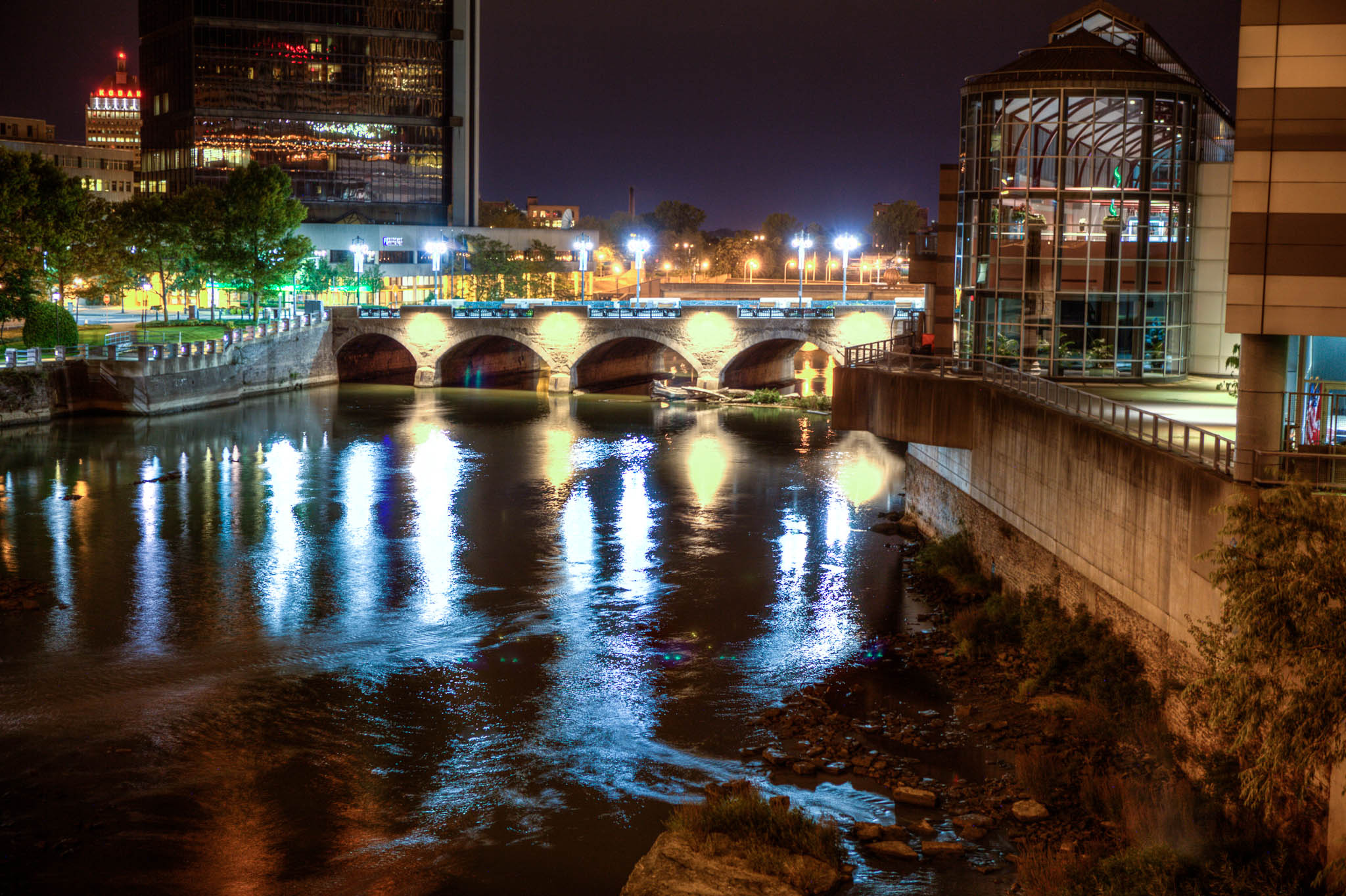
Charlotte is a lakefront community in Rochester bordering Lake Ontario. It is home to Ontario Beach Park, commonly known as Charlotte Beach, which is a popular summer destination for Rochesterians. A new terminal was built in 2004 for the Rochester-to-Toronto ferry service and was later sold after the ferry ceased operations in 2005. The Port of Rochester terminal still exists, but multiple attempts by the city to make additions have failed since 2016.
Corn Hill
Corn Hill is located in the city's old Third Ward, and best known today for the annual Corn Hill arts festival. Many of the city's wealthiest residents lived in the neighborhood during the 19th century, but they relocated to the East End and suburbs after the turn of the century. The neighborhood experienced decline, and much of the Third Ward was demolished for the construction of I-490 in the 1960s. Revival began in the late 1960s, as several of the Victorian homes in the neighborhood were restored by the Genesee Landmarks Foundation. In 1969 the Corn Hill arts festival was held and became an annual feature. The Third Ward Historic District was listed on the National Register of Historic Places in 1974.
Edgerton
The Edgerton neighborhood is in the city's northwest quadrant, along Lake Avenue. Historically an Italian-American neighborhood, the area around Lyell Avenue has been a target for the formation of a designated Little Italy neighborhood, although few Italian Americans live there today. The neighborhood is known for struggling with a high crime rate. Residents have pursued a number of strategies to improve the neighborhood in recent years, including the construction of housing for the homeless. The neighborhood features Edgerton Park, which was once home to most of the city's professional sports teams.
Maplewood

Maplewood is located in the northwest quadrant, centered around Lake Avenue and Maplewood Park. Eastman Business Park is located on its north edge. The neighborhood once contained both mansions for the wealthy and worker housing for nearby factories like Kodak's. Many of the neighborhood's old mansions have been converted to multi-family housing. Due to its diverse architectural heritage, the Maplewood Historic District was listed on the National Register of Historic Places in 1997.
Marketview Heights
The Marketview Heights neighborhood is northeast of downtown Rochester, running east from Union Street just north of Atlantic Ave. It is best known as the location of the Public Market, which first opened in 1905 and offers a variety of groceries and other goods from farms and shops from surrounding areas, primarily on the weekends. In the late twentieth century, the neighborhood experienced a severe decline, and roughly half of residents lived below the poverty line in 2000. Public investment was made in the neighborhood after 2008 to implement a number of community proposals. A second round of proposals are being explored currently for the planned removal of the Inner Loop in the southern end of the neighborhood.
Park Avenue
Park Avenue is centered on the eponymous street southeast of downtown. It originally functioned as a service street with businesses that catered to wealthy residents who lived on nearby East Avenue. Between 1894 and 1975, it was also home to Park Avenue Hospital. Today, the neighborhood is one of the most desirable in the city, highly valued for its walkability and density of bars, clubs, and restaurants. The city's annual pride parade is hosted in the neighborhood. The Park Avenue Historic District was listed on the National Register of Historic Places in 2020.
South Wedge
The South Wedge is a wedge-shaped neighborhood centered on South Avenue between the Genesee River and Interstate 490. It began as the home of several families involved in trades on the Erie Canal. In the 1840s, the Ellwanger and Barry nursery was built on South Avenue, introducing greenery to the neighborhood and drawing tourists. Frederick Douglass lived in a house in the neighborhood. The area fell on hard times after World War II, when residents moved to the suburbs and several homes and businesses were abandoned. The South Wedge Planning Committee was established in 1973 to revitalize the neighborhood. Today, the neighborhood is a hub of small businesses. The South Wedge Historic District was listed on the National Register of Historic Places in 2013, and the Gregory Tract Historic District was listed in 2022.
Climate
Rochester lies in the humid continental climate zone (Köppen: Dfa) and has four distinct seasons.
Winters are cold (temperatures drop to 0 °F on 4.2 nights annually). Like much of the eastern Great Lakes, Rochester is very cloudy and overcast in winter. Rochester normally receives heavy snow in winter (primarily lake effect snow resulting from its location on the southern shores of Lake Ontario), ranking among the snowiest large cities on earth and occasionally setting records for annual snowfall among large US metros. The 30-year annual average snowfall is just above 100 in. Spring sees plentiful rain with the rising temperatures, and occasional late snowstorms depending on the year. Summers are warm and sunny; there are occasional short periods of high heat and humidity but in general, Rochester is set apart from most of the continental US by comparatively cool, comfortable summers (ranking among the top five coolest summers among large metros alongside San Francisco, Seattle, Portland, Oregon, and neighboring Buffalo). Autumn features brilliant foliage colors, cooling temperatures and occasionally an excess of rain depending on the year, though precipitation is generally plentiful and dispersed fairly evenly throughout the year.
Demographics
| align-fn = center U.S. Decennial Census
As of the 2020 United States census, the population of Rochester was 211,328. Like most Rust Belt cities, the city has experienced a sustained population decline over the last 60 years. In 2020, for the first time in 200 years, Rochester dropped to the fourth most populous city in the state behind Yonkers. However, in 2020, an increase in the city's population was reported for the first time since the 1950 Census.
| Historical racial composition | url=http://quickfacts.census.gov/qfd/states/36/3663000.html | title=Rochester (city), New York | work=State & County QuickFacts | publisher=U.S. Census Bureau | access-date=May 4, 2012 | url-status=dead | archive-url=https://web.archive.org/web/20121123000948/http://quickfacts.census.gov/qfd/states/36/3663000.html | archive-date=November 23, 2012 }} | 2010 | 1990 | 1970 | 1950 |
|---|---|---|---|---|---|---|---|---|---|---|---|---|
| White | 35% | 43.7% | 61.1% | 82.4% | 97.6% | |||||||
| —Non-Hispanic | 33% | 37.6% | 58.3% | 80.2% | n/a | |||||||
| Black or African American | 38% | 41.7% | 31.5% | 16.8% | 2.3% | |||||||
| Hispanic or Latino (of any race) | 19.8% | 16.4% | 8.7% | 2.8% | (X) | |||||||
| Asian | 3.9% | 3.1% | 1.8% | 0.2% | − |
2020 census
| Race / ethnicity (*NH = Non-Hispanic*) | title=P004: Hispanic or Latino, and Not Hispanic or Latino by Race – 2000: DEC Summary File 1 – Rochester city, New York | url=https://data.census.gov/table?g=160XX00US3663000&tid=DECENNIALSF12000.P004 | publisher=United States Census Bureau | access-date= }} | title=P2: Hispanic or Latino, and Not Hispanic or Latino by Race – 2010: DEC Redistricting Data (PL 94-171) – Rochester city, New York | url=https://data.census.gov/cedsci/table?q=p2&g=160XX00US3663000&tid=DECENNIALPL2010.P2 | publisher=United States Census Bureau | access-date= }} | % 2000 | % 2010 |
|---|---|---|---|---|---|---|---|---|---|---|
| White alone (NH) | 97,395 | 79,178 | 69,792 | 44.32% | ||||||
| Black or African American alone (NH) | 82,267 | 83,346 | 80,459 | 37.43% | ||||||
| Native American or Alaska Native alone (NH) | 809 | 666 | 490 | 0.37% | ||||||
| Asian alone (NH) | 4,867 | 6,350 | 8,403 | 2.21% | ||||||
| Pacific Islander alone (NH) | 61 | 77 | 62 | 0.03% | ||||||
| Some Other Race alone (NH) | 474 | 392 | 1,004 | 0.22% | ||||||
| Mixed-race or multiracial (NH) | 5,868 | 6,100 | 9,249 | 2.67% | ||||||
| Hispanic or Latino (any race) | 28,032 | 34,456 | 41,869 | 12.75% | ||||||
| **Total** | **219,773** | **210,565** | **211,328** | **100.00%** |
As of the 2020 Census, 38.0% of Rochester residents were non-Hispanic Black, 33.0% were non-Hispanic White, 19.8% were Hispanic/Latino, 3.9% were Asian, 0.2% were Native American or Pacific Islander, and 5.1% were mixed or other.

In 2020, there were 91,500 households, of which 18.8% were married couples living together, 9.9% were unmarried co-habitating couples, 42.3% had a female householder with no partner present, and 29.0% had a male householder with no partner present. Of all households, 41.3% were made up of individuals, 25.3% had children under 18 living with them, and 9.2% had someone living alone 65 or older. 33.1% of housing units were owner-occupied, and 66.9% were rented. The age distribution was 18.8% under 18, 15.4% from 18 to 24, 30.8% from 25 to 44, 22.6% from 45 to 64, and 12.4% who were 65 or older. The median age was 32.9. For every 100 females, there were 93.6 males.
According to 2020 American Community Survey estimates, The median income for a city household was $37,395, and for a family was $43,873. Males had a median income of $30,379, versus $28,260 for females. The per capita income for the city was $24,916. About 25.5% of families and 30.4% of the population were below the poverty line, including 48.2% of those under age 18 and 17.3% of those age 65 or over.
Although losing population since 1950, over the course of the past 70 years Rochester has become a major center for immigration, particularly for arrivals from Eastern and Southeastern Europe, sub-Saharan Africa, and the Caribbean. Rochester had the highest percentage of Puerto Ricans of any major city in the United States in 2013, one of the four largest Turkish American communities, one of the largest Jamaican American communities in any major U.S. city and a large concentration of Polish Americans along with nearby Buffalo, New York. Rochester's Bhutanese and Nepalese communities are among the largest in the United States, concentrated primarily in Jones Square and Edgerton with growth fueled by recently arrived migrants and refugees. In addition, Rochester was ranked number 9 in the nation for the largest Italian population in the United States in 2018.
Rochester has been reported to have the largest per capita deaf population in the United States by the New York Times because it is home to the National Technical Institute for the Deaf. A 2012 report by the NTID concluded 3.7% of the Rochester metropolitan area is deaf or hard-of-hearing, compared to a national rate of 3.5%. Rochester has the largest deaf and hard-of-hearing population per capita when analyzing the working-age population, but may not have the largest per capita deaf population among all cities, due to deafness being much more prevalent in the elderly.
Economy
| Rank | Employer | Employees |
|---|---|---|
| 1 | University of Rochester | 32,100 |
| 2 | Rochester Regional Health | 17,592 |
| 3 | Wegmans | 12,946 |
| 4 | Paychex | 4,579 |
| 5 | Rochester Institute of Technology | 4,155 |
| 6 | L3Harris Technologies | 3,724 |
| 7 | Heritage Christian Services | 2,456 |
| 8 | Finger Lakes Health | 2,308 |
| 9 | Lifetime Healthcare Companies | 2,298 |
| 10 | Tops Markets | 2,038 |
Like many Rust Belt cities, Rochester was traditionally a manufacturing center, home to companies such as Bausch & Lomb, Kodak, and Xerox. In the 21st century, deindustrialization has occurred. Xerox and Kodak each laid off thousands of workers in the 1990s and 2000s, causing the University of Rochester to become the city's top employer in 2005, a title it holds today. Bausch & Lomb moved to Bridgewater, New Jersey, in 2014. The Gannett newspaper company and Western Union were founded in Rochester by Frank Gannett and Hiram Sibley, respectively, but have since moved to other cities. Today, the city's top employers are its educational and medical institutions. After the University of Rochester, major employers in these fields include Rochester Regional Health, the Rochester Institute of Technology, and Carestream Health. In recent years, a high technology industry has grown in Rochester, fostered in part by collaborations between private startup enterprises and the local higher learning institutions. Other organizations such as High Tech Rochester provide local startups with mentorship, office space, and other resources. Like its legacy manufacturers, Rochester's modern technological focus is on imaging and optical science among the industry and universities. The Institute of Optics of the University of Rochester and the Rochester Institute of Technology have popular imaging programs, and a research hub for photonics has operated in the city since 2015 following federal and state investment. Rochester is also home to the Fortune 500 beverage company Constellation Brands and the Fortune 1000 company Paychex (Fortune #681) and the supermarket chain Wegmans. The median single-family house price was $247,000 in the third quarter of 2023 in greater Rochester, an increase of 10.3% from a year earlier, according to the National Association of Realtors.
Arts and culture
The city of Rochester is home to numerous cultural institutions. These include the Garth Fagan Dance, the Rochester Philharmonic Orchestra, the Rochester City Ballet, Rochester Contemporary Art Center, the Rochester Broadway Theater League, Hochstein School of Music & Dance, the Auditorium Theater, and numerous arts organizations. Geva Theatre Center is the city's largest professional theater. The East End Theater is on East Main Street in the theater district. The Eastman School of Music, one of the top musical institutes in the nation, and its auditorium are also within the East End neighborhood. The Eastman Theatre is host to the Rochester Philharmonic Orchestra and other musical/drama events.The Rochester Association of Performing Arts is a non-profit organization that provides educational theater classes to the community.
Architecture
Several churches are among Rochester's architectural features, including Asbury First United Methodist Church, St. Joseph's Church and Rectory, and the First Unitarian Church of Rochester, which was designed by Louis Kahn and described by Paul Goldberger as one of "the most significant works of religious architecture of the century". Significant Art Deco buildings include the Cinema Theater and Times Square Building, noted for its 42' tall "Wings of Progress" sculpture. The Midtown Plaza, the nation's first downtown shopping mall, first opened in 1962, and remains partially standing today.
Museums
Museums in the Rochester area include the Genesee Country Village and Museum, George Eastman Museum, Memorial Art Gallery, Rochester Museum and Science Center, Strasenburgh Planetarium, Susan B. Anthony House, New York Museum of Transportation, Rochester & Genesee Valley Railroad Museum, and The Strong National Museum of Play. In 2023, plans were announced for a museum dedicated to the life of Frederick Douglass in the city.
Festivals
Rochester hosts a number of cultural festivals every year. The Lilac Festival at Highland Park is attended by hundreds of thousands annually. Established after an 1898 gathering, it features the largest collection of lilac varieties in North America, a parade, and dozens of musical acts and food vendors. The Rochester International Jazz Festival was established in 2002 and is one of the largest jazz festivals in the United States. It takes place in late June at dozens of clubs, concert halls and free outdoor stages throughout Downtown Rochester, regularly drawing over 200,000 visitors. Other notable annual festivals in Rochester include the Rochester International Film Festival in June, the Corn Hill Arts Festival in July, and the Rochester Fringe Festival in September.
Cuisine
One food product Rochester calls its own is the "white hot", a variant of the hot dog or smoked bratwurst made by the company Zweigle's and other local food manufacturers. Another local specialty is the Garbage Plate, a trademark of Nick Tahou Hots that traditionally includes macaroni salad, home fries, and two hot dogs or cheeseburgers topped with mustard, onions, and their famous meat hot sauce. Many area restaurants feature copies or variations with the word "plate" commonly used as a general term. Chicken Francese was first popularized by Rochester's Italian American community.
The Genesee Brewing Company is headquartered in Rochester, where it holds an annual December tradition of assembling a tower of beer kegs in the shape of a Christmas tree. Other local franchises include Abbott's Frozen Custard, Bill Gray's, DiBella's, and Tom Wahl's. Dinosaur Bar-B-Que, which originated in Syracuse, also operates its second franchise downtown in the former Lehigh Valley Railroad station on the Genesee River. The Ragú brand of pasta sauce used to be produced in Rochester. Some of the original facility still exists and produces products for other labels (including Newman's Own) as Private Label Foods. Rochester was also the original home of French's Mustard, whose address was 1 Mustard Street.
Sports
Main article: Sports in Rochester, New York
Professional sports
Rochester has several professional sports teams:
| Club | Sport | Began play | League | Venue | Titles |
|---|---|---|---|---|---|
| Rochester Red Wings | Baseball | 1899 | IL | Innovative Field | 20 |
| Rochester Royal Ballers | Basketball | 2024 | ABA | Roberts Wesleyan University | 0 |
| Rochester Americans | Ice hockey | 1956 | AHL | Blue Cross Arena | 6 |
| Rochester Knighthawks | Indoor lacrosse | 2019 | NLL | Blue Cross Arena | 0 |
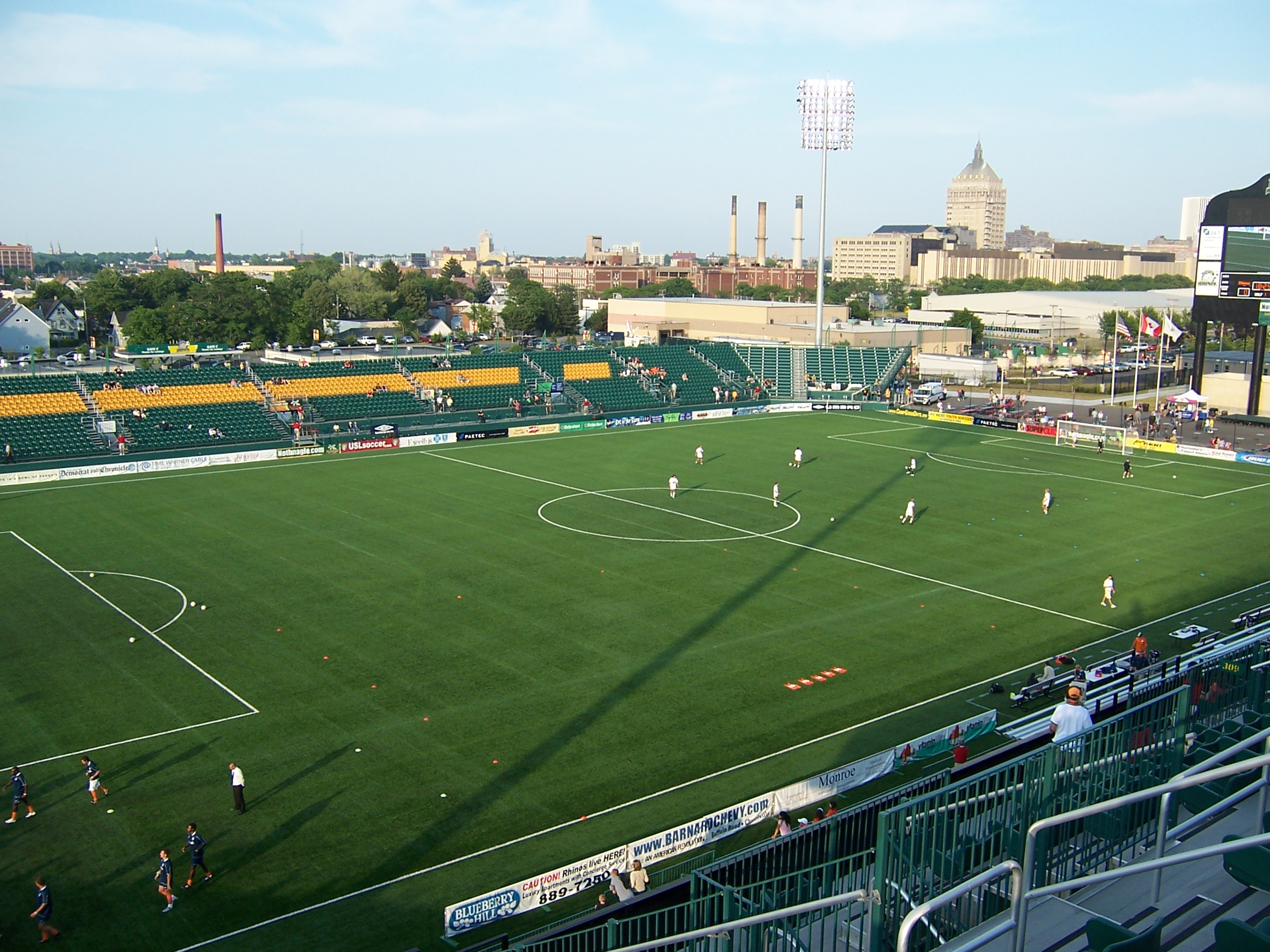
| Flower City Union | Soccer | 2021 | NPSL | Rochester Community Sports Complex Stadium | 1 |
The Rochester Royals (now the Sacramento Kings) were a professional basketball team in Rochester from 1945 to 1957 with roots as an amateur team dating back to 1923. They won the NBA title in 1951, defeating the New York Knicks in seven games. Rochester and its surrounding area also has a rich golf history and has hosted numerous professional tournaments on its local golf courses, most recently the 2023 PGA Championship.
Collegiate
NCAA Division I teams include the RIT men's and women's ice hockey teams, and the University of Rochester men's squash team, which has ranked top 5 in Division I.
Parks and recreation
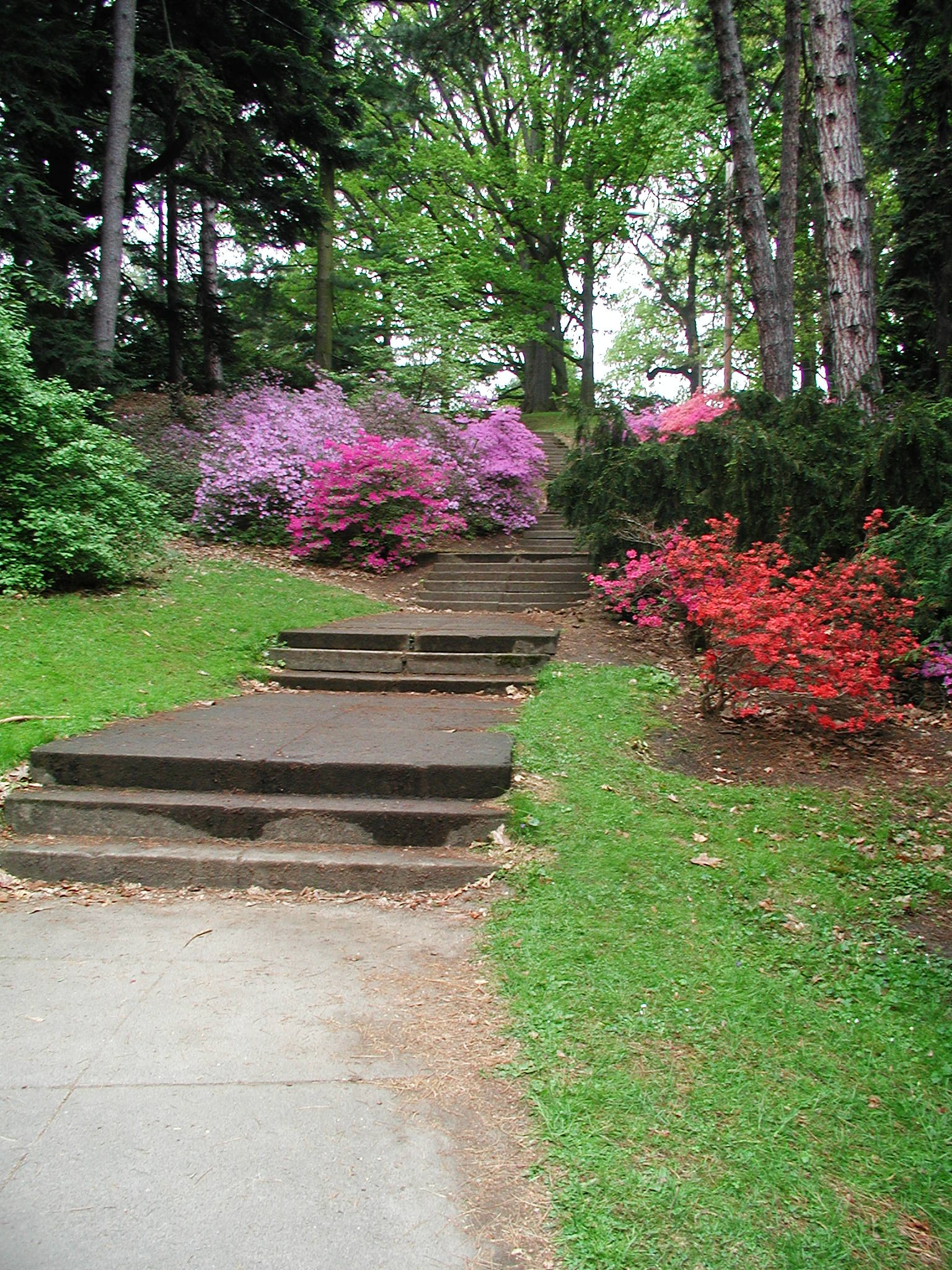
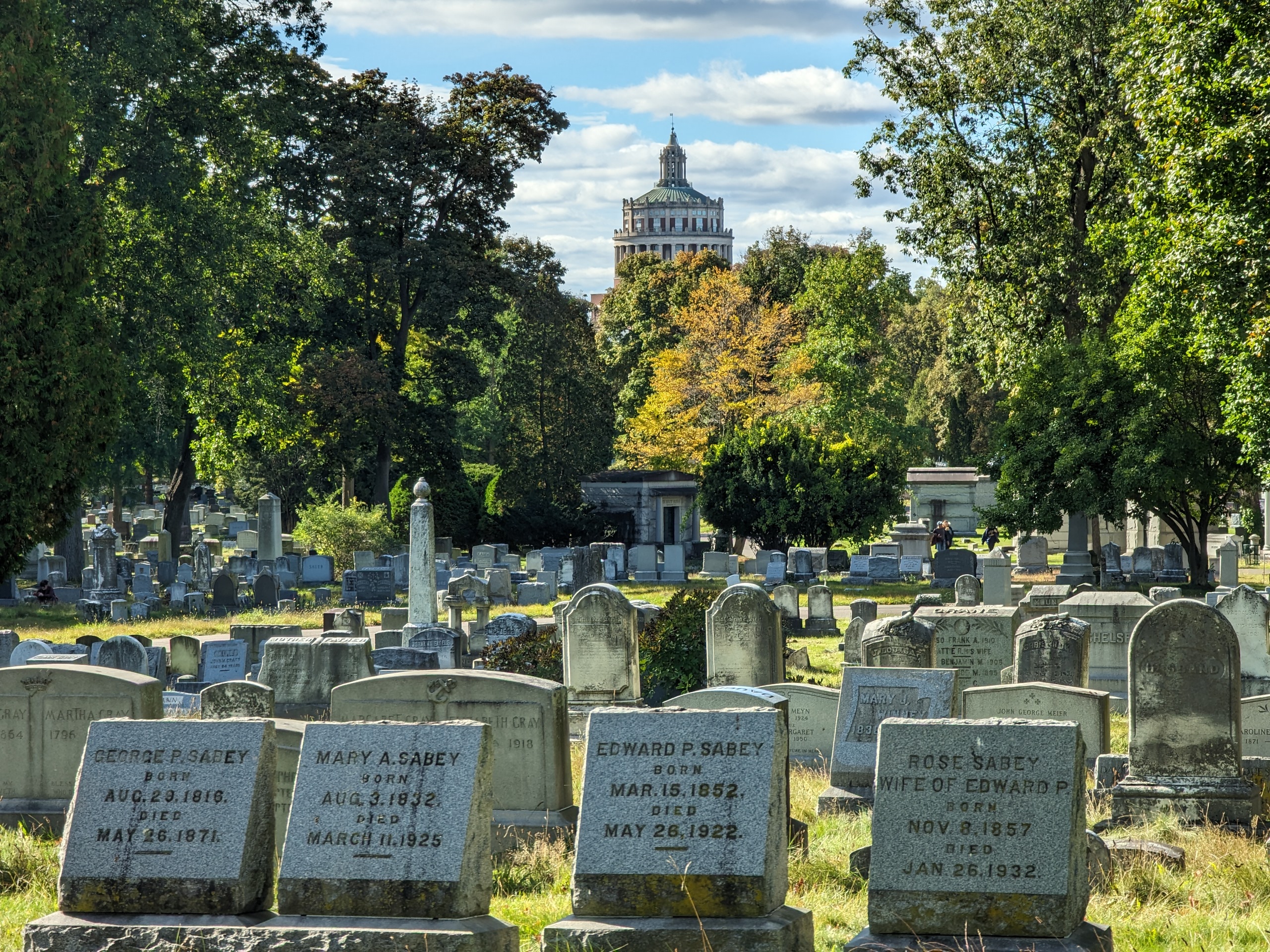
Notable cemeteries include the Victorian-era Mount Hope Cemetery, Holy Sepulchre and Riverside Cemetery. Mount Hope became a popular picnicking destination during the late nineteenth century, and the city began to develop public parks. Rochester's park system was initially designed by landscape architect Frederick Law Olmsted in the 1890s. Olmsted intended to preserve natural landscapes for the city residents to enjoy. The system included four major parks: Genesee Valley Park, Highland Park, Maplewood Park, and Seneca Park, the last of which is today home to the Seneca Park Zoo.
The park system was expanded in the early twentieth century with Cobb's Hill Park and Durand Eastman Park in 1908, Edgerton Park in 1911, and Ontario Beach Park in the early 1920s. The Park Commission also constructed new facilities in all parks, filling them with playgrounds, pavilions, and sports facilities. Modern additions to the park system include Martin Luther King Jr. Memorial Park, Turning Point Park, and Tryon Park, which are located on former industrial and urban sites, in contrast to the early parks. Most of the city's parks lie on the Genesee River and can be accessed by the Genesee Riverway Trail, which runs for the river's entire length through the city. Current city facilities include 12 full-time recreation centers, 48 playgrounds, two artificial ice rinks, 74 softball/baseball fields, 42 tennis courts, four soccer fields, and 45 outdoor basketball courts.
Government

Rochester is governed by a mayor serving as chief executive of city government and a city council consisting of four district members and five at-large members. Rochester has had a Strong mayor-council form of government since the approval of its current charter in a referendum in 1984. Administrative officers are appointed by the mayor and confirmed by the city council. All city legislation is proposed and passed by the council, and subject to a veto by the mayor, unless a majority of two-thirds approved it. The current mayor is Malik Evans, serving since January 1, 2022.
Upon the city's charter in 1834, the mayor had few powers and most power was vested in the city council, which was composed of alderman representing individual wards. The charter was frequently modified during the 19th century to expand or reduce the mayor's powers, until an 1898 act by the New York State Legislature centralized all appointments under the mayor. The city abolished the mayor's office and adopted a city manager system in a 1925 referendum, after which the mayor became a minor position and the city manager assumed executive authority, with both being chosen by the members of the city council. A 1984 referendum restored the Strong mayor system. William A. Johnson, the city's first African American mayor, served from 1994 to 2005. Lovely Warren, the city's first female mayor, served from 2014 to 2021.
Federal representation
The city is covered by New York's 25th congressional district currently represented by Democrat Joe Morelle of Irondequoit, Monroe County, in Congress. From 1987 until 2018, the city was represented by longtime Democrat Louise M. Slaughter of Fairport, Monroe County, in Congress.
State representation
After redistricting based on the 2020 United States census, the city was split between two state senate districts:
| District | Area of the city | Senator | Party | First took office | Residence |
|---|---|---|---|---|---|
| 55 | Eastern | Samra Brouk | Democratic | 2021 | Rochester, Monroe County |
| 56 | Western | Jeremy Cooney | Democratic | 2021 | Rochester, Monroe County |
After redistricting based on the 2020 census, the city was split between three state assembly districts:
| District | Areas of the city | Assemblyperson | Party | First took office | Residence |
|---|---|---|---|---|---|
| 136 | Brighton, Irondequoit, northwest portion and easternmost tip of the City of Rochester | Sarah Clark | Democratic | 2020 | Rochester, Monroe County |
| 137 | Gates, center of the City of Rochester | Demond Meeks | Democratic | 2020 | Rochester, Monroe County |
| 138 | Chili, Henrietta, Riga, and the Southeast portion of the City of Rochester | Harry B. Bronson | Democratic | 2011 | Rochester, Monroe County |
County representation
Rochester is represented by districts 7, 16, and 21–29 in the Monroe County legislature (a 29-seat body with legislators elected to two-year terms). Rochester is also under the jurisdiction of the county executive (currently Democrat Adam Bello) along with the rest of Monroe County. The District Attorney is also elected at the county level along with several other offices (such as Sheriff and Clerk) which in part govern the city.
Courts
Rochester is part of the 7th Judicial District of the New York Supreme Court and the 4th Department of the New York Supreme Court, Appellate Division.
Rochester City Court
Rochester City Court is part of the New York State Unified Court System and consists of ten full-time judges, each of whom is elected to a 10-year term. Each judge must be a city resident and must have been an attorney in New York for at least five years. Judges have a mandatory retirement age of 70. Vacancies on the court are filled by the mayor, and judges so appointed must run for a full term at the next general election.
In New York State, the 61 city courts outside of New York City handle the arraignment of felonies, try misdemeanors and lesser offenses, and try civil lawsuits involving claims of up to $15,000. Rochester City Court also hears small claims matters up to $5,000. Rules of practice and procedure within all city courts are prescribed by the Uniform City Court Act. Rochester City Court, like all city courts, follows the individual assignment system ("IAS"). This means that each case is assigned to a judge when the case is first initiated, and, with a few exceptions, stays under the supervision of that particular judge until the case is resolved.
Created in 1876, the court was initially named the "Municipal Court of the City of Rochester" and had two judges. Originally, city courts throughout the state were self-regulating, and prescribed their own rules of procedure and bounds of jurisdiction. Rochester City Court was governed by the Rochester City Court Act, which was a part of the Charter of the City of Rochester. In 1935, Judge Jacob Gitelman introduced weekend sentencing. He was the first judge in New York State to do so. In 1964, the New York State Constitution was amended to require uniform jurisdiction, practice, and procedure for the city courts, to be regulated by the state legislature. The court's first African-American judge, Reuben K. Davis, was appointed to the city court bench in March 1967.
In the 1980s, the court heard cases involving the prosecution of the "Topfree Seven", women who intentionally bared their chests once a year in order to protest the criminalization of female nudity. Judge Herman J. Walz ruled that the women could not be prosecuted under New York's public nudity statute because their act of going topless in order to protest the law was imbued with First Amendment protections. The decision was later affirmed by the New York Court of Appeals. By 1995, Rochester City Court had eight judges. A ninth was added in 2001. The court was brought to its current complement of ten judges in 2014.
Education
Primary and secondary education

The City of Rochester is served by the Rochester City School District, which encompasses all public primary and secondary education. During the 2022–23 school year, 22,238 students were enrolled in the district, with an average expenditure per student of and a four-year graduation rate of 71%. The district is governed by a popularly elected seven-member board of education. The Rochester City School District operates 14 public secondary schools, each serving grades 7 through 12.
- Dr. Alice Holloway Young School of Excellence (7–8)
- East Lower School (6–8)
- East Upper School (9–12)
- Edison Career & Technology High School (9–12)
- Franklin Lower School (7–8)
- Franklin Upper School (9–12)
- James Monroe Lower School (7–8)
- James Monroe Upper School (9–12)
- Joseph C. Wilson Magnet High School (9–12)
- Northeast College Preparatory High School (9–12)
- Northwest Junior High at Douglass (7–8)
- Rochester Early College International High School (9–12)
- School of the Arts (7–12)
- School Without Walls (9–12)
For the 2022–23 school year, Rochester additionally had fourteen free charter schools serving grades Kindergarten through 12. Other private schools in and near Rochester include McQuaid Jesuit High School, Aquinas Institute and Bishop Kearny High School.
Colleges and universities

Rochester and the surrounding region host a high concentration of colleges and universities, which drive much of the economic growth in the five-county area. The University of Rochester is the only large research institution primarily within the city limits, although Monroe Community College and SUNY Brockport operate campuses downtown. The Highland Park neighborhood was home to Colgate Rochester Crozer Divinity School (part of whose facility is leased by Ithaca College's Department of Physical Therapy) and an office maintained by the Cornell University School of Industrial and Labor Relations.
The University of Rochester is the metropolitan area's oldest and most prominent institution of higher learning, and one of the country's top research centers. It includes a nursing school, the Simon School of Business, and the Eastman School of Music. It was founded and endowed by George Eastman in his years as a philanthropist. He also contributed greatly to the University of Rochester from wealth based on the success of Eastman Kodak.
Five institutions began operations in the city and later moved to Rochester's inner-ring suburbs: the Empire State College Rochester Learning Center, Monroe Community College, Rochester Institute of Technology, St. Bernard's School of Theology and Ministry and Nazareth University. Rochester was the host of the Barleywood Female University, a short-lived women's college from 1852 to 1853. The Lutheran seminary that became Wagner College was established in the city in 1883 and remained for some 35 years before moving to Staten Island.
Libraries
The Rochester Public Library is headquartered at the Central Library of Rochester & Monroe County, which is located in the Rundel Memorial Library building and the adjacent Bausch & Lomb Public Library Building in downtown Rochester. The city is part of the larger Monroe County Library System. Library cards are freely available to residents of Monroe County and valid at the eleven branch libraries in the city and other branches in the county. The library had 8.1 visits per capita and over 6,000 programs as of 2018.
Media
Main article: Media in Rochester, New York
The Democrat and Chronicle, a Gannett newspaper*,* is Rochester's main daily newspaper. Other local publications exist which cater to special interests, such as the Rochester Business Journal and the Minority Reporter. Former publications serving the city include Insider magazine, the Rochester Post Express, the Rochester Evening Journal, and the Times-Union.
Rochester is also served by several local television and radio stations, with WROC-TV as the oldest television station serving the Rochester metro area. The WXXI Public Broadcasting Council is a non-profit organization in Rochester which provides public television and community radio programs. WXXI owns or operates several radio stations, the television station WXXI-TV, the alternative weekly publication City Magazine, and the Little Theater.
Several movies have been filmed at least in part in Rochester, including The Amazing Spiderman 2 (2014) and The Tomorrow Man (2019).
Infrastructure
Transportation
Maritime
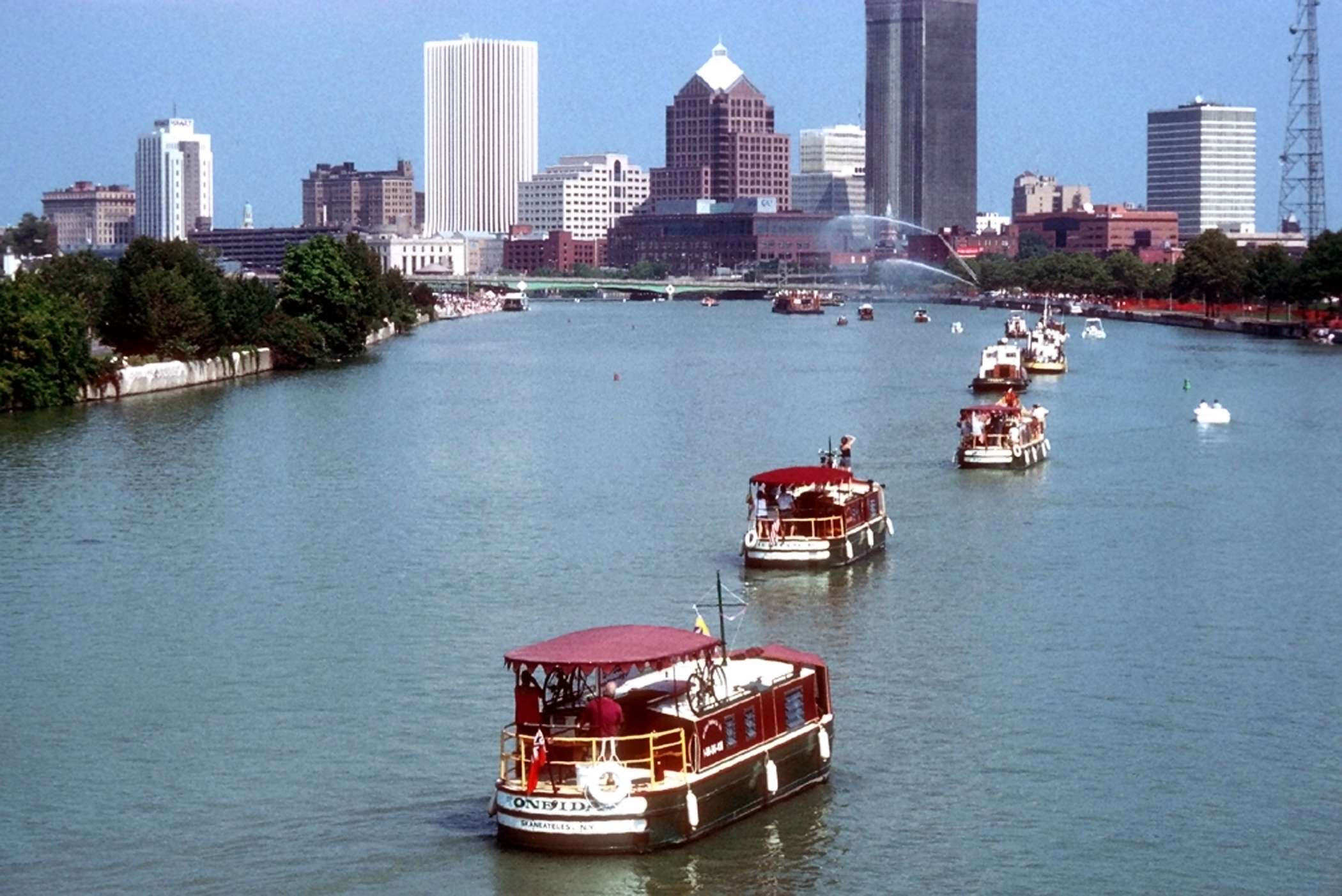
There is marine freight service at the Port of Rochester on Lake Ontario, which is connected to the Atlantic Ocean via the Saint Lawrence Seaway. The Erie Canal intersects the Genesee River on the south side of the city.
During the 19th and early 20th centuries, a number of passenger ferries operated on Lake Ontario between the Port of Rochester and Canada. Service ended in 1950 when the Ontario I and Ontario II ended their route between Rochester and Cobourg. A new ferry, the Spirit of Ontario I, operated between Rochester and Toronto from June 17, 2004, to December 12, 2005. The ferry suffered from numerous issues, including two separate pier collisions that damaged it. The initial operator, Canadian American Transportation Systems (CATS), went bankrupt by the end of the 2004 season. The city of Rochester then purchased the ferry and signed a contract with Bay Ferries Great Lakes to resume operations in 2005. The resumption of service was delayed until summer, causing the ferry to continue to operate at a loss. In 2006, the operation was shut down and the ferry was sold.
Air
Main article: Greater Rochester International Airport
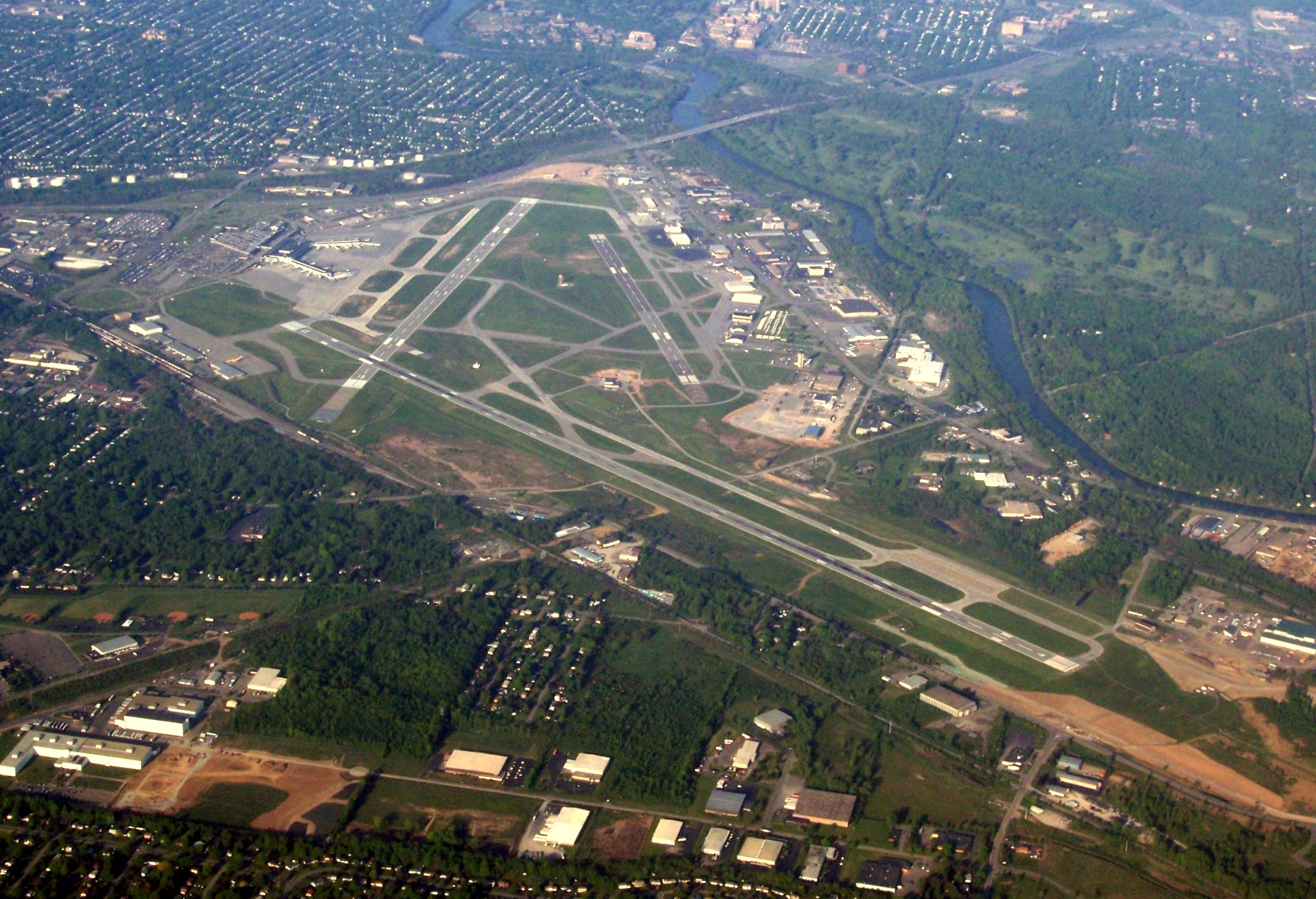
Rochester is served by the Frederick Douglass Greater Rochester International Airport (GRIA). Scheduled air service is provided by American, Allegiant, Delta, Frontier, JetBlue, Southwest, Spirit, and United.
FedEx founder Fred Smith has stated in several articles that Xerox's development of the copier, and its need to quickly get parts to customers, was one of the economic issues that led him to pioneer the overnight delivery business in 1971. Because Xerox manufactured its copiers in Rochester, the city was one of the original 25 cities FedEx served on its first night of operations on April 17, 1973.
In 2016, Governor Andrew Cuomo announced a $63.4 million project to renovate the GRIA. The renovations include a large canopy extending over both main entrances, solar panels, a rainwater collection system, and modern communication and security enhancements. All construction was completed by October 2018.
Rails and mass transit

Local bus service in Rochester and its county suburbs is provided by the Rochester-Genesee Regional Transportation Authority (RGRTA) via its Regional Transit Service (RTS) subsidiary. RTS also provides suburban service outside the immediate Rochester area and runs smaller transportation systems in outlying counties, such as WATS (Wayne Area Transportation System). All RTS routes are based out of the RTS Transit Center on Mortimer Street. Rochester has intercity and transcontinental bus service via Greyhound and Trailways.
Rail service to Rochester is provided by the Louise M. Slaughter Rochester Station, served by Amtrak's Empire Service between New York City and Niagara Falls, the Maple Leaf between New York City and Toronto, and the Lake Shore Limited between New York City/Boston and Chicago. Prior to 1965, Rochester had a smaller station reminiscent of New York City's "Grand Central Terminal". It was among Claude Fayette Bragdon's best works in Rochester. The current station is modeled after Bragdon's work and named in honor of former longtime congresswoman Louise Slaughter.
Rochester used to be a major stop on several railroad lines. The New York Central Railroad provided service to Chicago and Buffalo to the west and Albany and New York City to the east and southeast. The Buffalo, Rochester and Pittsburgh Railway (absorbed by the Baltimore and Ohio Railroad) served Buffalo and Pittsburgh until 1955. A rail route to Salamanca in southern New York State afforded connections in Salamanca to southwestern and southeastern New York State. The last long-distance train was the Northern Express/Southern Express, operated by the Pennsylvania Railroad on the Genesee Valley Canal Railroad, that went to Harrisburg, Pennsylvania via Canandaigua, Elmira and Williamsport; service ended in 1971. Also serving Rochester were the Erie Railroad and Lehigh Valley Railroad.
From 1927 to 1956, Rochester had a light rail underground transit system called the Rochester subway, which was first operated by New York State Railways and later by the Rochester Transit Corporation. Rochester was the smallest city in the world to have such a system. After the subway was shut down in 1956, the eastern half of the subway past Court Street became the Eastern Expressway, and the western end of the open cut was filled in 1976. The tunnel was last used for freight service by Gannett Company to bring paper to the printing presses for the Democrat and Chronicle in 1997. In the years since, the tunnel has become a hub for graffiti artists. Several proposals have been made to completely fill the remaining tunnel, redevelop the underground space, or convert the bridge to a pedestrian crossing. Portions have been filled in at the western end and the eastern end for new above-ground development. The Broad Street aqueduct, which contains part of the tunnel, was added to the National Register of Historic Places in 1976.
Major highways and roads
.jpg)
Three exits off the New York State Thruway (I-90) serve Rochester. Rochester's expressway system, conceived in the 1950s, was designed as two concentric circles with feeder expressways from the west, south and east. The system allows for quick travel within the metropolitan area and a lack of the traffic gridlock typically found in cities of comparable size; in part this is because the system was designed to accommodate rapid travel between the suburbs and downtown, and also because it was built when the city's population was over 330,000, whereas today it is a full third less.
The Outer Loop circles just outside the city limits while the former Inner Loop once circled around the immediate downtown area within the city (the easternmost sector was closed in 2015). From the west are Lake Ontario State Parkway, NY 531 and I-490; I-390 feeds from the south; and NY 104, NY 441, and I-490 approach from the east.
In the early 1970s, the Genesee Expressway Task Force, City leaders, and the New York State Department of Transportation studied the feasibility of connecting the outer and inner Loops with a new southern expressway. The proposed route extended north from the I-390 and I-590 interchange in Brighton, cutting through Rochester's Swillburg neighborhood. In 1972, consultants Berger Lehman Associates recommended a new 'Busway', an expressway with dedicated bus lanes, similar to Bus Rapid Transit. The expressway extension was never built. In 2016, the City of Rochester launched the Pace Car Program.
- I-390 runs south–north, crossing I-90 (exit 46) and routing north through Rochester's western suburbs. Its northern end is at I-490, however, it continues north as NY 390 until it merges into the Lake Ontario State Parkway. South of I-90, I-390 runs to Avoca, where it meets with US 15 and the Southern Tier Expressway, I-86.
- I-490 runs west–east through Rochester, starting at Le Roy and ending in Victor. It interchanges with the two other Interstates in Rochester: I-390 at the western city limit and I-590 at the eastern limit, as well as connecting at both ends with the Thruway, I-90 (exits 47 and 45). In July 2007, a new bridge over the Genesee River was completed and named the Frederick Douglass–Susan B. Anthony Memorial Bridge.
- I-590 runs south–north through Rochester's eastern suburbs. Its southern end is at I-390, while the northern terminus is at I-490; the highway continues north to the shore of Lake Ontario as NY 590.
- In decreasing usage is the term "Can of Worms", referring to the previously dangerous at-grade intersection of I-490 and expressway NY 590 on the eastern edge of the Rochester city limits, bordering the suburb of Brighton. In the 1980s, a multimillion-dollar project created a system of overpasses and ramps that reduced the danger but resulted in the loss of certain exits.
- NY 104 – Just east of the NY 590 interchange, NY 104 becomes the Irondequoit-Wayne County Expressway and crosses the Irondequoit Bay Bridge. On the other side of the Bay Bridge, in the town of Webster, NY 104 has exits before returning to an at-grade highway at Basket Road.

- NY 390 is an extension of Interstate 390 from the I-390/I-490 interchange in Gates. The northern terminus is at the Lake Ontario State Parkway in Greece, less than a mile from the Lake Ontario shoreline.
- NY 590 is a limited-access extension of Interstate 590 that runs from an interchange between Interstate 490 and I-590 on the Brighton/Rochester border. The northern terminus is at Culver Road in Irondequoit, near Sea Breeze (the western shore of Irondequoit Bay at Lake Ontario).
- The Inner Loop Runs from I-490 to Main Street on the north end and from 490 to Monroe Avenue at the south end. Formerly a loop, the eastern end was demolished and replaced with a surface road between 2014 and 2017. Unsigned reference NY 940T begins and ends at I-490, and the rest of the Loop is part of I-490 between exits 13 and 15, including the Frederick Douglass–Susan B. Anthony Memorial Bridge. This expressway is commonly used to define the borders of Downtown Rochester.
- Lake Ontario State Parkway travels from Lakeside Beach State Park in Carlton, Orleans County. The eastern end is at Lake Avenue in the city of Rochester in Monroe County.
Public safety
Fire protection and EMS services are provided by the Rochester Fire Department. The department employs 509 personnel and operates thirteen engines, six trucks, and heavy rescue from fifteen fire stations. In FY 2021–22, the department responded to 38,876 incidents. The current fire chief is Stefano Napolitano.
Law enforcement services are provided by the Rochester Police Department. The current chief of police is David Smith. Independent oversight of the department is provided by the Police Accountability Board, established in 2019 to investigate and discipline officers for misconduct. In 2023, the New York Court of Appeals ruled that the board could not enforce disciplinary actions on any officers in the department, as it would violate the contract between the city and police union.
In 2019, Rochester had 1,540 reported violent crimes. That same year, Rochester had 7,142 property crime incidents. These included 33 murders, 429 robberies, 976 aggravated assaults, 1,269 burglaries, 5,222 larceny thefts, 102 forcible rapes, 651 auto thefts, and 83 acts of arson.
On November 12, 2021, Rochester Mayor Lovely Warren declared a state of emergency due to a rising violent crime rate in the city, which produced 81 homicides by December 31, the highest number of any year on record. Additional law enforcement assistance was requested from, and granted by, the state government. On July 21, 2022, Rochester Mayor Malik Evans declared another state of emergency due to ongoing gun violence.
Rochester experienced a decline in its violent crime rate in both 2023 and 2024. In 2024, there were 37 reported homicide incidents (there were 45 victims), a 26 percent drop compared with 2023. There was also a sharp decline in automotive vehicle thefts in 2024—2,068 reported incidents, down from the record 3,943 in 2023. Overall, property crime incidents were down 33 percent in 2024 compared to 2023.
Healthcare
Most healthcare services in the Rochester area are provided by University of Rochester Medical Center (URMC) and Rochester Regional Health (RRH). Major hospitals in the Rochester area include:
- Highland Hospital, a URMC facility with 261 beds. Highland is a level 1 perinatal center and a primary stroke center.
- Rochester General Hospital, a RRH facility with 528 beds. Rochester General is a comprehensive stroke center and level 2 perinatal center.
- Rochester Psychiatric Center, a psychiatric hospital operated by the New York State Department of Mental Hygiene. The hospital's campus contains the abandoned Terrence Building.
- Strong Memorial Hospital, a URMC facility with 886 beds. Strong is home to the Golisano Children's Hospital for pediatric care, and is an AIDS center, burn center, comprehensive stroke center, level I trauma center for both pediatric and adult care, and regional perinatal center.
- Unity Hospital, a RRH facility with 311 beds. Unity is a regional perinatal center and primary stroke center.
In 2023, The Guardian reported that Rochester was becoming a desirable community for transgender individuals due to its network of gender-affirming care providers, such as Trillium Health.
Notable people==
:See List of people from Rochester, New York Notable individuals who were born in or lived in Rochester include American social reformer and women's rights activist Susan B. Anthony, African-American social reformer and abolitionist Frederick Douglass, and Kodak founder George Eastman.
Sister cities
Rochester has twelve sister cities, as designated by Sister Cities International. They are all dedicated by a branched concrete walkway over the Genesee River, dubbed the Sister Cities Bridge (known as the Frank and Janet Lamb Bridge since October 2006):
Rochester's sister cities are:
- FRA Rennes, France (1958)
- GER Würzburg, Germany (1964)
- ITA Caltanissetta, Italy (1965)
- ISR Rehovot, Israel (1972)
- POL Kraków, Poland (1973)
- MLI Bamako, Mali (1975)
- IRL Waterford, Ireland (1983)
- RUS Veliky Novgorod, Russia (1990)
- JPN Hamamatsu, Japan (1996)
- DOM Puerto Plata, Dominican Republic (1997)
- CHN Xianyang, China (2007)
- LTU Alytus, Lithuania (2009)
Notes
References
References
- "ArcGIS REST Services Directory". United States Census Bureau.
- {{GNIS. 979426
- "U.S. Census Bureau QuickFacts: Rochester city, New York".
- "Photography & Film".
- (April 1, 2008). "America's First Boomtown - Rochester, NY: The Early Years and the Notables Who Shaped It". Rochester History Alive Publications.
- "Abolition - Freethought Trail - New York".
- McKelvey, Blake. (July 1948). "Woman's Rights in Rochester: A Century of Progress". Rochester History.
- (September 10, 2018). "Fisher, RIT, U of R named among best universities in U.S.". [[WHAM-TV]].
- link. (January 26, 2016 , ''Democrat and Chronicle'' (March 2, 2008) ([https://www.rochesterbusinessalliance.com/core/contentmanager/uploads/0302%20Manufacturing%20DANDC.pdf archived copy] {{webarchive). link. (March 26, 2009 ))
- The United States Conference of Mayors & The Council on Metro Economies & the New American City, ''[https://usmayors.org/metroeconomies/2014/06/report.pdf U.S. Metro Economies: GMP & Employment 2013–2015] {{Webarchive. link. (March 4, 2016 '', prepared by IHS Global Insight (U.S.A.) [Lexington, Mass.: IHS Global Insight (U.S.A.), 2014‑06], app., table 1, pp. 1–9.)
- (August 6, 2012). "The Geography of America's Music Scenes". Bloomberg.com.
- "History of George Eastman House". George Eastman House website.
- (1945). "ROCHESTER THE WATER - POWER CITY 1812-1854". Harvard University Press.
- Sam, Bleiweis. (2013). "The Downfall of the Iroquois". [[Emory University]].
- Catapano, Andrea Lucielle. (2007). "The Rising of the Ongwehònwe: Sovereignty, Identity, and Representation on the Six Nations Reserve". [[Stony Brook University]].
- Peck, William F.. (1908). "History of Rochester and Monroe County, New York, From the Earliest Historic Times to the Beginning of 1907". The Pioneer Publishing Company.
- Peck, pp. 32–35
- Peck, p. 51
- Peck, p. 59
- Peck, p. 60
- (1945). "ROCHESTER THE WATER - POWER CITY 1812-1854". Harvard University Press.
- "Census". United States Census.
- Peck, p. 68
- (June 5, 2012). "The Locavore's Dilemma: In Praise of the 10,000-mile Diet". PublicAffairs.
- (1945). "ROCHESTER THE WATER - POWER CITY 1812-1854". Harvard University Press.
- Blake McKelvey, [http://www.rochester.lib.ny.us/%7Erochhist/v20_1958/v20i1.pdf "The Germans of Rochester: Their Traditions and Contributions"] {{Webarchive. link. (June 8, 2011 , ''Rochester History'', Vol. 20, No. 1 (January 1958), pp. 7–8.)
- (Fall 1989). "Two Centuries of Industry and Trade in Rochester". Rochester History.
- (Summer 2005). "Rochester's Frederick Douglass: Part One". Rochester History.
- (Fall 2005). "Rochester's Frederick Douglass: Part Two". Rochester History.
- (February 22, 2021). "Upstate's forgotten abolitionists: The former slave who wrote his autobiography".
- (1945). "ROCHESTER THE WATER - POWER CITY 1812-1854". Harvard University Press.
- (September 26, 1918). "Senators to Vote on Suffrage Today; Fate of Susan B. Anthony Amendment Hangs in Balance on Eve of Final Test". New York Times.
- "Listing of National Historic Landmarks by State: New York". National Park Service.
- "James Cunningham Son & Co". [[Carriage Museum of America]].
- Like many early companies, its production was small, about 400 a year including [[Hearse. hearses]], designed by [[Volney Lacey]]. [[G.N. Georgano]] ''Cars: Early and Vintage, 1886–1930''. (London: Grange-Universal, 1985)
- ''Democrat and Chronicle''. “A Rochester Enterprise.” Oct 29, 1895. Page 1
- A physical copy of the patent application was posted for sale on eBay. Its web page, with photos and partial text, was accessed online on January 23, 2026, at URL: https://www.ebay.com/itm/295609546042
- ''Democrat and Chronicle''. “Receiver for Cash Register Company.” Sep 19, 1899. Page 8.
- "Xerox Corporation Fact Book: Company facts, history, information". Xerox.com.
- "Erie Canal Time Machine - 1918: The Barge Canal".
- Lipman, Andrew David. (April 1974). "The Rochester Subway: Experiment in Municipal Rapid Transit". Rochester History.
- (July 1963). "Rochester's Ethnic Transformations". Rochester History.
- Barnes, Joseph W.. (January 1974). "Rochester's Era of Annexations, 1901–1926". PhD Diss., [[University at Buffalo.
- "New York – Race and Hispanic Origin for Selected Cities and Other Places: Earliest Census to 1990". U.S. Census Bureau.
- Donahue, Linda H.. (September 3, 2016). "Rochester's long history of organized labor".
- "Labor History".
- "The 1946 General Strike of Rochester New York".
- (May 30, 1946). "THOUSANDS RETURN TO ROCHESTER JOBS". [[The New York Times]].
- (Winter 2004). "Arsenal of Freedom: Part One Rochester Products that Helped Win World War II". Rochester History.
- (22 March 2014). "Whatever Happened To ... Front Street?". [[Democrat and Chronicle]].
- (7 October 2015). "Swillburg to celebrate highway project's defeat". [[Democrat and Chronicle]].
- (27 May 2021). "Can Removing Highways Fix America's Cities?". [[The New York Times]].
- Goodman, James. (July 20, 2014). "Riots revisited: 3 days that shook Rochester".
- Hosmer, Howard C. ''A Panoramic History of Rochester and Monroe County, New York'', 1979. Windsor Publishers.
- (July 20, 2014). "Riots spawned FIGHT, other community efforts". [[Democrat and Chronicle]].
- R. D. G. Wadhwani. "Kodak, FIGHT, and the Definition of Civil Rights in Rochester, New York: 1966-1967". ''The Historian''. Vol. 60, No. 1 (FALL), pp. 59-75
- (15 January 2018). "Can the City of Kodak and Xerox Rebuild Its Workforce for the Digital Age?". Next City.
- (Fall 2007). "Building the Barrio: A Story of Rochester's Puerto Rican Pioneers". Rochester History.
- "United States Census Bureau Quick Facts Rochester, NY". U.S. Census Bureau.
- (22 July 2021). "A haven for refugees". Rochester Beacon.
- "White House Sues Rochester Over Sanctuary City Policy (1)".
- (February 12, 2011). "US Gazetteer files: 2010, 2000, and 1990". [[United States Census Bureau]].
- Broad, William J.. (June 5, 2018). "How the Ice Age Shaped New York". [[The New York Times]].
- Fairchild, H. L.. (1896). "Kame Areas in Western New York South of Irondequoit and Sodus Bays". [[The Journal of Geology]].
- "A Pocket History of the Rochester Water Works".
- (30 January 2016). "City and Rochester Coalition for Neighborhood Living team up for "Celebrate City Living" campaign". Rochester First.
- "Home - Celebrate City Living".
- Macaluso, Tim Louis. (14 October 2015). "History, activism, and resilience in the 19th Ward". City Magazine.
- "19th Ward Community Association". 19wca.org.
- "Southwest Neighborhoods - 19th Ward".
- (Summer 1992). "At the Rapids on the Genesee Settlement at Castletown". Rochester History.
- (2005). "Rochester's 19th Ward". Arcadia Publishing.
- (April 21, 2004). "Sticking it to the 19th Ward". City Newspaper.
- Brown, James. (5 June 2019). "The state of the neighborhoods". Rochester City Magazine.
- (June 12, 2015). "National Register of Historic Places Listings". National Park Service.
- (July 10, 2015). "National Register of Historic Places Listings". National Park Service.
- (September 11, 2015). "National Register of Historic Places Listings". National Park Service.
- "Southeast Neighborhoods - Browncroft".
- (14 March 2012). "ANNUAL MANUAL '12: Rochester neighborhoods". Rochester City Magazine.
- {{NRISref
- "Northwest Neighborhoods - Charlotte".
- (June 30, 2016). "Port of Rochester Project Now On Hold, Charlotte Residents Say It's Great News".
- Sharp, Brian. (12 June 2019). "Another push to redevelop the Port of Rochester has fizzled". [[Democrat and Chronicle]].
- Morry, Emily. (6 July 2018). "Where were you in 1969? Corn Hill Arts Festival looks back". [[Democrat and Chronicle]].
- (19 August 2023). "Clarissa Street Reunion: A vital Rochester neighborhood gathers to remember what happened". [[Democrat and Chronicle]].
- "Northwest Neighborhoods - Edgerton, Dewey and Driving Park".
- Sharp, Brian. (May 31, 2017). "Group pushing "Little Italy" concept seeks historic district in Rochester".
- (May 23, 2017). "A new logo for Little Italy Historic District, and a look at what the future could hold".
- Fanelli, Gino. (30 June 2021). "Lyell Avenue, a very 'Little Italy,' and a neighborhood at a crossroads". Rochester City Magazine.
- Sharp, Brian. (3 May 2022). "Plan for tiny house village a first for Rochester, Monroe County". [[Democrat and Chronicle]].
- Johnson, James. (12 November 2019). "5 things to know about the Rochester Jeffersons". [[Democrat and Chronicle]].
- Kramer, David. (2 March 2015). "When NBA history was made at Edgerton Park". [[Democrat and Chronicle]].
- Macaluso, Tim Louis. (23 August 2017). "Maplewood and North Clinton in transition". Rochester City Magazine.
- (16 March 2011). "ANNUAL MANUAL '11: Welcome to the Neighborhoods". Rochester City Magazine.
- "NORTHEAST NEIGHBORHOODS - MARKETVIEW HEIGHTS".
- (28 June 2017). "Movers of the soil: Farmers of the Rochester Public Market". Rochester City Magazine.
- (6 September 2015). "How to fix a neighborhood on the edge". [[Democrat and Chronicle]].
- (28 August 2023). "Legacy of urban renewal: What does a church hope for when the Inner Loop gets filled in?". [[Democrat and Chronicle]].
- (25 March 2015). "Know your neighborhoods". Rochester City Magazine.
- (30 August 2014). "Whatever Happened To ... Park Avenue Hospital?". [[Democrat and Chronicle]].
- (20 June 2023). "Rochester's 2023 Pride Parade and Festival are less than a month away. What to know". [[Democrat and Chronicle]].
- (27 February 2020). "Park Ave. neighborhood gets historic designation". [[WXXI Public Broadcasting Council.
- "Retrofitting Rochester: Old South Wedge". [[Democrat and Chronicle]].
- (27 November 2015). "Small businesses thrive in the South Wedge". [[Democrat and Chronicle]].
- Peel, M. C., Finlayson, B. L., and McMahon, T. A.: [//upload.wikimedia.org/wikipedia/commons/7/77/Americas_K%C3%B6ppen_Map_original_colors.png Updated world map of the Köppen-Geiger climate classification], Hydrol. Earth Syst. Sci., 11, 1633–1644, 2007.
- Kuhne, Michael. (January 23, 2016). "Top 10 snowiest major cities around the world".
- "Snowiest Cities in United States - Current Results".
- "NowData - NOAA Online Weather Data". [[National Oceanic and Atmospheric Administration]].
- "Coolest US Cities in Summer - Current Results".
- "U.S. Decennial Census". Census.gov.
- (12 August 2021). "Census: Rochester falls to New York's fourth-largest city". WXXI News.
- "Rochester (city), New York". U.S. Census Bureau.
- "P004: Hispanic or Latino, and Not Hispanic or Latino by Race – 2000: DEC Summary File 1 – Rochester city, New York". [[United States Census Bureau]].
- "P2: Hispanic or Latino, and Not Hispanic or Latino by Race – 2010: DEC Redistricting Data (PL 94-171) – Rochester city, New York". [[United States Census Bureau]].
- "P2: Hispanic or Latino, and Not Hispanic or Latino by Race – 2020: DEC Redistricting Data (PL 94-171) – Rochester city, New York". [[United States Census Bureau]].
- "Explore Census Data".
- "Annual Estimates of the Resident Population for Incorporated Places of 50,000 or More, Ranked by July 1, 2013 Population: April 1, 2010 to July 1, 2013".
- Kaya, Ilhan. (2005). "Identity and Space: The Case of Turkish Americans*". [[Geographical Review]].
- "Ancestry Map of Jamaican Communities". Epodunk.com.
- Axelson, Ben. (February 28, 2018). "Which Upstate NY cities are the most Irish, Italian, Polish? 30 ancestries, ranked".
- "The Demographic Statistical Atlas of the United States - Statistical Atlas".
- "The 50 U.S. cities with the most Italian Americans".
- (May 24, 2003). "Making History: A Black Man's Hands Speak Eloquently". The New York Times.
- (25 December 2006). "Where Sign Language Is Far From Foreign". [[The New York Times]].
- "Number of Persons who are Deaf or Hard of Hearing: Rochester, NY".
- "Annual Comprehensive Financial Report {{!}} City of Rochester, New York".
- "Kodak loses title as top employer". Rochester Business Journal.
- (7 April 1998). "Xerox cutting 9,000 jobs". [[CNN Money]].
- Tobin, Tom. (June 6, 2014). "Bausch + Lomb tower in downtown Rochester to be sold for $15 million". Democrat & Chronicle.
- (November 7, 2013). "High Tech Rochester adds 4 businesses". Rochester Democrat and Chronicle.
- (25 June 2021). "As a tech hub, Rochester has hidden strengths". Rochester Beacon.
- "Home". NextCorps.
- "Optics, Photonics & Imaging". Greater Rochester Enterprise.
- "University Imaging Programs". The Society for Imaging Science and Technology.
- (21 March 2018). "Development of a Photo City". City Magazine.
- (21 March 2018). "From flour to photonics". City Magazine.
- (9 March 2023). "Rochester photonics hub aims to ramp up with $27M investment". WXXI.
- "Constellation Brands opens new headquarters in downtown Rochester's Aqueduct Building". Democrat & Chronicle.
- "Fortune 500".
- "Median Sales Price of Existing Single-Family Homes for Metropolitan Areas".
- Paul Goldberger. (December 26, 1982). "Housing for the Spirit". New York Times.
- (15 February 2023). "Frederick Douglass museum plans for downtown Rochester". [[WXXI News]].
- "2017 Lilac Festival dates set". Democrat and Chronicle.
- "Lilac Festival 2023: What to know about parking, music and more". Democrat and Chronicle.
- (July 7, 2023). "Rochester International Jazz Festival Reaches 20-Year Milestone in Style".
- (12 January 2024). "Rochester International Film Festival continues its historic run, moves all films to online viewing". Rochesterfirst.com.
- "Going to the 2023 Rochester Fringe Festival? Here's what to know: Parking, tickets and more". Democrat and Chronicle.
- "Zweigle's - Recipes using our products".
- (June 23, 2014). "Boardwalk Hot Dog (Brooklyn)".
- (23 January 2020). "How the Garbage Plate surpassed Kodak as Rochester's signature thing".
- (2 December 2014). "Memmott: In Rochester, chicken French rules the roost". [[Democrat and Chronicle]].
- (3 November 2023). "Genesee Brewery keg tree lighting 2023: What to know about the event this year". [[Democrat and Chronicle]].
- Morrell. (May 30, 2015). "Whatever Happened to ... Ragu?". [[Democrat and Chronicle]].
- "Whatever Happened To ... French's?". Rochester Democrat and Chronicle.
- "Rochester Sports".
- "America's 100 Greatest Golf Courses".
- (April 1988). "The Legacy of Frederick Law Olmsted". Rochester Public Library.
- (Fall 2013). "125 Years of Rochester's Parks". Rochester History.
- "GENESEE RIVERWAY TRAIL".
- "Department of Recreation and Human Services". City of Rochester.
- "Article V, Part A, The Council".
- (November 11, 1984). "STRONG-MAYOR SYSTEM RETURNING IN ROCHESTER". [[The New York Times]].
- "Article II, Administrative Departments".
- "Article V, Part A, Legislative Acts".
- (1945). "ROCHESTER THE WATER - POWER CITY 1812-1854". Harvard University Press.
- (January 1969). "His Honor, The Mayor of Rochester". Rochester History.
- "Senate District 55". The New York State Legislative Task Force on Demographic Research and Reapportionment.
- "Senate District 56". The New York State Legislative Task Force on Demographic Research and Reapportionment.
- "Assembly District 136". The New York State Legislative Task Force on Demographic Research and Reapportionment.
- "Assembly District 137". The New York State Legislative Task Force on Demographic Research and Reapportionment.
- "Assembly District 138". The New York State Legislative Task Force on Demographic Research and Reapportionment.
- (2016). "Legislative District Map". Monroe County Board of Elections.
- N.Y. Const. Art. VI, § 17(a).
- "Legislation".
- UCCA § 2104 (e)(2)(i)
- (Fall 1990). "City Courts: Organization and Civil Jurisdiction". Westchester Bar Journal.
- "SmallClaimsAppRocCityCourt | NYCOURTS.GOV".
- UCCA § 102
- Latwin, Joseph (Fall 1990). "City Courts: Organization and Civil Jurisdiction". Westchester Bar Journal, 280.
- (1909). "The Courts of the State of New York". Wilson Publishing Co..
- Latwin, Joseph (Fall 1990). "City Courts: Organization and Civil Jurisdiction". Westchester Bar Journal, 279.
- H.G. Fischer & Co. v Lincoln Rochester Trust Co., 195 Misc 983, 985 (Rochester City Court, 1949).
- "Jacob Gitelman Papers".
- "Celebrating Black History Month in the 7th Judicial District". The Legacy.
- "Judge Rules Women Free To Bare Breasts To Get A Message Across". Associated Press.
- "NY's Highest Court Throws Out Charges Against Topless Protesters". Associated Press.
- People v Santorelli, 80 NY2d 875 (1992), affg People v Craft, 134 Misc 2d 121 (Rochester City Court, 1986).
- (1993). "Equal in all things: drawing the line on nudity". Criminal Law Bulletin.
- L.2001, c. 584, §§ 3 to 6, effective December 28, 2001
- L.2013, c. 548 §§ 1 to 4, effective April 1, 2014.
- "ROCHESTER CITY SCHOOL DISTRICT DATA". [[New York State Education Department]].
- "Article II, Part I, Elective Officers".
- "School Directory". Rochester City School District.
- "Charter Schools Directory". [[New York State Education Department]].
- link. (May 8, 2016 , University of Rochester Press Releases)
- "Empire State College in Rochester". [[Empire State College]].
- "The Inauguration of Anne M. Kress; About MCC". [[Monroe Community College]].
- "History of RIT". Rochester Institute of Technology.
- (April 28, 2016). "College graduates fuel Rochester's fame". [[Democrat and Chronicle]].
- "Rochester Public Library - More Than You Think". City of Rochester.
- "Archived copy".
- "Rochester Business Journal".
- "Minority Reporter".
- "About The post express. (Rochester, N.Y.) 1882–1923". [[Library of Congress]].
- "About Rochester evening journal. (Rochester, N.Y.) 19??-1923". [[Library of Congress]].
- (12 June 2019). "News 8 Archives: The early days of Rochester's first TV station". Rochesterfirst.com.
- "About WXXI".
- "Filming Location Matching "Rochester%2C New York%2C USA" (Sorted by Popularity Ascending)".
- Goodman, W. “New York’s International Port at Rochester: Some History” in ''New York Almanack''. Accessed online Jan 24, 2026, at URL: https://www.newyorkalmanack.com/2026/01/charlotte-rochester-port-history/
- (24 December 2003). "Fast ferry, past and future".
- (23 December 2019). "Fast Ferry failure: Timeline of Rochester's doomed vessel".
- "Airlines Serving ROC".
- (September 20, 2004). "Fred Smith on the birth of FedEx". [[Bloomberg Businessweek]].
- Neill, Kenneth. (April 17, 2019). "Federal Express: The Million-Dollar Dream Machine".
- Staff Reporter, Wall Street Journal. (September 16, 1970). "Xerox Corp. to Build $15 Million Complex Near Rochester, N.Y.". [[The Wall Street Journal]].
- "History of FedEx Operating Companies".
- Clausen, Todd. (September 21, 2020). "Airport getting $39.8M for upgrades".
- Sharp, Brian. (April 23, 2018). "Airport canopy installation to begin; later, an Etch A Sketch and Pong".
- Spicer, Velvet. (October 31, 2018). "Rochester airport completes $79.4 million renovation project".
- "Rochester, New York - Bus Station and Stops".
- (March 25, 2019). "Rochester's train station named in honor of late Congresswoman Louise Slaughter".
- "Buffalo Rochester and Pittsburgh Railway".
- Christopher T. Baer. (September 8, 2009). "NAMED TRAINS OF THE PRR INCLUDING THROUGH SERVICES".
- Middleton, William D.. (2003). "Metropolitan Railways: Rapid Transit in America". Indiana University Press.
- Jacobs, Frank. (July 23, 2010). "The Ghost Subway of Rochester, New York". [[Big Think]].
- (12 July 2021). "Take a peek inside the stunning, abandoned Rochester subway tunnels". [[Democrat and Chronicle]].
- McDermott, Meaghan M.. (October 3, 2015). "Visitors go below to see unused tunnel".
- Sharp, Brian. (June 29, 2018). "City eyes parking in Rochester's old subway tunnel".
- (1976). "New York SP Erie Canal: Second Genesee Aqueduct". Department of the Interior. National Park Service..
- Harrison, David. (December 1, 2019). "Highways Give Way to Homes as Cities Rebuild". [[The Wall Street Journal]].
- Schneider, Keith. (November 1, 2016). "Taking Out a Highway That Hemmed Rochester In". [[The New York Times]].
- Pritchard, Keith. (December 24, 1972). "Fate of 'Busway' Rests With Drivers". Rochester Democrat and Chronicle.
- (November 16, 2016). "City of Rochester's Pace Car Program Asks Drivers to Be Part of the Solution - Reconnect Rochester works to promote transportation choices that enable a more vibrant and equitable community in the Rochester, NY region".
- (29 July 2023). "Fire: FY 2023-24 Budget".
- "ROCHESTER FIRE DEPARTMENT".
- (9 August 2023). "New Rochester Fire Chief steps into new position on Monday".
- (13 July 2022). "Meet RPD's new Chief, David Smith".
- (20 November 2023). "Police Accountability Board can't discipline officers, court says. What's next for PAB?". [[Democrat and Chronicle]].
- "Offenses Known to Law Enforcement by City, 2019". [[Uniform Crime Reports]].
- (November 12, 2021). "Mayor Warren declares state of emergency due to ongoing violence in Rochester". Rochester First.com.
- (July 21, 2022). "PROCLAMATION OF A LOCAL STATE OF EMERGENCY".
- (9 January 2025). "On crime, Rochester turned the tide in 2024". Rochester Beacon.
- "NYS Health Profile: Highland Hospital". [[New York State Department of Health]].
- "NYS Health Profile: Rochester General Hospital". [[New York State Department of Health]].
- "Rochester Psychiatric Center (RPC)".
- "NYS Health Profile: Strong Memorial Hospital". [[New York State Department of Health]].
- "NYS Health Profile: Unity Hospital". [[New York State Department of Health]].
- (18 December 2023). "Trans people are finding safe haven in an unexpected place: upstate New York". [[The Guardian]].
- (October 11, 2006). "Sister Cities Bridge Renamed "Frank and Janet Lamb Sister Cities Bridge"". City of Rochester, New York.
- "Rochester's Sister Cities". Visit Rochester.
This article was imported from Wikipedia and is available under the Creative Commons Attribution-ShareAlike 4.0 License. Content has been adapted to SurfDoc format. Original contributors can be found on the article history page.
Ask Mako anything about Rochester, New York — get instant answers, deeper analysis, and related topics.
Research with MakoFree with your Surf account
Create a free account to save articles, ask Mako questions, and organize your research.
Sign up freeThis content may have been generated or modified by AI. CloudSurf Software LLC is not responsible for the accuracy, completeness, or reliability of AI-generated content. Always verify important information from primary sources.
Report