From Surf Wiki (app.surf) — the open knowledge base
Robin Williams
American actor and comedian (1951–2014)
American actor and comedian (1951–2014)
| Field | Value | ||||
|---|---|---|---|---|---|
| name | Robin Williams | ||||
| image | Robin Williams 2011a (2).jpg | ||||
| caption | Williams in 2011 | ||||
| birth_name | Robin McLaurin Williams | ||||
| birth_date | |||||
| birth_place | Chicago, Illinois, U.S. | ||||
| death_date | |||||
| death_place | Paradise Cay, California, U.S. | ||||
| works | Full list | ||||
| occupation | {{flatlist | ||||
| years_active | 1976–2014 | ||||
| spouse | {{plainlist | ||||
| * {{marriage | Valerie Velardi | 1978 | 1988 | end | div}} |
| * {{marriage | Marsha Garces | 1989 | 2010 | end | div}} |
| children | 3, including Zelda | ||||
| relatives | Anselm J. McLaurin (great-great grandfather) | ||||
| awards | Full list | ||||
| module | {{Infobox comedian | embed=yes | |||
| medium | {{flatlist | ||||
| genre | {{flatlist | ||||
| module2 |
- Actor
- comedian}}
- Stand-up
- film
- television
- Observational comedy
- improvisational comedy
- physical comedy
- impressions
- self-deprecation
- surreal humor
- satire
- stand-up Robin McLaurin Williams (July 21, 1951August 11, 2014) was an American actor and comedian. Known for his improvisational skills and the wide variety of characters he created spontaneously and portrayed in drama and comedy films, he is regarded as one of the greatest comedians of all time. Williams received numerous accolades including an Academy Award, two Primetime Emmy Awards, and six Golden Globe Awards, as well as five Grammy Awards and two Screen Actors Guild Awards. He was awarded the Cecil B. DeMille Award in 2005.
Born in Chicago, Williams began performing stand-up comedy in San Francisco and Los Angeles during the mid-1970s, and released several comedy albums including Reality ... What a Concept in 1980. He rose to fame playing the alien Mork in the ABC sitcom Mork & Mindy (1978–1982). Williams received his first leading film role in Popeye (1980). He won the Academy Award for Best Supporting Actor for Good Will Hunting (1997). His other Oscar-nominated roles were for Good Morning, Vietnam (1987), Dead Poets Society (1989), and The Fisher King (1991).
Williams starred in the critically acclaimed dramas The World According to Garp (1982), Moscow on the Hudson (1984), Awakenings (1990), and World's Greatest Dad (2009), as well as the psychological thrillers Insomnia (2002) and One Hour Photo (2002). His feature film comedies and family films included Toys (1992), The Birdcage (1996), and Patch Adams (1998), Hook (1991), Mrs. Doubtfire (1993), Jumanji (1995), Jack (1996), Flubber (1997), RV (2006), and the Night at the Museum series (2006–2014). He provided voice work in the animated films Aladdin (1992), Robots (2005), Happy Feet (2006), and Happy Feet Two (2011).
During his final years, Williams struggled with severe depression before his 2014 suicide at age 63. According to his widow, Williams had been diagnosed with Parkinson's disease, and had been experiencing depression, anxiety, and increasing paranoia. His autopsy found "diffuse Lewy body disease", In the weeks following his suicide, Williams was celebrated in a wave of tributes.
Early life and education
Robin McLaurin Williams was born at St. Luke's Hospital in Chicago, Illinois, on July 21, 1951. His father, Robert Fitzgerald Williams (1906–1987), was a senior executive in Ford's Lincoln-Mercury Division. His mother, Laurie McLaurin (1922–2001), was a former model from Jackson, Mississippi, whose great-grandfather was Mississippi senator and governor Anselm J. McLaurin. Williams had two older half-brothers: a paternal half-brother, Robert (also known as Todd), and a maternal half-brother, McLaurin. While his mother was a practitioner of Christian Science, Williams was raised in his father's Episcopal faith. During a television interview on Inside the Actors Studio in 2001, Williams credited his mother as an important early influence on his humor, and he tried to make her laugh to gain attention.
Williams attended public elementary school at Gorton Elementary School in Lake Forest and later Deer Path Junior High School. He described himself as a quiet child who did not overcome his shyness until becoming involved with his high school drama department, while friends recalled him as being very funny. In late 1963, when Williams was 12, his father was transferred to Detroit. The family lived in a 40-room farmhouse on 20 acre in suburban Bloomfield Hills, Michigan, where Williams attended the private all-boys Detroit Country Day School. He excelled academically, served as class president, and was on the school's wrestling team, but was also bullied for his weight and would play at home by himself.
With both parents working, Williams was partly raised by the family's maid, who was his main companion. When Williams was 16, his father took early retirement and the family moved to Tiburon, California. Following their move, Williams attended Redwood High School in nearby Larkspur. Williams described the school as Gestalt, he went on to join the drama club becoming involved in theater, which first helped foster his interest in arts and entertainment. At the time of his graduation in 1969, he was voted "Most Likely Not to Succeed" and "Funniest" by his classmates. After high school graduation, Williams enrolled at Claremont Men's College in Claremont, California, to study political science; he dropped out to pursue acting. Williams studied theater for three years at the College of Marin, a community college in Kentfield, California. According to the College of Marin's drama professor, James Dunn, the depth of the young actor's talent became evident when Williams was cast in the musical Oliver! as Fagin. He often improvised during his time in the drama program, leaving cast members in hysterics. Dunn called his wife after one late rehearsal to tell her Williams "was going to be something special".
In 1973, Williams attained a full scholarship to the Juilliard School (Group 6, 1973–1976) in New York City. He was one of 20 students accepted into the freshman class, and Williams and Christopher Reeve were the only two accepted by John Houseman for the school's Advanced Program that year. Williams's classmates included William Hurt and Mandy Patinkin. According to biographer Jean Dorsinville, Franklyn Seales and Williams were roommates at Juilliard. Reeve recalled his first impression of Williams when they were new students at Juilliard: "He wore tie-dyed shirts with tracksuit bottoms and talked a mile a minute. I'd never seen so much energy contained in one person. He was like an untied balloon that had been inflated and immediately released. I watched in awe as he virtually caromed off the walls of the classrooms and hallways. To say that he was 'on' would be a major understatement."
Williams and Reeve had a class in dialects taught by Edith Skinner, whom Reeve said was one of the world's leading voice and speech teachers. According to Reeve, Skinner was bewildered by Williams and his ability to instantly perform in many different accents.
Their primary acting teacher was Michael Kahn, who was "equally baffled by this human dynamo". Williams already had a reputation for being funny, but Kahn criticized his antics as simple stand-up comedy. In a later production, Williams silenced his critics with his well-received performance as an old man in Tennessee Williams's Night of the Iguana. Reeve wrote, "He simply was the old man. I was astonished by his work and very grateful that fate had thrown us together." The two remained close friends until Reeve's death in 2004. Their friendship was like "brothers from another mother", according to Williams's son Zak.
During the summers of 1974 to 1976, Williams worked as a busboy at The Trident in Sausalito, California. He left Juilliard during his junior year in 1976, following Houseman's suggestion that the school had nothing more they could teach him. Gerald Freedman, another of his teachers at Juilliard, called Williams a "genius" and that the school's conservative and classical style of training did not suit him; to those who knew him, it came as no surprise that Williams left.
Career
1976–1982: Stand-up comedy and ''Mork & Mindy''
Williams began performing stand-up comedy in the San Francisco Bay Area in 1976. His first performance took place at the Holy City Zoo, a San Francisco comedy club where he worked his way up from tending bar. Reflecting on that era, Williams said that he found out about "drugs and happiness" during that period, adding that he saw "the best brains of my time turned to mud". Although the Laugh-In revival failed, it opened doors for Williams's television career; he continued performing stand-up at comedy clubs such as the Roxy to help keep his improvisational skills sharp. Williams also took his act overseas and performed at the Fighting Cocks in London.
David Letterman, who knew Williams for nearly 40 years, recalled first seeing him perform as a newcomer at the Comedy Store in Hollywood. Letterman, already an established comedian at the time, described Williams's arrival as "like a hurricane", saying that he thought to himself, "Holy crap, there goes my chance in show business." Williams's first credited film role was a minor part in the 1977 low-budget comedy Can I Do It... 'Til I Need Glasses?. However, his first starring performance was as the title character in Popeye (1980), in which Williams showcased the acting skills previously demonstrated in his television work. The film's commercial disappointment was not blamed on his performance.
''Mork & Mindy''
Main article: Mork & Mindy
After the Laugh-In revival, and appearing in the cast of The Richard Pryor Show on NBC, Williams was cast by Garry Marshall as the alien Mork in the 1978 Happy Days episode "My Favorite Orkan". Sought after as a last-minute cast replacement for a departing actor, Williams impressed the producer with his quirky humor when he sat on his head when asked to take a seat for the audition. As Mork, Williams improvised much of his dialogue and physical comedy, speaking in a high, nasal voice, and he made the most of the script. The cast and crew, as well as television network executives, were deeply impressed with Williams's performance. The executives moved quickly to sign Williams four days later before competitors could make their own offers.
Mork's appearance proved so popular with viewers that it led to the spin-off television sitcom Mork & Mindy, which co-starred Pam Dawber, and ran from 1978 to 1982; the show was written to accommodate his extreme improvisations in dialogue and behavior. Although he portrayed the same character as in Happy Days, the series was set in the present in Boulder, Colorado, instead of the late 1950s in Milwaukee. Mork & Mindy at its peak had a weekly audience of sixty million and was credited with turning Williams into a "superstar". Among young people, the show was very popular because Williams became "a man and a child, buoyant, rubber-faced, an endless gusher of ideas", according to critic James Poniewozik.
Mork became popular, featured on posters, coloring books, lunch-boxes, and other merchandise. Mork & Mindy was such a success in its first season that Williams appeared on the March 12, 1979, cover of Time magazine. The cover photo, taken by Michael Dressler in 1979, is said to have "[captured] his different sides: the funnyman mugging for the camera, and a sweet, more thoughtful pose that appears on a small TV he holds in his hands", according to Mary Forgione of the Los Angeles Times. This photo was installed in the National Portrait Gallery in the Smithsonian Institution shortly after Williams died to allow visitors to pay their respects. He also appeared on the cover of the August 23, 1979, issue of Rolling Stone, photographed by Richard Avedon.
With his success on Mork & Mindy, Williams began to reach a wider audience with his stand-up comedy, starting in the late 1970s and throughout the 1980s, including three HBO comedy specials: Off The Wall (1978), An Evening with Robin Williams (1983), and A Night at the Met (1986). Williams won a Grammy Award for Best Comedy Album for the recording of his 1979 live show at the Copacabana in New York City, Reality... What a Concept.
1982–1999: Film stardom and acclaim
Williams starred as the lead character in The World According to Garp (1982), which he noted "may have lacked a certain madness onscreen, but it had a great core". Williams continued with other smaller roles in less successful films, such as The Survivors (1983) and Club Paradise (1986).
In an interview with critic William Arnold in July 1986, Williams said, "My biggest problem in movies is that I'm a character actor. I don't like the pressure of having to carry the story, to have to advance the plot. It's hard. I guess I just don't want to be the total star. That's what attracted me to Club Paradise. Producers have a hard time understanding that. That's not really what I do. I don't want to be Bogart: I want to be Peter Lorre. Give me a moustache and we'll talk." But Williams later said that those smaller roles in films like Club Paradise ultimately did not help advance his film career.
In 1986, Williams also co-hosted the 58th Academy Awards. The following year, he appeared in a sketch comedy special Carol, Carl, Whoopi and Robin (1987), acting alongside Carol Burnett, Carl Reiner, and Whoopi Goldberg. Williams was also a regular guest on various talk shows, including The Tonight Show Starring Johnny Carson and Late Night with David Letterman, on which he appeared 50 times. Williams finally found his star-making role in director Barry Levinson's Good Morning, Vietnam (1987), which earned Williams a nomination for the Academy Award for Best Actor. The film is set in 1965 during the Vietnam War, with Williams playing the role of Adrian Cronauer, a radio shock jock who keeps troops entertained with comedy and sarcasm. Williams was allowed to play the role without a script, improvising most of his lines. Over the microphone, Williams created voice impressions of various people, including Walter Cronkite, Gomer Pyle, Elvis Presley, Mr. Ed, and Richard Nixon. "We just let the cameras roll," said producer Mark Johnson, and Williams "managed to create something new for every single take".
Williams appeared opposite Steve Martin at Lincoln Center in an off-Broadway production of Waiting for Godot in 1988. Many of his subsequent roles were in comedies tinged with pathos, such as Mrs. Doubtfire (1993) and Patch Adams (1998). Looking over most of Williams's filmography, one writer was "struck by the breadth" and radical diversity of most of the roles Williams portrayed. In 1989, he played a private-school English teacher in Dead Poets Society, which included a final, emotional scene that some critics said "inspired a generation" and became a part of pop culture. Similarly, Williams's performance as a therapist in Good Will Hunting (1997) deeply affected even some real therapists. In Awakenings (1990), he plays a doctor modeled after Oliver Sacks, who wrote the book on which the film is based. Sacks later said the way Williams's mind worked was a "form of genius". In 1991, Williams played an adult Peter Pan in the film Hook, although he had said that he would have to lose 25 pounds for the role. Terry Gilliam, who directed Williams in two of his films, The Fisher King (1991) and The Adventures of Baron Munchausen (1988), said in 1992 that Williams had the ability to "go from manic to mad to tender and vulnerable... [Williams had] the most unique mind on the planet. There's nobody like him out there."

While Williams voiced characters in several animated films, his voice role as the Genie in the animated musical Aladdin (1992) was written for Williams. The film's directors said that they had taken a risk by writing the role. At first, Williams refused the role because it was a Disney movie and he did not want the studio profiting by selling merchandise based on the movie. Williams accepted the role with certain conditions: "I'm doing it basically because I want to be part of this animation tradition. I want something for my children. One deal is, I just don't want to sell anything—as in Burger King, as in toys, as in stuff." Williams improvised much of his dialogue, recording approximately 30 hours of tape, and impersonated dozens of celebrities, including Ed Sullivan, Jack Nicholson, Robert De Niro, Groucho Marx, Rodney Dangerfield, William F. Buckley Jr., Peter Lorre, Arnold Schwarzenegger, and Arsenio Hall. Williams's role in Aladdin became one of his most recognized and best-loved, and the film was the highest-grossing of 1992; it won numerous awards, including a Special Golden Globe Award for Vocal Work in a Motion Picture for Williams. His performance paved the way for other animated films to incorporate actors with more star power. Williams was named a Disney Legend in 2009.
Due to Disney breaking an agreement with Williams regarding the use of the Genie in the advertising for Aladdin, he refused to sign for the direct-to-video sequel, The Return of Jafar (1994); the Genie was instead voiced by Dan Castellaneta. When Jeffrey Katzenberg was replaced by Joe Roth as Walt Disney Studios chairman, Roth organized a public apology to Williams. He would, in turn, reprise the role in the second sequel, Aladdin and the King of Thieves (1996). During this time, Williams lent his voice to FernGully: The Last Rainforest (1992). Other dramatic performances by Williams include Moscow on the Hudson (1984), What Dreams May Come (1998), and Bicentennial Man (1999). During the early 2000s, Williams demonstrated a new rank of his versatility by playing darker roles than he had in the previous decades. Williams appeared with fellow comedian, Billy Crystal, in an unscripted cameo at the beginning of a 1997 episode of the third season of Friends.
Williams's performances garnered various accolades, including an Academy Award for Best Supporting Actor for his performance in Good Will Hunting; as well as two previous Academy Award nominations, for Dead Poets Society, and as a troubled homeless man in The Fisher King, respectively. Among the actors who helped Williams during his acting career, he credited Robert De Niro, from whom Williams learned the power of silence and economy of dialogue when acting. From Dustin Hoffman, with whom Williams co-starred in Hook, he learned to take on totally different character types, and to transform his characters by extreme preparation. Mike Medavoy, producer of Hook, told its director, Steven Spielberg, that he intentionally teamed up Hoffman and Williams for the film because he knew they wanted to work together, and that Williams welcomed the opportunity of working with Spielberg. Having Woody Allen, who directed him and Billy Crystal in Deconstructing Harry (1997), helped Williams. Allen knew that Crystal and Williams had often worked together on stage.
2000–2014: Children's films, return to television, and final years

Williams was the host of a talk show for Audible that aired in April 2000 and was only available on Audible's website. In Insomnia (2002), Williams portrayed a murderer on the run from a sleep-deprived Los Angeles police detective (played by Al Pacino) in rural Alaska. That same year, in the psychological thriller One Hour Photo, Williams portrayed an emotionally disturbed photo development technician who becomes obsessed with a family for whom he has developed pictures for a long time. In the 2004 science fiction psychological thriller The Final Cut, Williams played a professional who specializes in editing the memories of unsavory people into uncritical memorials that are played at funerals. His many television appearances included an episode of Whose Line Is It Anyway?, and Williams starred in an episode of Law & Order: Special Victims Unit. He headlined his own one-man show, Robin Williams: Live on Broadway, which played at the Broadway Theatre in July 2002.
Williams's stand-up work was a consistent thread throughout his career, as seen by the success of his one-man show (and subsequent DVD), Robin Williams: Live on Broadway (2002). In 2004, Williams was voted 13th on Comedy Central's list of "100 Greatest Stand-ups of All Time". Two years later, he was the Surprise Guest at the Nickelodeon Kids' Choice Awards, and appeared on an episode of Extreme Makeover: Home Edition that aired January 30. After a six-year hiatus, in August 2008, Williams announced a new 26-city tour, Weapons of Self-Destruction. The tour began at the end of September 2009, and concluded in New York on December 3, and was the subject of an HBO Special on December 8, 2009.
Years after the films, Janet Hirshenson revealed in an interview that Williams had expressed interest in portraying Rubeus Hagrid in the Harry Potter film series, but was rejected by director Chris Columbus due to the "British-only edict". In 2006, Williams starred in five movies, including Man of the Year, a political satire, and The Night Listener, a thriller about a radio show host who realizes that a child with whom he has developed a friendship may not exist. Williams continued to provide voices in other animated films, including Robots (2005), the Happy Feet film franchise (2006–2011), and an uncredited vocal performance in Everyone's Hero (2006). He also voiced the holographic character Dr. Know in the live-action film A.I. Artificial Intelligence (2001). Williams was the voice of The Timekeeper, a former attraction at the Walt Disney World Resort about a time-traveling robot who encounters Jules Verne and brings him to the future.
In 2010, Williams appeared in a sketch with Robert De Niro on Saturday Night Live, and in 2012, he guest-starred as himself in two FX series, Louie and Wilfred. Williams made his Broadway acting debut in Rajiv Joseph's Bengal Tiger at the Baghdad Zoo, which opened at the Richard Rodgers Theatre March 31, 2011. For his performance, Williams was nominated for the Drama League Award for Outstanding Distinguished Performer. In May 2013, CBS started a new series, The Crazy Ones, starring Williams, which was canceled after one season. The Angriest Man in Brooklyn was his last movie to be released during his lifetime. In the movie, Williams played Henry Altmann, an angry, bitter man who tries to change his life after being told he has a terminal illness. Four films starring Williams were released after his death in 2014: Night at the Museum: Secret of the Tomb, A Merry Friggin' Christmas, Boulevard, and Absolutely Anything.
Personal life
Marriages and children
Williams married actress Valerie Velardi in 1978, following a live-in relationship with comedian, writer, and actress Elayne Boosler. Velardi and Williams met in 1976 while he was working as a bartender at a San Francisco tavern. Their son, Zachary Pym, was born in 1983. Velardi and Williams were divorced in 1988.
While it was reported that Williams began an affair with Zachary's nanny, Marsha Garces, in 1986, Velardi stated in the 2018 documentary, Robin Williams: Come Inside My Mind, that the relationship with Garces began after the two had separated. On April 30, 1989, Williams married Garces, who was six months pregnant with their first child. They had two children, Zelda Rae (born 1989) and Cody Alan (born 1991). In March 2008, Garces filed for divorce from Williams, citing irreconcilable differences. Their divorce was finalized in 2010.
In 2011, Williams married graphic designer Susan Schneider, and they remained married until his death. They lived at their house in Sea Cliff, San Francisco, California.
Interests
In New York City, Williams was part of the West Side YMCA runners club and showed promising results with 34:21 minutes at a 10K run in Central Park in 1975. His favorite novels were The Foundation Trilogy: Foundation (1951), Foundation and Empire (1952), and Second Foundation (1953) by Isaac Asimov, and his favorite book as a child was The Lion, the Witch and the Wardrobe (1950), which he later shared with his children.
Williams enjoyed pen-and-paper role-playing games and video games. His daughter Zelda was named after Princess Zelda from The Legend of Zelda, a family favorite video game series, and Williams sometimes performed at consumer entertainment trade shows.
Williams was a fan of anime and collectible figures. His daughter described him as a "figurine hoarder"; one of his figures was the character Deunan Knute from the 2004 anime film Appleseed, of which Williams was a fan. He also liked the 2004 anime film Ghost in the Shell 2: Innocence.
Williams became a devoted cycling enthusiast, having taken it up partly as a substitute for drugs. He accumulated a large bicycle collection and became a fan of professional road cycling, often traveling to racing events such as the Tour de France. In 2016, Williams's children donated 87 of his bicycles in support of the Challenged Athletes Foundation and Christopher & Dana Reeve Foundation.
Religious beliefs
Williams was raised and sometimes identified himself as an Episcopalian. In a comedy routine, Williams described his denomination as: "I have that idea of Chicago Protestant, Episcopal—Catholic light: half the religion, half the guilt." He also described himself as an "honorary Jew".
Philanthropy
In 1986, Williams teamed up with Whoopi Goldberg and Billy Crystal to establish Comic Relief USA. This annual HBO television benefit devoted to the homeless raised $80million as of 2014. Bob Zmuda, creator of Comic Relief, explains that Williams felt blessed because he came from a wealthy home, but wanted to do something to help those less fortunate. Williams made benefit appearances to support literacy and women's rights, along with appearing at benefits for veterans. He was a regular on the USO circuit, where Williams traveled to 13 countries and performed to approximately 90,000 troops. After his death, the USO thanked Williams "for all he did for the men and women of our armed forces".
Williams and his second wife Marsha founded a philanthropic organization called the Windfall Foundation to raise money for many charities. In December 1999, he sang in French on the BBC-inspired music video of international celebrities doing a cover version of the Rolling Stones' 1974 single "It's Only Rock 'n Roll (But I Like It)" for the charity Children's Promise.
In response to the 2010 Canterbury earthquake, Williams donated all proceeds of his Weapons of Self Destruction Christchurch performance to help rebuild the New Zealand city. Half the proceeds were donated to the Red Cross and half to the mayoral building fund. Williams performed with the USO for U.S. troops stationed in Iraq and Afghanistan. For several years, Williams supported St. Jude Children's Research Hospital.
Substance abuse
During the late 1970s and early 1980s, Williams was addicted to cocaine. He was a casual friend of the Saturday Night Live comedian John Belushi,
In 2003, Williams began abusing alcohol again during production of the film The Big White (2005) in Alaska. Years later, Williams acknowledged his failure to maintain sobriety, but said that he never returned to using cocaine, saying in a 2010 interview: "Cocaine—paranoid and impotent, what fun. There was no bit of me thinking, ooh, let's go back to that. Useless conversations until midnight, waking up at dawn feeling like a vampire on a day pass." In mid-2014, Williams was admitted to the Hazelden Foundation Addiction Treatment Center in Center City, Minnesota, again for alcoholism.
Health problems
In March 2009, Williams was hospitalized due to heart problems. He postponed his one-man tour for surgery to replace his aortic valve, repair his mitral valve and correct his irregular heartbeat. The surgery was completed March 13, 2009, at the Cleveland Clinic.
Williams's publicist, Mara Buxbaum, commented that he had severe depression before his death. His wife, Susan Schneider, said that in the period before his death, Williams had been sober but was diagnosed with early-stage Parkinson's disease, which he had not made public. An autopsy revealed that Williams had diffuse Lewy bodies
This cannot be linked to either Lewy body dementia or dementia with Lewy bodies because neither the autopsy nor his widow specified the terms correctly... see explanation in Death section.
--, which had been misdiagnosed as Parkinson's, and this may have contributed to his depression.
In an essay published in the journal Neurology two years after his death, Schneider revealed that the pathology of Lewy body disease in Williams was described by several doctors as among the worst pathologies they had seen. She described the early symptoms of his disease as beginning in October 2013. Williams's initial condition included a sudden and prolonged spike in fear, anxiety, stress, and insomnia, which worsened in severity and included memory loss, paranoia, and delusions. According to Schneider, "Robin was losing his mind and he was aware of it... He kept saying, 'I just want to reboot my brain.
Death
Williams died at his home in Paradise Cay, California, on August 11, 2014. His primary cause of death was declared as suicide by hanging amid Lewy body dementia (LBD) and other associated factors. Describing the disease as "the terrorist inside my husband's brain", Schneider said that "however you look at it—the presence of Lewy bodies took his life", referring to his previous diagnosis of Parkinson's. She noted "how we as a culture don't have the vocabulary to discuss brain disease in the way we do about depression. Depression is a symptom of LBD and it's not about psychology – it's rooted in neurology. His brain was falling apart." Medical experts had earlier struggled to determine a cause, and had eventually diagnosed him with Parkinson's disease.
The Lewy Body Dementia Association (LBDA) clarified the distinction between the term used in Williams's autopsy report, "diffuse Lewy body dementia", which is more commonly called "diffuse Lewy body disease", and refers to the underlying disease process—and the umbrella term, "Lewy body dementia"—which encompasses both Parkinson's disease dementia (PDD) and dementia with Lewy bodies (DLB). Williams's body was cremated at Monte's Chapel of the Hills in San Anselmo, and his ashes were scattered over San Francisco Bay on August 21, 2014.
Aftermath and tributes
After Williams's death was announced, media outlets published eulogies written by his family and associates, including Susan Schneider, Marsha Garces Williams, Zelda Williams, and Russell Brand. Many other artists and celebrities offered public acknowledgements on social media. President Barack Obama released a statement shortly after Williams's death:
At the time of his death, Williams planned to appear as the "Blackmail" special guest for the final night of Monty Python's ten-date stage shows in London with his friend Eric Idle but canceled, citing severe depression. The show's home video release was dedicated to Williams.
During the opening of the International Youth Day at the United Nations headquarters, Assistant Secretary General Thomas Gass stood on the pulpit of the United Nations Economic and Social Council Chamber and quoted one of Keating's lines from Dead Poets Society: "Dare to look at things in a different way!". Several fans paid tribute to Williams on social media with photo and video reenactments of Dead Poets Societys "O Captain! My Captain!" scene.
Shortly after Williams's death, Disney Channel, Disney XD, and Disney Junior aired Aladdin commercial-free over the course of a week, with a dedicated drawing of the Genie at the end of each airing before the credits. In honor of his theater work, the lights of Broadway were darkened for the evening of August 14. That night, the cast of the Aladdin musical joined the audience in a sing-along of "Friend Like Me", an Oscar-nominated song originally performed by Williams.
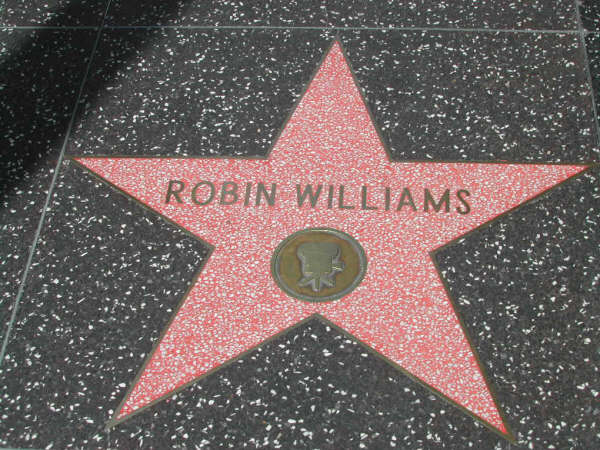
Fans of Williams created makeshift memorials at his star on the Hollywood Walk of Fame and at locations from his television and film career, such as the bench in Boston's Public Garden featured in Good Will Hunting; the Pacific Heights, San Francisco, home used in Mrs. Doubtfire; the sign for Parrish Shoes in Keene, New Hampshire, where parts of Jumanji were filmed; and the Boulder, Colorado, home used for Mork & Mindy.
During the 66th Primetime Emmy Awards on August 25, Billy Crystal presented a tribute to Williams, referring to him as "the brightest star in our comedy galaxy". Afterward, some of Williams's best comedy moments were shown, including his first The Tonight Show appearance, indicating his great life in making people laugh. Talk show hosts, including David Letterman, Conan O'Brien, Seth Meyers, Jimmy Kimmel, and Jimmy Fallon, paid tribute to Williams on their respective shows.
On September 9, 2014, PBS aired a one-hour special devoted to Williams's career. Later that month, family members and celebrities paid tribute to his life and career in San Francisco. British heavy metal band Iron Maiden dedicated a song to Williams, titled "Tears of a Clown", on their 2015 album The Book of Souls. The song looks into his depression and suicide, and how he attempted to hide his condition from the public.
A tunnel painted with a rainbow on Highway 101, north of the Golden Gate Bridge, was officially named the "Robin Williams Tunnel" on February 29, 2016. In 2017, Sharon Meadow in San Francisco's Golden Gate Park, the home of the annual Comedy Day, was renamed "Robin Williams Meadow".
In 2018, HBO produced a documentary about his life and career. Directed by Marina Zenovich, the film Robin Williams: Come Inside My Mind was also screened at the Sundance Film Festival. That same year, a mural of Robin Williams was created on Market Street in San Francisco. Work on a biography was begun by The New York Times writer David Itzkoff in 2014, and was published four years later, titled Robin.
In September 2020, Vertical Entertainment released a documentary titled Robin's Wish about Williams's battle with Lewy body dementia. In May 2022, Williams was inducted into a hall of fame at the National Comedy Center in Jamestown, New York. In 2025, the deceased Williams became the subject of a controversy over AI generated videos in which his daughter, Zelda Williams, pleaded for people to stop sending her AI videos of her father, stating that's "not what he would have wanted."
Recognition and legacy
Although Williams was first recognized as a stand-up comedian and television star, he became known for acting in film roles of substance and serious drama. Williams was considered a "national treasure" by many in the entertainment industry and by the public.
Williams's onstage energy and improvisational skill became a model for a new generation of stand-up comedians. Many comedians valued the way he worked highly personal issues into his comedy routines, especially his honesty about drug and alcohol addiction, along with depression. According to media scholar Derek A. Burrill, because of the openness with which Williams spoke about his own life, "probably the most important contribution he made to pop culture, across so many different media, was as Robin Williams the person".
Williams created a signature free-form comedy persona so widely and uniquely identified that new comedians like Jim Carrey impersonated him, paving the way for the growing comedy scene that developed in San Francisco. Young comedians felt more liberated on stage by seeing his spontaneously diverse range: "One moment acting as a bright, mischievous child, then as a wise philosopher or alien from outer space". According to Judd Apatow, the eclectic performer's rapid-fire improvisational style was an inspiration as well as an influence for other comedians, but his talent was so extremely unusual no one else could possibly attempt to copy it.
Williams's film performances often influenced other actors, both in and out of the film industry. Director Chris Columbus, who directed him in Mrs. Doubtfire, says watching him work "was a magical and special privilege. His performances were unlike anything any of us had ever seen, they came from some spiritual and otherworldly place." Looking over most of Williams's filmography, Alyssa Rosenberg at The Washington Post was "struck by the breadth" and radical diversity of most of his roles, writing that "Williams helped us grow up".
Comedic style
Williams said that, partly due to the stress of performing stand-up, he started using drugs and alcohol early in his career. He further said that he neither drank nor took drugs while on stage, but occasionally performed when hung over from the previous day. During the period when he was using cocaine, Williams said it made him paranoid when performing on stage.
Williams once described the life of stand-up comedians as follows:
Some, such as the critic Vincent Canby, were concerned that Williams's monologues were so intense that it seemed as though, at any minute, his "creative process could reverse into a complete meltdown". His biographer, Emily Herbert, described Williams's "intense, utterly manic style of stand-up [which sometimes] defies analysis... [going] beyond energetic, beyond frenetic... [and sometimes] dangerous... because of what it said about the creator's own mental state." Regarding the quick-fire delivery of his performance, Williams said, "Usually, you start off performing in bars, where you can't really take your time, because people go: [mimics a drunk person] 'Oy, what are you doing now?' So I developed a style that was very much synaptic: quick-firing, moving, so that they never really had a chance to lock on as a target."
Williams felt secure that he would not run out of ideas, as the constant change in world events would keep him supplied. The competitive nature of the show made things difficult. For example, some comedians said that Williams had stolen their jokes, which he strongly denied. David Brenner claimed that he confronted Williams's agent and threatened bodily harm if he heard him utter another one of his jokes. Whoopi Goldberg defended Williams, asserting that it is difficult for comedians not to reuse another comedian's material, and that it is done "all the time". Subsequently, he avoided going to performances of other comedians to deter similar accusations.
During a Playboy interview in 1992, Williams was asked whether he ever feared losing his balance between his work and his life. He replied, "There's that fear—if I felt like I was becoming not just dull but a rock, that I still couldn't speak, fire off or talk about things, if I'd start to worry or got too afraid to say something.... If I stop trying, I get afraid." While he attributed the recent suicide of novelist Jerzy Kosiński to his fear of losing his creativity and sharpness, Williams felt that he could overcome those risks. For that, he credited his father for strengthening his self-confidence, telling him to never be afraid of talking about subjects which were important to him.
Influences
Williams credited comedians, including Jonathan Winters, Peter Sellers, Nichols and May, and Lenny Bruce as influences, admiring their ability to attract a more intellectual audience with a higher level of wit. He also liked Jay Leno for his quickness in ad-libbing comedy routines, and Sid Caesar, whose acts he felt were "precious".
Jonathan Winters was his "idol" early in life; Williams, aged eight, first saw him on television and paid him homage in interviews throughout his career. Williams was inspired by Winters's ingenuity, saying "that anything is possible, that anything is funny... He gave me the idea that it can be free-form, that you can go in and out of things pretty easily."
During an interview in London in 2002, Williams told Michael Parkinson that Peter Sellers was an important influence, especially his multi-character roles in Dr. Strangelove, stating, "It doesn't get better than that." British comedy actors Dudley Moore and Peter Cook were also among his influences, Williams told Parkinson.
Williams was also influenced by Richard Pryor's fearless ability to talk about his personal life onstage, with subjects that included his use of drugs and alcohol, and Williams added those kinds of topics during his own performances. By bringing up such personal matters as a form of comedy, Williams told Parkinson that it was "cheaper than therapy", and gave him a way to release his pent-up energy and emotions.
Acting credits and accolades
Main article: List of Robin Williams performances, List of awards and nominations received by Robin Williams
Throughout his career, Williams won numerous awards, including an Academy Award for Best Supporting Actor for his role in Good Will Hunting (1997). He also won six Golden Globe Awards, including Best Actor—Motion Picture Musical or Comedy for his roles in Good Morning, Vietnam (1987), The Fisher King (1991), and Mrs. Doubtfire (1993), along with the Special Golden Globe Award for Vocal Work in a Motion Picture for his role Genie in Aladdin (1992), and the Golden Globe Cecil B. DeMille Award in 2005. Williams also received two Primetime Emmy Awards, two Screen Actors Guild Awards, and five Grammy Awards.
Discography
- Reality ... What a Concept (Casablanca, 1979)
- Throbbing Python of Love (Casablanca, 1983)
- A Night at the Met (Columbia, 1986)
- Live 2002 (Columbia, 2002)
- Weapons of Self Destruction (Sony Music, 2009)
Notes
References
Footnotes
Sources
References
- Kahn, Mattie. (August 12, 2014). "When Norm Macdonald Met Robin Williams – 'The Funniest Man in The World'". [[ABC News (United States).
- (August 11, 2014). "Robin Williams, 'funniest man alive,' dead at 63". The Bradenton Herald.
- (August 12, 2014). "Say What? Robin Williams' Most Iconic Character Voices". VH1 News.
- (August 10, 2017). "Remembering Robin Williams – the man with 1000 voices".
- "The 25 Funniest People Of All Time".
- "50 Best Stand-Up Comics of All Time".
- "The 50 Best Stand-up Comics of All Time".
- "Robin Williams Has Been Voted Funniest Person Ever".
- (November 18, 2020). "Robin Williams' former Bay Area home finally sells for under asking". [[SFGate]].
- Martin, Nick. (August 13, 2014). "San Francisco Neighbours Mourn Robin Williams". [[Sky News]].
- (November 4, 2015). "Robin Williams' widow speaks: Depression didn't kill my husband". CNN.
- (November 10, 2014). "LBDA Clarifies Autopsy Report on Comedian, Robin Williams". [[Lewy Body Dementia Association]].
- (September 30, 2016). "How Lewy body dementia gripped Robin Williams". Scientific American.
- (August 11, 2014). "Chicago Native Robin Williams Recalled 'Good Times' Growing Up Here". [[CBS Chicago]].
- "Robin Williams".
- Monk, Katherine. (July 4, 2007). "Marriage 101 with Robin Williams".
- Stuurman, Linda. [May 25, 2008] July 12, 2008. [http://www.robin-williams.net/interviews/RWF/rwfinterview.php RWF talks with Robin Williams: Proost!] {{Webarchive. link. (July 24, 2011 ." ''The Robin Williams Fansite''.)
- (November 22, 1993). "Robin Williams' Change Of Life: Fighting For His Family In His New Film, 'Mrs. Doubtfire,' And In Real Life". K-III Magazine Corporation.
- (August 14, 2014). "Robin Williams had family ties to state". [[Reporter-Times]].
- Rubenstein, Steve. (September 8, 2001). "Laurie Williams – comedian's mother". [[SFGate]].
- McLellan, Dennis. (August 18, 2007). "R. Todd Williams, 69; winery founder, comic's brother". [[Los Angeles Times]].
- (December 25, 1991). "Robin Williams' Half-brother Is An All-out Fan". Chicago Tribune.
- Gristwood, Sarah. (June 18, 1998). "Bobbin' Robin". Mail & Guardian.
- Topel, Fred. (July 3, 2007). "Robin Williams on License to Wed". CanMag.
- link. (June 22, 2015 , June 10, 2001)
- Cullotta, Karen Ann. (August 13, 2014). "Robin Williams' childhood in Lake Forest remembered". Chicago Tribune.
- "Robin Williams: 'The Night Listener'".
- Moore, Mary Ellen. (1979). "Robin Williams". Grosset & Dunlap.
- Strauss, Valerie. (August 11, 2014). "How high school changed Robin Williams' life". The Washington Post.
- (May 28, 1989). "Robin Williams, the Comic, Confronts Robin Williams, the Actor". [[The New York Times]].
- Klemesrud, Judy. (April 15, 1984). "Robin Williams Dons an Emigre's Guise". [[The New York Times]].
- Landrum, Gene N.. (2007). "Paranoia & Power: Fear & Fame of Entertainment Icons". Morgan James Publishing.
- Golum, Rob. (August 12, 2014). "Robin Williams, Oscar Winner, Dies After Hanging Himself". Bloomberg News.
- Hansen, Megan. (August 11, 2014). "'We knew him as a neighbor': Marin remembers Robin Williams megan". [[Marin Independent Journal]].
- (2008). "Make 'Em Laugh: The Funny Business of America". Twelve.
- Reeve, Christopher. (1998). "Still Me". [[Random House]].
- Dorsinville, Jean M.. (2011). "Franklyn V.E. Seales: Life of an Artist". iUniverse.
- (November 23, 2014). "Robin Williams' son remembers his dad and Christopher Reeve's friendship". [[Fox News]].
- (August 13, 2015). "We'll Always Love You Robin!".
- Feeney, Nolan. (August 12, 2014). "Listen to Robin Williams Talk About His Struggles on an April 26, 2010 Podcast".
- (August 11, 2014). "WTF with Marc Maron – Remembering Robin Williams". [[WTF with Marc Maron]].
- (May 18, 1991). "For Juilliard, Ex-Student Hams It Up". [[The New York Times]].
- Blair, Caroline. (August 12, 2014). "NC Comedian: Robin Williams Was My Hero, My Influence". Time Warner Cable News.
- (August 12, 2014). "Robin Williams' heart never strayed far from San Francisco".
- Nachman, Gerald. (2003). "Seriously Funny: The Rebel Comedians of the 1950s and 1960s". Pantheon Books.
- Williams moved to Los Angeles and continued performing stand-up at clubs, including [[the Comedy Store]]. There, in 1977, he was seen by television producer [[George Schlatter]], who asked him to appear on a revival of his show [[Rowan & Martin's Laugh-In. link. (February 1, 2020)
- Sharman, Jon. (August 12, 2014). "Comedy night organiser remembers Robin Williams surprise performance at Fighting Cocks".
- Lockett, Dee. (August 19, 2014). "Letterman Remembers the First Time He Met Robin Williams".
- Rea, Steven. (August 13, 2014). "Robin Williams, 63, comic genius". The Philadelphia Inquirer.
- Spitznagel, Eric. (August 12, 2014). "Popeye Is the Best Movie Robin Williams Ever Made". [[Vanity Fair (magazine).
- "Robin Williams Biography". Biography Channel.
- (November 20, 2014). "'Happy Days' Cast Reveals How Robin Williams Got Cast as a "Martian" in Show's "Worst Script"".
- Corliss, Richard. (August 25, 2014). "Robin Williams: The Heart of Comedy".
- "Mork & Mindy".
- (2014). "Robin Williams – March 12, 1979".
- (March 12, 1979). "How Robin Williams Went From Unknown To Star in 5 Months".
- Forgione, Mary. (August 12, 2014). "The lighter side of Robin Williams, now at National Portrait Gallery". Los Angeles Times.
- Williams, Robin. ''Rolling Stone'', May 18, 2006
- (June 1, 2011). "A History of Comedy Stars on the Cover of Rolling Stone".
- (December 6, 2012). "Comedy gold: Robin Williams' A Night at the Met". [[The Guardian]].
- "Grammy Award Nominees 1980 – Grammy Award Winners 1980".
- Arnold, William. (July 15, 1986). "Robin Williams Tries to Get Serious About His Movies". Seattle Post-Intelligencer.
- (March 26, 1986). "The Academy Awards Ceremony". The New York Times.
- {{YouTube. iqdSagycCWc. "Robin Williams on Johnny Carson's Tonight Show – 1991"
- Zehme, Bill. (February 25, 1988). "Robin Williams: The Rolling Stone Interview".
- (1991). "Inventing Vietnam: The War in Film and Television". Temple University Press.
- Kuchwara, Michael. (November 26, 1988). "Still 'Waiting for Godot': Robin Williams, Steve Martin play it for laughs". [[The Free Lance–Star]].
- Rich, Frank. (November 7, 1988). "Review/Theater: 'Godot': The Timeless Relationship of 2 Interdependent Souls". [[The New York Times]].
- (August 12, 2014). "A clown and his demons: Robin Williams mixed zany comedy, sharp satire and pathos (with video)". The Vancouver Sun.
- Rosenberg, Alyssa. (August 11, 2014). "How Robin Williams helped us grow up". [[The Washington Post]].
- Goodman, Jessica. (August 11, 2014). "Robin Williams and the 'O Captain' Scene That Inspired a Generation". [[HuffPost]].
- Neale, Ryan Thomas. (August 12, 2014). "Requiem for a Therapist: A Tribute to Robin Williams". [[HuffPost]].
- ''Rolling Stone'', February 21, 1991, p. 26.
- (August 15, 2014). "Turning Robin Williams into 'Aladdin's' Genie". [[ABC News (United States).
- McDonald, Soraya Nadia. (August 15, 2014). "Robin Williams almost didn't make 'Aladdin,' and a generation of children is grateful that he did". [[The Washington Post]].
- Labrecque, Jeff. (August 12, 2014). "Robin Williams in 'Aladdin': Animator Eric Goldberg remembers drawing Genie".
- Meslow, Scott. (October 28, 2011). "How Celebrities Took Over Cartoon Voice Acting".
- (September 1, 2009). "2009 Disney Legends Award Recipients to Be Honored During D23 Expo in Anaheim". [[Reuters]].
- Welkos, Robert. (October 24, 1994). "Abracadabra: Disney, Robin Williams Quit Feud". [[Los Angeles Times]].
- Cerone, Daniel Howard. (September 27, 1995). "Genie Grants Disney's Video Wish : Marketing: Robin Williams will reprise his 'Aladdin' role in 'King of Thieves,' continuing the emergence of direct-to-video projects as an industry gold mine.". [[Los Angeles Times]].
- "Robin Williams". [[AllMovie]].
- Cook, Jon. (April 4, 1997). "Comedians Crystal and Williams in "Friends" episode".
- Medavoy, Mike. (2002). "You're Only as Good as Your Next One: 100 Great Films, 100 Good Films, and 100 for Which I Should Be Shot". Simon & Schuster (Altria).
- Lax, Eric. (2007). "Conversations with Woody Allen: His Films, the Movies, and Moviemaking". [[Knopf Doubleday]].
- (January 6, 2000). "Robin Williams and Audible Announce New Weekly Internet Program.". [[The Free Library]].
- Frauenfelder, Mark. (December 1, 2002). "Living online".
- Williams, Karl. "Insomnia (2002)". AllMovie.
- Deming, Mark. "One Hour Photo (2002)". AllMovie.
- {{cite episode
- link. (February 12, 2010 , Internet Broadway Database. Retrieved January 19, 2019.)
- (April 1, 2006). "Kids' Choice Awards". CBS News.
- (November 3, 2011). "Quick Takes: An 'Extreme Makeover' salute to military families". Los Angeles Times.
- Gans, Andrew. (July 8, 2009). "HBO to Air Robin Williams' Weapons of Self-Destruction".
- (January 2, 2017). "He really wanted to be in the movie".
- Veness, Susan. (2009). "The Hidden Magic of Walt Disney World: Over 600 Secrets of the Magic Kingdom, Epcot, Disney's Hollywood Studios, and Animal Kingdom". [[Adams Media]].
- Stanhope, Kate. (August 11, 2014). "Robin Williams Dies of Suspected Suicide at 63".
- Isherwood, Charles. (March 31, 2011). "Ghostly Beast Burning Bright in Iraq". The New York Times.
- (May 10, 2013). "CBS Orders Chuck Lorre's 'Mom,' Robin Williams' 'Crazy Ones,' Will Arnett Comedy, More".
- Littleton, Cynthia. (May 10, 2014). "CBS Renews 'Mentalist', Cancels 'Crazy Ones', 'Hostages', 'Intelligence' & 2 More".
- Hachard, Tomas. (May 22, 2014). "The 'Angriest' Robin Williams Sadly Becomes The Inspirational One". [[NPR]].
- Elavsky, Cindy. (August 24, 2014). "Celebrity Extra". [[King Features]].
- Browne, David. (September 11, 2014). "Robin Williams, 1951–2014".
- Darrach, Brad. (February 22, 1988). "A Comic's Crisis of the Heart".
- "Robin Williams bio revelations: Infidelity, substance abuse, insecurity over Jim Carrey".
- (April 14, 2008). "Robin Williams Surprise Split".
- LaSalle, Mick. (July 11, 2018). "Robin Williams gets his just due in documentary 'Come Inside My Mind'". San Francisco Chronicle.
- Hochman, David. (September 9, 2013). "Still Crazy: Years after Mork and Buffy, Robin Williams and Sarah Michelle Gellar hope to rope us in with a new sitcom".
- Garchik, Leah. (March 27, 2008). "Robin Williams' wife files for divorce after nearly 19 years". [[San Francisco Chronicle]].
- (October 24, 2011). "Robin Williams and Susan Schneider reportedly wed". [[The Washington Post]].
- Ravitz, Justin. (October 24, 2011). "Robin Williams Weds!".
- (September 25, 2013). "Robin Williams. It's time for a convoluted stream of consciousness. Ask Me Anything!". Reddit.
- (2014). "Robin Williams, My Teammate".
- Williams, Robin. (September 25, 2013). "Robin Williams. It's time for a convoluted stream of consciousness. Ask Me Anything!".
- (September 25, 2013). "Robin Williams. It's time for a convoluted stream of consciousness. Ask Me Anything!".
- Szymanski, Mike. (August 21, 2002). "Robin Williams Confesses to Another Addiction ... the Internet". [[Tribune Media Services]].
- (2003). "High Score!: The Illustrated History of Electronic Games". [[McGraw-Hill Education.
- Graser, Marc. (August 13, 2014). "Robin Williams to Be Memorialized in 'World of Warcraft'".
- Boutin, Paul. (January 6, 2006). "Live coverage of Google Keynote with Robin Williams".
- Terdiman, Daniel. (May 11, 2006). "Robin Williams yucks it up for 'Spore'". [[CNET]].
- "Dungeons and Dragons Game Day at London Dungeon".
- Peters, Megan. (May 17, 2018). "Robin Williams' Daughter Asks Fans To Help Identify His Massive Anime Collection".
- Macdonald, Christopher. (May 5, 2005). "More Robin Williams on Anime".
- Murphy, Brian. "Tour de Lance: 100 percent pure". [[ESPN]].
- Koeppel, Dan. (2003). "Robin Williams Profile – Robin Williams: "I'm Lucky to Have Bikes in My Life"".
- "Cycle of Life {{!}} Paddle8".
- Johnson, Caitlin A.. (July 3, 2007). "A "License" to Laugh". [[CBS News]].
- Borschel, Amanda. (August 12, 2014). "'Honorary Jew' Robin Williams, 63, found dead". [[The Times of Israel]].
- Brown, Carolyn M.. (August 12, 2014). "Robin Williams, Whoopi Goldberg and Billy Crystal Raised $80 Million For Homeless".
- Finn, Natalie. (August 12, 2014). "Billy Crystal and Whoopi Goldberg React in Kind to Robin Williams' Death: "No Words"". [[E!]].
- Thompson, Mark. (August 12, 2014). "The Military Absolutely Loved Robin Williams".
- ''On Patrol'', USO, Fall 2014, p. 8
- (December 10, 1999). "Stones cover enters festive race". [[BBC News]].
- Greenhill, Marc. (November 16, 2010). "Robin Williams' quake donation".
- Bronstein, Phil. (February 9, 2005). "Good Morning, Iraq". [[San Francisco Chronicle]].
- "Celebrity Involvement at St. Jude". St. Jude.
- Aitkenhead, Decca. (September 20, 2010). "Robin Williams: 'I was shameful, did stuff that caused disgust—that's hard to recover from'". [[The Guardian]].
- (August 13, 2014). "(video) Robin Williams Told Friend 'Cycling Saved My Life' Post-Cocaine Days".
- Duke, Alan. (August 14, 2014). "Robin Williams was in early stages of Parkinson's disease, wife reveals". [[CNN]].
- (August 14, 2014). "Robin Williams and Dario Pegoretti: The Comedian and the Bike Builder". [[The Wall Street Journal]].
- (October 2, 2006). "Robin Williams Comes Clean on 'GMA'". [[American Broadcasting Company.
- Duke, Alan. (March 4, 2009). "Robin Williams, short of breath, takes a break". [[CNN]].
- Aitkenhead, Decca. (2010-09-20). "Robin Williams: 'I was shameful, did stuff that caused disgust – that's hard to recover from'".
- Errico, Marcus. (August 11, 2014). "Robin Williams Dead of Apparent Suicide at 63". Yahoo!.
- (March 5, 2009). "Robin Williams to undergo heart surgery". Today.
- Doheny, Kathleen. "Robin Williams' Heart Surgery: Road to Recovery". WebMD.
- (March 23, 2009). "Robin Williams' heart surgery goes 'extremely well'". [[CNN]].
- Duke, Alan. (August 12, 2014). "Robin Williams dead; family, friends and fans are 'totally devastated'". CNN.
- Ryder, Taryn. (August 15, 2014). "Wife: Robin Williams Had Parkinson's Disease, His Sobriety Intact Before Death". Yahoo!.
- (September 1, 2019). "Dementia with Lewy Bodies and Functional Magnetic Resonance Imaging Application". International Journal of Gerontology.
- "Robin Williams coroner's report finds no illegal drugs or alcohol in system". Daily News.
- (October 2, 2016). "Robin Williams suffered from a common form of dementia that many people don't know about".
- (September 27, 2016). "The terrorist inside my husband's brain". [[Neurology (journal).
- (August 11, 2014). "Robin Williams, Oscar-Winning Comedian, Dies at 63". [[The New York Times]].
- Stucker, Matthew. (November 7, 2014). "Robin Williams' death ruled suicide". CNN.
- Freeman, Hadley. (January 1, 2021). "Robin Williams's widow: 'There were so many misunderstandings about what had happened to him'". The Guardian.
- McKeith, IG. "Robin Williams had dementia with Lewy bodies—so, what is it and why has it been eclipsed by Alzheimer's?". The Conversation.
- Ford, Dana. (August 21, 2014). "Robin Williams' ashes scattered in San Francisco Bay". CNN.
- (August 21, 2014). "Death Certificate Indicates Robin Williams Cremated, Ashes Scattered In San Francisco Bay". CBS Local.
- (August 12, 2014). "Robin Williams' Family: 'The World is Forever a Little Darker'".
- Brand, Russell. (August 12, 2014). "Robin Williams' divine madness will no longer disrupt the sadness of the world". The Guardian.
- Derschowitz, Jessica. (August 12, 2014). "Robin Williams tributes pour in from Hollywood". [[CBS News]].
- (August 11, 2014). "President Obama on the Passing of Robin Williams: "He Was One of a Kind"". White House.
- Collis, Clark. (November 11, 2014). "Monty Python reunion: Eric Idle on his late friend Robin Williams".
- "International Youth Day Event: Mental Health Matters".
- Idato, Michael. (August 14, 2014). "Robin Williams death: Jimmy Fallon fights tears, pays tribute with 'Oh Captain, My Captain'". [[The Sydney Morning Herald]].
- Lewis, Hilary. (August 14, 2014). "Disney Networks to Air 'Aladdin' in Honor of Robin Williams".
- (August 14, 2014). "Robin Williams honored on Broadway with dimmed lights, 'Aladdin' tribute". NBC News.
- Simakis, Andrea. (August 14, 2014). "Broadway's 'Aladdin' cast honors Robin Williams with song". The Plain Dealer.
- (August 12, 2014). "Fans mourn Robin Williams at Hollywood Walk of Fame star, autopsy pending". [[Los Angeles Daily News]].
- (August 12, 2014). "Boston fans remember Robin Williams". [[The Boston Globe]].
- Rocha, Veronica. (August 13, 2014). "Robin Williams memorial grows outside 'Mrs. Doubtfire' house". [[Los Angeles Times]].
- (August 15, 2014). "Keene theater to host free 'Jumanji' screening after star's death".
- Bacle, Ariana. (August 12, 2014). "Fans remember Robin Williams at 'Mork and Mindy' house".
- Therrell, Lane. (August 22, 2014). "Billy Crystal Emmys Tribute to Robin Williams Expected to Honor Humor".
- Sacks, Ethan. (August 25, 2014). "Emmys 2014: Robin Williams given emotional tribute by good friend Billy Crystal". Daily News.
- (August 13, 2014). "Robin Williams late-night tributes: Jimmy Fallon, Seth Meyers and Conan O'Brien share memories". The Washington Post.
- Weinstein, Shelli. (September 2, 2014). "Robin Williams Tribute Special to Air on PBS".
- Barnes, Mike. (September 27, 2014). "Robin Williams' Life Celebrated at San Francisco Tribute Attended by Family, Industry Friends".
- (August 24, 2015). "Iron Maiden dedicate new song 'Tears Of A Clown' to Robin Williams".
- (March 2016). "Robin Williams tunnel officially gets new signs". San Francisco Chronicle.
- (December 22, 2017). "Golden Gate Park meadow renamed for Robin Williams".
- Gleiberman, Owen. (January 20, 2018). "Sundance Film Review: 'Robin Williams: Come Inside My Mind'".
- (August 30, 2018). "San Francisco mural honors Robin Williams". Los Angeles Times.
- Rodriguez, Joe Fitzgerald. (August 29, 2018). "Artist paints Robin Williams mural for free on SF's Market Street". San Francisco Examiner.
- Lewis, Andy. (August 27, 2014). "Robin Williams Bio in the Works".
- Itzkoff, Dave. (May 15, 2018). "Robin". Henry Holt and Company.
- (August 6, 2020). "Robin Williams' final days detailed in touching trailer for new documentary Robin's Wish".
- "The Hall — National Comedy Center, Jamestown, NY". National Comedy Center.
- (2025-10-07). "Robin Williams' daughter pleads for people to stop sending AI videos of her dad".
- Goodale, Gloria. (August 12, 2014). "Robin Williams: His unscripted riffs were not merely funny, but observant". The Christian Science Monitor.
- {{YouTube. 9zorOqE0j1c. "Jim Carrey Impersonates Robin Williams"
- Rappoport, Leon. ''Punchlines: The Case for Racial, Ethnic, and Gender Humor'', Greenwood Publishing (2005) p. 136
- Browne, David. (September 11, 2014). "Robin Williams, 1951–2014".
- (August 13, 2014). "Valley native Chris Columbus speaks about life with Robin Williams".
- Grobel, Lawrence. (January 1992). "Playboy Interview: Robin Williams". [[Playboy Enterprises]].
- Herbert, Emily. (November 15, 2014). "Robin Williams: When the Laughter Stops 1951–2014". John Blake Publishing Ltd..
- (April 2021). "Robin Williams/Stephen Fry UK Interview (RE-EDITED)".
- "Robin Williams: Prince of Thieves".
- Zoglin, Richard. (2008). "Comedy at the Edge". Bloomsbury USA.
- Sims, David. (July 28, 2015). "In Conan O'Brien Versus Twitter Comedians, Whose Joke Is It Anyway?". [[The Atlantic]].
- Giles, Jeff. (February 21, 1991). "Robin Williams: Fears of a Clown".
- (April 12, 2013). "Jonathan Winters Dead: 'Mork and Mindy' Star Dies At Age 87". HuffPost.
- Williams, Robin. "Robin Williams, Parkinson interview 2002".
- "Robin Williams".
- "Robin Williams".
- "Robin Williams – Artist". National Academy of Recording Arts and Sciences.
This article was imported from Wikipedia and is available under the Creative Commons Attribution-ShareAlike 4.0 License. Content has been adapted to SurfDoc format. Original contributors can be found on the article history page.
Ask Mako anything about Robin Williams — get instant answers, deeper analysis, and related topics.
Research with MakoFree with your Surf account
Create a free account to save articles, ask Mako questions, and organize your research.
Sign up freeThis content may have been generated or modified by AI. CloudSurf Software LLC is not responsible for the accuracy, completeness, or reliability of AI-generated content. Always verify important information from primary sources.
Report