From Surf Wiki (app.surf) — the open knowledge base
Right-wing populism
Political ideology
Political ideology
|Prime Minister of India Narendra Modi and Prime Minister of Italy Giorgia Meloni |President of the United States Donald Trump and Prime Minister of Israel Benjamin Netanyahu}}
Right-wing populism, also called right populism and national populism, is a political ideology that combines right-wing politics with populist rhetoric and themes. Its rhetoric employs anti-elitist sentiments, opposition to the Establishment, and speaking to or for the common people. Recurring themes of right-wing populists include neo-nationalism, social conservatism, economic nationalism, and fiscal conservatism. Frequently they aim to defend a national culture, identity, and economy against perceived attacks by outsiders.
Right-wing populism has associations with authoritarianism, while some far-right populists draw comparisons to fascism. Right-wing populism in the Western world is sometimes associated with ideologies such as anti-environmentalism, anti-globalisation, nativism, and protectionism. In Europe the term is often used to describe groups, politicians and political parties generally known for their opposition to immigration, and for Euroscepticism. Some right-wing populists may support expanding the welfare state, but only for those they deem fit to receive it; this concept has been referred to as "welfare chauvinism". Since the Great Recession, European right-wing populist movements began to grow in popularity, in large part due to increasing opposition to immigration from the Middle East and Africa, rising Euroscepticism and discontent with the economic policies of the European Union.
From the 1990s, right-wing populist parties became established in the legislatures of various democracies. Right-wing populism has remained the dominant political force in the Republican Party in the United States since the 2010s. Although extreme right-wing movements in the United States (where they are normally referred to as the "radical right") are usually characterised as separate entities, some writers consider them to be a part of a broader, right-wing populist phenomenon. Donald Trump, an American businessman and media personality, won the 2016 and 2024 United States presidential elections after running on platforms founded on right-wing populist themes.
Definition
Right-wing populism is an ideology that primarily espouses neo-nationalism, social conservatism and economic nationalism.
The political scientist Cas Mudde argues that what he calls the "populist radical right" starts with the idea of 'the nation'. He however rejects the use of nationalism as a core ideology of right-wing populism on the ground that there are also purely "civic" or "liberal" forms of nationalism, preferring instead the term nativism: a xenophobic form of nationalism asserting that "states should be inhabited exclusively by members of the native group ('the nation'), and that non-native elements (persons and ideas) are fundamentally threatening to the homogeneous nation-state". Mudde further argues that "while nativism could include racist arguments, it can also be non-racist (including and excluding on the basis of culture or even religion)", and that the term nativism does not reduce the parties to mere single-issue parties, such as the term anti-immigrant does. In the maximum definition, to nativism is added authoritarianism—an attitude, not necessarily anti-democratic or autocratic, to prefer "law and order" and the submission to authority—and populism—a "thin-centered ideology" that considers society to be ultimately separated into two homogeneous and antagonistic groups, "the pure people" versus "the corrupt elite", and which argues that politics should be an expression of the "general will of the people", regardless of human rights or constitutional guarantees. Cas Mudde and Cristóbal Rovira Kaltwasser reiterated in 2017 that within European right-wing populism, there is a "marriage of convenience" of populism based on an "ethnic and chauvinistic definition of the people", authoritarianism, and nativism. This results in right-wing populism having a "xenophobic nature".
Roger Eatwell, emeritus Professor of Comparative Politics at the University of Bath, writes that, "whilst populism and fascism differ notably ideologically, in practice the latter has borrowed aspects of populist discourse and style, and populism can degenerate into leader-oriented authoritarian and exclusionary politics." According to left-wing media Vice, for populism to transition into fascism or proto-fascism it requires a "nihilistic culture and an intractable crisis".
[P]opulism is like fascism in being a response to liberal and socialist explanations of the political. And also like fascism, populism does not recognize a legitimate political place for an opposition that it regards as acting against the desires of the people and that it also accuses of being tyrannical, conspiratorial, and antidemocratic. ... The opponents are turned into public enemies, but only rhetorically. If populism moves from rhetorical enmity to practices of enemy identification and persecution, we could be talking about its transformation into fascism or another form of dictatorial repression. This has happened in the past ... and without question it could happen in the future. This morphing of populism back into fascism is always a possibility, but it is very uncommon, and when it does happen, and populism becomes fully antidemocratic, it is no longer populism.
Erik Berggren and Andres Neergard wrote in 2015 that, "[m]ost researchers agree [...] that xenophobia, anti-immigration sentiments, nativism, ethno-nationalism are, in different ways, central elements in the ideologies, politics, and practices of right-wing populism and Extreme Right Wing Parties." Similarly, the historian Rick Shenkman describes the ideology presented by right-wing populism as "a deadly mix of xenophobia, racism, and authoritarianism". Tamir Bar-On also concluded in 2018 that the literature generally places "nativism" or "ethnic nationalism" as the core concept of the ideology, which "implicitly posits a politically dominant group, while minorities are conceived as threats to the nation". It is "generally, but not necessarily racist"; in the case of the Dutch Party for Freedom for instance, "a religious [minority, i.e. Muslims] instead of an ethnic minority constitutes the main 'enemy'".
Scholars use terminology inconsistently, sometimes referring to right-wing populism as "radical right" or other terms such as new nationalism. Pippa Norris noted that "standard reference works use alternate typologies and diverse labels categorising parties as 'far' or 'extreme' right, 'New Right', 'anti-immigrant' or 'neo-fascist', 'anti-establishment', 'national populist', 'protest', 'ethnic', 'authoritarian', 'anti-government', 'anti-party', 'ultranationalist', 'right-libertarian' and so on". The term authoritarian populism can be used to describe right-wing populism, although it is also used to refer to left-wing political movements.
In regard to the authoritarian aspect of right-wing populism, the political psychologist Shawn W. Rosenberg asserts that its "intellectual roots and underlying logic" are best seen as "a contemporary expression of the fascist ideologies of the early 20th century".
Guided by its roots in ideological fascism ... and its affinity to the fascist governments of 1930s Germany and Italy, [right-wing populism] tends to delegate unusual power to its leadership, more specifically its key leader. This leader embodies the will of the people, renders it clear for everyone else and executes accordingly. Thus distinctions between the leadership, the people as a whole and individuals are blurred as their will is joined in a single purpose. (p.5) ... In this political cultural conception, individuals have a secondary and somewhat derivative status. They are rendered meaningful and valued insofar as they are part of the collective, the people and the nation. Individuals are thus constituted as a mass who share a single common significant categorical quality – they are nationals, members of the nation. ... In this conception, the individual and the nation are inextricably intertwined, the line between them blurred. As suggested by philosophers of fascism ... the state is realized in the people and the people are realized in the state. It is a symbiotic relation. Individuals are realized in their manifestation of the national characteristics and by their participation in the national mission. In so doing, individuals are at once defined and valued, recognized and glorified. (p. 12)
According to Rosenberg, right-wing populism accepts the primacy of "the people", but rejects liberal democracy's protection of the rights of minorities, and favors ethno-nationalism over the legal concept of the nation as a polity, with the people as its members; in general, it rejects the rule of law. All of these attributes, as well as its favoring of strong political leadership, suggest right-wing populism's fascist leanings. The historian Federico Finchelstein defines populism as a form of authoritarian democracy while fascism is an ultraviolent dictatorship.
Motivations and methods
According to Roger Eatwell and Matthew Goodwin, "National populists prioritize the culture and interests of the nation, and promise to give voice to a people who feel that they have been neglected, even held in contempt, by distant and often corrupt elites." They are part of a "growing revolt against mainstream politics and liberal values. This challenge is in general not anti-democratic. Rather, national populists are opposed to certain aspects of liberal democracy as it has evolved in the West. [...] [Their] 'direct' conception of democracy differs from the 'liberal' one that has flourished across the West following the defeat of fascism and which has gradually become more elitist in character." Furthermore, national populists question what they call the "erosion of the nation-state", "hyper ethnic change" and the "capacity to rapidly absorb [high] rates of immigration", the "highly unequal societies" of the West's current economic settlement. They are suspicious of "cosmopolitan and globalizing agendas".
Populist parties use crises in their domestic governments to enhance anti-globalist reactions; these include refrainment towards trade and anti-immigration policies. The support for these ideologies commonly comes from people whose employment might have low occupational mobility. This makes them more likely to develop an anti-immigrant and anti-globalisation mentality that aligns with the ideals of the populist party.
Jean-Yves Camus and Nicolas Lebourg see "national populism" as an attempt to combine the socio-economical values of the left and political values of the right and the support for a referendary republic that would bypass traditional political divisions and institutions as they aim for the unity of the political (the demos), ethnic (the ethnos) and social (the working class) interpretations of the "people", national populists claim to defend the "average citizen" and "common sense", against the "betrayal of inevitably corrupt elites". As the Front National ideologue François Duprat put in the 1970s, inspired by the Latin American right of that time, right-populism aims to constitute a "national, social, and popular" ideology. If both left and right parties share populism itself, their premises are indeed different in that right-wing populists perceive society as in a state of decadence, from which "only the healthy common people can free the nation by forming one national class from the different social classes and casting aside the corrupt elites".
Methodologically, by co-opting concepts from the left—such as multiculturalism and ethnopluralism, which is espoused by the left as a means of preserving minority ethnic cultures within a pluralistic society—and then jettisoning their non-hierarchical essence, right-wing populists can, in the words of the sociologist Jens Rydgren, "mobilize on xenophobic and racist public opinions without being stigmatized as racists". The sociologist Hande Eslen-Ziya argues that right-wing populist movements rely on "troll science", namely "(distorted) scientific arguments moulded into populist discourse" that creates an alternative narrative. In addition to rhetorical methods, right-wing populist movements have also flourished by using tools of digital media, including websites and newsletters, social media groups and pages, as well as YouTube and messaging chat groups.
Cultural issues and immigration
While immigration is a common theme at the center of many national right-wing populist movements, the theme often crystallizes around cultural issues, such as religion, gender roles, and sexuality, as is the case with the transnational anti-gender theory movements. A body of scholarship has also found populist movements to employ or be based around conspiracy theories, rumors, and falsehoods. Some scholars argue that right-wing populism's association with conspiracy, rumor and falsehood may be more common in the digital era thanks to widely accessible means of content production and diffusion. These media and communication developments in the context of specific historical shifts in immigration and cultural politics have led to the association of right-wing populism with post-truth politics.
History
Germany and France (1870–1900)
German and French right-wing populism can be traced back to the period 1870–1900 in the aftermath of the Franco-Prussian War, with the nascence of two different trends in Germany and France: the Völkisch movement and Boulangism. Völkischen represented a romantic nationalist, racialist and, from the 1900s, antisemitic tendency in German society, as they idealised a bio-mystical "original nation" that still could be found in their views in the rural regions, a form of "primitive democracy freely subjected to their natural elites". In France the anti-parliamentarian Ligue des Patriotes, led by Georges Ernest Boulanger, Paul Déroulède and Maurice Barrès, called for a "plebiscitary republic", with the president elected by universal suffrage, and the popular will expressed not through elected representatives (the "corrupted elites"), but rather via "legislative plebiscites", another name for referendums. It also evolved to antisemitism after the Dreyfus affair (1894).
Denmark and Norway (1970s)
Modern national populism—what Pierro Ignazi called "post-industrial parties"—emerged in the 1970s, in a dynamic sustained by voters' rejection of the welfare state and of the tax system, both deemed "confiscatory"; the rise of xenophobia against the backdrop of immigration which, because originating from outside Europe, was considered to be of a new kind; and finally, the end of the prosperity that had reigned since the post–Second World War era, symbolised by the oil crisis of 1973. Two precursor parties consequently appeared in the early 1970s: the Progress Party, the ancestor of the Danish People's Party, and Anders Lange's Party in Norway.
Netherlands and France (2001)
A new wave of right-wing populism arose after the September 11 attacks. "Neo-populists" are nationalist and Islamophobic politicians who aspire "to be the champions of freedoms for minorities (gays, Jews, women) against the Arab-Muslim masses"; a trend first embodied by the Dutch Pim Fortuyn List and later followed by Geert Wilders' Party for Freedom and Jean Marie and his daughter Marine Le Pen's National Rally. According to Jean-Yves Camus and Nicolas Lebourg, those parties are not a real syncretism of the left and right, as their ideology and voter base are interclassist. Furthermore, neo-populist parties went from a critique of the welfare state to that of multiculturalism, and their priority demand remains the reduction of immigration.
Hungary (early 2000s)
In the early 2000s the Jobbik Party, formally known as the Movement for a Better Hungary, emerged and rapidly became the country's most successful far-right political party. Jobbik, which was founded in 2003, exploited antisemitic and anti-Roma feelings to rally support, as well as strong nationalist rhetoric and hostility to capitalism and liberalism. The party's successful use of internet channels to attract and mobilise young people resulted in tremendous popularity and influence.
Viktor Orbán's Fidesz Party is also a prominent factor in Hungarian right-wing populism. Since taking office in 2010, Orbán has changed Fidesz from a centre-right party to a right-wing populist organisation. Under Orbán's leadership, the party has stressed national sovereignty, anti-immigrant policies, and conservative social values, frequently battling with the EU on a variety of topics. Orbán's administration has centralised authority, controlled media and altered legal frameworks to keep power.
By country
, an Italian political scientist, divided right-wing populist parties, which he called "extreme right parties", into two categories: he placed traditional right-wing parties that had developed out of the historical right and post-industrial parties that had developed independently. He placed the British National Party, the National Democratic Party of Germany, the German People's Union, and the former Dutch Centre Party in the first category, whose prototype would be the disbanded Italian Social Movement. In contrast, he placed the French National Front, the German Republicans, the Dutch Centre Democrats, the former Belgian Vlaams Blok (which would include certain aspects of traditional extreme-right parties), the Danish Progress Party, the Norwegian Progress Party and the Freedom Party of Austria in the second category.
Right-wing populist parties in the English-speaking world include the UK Independence Party, Reform UK, and the Australian One Nation. The US Republican Party, the Conservative Party of Canada, the British Conservative Party, the Liberal Party of Australia, and the New Zealand National Party include right-wing populist factions.
Africa
Nigeria
Rabiu Kwankwaso, as well as his New Nigeria People's Party, are generally as populist and ultraconservative. Styling himself off of Aminu Kano, Kwankwaso has voiced support for the welfare state and building more universities, while also increasing the size of the Nigerian Armed Forces and Nigerian Police Force. Kwankwaso is seen as being strongly culturally conservative and a deeply pious Muslim, although he is no Islamist. Even with Kwankwaso's cultural conservatism, he has expressed support for women's rights in Nigeria.
South Africa
Main article: Afrikaner nationalism
According to John Campbell from the Council on Foreign Relations, Freedom Front Plus is a white and coloured dominated political party that promotes Afrikaner nationalism. The current party manifesto, written by Pieter Groenewald, calls for an end to affirmative action and Black Economic Empowerment while supporting proportional representation. Freedom Front Plus has always promoted policies which are conservative in nature and support Afrikaans-speakers and Christians from the Dutch Reformed Church of South Africa.
Uganda
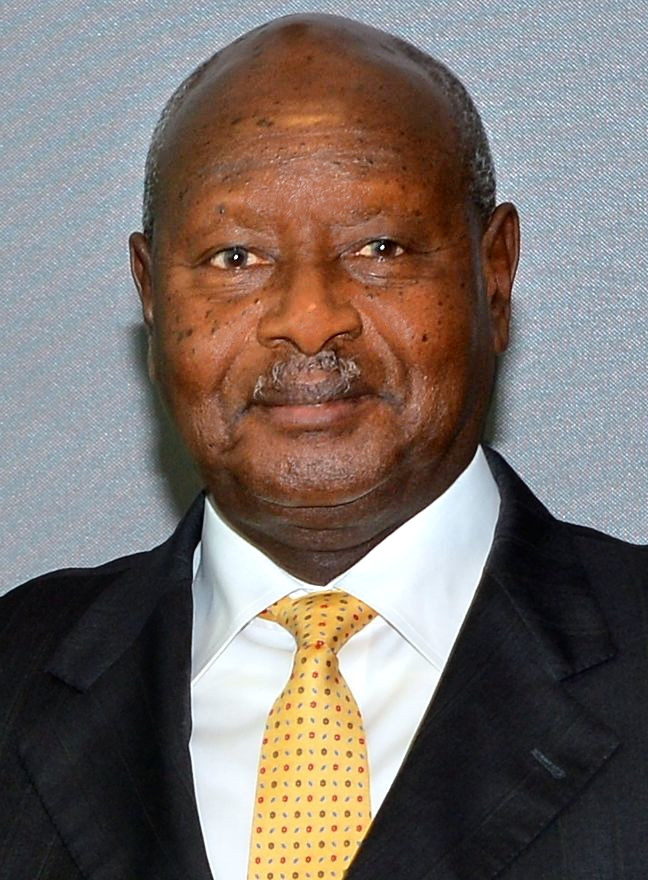
President Yoweri Museveni and his party, National Resistance Movement, are usually considered right-wing populist, anti-LGBT, and Ugandan nationalist. According to Corina Lacatus, "Museveni came to power in 1986 as a populist figure who adopted an authoritarian leadership style and converted over the years in an authoritarian leader. Over the years, he has continued to rely on a tried-and-tested populist discourse that granted him political success in the first place, to continue the advancement of his regime and to promote his election campaigns."
Americas
Argentina
Javier Milei, the incumbent president of Argentina, is known for his flamboyant personality, distinctive personal style, and strong media presence. Milei's views distinguish him in the Argentine political landscape and have garnered him significant public attention and polarising reactions. He has been described politically as a right-wing libertarian and right-wing populist who supports laissez-faire economics, aligning specifically with minarchist and anarcho-capitalist principles. Milei has proposed a comprehensive overhaul of the country's fiscal and structural policies. He supports freedom of choice on drug policy, firearms, prostitution, same-sex marriage, sexual preference and gender identity, while opposing abortion and euthanasia. In foreign policy he advocates closer relations with the United States, supporting Ukraine in response to the Russian invasion of the country. He is also distancing Argentina from geopolitical ties with China.
Milei has been variously described as far-right, far-right populist, right-wing libertarian, ultraconservative, and ultra-liberal. A philosophical anarcho-capitalist who is for practical purposes a minarchist, Milei advocates minimal government, focusing on justice and security, with a philosophy rooted in life, liberty, and property, and free-market principles. He criticises socialism and communism, advocating economic liberalisation and the restructuring of government ministries. He opposes the Central Bank of Argentina and current taxation policies.
Economically, Milei is influenced by the Austrian school of economics and admires the former president Carlos Menem's policies. He supports capitalism, viewing socialism as embodying envy and coercion. Milei proposes reducing government ministries and addressing economic challenges through spending cuts and fiscal reforms, criticising previous administrations for excessive spending. He has praised the economic policies of the former British prime minister Margaret Thatcher and called her "a great leader".
Brazil
In Brazil right-wing populism began to rise roughly around the time Dilma Rousseff won the 2014 presidential election. In the 2014 general election, Levy Fidelix, from the Brazilian Labour Renewal Party, presented himself with a conservative speech and, according to him, the only right-wing candidate. He spoke for traditional family values and opposed abortion, legalisation of cannabis, and same-sex marriage and proposed that homosexual individuals should be treated far away from the good citizens' and workers' families. In the first round of the general election, Fidelix received 446,878 votes, representing 0.43% of the popular vote. Fidelix ranked 7th out of 11 candidates. In the second round Fidelix supported Aécio Neves.
In addition, according to the political analyst of the Inter-Union Department of Parliamentary Advice, Antônio Augusto de Queiroz, the National Congress elected in 2014 may be considered the most conservative since the "re-democratisation" movement, noting an increase in the number of parliamentarians linked to more conservative segments, such as ruralists, the military, the police and the religious right. The subsequent economic crisis of 2015 and investigations of corruption scandals led to a right-wing movement that sought to rescue fiscally and socially conservative ideas in opposition to the left-wing policies of the Workers' Party. At the same time, right-libertarians, such as those that make up the Free Brazil Movement, emerged among many others. For Manheim (1952), within a single real generation, there may be several generations which he called "differentiated and antagonistic". For him, it is not the common birth date that marks a generation, although it matters, but rather the historical moment in which they live in common. In this case, the historical moment was the impeachment of Dilma Rousseff. They can be called the "post-Dilma generation".
The centrist interim president Michel Temer took office following the impeachment of President Dilma Rousseff. Temer held 3% approval ratings in October 2017, facing a corruption scandal after accusations of obstructing justice and racketeering against him. He managed to avoid trial thanks to the support of the right-wing parties in the National Congress of Brazil. On the other hand, President of the Senate Renan Calheiros, acknowledged as one of the key figures behind Rousseff's destitution and a member of the centrist Brazilian Democratic Movement, was removed from office after facing embezzlement charges.
In March 2016, after entering the Social Christian Party, the far-right congressman Jair Bolsonaro decided to run for President of the Republic. In 2017 he tried to become the presidential nominee of Patriota, but, eventually, Bolsonaro entered the Social Liberal Party and, supported by the Brazilian Labour Renewal Party, he won the 2018 presidential election, followed by the left-wing former Mayor of São Paulo Fernando Haddad of Luiz Inácio Lula da Silva's Workers' Party. Lula was banned from running after being convicted on criminal corruption charges and imprisoned. Bolsonaro has been accused of racist, xenophobic, misogynistic and homophobic rhetoric. His campaign was centred on opposition to crime, political corruption and queer identity, and support for tax cuts, militarism, Catholicity and evangelicalism.
Canada
.jpg)
In recent years, right-wing populist elements have existed within the Conservative Party of Canada and mainstream provincial parties and have been espoused by Ontario MP Kellie Leitch; the businessman Kevin O'Leary; Quebec Premier François Legault; the former Mayor of Toronto Rob Ford; and his brother, Ontario Premier Doug Ford. Doug Ford endorsed Donald Trump during the 2016 United States presidential election and publicly expressed support for him during his first presidency. He again supported Trump in the 2024 election, but later opposed him after that election and expressed regret for supporting him.
In August 2018 the Conservative MP Maxime Bernier left the party, and the following month he founded the People's Party of Canada, which has self-described as "smart populism" and been described as a "hard-right populist" party by Canadian journalists. Bernier lost his seat in the 2019 Canadian federal elections, and the People's Party scored just above 1% of the vote; however, in the 2021 election, it saw improved performance and climbed to nearly 5% of the popular vote.
.jpg)
Pierre Poilievre, who has been described as populist by some journalists, won the 2022 Conservative Party of Canada leadership election and became the leader of both the Conservative Party and the Official Opposition. Some journalists have compared Poilievre to American Republican populists such as Donald Trump and Ted Cruz; however, many journalists have dismissed these comparisons due to Poilievre's pro-choice, pro-immigration and pro-same-sex marriage positions. Zack Beauchamp writing for Vox in 2024 described Poilievre as a "tame populist" and stated that he does not fit the far right because "on policy substance, he's actually considerably more moderate than Trump or European radicals" and "he's unwilling to attack immigrants and ethnic minorities in the way that others in the global far right do". Beauchamp further described "relatively neutered populism" as a strength of Canada's politics rather than a failure.
Chile
_4x3_cropped.jpg)
The Chilean right-wing Republican Party, and its candidate Jose Antonio Kast during the 2021 and 2025 presidential elections have been labeled as right-wing populist. Johannes Kaiser, founder and candidate of the National Libertarian Party in the 2025 presidential election, has also been described as a right-wing populist.
Costa Rica
In the 2018 political campaign, both the Evangelical Christian candidate Fabricio Alvarado Muñoz and the right-wing anti-establishment candidate Juan Diego Castro Fernández were described as examples of right-wing populists.
United States
.jpg)
In the United States right-wing populism is frequently aligned with evangelical Christianity, segregationism, anti-intellectualism The Republican Party, particularly supporters of Donald Trump, includes right-wing populist factions.
Moore (1996) argues that "populist opposition to the growing power of political, economic, and cultural elites" helped shape "conservative and right-wing movements" since the 1920s. Historical right-wing populist figures in both major parties in the United States have included Thomas E. Watson, Strom Thurmond, Joseph McCarthy, Barry Goldwater, George Wallace and Pat Buchanan.
Several of the prominent members of the Populist Party of the 1890s and 1900s, while economically liberal, supported social aspects of right-wing populism. William Jennings Bryan, the 1896 Populist presidential nominee, was socially and theologically conservative, supporting creationism, Prohibition and other aspects of Christian fundamentalism. Bradley J. Longfield posits Bryan was a "theologically conservative Social Gospeler". An article by National Public Radio's Ron Elving likens the populism of Bryan to the later right-wing populism of Trump.
In 2010 Rasmussen and Schoen characterised the Tea Party movement as "a right-wing anti-systemic populist movement". They added, "Today our country [the United States] is in the midst of a...new populist revolt that has emerged overwhelmingly from the right – manifesting itself as the Tea Party movement." In 2010 David Barstow wrote in The New York Times, "The Tea Party movement has become a platform for conservative populist discontent." Some political figures closely associated with the Tea Party, such as the US senator Ted Cruz and the former US representative Ron Paul, have been described as appealing to right-wing populism. In the US House of Representatives the Freedom Caucus, associated with the Tea Party movement, has been described as right-wing populist.
Donald Trump's presidential campaigns in 2016, 2020, and 2024, noted for their anti-establishment, anti-immigration and protectionist rhetoric, have been characterised as right-wing populist. The ideology of Trump's former Chief Strategist Steve Bannon has also been described as such. Trump's policies and rhetoric have been frequently described as right-wing populist by academics and political commentators.
Asia-Pacific countries
Australia
.jpg)
Right-wing populism in Australia often utilises narratives on having a national identity based on settler colonialism with a deeply rooted thought on being the rightful occupants of the land and downplaying the presence and rights of Indigenous Population such as opposition to Indigenous land rights, and resistance to Indigenous recognition.
Right-wing populism has also been represented by Pauline Hanson's One Nation, led by Pauline Hanson, Senator for Queensland and typically preferences votes to the mainstream Liberal-National Coalition, and Katter's Australian Party, led by Queensland MP Bob Katter.
Furthermore, the main centre-right party the Coalition has certain members belonging to the right-wing populist faction known as National Right including the former opposition leader Peter Dutton.
China
In the 2010s the wave of refugees caused by the Syrian civil war caused a wave of anti-immigration sentiment on the Chinese internet, and many narratives have been similar to those of the populist right have since been observed, such as anti-"western leftism", Islamophobia and anti-multiculturalism.
Japan
Right-wing populism in Japan encompasses two distinct factions. One faction includes conservatives such as Nippon Ishin no Kai, who are either unaffiliated with or opposed to the Liberal Democratic Party's (LDP) 1955 System. The other faction resembles Western far-right populists and includes parties such as Japan First Party, Sanseitō, and the Conservative Party of Japan.
New Zealand
Main article: Populism in New Zealand
Right-wing populism is thought to have emerged in New Zealand with Robert Muldoon, the New Zealand National Party prime minister from 1975 to 1984. An economic nationalist and social conservative, Muldoon has been cited as having appealed to the masses through his animosity towards the media and leftists and his own abrasive and colourful public persona. He also often made rude or unusually frank comments about foreign leaders, including American president Jimmy Carter and Australian prime minister Malcolm Fraser, whom he ridiculed and even bullied.
The New Zealand First party, which has historically taken a nationalist standpoint, has been described as a populist party.
Pakistan
In Pakistan, Pakistan Tehreek Insaaf (PTI) has recently been described as centrist-populist while sharing some characteristics with right-wing populists. Its leader Imran Khan has attacked traditional politicians. The British journalist Ben Judah, in an interview, compared Khan with Donald Trump on his populist rhetoric.
Taiwan
Taiwan's right-wing populists tend to deny the independent identity of their country's 'Taiwan' and emphasise their identity as a 'Republic of China'. Taiwan's left-wing Taiwanese nationalists have strong pro-American tendencies, so Taiwan's major and minor conservatives are critical of this.{{cite news |title=마잉주 전 대만 총통 "차이잉원 친미노선 전쟁 위험 야기" (Former Taiwan President Ma Ying-jeou said, "Tsai Ing-wen's pro-American line poses a war risk.") |url=https://www.yna.co.kr/view/AKR20200822040900083 |work=Yonhap News Agency |language=korean |access-date=2021-02-12 |date=22 August 2020}} In particular, Taiwan's right-wing populists demand that economic growth and right-wing Chinese nationalist issues should be more important than liberal democracy and that they should become closer to the People's Republic of China. Some of Taiwan's leading right-wing populists include Terry Gou, Han Kuo-yu and Chang Ya-chung.
European countries
Main article: Radical right (Europe)
In May 2019 Foreign Policy magazine described Ireland, Malta and Portugal as the only three European Union countries without far-right populist parties in their parliament. Portugal subsequently elected the Chega party to its parliament in October 2019. The French-speaking Belgian region of Wallonia is also described as a rare place in Europe without a significant right-wing populism presence, in part due to a media cordon sanitaire which prohibits far-right candidates from live media appearances.
In 2016 senior EU diplomats cited growing anxiety in Europe about Russian financial support for far-right and populist movements and told the Financial Times that the intelligence agencies of "several" countries had scrutinised possible links with Moscow. Also in 2016, the Czech Republic warned that Russia was trying to "divide and conquer" the EU by supporting right-wing populist politicians across the bloc. A 2019 study shows a significant correlation between the price of housing and voting for populist parties in Europe.
Belgium
Vlaams Blok, established in 1978, operated on a platform of law and order, anti-immigration (with a particular focus on Islamic immigration) and secession of the Flanders region of the country. The secession was originally planned to end in the annexation of Flanders by the culturally and linguistically similar Netherlands until the plan was abandoned due to the multiculturalism in that country. In the elections to the Flemish Parliament in June 2004, the party received 24.2% of the vote, within less than 2% of being the largest party. However, in November of the same year, the party was ruled illegal under the country's anti-racism law for, among other things, advocating segregated schools for citizens and immigrants.
In less than a week, the party was re-established under the name Vlaams Belang, initially with a near-identical ideology before moderating parts of its statute. It advocates the adoption of the Flemish culture and language by immigrants who wish to stay in the country. It also calls for a zero-tolerance stance on illegal immigration and the reinstatement of border controls. Despite some accusations of antisemitism from Belgium's Jewish population, the party has demonstrated a staunch pro-Israel stance as part of its opposition to Islam. In Antwerp, sections of the city's significant Jewish population have begun to support the party. With 23 of 124 seats, Vlaams Belang leads the opposition in the Flemish Parliament. It also holds 11 out of the 150 seats in the Belgian Chamber of Representatives.
The Flemish nationalist and conservative liberal New Flemish Alliance party has been described as populist or containing right-wing populist elements by foreign media such as the German Die Zeit magazine. However, the party has rebutted the term and does not label itself as such.
In the French-speaking Wallonia, Mischaël Modrikamen, an associate of Steve Bannon, was chairman of the Parti Populaire (PP), which contested elections in Wallonia. Political analysts have generally observed that right-wing populist parties tend to perform better with the Flemish electorate over French-speaking Belgian voters, on the whole, owing to the Flemish vote moving to the right in recent decades and Flemish parties intertwining Flemish nationalism with other issues.
As of the 2019 federal, regional, and European elections, Vlaams Belang has surged from 248,843 votes in 2014 to 783,977 on 26 May 2019.
Denmark
In the early 1970s the home of the strongest right-wing populist party in Europe was in Denmark, the Progress Party. In the 1973 election it received almost 16% of the vote. In the following years its support dwindled, but the Danish People's Party replaced it in the 1990s, becoming an important support party for the governing coalition in the 2000s. At the height of its popularity it won 21% of the vote (corresponding to 37 seats) in the 2015 Danish general election, becoming the second-largest party in the Folketing and serving once again as support party for two minority governments 2015–2019 before being reduced to 16 seats in the 2019 Danish general election and 5 seats (2.6% of the vote) in 2022. In 2015 the New Right party was founded, which gained six seats (3.7% of the vote) at the 2022 election. In 2022 the Denmark Democrats were founded as the most recent right-wing populist party in the Folketing, gaining 8% of the vote and 14 seats at the 2022 general election.
Finland
In Finland the most popular right wing to far-right party is the Finns Party. The most recent parliamentary election took place on 2 April 2023. After the 2023 election the Orpo Cabinet was formed by the National Coalition, Finns and Swedish People's Party as well as the Christian Democrats.
France
.jpg)
Gaullism is considered part of (right-wing) populism because it is based on charisma, popular mobilisation, French nationalism, and exceptionalism. Gaullism is deeply embedded in modern right-wing politics in France.
The National Front (NF)—renamed in 2018 as the "National Rally"—has been cited as the "prototypical populist radical right-wing party".
Right-wing populism in France has also involved cultural issues such as the anti-gay marriage and anti-gender theory movements exemplified by La Manif pour tous.
Germany
In 2005 a nationwide Pro Germany Citizens' Movement (pro Deutschland) was founded in Cologne. The Pro-movement appeared as a conglomerate of numerous small parties, voters' associations and societies, distinguishing themselves by campaigns against extremism and immigrants.
The AfD has grown in popularity, particularly in eastern Germany, where it has benefited from economic dissatisfaction and immigration fears. According to studies, the AfD will be the second most popular party in Germany by 2023, with rising influence at both the national and provincial levels.Their stance has grown more radical, advocating for Germany's exit from the EU and NATO and opposing climate protection measures. The party's popularity might be attributed to internal disputes and policy debates inside Germany's ruling coalition, which have eroded public trust in traditional parties.
In 2024 the AfD won the state election in Thuringia and finished a close second in Saxony and Brandenburg.
Greece

The most prominent right-wing populist party in Greece is the Independent Greeks (ANEL). Despite being smaller than the more extreme Golden Dawn party, after the January 2015 legislative elections, ANEL formed a governing coalition with the left-wing Coalition of the Radical Left (SYRIZA), thus making the party a governing party and giving it a place in the Cabinet of Alexis Tsipras.
The Neo-Nazi Golden Dawn has grown significantly in Greece during the economic downturn, gaining 7% of the vote and 18 out of 300 seats in the Hellenic Parliament. The party's ideology includes annexing territory in Albania and Turkey, including the Turkish cities of Istanbul and İzmir. Controversial measures by the party included a poor people's kitchen in Athens, which only supplied Greek citizens and was shut down by the police.
The Popular Orthodox Rally is not represented in the Greek legislature but supplied 2 of the country's 22 MEPS until 2014. It supports anti-globalisation, lower taxes for small businesses, and opposition to Turkish accession to the European Union and the Republic of Macedonia's use of the name Macedonia and immigration only for Europeans. Its participation in government has been one of the reasons why it became unpopular with its voters who turned to Golden Dawn in Greece's 2012 elections.
Italy
In Italy, Prime Minister Silvio Berlusconi served four separate term between 1994 and 2011, and is considered the first prominent populist politician in modern Europe, fueling anti-immigrant sentiments, denying the results of the 2006 general election, and often making offensive comments towards the judiciary and political opponents, although his Forza Italia party is considered to be more moderate. Instead, the most prominent right-wing populist party in the last twenty years was the Lega, formerly Lega Nord (LN), whose leaders reject the right-wing label, although not the "populist" one.
The Lega is a federalist, regionalist and sometimes secessionist party, founded in 1991 as a federation of several regional parties of northern and central Italy, most of which had arisen and expanded during the 1980s. LN's program advocates the transformation of Italy into a federal state, fiscal federalism, and greater regional autonomy, especially for the northern regions. At times, the party has advocated for the secession of the north, which it calls Padania. The party generally takes an anti-southern Italian stance as members are known for opposing southern Italian emigration to northern Italian cities, stereotyping southern Italians as welfare abusers and detrimental to Italian society, and attributing Italy's economic troubles and the disparity of the north–south divide in the Italian economy to supposed inherent negative characteristics of the southern Italians, such as laziness, lack of education, or criminality. Certain LN members have been known to publicly deploy the offensive slur terrone, a common pejorative term for southern Italians evocative of negative southern Italian stereotypes.
With the rise of immigration into Italy since the late 1990s, LN has increasingly turned its attention to criticising mass immigration to Italy. The LN, which opposes illegal immigration, is critical of Islam, and proposes Italy's exit from the Eurozone, is considered a Eurosceptic movement and, as such, is a part of the Identity and Democracy (ID) group in the European Parliament. LN was or is part of the national government in 1994, 2001–2006, 2008–2011, and 2018–2019. Most recently, the party, including among its members the presidents of Lombardy and Veneto, won 17.4% of the vote in the 2018 general election, becoming the third-largest party in Italy (largest within the centre-right coalition). In the 2014 European election, under the leadership of Matteo Salvini, it took 6.2% of votes. Under Salvini, the party has, to some extent, embraced Italian nationalism and emphasised Euroscepticism, opposition to immigration, and other "populist" policies while allying with right-wing populist parties in Europe.
.jpg)
Between the late 2010s and the early 2020s, another right-wing populist movement emerged within the centre-right coalition. The nationalist and national-conservative Brothers of Italy (FdI), led by Giorgia Meloni, gained 4.4% of votes in the 2018 election and, four years later, it became the most voted party in the 2022 general election, gaining 26% of votes. Meloni was appointed prime minister on 22 October, at the head of what it was considered as the most right-wing Italian government since 1945.
Netherlands
In the Netherlands, right-wing populism was represented in the 150-seat House of Representatives in 1982 when the Centre Party won a single seat. During the 1990s a splinter party, the Centre Democrats, was slightly more successful, although its significance was still marginal. Not before 2002 did a right-wing populist party break through in the Netherlands, when the Pim Fortuyn List (LPF) won 26 seats and subsequently formed a coalition with the Christian Democratic Appeal (CDA) and People's Party for Freedom and Democracy (VVD). Pim Fortuyn, who had strong views against immigration, particularly by Muslims, was assassinated in May 2002, two weeks before the election. Ideologically, the LPF differed somewhat from other European right-wing populist movements by holding more liberal stances on certain social issues such as abortion, gay rights, and euthanasia (Fortuyn himself was openly gay) while maintaining an uncompromising stance on immigration, law and order, and the EU. Fortuyn was also credited with shifting the Dutch political landscape by bringing the topics of multiculturalism, immigration, and the integration of immigrants into the political mainstream.
Since 2006 the Party for Freedom (PVV) has been represented in the House of Representatives and described as inheriting the mantle of the Pim Fortuyn List. Following the 2010 general election, it has been in a pact with the right-wing minority government of CDA and VVD after it won 24 seats in the House of Representatives. The party is Eurosceptic and plays a leading role in the changing stance of the Dutch government towards European integration as they came second in the 2009 European Parliament election, winning 4 out of 25 seats. The party's main program revolves around strong criticism of Islam, restrictions on migration from new European Union countries and Islamic countries, pushing for cultural assimilation of migrants into Dutch society, opposing the accession of Turkey to the European Union, advocating for the Netherlands to withdraw from the European Union and advocating for a return to the guilder and abandoning the euro.
From 2017 onwards, the Forum for Democracy (FvD) emerged as another right-wing populist force in the Netherlands. The FvD also advocates a stricter immigration policy and a referendum on Dutch membership of the EU.
The Farmer–Citizen Movement, described as a right-wing populist party, won the 2023 Dutch provincial elections, winning the popular vote and receiving the most seats in all twelve provinces.
Poland

The largest right-wing populist party in Poland is Law and Justice. It combines social conservatism and criticism of immigration with strong support for NATO and an interventionist economic policy.
Romania
The most prominent Romanian right-wing populist party, the Alliance for the Union of Romanians (AUR, in Romanian: Alianța pentru Unirea Românilor), was founded in 2019 by George Simion, an independent candidate for the 2019 Romanian European Parliament Election. Running on a conservative nationalist platform, which was also described as pro-Russian, and aiming for the unification of Moldova with Romania, the party became the fourth-largest political force in the country after the 2020 Romanian parliamentary election. Growing in popularity over the next four years, in the 2024 Romanian parliamentary election, the party became the second-largest political party in Romania and the leading party of the opposition.
The right-wing populist move of AUR prompted the founding of other nationalist parties, with diverse rates of success in the elections. The 2024 parliamentary elections oversaw the entering of the Parliament of Romania of two other right-wing to far-right parties, namely S.O.S. Romania (SOS, in Romanian: S.O.S. România) and the Party of Young People (POT, in Romanian: Partidul Oamenilor Tineri). Both parties split from AUR and are led by former AUR members: Diana Șoșoacă for SOS and Anamaria Gavrilă for POT. S.O.S. Romania has been often called to be "even worse" than AUR by activelly being Russophile, neo-Legionnaire and bearing a Hard Eurosceptic position, calling for the withdrawal of Romania from the European Union.
2024 and 2025 Romanian presidential elections and aftermath
With Georgescu barred from candidating, both George Simion and Anamaria Gavrilă filled their candidacies on 14 March, announcing that, shall both candidacies be validated, one of them would withdraw in order to allow full support for one nationalist candidate. The one withdrawing was Anamaria Gavrilă, which publicly announced this on 19 March. In the elections taking place in May, George Simion won the first round by a wide margin, entering the second round with the Save Romania Union (USR, in Romanian: Uniunea Salvați România) endorsed the independent mayor of Bucharest, Nicușor Dan. Dan, who previously received less than two million votes, won by a narrow margin, being elected as President of Romania.
Spain
In Spain, the appearance of right-wing populism began to gain strength after the December 2018 election for the Parliament of Andalusia, in which the right-wing populist party VOX managed to obtain 12 seats and agreed to support a coalition government of the parties of the right People's Party and Citizens, although the Socialist Party won the elections. VOX, which has been frequently described as far-right, both by the left parties and by Spanish or international press, promotes characteristic policies of the populist right, such as the expulsion of all illegal immigrants from the country—and of legal immigrants who commit crimes—a generalised criminal tightening, combined with traditional claims of right-wing conservatives, such as the centralisation of the state and the suppression of the Autonomous Communities, and has harshly criticised the laws against gender violence, approved by the socialist government of José Luis Rodríguez Zapatero, but later maintained by the PP executive of Mariano Rajoy, accusing the people and institutions that defend them of applying "gender totalitarianism".
The party official Javier Ortega Smith is being investigated for alleged hate speech after Spanish prosecutors admitted a complaint by an Islamic association in connection with a rally that talked about "the Islamist invasion".
After months of political uncertainty and protests against the party in Andalusia and other regions, in the 2019 Spanish general election, VOX managed to obtain 24 deputies in the Congress of Deputies, with 10.26% of the vote, falling short of expectations after an intense electoral campaign in which VOX gathered big crowds of people at their events. Although the People's Party and Citizens leaders, Pablo Casado and Albert Rivera, had admitted repeatedly during the campaign that they would again agree with VOX to reach the government, the sum of all their seats finally left them far from any possibility, giving the government to the social democrat Pedro Sánchez.
Madrilenian president Isabel Díaz Ayuso, despite being a member of the centre-right People's Party, has been sustained in government by VOX and adopted many policies championed by the party. She has embraced populist rhetoric, defended Spanish imperialism, dismissed climate change, and opposed COVID-19 lockdowns. She has been to compared to Donald Trump by several of her critics.
The 2024 European Parliament election in Spain saw the right-wing populist party Se Acabó La Fiesta (SALF) entering the European Parliament with 3 seats, obtaining over 800,000 votes.
Sweden
In Sweden, the first openly populist movement to be represented in the Riksdag (Swedish parliament), New Democracy was founded in 1994 by businessman Bert Karlsson and aristocrat Ian Wachtmeister. Although New Democracy promoted economic issues as its foremost concern, it also advocated restrictions on immigration and welfare chauvinism. The party saw a sharp rise in support in 1994 before declining soon after.
In 2010, the Sweden Democrats entered parliament for the first time. The Sweden Democrats originally had connections to white nationalism during its early days but later began expelling hardline members and moderated its platform to transform itself into a more mainstream movement. The party calls for more robust immigration and asylum policies, compulsory measures to assimilate immigrants into Swedish society, and stricter law and order policies. The Sweden Democrats are currently the second largest party in Sweden, with 20.5% of the popular vote in the 2022 Swedish general election, and the second most seats in the Swedish parliament with 72 seats.
Switzerland
In Switzerland, the right-wing populist Swiss People's Party (SVP) reached an all-time high in the 2015 elections. The party is mainly considered national conservative, but it has also variously been identified as "extreme right" and "radical right-wing populist", reflecting a spectrum of ideologies among its members. Its far-right wing includes members such as Ulrich Schlüer and Pascal Junod, who heads a New Right study group and has been linked to Holocaust denial and neo-Nazism.
In Switzerland, radical right populist parties held close to 10% of the popular vote in 1971, were reduced to below 2% by 1979, and grew to more than 10% in 1991. Since 1991, these parties (the Swiss Democrats and the Swiss Freedom Party) have been absorbed by the SVP. During the 1990s, the SVP grew from the fourth largest party to the largest and gained a second seat in the Swiss Federal Council in 2003 with the prominent politician and businessman Christoph Blocher. In 2015, the SVP received 29.4% of the vote, the highest vote ever recorded for a single party throughout Swiss parliamentary history.
United Kingdom
The scholarly authors Breeze, Bale, Ashkenas and Aisch, and Clarke et al. characterised the UK Independence Party (UKIP), then led by Nigel Farage, as a right-wing populist party. UKIP campaigned for an exit from the European Union prior to the 2016 European membership referendum and a points-based immigration system similar to that used in Australia. In the 2019 general election, UKIP entered candidates in 44 of the 650 available seats, winning none of them, and achieving 0.1% of the popular vote. In 2013, the Conservative Party, which along with the Liberal Democrats governed from 2010 to 2015 as a coalition government, saw local party campaigners pledging support for UKIP over issues related to the European Union and gay marriage.
The role of UKIP in the UK underwent a rapid transformation post-Brexit, with Nigel Farage leading the initiative to establish the Brexit Party, which was subsequently rebranded as Reform UK. These entities have consistently been identified as extensions of UKIP, sharing common populist ideological elements. After winning 14% of the vote in the 2024 election, political scientist Tim Bale described Reform UK party leader Farage as the "British representative of the populist radical right in Europe", as one of the moderate far-right parties in Europe. Cas Mudde, an expert on populism and extremism, categorised the party as radical right due to the opposition towards "fundamental elements of liberal democracy". In British Politics, political scientist Peter Dorey attributed the electoral decline of the Conservative Party as being intensified by the rise of Reform UK, as a party on the "authoritarian populist Right".
In the Conservative Party, Thatcherism had right-wing populist elements, including nationalism and social conservatism Although Margaret Thatcher has been characterised by some scholars as a right-wing populist politician in the UK, this has been disputed by other scholars due to its applicability in the context of the 1980s. Others contend that Thatcher's role was pivotal in steering the party's ideology towards a more populist direction. The phenomenon is commonly referred to as "Thatcherite populism". Other prominent right-wing populists in the party include past prime minister Boris Johnson and Jacob Rees-Mogg, the former Secretary of State for Business, Energy and Industrial Strategy.
Ingle and Swanson, et al. consider the Northern Ireland Democratic Unionist Party (DUP) to be a right-wing populist party.
List of parties
Main article: List of populists
Current parties or parties with right-wing populist factions
Represented in national legislatures
- Argentina – La Libertad Avanza
- Australia – Liberal–National Coalition (Factions including National Right), Pauline Hanson's One Nation, Katter's Australian Party, United Australia Party
- Austria – Freedom Party of Austria, Austrian People's Party (factions)
- Bangladesh – Bangladesh Jamaat-e-Islami
- Belgium – Vlaams Belang
- Brazil – Liberal Party (factions), Democratic Renewal Party
- Bulgaria – Revival, There is Such a People
- Canada – Conservative Party
- Chile – Republican Party
- Costa Rica – National Restoration Party, New Republic Party, National Integration Party
- Croatia – Homeland Movement
- Cyprus – ELAM, Solidarity Movement
- Czech Republic – Freedom and Direct Democracy, Motorists for Themselves, ANO 2011
- Denmark – Danish People's Party, New Right, Denmark Democrats
- Estonia – Conservative People's Party of Estonia
- European Union – Patriots.eu, Europe of Sovereign Nations, European Conservatives and Reformists Party (factions)
- Finland – Finns Party
- France – National Rally, Debout la France, Reconquête
- Georgia – People's Power
- Germany – Alternative for Germany
- Greece – Greek Solution, New Democracy (factions), Spartans, Victory
- Hungary – Fidesz, Our Homeland Movement
- Iceland – Centre Party (Iceland)
- India – Bharatiya Janata Party, Shiv Sena
- Indonesia – Gerindra Party, Prosperous Justice Party
- Italy – Lega, Brothers of Italy, Five Star Movement (factions), Forza Italia (factions)
- Israel – Likud, Yamina, Religious Zionist Party, Otzma Yehudit
- Japan – Liberal Democratic Party, Nippon Ishin no Kai, Sanseitō, Conservative Party of Japan,Democratic Party for the People
- Latvia – National Alliance, Latvia First
- Liechtenstein – Democrats for Liechtenstein
- Luxembourg – Alternative Democratic Reform Party
- Netherlands – Party for Freedom, Forum for Democracy, JA21, Farmer-Citizen Movement,
- New Zealand – New Zealand First
- Norway – Progress Party
- Panama – Realizing Goals
- Paraguay – National Union of Ethical Citizens
- Peru – Popular Renewal
- Philippines – Nacionalista Party
- Poland – Law and Justice, Confederation (New Hope, National Movement), Kukiz'15, Confederation of the Polish Crown
- Portugal – Chega
- Romania – Alliance for the Union of Romanians, S.O.S. Romania, Party of Young People
- Russia – United Russia (factions), Liberal Democratic Party of Russia, Rodina
- Serbia – United Serbia, Serbian People's Party
- Slovakia – Slovak National Party
- Slovenia – Slovenian Democratic Party
- South Africa – Freedom Front Plus
- Spain – Vox
- Sweden – Sweden Democrats
- Switzerland – Swiss People's Party, Geneva Citizens' Movement, Ticino League
- Taiwan – Kuomintang (factions),
- Thailand – Bhumjaithai, United Thai Nation Party
- Turkey – Justice and Development Party, Nationalist Movement Party, New Welfare Party, Free Cause Party
- Ukraine – Svoboda
- United Kingdom – Reform UK, Democratic Unionist Party,
- United States – Republican Party (Majority including the Freedom Caucus)
- Uruguay – Open Cabildo
Not represented in national legislatures
- Albania – Red and Black Alliance, Albanian National Front Party
- Australia – Shooters, Fishers and Farmers Party, Australian Protectionist Party
- Austria – Alliance for the Future of Austria, Free Party Salzburg
- Bangladesh – Bangladesh Jamaat-e-Islami
- Belgium – Libertair, Direct, Democratisch, Chez Nous, VLOTT
- Botswana – Botswana Movement for Democracy
- Brazil – Alliance for Brazil, Brazilian Labour Renewal Party
- Bulgaria – Bulgaria Without Censorship, National Front for the Salvation of Bulgaria, IMRO – Bulgarian National Movement, Attack, Volya
- Canada – People's Party of Canada
- Chile – National Force
- Croatia – Croatian Party of Rights, Croatian Party of Rights Dr. Ante Starčević, Independents for Croatia
- Denmark – Progress Party, Hard Line
- Finland – Blue and White Front, Seven Star Movement, Blue Reform
- France – Alsace First
- Germany – The Homeland, Citizens' Movement Pro Chemnitz, German Social Union, The Republicans
- Greece – Golden Dawn, National Popular Consciousness, National Party - Hellenes, Popular Orthodox Rally, Independent Greeks
- Iceland – Icelandic National Front
- India – Maharashtra Navnirman Sena, Hindu Mahasabha
- Ireland – National Party, Irish Freedom Party
- Israel – Zehut
- Italy – Tricolour Flame, Die Freiheitlichen, Citizens' Union for South Tyrol, South Tyrolean Freedom
- Latvia – For a Humane Latvia, Platform 21
- Liechtenstein – The Independents
- Lithuania – National Alliance, Christian Union, Young Lithuania, Order and Justice
- Malta – Moviment Patrijotti Maltin
- Montenegro – Party of Serb Radicals, True Montenegro, Serb List
- Netherlands – Forza! Nederland
- New Zealand – New Conservative Party, Advance New Zealand, Vision NZ, New Zealand Public Party
- Poland – Congress of the New Right, Real Politics Union
- Portugal – National Renovator Party
- Romania – National Identity Bloc in Europe (Greater Romania Party, United Romania Party, Noua Dreaptă), New Generation Party, M10, Romanian Nationhood Party
- Serbia – Serbian Radical Party, Dveri, Hungarian Hope Movement, Enough is Enough, New Serbia, People's Freedom Movement, Leviathan Movement, Serbian Right, Love, Faith, Hope, Serbian Party Oathkeepers, Healthy Serbia, Dveri,
- Slovakia – Republic, We Are Family, People's Party Our Slovakia
- Korea – New Pro-Park Party, Liberty Republican Party, Dawn of Liberty
- Spain – Se Acabó La Fiesta, Catalan Alliance
- Sweden – Alternative for Sweden
- Switzerland – Federal Democratic Union of Switzerland, Freedom Party of Switzerland, Swiss Democrats
- Taiwan – New Party
- Transnistria – Obnovlenie
- Ukraine – Congress of Ukrainian Nationalists
- United Kingdom – British National Party, For Britain, UK Independence Party
- United States – Constitution Party
Former or disbanded parties
- Austria – Team Stronach
- Belgium – National Front, Vlaams Blok, People's Party
- Canada – Union Nationale (Quebec), Ralliement national, Action démocratique du Québec, Reform Party of Canada, Canadian Alliance, Social Credit Party, British Columbia Social Credit Party
- Cyprus – New Horizons
- Croatia – Croatian Democratic Alliance of Slavonia and Baranja, Croatian Democratic Union (factions)
- Czech Republic – Public Affairs, Dawn - National Coalition
- Denmark – Progress Party
- Germany – Citizens' Movement Pro Cologne, German Freedom Party, German People's Union, Pro Germany Citizens' Movement, Pro NRW, German National People's Party
- European Union – Movement for a Europe of Liberties and Democracy
- Iceland – Citizens' Party
- India – Bharatiya Jana Sangh (succeeded by Bharatiya Janata Party)
- Italy – National Alliance
- Japan – Japan Restoration Party
- Netherlands – Centre Democrats, Pim Fortuyn List
- Portugal – Portugal Pro-Life ; Chega
- Serbia – Serbian Patriotic Alliance
- Korea – Democratic Republican Party, Liberty Korea Party, Onward for Future 4.0
- Spain – Platform for Catalonia
- Sweden – New Democracy
- Switzerland – Party of Farmers, Traders and Independents, Republican Movement
- Syria – Arab Liberation Movement
- Thailand – Thai Rak Thai Party
- United Kingdom – National Democrats, Veterans and People's Party
Notes
References
Bibliography
- Berlet, Chip and Matthew N. Lyons. 2000. Right-Wing Populism in America: Too Close for Comfort. New York: Guilford Press. , .
- Betz, Hans-Georg. Radical right-wing populism in Western Europe. New York: Palgrave Macmillan, 1994. .
- Betz, Hans-Georg and Immerfall, Stefan. The New Politics of the Right: Neo-Populist Parties and Movements in Established Democracies. Houndsmill, Basingstoke, Hampshire, UK, Macmillan Press Ltd., 1998. .
- Fielitz, Maik; Laloire, Laura Lotte (eds.) (2016). Trouble on the Far Right. Contemporary Right-Wing Strategies and Practices in Europe. Bielefeld: transcript. .
- Fritzsche, Peter. 1990. Rehearsals for Fascism: Populism and Political Mobilization in Weimar Germany. New York: Oxford University Press. .
References
- (11 May 2021). "The Causes of Populism in the West". Annual Review of Political Science.
- (20 March 2017). "Far-Right Politics in Europe". [[Harvard University Press]].
- (25 October 2018). "National Populism: The Revolt Against Liberal Democracy". Penguin UK.
- Zembylas, Michalinos. "Affect and the Rise of Right-Wing Populism.".
- Akkerman, Agnes (2003) "Populism and Democracy: Challenge or Pathology?" ''[[Acta Politica]]'' n.38, pp.147–159
- (July 2013). "Latin America's Authoritarian Drift". Journal of Democracy.
- (2018). "Cultural backlash: Trump, Brexit, and the rise of authoritarian-populism". [[Cambridge University Press]].
- Bierbach, Mara. (26 February 2019). "Climate protection: Where do the EU's right-wing populists stand?".
- North, Bonnie. "The Rise of Right-Wing Nationalist Political Parties in Europe".
- (5 August 2021). "Why Does Globalization Fuel Populism? Economics, Culture, and the Rise of Right-Wing Populism". [[Annual Review of Economics]].
- "Fear of Diversity Made People More Likely to Vote Trump". The Nation.
- "The political lexicon of a billionaire populist". Washington Post.
- "The End of Reaganism". POLITICO Magazine.
- (2018). "The Oxford Handbook of the Radical Right". [[Oxford University Press]].
- Sharpe, Matthew. "The metapolitical long game of the European New Right". The Conversation.
- Buruma, Ian. (10 March 2017). "How the Dutch Stopped Being Decent and Dull". The New York Times.
- (2 March 2021). "Authoritarian values and the welfare state: the social policy preferences of radical right voters". West European Politics.
- (2022). "Authoritarian values and the welfare state: the social policy preferences of radical right voters". [[West European Politics]].
- (2022). "Radical right parties and their welfare state stances – not so blurry after all?". [[West European Politics]].
- (16 December 2014). "The Rise of 'Welfare Chauvinism'".
- (4 May 2012). "The European far right: actually right? Or left? Or something altogether different?".
- (20 November 2013). "The Far-Left Economics of France's Far Right". Bloomberg.com.
- Judis, John B.. (5 October 2016). "The Populist Explosion: How the Great Recession Transformed American and European Politics". Columbia Global Reports.
- Cooper, Ryan. (15 March 2017). "The Great Recession clearly gave rise to right-wing populism".
- Sarmadi, Dario. (20 October 2015). "Far-right parties always gain support after financial crises, report finds".
- (15 May 2015). "The map which shows how Ukip support is growing in every constituency but two". [[The Independent]].
- Hunt, Alex. (21 November 2014). "UKIP: The story of the UK Independence Party's rise". [[BBC News]].
- (23 November 2016). "Why Europe's populist revolt is spreading".
- (December 2022). "The Rise of Donald Trump Right-Wing Populism in the United States: Middle American Radicalism and Anti-Immigration Discourse". Societies.
- "Trump's 6 populist positions". POLITICO.
- (December 27, 2024). "The Progressive Moment in Global Politics is Over".
- Zembylas, Michalinos. "Affect and the Rise of Right-Wing Populism".
- Mudde, Cas. (2007). "Populist Radical Right Parties in Europe". Cambridge University Press.
- (2017). "Populism: A Very Short Introduction". Oxford University Press.
- Eatwell, Roger. (2017-10-26). "Populism and Fascism". Oxford University Press.
- Brown, Drew (31 October 2018) [https://www.vice.com/en/article/where-does-right-wing-populism-end-and-fascism-begin/ "Where Does 'Right-Wing Populism' End, and Fascism Begin?"] [[Vice Media. Vice]]
- 978-0-520-30935-7.
- 978-1-317-65590-9.
- Shenkman, Rick (8 September 2019) [https://www.politico.com/magazine/story/2019/09/08/shawn-rosenberg-democracy-228045/ "The Shocking Paper Predicting the End of Democracy"] ''[[Politico. Politico Magazine]]''
- Rydgren, Jens. (2018). "The Oxford Handbook of the Radical Right". Oxford University Press.
- Rooduijn, Matthijs. (2014). "Vox populismus: a populist radical right attitude among the public?". Nations and Nationalism.
- "From 'Brexit' To Trump, Nationalist Movements Gain Momentum Around World".
- AKGEMCİ, Esra. (2022). "Authoritarian Populism as a Response to Crisis: The Case of Brazil". Uluslararası İlişkiler Konseyi İktisadi İşletmesi.
- (2024). "Authoritarian Populism Index 2024".
- Corrales, Javier. (2024-08-19). "Why Populism is the Sugar, Salt, and Fat of Our Politics. . . with Variations: A Reflection". SAGE Publications.
- Rosenberg cites Gentile, G. (1928) ''The philosophic basis of fascism''. ''[[Foreign Affairs]]'', v.6, n.2 pp. 290–304
- Rosenberg, Shawn W. (2019) [https://www.academia.edu/38564962/Democracy_Devouring_Itself_The_Rise_of_the_Incompetent_Citizen_and_the_Appeal_of_Populism.docx "Democracy Devouring Itself: The Rise of the Incompetent Citizen and the Appeal of Right Wing Populism"] in Hur, Domenico Uhng and Sabucedo, José Manuel eds. (forthcoming) ''Psychology of Political and Everyday Extremisms''
- Finchelstein, Federico. (2019). "From Fascism to populism in history: with a new preface". University of California Press.
- (2 July 2020). "Decompensating domestically: the political economy of anti-globalism". Journal of European Public Policy.
- (20 March 2017). "Far-Right Politics in Europe". Harvard University Press.
- (20 March 2017). "Far-Right Politics in Europe". Harvard University Press.
- [[Jens Rydgren. Rydgren, Jens]] (2005) "Is Extreme Right-Wing Populism Contagious? Explaining the Emergence of a New Party Family" ''[[European Journal of Political Research]]'' n.44, pp.413–37
- (2020). "Right-wing populism in New Turkey: Leading to all new grounds for troll science in gender theory". [[HTS Teologiese Studies]].
- "Juan Branco, le populisme par le complotisme".
- (April 2020). "Right-wing populism, social media and echo chambers in Western democracies". New Media & Society.
- Harsin, Jayson. (1 March 2018). "Post-Truth Populism: The French Anti-Gender Theory Movement and Cross-Cultural Similarities". Communication, Culture and Critique.
- (7 August 2017). "Anti-Gender Campaigns in Europe: Mobilizing against Equality". Rowman & Littlefield.
- (February 1998). "From Coughlin to contemporary talk radio: Fallacies & propaganda in American populist radio". Journal of Radio Studies.
- (7 May 2013). "Varieties of Right-Wing Extremism in Europe". Routledge.
- Jamin, Jérôme. (2009). "L'imaginaire du complot: discours d'extrême droite en France et aux Etats-Unis". Amsterdam University Press.
- Harsin, Jayson. (24 December 2020). "The Rumour Bomb: Theorising the Convergence of New and Old Trends in Mediated US Politics". Southern Review.
- (20 March 2017). "Far-Right Politics in Europe". Harvard University Press.
- [[Stéphane François]]. (24 August 2009). "Qu'est ce que la Révolution Conservatrice ?".
- Drake, D.. (5 April 2005). "French Intellectuals and Politics from the Dreyfus Affair to the Occupation". Springer.
- Betz, Hans-Georg. "Radical Right-Wing Populism in Western Europe".
- (20 March 2017). "Far-Right Politics in Europe". Harvard University Press.
- Wodak, Ruth. "Right-Wing Populism in Europe: Politics and Discourse".
- "Populism in Europe: Hungary".
- Gross, Stephen G.. (August 2023). "Understanding Europe's Populist Right: The State of the Field". Contemporary European History.
- Mudde, C.. (2002). "The Ideology of the Extreme Right". Manchester University Press.
- "Nigeria • Africa Elects".
- "Nigeria presidential election results 2023 by the numbers".
- "How Rabiu Kwankwaso became wildcard in Nigerian presidential race".
- (3 February 2023). "Nigeria election 2023: Who is Rabiu Kwankwaso of the NNPP?".
- "Right-Wing White Party Releases Election Manifesto in South Africa".
- (9 November 2016). "Africa's populists and strongmen are some of the first to welcome a Trump presidency".
- Lacatus, Corina. (20 January 2023). "Populism, Competitive Authoritarianism, and Foreign Policy: The Case of Uganda's 2021 Election". Global Studies Quarterly.
- (3 April 2024). "Ugandan court upholds anti-LGBTQ law but says some rights infringed".
- (30 May 2023). "Uganda's President Signs Repressive Anti-LGBT Law {{!}} Human Rights Watch".
- (20 November 2023). "Argentinian President Javier Milei's Stance: Anti-Abortion, Anti-Socialism and More".
- Buschschlüter, Vanessa. (19 November 2023). "Javier Milei: Argentina's far-right outsider wins presidential election". [[BBC News]].
- Phillips, Tom. (20 November 2023). "Who is Javier Milei? Argentina's new far-right president 'El Loco' takes the stage". [[The Guardian]].
- Oner, Imdat. (22 November 2023). "Javier Milei's Victory: A New Chapter for Right-Wing Populism in Argentina?".
- Kahn, Carrie. (19 November 2023). "Javier Milei, a radical libertarian populist, elected president of Argentina".
- (20 November 2023). "Argentina elects far-right populist Javier Milei 'the madman' as new president". ITV News.
- (20 November 2023). "Far-right populist Javier Milei becomes Argentina's new president".
- (20 November 2023). "Analyst View Argentine far-right libertarian Milei sweeps to victory". Reuters.
- (20 November 2023). "Argentina election: What's next after Javier Milei's victory?".
- Meredith, Sam. (21 November 2023). "China says it stands ready to work with Argentina despite Milei criticism".
- Feldman, Ella. (16 October 2023). "As inflation skyrockets, Argentina must choose: Far-right outsider or status quo for president?". Courthouse News Service.
- Criales, José Pablo. (13 November 2023). "Sergio Massa drags Javier Milei through the mud in Argentina's last presidential debate: 'Is Margaret Thatcher your role model?'".
- Bulbul, Nuray. (20 November 2023). "Who is Javier Milei, Argentina's new hard-right president?".
- Genoux, Flora. (8 November 2023). "Argentina: Far-right candidate Javier Milei leaves the business community skeptical". Le Monde.
- Fest, Sebastián. (19 November 2023). "Javier Milei, el ultraliberal que promete poner patas arriba a Argentina y llevar a mínimos el vínculo con España".
- Chitre, Manjiri. (20 November 2023). "Who is Javier Milei, Argentina's new 'shock therapy' libertarian President?".
- (14 August 2023). "Javier Milei, il leader di estrema destra che ha vinto le primarie in Argentina".
- (12 February 2019). "La charla TEDx de Milei donde explica la 'belleza' del capitalismo".
- (4 August 2023). "Punto por punto: el plan de gobierno que presentó Javier Milei".
- (14 August 2023). "Ultra-conservative Javier Milei capitalizes on the protest vote and wins Argentina's primaries".
- (14 August 2023). "Who is Javier Milei, the Central Bank-Hating Economist Who Upended Argentine Polls?".
- Fiore Viani, Gonzalo. (10 September 2021). "Milei y los libertarios: una corriente (no tan) nueva en la política argentina".
- Viriglio, Veronique. (16 August 2023). "Il 'Trump argentino' che sfida Kirchner".
- EM-electomania.es. (16 August 2023). "La propuesta de Javier Milei con los ministerios".
- Goñi, Uki. (13 November 2023). "Argentina's far-right Milei angers Falklands veterans with Thatcher praise". [[The Guardian]].
- (14 November 2023). "Margaret Thatcher 'a great leader', Argentine candidate declares".
- (17 November 2023). "Argentina's Javier Milei: the radical who could blow up political status quo". Reuters.
- Boulos, Guilherme. (November 2018). "Onda Conservadora".
- (15 June 2014). "PRTB oficializa candidatura de Levy Fidelix à Presidência da República". Eleições 2014 em São Paulo.
- "Levy se assume como candidato da direita e promete defender ditadura – Notícias – Política". Política.
- "Apuração de votos e resultado das Eleições 2014 (Fonte: TSE): Presidente e candidatos eleitos – UOL Eleições 2014".
- (15 October 2014). "Levy Fidelix anuncia apoio a Aécio Neves no segundo turno". Eleições 2014.
- Soares, José Manoel Montanha da Silveira. (2017). "A onda conservadora: ensaios sobre os atuais tempos sombrios no Brasil". Revista Em Pauta.
- (17 October 2017). "Accused of corruption, popularity near zero – why is Temer still Brazil's president?".
- "Brazil's President Temer avoids corruption trial".
- (6 December 2016). "Brazil's Senate president ousted over embezzlement charges".
- (9 October 2018). "Future of Western Democracy Being Played Out in Brazil". Consortium News.
- (19 March 2019). "Trump Cements Alliance With Far-Right Brazilian President Bolsonaro". The Globe Post.
- (2 December 2017). "Lula lidera, e Bolsonaro se consolida em 2º, aponta Datafolha".
- (12 July 2017). "Lula é condenado na Lava Jato no caso do triplex". G1.
- (24 January 2018). "Urgente: Lula É Condenado Por Unanimidade Pelo TRF-4". O Antagonista.
- Gavin Fernando. (29 April 2016). "Is this the world's most repulsive politician?". News.com.au.
- Simon Romero. (7 May 2016). "Conservative's Star Rises in Brazil as Polarizing Views Tap Into Discontent". The New York Times.
- (11 December 2014). "The Most Misogynistic, Hateful Elected Official in the Democratic World: Brazil's Jair Bolsonaro – The Intercept".
- "A lightning rod for attacks by Brazil's right wing". Los Angeles Times.
- Watts, Jonathan. (18 April 2016). "Dilma Rousseff: Brazilian congress votes to impeach president". [[The Guardian]].
- "'Irresponsible' populism: Lisa Raitt slams Kevin O'Leary, Kellie Leitch".
- (15 March 2017). "Could Trumpism Take Root in Canada?". Pacific Standard.
- (28 March 2018). "Patrick Brown returns to Queen's Park for budget speech". [[Toronto Star]].
- (19 April 2018). "Anti-elitist politicians in Canada are courting immigrants". [[The Economist]].
- (June 8, 2018). "How Ford Nation and buck-a-beer populism carried Doug Ford to victory". [[CBC News]].
- (October 11, 2016). "Doug Ford says his support of Donald Trump is unwavering".
- (February 7, 2020). "Doug Ford criticizes Democrats, praises Trump during Washington visit".
- "Before tariffs, Ford says he was '100% happy' Trump won U.S. Election in hot mic comments | Globalnews.ca".
- (11 October 2018). "Maxime Bernier says his new party offers 'smart populism'". YouTube.
- Platt, Brian. (September 11, 2021). "Why the Conservatives aren't worried — at least not yet — about vote-splitting with Maxime Bernier's PPC".
- (14 September 2018). "Maxime Bernier Launches 'The People's Party of Canada'". [[Complex (magazine).
- (25 May 2022). "Conservative frontrunner deploys populist strike on Ottawa's elites".
- (12 September 2022). "Canadian Conservatives elect "right-wing populist" Pierre Poilievre to lead fight against Justin Trudeau". [[CBS News]].
- (June 19, 2022). "Opinion: There are several good reasons Pierre Poilievre will never be prime minister — and one reason he just might".
- (5 August 2022). "NP View: The unstoppable Pierre Poilievre".
- Forrest, Maura. (12 September 2022). "The quick take on Canada's new Conservative leader".
- (9 August 2022). "Is there room for centrists in the current Conservative Party?: Tasha Kheiriddin on the right path forward for Conservatives in Canada".
- McConkey, David. (23 October 2022). "Pierre Poilievre, populist politician?".
- Campbell, Clark. (16 September 2022). "The making of Pierre Poilievre, conservative proselytizer".
- (15 September 2022). "Canada's Conservatives pick a brainy brawler as leader". [[The Economist]].
- Moore, Samuel. (4 November 2022). "Pierre Poilievre: Canada's next Prime Minister?".
- Oliver, Joe. (7 September 2022). "Liberals risk drowning in the Poilievre wave".
- Beauchamp, Zack. (26 April 2024). "Canada's polite Trumpism". [[Vox Media]].
- Espinoza-Bianchini, Lisa Zanotti, Gonzalo. (2023-07-25). "The rise of the populist radical right in Chile".
- "The Radical Libertarian Reshaping Chile's Presidential Race".
- (2018). "Costa Rica shows an admirable resistance to demagoguery".
- (2 April 2018). "Costa Rica: Carlos Alvarado wins presidency in vote fought on gay rights".
- (19 February 2018). "Costa Rica's Election: It Wasn't the Economy, Stupid!".
- (9 February 2018). "Costa Rica's Rollercoaster Election Was About More Than Gay Marriage".
- Marcia Pally. (7 October 2022). "White Evangelicals and Right-wing Populism".
- [[Ron Elving]]. (20 May 2023). "Ghost of William Jennings Bryan haunts Trump's next run for the White House". [[National Public Radio]].
- (December 2022). "The Rise of Donald Trump Right-Wing Populism in the United States: Middle American Radicalism and Anti-Immigration Discourse". Societies.
- Leonard J. Moore. "Good Old-Fashioned New Social History and the Twentieth-Century American Right", ''Reviews in American History'', Vol. 24#4 (1996), pp. 555–73, quote at p. 561.
- Stark, Steven. (February 1996). "Right-Wing Populist". [[The Atlantic]].
- Scott Rasmussen and Doug Schoen, ''Mad As Hell: How the Tea Party Movement Is Fundamentally Remaking Our Two-Party System'' (2010) quotes on p. 19
- David Barstow, "Tea Party Lights Fuse for Rebellion on Right," [https://www.nytimes.com/2010/02/16/us/politics/16teaparty.html ''New York Times'' Feb 6, 2010]
- (23 September 2016). "What On Earth Is Ted Cruz Doing?". [[Vanity Fair (magazine).
- (12 December 2015). "Playing with fear". [[The Economist]].
- Maltsev, Yuri. (2013). "The Tea Party Explained: From Crisis to Crusade". Open Court.
- (7 April 2017). "In The Freedom Caucus, Trump Meets His Match". [[The Atlantic]].
- Matthew N. Lyons, Chip Berlet. "Right-Wing Populism in America: Too Close for Comfort".
- Neiwert, David. (2016). "Trump and Right-Wing Populism: A Long Time Coming". Political Research Associates.
- (25 August 2017). "The future of Bannonism". [[The Economist]].
- (2 November 2022). "The Rise of Donald Trump Right-Wing Populism in the United States: Middle American Radicalism and Anti-Immigration Discourse". Societies.
- (30 November 2022). "Trump, Bolsonaro, Meloni and the New Wave of Populism". [[The Washington Post]].
- Tout, Dan. (14 March 2024). "'Australia' as competing projects of settler nationalism". Settler Colonial Studies.
- (1 March 2017). "The rise of populist politics in Australia". [[BBC]].
- (4 March 2017). "Pauline Hanson's One Nation emerges as government's most reliable Senate voting partner". [[Sydney Morning Herald]].
- (28 August 2013). "[[The Conversation (website)".
- (27 April 2017). "Bernardi's alliance intends to bloc Xenophon". [[The Australian]].
- (May 2023). "The Libs are all right".
- (March 2020). "Right-wing populism with Chinese characteristics? Identity, otherness and global imaginaries in debating world politics online". [[European Journal of International Relations]].
- McCurry, Justin. (1 November 2021). "Japan election: rightwing populists sweep vote in Osaka". [[The Guardian]].
- (2020). "The International Alt-Right: Fascism for the 21st Century?". Routledge.
- (13 February 2017). "Feisty, Protectionist Populism? New Zealand Tried That". Bloomberg L.P..
- (31 March 2024). "NZ and Australia: Standing together, and apart".
- (1998). "New Zealand First". St Martin's Press.
- (17 August 2018). "Populism visits Pakistan – Daily Times". Daily Times.
- "The limits of populism".
- (29 July 2019). "Can Taiwan's President fend off a populist wave?". [[Lowy Institute.
- (12 December 2019). "Taiwan's 2020 Presidential Elections". [[The Diplomat (magazine).
- (9 July 2019). ""중국과 평화냐 전쟁이냐 묻겠다"…'대만판 트럼프' 신드롬". [[JoongAng Ilbo]].
- Hockenos, Paul. (2019-05-09). "Is There a Secret Recipe for Preventing Far-Right Populism?".
- Chiappa, Claudia. (2024-03-12). "Chega: 5 things to know about Portugal's surging far-right party".
- de Jonge, Léonie. (2021). "The Curious Case of Belgium: Why is There no Right-Wing Populism in Wallonia?". Government and Opposition.
- Kasteel, Jean van. (2024-06-11). "The Walloons do not send any far-right elected officials either to the Region, nor to the Federal, nor to Europe".
- "EU leaders to hold talks on Russian political meddling". Financial Times.
- "Czech Republic accuses Putin of backing EU's rightwing". Financial Times.
- (2019). "Housing and populism". West European Politics.
- "Elections 2004 – Flemish Council – List Results". polling2004.belgium.be.
- (9 November 2004). "Court rules Vlaams Blok is racist". [[BBC News]].
- Vlaams Belang. (7 January 2005). "Programmaboek 2004".
- (12 December 2008). "Advertisement". haaretz.com.
- Smith, Craig S.. (12 February 2005). "Fear of Islamists Drives Growth of Far Right in Belgium". [[The New York Times]].
- "Vlaams Parlement". vlaamsparlement.be.
- "De Belgische Kamer van volksvertegenwoordigers".
- "ZEIT ONLINE {{!}} Lesen Sie zeit.de mit Werbung oder imPUR-Abo. Sie haben die Wahl.".
- "Vlaams Parlement 2019".
- Jens Rydgren. "Explaining the Emergence of Radical Right-Wing Populist Parties", ''The Case of Denmark West European Politics'', Vol. 27, No. 3, May 2004, pp. 474–502.
- Givens, Terri E.. (2005). "Voting radical right in Western Europe". Cambridge University.
- (8 August 2012). "Head of Danish Populist Party to Resign".
- Eddy, Melissa. (18 June 2015). "Anti-Immigrant Party Gains in Denmark Elections". The New York Times.
- (20 October 2015). "Her er Danmarks nye borgerlige parti: Vil udfordre DF og LA". [[TV 2 News]].
- "Resultater – Hele landet – Folketingsvalg tirsdag 1. november 2022 – Danmarks Statistik".
- (11 May 2023). "Danmarksdemokraterne – Politisk parti stiftet 2022 – lex.dk".
- "Prime Minister Orpo's Government appointed".
- (18 June 2023). "Finland's conservative party picks ministers for right-wing coalition government – The Seattle Times".
- (18 June 2023). "Petteri Orpo to be Finland's new prime minister".
- Kumar, Natasha. (18 June 2023). "Here are the ministers of basic Finns – Speaker from Halla-ahota".
- (2016). "The Right Wing in France: From 1815 to de Gaulle". University of Pennsylvania Press.
- (2003). "The Politics Today Companion to West European Politics". [[Manchester University Press]].
- Nossiter, Adam. (10 March 2018). "'Let Them Call You Racists': Bannon's Pep Talk to National Front". The New York Times.
- (5 July 2012). "Salafists and Right-Wing Populists Battle in Bonn". [[Spiegel (magazine).
- "AfD's success: A turning point for Germany's far right – DW – 07/27/2023".
- (7 June 2023). "Far-right surge triggers alarm in Germany".
- Boyka M. Stefanova. (14 November 2014). "The European Union beyond the Crisis: Evolving Governance, Contested Policies, and Disenchanted Publics". Lexington Books.
- (30 September 2013). "The Use and Abuse of Memory: Interpreting World War II in Contemporary European Politics". Transaction Publishers.
- (26 January 2015). "Greece anti-bailout leader Tsipras made prime minister". [[BBC News]].
- "Greek far-right leader vows to 'take back' İstanbul, İzmir". todayszaman.com.
- Squires, Nick. (2 May 2013). "Golden Dawn's 'Greeks only' soup kitchen ends in chaos". The Daily Telegraph.
- "Laos.gr".
- (16 January 2013). "Tribunes and Patricians: Radical Fringe Parties in the 21st Century". carleton.ca.
- (18 February 2013). "Berlusconi: "Nel 2006 sconfitti per i brogli". Pisanu: "Bugiardo incallito e alterato"".
- "Berlusconi: "I giudici sono un cancro" E la Confesercenti fischia il premier".
- Liang, Christina. (2016). "Europe for the Europeans: The Foreign and Security Policy of the Populist Radical Right". [[Routledge]].
- Feffer, John. (23 November 2016). "What Europe Can Teach Us about Trump". Foreign Policy in Focus.
- (28 September 2010). "Continent of Fear: The Rise of Europe's Right-Wing Populists". spiegel.de.
- "Così la Lega conquista nuovi elettori (non solo al nord)". ilfoglio.it.
- "Lega Nord: Maroni ne' destra ne' sinistra, alleanze dopo congresso". asca.it.
- (20 March 2014). "INTERVISTA Matteo Salvini (Lega): "Renzi? Peggio di Monti, vergognoso con la Merkel". termometropolitico.it.
- "Lega Nord". leganord.org.
- (6 December 2012). "Nationalism in Italian Politics: The Stories of the Northern League, 1980–2000". Routledge.
- (14 April 2012). "The rise and fall of Northern League founder Umberto Bossi".
- (8 March 2011). "Italy unity anniversary divides more than unites". Reuters.
- (2010). "From Terrone to Extracomunitario: New Manifestations of Racism in Contemporary Italian Cinema: Shifting Demographics and Changing Images in a Multi-cultural Globalized Society". Troubador Publishing Ltd.
- (17 December 2014). "Politics of National Identity in Italy: Immigration and 'Italianità'". Routledge.
- (20 February 2018). "Italy's Northern League Is Suddenly In Love With the South".
- (24 July 2017). "Rivoluzione nella Lega: cambiano nome e simbolo".
- (27 October 2017). "Lega, nuovo simbolo senza "nord". Salvini: "Sarà valido per tutta Italia"".
- (26 September 2022). "Giorgia Meloni claims victory to become Italy's most far-right prime minister since Mussolini". [[CNN]].
- (26 September 2022). "Italy election: Meloni says center-right bloc has 'clear' mandate". Deutsche Welle.
- (7 May 2002). "In pictures: Death of Pim Fortuyn". [[BBC News]].
- (12 February 2017). "Far-right outcast Geert Wilders vows to 'de-Islamise' the Netherlands after taking lead in Dutch polls". The Independent.
- (22 March 2017). "The Dutch defeat 'the wrong kind of populism'". [[Heinrich Böll Foundation]].
- (5 April 2018). "Is Dutch Bad Boy Thierry Baudet the New Face of the European Alt-Right?".
- "Column (Maarten van Nieuw Amerongen): Het populisme van van der Plas en Boswijk".
- Corder, Mike. (16 March 2023). "Populist Farmer Citizen Movement wins big in Dutch election". [[Associated Press]].
- Camut, Nicolas. (16 March 2023). "Dutch pro-farmers party wins big in provincial elections".
- (3 February 2018). "Can Europe's new xenophobes reshape the continent?". [[The Guardian]].
- (5 July 2017). "In Poland, a right-wing, populist, anti-immigrant government sees an ally in Trump". Los Angeles Times.
- (7 December 2020). "Romanian opposition takes narrow lead after election". [[BBC News]].
- McGrath, Stephen. (8 December 2020). "How a far-right party came from nowhere to shock in Romania's election". Euronews.
- (July 17, 2023). "Șoc pe piața politică: Miron Mitrea spune că partidul lui Șoșoacă are 5-6 la sută".
- McGrath, Stephen. (2 December 2024). "Romania's leftists set to top polls in parliamentary election, but far-right populists see big gains". Associated Press.
- (11 March 2025). "Nu pot exista alegeri libere atâta timp cât o parte semnificativă a societății este exclusă de la a putea fi reprezentată.". The Right Alternative.
- Gálvez, José María Jiménez. (3 December 2018). "Vox: the far-right party that made shock gains in the regional polls". El País.
- (3 December 2018). "Spain's center-right mulls deal with Vox to gain control of Andalusia". El País.
- Loucaides, Sohail Jannessari, Darren. (27 April 2019). "Spain's Vox Party Hates Muslims—Except the Ones Who Fund It".
- Pardo, Pablo. (27 April 2019). "Make Spain Great Again".
- "Programa electoral".
- Rodríguez, Jorge A.. (3 December 2018). "Far-right Spanish political party Vox: What are its policies?". El País.
- González, Miguel. (4 April 2019). "Vox party official under scrutiny for alleged hate speech against Muslims". El País.
- (15 January 2019). "Protests outside Andalusian parliament as investiture debate begins". El País.
- (16 January 2019). "Thousands of women march across Spain against far-right party Vox". El País.
- González, Miguel. (29 April 2019). "Vox enters Congress for the first time but falls short of expectations". El País.
- Jones, Sam. (23 April 2019). "Spain's general election 2019: all you need to know". [[The Guardian]].
- (29 April 2019). "'The future has won,' says Spain's Socialist party leader after election victory – video report". [[The Guardian]].
- Wilkinson, Isambard. (7 July 2023). "Isabel Díaz Ayuso, the charismatic populist tipped as a future national leader". [[The Times]].
- (27 May 2023). "Madrid's loose-cannon populist is an asset and a worry for Spain's conservatives".
- Riviera, Carolina. (25 March 2019). "España rechaza con "toda firmeza" carta de AMLO sobre disculpa por la Conquista".
- (12 November 2022). "Barcelona students to take mandatory climate crisis module from 2024".
- (13 June 2022). "Spain's pop polarizer: The unlikely rise of Isabel Díaz Ayuso". Politico.
- Madrid, Isambard Wilkinson. (7 July 2023). "Isabel Díaz Ayuso: patron saint or Spanish Trumpista?". [[The Times]].
- (25 May 2023). "Meet The Woman Spain Can't Stop Listening To". Der Spiegel.
- Madrid, David Sharrock. (2024-06-24). "Influencer's movement The Party's Over wins 800,000 EU votes".
- Rydgren, 2006, pp. 33–34.
- Rydgren, 2006, p. 54.
- [[Jake Wallis Simons]]. (14 May 2014). "EU elections 2014: 'I can hear the boots of the 1930s marching through Europe'". [[The Daily Telegraph.
- H-G Betz, 'Xenophobia, Identity Politics and Exclusionary Populism in Western Europe', L. Panitch & C. Leys (eds.), ''Socialist Register 2003 – Fighting Identities: Race, Religion and Ethno-nationalism'', London: Merlin Press, 2002, p. 198
- "Antisemitism And Racism in Switzerland 2000-1".
- "Antisemitism and Racism in Switzerland 1999–2000". tau.ac.il.
- (19 October 2015). "Anti-immigration party wins Swiss election in 'slide to the Right'". The Daily Telegraph.
- (19 October 2015). "Anti-immigration SVP wins Swiss election in big swing to right". [[BBC News]].
- (19 October 2015). "Swiss parliament shifts to right in vote dominated by migrant fears". Yahoo!.
- (19 October 2015). "Amid rising fears over refugees, far-right party gains ground in Swiss election". Deutsche Welle.
- Breeze, Ruth. (2 January 2019). "Positioning "the people" and Its Enemies: Populism and Nationalism in AfD and UKIP". Javnost – the Public.
- Bale, Tim. (2018). "Who leads and who follows? The symbiotic relationship between UKIP and the Conservatives – and populism and Euroscepticism". Politics.
- (5 December 2016). "European Populism in the Age of Donald Trump". The New York Times.
- (2 April 2016). "Modelling the dynamics of support for a right-wing populist party: the case of UKIP". Journal of Elections, Public Opinion and Parties.
- "Who wants to leave the European Union?". The Telegraph.
- (19 January 2014). "Ukip tops Independent on Sunday poll as the nation's favourite party". The Independent.
- (18 January 2014). "Poll says Labour still on course for 2015 victory – but UKIP is now Britain's 'favourite' political party". mirror.co.uk.
- (2019). "Election Result Conservatives win historic majority". The Telegraph.
- Ross, Tim. (19 May 2013). "Tories begin defecting to Ukip over 'loons' slur". The Daily Telegraph.
- McManus, Ian. (2021). "The Case of the United Kingdom Independence Party (UKIP)". Springer International.
- Quinn, Ben. (25 December 2022). "Senior Tories risk losing seats if Nigel Farage returns to politics, experts say". [[The Guardian]].
- Gultasli, Selcuk. (2024-07-09). "Professor Bale: PRR Parties Can Be Beaten at Elections, But They Can't Be Eradicated".
- Mulhall, Dr Joe. (2024-10-07). "Why Reform UK is Far-Right - and why Using the Right Terminology Matters".
- Dorey, Peter. (2025-06-01). "'Things Fall Apart, the Centre-Right Cannot Hold': the crises of British Conservatism since 1990". [[British Politics (journal).
- (). "Populism, Neoliberalism and Agrarian Movements in Europe. Understanding Rural Support for Right-Wing Politics and Looking for Progressive Solutions". Sociologia Ruralis.
- Gifford, Chris. (2006). "The rise of post-imperial populism: The case of right-wing Euroscepticism in Britain". European Journal of Political Research.
- (2014). "Populism, Democracy and Community Development". [[Policy Press]].
- (5 January 2021). "The Faces of Contemporary Populism in Western Europe and the US". Springer International Publishing.
- Fry, Geoffrey K.. (1998). "Parliament and 'morality': Thatcher, Powell and Populism". Contemporary British History.
- (2015). "'One Woman's Prejudice': Did Margaret Thatcher Cause Britain's Anti-Europeanism?: 'One woman's prejudice'". JCMS: Journal of Common Market Studies.
- (1 August 2019). "Populism". Soundings.
- Mouffe, Chantal. (2018). "[[For a Left Populism]]". Verso.
- Wood, Brennon. (1998). "Stuart Hall's Cultural Studies and the Problem of Hegemony". The British Journal of Sociology.
- (18 August 2022). "Tweeting through a Public Health Crisis: Communication Strategies of Right-Wing Populist Leaders during the COVID-19 Pandemic". Government and Opposition.
- Levitz, Eric. (30 June 2016). "Boris Johnson Brexit But Won't Buy it". [[New York (magazine).
- (27 May 2022). "'Saying it like it is': Right-wing populism, international politics, and the performance of authenticity". The British Journal of Politics and International Relations.
- (4 July 2023). "The great moving Boris show: Brexit and the mainstreaming of the far right in Britain". Globalizations.
- (14 July 2017). "Populism's Latest Twist: An Aristocrat Could Be Britain's Prime Minister". [[New York Observer]].
- Way, Lyndon C. S.. (27 May 2021). "Populism in musical mash ups: recontextualising Brexit". Social Semiotics.
- (2020). "What is Populism?". Springer International.
- (14 November 2021). "Javier Milei, el libertario radical 'outsider' que desafiará a la "casta política" en Argentina".
- EPE. (15 November 2021). "La libertad avanza: el nuevo partido libertario que ha entrado en el Congreso de Argentina".
- (20 March 2021). "Who's who in the Liberals' left, right and centre factions?".
- (28 August 2013). "The mice that may yet roar: who are the minor right-wing parties?". [[The Conversation (website).
- Hans-Jürgen Bieling. (2015). "Asymmetric Crisis in Europe and Possible Futures: Critical Political Economy and Post-Keynesian Perspectives". Routledge.
- Tessa Szyszkowitz. (8 October 2019). "Austria: The Successful Populist". [[Royal United Services Institute]].
- (16 January 2024). "Mapping Global Populism - Panel #9: Civilizational Populism and Religious Authoritarianism in Bangladesh, Sri Lanka and the Maldives".
- (2013). "The Welfare State as Crisis Manager: Explaining the Diversity of Policy Responses to Economic Crisis". Palgrave Macmillan.
- (20 July 2020). "Прокуратурата поиска заличаване и разпускане на партия "Възраждане"".
- (19 June 2024). "The monster within: how Bulgaria's political crisis is evolving". Foundation for European Progressive Studies.
- (23 September 2016). "How Kellie Leitch touched off a culture war – Macleans.ca". macleans.ca.
- (26 November 2016). "Groundswell of right-wing populism will test our Canadian resolve, readers say". The Toronto Star.
- "The popular comeback of populist politics". Toronto Sun.
- "Kellie Leitch latches on to Trump victory – Macleans.ca".
- Blackman, Jesse. (24 November 2016). "The Conservative Party of Canada is ripe for a populist takeover".
- (16 November 2021). "Chile Prepares to Choose a New Direction". Foreign Policy.
- (2019). "Populismo religioso en las urnas". El País.
- (2018). "La sombra de la vuelta al populismo". El País.
- (2018). "Populismo de derechas". Thinking Heads.
- (2018). "Elecciones políticas en Costa Rica: vísperas de caos". Mundo.
- (7 March 2020). "Projekt za vlast Miroslava Škore: novi vođa populista nada se Plenkovićevoj pobjedi, a nakon toga aktivirat će uhodani plan za 30 zastupnika u Saboru".
- "Kroatischer Premier will Pandemie für vorgezogene Wahlen nutzen".
- (24 May 2016). "After Loss in Austria, a Look at Europe's Right-wing Parties". [[Haaretz]].
- Nordsieck, Wolfram. (2017). "Czechia".
- (11 June 2024). "Motoristé úspěch těžko zopakují, míní sociolog". Borgis.
- (10 June 2024). "Turek přejel Okamuru a startuje směr Brusel. Motoristé s Přísahou jsou SPD pro mladé". Czech News Center.
- Pausch, Robert. (4 February 2015). "Populismus oder Extremismus? – Radikale Parteien in Europa". Die Zeit.
- (2005). "Challenges to Consensual Politics: Democracy, Identity, and Populist Protest in the Alpine Region". Peter Lang.
- (28 April 2016). "Contentious politics in the Baltics: the 'new' wave of right-wing populism in Estonia". [[openDemocracy]].
- Ivaldi, Gilles. (2018). "Crowding the market: the dynamics of populist and mainstream competition in the 2017 French presidential elections".
- (December 2022). "Policy Memo #63 - People's Power or Populist Pawns? Examining Georgia's New Anti-Western Political Movement". Georgian Institute of Politics.
- Nordsieck, Wolfram. (2019). "Greece".
- (4 June 2019). "Athens' youngest mayor: I'm interested in real life, not utopias". [[The Guardian]].
- Betz, Hans-Georg. (1994). "Radical Right-Wing Populism in Western Europe (The New Politics of Resentment)". [[Palgrave MacMillan]].
- Wodak, Ruth. (2013). "Right-Wing Populism in Europe: Politics and Discourse". A&C Black.
- Prakash, Gyan. (2010). "Mumbai Fables". Princeton University Press.
- Kaltwasser, Cristóbal Rovira. (2017). "The Oxford Handbook of Populism". Oxford University Press.
- (2009). "Re-inventing the Italian Right: Territorial Politics, Populism and 'post-fascism'". Routledge.
- Liang, Kristina. (2016). "Europe for the Europeans: The Foreign and Security Policy of the Populist Radical Right". [[Routledge]].
- Langford, Barry. (2017). "All Together Now". Biteback Publishing.
- (3 July 2016). "Right-wing Populism Wins in Britain and Israel". [[Haaretz]].
- (24 March 2021). "Opinion | To remain prime minister, Netanyahu might have to work with Israeli Arabs". The Washington Post.
- Jönsson, Anton. (1 October 2020). "Populism in Israel: A study of the manifestation of populist rhetoric among Israeli right-wing political actors between 2015 and 2020". Lund University.
- (2020). "Antidemocratic populism in power: Comparing Erdoğan's Turkey with Modi's India and Netanyahu's Israel". Democratization.
- (2015). "Bilateral Legacies in East and Southeast Asia". Institute of Southeast Asian Studies.
- Hofmann, Reto. (22 June 2018). "Why Steve Bannon Admires Japan". The Diplomat.
- (21 November 2019). "Political factors and limitations that made the Abe administration the longest ever. (Japanese)". Newsweek Japan.
- Tom Lansford (2019). [https://books.google.com/books?id=oSJoDwAAQBAJ&dq=JRP+japan+right-wing&pg=PA813 Political Handbook of the World 2018–2019]. "... the JRP was a right-wing, populist grouping that advocated deregulation, educational reform, ..."
- (2022-07-10). "演説とSNSで支持伸ばした「参政党」とは。どんな党? なぜ勢力拡大?主張には危うさも… 参院選で議席獲得". BuzzFeed.
- (2024-03-26). "「庶民感覚」「自民党ぎらい」の受け皿に…河村たかし氏ら率いる日本保守党が「意外と伸びる」かもしれないワケ".
- (2024-03-26). "百田尚樹氏ら「安倍応援団」が自民党批判に転じた理由は? 「日本保守党」国政選の初陣へ 衆院東京15区補選".
- Mark, Craig. (2025-07-23). "Young Japanese voters embrace right-wing populist parties, leaving the prime minister on the brink".
- (2025-09-01). "「右のポピュリズム」は参院選で何処まで伸びるか".
- "Comparing Radical-Right Populism in Estonia and Latvia".
- (7 February 2021). "In Liechtenstein, 38,378 of the world's wealthiest go to the polls".
- (2014). "Doing Identity in Luxembourg". Transaction Publishers.
- (14 March 2021). "Rechts-populistische partijen: De verschillen en overeenkomsten".
- (19 March 2023). "Waar staat BBB op het politieke spectrum? Drie politicologen aan het woord".
- (23 March 2023). "Een beetje links, een beetje rechts én agrarisch populisme: dit is waar de BoerBurgerBeweging voor staat".
- "Ook populistische partijen BBB, JA21, BVNL en PVV voeden steeds de haat tegen journalisten – Joop – BNNVARA".
- (3 October 2023). "Race issues emerge in New Zealand's election". Reuters.
- Wolfram Nordsieck. (2013). "Parties and Elections in Europe: Norway". Parties and Elections in Europe.
- (9 August 2012). "The Lightning Impeachment of Paraguay's President Lugo".
- (21 January 2020). "Rafael López Aliaga: Derecha Popular no es corrupta ni tampoco mercantilista".
- (7 October 2019). "Portugal's Socialists win election, now eye alliances". [[Star Tribune]].
- Henceroth, Nathan. (2019). "Open Society Foundations". ABC-CLIO.
- Wolfram Nordsieck. "Parties and Elections in Europe".
- Kuhrt, Natasha. (2014). "Russia and the World". Routledge.
- (28 April 2021). "A Conservative Populist Charged with Pimping Girls".
- (30 December 2019). "The state of global right-wing populism in 2019". [[Quartz (publication).
- (11 May 2019). "ANC holds onto power in South Africa as other parties increase vote share". [[Times of India]].
- (14 October 2019). "Appendix A: Classifying European populist parties". [[Pew Research Center]].
- Mazzoleni, Oskar. (2007). "The Swiss People's Party and the Foreign and Security Policy Since the 1990s". Ashgate.
- (11 October 2009). "Les populistes brillent aux élections genevoises".
- (11 November 2013). "Cross-Border Issues Cloud Geneva Election Result".
- "NFP 40+ "Rechtsextremismus – Ursachen und Gegenmassnahmen" – SNF".
- (2013). "The Kurdish Question in Turkey". Routledge.
- (2011). "Turks in Europe: From Guest Worker to Transnational Citizen". Berghahn Books.
- (20 April 2018). "Istanbul: Erdogans Widersacher".
- Kuzio, Taras. (November–December 2010). "Populism in Ukraine in a Comparative European Context". Problems of Post-Communism.
- Ivaldi, Gilles. (2011). "The Populist Radical Right in European Elections 1979-2009". Vandenhoeck & Ruprecht.
- Ingle, Stephen. (2008). "The British Party System: An Introduction". Routledge.
- (26 June 2023). "From opposition to government: how populist parties change their political communication in Northern Ireland". Irish Political Studies.
- Panitch, Leo. (2015). "The Politics of the Right". NYU Press.
- Cassidy, John. (29 February 2016). "Donald Trump is Transforming the G.O.P. Into a Populist, Nativist Party".
- Gould, J.J.. (2 July 2016). "Why Is Populism Winning on the American Right?".
- Cottle, Michelle. (7 April 2017). "In The Freedom Caucus, Trump Meets His Match".
- (2011). "Der Rückfall ins Nationale". [[Deutsche Welle]].
- (16 January 2024). "Mapping Global Populism - Panel #9: Civilizational Populism and Religious Authoritarianism in Bangladesh, Sri Lanka and the Maldives".
- (2012). "Populism in Europe and the Americas: Threat Or Corrective for Democracy?". Cambridge University Press.
- "European Election Database (EED)". uib.no.
- "Botswana • Africa Elects".
- Historical Dictionary of the Republic of Macedonia, Dimitar Bechev, Scarecrow Press, 2009, {{ISBN. 0-8108-6295-6, p. 104.
- (2012). "Understanding Media Policies: A European Perspective". Palgrave Macmillan.
- Paul Hainsworth (2008). ''[https://books.google.com/books?id=6VZ8AgAAQBAJ&pg=PA49 The Extreme Right in Western Europe]''. Routledge. p. 49
- Christina Schori Liang. (2013). "Europe for the Europeans: The Foreign and Security Policy of the Populist Radical Right". Ashgate Publishing, Ltd..
- [http://www.chemnitz.de/chemnitz/media/download/buerger_und_rathaus/lap_fortschreibung_2012.pdf Lokaler Aktionsplan für Demokratie, Toleranz und für ein weltoffenes Chemnitz (LAP).] {{Webarchive. link. (8 December 2012 (PDF; 275 kB) Fortschreibung 2012. Stand: November 2011, veröffentlicht auf chemnitz.de)
- Swen Uhlig: [http://www.freiepresse.de/LOKALES/CHEMNITZ/NPD-plant-Aufmarsch-in-Chemnitz-artikel1683327.php ''NPD plant Aufmarsch in Chemnitz''], freiepresse.de, 16. Februar 2010.
- https://eu.boell.org/sites/default/files/greek_right_wing_populist_parties_and_euroscepticism.pdf Antonis Galanopoulos: Greek right-wing populist parties and Euroscepticism, p.2 "Golden Dawn is also Eurosceptical and it is opposing Greece's participation in the European Union and the Eurozone"
- Gemenis, Kostas (2008) "The 2007 Parliamentary Election in Greece", ''Mediterranean Politics'' 13: 95–101 and Gemenis, Kostas and Dinas, Elias (2009) "[http://www.keele.ac.uk/research/lpj/kgemenis/download/Gemenis-Dinas-CEP.pdf Confrontation still? Examining parties' policy positions in Greece]{{dead link. (September 2017)
- Art, David. (2011). "Inside the Radical Right: The Development of Anti-Immigrant Parties in Western Europe". Cambridge University Press.
- Tamadonfar, Mehran. (2013). "Religion and Regimes". Lexington Books.
- Wolfram Nordsieck. "Parties and Elections in Europe: The database about parliamentary elections and political parties in Europe, by Wolfram Nordsieck". Parties-and-elections.eu.
- "BürgerUnion bei Wahlauftakt der Tiroler FPÖ".
- (13 January 2015). "Herr Pöder, was tun Sie bei Pegida?".
- (25 February 2018). "Nicht wählen ist keine Lösung.".
- (15 September 2017). "The Baltic Sea Region: A Comprehensive Guide". BWV Verlag.
- (23 April 2024). "Latvia".
- "Gobzema partija – dāvana valdošajai politiskajai šķirai".
- Balcere, Ilze. (April 2021). "Comparing Populist Political Parties in the Baltic States and Western Europe". European Consortium for Political Research.
- (December 2016). "Rechtspopulistische und rechtsextreme Parteien in Europa". Federal Agency for Civic Education.
- Berend, Iván T.. (2010). "Europe Since 1980". Cambridge University Press.
- "Wolfram Nordsieck, Parties and Elections in Europe".
- (2013). "Right-Wing Populism in Europe: Politics and Discourse". A&C Black.
- "Populism in the Balkans. The Case of Serbia".
- "Desni populisti i ekstremisti u Europi".
- Passarelli. Gianluca. (2019). Springer International
- "Slowakei: Rechte wollen Fico verhindern". [[Der Standard]].
- Alica Rétiová. "A Hero Is Coming! The master narrative of Marián Kotleba in the Slovak regional election of 2013". [[Masaryk University]].
- "A right-wing extremist or people's protector? Media coverage of extreme right leader Marian Kotleba in 2013 regional elections in Slovakia | Kluknavská | Intersections. East European Journal of Society and Politics". Intersections.tk.mta.hu.
- (2003). "Explaining Variation in the Success of Extreme Right Parties in Western Europe". Comparative Political Studies.
- Evans, Jocelyn A.J.. (April 2005). "The dynamics of social change in radical right-wing populist party support". [[Comparative European Politics]].
- (8 March 2013). "Lords by party, type of peerage and gender". Parliament of the United Kingdom.
- Eric Micklin. (August 2023). "The Palgrave Handbook of National Parliaments and the European Union". Palgrave Macmillan.
- (1992). "Recent Social Trends in Quebec, 1960–1990". McGill-Queen's Press – MQUP.
- Garth Stevenson. (2004). "Unfulfilled Union, 5th Edition: Canadian Federalism and National Unity". McGill-Queen's Press – MQUP.
- (2009). "Comparative Studies and the Politics of Modern Medical Care". Yale University Press.
- Amir Abedi. (2004). "Anti-Political Establishment Parties: A Comparative Analysis". Routledge.
- (2001). "Cultural Identity and the Nation-state". Rowman & Littlefield.
- (1987). "Ideology, Strategy and Party Change: Spatial Analyses of Post-War Election Programmes in 19 Democracies". Cambridge University Press.
- Denis Pilon. (2015). "Transforming Provincial Politics: The Political Economy of Canada's Provinces and Territories in the Neoliberal Era". University of Toronto Press.
- Nathalie Tocci. (2007). "European Politics". Oxford University Press.
- Stefan Engert. (2010). "EU Enlargement and Socialization: Turkey and Cyprus". Routledge.
- (18 July 2016). "Croatia's conservatives reject rightwing populism with new leader". [[Financial Times]].
- Klausmann, Alexandra. (21 May 2010). "Tschechien: Jugend vereint gegen Linksparteien". [[Wiener Zeitung]].
- (25 October 2013). "Czech elections: An angry electorate". [[The Economist]].
- Paul Hainsworth. (2008). "The Extreme Right in Europe". Routledge.
- Alexander Häusler (Hrsg.): ''Rechtspopulismus als "Bürgerbewegung". Kampagnen gegen Islam und Moscheebau und kommunale Gegenstrategien''. VS Verlag für Sozialwissenschaften, Wiesbaden 2008, {{ISBN. 978-3-531-15919-5.
- (11 January 2011). "Obdachlose Rechtspopulisten". Süddeutsche Zeitung.
- (10 July 2009). "Pro Köln unterliegt vor Gericht". FOCUS.
- (25 July 2011). "Pro Deutschland protestiert vor Norwegen-Botschaft". Berliner Morgenpost.
- Kristian Frigelj: [https://www.welt.de/politik/deutschland/article5529800/Rechtspopulisten-planen-Anti-Minarett-Kampagne.html ''Rechtspopulisten planen Anti-Minarett-Kampagne.''] In: ''[[Die Welt]]'', 14. Dezember 2009.
- (1999). "Equal Democracies?: Gender and Politics in the Nordic Countries". Nordic Council of Ministers.
- De Lange, Sarah L.. (2008). "Radical Right-wing Populist Parties in Government: determinants of coalition membership".
- Foster, Malcolm. (16 December 2012). "Japan Elections 2012: LDP Wins Majority In Parliamentary Elections". HuffPost.
- Soble, Jonathan. (17 December 2012). "Portrait of Japan's main political parties". [[Nikkei, Inc.]].
- (15 December 2012). "Japan loses faith in traditional politics". [[BBC News]].
- David Art. (2011). "The Extreme Right in Europe: Current Trends and Perspectives". Vandenhoeck & Ruprecht.
- [[Rudy Andeweg. Andeweg, R.]] and Irwin, G. ''Politics and Governance in the Netherlands'', Basingstoke (Palgrave). p. 49.
- (21 June 2020). "Serbien: Wahl im Schatten Vucics".
- [http://www.minutodigital.com/noticias/2010/04/22/josep-anglada-ser-populista-identitario-es-ser-hondamente-democratico/ Anglada: "Being populist and identitarian is being honestly democratic"] {{webarchive. link. (3 October 2011 Minuto Digital (Spanish))
This article was imported from Wikipedia and is available under the Creative Commons Attribution-ShareAlike 4.0 License. Content has been adapted to SurfDoc format. Original contributors can be found on the article history page.
Ask Mako anything about Right-wing populism — get instant answers, deeper analysis, and related topics.
Research with MakoFree with your Surf account
Create a free account to save articles, ask Mako questions, and organize your research.
Sign up freeThis content may have been generated or modified by AI. CloudSurf Software LLC is not responsible for the accuracy, completeness, or reliability of AI-generated content. Always verify important information from primary sources.
Report