From Surf Wiki (app.surf) — the open knowledge base
Rhyolite
Igneous, volcanic rock, of felsic (silica-rich) composition

Igneous, volcanic rock, of felsic (silica-rich) composition
| Field | Value |
|---|---|
| name | Rhyolite |
| type | Igneous |
| image | Loebejuener porphyr poliert.jpg |
| composition | Quartz and alkali feldspar (sanidine and sodic plagioclase) |
| composition_secondary | Biotite and hornblende |
| class | Felsic |
| texture | Glassy or aphanitic, sometimes porphyritic |
| equivalent | Granite of intrusive equivalent |
Rhyolite ( ) is the most silica-rich of volcanic rocks. It is generally glassy or fine-grained (aphanitic) in texture, but may be porphyritic, containing larger mineral crystals (phenocrysts) in an otherwise fine-grained groundmass. The mineral assemblage is predominantly quartz, sanidine, and plagioclase. It is the extrusive equivalent of granite.
Its high silica content makes rhyolitic magma extremely viscous. This favors explosive eruptions over effusive eruptions, so this type of magma is more often erupted as pyroclastic rock than as lava flows. Rhyolitic ash-flow tuffs are among the most voluminous of continental igneous rock formations.
Rhyolitic tuff has been used extensively for construction. Obsidian, which is rhyolitic volcanic glass, has been used for tools from prehistoric times to the present day because it can be shaped to an extremely sharp edge. Rhyolitic pumice finds use as an abrasive, in concrete, and as a soil amendment.
Description
Rhyolite is an extrusive igneous rock, formed from magma rich in silica that is extruded from a volcanic vent to cool quickly on the surface rather than slowly in the subsurface. It is generally light in color due to its low content of mafic minerals, and it is typically very fine-grained (aphanitic) or glassy.
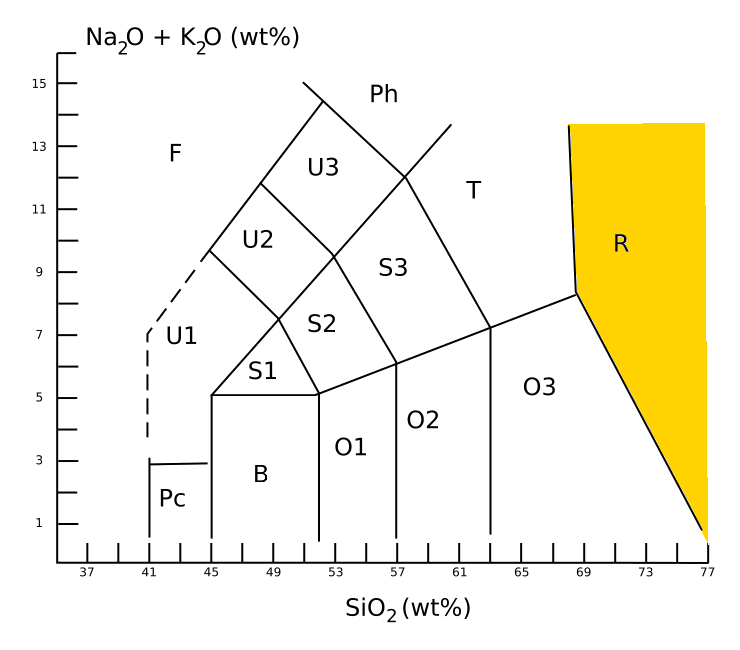
An extrusive igneous rock is classified as rhyolite when quartz constitutes 20% to 60% by volume of its total content of quartz, alkali feldspar, and plagioclase (QAPF) and alkali feldspar makes up 35% to 90% of its total feldspar content. Feldspathoids are not present. This makes rhyolite the extrusive equivalent of granite. However, while the IUGS recommends classifying volcanic rocks on the basis of their mineral composition whenever possible, volcanic rocks are often glassy or so fine-grained that mineral identification is impractical. The rock must then be classified chemically based on its content of silica and alkali metal oxides (K2O plus Na2O). Rhyolite is high in silica and total alkali metal oxides, placing it in the R field of the TAS diagram.
The alkali feldspar in rhyolites is sanidine or, less commonly, orthoclase. It is rarely anorthoclase. These feldspar minerals sometimes are present as phenocrysts. The plagioclase is usually sodium-rich (oligoclase or andesine). Cristobalite and trydimite are sometimes present along with the quartz. Biotite, augite, fayalite, and hornblende are common accessory minerals.
Geology
Due to their high content of silica and low iron and magnesium contents, rhyolitic magmas form highly viscous lavas. As a result, many eruptions of rhyolite are highly explosive, and rhyolite occurs more frequently as pyroclastic rock than as lava flows. Rhyolitic ash flow tuffs are the only volcanic product with volumes rivaling those of flood basalts. Rhyolites also occur as breccias or in lava domes, volcanic plugs, and dikes. Rhyolitic lavas erupt at a relatively low temperature of 800 to, significantly cooler than basaltic lavas, which typically erupt at temperatures of 1100 to.
Rhyolites that cool too quickly to grow crystals form a natural glass or vitrophyre, also called obsidian. Slower cooling forms microscopic crystals in the lava and results in textures such as flow foliations, spherulitic, nodular, and lithophysal structures. Some rhyolite is highly vesicular pumice.
Peralkaline rhyolites (rhyolites unusually rich in alkali metals) include comendite and pantellerite. Peralkalinity has significant effects on lava flow morphology and mineralogy, such that peralkaline rhyolites can be 10–30 times more fluid than typical calc-alkaline rhyolites. As a result of their increased fluidity, they are able to form small-scale flow folds, lava tubes and thin dikes. Peralkaline rhyolites erupt at relatively high temperatures of more than 1200 °C. They comprise bimodal shield volcanoes at hotspots and rifts (e.g. Rainbow Range, Ilgachuz Range and Level Mountain in British Columbia, Canada).
Eruptions of rhyolite lava are relatively rare compared to eruptions of less felsic lavas. Only four eruptions of rhyolite have been recorded since the start of the 20th century: at the St. Andrew Strait volcano in Papua New Guinea and Novarupta volcano in Alaska as well as at Chaitén and Cordón Caulle volcanoes in southern Chile. The eruption of Novarupta in 1912 was the largest volcanic eruption of the 20th century, and began with explosive volcanism that later transitioned to effusive volcanism and the formation of a rhyolite dome in the vent.
Petrogenesis
Rhyolite magmas can be produced by igneous differentiation of a more mafic (silica-poor) magma, through fractional crystallization or by assimilation of melted crustal rock (anatexis). Associations of andesites, dacites, and rhyolites in similar tectonic settings and with similar chemistry suggests that the rhyolite members were formed by differentiation of mantle-derived basaltic magmas at shallow depths. In other cases, the rhyolite appears to be a product of melting of crustal sedimentary rock. Water vapor plays an important role in lowering the melting point of silicic rock, and some rhyolitic magmas may have a water content as high as 7–8 weight percent.
High-silica rhyolite (HSR), with a silica content of 75 to 77·8% , forms a distinctive subgroup within the rhyolites. HSRs are the most evolved of all igneous rocks, with a composition very close to the water-saturated granite eutectic and with extreme enrichment in most incompatible elements. However, they are highly depleted in strontium, barium, and europium. They are interpreted as products of repeated melting and freezing of granite in the subsurface. HSRs typically erupt in large caldera eruptions.
Occurrence

Rhyolite is common along convergent plate boundaries, where a slab of oceanic lithosphere is being subducted into the Earth's mantle beneath overriding oceanic or continental lithosphere. It can sometimes be the predominant igneous rock type in these settings. Rhyolite is more common when the overriding lithosphere is continental rather than oceanic. The thicker continental crust gives the rising magma more opportunity to differentiate and assimilate crustal rock.
Rhyolite has been found on islands far from land, but such oceanic occurrences are rare. The tholeiitic magmas erupted at volcanic ocean islands, such as Iceland, can sometimes differentiate all the way to rhyolite, and about 8% of the volcanic rock in Iceland is rhyolite. However, this is unusual, and the Hawaiian Islands (for example) have no known occurrences of rhyolite. The alkaline magmas of volcanic ocean islands will very occasionally differentiate all the way to peralkaline rhyolites, but differentiation usually ends with trachyte.
Small volumes of rhyolite are sometimes erupted in association with flood basalts, late in their history and where central volcanic complexes develop.
Name
The name rhyolite was introduced into geology in 1860 by the German traveler and geologist Ferdinand von Richthofen from the Greek word rhýax ("a stream of lava") and the rock name suffix "-lite".
Uses
In North American pre-historic times, rhyolite was quarried extensively in what is now eastern Pennsylvania. Among the leading quarries was the Carbaugh Run Rhyolite Quarry Site in Adams County. Rhyolite was mined there starting 11,500 years ago. Tons of rhyolite were traded across the Delmarva Peninsula,
Obsidian is usually of rhyolitic composition, and it has been used for tools since prehistoric times. Obsidian scalpels have been investigated for use in delicate surgery. Pumice, also typically of rhyolitic composition, finds important uses as an abrasive, in concrete, and as a soil amendment. Rhyolitic tuff was used extensively for construction in ancient Rome and has been used in construction in modern Europe.
References
References
- {{cite LPD. 3
- {{cite Dictionary.com. rhyolite
- {{cite Merriam-Webster. rhyolite
- {{cite American Heritage Dictionary. rhyolite
- (1996). "Petrology : igneous, sedimentary, and metamorphic.". W.H. Freeman.
- (1991). "The IUGS systematics of igneous rocks". Journal of the Geological Society.
- (1999). "Rock Classification Scheme - Vol 1 - Igneous". British Geological Survey: Rock Classification Scheme.
- "Classification of igneous rocks".
- (2009). "Principles of igneous and metamorphic petrology". Cambridge University Press.
- (1984). "Pyroclastic rocks". Springer-Verlag.
- (1 November 1982). "Chilling and Brecciation of a Devonian Rhyolite Sill Intruded into Wet Sediments, Northern Sierra Nevada, California". The Journal of Geology.
- (1989). "Petrogenesis of Valle Grande Member rhyolites, Valles Caldera, New Mexico: Implications for evolution of the Jemez Mountains Mgmatic System". Journal of Geophysical Research: Solid Earth.
- (1997). "Petrology : the study of igneous, sedimentary, metamorphic rocks". McGraw-Hill Companies, Inc.
- (2012). "Petrology of the Late Cretaceous peralkaline rhyolites (pantellerite and comendite) from Lake Chad, Central Africa". [[Journal of Geosciences]].
- Wood, Charles A.. (1990). "Volcanoes of North America: United States and Canada". [[Cambridge University Press]].
- Wilson, C.J.. (2011). "Insights Into the Workings of Rhyolitic Explosive Eruptions and Their Magmatic Sources". [[American Geophysical Union]].
- (2017). "Emplacing a Cooling-Limited Rhyolite Lava Flow: Similarities with Basaltic Lava Flows". Frontiers in Earth Science.
- Fierstein, Judy. (1998). "Can Another Great Volcanic Eruption Happen in Alaska?". [[United States Geological Survey]].
- (August 2014). "Explosive to effusive transition during the largest volcanic eruption of the 20th century (Novarupta 1912, Alaska)". Geology.
- (1 March 1975). "Quaternary acid magma in New Zealand". Contributions to Mineralogy and Petrology.
- (2003). "Volcanism". Springer.
- (1 February 2014). "Processes in Caldera-Forming High-Silica Rhyolite Magma: Rb-Sr and Pb Isotope Systematics of the Otowi Member of the Bandelier Tuff, Valles Caldera, New Mexico, USA". Journal of Petrology.
- Farndon, John (2007) ''The Illustrated Encyclopedia of Rocks of the World''. Southwater. p. 54. {{ISBN. 1844762696
- (1860). "Studien aus den ungarisch-siebenbürgischen Trachytgebirgen". Jahrbuch der Kaiserlich-Königlichen Geologischen Reichsanstalt (Wein) [Annals of the Imperial-Royal Geological Institute of Vienna].
- (1989). "Oxford English Dictionary". [[Oxford University Press]].
- Young, Davis A.. (2003). "Mind Over Magma: The Story of Igneous Petrology". [[Princeton University Press]].
- (18 April 2024). "Definition of RHYOLITE".
- (7 May 2023). "Definition of LITE".
- Fergus, Charles. (2001). "Natural Pennsylvania: Exploring the State Forest Natural Areas". Stackpole Books.
- Bricker, Dakota. "Snaggy Ridge Indian Rhyolite Quarries". Mercersburg Historical Society.
- (1992). "Mechanics of pre-industrial technology: an introduction to the mechanics of ancient and traditional material culture". Cambridge University Press.
- Buck, BA. (March 1982). "Ancient Technology in Contemporary Surgery". The Western Journal of Medicine.
- (1990). "Building with Pumice". Deutsche Gesellschaft für Technische Zusammenarbeit (GTZ).
- (January 2012). "Pumice and pumicite – USGS Mineral Resources Program". United States Geological Survey.
- (2005). "The Judicious Selection and Preservation of Tuff and Travertine Building Stone in Ancient Rome*". Archaeometry.
This article was imported from Wikipedia and is available under the Creative Commons Attribution-ShareAlike 4.0 License. Content has been adapted to SurfDoc format. Original contributors can be found on the article history page.
Ask Mako anything about Rhyolite — get instant answers, deeper analysis, and related topics.
Research with MakoFree with your Surf account
Create a free account to save articles, ask Mako questions, and organize your research.
Sign up freeThis content may have been generated or modified by AI. CloudSurf Software LLC is not responsible for the accuracy, completeness, or reliability of AI-generated content. Always verify important information from primary sources.
Report