From Surf Wiki (app.surf) — the open knowledge base
Reverse triiodothyronine
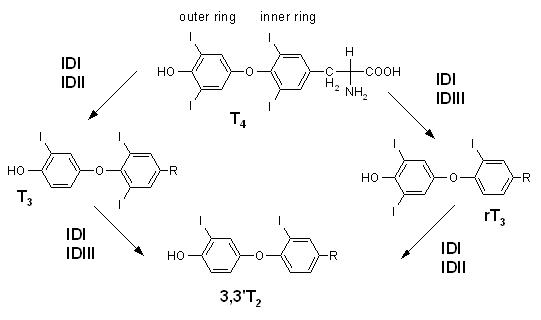
reverse T3 rT3 3,3′,5′-triiodothyronine Reverse triiodothyronine, also known as rT3, is an isomer of triiodothyronine (T3).
Reverse T3 is the third-most common iodothyronine the thyroid gland releases into the bloodstream, at 0.9%; tetraiodothyronine (levothyroxine, T4) constitutes 90% and T3 is 9%. However, 95% of rT3 in human blood is made elsewhere in the body, as enzymes remove a particular iodine atom from T4.
The production of hormone by the thyroid gland is controlled by the hypothalamus and pituitary gland. The physiological activity of thyroid hormone is regulated by a system of enzymes that activate, inactivate or simply discard the prohormone T4 and in turn functionally modify T3 and rT3. These enzymes operate under complex direction of systems including neurotransmitters, hormones, markers of metabolism and immunological signals.
The levels of rT3 increase in conditions such as euthyroid sick syndrome because its clearance decreases while its production stays the same. The decreased clearance is possibly from lower thyroxine 5-deiodinase activity in the peripheral tissue or decreased liver uptake of rT3. In addition, increased rT3 concentrations result from upregulated thyroxine 5-deiodinase activity in critical illness, starvation and fetal life.
Reactions
References
References
- Chopra IJ. (July 1976). "An assessment of daily production and significance of thyroidal secretion of 3,3′,5′-triiodothyronine (reverse T3) in man". J. Clin. Invest..
- {{EMedicine. article. 118651. Euthyroid Sick Syndrome
- (20 July 2017). "Thyroid Allostasis–Adaptive Responses of Thyrotropic Feedback Control to Conditions of Strain, Stress, and Developmental Programming". Frontiers in Endocrinology.
This article was imported from Wikipedia and is available under the Creative Commons Attribution-ShareAlike 4.0 License. Content has been adapted to SurfDoc format. Original contributors can be found on the article history page.
Ask Mako anything about Reverse triiodothyronine — get instant answers, deeper analysis, and related topics.
Research with MakoFree with your Surf account
Create a free account to save articles, ask Mako questions, and organize your research.
Sign up freeThis content may have been generated or modified by AI. CloudSurf Software LLC is not responsible for the accuracy, completeness, or reliability of AI-generated content. Always verify important information from primary sources.
Report