From Surf Wiki (app.surf) — the open knowledge base
Renal cyst

| Field | Value |
|---|---|
| name | Renal cyst |
| synonyms | Kidney cysst |
| image | File:Renal cyst MRI.jpg |
| caption | Renal cyst of the left kidney (hyperintense area) as shown on MRI |
A renal cyst is a fluid collection in or on the kidney. There are several types based on the Bosniak classification. The majority are benign, simple cysts that can be monitored and not intervened upon. However, some are cancerous or are suspicious for cancer and are commonly removed in a surgical procedure called nephrectomy.
Numerous renal cysts are seen in the cystic kidney diseases, which include polycystic kidney disease and medullary sponge kidney.
Classification
Renal cysts are classified by malignant risk using the Bosniak classification system. The system was created by Morton Bosniak (1929–2016), a faculty member at the New York University Langone Medical Center in New York City.
The Bosniak classification categorizes renal cysts into five groups. Online calculators have been developed that facilitate calculation of the Bosniak score.
Category I
:Benign simple cyst with thin wall without septa, calcifications, or solid components, and has a density of 0–20 Hounsfield units (HU) (about equal to that of water). In such cases, a CT scan without intravenous contrast is enough for classification. Still, if a contrast CT is performed, a category I cyst should not show significant enhancement, which can be regarded as an increase of less than 10HU.
Category II
:Benign cyst with a few thin septa, which may contain fine calcifications or a small segment of mildly thickened calcification. This includes homogenous, high-attenuation (60–70 Hounsfield units) lesions less than 3 cm with sharp margins but without enhancement. Hyperdense cysts must be exophytic with at least 75 percent of its wall outside the kidney to allow for appropriate assessment of margins, otherwise they are categorized as IIF.
Category IIF

This category includes renal cysts with multiple thin septa, a septum thicker than hairline, slightly thick wall, or with calcification, which may be thick. It also includes intrarenal cysts larger than 3 cm if:
- there is no contrast enhancement (otherwise category III).
- there is high attenuation or there is a maximum 25% of their walls visible outside the kidney (otherwise category II).
Category IIF cysts have a 5–10% risk of being kidney cancer, and therefore follow-up is recommended. However, there is no consensus recommendation on the appropriate interval of follow up.
Category III
:Indeterminate cystic masses with thickened, irregular or smooth walls or septa with measurable enhancement. Approximately 40 to 60% of these lesions are ultimately found to be malignant, most commonly in the forms of cystic renal cell carcinoma and its multiloculated variant. The remaining lesions are benign and include hemorrhagic cysts, chronic infected cysts, and multiloculated cystic nephromas.
Category IV
:Malignant cystic masses with all the characteristics of category III lesions but also with enhancing soft tissue components independent of but adjacent to the septa. Approximately 85 to 100% of these lesions are malignant. The presence of measurable contrast enhancement of the lesion is the most important characteristic in distinguishing between high-risk cysts (classifications III and IV) from the typically benign, low-risk Bosniak I, II, and IIF cysts. Such contrast enhancement should be at least 10 to 15 Hounsfield units higher when compared with unenhanced images.
| Bosniak category | I | II | IIF | III | IV |
|---|---|---|---|---|---|
| Attenuation | 0–20 HU | 60–70 Hounsfield units | |||
| Walls | Thin and smooth | Small and fine calcifications | Nodular or irregular calcifications | Thick, heterogeneous. Gross calcifications with enhancement | |
| Solid components | No | Yes |
Diagnosis
The complex cyst can be further evaluated with doppler ultrasonography, and for Bosniak classification and follow-up of complex cysts, either contrast-enhanced ultrasound (CEUS) or contrast CT is used.
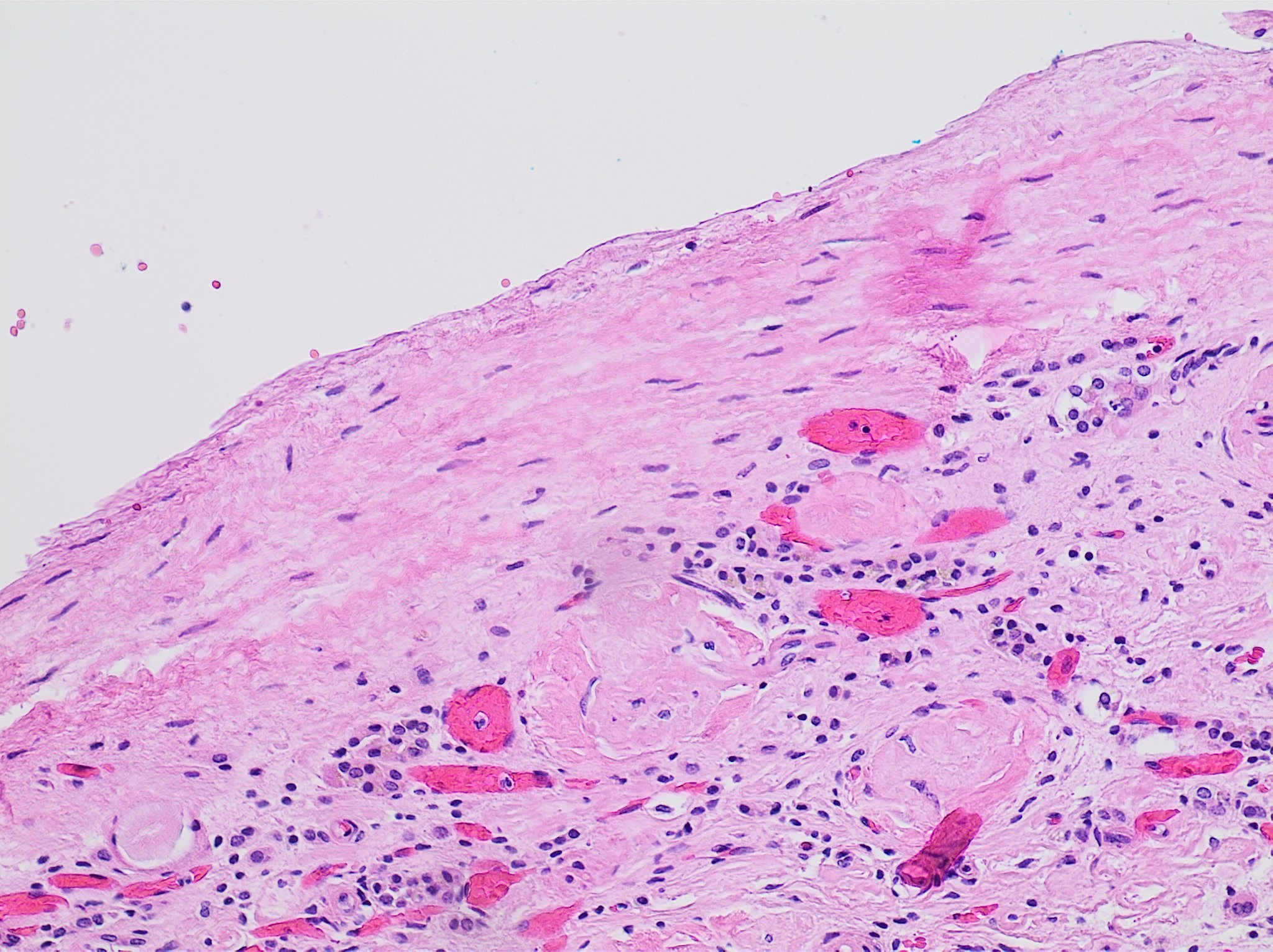
Simple cyst with posterior enhancement.jpg|Renal ultrasonography of a simple renal cyst with posterior enhancement File:Advanced polycystic kidney disease with multiple cysts.jpg|Advanced polycystic kidney disease with multiple cysts Renal cyst ultrasound.jpg|Renal cyst as seen on abdominal ultrasound Renal cyst ultrasound 2.jpg|Renal cyst as seen on abdominal ultrasound Renal cyst ultrasound 3.jpg|Renal cyst as seen on abdominal ultrasound Small simple renal cyst.jpg|A very small (8 mm) simple renal cyst Complex cysts at the lower pole of right kidney showing septations and sediment within.jpg|Bosniak II cyst at the lower pole of right kidney with septations within
Treatment
This system is more directly focused on the most appropriate management. These alternatives are broadly to ignore the cyst, schedule follow-up or perform a surgical excision of it. When a cyst shows discrepancy in severity across categories, it is the most worrisome feature that is used in deciding about management. There is no established rule regarding the follow-up frequency, but one possibility is after 6 months, which can later be doubled if unchanged.
| Recommended management | Ignore | Follow | Excise |
|---|---|---|---|
| Calcification | Thick, nodular | ||
| If radiodensity 20 HU without radiocontrast | |||
| Septations | Thin and smooth | Slightly greater than hairline | |
| Enhancement (increase with radiocontrast) | 10–15 HU | 15 HU | |
| Multilocular | If infection | All others | |
| Nodularity | Very small and nonenhancing | All others | |
| Wall thickening | If infection | All others |
Peripelvic versus parapelvic cysts
Parapelvic cysts originate from around the kidney at the adjacent renal parenchyma, and plunge into the renal sinus. Peripelvic cysts are contained entirely within the renal sinus, possibly related to dilated lymphatic channels. When viewed on CT in absence of contrast, they can mimic hydronephrosis. If symptomatic, they can be laparoscopically decorticated - removal of the outer layer or cortex.
Epidemiology
Up to 27 percent of individuals older than 50 years may have simple renal cysts that cause no symptoms.
References
References
- "Education & Research at NYU Langone Health".
- (August 2000). "Cystic renal masses: accurate Bosniak classification requires adequate renal CT". American Journal of Roentgenology.
- (2025-06-22). "Bosniak Calculator For Renal Cystic Masses 2019 (CT/MRI) - Rad At Hand".
- (2014). "Classificação de Bosniak para cistos renais complexos: histórico e análise crítica". Radiologia Brasileiro.
- Karen Garfield and Stephen W. Leslie. (2019-03-14). "Simple Renal Cyst". StatPearls.
- (2014). "Bosniak classification of renal cystic lesions according to multidetector computed tomography findings". Radiologia Brasileiro.
- "Bosniak classification of renal cystic disease".
- (September 2005). "An update of the Bosniak renal cyst classification system". Urology.
- (August 2000). "Cystic Renal Masses: Accurate Bosniak Classification Requires Adequate Renal CT". American Journal of Roentgenology.
- (March 2003). "Incidence of Malignancy in Complex Cystic Renal Masses (Bosniak Category III): Should Imaging-Guided Biopsy Precede Surgery?". American Journal of Roentgenology.
- Bosniak, M A. (May 1991). "The small (less than or equal to 3.0 cm) renal parenchymal tumor: detection, diagnosis, and controversies.". Radiology.
- (2015). "Ultrasonography of the Kidney: A Pictorial Review". Diagnostics.
- Mandolin S. Ziadie, M.D.. "Simple cysts".
- David S. Hartman, MD and Ileana Chesaru, MD.. "Kidney – Cystic masses".
- (1997). "Peripelvic cysts simulating hydronephrosis". Abdominal Imaging.
- (2006). "Laparoscopic decortication of symptomatic simple renal cysts: 10-year experience from one institution". BJU International.
- (July 1983). "The incidence of simple renal cyst by computed tomography". Clinical Radiology.
This article was imported from Wikipedia and is available under the Creative Commons Attribution-ShareAlike 4.0 License. Content has been adapted to SurfDoc format. Original contributors can be found on the article history page.
Ask Mako anything about Renal cyst — get instant answers, deeper analysis, and related topics.
Research with MakoFree with your Surf account
Create a free account to save articles, ask Mako questions, and organize your research.
Sign up freeThis content may have been generated or modified by AI. CloudSurf Software LLC is not responsible for the accuracy, completeness, or reliability of AI-generated content. Always verify important information from primary sources.
Report