From Surf Wiki (app.surf) — the open knowledge base
Regions of Italy
Primary administrative divisions of Italy

Primary administrative divisions of Italy
| Field | Value |
|---|---|
| name | Regions of Italy |
| it | |
| map | |
| category | Regionalised unitary state |
| territory | Italian Republic |
| current_number | 20 |
| population_range | 122,714 (Aosta Valley) – 10,035,481 (Lombardy) |
| area_range | 3,261 sqkm (Aosta Valley) – |
| 25,832 sqkm (Sicily) | |
| government | Regional government, national government |
| subdivision | Provinces |
it 25,832 sqkm (Sicily)
The regions of Italy () are the first-level administrative divisions of the Italian Republic, constituting its second NUTS administrative level. There are twenty regions, five of which are autonomous regions with special status. Under the Constitution of Italy, each region is an autonomous entity with defined powers. With the exception of the Aosta Valley (since 1945) and Friuli-Venezia Giulia (since 2015), each region is divided into a number of provinces.
History
During the Kingdom of Italy, regions were mere statistical districts of the central state. Under the Republic, they were granted a measure of political autonomy by the 1948 Italian Constitution. The original draft list comprised the Salento region (which was eventually included in Apulia); Friuli and Venezia Giulia were separate regions, and Basilicata was named Lucania. Abruzzo and Molise were identified as separate regions in the first draft, but were later merged into Abruzzi e Molise in the final constitution of 1948, before being separated in 1963.
Implementation of regional autonomy was postponed until the first Regional elections of 1970. The ruling Christian Democracy party did not want the opposition Italian Communist Party to gain power in the regions where it was historically rooted (the red belt of Emilia-Romagna, Tuscany, Umbria and the Marches).
Regions acquired a significant level of autonomy following a constitutional reform in 2001 (brought about by a centre-left government and confirmed by popular referendum), which granted them residual policy competence. A further federalist reform was proposed by the regionalist party Lega Nord and in 2005, the centre-right government led by Silvio Berlusconi proposed a new reform that would have greatly increased the power of regions.
The proposals, which had been particularly associated with Lega Nord, and seen by some as leading the way to a federal state, were rejected in the 2006 Italian constitutional referendum by 61.7% "no" to 38.3% "yes". The results varied considerably among the regions, ranging from 55.3% in favour in Veneto to 82% against in Calabria.
Political control
Number of regions governed by each coalition since 1995:
ImageSize = width:1000 height:230 PlotArea = width:835 height:180 left:30 bottom:20 AlignBars = justify
DateFormat = yyyy Period = from:0 till:20 TimeAxis = orientation:vertical ScaleMajor = unit:year increment:4 start:0
Colors = id:red value:rgb(0.94,0.24,0.24) id:blue value:rgb(0.04,0.42,0.88) id:grey value:rgb(0.75,0.75,0.75) id:black value:rgb(0.40,0.40,0.40)
PlotData= bar:1995 color: red from:start till:11 text:11 bar:1995 color: blue from:11 till:20 text:9
bar:1996 color: red from:start till:11 text:11 bar:1996 color: blue from:11 till:20 text:9
bar:1997 color: red from:start till:11 text:11 bar:1997 color: blue from:11 till:20 text:9
bar:1998 color: red from:start till:12 text:12 bar:1998 color: blue from:12 till:20 text:8
bar:1999 color: red from:start till:15 text:15 bar:1999 color: blue from:15 till:20 text:5
bar:2000 color: red from:start till:11 text:11 bar:2000 color: blue from:11 till:20 text:9
bar:2001 color: red from:start till:10 text:10 bar:2001 color: blue from:10 till:20 text:10
bar:2002 color: red from:start till:9 text:9 bar:2002 color: blue from:9 till:20 text:11
bar:2003 color: red from:start till:10 text:10 bar:2003 color: blue from:10 till:20 text:10
bar:2004 color: red from:start till:10 text:10 bar:2004 color: blue from:10 till:20 text:10
bar:2005 color: red from:start till:16 text:16 bar:2005 color: blue from:16 till:20 text:4
bar:2006 color: red from:start till:15 text:15 bar:2006 color: grey from:15 till:16 text:1 bar:2006 color: blue from:16 till:20 text:4
bar:2007 color: red from:start till:15 text:15 bar:2007 color: grey from:15 till:16 text:1 bar:2007 color: blue from:16 till:20 text:4
bar:2008 color: red from:start till:13 text:13 bar:2008 color: blue from:13 till:20 text:7
bar:2009 color: red from:start till:12 text:12 bar:2009 color: blue from:12 till:20 text:8
bar:2010 color: red from:start till:8 text:8 bar:2010 color: blue from:8 till:20 text:12
bar:2011 color: red from:start till:8 text:8 bar:2011 color: blue from:8 till:20 text:12
bar:2012 color: red from:start till:9 text:9 bar:2012 color: blue from:9 till:20 text:11
bar:2013 color: red from:start till:12 text:12 bar:2013 color: blue from:12 till:20 text:8
bar:2014 color: red from:start till:17 text:17 bar:2014 color: blue from:17 till:20 text:3
bar:2015 color: red from:start till:17 text:17 bar:2015 color: blue from:17 till:20 text:3
bar:2016 color: red from:start till:17 text:17 bar:2016 color: blue from:17 till:20 text:3
bar:2017 color: red from:start till:16 text:16 bar:2017 color: blue from:16 till:20 text:4
bar:2018 color: red from:start till:14 text:14 bar:2018 color: blue from:14 till:20 text:6
bar:2019 color: red from:start till:7 text:7 bar:2019 color: grey from:7 till:8 text:1 bar:2019 color: blue from:8 till:20 text:12
bar:2020 color: red from:start till:6 text:6 bar:2020 color: blue from:6 till:20 text:14
bar:2021 color: red from:start till:6 text:6 bar:2021 color: blue from:6 till:20 text:14
bar:2022 color: red from:start till:6 text:6 bar:2022 color: blue from:6 till:20 text:14
bar:2023 color: red from:start till:5 text:5 bar:2023 color: blue from:5 till:20 text:15
bar:2024 color: red from:start till:7 text:7 bar:2024 color: blue from:7 till:20 text:13
bar:2025 color: red from:start till:6 text:6 bar:2025 color: blue from:6 till:20 text:14
Regions
| Flag | Region | |||||||||||||
|---|---|---|---|---|---|---|---|---|---|---|---|---|---|---|
| *Italian name* (if different) | Status | Population | ||||||||||||
| 1 January 2025 | Area | Pop. density | ||||||||||||
| (p/km2) | HDI 2022 | Capital | President | Number of comuni | Prov. or | |||||||||
| metrop. cities | Number | % | km2 | % | ||||||||||
| [[File:Flag of Abruzzo.svg | 40px | border]] | **Abruzzo** | Ordinary | 1,268,430 | 2.16% | 10,832 km2 | 3.59% | 117.1 | 0.889 | L'Aquila | Centre-right coalition}}" | Marco Marsilio | |
| *Brothers of Italy* | 305 | 4 | ||||||||||||
| [[File:Flag of Valle d'Aosta.svg | 40px | border]] | **Aosta Valley** | |||||||||||
| *Valle d'Aosta*/*Vallée d'Aoste* | Autonomous | 122,714 | 0.21% | 3,261 km2 | 1.08% | 37.63 | 0.887 | Aosta | Centre-right coalition}}" | Renzo Testolin | ||||
| *Valdostan Union* | 74 | 1 | ||||||||||||
| [[File:Flag of Apulia.svg | 40px | border]] | **Apulia** | |||||||||||
| *Puglia* | Ordinary | 3,874,166 | 6.63% | 19,541 km2 | 6.48% | 198.3 | 0.854 | Bari | Centre-left coalition}}" | Michele Emiliano | ||||
| *Democratic Party* | 257 | 6 | ||||||||||||
| [[File:Flag of Basilicata.svg | 40px | border]] | **Basilicata** | Ordinary | 529,897 | 0.92% | 10,073 km2 | 3.34% | 52.61 | 0.862 | Potenza | Centre-right coalition}}" | Vito Bardi | |
| Forza Italia | 131 | 2 | ||||||||||||
| [[File:Flag of Calabria.svg | 40px | border]] | **Calabria** | Ordinary | 1,832,147 | 3.13% | 15,222 km2 | 5.04% | 120.4 | 0.845 | Catanzaro | Centre-right coalition}}" | Roberto Occhiuto | |
| Forza Italia | 404 | 5 | ||||||||||||
| [[File:Flag of Campania.svg | 40px | border]] | **Campania** | Ordinary | 5,575,025 | 9.48% | 13,671 km2 | 4.53% | 407.8 | 0.854 | Naples | Centre-left coalition}}" | Vincenzo De Luca | |
| *Democratic Party* | 550 | 5 | ||||||||||||
| [[File:Fictional Emilia-Romagna Flag.svg | 40px | border]] | **Emilia-Romagna** | Ordinary | 4,465,678 | 7.51% | 22,453 km2 | 7.44% | 198.5 | 0.921 | Bologna | Centre-left coalition}}" | Michele De Pascale | |
| *Democratic Party* | 330 | 9 | ||||||||||||
| [[File:Flag of Friuli-Venezia Giulia.svg | 40px | border]] | **Friuli-Venezia Giulia** | |||||||||||
| *Furlanija-Julijska Krajina/Friûl-Vignesie Julie/Friaul-Julisch Venetien* | Autonomous | 1,194,095 | 2.03% | 7,924 km2 | 2.63% | 150.5 | 0.903 | Trieste | Centre-right coalition}};" | Massimiliano Fedriga | ||||
| *League* | 215 | 4 | ||||||||||||
| [[File:Lazio Flag.svg | 40px | border]] | **Lazio** | Ordinary | 5,710,272 | 9.69% | 17,232 km2 | 5.71% | 331.4 | 0.914 | Rome | Centre-right coalition}};" | Francesco Rocca | |
| *Independent* | 378 | 5 | ||||||||||||
| [[File:Flag of Liguria.svg | 40px | border]] | **Liguria** | Ordinary | 1,509,908 | 2.56% | 5,416 km2 | 1.79% | 278.8 | 0.898 | Genoa | Centre-right coalition}};" | Marco Bucci | |
| *Independent* | 234 | 4 | ||||||||||||
| [[File:Flag of Lombardy.svg | 40px | border]] | **Lombardy** | |||||||||||
| *Lombardia* | Ordinary | 10,035,481 | 16.89% | 23,864 km2 | 7.91% | 420.5 | 0.912 | Milan | Centre-right coalition}};" | Attilio Fontana | ||||
| *League* | 1,506 | 12 | ||||||||||||
| [[File:Flag of Marche.svg | 40px | border]] | **Marche** | Ordinary | 1,481,252 | 2.53% | 9,401 km2 | 3.12% | 158.5 | 0.901 | Ancona | Centre-right coalition}}" | Francesco Acquaroli | |
| *Brothers of Italy* | 225 | 5 | ||||||||||||
| [[File:Flag of Molise.svg | 40px | border]] | **Molise** | Ordinary | 287,966 | 0.49% | 4,461 km2 | 1.48% | 64.56 | 0.872 | Campobasso | Centre-right coalition}};" | Francesco Roberti | |
| Forza Italia | 136 | 2 | ||||||||||||
| [[File:Flag of Piedmont.svg | 40px | border]] | **Piedmont** | |||||||||||
| *Piemonte* | Ordinary | 4,255,702 | 7.21% | 25,387 km2 | 8.41% | 167.6 | 0.898 | Turin | Centre-right coalition}}" | Alberto Cirio | ||||
| Forza Italia | 1,181 | 8 | ||||||||||||
| [[File:Flag of Sardinia, Italy.svg | 40px | border]] | **Sardinia** | |||||||||||
| *Sardegna* | Autonomous | 1,561,339 | 2.68% | 24,100 km2 | 7.99% | 64.79 | 0.868 | Cagliari | Centre-left coalition}}" | Alessandra Todde | ||||
| *Five Star Movement* | 377 | 5 | ||||||||||||
| [[File:Flag of Sicily.svg | 40px | border]] | **Sicily** | |||||||||||
| *Sicilia* | Autonomous | 4,779,371 | 8.14% | 25,832 km2 | 8.56% | 185.0 | 0.845 | Palermo | Centre-right coalition}}" | Renato Schifani | ||||
| Forza Italia | 391 | 9 | ||||||||||||
| [[File:Flag of Trentino-South Tyrol.svg | 40px | border]] | **Trentino-South Tyrol** | |||||||||||
| *Trentino-Alto Adige/Südtirol* | Autonomous | 1,086,095 | 1.83% | 13,606 km2 | 4.51% | 79.82 | Trentino: 0.920 | Trento | Centre-right coalition}};" | Arno Kompatscher | ||||
| *South Tyrolean People's Party* | 282 | 2 | ||||||||||||
| South Tyrol: 0.910 | ||||||||||||||
| [[File:Flag of Tuscany.svg | 40px | border]] | **Tuscany** | |||||||||||
| *Toscana* | Ordinary | 3,660,834 | 6.23% | 22,987 km2 | 7.62% | 159.3 | 0.907 | Florence | Centre-left coalition}}" | Eugenio Giani | ||||
| *Democratic Party* | 273 | 10 | ||||||||||||
| [[File:Flag of Umbria.svg | 40px | border]] | **Umbria** | Ordinary | 851,954 | 1.46% | 8,464 km2 | 2.81% | 100.7 | 0.897 | Perugia | Centre-left coalition}}" | Stefania Proietti | |
| *Independent* | 92 | 2 | ||||||||||||
| [[File:Flag of Veneto.svg | 40px | border]] | **Veneto** | Ordinary | 4,851,851 | 8.23% | 18,345 km2 | 5.97% | 264.5 | 0.900 | Venice | Centre-right coalition}};" | Luca Zaia | |
| *League* | 563 | 7 | ||||||||||||
| [[File:Flag of Italy.svg | 40px | border]] | '*Italy | |||||||||||
| *Italia''''' | **—** | **58,934,177** | **100.00%** | **302,068.26 km2** | **100.00%** | **195.1** | **0.892** | **Rome** | Independent politician}}" | **Sergio Mattarella | ||||
| *Independent*** | **7,904** | **107** |
Macroregions
Macroregions are the first-level NUTS of the European Union.(it)
| Map | Macroregion | ||||||||
|---|---|---|---|---|---|---|---|---|---|
| *Italian name* | Regions | Major city | Population | ||||||
| January 2022 | Area (km2) | Population | |||||||
| density | |||||||||
| (km2) | MEPs | Number | % | km2 | % | ||||
| [[File:Italian NUTS1 Central.svg | 130px | center]] | **Centre** | ||||||
| *Centro* | Lazio | ||||||||
| Marche | |||||||||
| Tuscany | |||||||||
| Umbria | Rome | 11,740,836 | 19.91% | 58,085 km2 | 19.23% | 202 | 15 | ||
| [[File:Italian NUTS1 NorthWest.svg | 130px | center]] | **North-West** | ||||||
| *Nord-Ovest* | Aosta Valley | ||||||||
| Liguria | |||||||||
| Lombardy | |||||||||
| Piedmont | Milan | 15,848,100 | 26.87% | 57,928 km2 | 19.18% | 274 | 20 | ||
| [[File:Italian NUTS1 NorthEast.svg | 130px | center]] | **North-East** | ||||||
| *Nord-Est* | Emilia-Romagna | ||||||||
| Friuli-Venezia Giulia | |||||||||
| Trentino-Alto Adige/Südtirol | |||||||||
| Veneto | Bologna | 11,561,676 | 19.60% | 62,003 km2 | 20.63% | 186 | 15 | ||
| [[File:Italian NUTS1 South.svg | 130px | center]] | **South** | ||||||
| *Sud* | Abruzzo | ||||||||
| Apulia | |||||||||
| Basilicata | |||||||||
| Calabria | |||||||||
| Campania | |||||||||
| Molise | Naples | 13,451,861 | 22.81% | 73,800 km2 | 24.43% | 182 | 18 | ||
| [[File:Italian NUTS1 Islands.svg | 130px | center]] | **Islands** | ||||||
| *Isole* or *Insulare* (adj) | Sardinia | ||||||||
| Sicily | Palermo | 6,380,649 | 10.82% | 49,932 km2 | 16.53% | 128 | 8 |
Status
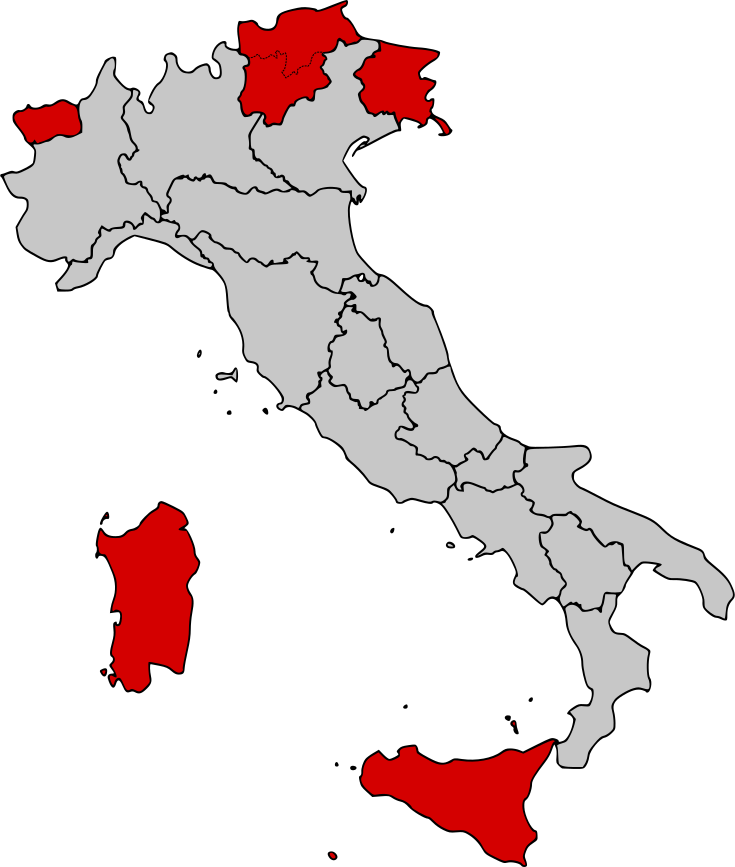
Every region has a statute that serves as a regional constitution, determining the form of government and the fundamental principles of the organization and the functioning of the region, as prescribed by the Constitution of Italy (Article 123). Although all the regions except Tuscany define themselves in various ways as an "autonomous Region" in the first article of their Statutes, fifteen regions have ordinary statutes and five have special statutes, granting them extended autonomy.
Regions with ordinary statute
These regions, whose statutes are approved by their regional councils, were created in 1970, even though the Italian Constitution dates back to 1948. Since the constitutional reform of 2001 they have had residual legislative powers: the regions have exclusive legislative power with respect to any matters not expressly reserved to state law (Article 117). Yet their financial autonomy is quite modest: they keep just 20% of all levied taxes, mostly used to finance the region-based healthcare system.
Autonomous regions with special statute
Article 116 of the Italian Constitution grants home rule to five regions: the Aosta Valley, Friuli-Venezia Giulia, Sardinia, Sicily, and Trentino-Alto Adige/Südtirol, allowing them some legislative, administrative and financial power to a varying extent, depending on their specific statute. These regions became autonomous in order to take into account cultural differences and protect linguistic minorities. Moreover, the government wanted to prevent them from potentially seceding or being taken away from Italy after its defeat in World War II.
Institutions
Each region has an elected parliament, called Consiglio Regionale (regional council), or Assemblea Regionale (regional assembly) in Sicily, and a government called Giunta Regionale (regional committee), headed by a governor called Presidente della Giunta Regionale (president of the regional committee) or Presidente della Regione (regional president). The latter is directly elected by the citizens of each region, with the exceptions of Aosta Valley and Trentino-Alto Adige/Südtirol regions where the president is chosen by the regional council.
Under the 1995 electoral law, the winning coalition receives an absolute majority of seats on the council. The president chairs the giunta, and nominates or dismisses its members, called assessori. If the directly elected president resigns, new elections are called immediately.
In the Trentino-Alto Adige/Südtirol region, the regional council is made up of the joint session of the two provincial councils of Trentino and of South Tyrol. The regional president is one of the two provincial commissioners.
Representation in the Senate

Article 57 of the Constitution of Italy originally established that the Senate of the Republic was to be elected on a regional basis by Italian citizens aged 25 or older (unlike the Chamber of the Deputies, which was elected on a national basis and by all Italian citizens aged 18 or older). No region could have fewer than 7 senators, except for the two smallest regions: Aosta Valley (1 senator) and Molise (2 senators). From 2006 to 2020, 6 out of 315 senators (and 12 out of 630 deputies) were elected by Italians residing abroad.
After two constitutional amendments were passed respectively in 2020 (by constitutional referendum) and 2021, however, there have been changes. The Senate is still elected on a regional basis, but the number of senators was reduced from 315 to 200, who are now elected by all citizens aged 18 or older, just like deputies (themselves being reduced from 630 to 400). Italians residing abroad now elect 4 senators (and 8 deputies).
The remaining 196 senators are assigned to each region proportionally according to their population. The amended Article 57 of the Constitution provides that no region can have fewer than 3 senators representing it, barring Aosta Valley and Molise, which retained 1 and 2 senators respectively.
| Region | Seats | Region | Seats | Region | Seats |
|---|---|---|---|---|---|
| Abruzzo | 4 | Friuli-Venezia Giulia | 4 | Sardinia | 5 |
| Aosta Valley | 1 | Lazio | 18 | Sicily | 16 |
| Apulia | 13 | Liguria | 5 | Trentino-Alto Adige/Südtirol | 6 |
| Basilicata | 3 | Lombardy | 31 | Tuscany | 12 |
| Calabria | 6 | Marche | 5 | Umbria | 3 |
| Campania | 18 | Molise | 2 | Veneto | 16 |
| Emilia-Romagna | 14 | Piedmont | 14 | Overseas constituencies | 4 |
Economy of regions and macroregions

| Flag | Name | GDP 2018, | |||||
|---|---|---|---|---|---|---|---|
| million EUR | GDP per capita 2018, | ||||||
| EUR | GDP 2011, | ||||||
| million PPS | GDP per capita 2011, | ||||||
| PPS | |||||||
| [[File:Flag of Abruzzo.svg | 40px | border]] | Abruzzo | 33,900 | 25,800 | 29,438 | 21,900 |
| [[File:Flag of Valle d'Aosta.svg | 40px | border]] | Aosta Valley | 4,900 | 38,900 | 4,236 | 33,000 |
| [[File:Flag of Apulia.svg | 40px | border]] | Apulia | 76,600 | 19,000 | 68,496 | 16,700 |
| [[File:Flag of Basilicata.svg | 40px | border]] | Basilicata | 12,600 | 22,200 | 10,517 | 17,900 |
| [[File:Flag of Calabria.svg | 40px | border]] | Calabria | 33,300 | 17,000 | 32,357 | 16,100 |
| [[File:Flag of Campania.svg | 40px | border]] | Campania | 108,000 | 18,600 | 91,658 | 15,700 |
| [[File:Fictional Emilia-Romagna Flag.svg | 40px | border]] | Emilia-Romagna | 161,000 | 36,200 | 139,597 | 31,400 |
| [[File:Flag of Friuli-Venezia Giulia.svg | 40px | border]] | Friuli-Venezia Giulia | 38,000 | 31,200 | 35,855 | 29,000 |
| [[File:Lazio Flag.svg | 40px | border]] | Lazio | 198,000 | 33,600 | 168,609 | 29,300 |
| [[File:Flag of Liguria.svg | 40px | border]] | Liguria | 49,900 | 32,100 | 43,069 | 26,700 |
| [[File:Flag of Lombardy.svg | 40px | border]] | Lombardy | 388,800 | 38,600 | 330,042 | 33,200 |
| [[File:Flag of Marche.svg | 40px | border]] | Marche | 43,200 | 28,300 | 40,014 | 25,500 |
| [[File:Flag of Molise.svg | 40px | border]] | Molise | 6,500 | 20,900 | 6,278 | 19,700 |
| [[File:Flag of Piedmont.svg | 40px | border]] | Piedmont | 137,000 | 31,500 | 123,336 | 27,600 |
| [[File:Flag of Sardinia, Italy.svg | 40px | border]] | Sardinia | 34,900 | 21,200 | 32,377 | 19,300 |
| [[File:Flag of Sicily.svg | 40px | border]] | Sicily | 89,200 | 17,800 | 82,183 | 16,300 |
| [[File:Flag of Trentino-South Tyrol.svg | 40px | border]] | Trentino-Alto Adige/Südtirol | 41,700 | 39,200 | 35,041 | 33,700 |
| [[File:Flag of Tuscany.svg | 40px | border]] | Tuscany | 118,000 | 31,500 | 103,775 | 27,600 |
| [[File:Flag of Umbria.svg | 40px | border]] | Umbria | 22,500 | 25,400 | 21,078 | 23,200 |
| [[File:Flag of Veneto.svg | 40px | border]] | Veneto | 163,000 | 33,200 | 146,369 | 29,600 |
| Code | Name | GDP 2011, | |||
|---|---|---|---|---|---|
| million EUR | GDP per capita 2011, | ||||
| EUR | GDP 2011, | ||||
| million PPS | GDP per capita 2011, | ||||
| PPS | |||||
| ITE | **Centre** | 340,669 | 28,400 | 333,475 | 27,800 |
| ITC | **North-West** | 511,484 | 31,700 | 500,683 | 31,000 |
| ITD | **North-East** | 364,560 | 31,200 | 356,862 | 30,600 |
| ITF | **South** | 243,895 | 17,200 | 238,744 | 16,800 |
| ITG | **Islands** | 117,031 | 17,400 | 114,560 | 17,000 |
| - | ***Extra-regio*** | *2,771* | – | *2,712* | – |
References
References
- "National structures". Eurostat.
- (26 June 2006). "Speciale Referendum 2006". la Repubblica.
- "Population Italian Regions".
- "Sub-national HDI – Area Database – Global Data Lab".
- "Italian Comuni".
- "ISTAT geo-demo".
- Torrente, Luciano. "Statuti Regionali – Casa Editrice: Edizioni Simone".
- LL.M., Prof. Dr. Axel Tschentscher. "ICL – Italy – Constitution".
- Report [[RAI]] – Le regioni a statuto speciale (Italian), retrieved 21 January 2009 [http://www.report.rai.it/R2_popup_articolofoglia/0,7246,243%255E90034,00.html] {{Webarchive. link. (22 March 2009, [http://www.report.rai.it/R2_popup_articolofoglia/0,7246,243%255E90114,00.html] {{Webarchive). link. (6 October 2008)
- Hiroko Kudo, "Autonomy and Managerial Innovation in Italian Regions after Constitutional Reform", Chuo University, Faculty of Law and Graduate School of Public Policy (2008): p. 1. Retrieved on 6 April 2012 from http://www.med-eu.org/proceedings/MED1/Kudo.pdf {{Webarchive. link. (17 November 2015 .)
- "GDP per capita in the EU in 2011".
This article was imported from Wikipedia and is available under the Creative Commons Attribution-ShareAlike 4.0 License. Content has been adapted to SurfDoc format. Original contributors can be found on the article history page.
Ask Mako anything about Regions of Italy — get instant answers, deeper analysis, and related topics.
Research with MakoFree with your Surf account
Create a free account to save articles, ask Mako questions, and organize your research.
Sign up freeThis content may have been generated or modified by AI. CloudSurf Software LLC is not responsible for the accuracy, completeness, or reliability of AI-generated content. Always verify important information from primary sources.
Report