From Surf Wiki (app.surf) — the open knowledge base
Reading frame
Specific grouping of nucleotides into threes

Specific grouping of nucleotides into threes
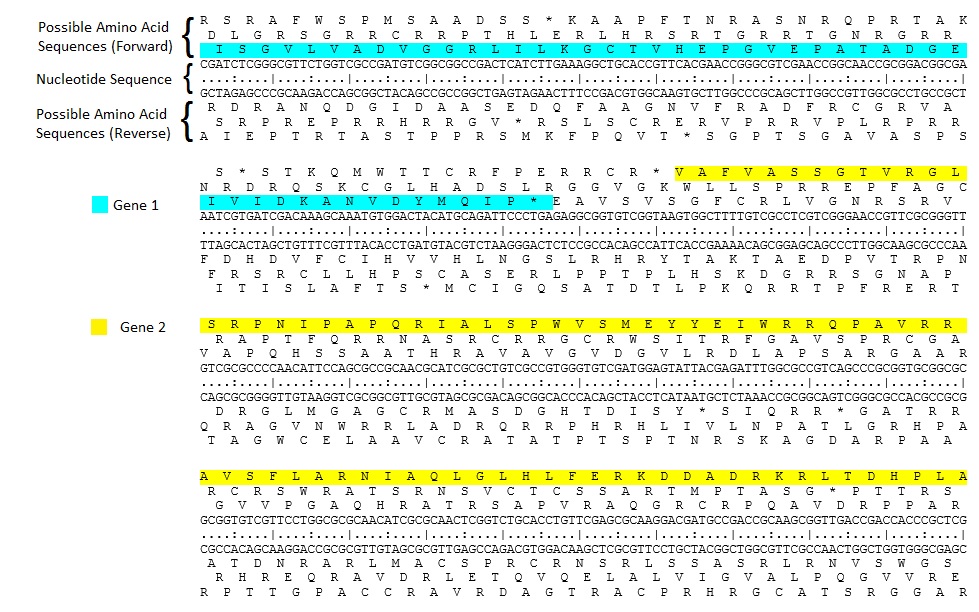
AGG·TGA·CAC·CGC·AAG·CCT·TAT·ATT·AGC A**·GGT·GAC·ACC·GCA·AGC·CTT·ATA·TTA**·GC AG**·GTG·ACA·CCG·CAA·GCC·TTA·TAT·TAG·**C]] In molecular biology, a reading frame is a specific choice out of the possible ways to read the sequence of nucleotides in a nucleic acid (DNA or RNA) molecule as a sequence of triplets. Where these triplets equate to amino acids or stop signals during translation, they are called codons.
A single strand of a nucleic acid molecule has a phosphoryl end, called the 5′-end, and a hydroxyl or 3′-end. These define the 5′→3′ direction. There are three reading frames that can be read in this 5′→3′ direction, each beginning from a different nucleotide in a triplet. In a double stranded nucleic acid, an additional three reading frames may be read from the other, complementary strand in the 5′→3′ direction along this strand. As the two strands of a double-stranded nucleic acid molecule are antiparallel, the 5′→3′ direction on the second strand corresponds to the 3′→5′ direction along the first strand.
In general, at the most, one reading frame in a given section of a nucleic acid, is biologically relevant (open reading frame). Some viral transcripts can be translated using multiple, overlapping reading frames. There is one known example of overlapping reading frames in mammalian mitochondrial DNA: coding portions of genes for 2 subunits of ATPase overlap.
Genetic code
Main article: Genetic code}}DNA encodes protein sequence by a series of three-nucleotide [[codon]]s. Any given sequence of DNA can therefore be read in six different ways: Three reading frames in one direction (starting at different nucleotides) and three in the opposite direction. During [Transcription (biology), [transcription]], the RNA polymerase read the template DNA strand in the 3′→5′ direction, but the mRNA is formed in the 5′ to 3′ direction.{{cite book
Open reading frame
Main article: Open reading frame
An open reading frame (ORF) is a reading frame that has the potential to be transcribed into RNA and translated into protein. It requires a continuous sequence of DNA which may include a start codon, through a subsequent region which has a length that is a multiple of 3 nucleotides, to a stop codon in the same reading frame.
When a putative amino acid sequence resulting from the translation of an ORF remained unknown in mitochondrial and chloroplast genomes, the corresponding open reading frame was called an unidentified reading frame (URF). For example, the MT-ATP8 gene was first described as URF A6L when the complete human mitochondrial genome was sequenced.
Multiple reading frames

The usage of multiple reading frames leads to the possibility of overlapping genes; there may be many of these in viral, prokaryote, and mitochondrial genomes. Some viruses, e.g. hepatitis B virus and BYDV, use several overlapping genes in different reading frames.
In rare cases, a ribosome may shift from one frame to another during translation of an mRNA (translational frameshift). This causes the first part of the mRNA to be translated in one reading frame, and the latter part to be translated in a different reading frame. This is distinct from a frameshift mutation, as the nucleotide sequence (DNA or RNA) is not altered—only the frame in which it is read.
References
References
- "Quantitative sequence and open reading frame analysis based on codon bias". Systemics, Cybernetics and Informatics.
- (April 1999). "CRITICA: Coding Region Identification Tool Invoking Comparative Analysis". Mol Biol Evol.
- Lodish. (2007). "Molecular Cell Biology". W. H. Freeman.
- Benjamin C. Pierce. (2012). "Genetics: a conceptual approach". [[W. H. Freeman]].
- (April 1981). "Sequence and organization of the human mitochondrial genome". Nature.
- (2004). "Properties of overlapping genes are conserved across microbial genomes". Genome Res.
This article was imported from Wikipedia and is available under the Creative Commons Attribution-ShareAlike 4.0 License. Content has been adapted to SurfDoc format. Original contributors can be found on the article history page.
Ask Mako anything about Reading frame — get instant answers, deeper analysis, and related topics.
Research with MakoFree with your Surf account
Create a free account to save articles, ask Mako questions, and organize your research.
Sign up freeThis content may have been generated or modified by AI. CloudSurf Software LLC is not responsible for the accuracy, completeness, or reliability of AI-generated content. Always verify important information from primary sources.
Report