From Surf Wiki (app.surf) — the open knowledge base
Rankin Inlet
| Field | Value |
|---|---|
| official_name | Rankin Inlet |
| native_name | Kangiqiniq |
| iu | |
| image_skyline | Rankin Inlet From Air.jpg |
| image_caption | Rankin Inlet from the air |
| pushpin_map | Canada Nunavut#Canada |
| subdivision_type | Country |
| subdivision_name | Canada |
| subdivision_type1 | Territory |
| subdivision_name1 | Nunavut |
| subdivision_type3 | Region |
| subdivision_name3 | Kivalliq |
| subdivision_type4 | Electoral districts |
| subdivision_name4 | Rankin Inlet North-Chesterfield Inlet |
| Rankin Inlet South | |
| government_footnotes | |
| government_type | Hamlet Council |
| leader_title | Mayor |
| leader_name | Harry Towtongie |
| leader_title1 | MLAs |
| leader_name1 | Alexander Sammurtok |
| Annie Tattuinee | |
| area_footnotes | (2021) |
| area_total_km2 | 20.03 |
| area_blank1_title | Population centre |
| area_blank1_km2 | 2.86 |
| population_as_of | 2021 |
| population_footnotes | |
| population_total | 2,975 |
| population_density_km2 | 148.5 |
| population_blank1_title | Population centre |
| population_blank1 | 2,698 |
| population_density_blank1_km2 | 942.6 |
| timezone | CST |
| utc_offset | −06:00 |
| timezone_DST | CDT |
| utc_offset_DST | −05:00 |
| coordinates | |
| elevation_footnotes | |
| elevation_m | 28 |
| postal_code_type | Canadian Postal code |
| postal_code | X0C 0G0 |
| area_code | 867 |
| blank_name | Telephone Exchange |
| blank_info | 645 |
| blank1_name | GNBC Code |
| blank1_info | OANSI |
| blank2_name | NTS Map |
| blank2_info | |
| blank3_name | Waterway |
| blank3_info | Hudson Bay |
| website | www.rankininlet.net |
iu Rankin Inlet South Annie Tattuinee
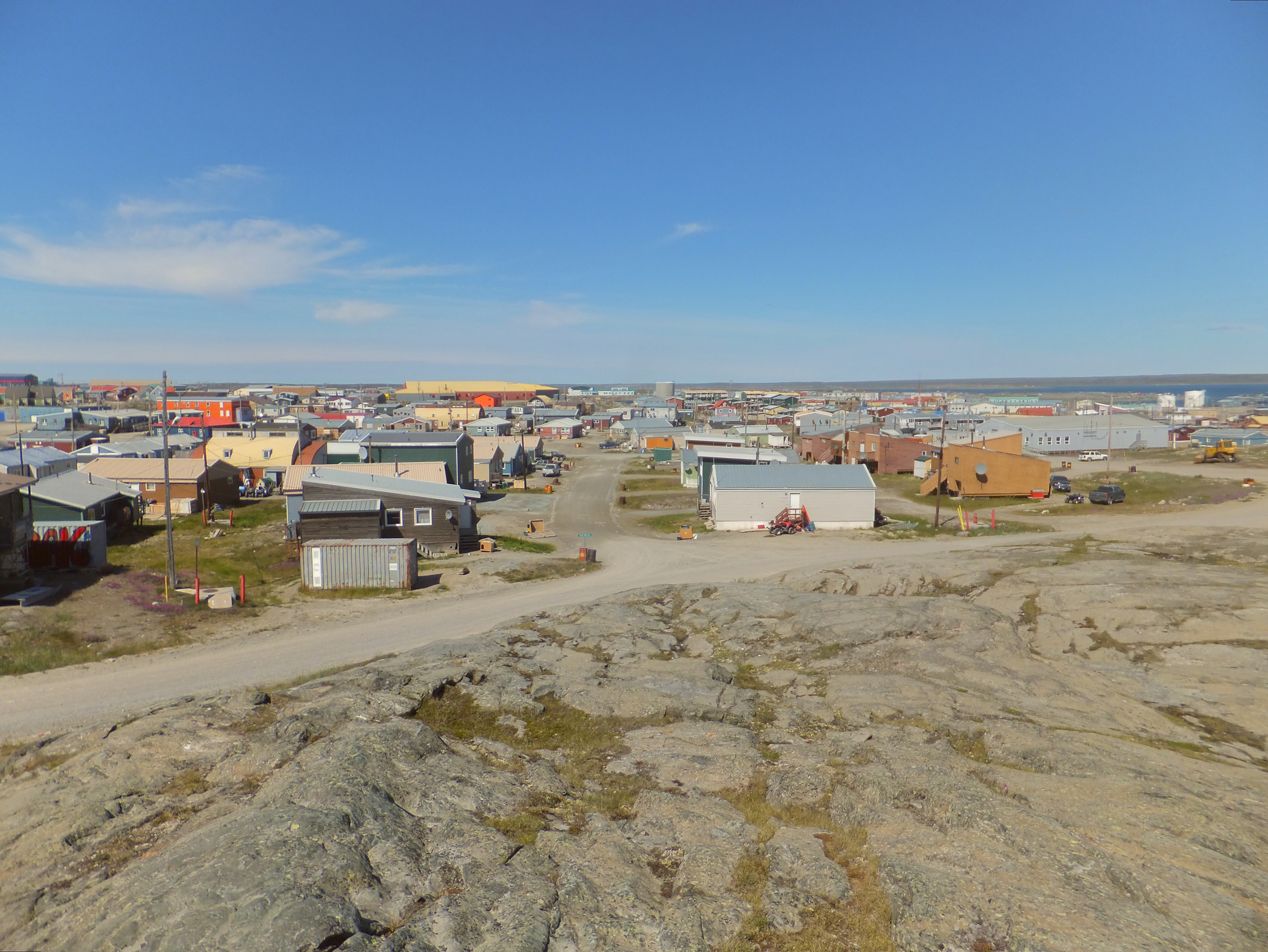
Rankin Inlet, which fronts to Hudson Bay, is an Inuit hamlet on the Kudlulik Peninsula in Nunavut, Canada. It is the largest hamlet and second-largest settlement in Nunavut after the territorial capital, Iqaluit. Rankin Inlet is the regional centre for the Kivalliq Region. It is also the largest settlement in mainland Nunavut.
In the 1995 Nunavut capital plebiscite, voters chose Iqaluit over Rankin Inlet to become the territorial capital of Nunavut.
Inuktitut
Rankin Inlet is also known in Inuktitut as ; Inuktitut syllabics: ᑲᖏᕿᓂᖅ or Kangirliniq, ᑲᖏᖅᖠᓂᖅ, or Kangir&iniq meaning deep bay/inlet.
History
Archaeological sites suggest the area was inhabited around 1200 CE by Thule people who were bowhead whale hunters. By the late 18th century, they were succeeded by Kivallirmiut (Caribou Inuit) who hunted the inland barren-ground caribou, and fished for Arctic char along the coast, as well as the Diane River and Meliadine River. The Hudson's Bay Company (HBC) established itself throughout the bay in the 17th century, and after 1717, sloops from Churchill, Manitoba traded north to Rankin Inlet and beyond. There was an unfortunate expedition shipwrecked on Marble Island, 32 km east of Rankin Inlet: James Knight's expedition died on the island around 1722. It was surveyed by William Moor in 1747. HBC contact was followed in the mid-19th century by American and European whalers, who were followed by fur traders trapping Arctic foxes for their skins in the early 20th century, followed by missionaries who brought a written language system.
The town itself was founded by the owners of the Rankin Inlet Mine, just north of Johnston Cove. Starting in 1957, the mine produced nickel and copper ores from an underground operation. The mine was the first case of Inuit miners in Canada. When the mine closed in 1962, Rankin Inlet had a population of approximately 500 Inuit, and 70-80% had been mine workers. Several unsuccessful attempts followed to develop alternate sources of income for the town. These included a pig ranch in 1969 and a chicken-raising venture in the 1970s. Both animal groups were fed a diet of local fish, which gave the meat an unpleasant flavour. It was also common for the animals to freeze to death or be eaten by polar bears.
The Meliadine Gold Mine operated by Agnico Eagle opened in 2019 and is expected to produce until at least 2032. It is the second mine opened in the low Arctic, after the Meadowbank Gold Mine, and is both an underground and open-pit mine.
From 1985 to 1997, Kivalliq Hall operated as a boarding school for Inuit pupils; it had been recognized as a residential school for the pre-1995 period when it was operated by the Federal government.
Voters chose Iqaluit over Rankin Inlet to become the new territorial capital of Nunavut in the 1995 Nunavut capital plebiscite.
Demographics
|1971|566 |1976|852 |1981|1109 |1986|1374 |1991|1706 |1996|2058 |2001|2177 |2006|2358 |2011|2557 |2016|2842 |2021|2975

In the 2021 Canadian census conducted by Statistics Canada, Rankin Inlet had a population of 2,975 living in 826 of its 1,026 total private dwellings, a change of from its 2016 population of 2,842. With a land area of 20.03 km2, it had a population density of in 2021.
| Panethnic group | 2021 | 2016 | 2011 | 2006 | 2001 | Pop. | % | Pop. | % | Pop. | % | Pop. | % | Pop. | % | Total responses | 2,930 | 2,775 | 2,245 | 2,340 | 2,165 | Total population | 2,975 | 2,842 | 2,577 | 2,358 | 2,177 |
|---|---|---|---|---|---|---|---|---|---|---|---|---|---|---|---|---|---|---|---|---|---|---|---|---|---|---|---|
| Indigenous | 2,525 | 2,320 | 1,835 | 1,955 | 1,720 | ||||||||||||||||||||||
| European | 275 | 345 | 310 | 325 | 405 | ||||||||||||||||||||||
| Southeast Asian | 55 | 60 | 65 | 25 | 20 | ||||||||||||||||||||||
| African | 35 | 20 | 20 | 20 | 10 | ||||||||||||||||||||||
| South Asian | 30 | 20 | 20 | 0 | 10 | ||||||||||||||||||||||
| East Asian | 0 | 0 | 0 | 10 | 10 | ||||||||||||||||||||||
| Middle Eastern | 0 | 0 | 0 | 10 | 0 | ||||||||||||||||||||||
| Latin American | 0 | 0 | 0 | 0 | 0 | ||||||||||||||||||||||
| Other/multiracial | 10 | 0 | 10 | 0 | 0 | ||||||||||||||||||||||
| Note: Totals greater than 100% due to multiple origin responses |
Arts and culture
Rankin Inlet houses the only Inuit fine-arts ceramics production facility in the world. Community artists work in a variety of media including ceramics, prints, bronze castings, carvings, watercolour and drawing. The Matchbox Gallery, founded in 1987, showcases art work and provides educational resources.
The community is served by Kivalliq News, a weekly newspaper which publishes in both English and Inuktitut.
The annual spring festival Pakallak Tyme includes a fishing competition and snowmobile races.
Transportation
Due to the remoteness of the community and the fact that there is no all-season road to access the community, the primary mode of year-round transportation into and out of the community is by airplane. Two passenger airlines fly into the hamlet: Calm Air and Canadian North.
Calm Air flies direct to Winnipeg, with round-trip service twice daily on weekdays. Rankin Inlet serves as a hub for transit further into the Kivalliq region. Destinations from Rankin Inlet include Arviat, Baker Lake, Chesterfield Inlet, Coral Harbour, Naujaat, and Whale Cove.
Canadian North also serves the community, with service to Edmonton, Yellowknife, Iqaluit, and Montreal, on a milk-run that flies very infrequently.
The community is also serviced by sealifts originating from Montreal.
Broadband communications
The community has been served by the Qiniq network since 2005. Qiniq is a fixed wireless service to homes and businesses, connecting to the outside world via a satellite backbone. The Qiniq network is designed and operated by SSi Canada. In 2017, the network was upgraded to 4G LTE technology, and 2G-GSM for mobile voice.
Geography
Rankin Inlet is notable for the chilling wind, severe winter storms, and water resources. The Diana River empties from the north into the hamlet's namesake inlet. The Kivalliq Region has several lakes, the largest being Nipissa Lake, and is flanked by two bays, Melvin Bay on the west and Prairie Bay on the east. Paniqtoq Peninsula, on the inlet's far western shore, provides a barrier shelter for the smaller Kivalliq Region. Dozens of islands dot the inlet, including Thomson Island, the largest, and the Barrier Islands, the longest chain. These natural resources attract tourists who hunt, fish, and canoe. The Iqalugaarjuup Nunanga Territorial Park, 10 km northwest of Rankin Inlet, is notable for hiking, fishing, bird watching and Thule archaeological sites.

Climate
Rankin Inlet has a subarctic climate (Köppen: Dfc; Trewartha: Ecld), just short of a tundra climate. It is above the tree line. Temperatures stay below freezing from late September to early June. Although the climate is subarctic, temperatures rise and fall too rapidly and do not stay above 10 C for long enough (30 days) for trees to grow. Under the alternate formula for determining the boundary between Arctic and subarctic climates posited by Otto Nordenskjöld, however, Rankin Inlet, along with Arviat and Baker Lake, qualify as Arctic based on the relationship between the temperatures of the coldest and warmest months; in the case of Rankin Inlet, with a coldest-month (January) mean of -30.1 C, said boundary for the warmest month would be 12.0 C using the Nordenskjöld formula and Rankin Inlet's warmest month (July) averages only 10.9 C.
Beginning on 16 January 2008, Rankin Inlet endured the longest recorded blizzard in Canada. Wind speed was 74 km/h or above, with gusts to 90 km/h, and wind chill values were as low as −58 C. This blizzard lasted 7 days 5 hours.
Notable people
.jpg)
- Jack Anawak, federal and territorial level Inuk politician
- Levinia Brown, territorial level Inuk politician
- Tagak Curley, Inuk politician and a prominent figure in the negotiations that led to the creation of Nunavut
- Piita Irniq, Inuk politician and commissioner of Nunavut
- Peter Ittinuar, first federal level Inuk politician
- Victoria Kakuktinniq, Inuk fashion designer
- Jose Kusugak, Inuk politician, president of Inuit Tapiriit Kanatami and Nunavut Tunngavik Incorporated, married to Nellie Kusugak
- Lorne Kusugak, territorial level Inuk politician
- Michael Kusugak, Inuk storyteller and children's writer
- Nellie Kusugak, Inuk educator and commissioner of Nunavut, married to Jose Kusugak
- Manitok Thompson, territorial level Inuk politician
- John Tiktak, Inuk sculptor
- Hunter Tootoo, former Minister of Fisheries, Oceans and the Canadian Coast Guard
- Jordin Tootoo, former National Hockey League player
Notes
References
References
- "Municipal Election Results 2019-2020". Elections Nunavut.
- "2021 General Election". Elections Nunavut.
- (6 December 2022). "Census Profile, 2021 Census Rankin Inlet Nunavut [Population centre]". Statistics Canada.
- {{Cite cgndb. OANSI. Rankin Inlet
- Elevation at airport. {{CFS
- OAJJB. Kudlulik Peninsula
- (February 9, 2022). "Population and dwelling counts: Canada, provinces and territories, and census subdivisions (municipalities), Nunavut". Statistics Canada.
- "Rankin Inlet".
- "Rankin Inlet".
- [https://web.archive.org/web/20120425151935/http://data.nwtresearch.com/nunavut/ Research Database]
- "Harvest Estimates".
- [https://web.archive.org/web/20140826115203/http://www.nunatsiaqonline.ca/stories/article/language_watchdog_needed_in_nunavut/ 'Language watchdog needed in Nunavut]
- "Notre Dame Du Cap". arcicomi.ca.
- "Pulaarvik Kablu Friendship Centre". pulaarvik.ca.
- "History of the Development of Agriculture in the N.W.T.".
- "The Meliadine mine in the Kivalliq District of Nunavut is Agnico Eagle's second mine in Canada's Low Arctic, opening nine years after the Meadowbank mine.".
- Pucci, Michelle. (31 July 2018). "Kivalliq Hall qualifies for residential school settlements, Nunavut appeals court rules". CBC News.
- (20 December 2016). "Nunavut judge recognizes Kivalliq Hall as a residential school".
- (7 June 2002). "Decentralize or else".
- Armstrong, Brian. "The Election of Nunavut’s First Legislative Assembly".
- (May 1992). "1981 Census of Canada: Census subdivisions in decreasing population order". Statistics Canada.
- (September 1987). "1986 Census: Population - Census Divisions and Census Subdivisions". Statistics Canada.
- (April 1992). "91 Census: Census Divisions and Census Subdivisions - Population and Dwelling Counts". Statistics Canada.
- (April 1997). "96 Census: A National Overview - Population and Dwelling Counts". Statistics Canada.
- (15 August 2012). "Population and Dwelling Counts, for Canada, Provinces and Territories, and Census Subdivisions (Municipalities), 2001 and 1996 Censuses - 100% Data (Nunavut)". Statistics Canada.
- (20 August 2021). "Population and dwelling counts, for Canada, provinces and territories, and census subdivisions (municipalities), 2006 and 2001 censuses - 100% data (Nunavut)". Statistics Canada.
- (25 July 2021). "Population and dwelling counts, for Canada, provinces and territories, and census subdivisions (municipalities), 2011 and 2006 censuses (Nunavut)". Statistics Canada.
- (8 February 2017). "Population and dwelling counts, for Canada, provinces and territories, and census subdivisions (municipalities), 2016 and 2011 censuses – 100% data (Nunavut)". Statistics Canada.
- (9 February 2022). "Population and dwelling counts: Canada, provinces and territories, and census subdivisions (municipalities), Nunavut". Statistics Canada.
- Government of Canada, Statistics Canada. (2022-10-26). "Census Profile, 2021 Census of Population".
- Government of Canada, Statistics Canada. (2021-10-27). "Census Profile, 2016 Census".
- Government of Canada, Statistics Canada. (2015-11-27). "NHS Profile".
- Government of Canada, Statistics Canada. (2019-08-20). "2006 Community Profiles".
- Government of Canada, Statistics Canada. (2019-07-02). "2001 Community Profiles".
- [http://matchboxgallery.com/about.htm Rankin Inlet art and artists] {{webarchive. link. (22 October 2007)
- Rogers, Sarah. (5 December 2020). "CBC to air comedy series episode filmed in Nunavut". Nortext Publishing.
- "Flight Schedules {{!}} Calm Air International LP".
- "Flight Schedule".
- "Landmarks". worldviewtravel.com.
- "Iqalugaarjuup Nunanga Territorial Park.". Nunavut Parks.
- (29 October 2020). "Blizzard Table 2. Alerting parameters Environment Canada uses for issuing a Blizzard Warning".
- (Oct–Nov 2008). "Home of the blizzard". [[Up Here (magazine).
This article was imported from Wikipedia and is available under the Creative Commons Attribution-ShareAlike 4.0 License. Content has been adapted to SurfDoc format. Original contributors can be found on the article history page.
Ask Mako anything about Rankin Inlet — get instant answers, deeper analysis, and related topics.
Research with MakoFree with your Surf account
Create a free account to save articles, ask Mako questions, and organize your research.
Sign up freeThis content may have been generated or modified by AI. CloudSurf Software LLC is not responsible for the accuracy, completeness, or reliability of AI-generated content. Always verify important information from primary sources.
Report