From Surf Wiki (app.surf) — the open knowledge base
Rail transport in Italy
none

none
| Field | Value |
|---|---|
| name | Italy |
| image | Frecciarossa_and_E.444R_at_Milano_Centrale.jpg |
| image_width | 350px |
| caption | A *frecciarossa* high-speed train next to an older E.444R at Milano Centrale |
| nationalrailway | Ferrovie dello Stato |
| majoroperators | Trenitalia (national) |
| .italo (national) | |
| Trenord (local) | |
| EAV (local) | |
| Trenitalia Tper (local) | |
| Ferrovie del Sud Est (local) | |
| Thello (international) | |
| Mercitalia (freight) | |
| ridership | 883.3 million (2019) |
| length | 16832 km |
| doublelength | 7734 km |
| gauge | |
| el1 | 3 kV DC |
| el1length | conventional lines |
| el2 | 25 kV AC |
| el2length | high-speed lines |
.italo (national) Trenord (local) EAV (local) Trenitalia Tper (local) Ferrovie del Sud Est (local) Thello (international) Mercitalia (freight) |}} The Italian railway system is one of the most important parts of the infrastructure of Italy, with a total length of 24567 km of which active lines are 16832 km.
The network
RFI (Rete Ferroviaria Italiana, Italian Rail Network), a state owned infrastructure manager which administers most of the Italian rail infrastructure. The Italian railway system has a length of 19394 km, of which 18071 km standard gauge. The active lines are 16723 km,
Lines are divided into 3 categories:
- fundamental lines (fondamentali), which have high traffic and good infrastructure quality, comprise all the main lines between major cities throughout the country. Fundamental lines are 6460 km long;
- complementary lines (complementari), which have less traffic and are responsible for connecting medium or small regional centres. Most of these lines are single track and some are not electrified;
- node lines (di nodo), which link complementary and fundamental lines near metropolitan areas for a total 950 km.
Most of the Italian network is electrified (11921 km). The electric system is 3 kV DC on conventional lines and 25 kV AC on high-speed lines.
A major part of the Italian rail network is managed and operated by RFI (Rete Ferroviaria Italiana, Italian Rail Network). Other regional agencies, mostly owned by public entities such as regional governments, operate on the Italian network.
Travellers who often make use of the railway during their stay in Italy might use rail passes, such as the European Interrail / Eurail passes or Italy's national and regional passes. These rail passes allow travellers the freedom to use regional trains during the validity period, but all high-speed and intercity trains require up to a 15-euro reservation fee. Regional passes, such as "Io viaggio ovunque Lombardia", offer one-day, multiple-day and monthly periods of validity. There are also saver passes for adults, who travel as a group, with savings up to 20%. Foreign travellers should purchase these passes in advance so that the passes can be delivered by post prior to the trip. When using the rail passes, the date of travel needs to be filled in before boarding the trains.
Companies certified to run railways in Italy are:
;From 2000
- Ferrovie dello Stato S.p. A.
- Trenitalia S.p. A.
;From 2001
- Metronapoli S.p. A.
- Ferrovie Nord Milano Esercizio S.p. A.
- Rail Traction Company S.p. A.
;From 2002
- Del Fungo Giera Servizi Ferroviari S.p. A.
- Gruppo Torinese Trasporti S.p. A.(ex SATTI)
- SERFER Servizi Ferroviari S.r.l.
- Hupac S.p. A.
;From 2003
- Ferrovie Emilia Romagna S.r.l.
- La Ferroviaria Italiana S.p. A.
- Cargo Nord S.r.l.
- Ferrovie Adriatico Sangritana S.r.l.
- Sistemi Territoriali S.p. A.
- Strade Ferrate del Mediterraneo S.r.l.
- Swiss Rail Cargo Italy S.r.l.
;From 2004
- SBB Cargo Italia S.r.l.
- Ferrovie Nord Cargo S.r.l.
- Azienda Consorziale Trasporti di Reggio Emilia
- Ferrovia Alifana e Benevento Napoli S.r.l.
- Ferrovie Nord Milano Trasporti S.r.l.
;From 2005
- Trasporto Ferroviario Toscano S.p. A. (La Ferroviaria Italiana S.p. A.)
- Ferrovie Centrali Umbre S.r.l.
- Railion Italia S.r.l. (ex S.F.M.)
- Rail One S.p. A.
- Azienda Trasporti Collettivi e Mobilità S.p. A.
- A.T.C. Bologna S.p. A.
- Monferail S.r.l.
;From 2006
- SAD - Trasporto Locale S.p.A.
- Nord Cargo S.r.l. (ex Ferrovie Nord Cargo S.r.l.)
- Arenaways S.p.A.
History
Main article: History of rail transport in Italy


The first line to be built on the peninsula was the Naples–Portici line, in the Kingdom of the Two Sicilies, which was 7.64 km long and was inaugurated on 3 October 1839, nine years after the world's first "modern" inter-city railway, the Liverpool and Manchester Railway. The following year the firm Holzhammer of Bolzano was granted the "Imperial-Royal privilege" to build the Milano–Monza line (12 km), the second railway built in Italy, in the then Kingdom of Lombardy–Venetia, a part of the Austrian Empire.
After the creation of the Kingdom of Italy in 1861, a project was started to build a network from the Alps to Sicily, in order to connect the country. After unification, construction of new lines was boosted: in 1875, with the completion of the section Orte-Orvieto, the direct Florence–Rome line was completed, reducing the travel time of the former route passing through Foligno-Terontola. Private companies were definitively bought back by the Italian state on 1 July 1905, with the creation of the Ferrovie dello Stato (State Railways), or FFSS, with a total of 10,557 km of lines, of which it already owned 9686 km. The move was completed the following year with the acquisition of the remaining SFM network: by then FFSS possessed 13,075 km of lines, of which 1917 km with double tracks.
The period from 1922 to 1939 was heavy with important construction and modernisation programmes for the Italian railways, which also incorporated 400 km from the Ferrovie Reali Sarde of Sardinia. The most important programme was that of the Rome–Naples and Bologna–Florence direttissimas ("very direct lines"): the first reduced the travel time from the two cities by an hour and a half; the second, announced proudly as "constructing Fascism", included the second longest tunnel in the world at the time, under the Apennines. Electrification on 3,000 V direct current was introduced, which later supplanted the existing three-phase system. Other improvements included automatic blocks, light signals, construction of numerous main stations (Milan Central, Napoli Mergellina, Roma Ostiense and others) and other technical modernisations. The first high-speed train was the Italian ETR 200, which in July 1939 went from Milan to Florence at 165 km/h, with a top speed of 203 km/h. With this service, the railway was able to compete with the upcoming aeroplanes. The Second World War stopped these services.
After World War II, Italy started to repair the damaged railways and built nearly 20000 km of new tracks. Entire lines were out of action and much of the rolling stock was destroyed. Thanks to the Marshall Plan, in the following years they could be rebuilt, although the possibility of reorganizing the network was missed due to short-sighted policies. The main Battipaglia-Reggio Calabria line (running along the west coast) was doubled, while a program of updating of infrastructures, superstructures, services, colour-light signalling and cars was updated or extended. The three-phase lines were gradually turned into standard 3,000 V dc lines.
Increasing numbers of steam locomotives were replaced by electric or diesel ones; in the 1960s also the first unified passenger cars appeared and the first attempts of interoperability with foreign companies were started, culminating in the creation of Trans Europe Express services. Nowadays the rail tracks and infrastructure are managed by Rete Ferroviaria Italiana (RFI), while the train and the passenger section is managed mostly by Trenitalia. Both are Ferrovie dello Stato (FS) subsidiaries, once the only train operator in Italy.
High-speed rail
Main article: High-speed rail in Italy


.JPG)
The Italian high-speed service began in 1938 with an electric-multiple-unit ETR 200, designed for 200 km/h, between Bologna and Naples. It too reached 160 km/h in commercial service, and achieved a world mean speed record of 203 km/h between Florence and Milan in 1938.
High-speed trains were developed during the 1960s. E444 locomotives were the first standard locomotives capable of top speed of 200 km/h, while an ALe 601 electrical multiple unit (EMU) reached a speed of 240 km/h during a test. Other EMUs, such as the ETR 220, ETR 250 and ETR 300, were also updated for speeds up to 200 km/h. The braking systems of cars were updated to match the increased travelling speeds.
On 25 June 1970, work was started on the Rome–Florence Direttissima, the first high-speed line in Italy and in Europe. It included the 5,375 m bridge on the Paglia river, then the longest in Europe. Works were completed in the early 1990s.
In 1975, a program for a widespread updating of the rolling stock was launched. However, as it was decided to put more emphasis on local traffic, this caused a shifting of resources from the ongoing high-speed projects, with their subsequent slowing or, in some cases, total abandonment. Therefore, 160 E.656 electric and 35 D.345 locomotives for short-medium range traffic were acquired, together with 80 EMUs of the ALe 801/940 class, 120 ALn 668 diesel railcars. Some 1,000 much-needed passenger and 7,000 freight cars were also ordered.
In the 1990s, work started on the Treno Alta Velocità (TAV) project, which involved building a new high-speed network on the routes Milan – (Bologna–Florence–Rome–Naples) – Salerno, Turin – (Milan–Verona–Venice) – Trieste and Milan–Genoa. Most of the planned lines have already been opened, while international links with France, Switzerland, Austria and Slovenia are underway.
Most of the Rome–Naples line opened in December 2005, the Turin–Milan line partially opened in February 2006 and the Milan–Bologna line opened in December 2008. The remaining sections of the Rome–Naples and the Turin–Milan lines and the Bologna–Florence line were completed in December 2009. All these lines are designed for speeds up to 300 km/h. Since then, it is possible to travel from Turin to Salerno (ca. 950 km) in less than 5 hours. More than 100 trains per day are operated.
Other proposed high-speed lines are Salerno-Reggio Calabria (connected to Sicily with the future bridge over the Strait of Messina), Palermo-Catania and Naples–Bari.
The main public operator of high-speed trains (alta velocità AV, formerly Eurostar Italia) is Trenitalia, part of FSI. Trains are divided into three categories (called "Le Frecce"): Frecciarossa ("Red arrow") trains operate at a maximum of 300 km/h on dedicated high-speed tracks; Frecciargento (Silver arrow) trains operate at a maximum of 250 km/h on both high-speed and mainline tracks; Frecciabianca (White arrow) trains operate at a maximum of 200 km/h on mainline tracks only.
Since 2012, a new and Italy's first private train operator, NTV (branded as Italo), run high-speed services in competition with Trenitalia. Even nowadays, Italy is the only country in Europe with a private high-speed train operator.
Construction of the Milan-Venice high-speed line began in 2013 and in December 2016 the Milan-Treviglio-Brescia section has been opened to passenger traffic; the Milan-Genoa high-speed line (Terzo Valico dei Giovi) is also under construction.
Today it is possible to travel from Rome to Milan in less than 3 hours (2h 55' without intermediate stops) with the Frecciarossa 1000, the new high-speed train. As of June 2024, there are 46 Trenitalia and 33 Italo round-trip high-speed trains every weekday that cover this route,
Night trains
Main article: Nightjet
The Nightjet of the Austrian Federal Railways (ÖBB) serves different major cities in Italy like Rome, Venice, Florence and Milano. The trains can be used for rides inside Italy as well as for journeys abroad.
Nightjet trains offer beds in sleeper carriages (Nightjet's most comfortable service category), couchette carriages, and seated carriages. On certain connections, cars can also be transported on the train. Bikes can be transported in a bike transport bag, or on some connections also in special bike racks.
Trenitalia operates many night trains within Italy, under the brand Intercity Notte. Routes include connections between the Northern Italian cities of Turin, Milan, and Trieste, to Rome and further to Southern Italian cities such as Lecce or Palermo and Syracuse in Sicily. The trains offer standard seats as well as modern couchettes and sleeping compartments.
Intercity trains
Main article: Inter-city rail, InterCity

_in_2023.01.jpg)
With the introduction of high-speed trains, intercity trains are limited to a few services per day on mainline and regional tracks.
The daytime services (InterCity IC), while not frequent and limited to one or two trains per route, are essential in providing access to cities and towns off the railway's mainline network. The main routes are Trieste to Rome (stopping at Venice, Bologna, Prato, Florence and Arezzo), Milan to Rome (stopping at Genoa, La Spezia, Pisa and Livorno / stopping at Parma, Modena, Bologna, Prato, Florence and Arezzo), Bologna to Lecce (stopping at Rimini, Ancona, Pescara, Bari and Brindisi) and Rome to Reggio di Calabria (stopping at Latina and Naples). In addition, the Intercity trains provide a more economical means of long-distance rail travel within Italy.
The night trains (Intercity Notte ICN) have sleeper compartments and washrooms, but no showers on board. The main routes are Rome to Bolzano/Bozen (calling at Florence, Bologna, Verona, Rovereto and Trento), Milan to Lecce (calling at Piacenza, Parma, Reggio Emilia, Modena, Bologna, Faenza, Forlì, Cesena, Rimini, Ancona, Pescara, Bari and Brindisi), Turin to Lecce (calling at Alessandria, Voghera, Piacenza, Parma, Bologna, Rimini, Pescara, Termoli, San Severo, Foggia, Barletta, Bisceglie, Molfetta, Bari, Monopoli, Fasano, Ostuni and Brindisi) and Reggio di Calabria to Turin (calling at Naples, Rome, Livorno, La Spezia and Genova). Most portions of these ICN services run during the night; since most services take 10 to 15 hours to complete a one-way journey, their daytime portion provides extra train connections to complement the Intercity services.
Regional trains
Trenitalia operates regional services (both fast veloce RV and stopping REG) throughout Italy.
Regional train agencies exist: their train schedules are largely connected to and shown on Trenitalia, and tickets for such train services can be purchased through Trenitalia's national network. Other regional agencies have separate ticket systems which are not mutually exchangeable with that of Trenitalia. These "regional" tickets could be purchased at local newsagents or tobacco stores instead.
- Campania: Ente Autonomo Volturno (EAV) operates most regional and metropolitan rail services in Campania. EAV runs the Naples metropolitan railway service, including the Circumvesuviana lines (connecting Naples with Vesuvio-area towns such as Pompei, Ercolano, Sorrento and Sarno), the Cumana and the Circumflegrea railways. It also operates regional lines outside the metropolitan area, including the Alifana railway, the Benevento–Cancello railway.
- Trentino-Alto Adige / Trentin-Südtirol: Südtirol Bahn () runs regional services on Ala/Ahl-am-Etsch to Bolzano/Bozen (calling at Rovereto/Rofreit, Trento/Trient and Mezzocorona/Kronmetz), Bolzano/Bozen to Merano/Meran, Bressanone/Brixen to San Candido/Innichen, and a direct "Tirol regional express REX" service between Bolzano/Bozen in Italy and Innsbruck in Austria.
- Veneto: Sistemi Territoriali runs regional trains in Veneto region.
- Lombardy: Trenord runs the Malpensa Express airport train, many Milan's suburban lines and most regional train services in Lombardy. Trenord also co-operates with DB and ÖBB on the EuroCity Verona-Munich service, and with SBB CFF FFS (joint-venture TiLo) on the regional express and suburban trains between Lombardy and the towns of Canton of Ticino, such as Lugano, Locarno, Cadenazzo, Bellinzona and Mendrisio.
- Emilia-Romagna: Trasporto Passeggeri Emilia-Romagna provides vital connections across cities on different mainline networks, including Modena, Parma, Suzzara, Ferrara, Reggio Emilia and Bologna.
- Tuscany: La Ferroviaria Italiana operates in Arezzo province.
- Abruzzo: Sangritana runs daily services between Pescara and Lanciano.
In addition to these agencies, there is a great deal of other little operators, such as AMT Genova for the Genova-Casella railway.
Stations


Main article: Railway stations in Italy
Italy's top ten railway stations by annual passengers are:
| Rank | Railway Station | Annual entries/exits (millions) | Number of platforms | City | Region | |||||
|---|---|---|---|---|---|---|---|---|---|---|
| 1 | **Roma Termini** | 150 | 32 | Rome | Lazio | |||||
| 2 | **Milano Centrale** | 145 | 24 | Milan | Lombardy | |||||
| 3 | **Torino Porta Nuova** | 70 | 20 | Turin | Piedmont | |||||
| 4 | **Firenze Santa Maria Novella** | 59 | 19 | Florence | Tuscany | |||||
| 5 | **Bologna Centrale** | 58 | 28 | Bologna | Emilia-Romagna | |||||
| 6 | **Roma Tiburtina** | 51 | 20 | Rome | Lazio | |||||
| 7 | **Napoli Centrale** | 50 | 25 | Naples | Campania | |||||
| 8 | **Milano Cadorna** | 33.1 | 10 | Milan | Lombardy | |||||
| 9 | **Venezia Mestre** | url=http://www.grandistazioni.it/cms/v/index.jsp?vgnextoid=14104cb9ff09a110VgnVCM1000003f16f90aRCRD | title=Venezia Mestre - Venezia Mestre - Grandi Stazioni | access-date=12 November 2022 | archive-date=8 September 2018 | archive-url=https://web.archive.org/web/20180908164929/http://www.grandistazioni.it/cms/v/index.jsp?vgnextoid=14104cb9ff09a110VgnVCM1000003f16f90aRCRD | url-status=dead}} | 13 | Venice | Veneto |
| 10 | **Venezia Santa Lucia** | 30 | 16 | Venice | Veneto |
Rapid transit
Metro


.jpg)
Milan Metro is the largest rapid transit system in Italy in terms of length, number of stations and ridership; and the fifth longest in the European Union and the eighth in the Europe. Seven cities have metro systems:
| City | Name | Lines | Length (km) | Stations | Opening |
|---|---|---|---|---|---|
| Brescia | Brescia Metro | 1 | 13.7 | 17 | 2013 |
| Catania | Catania Metro | 1 | 8.8 | 10 | 1999 |
| Genoa | Genoa Metro | 1 | 7.1 | 8 | 1990 |
| Milan | Milan Metro | 5 | 102.5 | 119 | 1964 |
| Naples | Naples Metro | 3 | 36.4 | 31 | 1993 |
| Rome | Rome Metro | 3 | 60 | 75 | 1955 |
| Turin | Turin Metro | 1 | 15.1 | 23 | 2006 |
Commuter rail
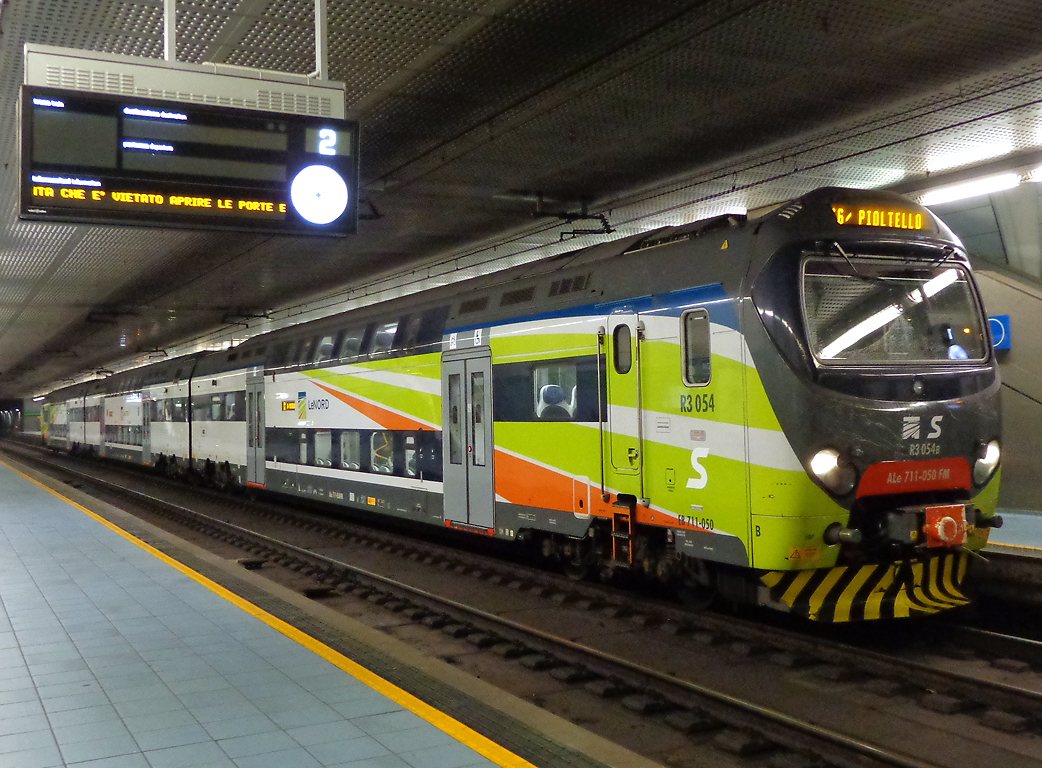
15 cities have commuter rail systems; cities without wikilink are those listed just above for their metro rail system.
- Bari (Bari metropolitan railway service, 3 lines)
- Bologna (Bologna metropolitan railway service, 8 lines)
- Cagliari, 1 line
- Catanzaro, 2 lines
- Genoa (Genoa urban railway service, 3 lines)
- Messina, 1 line
- Milan (Milan suburban railway service, 12 lines)
- Naples (Naples metropolitan railway service, 8 lines)
- Palermo (Palermo metropolitan railway service, 2 lines)
- Perugia, 1 line
- Potenza, 1 line
- Reggio Calabria, 1 line
- Rome (FL lines, 8 lines)
- Salerno (Salerno metropolitan railway service, 1 line)
- Turin (Turin metropolitan railway service, 8 lines)
Airport shuttles
Airport shuttle buses are highly developed and convenient for rail travellers. Most airports in Italy are not connected to the railway network, except for Rome Fiumicino Airport, Milan Malpensa Airport and Turin Caselle Airport. In Bologna, there is the monorail Marconi Express, connecting Bologna Airport to the main railway station. Linate Airport in Milan has been connected to line 4 of the Milan metro since 2022.
- Venice: Venezia-Mestre station - Marco Polo Airport (50 minutes) and Treviso Airport
- Milan: Milano Centrale station - Malpensa Airport (1 hour 5 minutes), Linate Airport (35 minutes) and Milan Bergamo Airport (1 hour)
- Brescia: Brescia station - Milan Bergamo Airport (1 hour)
- Rome: Rome Termini station - Fiumicino Airport (31 minutes)
- Verona: Verona Porta Nuova station - Villafranca "Catullo" Airport (20 minutes)
- Bologna: Centrale station - Bologna Airport (20 minutes) - Route modified in November 2020. It shifted from route BLQ (Bologna Centrale Station-Bologna Airport) to route 944 Ospedale Maggiore-Bologna Airport
- Pescara Centrale station - Abruzzo Airport (10 minutes)
- Pisa: Pisa Centrale station - San Giusto Airport (5 minutes)
- Florence: Firenze S M Novella station - Florence Airport
Tram

11 cities have tram system:
- Bergamo–Albino light rail
- Cagliari light rail
- Trams in Florence
- Trams in Messina
- Trams in Mestre
- Trams in Milan
- Trams in Naples
- Trams in Padua
- Trams in Palermo
- Trams in Rome
- Trams in Turin
- Trieste–Opicina tramway
Tram-train

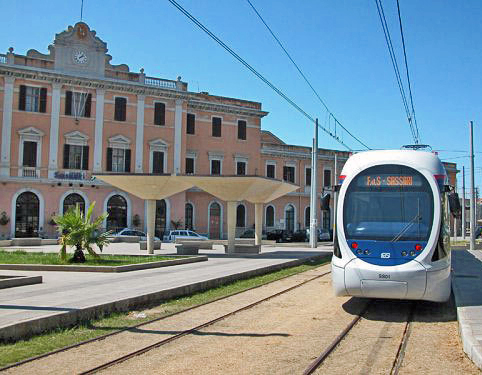
2 cities have tram-train system, Rome and Sassari. The Rome–Giardinetti railway connects Laziali (a regional train station some 800 m from Termini's main concourse) with Giardinetti to the east just past the Grande Raccordo Anulare, Rome's orbital motorway. It is run by ATAC, the company responsible for public transportation in the city, which also operates the Rome Metro. The present railway is the only part of the old and longer Rome–Fiuggi–Alatri–Frosinone railway to be in service. The latest shortening of the line occurred in 2008 with the closing of the Giardinetti–Pantano section, which has now become part of the Metro Line C. The line had been due to be dismantled in 2016 to be replaced with a bus lane along Via Casilina, but in March 2015 it was announced that the line would instead be retained and modernised.
Metrosassari, also called Sassari tramway, Sassari tram-train or Sassari metro-tramway ( or ) is the commercial name of a tram-train line in Sassari, Sardinia, Italy, operated by the regional public transport company ARST (Azienda Regionale Sarda Trasporti). Despite having been built in the early 2000s, in the urban section the line was built with single track and narrow gauge, to connect with the same gauge used in the secondary railway lines in Sardinia. The 2.45 km tramway part of the line (Stazione - Emiciclo Garibaldi) opened in October 2006, linking the railway station with the city centre via the hospital district. On 27 September 2009 the line was extended into the peripheral district of Santa Maria di Pisa, running on the electrified portion of the Sassari–Sorso railway. The main part of the network was in 2013 in the advanced development phase. It is under construction is the extension of the line from Santa Maria di Pisa to Li Punti and Baldinca, and the electrification of the railway to Sorso, 10 km from Sassari. It is also planned to convert and electrify the 28 km Sassari-Alghero railway to allow the trams to reach the village of Olmedo, Fertilia Airport and the town of Alghero.
Rail links to adjacent countries
Italy has 11 rail border crossings over the Alpine mountains with her neighbouring countries: six are designated as mainline tracks and two are metre-gauge tracks. The six mainline border crossings are: two with France (one for Nice and Marseille; the other for Lyon and Dijon), two with Switzerland (one for Brig, Bern and Geneva; the other for Chiasso, Lugano, Lucerne and Zürich), and two with Austria (one for Innsbruck; the other for Villach, Graz and Vienna). The two-metre-gauge track crossings are located at the border town of Tirano (enters Switzerland's Canton Graubünden/Grisons) and Domodossola (enters Switzerland's canton of Ticino).
There was a railway line connecting Italy's northeastern port of Trieste to Ljubljana (Slovenia) and Vienna, built when Trieste was part of the Austro-Hungarian Empire:the Austrian Southern Railway. This railway stopped operating at the end of World War II.Direct connections between Trieste and Ljubljana have resumed since September 2018.
- Italy-France: Marseille-Ventimiglia railway, usually a change of train is required in Ventimiglia (former direct Milan-Marseille services by Thello do not run anymore since 2019)
- Italy-France: Tenda line, operated by Trenitalia
- Italy-France: Fréjus Rail Tunnel at 1338 m above sea, currently SNCF TGV trains Milan-Paris via Turin, as well as Trenitalia Frecciarossa trains on the same line
- Italy-Switzerland: Simplon Tunnel, currently EuroCity (EC) trains of SBB CFF FFS Milan-Geneva and Milan-Bern
- Italy-Switzerland: Domodossola–Locarno railway line line connecting Domodossola (Italy) with Locarno (Switzerland), operated by Ferrovie Autolinee Regionali Ticinesi SA (FART)
- Italy-Switzerland: Cadenazzo–Luino railway line connecting Luino (Italy) to Bellinzona (Switzerland) and runs on the eastern coast of Lake Maggiore, operated by TILO regional trains
- Italy-Switzerland: Mendrisio–Varese railway line connecting Varese (Italy) to Mendrisio (Switzerland), operated by TILO regional trains
- Italy-Switzerland: Milan–Chiasso railway, currently EuroCity trains of SBB CFF FFS Milan-Zürich
- Italy-Switzerland: Bernina railway at 2253 m above sea, metre-gauge trains of RhB Tirano-St. Moritz and the Bernina Express tourist train
- Italy-Austria: Brenner railway at 1371 m above sea, currently EuroCity trains of ÖBB-DB Munich-Verona and Munich-Venice/Bologna, and ÖBB Nightjet Munich-Rome/Milan
- Italy-Austria: Drava Valley Railway at 1175 m above sea connecting San Candido/Innichen (Italy) and Lienz (Austria)
- Italy-Austria: Rudolf Railway connecting Venice and Udine (Italy) to Villach (Austria), currently EuroCity trains of ÖBB Venice-Vienna, Nightjet trains of ÖBB Vienna-Rome/Milan/Venice/La Spezia
- Italy-Slovenia: Tarvisio–Ljubljana Railway, Trieste-Ljubljana
- Italy-Slovenia-Croatia:Trieste-Rijeka
The Vatican City is also linked to Italy with a railway line serving a single railway station, the Vatican City railway station. This line is used only for special occasions. San Marino used to have a narrow gauge rail connection with Italy; this was dismantled in 1944.
All links have the same gauge.
- Austria Austria — voltage change 3 kV DC/15 kV AC
- France France — voltage change 3 kV DC/25 kV AC or 1.5 kV DC
- Slovenia Slovenia — same voltage
- Switzerland Switzerland — voltage change 3 kV DC/15 kV AC (plus two narrow gauge lines, same voltage)
- Vatican City Vatican City — no electrification
- San Marino San Marino — closed, narrow gauge

Stations on the border are:
- Roma San Pietro is the border station of the Rome-Vatican City railway
- Ventimiglia is the border station on the Genoa-Nice main line.
- Olivetta San Michele and Limone Piemonte on both sides of the Tenda Railway
- Modane is the border station on the Turin-Lyon main line (Fréjus Tunnel line).
- Domodossola is the border station of the Milan-Bern/Geneva main line (Simplon Tunnel line).
- Ribellasca is on the Vigezzina.
- Luino is the border station of the Oleggio–Pino railway.
- Chiasso is the border station of the Milan-Zürich main line (Gotthard Tunnel line).
- Tirano is the terminus on the Italian side of the Bernina line of the Rhätische Bahn.
- Brenner is the border station of the Verona-Innsbruck main line (Brenner railway).
- San Candido is the border station of the Fortezza-Lienz secondary line.
- Tarvisio Boscoverde is the border station of the Venezia-Wien main line (Austrian Southern Railway line).
- Gorizia Centrale station serves as link to the Slovenian Railways, through the station of Nova Gorica, which can be entered also directly by pedestrians from the Italian side.
- Villa Opicina (Villa Opicina, Trieste) serves as link to the Slovenian Railways, through the stations of Sežana and Repentabor.
Heritage railways
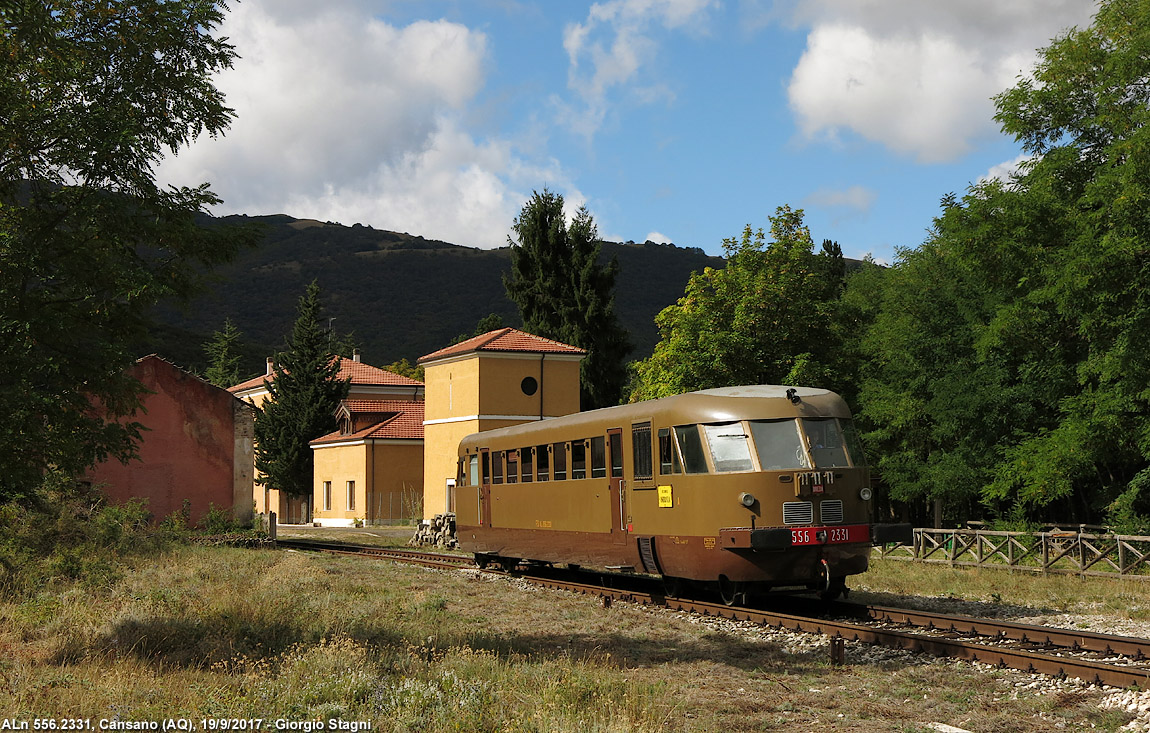
In Italy, the heritage railways institute is recognized and protected by law no. 128 of 9 August 2017, which has as its objective the protection and valorisation of disused, suspended or abolished railway lines, of particular cultural, landscape and tourist value, including both railway routes and stations and the related works of art and appurtenances, on which, upon the proposal of the regions to which they belong, tourism-type traffic management is applied (art. 2, paragraph 1). At the same time, the law identified a first list of 18 tourist railways, considered to be of particular value (art. 2, paragraph 2).
The list is periodically updated by decree of the Ministry of Infrastructure and Transport, in agreement with the Ministry of Economy and Finance and the Ministry of Culture, also taking into account the reports in the State-Regions Conference, a list which in 2022 reached 26 railway lines. According to article 1, law 128/2017 has as its purpose: "the protection and valorisation of railway sections of particular cultural, landscape and tourist value, which include railway routes, stations and related works of art and appurtenances, and of the historic and tourist rolling stock authorized to travel along them, as well as the regulation of the use of ferrocycles".
Below is the list of railway lines recognized as tourist railways by Italian legislation. a) pursuant to art. 2 paragraph 2 law 128/2017:
- Sulmona-Castel di Sangro section of the
- Castel di Sangro-Carpinone section of the Sulmona-Isernia railway
- Ceva–Ormea railway
- Sassari–Tempio-Palau railway
- Castelvetrano-Porto Palo section of the
- Agrigento Bassa-Porto Empedocle section of the Castelvetrano-Porto Empedocle railway
- Asciano–Monte Antico railway
b) pursuant to the Ministerial Decree of 30 March 2022: 1. 1.
- Alba-Nizza Monferrato section of the
- Novara–Varallo railway
- Fabriano-Pergola section of the
- Malnate Olona-Swiss border section of the Valmorea railway.
The Bernina railway line is a single-track railway line forming part of the Rhaetian Railway (RhB). It links the spa resort of St. Moritz, in the canton of Graubünden, Switzerland, with the town of Tirano, in the Province of Sondrio, Italy, via the Bernina Pass. Reaching a height of 2,253 m above sea level, it is the third highest railway crossing in Europe. It also ranks as the highest adhesion railway of the continent, andwith inclines of up to 7%as one of the steepest adhesion railways in the world. The elevation difference on the section between the Bernina Pass and Tirano is 1824 m, allowing passengers to view glaciers along the line. On 7 July 2008, the Bernina line and the Albula railway line, which also forms part of the RhB, were recorded in the list of UNESCO World Heritage Sites, under the name Rhaetian Railway in the Albula / Bernina Landscapes. The whole site is a cross-border joint Swiss-Italian heritage area. Trains operating on the Bernina line include the Bernina Express.
In July 2023, Ferrovie dello Stato established a new company, the "FS Treni Turistici Italiani" (English: FS Italian Tourist Trains), with the mission "to propose an offer of railway services expressly designed and calibrated for quality, sustainable tourism and attentive to rediscovering the riches of the Italian territory. Tourism that can experience the train journey as an integral moment of the holiday, an element of quality in the overall tourist experience". There are three service areas proposed:
- Luxury trains, which includes the circulation of the "Orient Express - La Dolce Vita" from 2024, and Venice Simplon Orient Express, already operating on European routes;
- Express and historic trains, with the express trains of the 1980s and 1990s being redeveloped and modernized in the railway workshops of Rimini, while the historic trains are used for journeys that include stops with guided tours and tastings;
- Regional trains, also with trips that include experiential tourist stops, which pass through places rich in history, with villages and areas of landscape, naturalistic, food and wine and agri-food interest.
Funding
The Italian railways are partially funded by the government, receiving €8.1 billion in 2009.
Categories and types of trains
These are the major service categories and models of Italian trains. File:L'ETR.675 n. 14 alla stazione di Roma Termini.jpg |Italo operates on main High-Speed lines by NTV. Makes a few stops in the most important cities. File:ETR.600 Frecciarossa.jpg |Frecciarossa operates on High-Speed lines by Trenitalia. Makes a few stops in major cities. File:Venetië Frecciargento High Speed 11a uit Rome (10668443663).jpg|Frecciargento operates on High-Speed lines by Trenitalia. Makes some stops in big cities. File:Trenitalia Frecciabianca.jpg|Frecciabianca operates on main lines by Trenitalia. Stops in big cities. File:E.464.340 corsa prova Roma Ostiense.jpg|Intercity operates on main lines by Trenitalia. Stops in big cities. File:ETR 610 "Cisalpino due".jpg|Eurocity, formerly Cisalpino, operates on international main lines within the European Union by Trenitalia. Stops in big cities. File:FS Vivalto 20 at Venezia Santa Lucia train station.jpg|Regionale Veloce operates on regional lines in a region or in adjacent regions by Trenitalia. Stops in the main stations of the local service. File:Roma - stazione Termini - ETR.425.jpg|Regionale operates on regional lines by Trenitalia. Stops in every station of the local service. File:Trenord R3 009 2011.jpg|Regio-Express operates on regional lines by Trenord. Stops in some stations of the local service. File:Logo on Stadler BTR.813.jpg|Regionale Veloce as operates in the Aosta Valley by Trenitalia File:ETR 521 Rock con leone S. Marco 2.jpg|Regionale Veloce as operates in Veneto by Trenitalia File:Bruneck ETR155-003 20100717Y673a.jpg|Regionale as operates in Trentino-Alto Adige by SAD File:FLIRT a Venezia Mestre.jpg|Regionale as operates in some lines of Veneto by Sistemi Territoriali (ST) File:FUC ATR 110 002 Cividale stazione 20120414.JPG|Regionale as operates in Friuli-Venezia Giulia by Società Ferrovie Udine-Cividale (FUC) File:ATR220_FSE.png|Regionale as operates in Apulia by Ferrovie del Sud Est (FSE)
Main stations
File:Sezione storica della stazione centrale di Bari.jpg|Bari Centrale, Bari File:Bologna-Stazione Centrale-DSCF7236.JPG|Bologna Centrale, Bologna File:Stazione di santa maria novella vista dal convento di santa maria novella.jpg|Firenze Santa Maria Novella, Florence File:Genova Stazione Brignole Esterno 02.jpg|Genova Brignole, Genoa File:Genova Stazione di Genova Piazza Principe Esterno 01.jpg|Genova Piazza Principe, Genoa File:Milano - Piazzale Cadorna e Stazione Ferrovie Nord - panoramio.jpg|Milano Cadorna, Milan File:Front view of Milan Stazione Centrale entrance portico.jpg|Milano Centrale, Milan File:Stazione di Porta Garibaldi, Milano, ingresso viaggiatori.jpg|Milano Porta Garibaldi, Milan File:Stazione alta velocita, Zaha Hadid, Napoli Afragola.jpg|Napoli Afragola, Metropolitan City of Naples File:Napoli Centrale railway station in 2018.10.jpg|Napoli Centrale, Naples File:"Praça da Estação" de Palermo (1036620145).jpg|Palermo Centrale, Palermo File:Roma Ostiense station.jpg|Roma Ostiense, Rome File:Roma termini 01.jpg|Roma Termini, Rome File:2013-06-15 Roma Stazione FS Tiburtina.jpg|Roma Tiburtina, Rome File:Trieste Centrale (IMG 20211010 115938).jpg|Trieste Centrale, Trieste File:Porta Nuova Station Turin.jpg|Torino Porta Nuova, Turin File:Arriere-gare-torino-porta-susa.jpg|Torino Porta Susa, Turin File:Mestre train station.jpg|Venezia Mestre, Venice File:Stazione di Venezia Santa Lucia - panoramio - Mister No (1).jpg|Venezia Santa Lucia, Venice File:Stazione Verona PN.jpg|Verona Porta Nuova, Verona
References
Bibliography
References
- (8 December 2019). "Railway passenger transport statistics". Europa EU.
- (31 December 2023). "La rete oggi". RFI Rete Ferroviaria Italiana.
- Total length of tracks: double tracks are counted twice.
- (2025-03-10). "Italy’s Trenitalia best, Eurostar worst in European rail passenger rankings".
- "Il sistema di elettrificazione a 25kV c.a.". RFI Rete Ferroviaria Italiana.
- "Domestic train fees per country".
- "Rail Passes - ItaliaRail - Italy Train Ticket and Rail Pass Experts".
- "Special report: A European high-speed rail network".
- "La Dolce Vita? Italy By Rail, 1839-1914 {{!}} History Today".
- "Le ferrovie nell'Unità d'Italia. Cronologia storica 1839-1861".
- (1927). "Prospetto cronologico dei tratti di ferrovia aperti all'esercizio dal 1839 al 31 dicembre 1926". Ufficio Centrale di Statistica delle Ferrovie dello Stato.
- Gian Guido Turchi. (2006). "Strade Ferrate Meridionali: ultimo atto". Edizioni ETR.
- Cesare Columba, ''Da Firenze a Bologna bucando l'Appennino'' in, ''VdR 1839-1939: i centocinquant'anni delle ferrovie italiane'', pp. 26-28
- Cornolo Giovanni. ''Una leggenda che corre: breve storia dell'elettrotreno e dei suoi primati; ETR.200 – ETR.220 – ETR 240''. {{ISBN. 88-85068-23-5
- (2011). "1861-2011, 150°, L'unità d'Italia attraverso le ferrovie". Editoriale del Garda.
- "Ferrovie dello Stato".
- "Frecciarossa 1000 in Figures". Ferrovie dello Stato Italiane.
- "Frecciarossa 1000 Very High-Speed Train".
- "French Train Breaks Speed Record".
- (4 February 2009). "Due record in prova per il Frecciarossa". Repubblica.
- "Viaggia con i treni Frecciarossa e acquista il biglietti a prezzi scontati - Le Frecce - Trenitalia".
- "Ferrovie: Ecco il progetto della AV/AC Salerno-Reggio Calabria".
- "Alta velocità ferroviaria SA-RC, come cambiano gli scenari.".
- "Alta velocità ferroviaria Salerno-Reggio e Palermo-Catania Messina: aggiudicati lavori per altri 3,7 miliardi".
- "Alta velocità Napoli-Bari. Partiti i lavori. Sei miliardi per collegare le due città in 2 ore a 40 minuti".
- "Treno ad alta velocità Le Frecce".
- "Ferrovie.it - A 300 km/h da Milano a Brescia".
- "Trenitalia".
- "Italotreno.com".
- "Intercity Notte".
- "Roma Termini - Roma Termini - Grandi Stazioni".
- "Stazione di Milano Centrale - Info Stazione Milano Centrale - Tour Virtuale stazione {{!}} Milano Centrale".
- "Torino Porta Nuova - Torino Porta Nuova - Grandi Stazioni".
- "Firenze S. Maria Novella - Firenze S. Maria Novella - Grandi Stazioni".
- "Bologna Centrale - Bologna Centrale - Grandi Stazioni".
- "Roma Tiburtina - Roma Tiburtina - Grandi Stazioni".
- "Napoli Centrale - Napoli Centrale - Grandi Stazioni".
- Bilancio Sociale "LeNord" 2004-2005
- "Venezia Mestre - Venezia Mestre - Grandi Stazioni".
- "Effetto M4: la metro di Milano entra nella top europea".
- "Perché a San Francisco girano (anche) i tram di Milano".
- "Il Libro Giallo del Trenino".
- (25 June 2013). "Un 'carro bestiame' nel cuore della città: quale futuro per la Roma-Giardinetti?". Roma Today.
- "Metro C, apre la Pantano-Centocelle: folla di romani all'inaugurazione".
- (25 January 2015). "Trenino Roma-Giardinetti, la corsa è finita". Il Tempo.
- (19 March 2015). "La Roma Giardinetti devierà sulla Togliatti: destinazione Tor Vergata". Roma Today.
- {{in lang. it [http://arst.sardegna.it/orari_e_autolinee/servizimetross.html ARST - Metrosassari]
- {{in lang. link. (1 February 2016)
- {{in lang. it [http://www.cityrailways.it/storage/pdf/Tram_treno_vol_1_v.2.pdf Andrea Spinosa - Progetto tram-treno] {{Webarchive. link. (9 November 2011)
- {{in lang. it[http://www.psbenevento.it/Materiali/bestpum/sassari.pdf Comune di Benevento - SCHEDA n° 2 Sassari, Italia, Tram Treno]
- {{in lang. it Elena Molinaro, [http://www.asstra.it/asstrasql/bannerhp/attibologna/8-2.pdf ''Linee guida tram treno'']{{dead link. (January 2018)
- (1 January 2007). "Metros January 2007". [[Railway Gazette International]].
- {{in lang. it [http://www.lestradeferrate.it/34mono/34smariapisa.htm Lestradeferrate.it - Stazione di Santa Maria di Pisa]
- {{in lang. it ''Tram oltre Sassari''. In: ″I Treni″ Nr. 320 (November 2009), p. 8.
- "Dal 9 settembre al via i treni Trieste-Lubiana". TriestePrima.
- "Riparte dopo decenni il treno transfrontaliero Trieste-Fiume". ANSA.
- "La Ferrovia dello Stato della Città del Vaticano". Sala stampa della Santa Sede.
- "la "Ferrovia Rimini - San Marino"". ferroviedismesse.com.
- Gazzetta Ufficiale della Repubblica Italiana. "Legge 9 agosto 2017, n. 128".
- "Tratte ferroviarie ad uso turistico".
- An ordinary gauge, owned by [[Rete Ferroviaria Italiana. RFI]].
- A [[narrow gauge]], regional railway owned by {{ill. Calabria railways. it. Ferrovie della Calabria; the service is called ''{{ill. Trenino della Sila. it''.
- Subsequently extended to Isernia.
- A [[narrow gauge]], regional railway owned by [[ARST]]; the service is called ''[[Trenino Verde]]''.
- Line part of the disused narrow gauge FS network of Sicily.
- A ordinary gauge, regional railway owned by [[Ferrovienord]].
- "Gruppo FS, nasce la nuova società "FS Treni Turistici Italiani"".
- "The age of the train".
This article was imported from Wikipedia and is available under the Creative Commons Attribution-ShareAlike 4.0 License. Content has been adapted to SurfDoc format. Original contributors can be found on the article history page.
Ask Mako anything about Rail transport in Italy — get instant answers, deeper analysis, and related topics.
Research with MakoFree with your Surf account
Create a free account to save articles, ask Mako questions, and organize your research.
Sign up freeThis content may have been generated or modified by AI. CloudSurf Software LLC is not responsible for the accuracy, completeness, or reliability of AI-generated content. Always verify important information from primary sources.
Report