From Surf Wiki (app.surf) — the open knowledge base
Radio window
Region of the radio spectrum
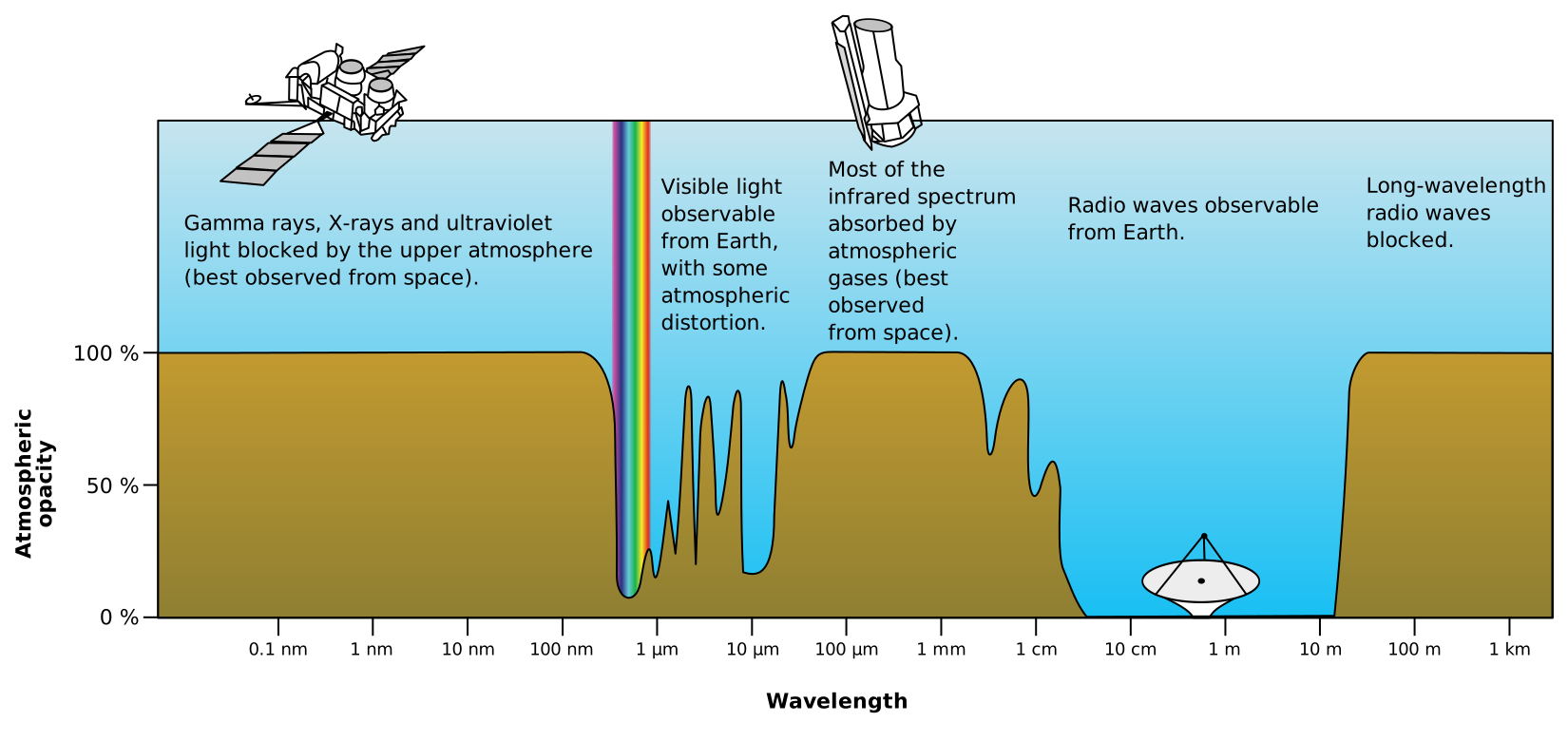
Region of the radio spectrum
The radio window is the region of the radio spectrum that penetrate the Earth's atmosphere. Typically, the lower limit of the radio window's range has a value of about 10 MHz (λ ≈ 30 m); the best upper limit achievable from optimal terrestrial observation sites is equal to approximately 1 THz (λ ≈ 0.3 mm).
It plays an important role in astronomy; up until the 1940s, astronomers could only use the visible and near infrared spectra for their measurements and observations. With the development of radio telescopes, the radio window became more and more utilizable, leading to the development of radio astronomy that provided astrophysicists with valuable observational data.
Factors affecting lower and upper limits
The lower and upper limits of the radio window's range of frequencies are not fixed; they depend on a variety of factors.
Absorption of mid-IR
The upper limit is affected by the vibrational transitions of atmospheric molecules such as oxygen (O2), carbon dioxide (CO2), and water (H2O), whose energies are comparable to the energies of mid-infrared photons: these molecules largely absorb the mid-infrared radiation that heads towards Earth.
Ionosphere
The radio window's lower frequency limit is greatly affected by the ionospheric refraction of the radio waves whose frequencies are approximately below 30 MHz (λ 10 m); radio waves with frequencies below the limit of 10 MHz (λ 30 m) are reflected back into space by the ionosphere. The lower limit is proportional to the density of the ionosphere's free electrons and coincides with the plasma frequency: f_p = 9 \sqrt{N_e}, where f_p is the plasma frequency in Hz and N_e the electron density in electrons per cubic meter. Since it is highly dependent on sunlight, the value of N_e changes significantly from daytime to nighttime usually being lower during the day, leading to a decrease of the radio window's lower limit and higher during the night, causing an increase of the radio window's lower frequency end. However, this also depends on the solar activity and the geographic position.
Troposphere
When performing observations, radio astronomers try to extend the upper limit of the radio window towards the 1 THz optimum, since the astronomical objects give spectral lines of greater intensity in the higher frequency range. Tropospheric water vapour greatly affects the upper limit since its resonant absorption frequency bands are 22.3 GHz (λ ≈ 1.32 cm), 183.3 GHz (λ ≈ 1.64 mm) and 323.8 GHz (λ ≈ 0.93 mm). The tropospheric oxygen's bands at 60 GHz (λ ≈ 5.00 mm) and 118.74 GHz (λ ≈ 2.52 mm) also affect the upper limit. To tackle the issue of water vapour, many observatories are built at high altitudes where the climate is more dry. However, little can be done to avoid the oxygen's interference with radio waves propagation.
Radio frequency interference
The width of the radio window is also affected by radio frequency interference which hinders the observations at certain wavelength ranges and undermines the quality of the observational data of radio astronomy.
References
References
- (2016). "Essential Radio Astronomy". [[Princeton University Press]].
- "1 Introduction‣ Essential Radio Astronomy".
- (2016). "Tools of Radio Astronomy". [[Springer Science+Business Media.
- (2016). "Light scattering by ice crystals: fundamentals and applications". [[Cambridge University Press]].
- Ritchie, Grant. (2017). "Atmospheric chemistry: from the surface to the stratosphere". [[World Scientific]].
- (2005). "Understanding information transmission". [[IEEE Press]], [[Wiley-Interscience]].
- (2012). "Geodesy". [[De Gruyter]].
- (2018). "Phased arrays for radio astronomy, remote sensing and satellite communications". [[Cambridge University Press]].
- (2016). "Tools of Radio Astronomy". [[Springer Science+Business Media.
- Otung, Ifiok. (2021). "Communication engineering principles". [[Wiley (publisher).
- Karttunen, Hannu. (2007). "Fundamental astronomy". [[Springer Science+Business Media.
- (1990). "Conference Proceedings". [[IEEE]].
- McNally, Derek. (1994). "The vanishing universe: adverse environmental impacts on astronomy: proceedings of the conference sponsored by Unesco". [[Cambridge University Press]].
This article was imported from Wikipedia and is available under the Creative Commons Attribution-ShareAlike 4.0 License. Content has been adapted to SurfDoc format. Original contributors can be found on the article history page.
Ask Mako anything about Radio window — get instant answers, deeper analysis, and related topics.
Research with MakoFree with your Surf account
Create a free account to save articles, ask Mako questions, and organize your research.
Sign up freeThis content may have been generated or modified by AI. CloudSurf Software LLC is not responsible for the accuracy, completeness, or reliability of AI-generated content. Always verify important information from primary sources.
Report