From Surf Wiki (app.surf) — the open knowledge base
Radial neuropathy
Human disease
Human disease
| Field | Value |
|---|---|
| name | Radial neuropathy |
| image | Gray818.png |
| caption | The suprascapular, axillary, and radial nerves. |
| width | 130 |
| synonyms | **Radial mononeuropathy**, **Saturday night palsy** |
| symptoms | Wrist drop |
| causes | Broken bone, Direct nerve injury |
| diagnosis | MRI, Ultrasound |
| treatment | Corticosteroid, Pain medication |
| Radial neuropathy is a type of mononeuropathy which results from acute trauma to the radial nerve that extends the length of the arm. It is known as transient paresthesia when sensation is temporarily abnormal.
Signs and symptoms
Symptoms of radial neuropathy vary depending on the severity of the trauma; however, common symptoms may include wrist drop, numbness on the back of the hand and wrist, and inability to voluntarily straighten the fingers. Loss of wrist extension is due to loss of the ability to move the posterior compartment of forearm muscles. In the event of lacerations to the wrist area the symptom would therefore be sensory. Additionally, depending on the type of trauma, other nerves may be affected, such as the median nerve and axillary nerves.
Causes

There are many ways to acquire radial nerve neuropathy, including: :::::::::::*Upper arm - a fracture of the bone :::::::::::*Elbow - entrapment of the nerve :::::::::::*Wrist - elbow deformity and soft-tissue masses :::::::::::*Axilla - here the most common cause is compression. However, a dislocation of the humerus is a possible factor as well. It could also be due to brachial plexus compression.
Mechanism
The mechanism of radial neuropathy is such that it can cause focal demyelination and axonal degeneration. These would be caused via laceration or compression of the nerve in question.
Diagnosis
Radial neuropathy may be diagnosed using MRI, ultrasound, nerve conduction study or electromyography (EMG).
Treatment
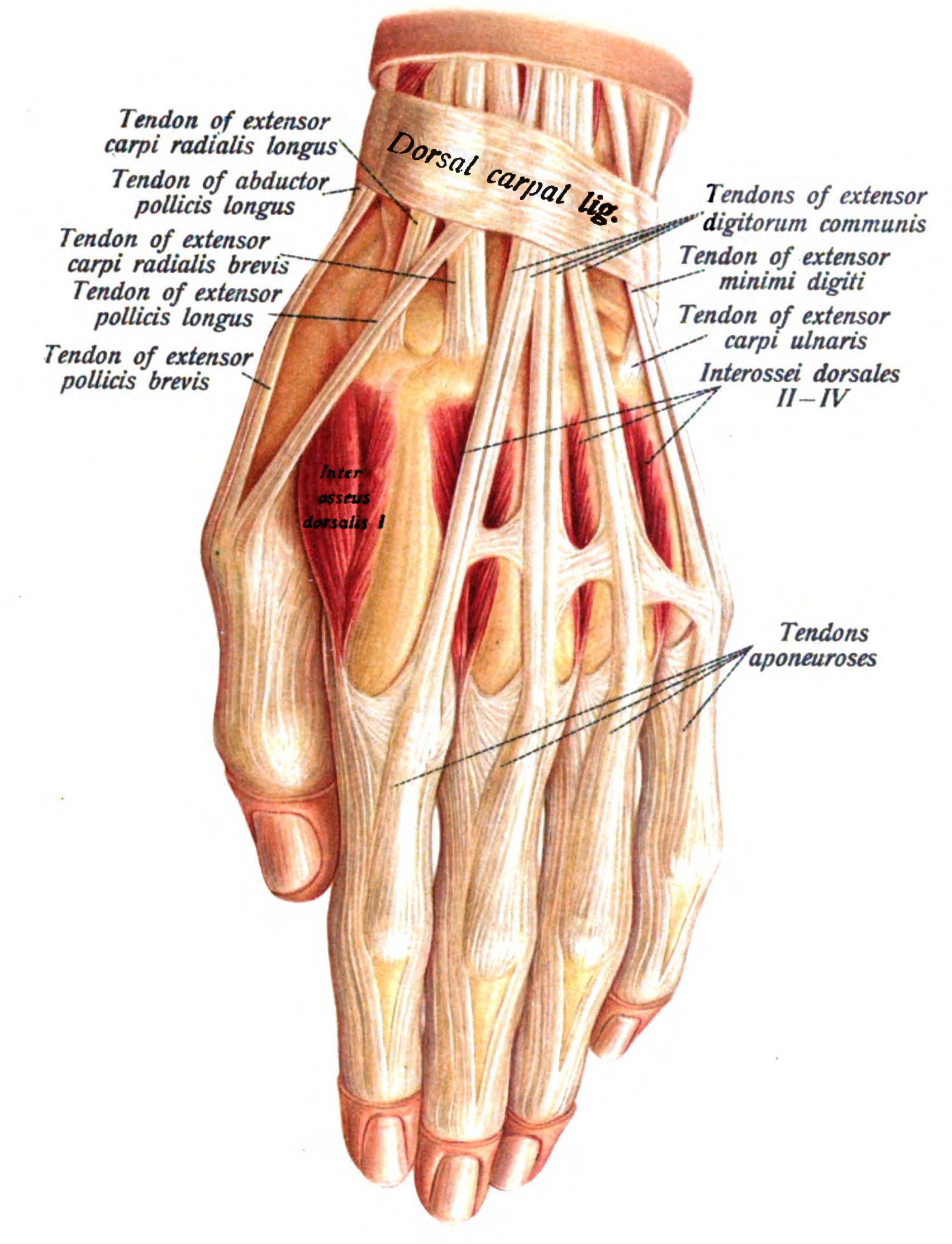
The treatment and management of radial neuropathy can be achieved via the following methods:
- Physical therapy or occupational therapy
- Surgery (depending on the specific area and extent of damage) :*Tendon transfer (the origin remains the same, but the insertion is moved)
- Splinting
Prognosis
Radial neuropathy is not necessarily permanent, though there could be partial loss of movement or sensation. Complications may include hand deformity in some individuals. If the injury is axonal (the underlying nerve fiber itself is damaged), recovery may take months or years, and full recovery may never occur. EMG and nerve conduction studies are typically performed to diagnose the extent and distribution of the damage, and to help with prognosis for recovery.. A compressive neuropraxia of the radial nerve (Saturday night palsy) takes between 2 and 12 weeks to recover. It is a common misunderstanding to attribute severe motor weakness of the hand lasting only minutes to hours to radial nerve neuropraxia
Culture and society
There are several terms used to describe radial nerve injuries, which are dependent on the causation factor, such as:
- Honeymoon palsy from another individual sleeping on and compressing one's arm overnight.
- Saturday night palsy from falling asleep with one's arm hanging over the armrest of a chair or the edge of the bed, compressing the radial nerve.
- Saturnine palsy from lead poisoning
- Squash palsy, from traction forces associated with the sport squash, happens to squash players during periods between matches.
References
References
- "Radial Mononeuropathy: Background, Pathophysiology, Epidemiology". eMedicine.
- "Paresthesia Information Page: National Institute of Neurological Disorders and Stroke (NINDS)".
- Han, Bo Ram. (1 March 2014). "Clinical Features of Wrist Drop Caused by Compressive Radial Neuropathy and Its Anatomical Considerations". [[Journal of Korean Neurosurgical Society]].
- Frontera, Walter R.. (2014-09-05). "Essentials of Physical Medicine and Rehabilitation". Elsevier Health Sciences.
- "Radial Nerve Lesion (C5-C8) Professional Reference {{!}} Patient".
- Wang, Jack T.. (9 January 2012). "Axon degeneration: Molecular mechanisms of a self-destruction pathway". The Journal of Cell Biology.
- (2010). "Musculoskeletal, Sports and Occupational Medicine". Demos Medical Pub., LLC.
- Wolfe, Scott W.. (2010-11-24). "Green's Operative Hand Surgery: Expert Consult: Online and Print". Elsevier Health Sciences.
- "Radial nerve dysfunction: MedlinePlus Medical Encyclopedia". NIH.
- Ebnezar, John. (2010). "Textbook of Orthopedics". JP Medical Ltd.
- Goodman, Catherine C.. (2011-02-14). "Pathology for the Physical Therapist Assistant". Elsevier Health Sciences.
- Spinner, Robert J.. (2002). "The Origin of "Saturday Night Palsy"?". Neurosurgery.
- "Medscape /Axillary Nerve Injury Associated With Sports".
This article was imported from Wikipedia and is available under the Creative Commons Attribution-ShareAlike 4.0 License. Content has been adapted to SurfDoc format. Original contributors can be found on the article history page.
Ask Mako anything about Radial neuropathy — get instant answers, deeper analysis, and related topics.
Research with MakoFree with your Surf account
Create a free account to save articles, ask Mako questions, and organize your research.
Sign up freeThis content may have been generated or modified by AI. CloudSurf Software LLC is not responsible for the accuracy, completeness, or reliability of AI-generated content. Always verify important information from primary sources.
Report