From Surf Wiki (app.surf) — the open knowledge base
Quercetin

Quercetin is a plant flavonol from the flavonoid group of polyphenols. It is found in many fruits, vegetables, leaves, seeds, and grains; capers, red onions, and kale are common foods containing appreciable amounts of it. It has a bitter flavor and is used as an ingredient in dietary supplements, beverages, and foods.
Occurrence
Quercetin is a flavonoid widely distributed in nature. It is a naturally occurring polar auxin transport inhibitor.
Quercetin is one of the most abundant dietary flavonoids, with an average daily consumption of 25–50 mg.
| Foods | Quercetin, |
|---|---|
| mg / 100 g | |
| capers, raw | 234 |
| capers, canned | 173 |
| lovage leaves, raw | 170 |
| dock like sorrel | 86 |
| radish leaves | 70 |
| carob fiber | 58 |
| dill weed, fresh | 55 |
| coriander | 53 |
| yellow wax pepper, raw | 51 |
| fennel leaves | 49 |
| onion, red | 32 |
| radicchio | 32 |
| watercress | 30 |
| kale | 23 |
| chokeberry | 19 |
| bog blueberry | 18 |
| buckwheat seeds | 15 |
| cranberry | 15 |
| lingonberry | 13 |
| plums, black | 12 |
In red onions, higher concentrations of quercetin occur in the outermost rings and in the part closest to the root, the latter being the part of the plant with the highest concentration. One study found that organically grown tomatoes had 79% more quercetin than non-organically grown fruit. Quercetin is present in various kinds of honey from different plant sources.
Biosynthesis
In plants, phenylalanine is converted to 4-coumaroyl-CoA in a series of steps known as the general phenylpropanoid pathway using phenylalanine ammonia-lyase, cinnamate-4-hydroxylase, and 4-coumaroyl-CoA-ligase. One molecule of 4-coumaroyl-CoA is added to three molecules of malonyl-CoA to form tetrahydroxychalcone using 7,2′-dihydroxy-4′-methoxyisoflavanol synthase. Tetrahydroxychalcone is then converted into naringenin using chalcone isomerase.
Naringenin is converted into eriodictyol using flavanoid 3′-hydroxylase. Eriodictyol is then converted into dihydroquercetin with flavanone 3-hydroxylase, which is then converted into quercetin using flavonol synthase.
Glycosides
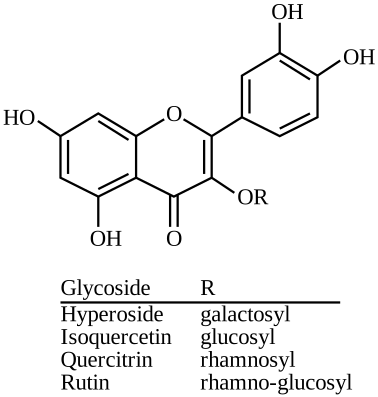
Quercetin is the aglycone form of a number of other flavonoid glycosides, such as rutin (also known as quercetin-3-O-rutinoside) and quercitrin, found in citrus fruit, buckwheat, and onions.
Several taxifolin (also known as dihydroquercetin) glycosides also exist. Isoquercetin is the 3-O-glucoside of quercetin.
Rutin degradation pathway
The enzyme quercitrinase can be found in Aspergillus flavus. This enzyme hydrolyzes the glycoside quercitrin to release quercetin and L-rhamnose. It is an enzyme in the rutin catabolic pathway.
Pharmacology
Pharmacokinetics
The bioavailability of quercetin in humans after oral intake is very low, with one study concluding it must be less than 1%. Intravenous injection of quercetin shows a rapid decay in concentration described by a two-compartment model (initial half-life of 8.8 minutes, terminal half-life of 2.4 hours). Because it undergoes rapid and extensive metabolism, the biological effects presumed from in vitro studies are unlikely to apply in vivo. Quercetin supplements in the aglycone form are less bioavailable than the quercetin glycoside often found in foods, especially red onions. Ingestion with high-fat foods may increase bioavailability compared to ingestion with low-fat foods, and carbohydrate-rich foods may increase absorption of quercetin by stimulating gastrointestinal motility and colonic fermentation. Because of low solubility and poor bioavailability of quercetin, derivatives have been synthesized to overcome these challenges and enhance its biological activity, leading to compounds with improved properties for possible therapeutic applications.
Metabolism
Quercetin is rapidly metabolized (via glucuronidation) after the ingestion of quercetin foods or supplements. Five metabolites (quercetin glucuronides) have been found in human plasma after quercetin ingestion. Taken together, the quercetin glucuronides have a half-life around 11–12 hours.
In rats, quercetin did not undergo any significant phase I metabolism. In contrast, quercetin did undergo extensive phase II (conjugation) to produce metabolites that are more polar than the parent substance, hence are more rapidly excreted from the body. In vitro, the meta-hydroxyl group of catechol is methylated by catechol-O-methyltransferase. Four of the five hydroxyl groups of quercetin are glucuronidated by UDP-glucuronosyltransferase. The exception is the 5-hydroxyl group of the flavonoid ring, which generally does not undergo glucuronidation. The major metabolites of orally absorbed quercetin are quercetin-3-glucuronide, 3'-methylquercetin-3-glucuronide, and quercetin-3'-sulfate. A methyl metabolite of quercetin has been shown *in vitro *to be more effective than quercetin at inhibiting lipopolysaccharide-activated macrophages.
Compared to other flavonoids, quercetin is one of the most effective inducers of the phase II detoxification enzymes.
In vitro studies show that quercetin is a strong inhibitor of the cytochrome P450 enzymes CYP3A4 and CYP2C19 and a moderate inhibitor of CYP2D6. Drugs that are metabolized by these pathways may have increased effect. An in vivo study found that quercetin supplementation slows the metabolism of caffeine to a statistically significant extent in a particular genetic subpopulation, but in absolute terms the effect was almost negligible. Quercetin is an inhibitor of CYP46A1.
Food safety
In 2010, the U. S. Food and Drug Administration acknowledged high-purity quercetin as generally recognized as safe for use as an ingredient in various specified food categories at levels up to 500 mg per serving.
Health claims
Quercetin has been studied in basic research and small clinical trials. While supplements have been promoted for the treatment of cancer and various other diseases, or any other disease.
The US Food and Drug Administration has issued warning letters to several manufacturers advertising on their product labels and websites that quercetin product(s) can be used to treat diseases. The FDA regards such quercetin advertising and products as unapproved – with unauthorized health claims concerning the anti-disease products – as defined by "sections 201(g)(1)(B) and/or 201 (g)(1)(C) of the Act [21 U.S.C. § 321(g)(1)(B) and/or 21 U.S.C. § 321(g)(1)(C)] because they are intended for use in the diagnosis, cure, mitigation, treatment, or prevention of disease", conditions not met by the manufacturers.
Safety
Little research has been conducted into the safety of quercetin supplementation in humans, and the results are insufficient to give confidence that the practice is safe. In particular, a lack of safety information exists on the effect of quercetin supplementation for pregnant women, breastfeeding women, children, and adolescents. The hormonal effects of quercetin found in animal studies raise the suspicion of a parallel effect in humans, particularly in respect of estrogen-dependent tumors.
Quercetin supplementation can interfere with the effects of medications. The precise nature of this interaction is known for some common medicines, but for many, it is not.
References
References
- "Quercetin dihydrate safety sheet".
- (November 2015). "Flavonoids". Micronutrient Information Center, Linus Pauling Institute, Oregon State University, Corvallis, OR.
- (29 November 2023). "Quercetin". Merriam-Webster.
- "Quercetin (biochemistry)". Encyclopædia Britannica.
- (Oct 1997). "Induction of Zygotic Polyembryos in Wheat: Influence of Auxin Polar Transport". The Plant Cell.
- (1995). "Review of the biology of quercetin and related bioflavonoids". Food and Chemical Toxicology.
- (December 2007). "Onions: a source of unique dietary flavonoids". Journal of Agricultural and Food Chemistry.
- (Jul 2007). "Ten-year comparison of the influence of organic and conventional crop management practices on the content of flavonoids in tomatoes". Journal of Agricultural and Food Chemistry.
- (Jun 2011). "Analysis of flavonoids in honey by HPLC coupled with coulometric electrode array detection and electrospray ionization mass spectrometry". Analytical and Bioanalytical Chemistry.
- (Jun 2001). "Flavonoid biosynthesis. A colorful model for genetics, biochemistry, cell biology, and biotechnology". Plant Physiology.
- "Information on EC 3.2.1.66 - quercitrinase". Helmholtz Centre for Infection Research.
- (Nov 2010). "The rutin catabolic pathway with special emphasis on quercetinase". Biodegradation.
- (1 March 1975). "Disposition of quercetin in man after single oral and intravenous doses". European Journal of Clinical Pharmacology.
- (May 2011). "The metabolism and analysis of isoflavones and other dietary polyphenols in foods and biological systems". Food & Function.
- (2020). "Bioactivity of dietary polyphenols: The role of metabolites". [[Critical Reviews in Food Science and Nutrition]].
- (February 2022). "Quercetin derivatives: Drug design, development, and biological activities, a review". Eur J Med Chem.
- (1999). "Pharmacokinetics and bioavailability of the flavonol quercetin in humans". International Journal of Clinical Pharmacology and Therapeutics.
- (April 2001). "Identification of quercetin glucuronides in human plasma by high-performance liquid chromatography–tandem mass spectrometry". Journal of Chromatography B: Biomedical Sciences and Applications.
- (2004). "Phytochemicals in health and disease". Dekker.
- (2011). "Antioxidant and prooxidant properties of flavonoids". [[Fitoterapia]].
- (January 2018). "Studying the Inhibitory Effect of Quercetin and Thymoquinone on Human Cytochrome P450 Enzyme Activities". Pharmacognosy Magazine.
- (December 2014). "Evaluation of Inhibitory Effects of Caffeic acid and Quercetin on Human Liver Cytochrome P450 Activities". Phytotherapy Research.
- (2014). "Quercetin Significantly Inhibits the Metabolism of Caffeine, a Substrate of Cytochrome P450 1A2 Unrelated to ''CYP''1''A''21''C'' (−2964G>A) and 1''F'' (734C>A) Gene Polymorphisms". BioMed Research International.
- Kaur K, Devi B, Agrawal V, Kumar R, Sandhir R. (16 November 2022). "Identification of potential inhibitors of brain-specific CYP46A1 from phytoconstituents in Indian traditional medicinal plants". J Proteins Proteom.
- (22 November 2010). "GRN No. 341 (Quercetin)". US Food and Drug Administration.
- (March 1, 2009). "New Roles for Polyphenols. A 3-Part Report on Current Regulations & the State of Science". Nutraceuticals World.
- (2014). "Molecular and physiological actions of quercetin: need for clinical trials to assess its benefits in human disease". Nutrition Reviews.
- (2 March 2017). "Warning Letter to Cape Fear Naturals". Inspections, Compliance, Enforcement, and Criminal Investigations, US Food and Drug Administration.
- (17 April 2017). "Warning Letter to DoctorVicks.com". Inspections, Compliance, Enforcement, and Criminal Investigations, US Food and Drug Administration.
- (January 2018). "Safety Aspects of the Use of Quercetin as a Dietary Supplement". Mol Nutr Food Res.
This article was imported from Wikipedia and is available under the Creative Commons Attribution-ShareAlike 4.0 License. Content has been adapted to SurfDoc format. Original contributors can be found on the article history page.
Ask Mako anything about Quercetin — get instant answers, deeper analysis, and related topics.
Research with MakoFree with your Surf account
Create a free account to save articles, ask Mako questions, and organize your research.
Sign up freeThis content may have been generated or modified by AI. CloudSurf Software LLC is not responsible for the accuracy, completeness, or reliability of AI-generated content. Always verify important information from primary sources.
Report