From Surf Wiki (app.surf) — the open knowledge base
Queen Mary 2
British transatlantic ocean liner
British transatlantic ocean liner
| Field | Value | |||
|---|---|---|---|---|
| display_title | ital | |||
| section1 | {{Infobox ship/image | |||
| image | Queen Mary 2 Boston July 2015 01 (cropped).jpg | |||
| image_size | 350px | |||
| image_caption | Queen Mary 2 in Boston on 12 July 2015 | |||
| section2 | {{Infobox ship/career | |||
| country | Bermuda | |||
| flag | ||||
| name | Queen Mary 2 | |||
| namesake | ||||
| owner | [[File:Carnival Corporation house flag.svg | border | 20px]] Carnival Corporation & plc | |
| operator | [[File:House flag of the Cunard Line.svg | border | 20px]] Cunard Line | |
| ordered | 6 November 2000 | |||
| builder | STX Europe Chantiers de l'Atlantique, Saint-Nazaire, France | |||
| yard_number | G32 | |||
| laid_down | 4 July 2002 | |||
| launched | 21 March 2003 | |||
| completed | 22 December 2003 | |||
| christened | 8 January 2004 by Elizabeth II | |||
| maiden_voyage | 12 January 2004 | |||
| in_service | 2004–present | |||
| registry | *Southampton, United Kingdom(2004–2011) | |||
| status | In Service | |||
| identification | *Call sign: ZCEF6 | |||
| section3 | {{Infobox ship/characteristics | |||
| type | Ocean liner | |||
| tonnage | ||||
| displacement | 79,287 tonnes | |||
| length | 345.03 m | |||
| beam | *41 m waterline, | |||
| *{{convert | 147.5 | ft | abbr | on}} extreme (bridge wings) |
| height | 236.2 ft keel to (top of) funnel | |||
| draught | 10.3 m | |||
| decks | 14 passenger, 18 total decks | |||
| power | * 4×Wärtsilä 16V46C-CR (4×16,800kW) | |||
| propulsion | Integrated electric propulsion; diesel generators & gas turbines used to generate electricity to drive four Rolls-Royce/Alstom Mermaid propulsion units (4×21.5MW) | |||
| speed | Max speed 30 kn Service speed 26 knots | |||
| capacity | * 2,695 passengers (after 2016 refit) | |||
| crew | 1,253 officers and crew |
-
Hamilton, Bermuda(2011–present)
-
147.5 ft extreme (bridge wings)
-
2×General Electric LM2500+ (2×25,060kW)
-
2,620 passengers (original design)
'RMS Queen Mary 2* (**QM2''') is a British ocean liner. She has served as the flagship of the Cunard Line since April 2004, and as of 2026, is the only active, purpose-built ocean liner still in service. Queen Mary 2 sails regular transatlantic crossings between Southampton and New York City, in addition to short cruises and an annual world voyage.
She was designed by a team of British naval architects led by Stephen Payne, and was constructed in France by Chantiers de l'Atlantique. At the time of her construction, Queen Mary 2 was the longest, at 345.03 m, and largest, with a gross tonnage of , passenger ship ever built. She no longer holds these records after the construction of Royal Caribbean International's (a cruise ship) in April 2006, but remains the largest ocean liner ever built.
Queen Mary 2 was intended for some crossings of the Atlantic Ocean; the final construction cost was approximately $300,000 per berth. The cost was increased by the high quality of materials; having been designed as an ocean liner, 40% more steel was required for a cruise liner than for a standard cruise ship. Queen Mary 2 has a maximum speed of just over 30 kn and a cruising speed of 26 kn, which is faster than a contemporary cruise ship. Instead of the common diesel-electric configuration, Queen Mary 2 uses integrated electric propulsion to achieve her top speed. Diesel engines, augmented by gas turbines, are used to generate electricity for electric motors for propulsion and for on-board use.
Queen Mary 2s facilities include fifteen restaurants and bars, five swimming pools, a casino, a ballroom (the largest on a current ship), a theatre, a library, a gym, an art gallery, a golf simulator, and the first planetarium at sea.
Characteristics
Queen Mary 2 is the flagship of Cunard Line. She was constructed to replace the aging Queen Elizabeth 2, which was the Cunard flagship from 1969 to 2004 and the last major ocean liner built before Queen Mary 2. Queen Mary 2 had the Royal Mail Ship (RMS) prefix conferred on her by the Royal Mail when she entered service in 2004, as a gesture to Cunard's history.
Queen Mary 2 is not a steamship like many of her predecessors, but is powered primarily by four diesel engines, with two additional gas turbines providing extra power when required; this integrated electric propulsion configuration is used to produce the power to drive her four electric propulsion pods as well as the ship's hotel services. The spaces for these prime movers are also split, and controls are also backed up, with the intention of preventing a single failure from disabling the ship.
Like her predecessor Queen Elizabeth 2 she is built for crossing the Atlantic Ocean, and is also regularly used for cruising. In the winter season she cruises from New York to the Caribbean. *Queen Mary 2'''s 30 kn open ocean speed sets the ship apart from cruise ships, such as , which has a service speed of 22.6 kn; Queen Mary 2s normal service speed is 26 kn. While the hull of a cruise ship will typically have a block coefficient of 0.73 (1.0 would represent a rectangular block) *Queen Mary 2'' is more fine-lined, with a block coefficient of 0.61.
Design and construction
Cunard completed a design for a new class of , 2,000 passenger liners on 8 June 1998, but revised them upon comparing those specifications with Carnival Cruise Line's Destiny-class cruise ships and Royal Caribbean International's Voyager class.
In December 1998, Cunard released details of Project Queen Mary, the project to develop a liner that would complement Queen Elizabeth 2. Harland and Wolff of Northern Ireland, Aker Kværner of Norway, Fincantieri of Italy, Meyer Werft of Germany, and Chantiers de l'Atlantique of France were invited to bid on the project. The contract was finally signed with Chantiers de l'Atlantique, a subsidiary of Alstom, on 6 November 2000. This was the same yard that built Cunard's former rivals, the and of the Compagnie Générale Transatlantique.
*Queen Mary 2'''s keel was laid down on 4 July 2002, in the construction dock at Saint-Nazaire, France, with the hull number *G32''. Approximately 3,000 craftsmen spent around eight million working hours on the ship, and around 20,000 people were directly or indirectly involved in her design, construction, and fitting out. In total, 300,000 pieces of steel were assembled into 94 "blocks" off the dry dock, which were then positioned and welded together to complete the hull and superstructure. After floating out on 21 March 2003, the Queen Mary 2 was fitted out in the large fitting out basin ("Bassin C"), the first ship to use this huge dry dock since the shipyard built large tankers in the 1970s, such as . Her sea trials were conducted during 25–29 September and 7–11 November 2003, between Saint-Nazaire and the offshore islands of Île d'Yeu and Belle-Île.
The final stages of construction were marred by a fatal accident on 15 November 2003, when a gangway collapsed under a group of shipyard workers and their relatives who had been invited to visit the vessel. In total, 16 people were killed and another 32 people injured after a 15 m fall into the drydock.
Construction was completed on schedule. On 22 December 2003, Queen Mary 2 left Saint-Nazaire and arrived in Southampton, England, on 26 December 2003. On 8 January 2004, the liner was officially named by Queen Elizabeth II.
Exterior
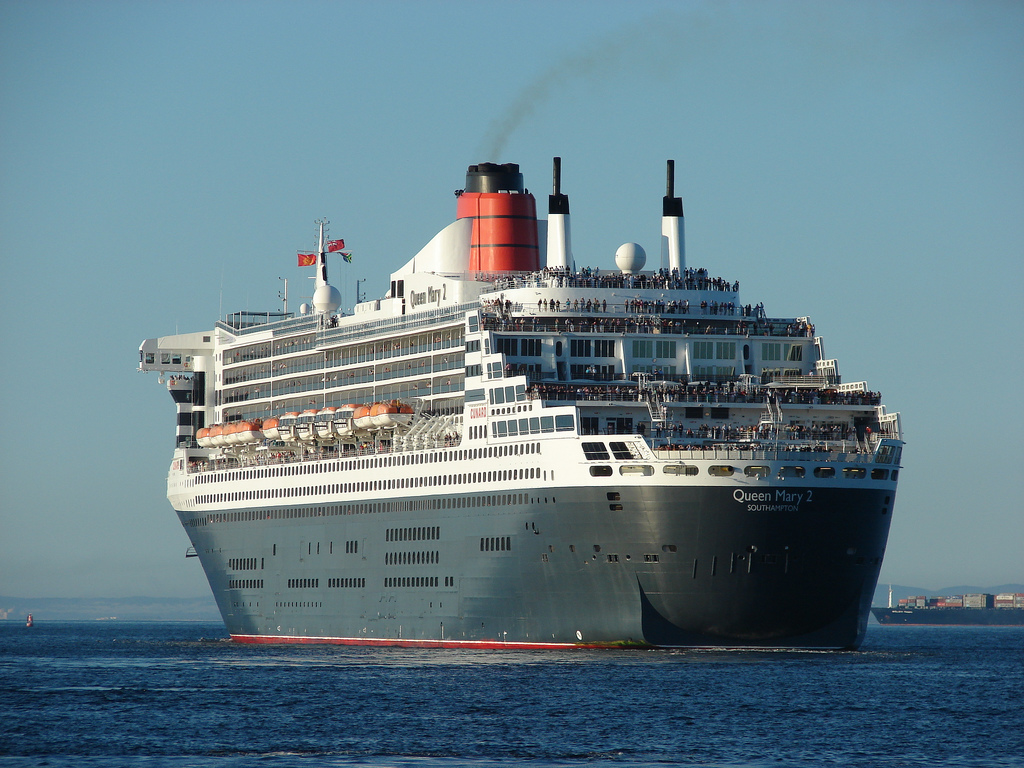
*Queen Mary 2'''s principal naval architect was Carnival's in-house designer, Stephen Payne. He intended many aspects of the ship's design to resemble notable aspects of former ocean liners, such as the ship's predecessor Queen Elizabeth 2 and her predecessors Queen Mary and Queen Elizabeth. These include the three thick black lines known as "hands" that wrap around either edge of the ship's bridge screen, and at the stern end of the superstructure, which are to recall the appearance of the crossovers of the forward decks on the first *Queen Mary''.
Queen Mary 2 has 14164 m2 of exterior deck space, with wind screens to shield passengers in rough seas. The ship was originally constructed with five swimming pools. However, the shallow "Splash Pool" on Deck 13 was removed during the ship's 2016 refurbishment to make room for additional staterooms. Two of her remaining four swimming pools are outdoors. There are indoor pools on Deck 7, in the Canyon Ranch Spa Club, and on Deck 12. The Pavilion Pool on Deck 12 is covered with a retractable magrodome.
In common with liners such as , there is a continuous wrap-around promenade deck (Deck 7). This passes behind the bridge screen and allows passengers to circumnavigate the deck while protected from the winds; one circuit is 620 m long. The flanking promenades are created by the need to step the superstructure to allow space for lifeboats. By SOLAS standards, these should have been lower on the hull (15 m above the waterline), but for the sake of appearance as well as to avoid the danger of large waves damaging the boats, Payne convinced SOLAS officials to exempt Queen Mary 2 from this requirement, and the boats are 25 m above the waterline.
Payne's original intention was for a stern profile with a spoon shape, similar to most previous liners, but the mounting of the propeller pods required a flat transom. The compromise was a Costanzi stern – a combination of the two, which provides the transom required for azimuthal pod propulsors and has better seaholding characteristics in a following swell. In common with many modern ships, Queen Mary 2 has a bulbous bow to reduce drag and thereby increase speed, range, and fuel efficiency.
While of a design similar to that of Queen Elizabeth 2, ''Queen Mary 2'''s funnel has a slightly different shape, because a taller funnel would have made it impossible for the ship to pass under the Verrazzano–Narrows Bridge in New York City at high tide. The final design permits a minimum of 13 ft of clearance under the bridge.
As Queen Mary 2 is too large to dock in many ports, passengers are often ferried to and from the ship in tenders, which can also be used as lifeboats. These are stored at sea in davits alongside the lifeboats. To transport passengers ashore the tenders pull up to one of four loading stations, each of which has a large hull door that opens hydraulically to form a boarding platform, complete with railings and decking.
Queen Mary 2 is a post-Panamax ship, too wide to use the Panama Canal before its expansion in 2016. As a result, she had to circumnavigate South America to transit between the Atlantic and Pacific oceans. The decision not to constrain her width to transit the Panama Canal was taken as Queen Elizabeth 2 only transited once a year, during the world cruise. Cunard decided to pass up the convenience of the occasional passage in favour of a greater passenger capacity.
Interior


The King's Court area on the ship is open twenty four hours a day, serving as a buffet restaurant for breakfast and lunch. The overall space is divided into quarters, with each section decorated according to the theme of the four separate alternate dining venues that are "created" each evening through lighting, tableware, and menus: Lotus, which specialises in Asian cuisine; the Carvery, a British style grille; La Piazza, with Italian food; and the Chef's Galley, which offers an interactive experience to food preparation.
The passengers' dining arrangements on board are dictated by the type of accommodation in which they choose to travel. Around 85% of passengers are in Britannia class, and, therefore, dine in the main restaurant. However, passengers can choose to upgrade to either a "junior suite", and dine in the "Princess Grill"', or a suite, and dine in the "Queens' Grill". Those in the two latter categories are grouped together by Cunard as "Grill Passengers", and they are permitted to use the "Queens' Grill Lounge" and a private outdoor area on deck 11 with its own whirlpool. This feature is also present on both Queen Victoria and Queen Elizabeth. However, all other public areas can be used by all passengers.
As the Britannia Restaurant takes up the full width of the ship on two decks, a 'tween deck, called Deck 3L, was devised to allow passengers to walk from the Grand Lobby to the Queen's Room without traversing the dining room mid-meal. The deck consists of two corridors that run beneath the upper balcony of the restaurant on Deck 3, and above the main dining area on Deck 2. This is why the balcony of the Britannia has tiers that step up towards the hull. This arrangement is illustrated on the hull where there is a stack of three rows of windows in the area where the main restaurant sits, the two upper and lower most rows illuminate the dining room, while the centre row serves Deck 3L. There is a similar arrangement through the Royal Court Theatre. As well, the passages that run on either side of Illuminations on Deck 3 ramp upwards to compensate for the change in deck elevation between the entrance to Illuminations and an elevator bank forward of the room.

More than 5,000 commissioned works of art are visible in *Queen Mary 2'''s public rooms, corridors, staterooms and lobbies, having been created by 128 artists from sixteen countries. Two of the most notable pieces are Barbara Broekman's tapestry, an abstract depiction of an ocean liner, bridge, and New York skyline which spans the full height of the Britannia Restaurant, and the British sculptor John McKenna's sheet bronze relief mural in the Grand Lobby, a seven square metre portrait of the ship fabricated in bronze inspired by the Art Deco mural in the main dining room of the original *Queen Mary''. The Deck 10 Pavilion features a glass ellipse sculpture by Tomasz Urbanowicz called "Blue Sun Setting in the Ocean".
Technical aspects
Power plant and propulsion system
Queen Mary 2's power plant comprises four sixteen-cylinder Wärtsilä 16V46CR EnviroEngine marine diesel engines, generating a combined 67200 kW at 514 rpm, and two General Electric LM2500+ gas turbines, provide a further 50000 kW; these drive electric generators, which in turn provide the power to drive four 21500 kW Alstom electrical motors located inside the podded propulsors (and thus entirely outside the vessel's hull). Such an arrangement, known as integrated electric propulsion (IEP), provides for economical cruising at low speed combined with an ability to sustain much higher speeds when required, and has been common in naval vessels for several decades. The ''Queen Mary 2'''s gas turbines are not housed along with her diesels in the engine room deep in her hull, but instead are in a soundproofed enclosure directly beneath the funnel. This arrangement allows the turbines to be supplied with sufficient air without having to run large diameter air ducts the height of the ship, which would have wasted valuable interior space.
The propulsors are Rolls-Royce Mermaid azimuth thruster type podded propulsion units, each with one forward-facing low-vibration propeller with separately bolted blades. The forward pair of thrusters is fixed, but the aft pair can swivel through 360°, removing the need for a rudder. Queen Mary 2 is the first quadruple-propeller passenger ship completed since the SS France in 1961. Queen Mary 2 carries eight spare blades on the foredeck, immediately forward of the bridge screen. In addition to the primary thrusters, the ship is also fitted with three bow thrusters, with a power output of 3.2 MW each. These allow the ship to turn in its own length while in port, to conduct more complex docking manoeuvres.
The propulsor pods fitted to Queen Mary 2 have been prone to failure, attributed to the motors' thrust bearings, which continued to show a tendency to fail even after numerous attempts at redesign. In January 2009, Carnival, through its Cunard division, sued Rolls-Royce in the United States. The line alleged that the Mermaid pod propulsion systems fitted to Queen Mary 2 were inherently defective in design, and that Rolls-Royce knew about the design deficiencies and deliberately conspired to mislead, deceive and defraud in the course of winning the contract. In January 2011, the court awarded Carnival US$24 million (approximately UK£15 million at the time of verdict).

Navigation
Queen Mary 2 has a fully integrated bridge system initially designed by British firm Kelvin Hughes, which controls the ship's navigation systems, radar, dynamic positioning system, and engine monitoring system. Kelvin Hughes supplied many of the ship's components, including the Electronic Chart Display and Information System (ECDIS) and eight multifunction display units. This system was replaced by Wärtsilä NACOS Platinum suite in 2023 to bring her inline with her fleetmates.
Water supply
Fresh water aboard Queen Mary 2 is supplied by three Alfa Laval multiple effect plate (MEP) evaporators, each with a capacity of 630000 L per day. The plants' energy is supplied primarily by steam and cooling water from the ship's gas turbines and diesel engines, or if needed by steam from the ship's two oil-fired boilers. The traditional multiple-effect distillation technology has been improved for the ship's plant, so that scaling of plates is reduced, vastly reducing maintenance required. The desalinated water has a very low salt content of less than five parts per million. Average total water production is 1100000 L per day with a capacity of 1890000 L so that there is ample spare capacity. The ship could easily be supplied by only two of the three plants. Potable water tanks have a capacity of 3830000 L, enough for more than three days of supply. If the engines are running on low load (when the ship is running at a slow speed) the engine jacket cooling water temperature is insufficient to heat the seawater to run the desalination plants. In that case steam from oil-fired boilers is used to heat the sea water. This is uneconomical as generating steam is expensive. It may be cheaper, therefore, to buy water in a particular port than to produce it on board. The seawater intakes are located in the hull of the ship. Concentrated salt solution (brine) is discharged to the sea closer to the ship's stern together with cooling water from the engines.
Service history
On 12 January 2004 Queen Mary 2 set sail on her maiden voyage from Southampton, England, to Fort Lauderdale, Florida, in the United States, carrying 2,620 passengers. She was under the command of captain Ronald Warwick, who had previously commanded Queen Elizabeth 2. Warwick is the son of William (Bil) Warwick, who had also been a senior Cunard officer and the first captain of Queen Elizabeth 2. The ship returned to Southampton late from her maiden voyage after bow doors covering the thrusters failed to shut in Portugal.
During the 2004 Summer Olympics Queen Mary 2 sailed to Athens and docked at Piraeus for two weeks for use as a floating hotel, serving the then Prime Minister of the United Kingdom Tony Blair and his wife Cherie, French President Jacques Chirac, then United States President George W. Bush, and the United States Olympic men's basketball team. According to Cunard, *Queen Mary 2'''s passengers have also included jazz musician Dave Brubeck and singers Rod Stewart, Carly Simon, and James Taylor. [[File:RMS Queen Mary 2 in san francisco bay.jpg|thumb|left|*Queen Mary 2 ''in [[San Francisco]], [[California]] in 2007]]
One 2005 transatlantic crossing saw Queen Mary 2 carrying, in a locked steamer trunk, the first United States copy of J. K. Rowling's book Harry Potter and the Half-Blood Prince, autographed by the author. In a promotional press release for the event, Cunard said that this marked the first time a book had been transported to its international launch on an ocean liner. The signed copy was given to the West Asheville Library, located in the city of Asheville, North Carolina.
In January 2006 Queen Mary 2 embarked on a cruise to South America. Upon departure from Fort Lauderdale, one of her propeller pods was damaged when it struck a channel wall, forcing the ship to sail at a reduced speed, which resulted in Commodore Warwick's decision to skip several calls on its voyage to Rio de Janeiro. Many of her passengers threatened to stage a sit-in protest because of the missed calls, before Cunard offered to refund the voyage costs. Queen Mary 2 continued to operate at a reduced service speed and several itinerary changes were necessary until repairs had been completed after the ship returned to Europe in June, where Queen Mary 2 went into drydock and the damaged propeller pod was unseated. In November, Queen Mary 2 was drydocked once more at the Blohm+Voss yard in Hamburg (drydock Elbe 17) for the reinstallation of the repaired propeller pod. At the same time, sprinkler systems were installed in all of the vessel's balconies to comply with new safety regulations which had come into effect since the MS Star Princess fire. Additionally, both bridge wings were extended by two metres to improve visibility.
After completing the journey around South America, on 23 February 2006, Queen Mary 2 met her namesake, the original , which is permanently docked at Long Beach, California. Escorted by a flotilla of smaller ships, the two Queens exchanged a "whistle salute" which was heard throughout the city of Long Beach. Queen Mary 2 met the other serving Cunard liners and Queen Elizabeth 2 on 13 January 2008 near the Statue of Liberty in New York City harbour, with a celebratory fireworks display; Queen Elizabeth 2 and Queen Victoria made a tandem crossing of the Atlantic for the meeting. This marked the first time three Cunard Queens have been present in the same location. Cunard stated this would be the last time these three ships would ever meet, due to *Queen Elizabeth 2'''s impending retirement from service in late 2008. However this would prove not to be the case, as the three Queens met in Southampton on 22 April 2008. Queen Mary 2 rendezvoused with Queen Elizabeth 2 in Dubai on Saturday 21 March 2009, after the latter ship's retirement, while both ships were berthed at Port Rashid. With the withdrawal of Queen Elizabeth 2 from Cunard's fleet and its docking in Dubai, *Queen Mary 2'' became the only ocean liner left in active passenger service.
On 3 August 2007 three men were stopped by police while escorting and piloting a replica of the first American combat submarine within 200 ft of Queen Mary 2, which was docked at the cruise ship terminal in Red Hook, Brooklyn. The replica was created by New York artist Philip "Duke" Riley and two out-of-town residents, one of whom claimed to be a descendant of David Bushnell, who had invented it. The Coast Guard issued Riley a citation for having an unsafe vessel, and for violating the security zone around Queen Mary 2.
On 19 October 2011, Queen Mary 2 had her registry changed to Hamilton, Bermuda, from her previous home port of Southampton, to allow the ship to host on-board weddings. This marked the first time in its 171-year history that Cunard has not had a ship registered within the UK. Bermuda is a member of the Red Ensign Group and the ship continues to fly the undefaced Red Ensign rather than the Bermuda Red Ensign.
Boston Cup

Carried aboard Queen Mary 2 is the Boston Cup. Sometimes referred to as The Britannia Cup, this artefact was created for Sir Samuel Cunard in Boston, United States, to commemorate the arrival of his first vessel . Cunard had selected Boston as the American port for his Atlantic service, which resulted in a strong connection between Boston and the Cunard Line. It is believed that the cup was presented to Sir Samuel Cunard sometime in 1840, but for much of its life it was missing. It was discovered in an antique shop in 1967 and returned to Cunard, where it was placed aboard Queen Elizabeth 2. In 2004, when Queen Mary 2 became the flagship, the Boston Cup was placed aboard Queen Mary 2.
Special cruises
On 10 January 2007, Queen Mary 2 started her first world cruise, circumnavigating the globe in 81 days. On 20 February, she met her fleet-mate, Queen Elizabeth 2, also on her 2007 world cruise, in Sydney harbour. This is the first time two Cunard Queens had been together in Sydney since the original Queen Mary and Queen Elizabeth served as troop ships in 1941. Despite the early arrival time of 5:42 am, the *Queen Mary 2'''s presence attracted so many viewers that the Sydney Harbour Bridge and Anzac Bridge were blocked. With 1,600 passengers leaving the ships in Sydney, Cunard estimated the stopovers injected more than $3 million into the local economy.
On 10 January 2012, the ship embarked on a three-month world cruise from Southampton, travelling south and then east around Africa, a first ever circumnavigation of Australia, to Japan, then back to Southampton along the south coastline of Eurasia and through the Suez Canal.
Three years after the first Cunard Royal Rendezvous on the same date, Queen Mary 2 met up with and the then brand-new for another Royal Rendezvous in New York City on 13 January 2011. and made a tandem crossing of the Atlantic for the event. All three ships met in front of the statue of Liberty at 6:45 pm for Grucci fireworks. The Empire State Building was lit up in red to mark the event. On 5 June 2012, the three met again, but this time in Southampton to celebrate the Diamond jubilee of Queen Elizabeth II.
Queen Mary 2 has rendezvoused with ocean rowing teams in the middle of the Atlantic. On 30 July 2010 she met up with Artemis Investments, whose rowing crew were Don Lennox, Livar Nysted, Ray Carroll, Leven Brown. Carroll had been a former engineer and was patched through via marine VHF radio and Queen Mary 2's public address system to speak to the captain and crew. On 26 September 2013 Queen Mary 2 resupplied solo-rower Mylène Paquette and her vessel Hermel with a replacement satellite phone, drogue anchor and groceries. Queen Mary 2 changed her course by 20 degrees and only added 14 nmi to the overall distance of the crossing.
On 6 July 2013 Queen Mary 2 departed New York en route to Southampton on her 200th transatlantic voyage. On board speakers were Stephen Payne OBE—the ship's designer—and presenter and newsreader Nick Owen, who presented talks about the ship's design. On 25 May 2015, all three Queens met, once again, at Liverpool, in order to celebrate the 175th anniversary of the shipping line. After arriving at Liverpool the previous day, Queen Mary 2 made a brief excursion to the entrance of the River Mersey to welcome her two fleetmates into port in the early afternoon. The three Cunarders then sailed, in formation, towards Liverpool. The ships spent several hours together, before the departure of Queen Mary 2 to Saint Peter Port, Guernsey.

On 2 July 2015, Queen Mary 2 began a 175th Anniversary Crossing in Southampton. She sailed first to Liverpool, leaving that city after a fireworks display on 4 July, the actual anniversary date of Cunard's first transatlantic voyage. Queen Mary 2 followed the route of the original ship Britannia, calling first at Halifax, Nova Scotia. After a day there, she headed first upriver into the harbor, using her bow thrusters and swivel-pod motors to negotiate the tight turnaround to come back down close to the cityfront. A 21-gun salute and bagpipe band honored the ship. From Halifax, the ship sailed to Boston and was there for a full day at the cruise terminal (Boston was the terminus of the original crossing in 1840). In the evening the ship backed out into Boston Harbor, where a fireworks display was presented before Queen Mary 2 sailed away. After a night and day at sea, the vessel entered New York Harbor early the morning of 14 July and docked at the Brooklyn Cruise Terminal. Later in the evening the vessel sailed to the lower harbor, between the Statue of Liberty and the Battery, for the Forever Cunard Queen Mary 2 Light Show. On 24 June 2025, Queen Mary 2 departed Southampton on a crossing to New York commemorating Cunard's 185th anniversary.
2016 refit
In June 2016, Queen Mary 2 underwent a $132 million/£90 million renovation at Blohm+Voss over 25 days. Major changes included the addition of fifteen single-occupancy staterooms, additional balcony staterooms, and ten more animal cages for an enlarged kennels. According to Blohm+Voss, the refit included the installation of exhaust gas scrubbers and filters to reduce emissions. A block of 35 new cabins was added to the top of the ship that took the place of a little-used deck-top area that offered tennis courts, a wading pool, and two hot tubs. A majority of the loose furniture was replaced in public venues. Other modifications included the removal of the panoramic glass lifts in the Grand Foyer, reconfiguration of the King's Court, the infill of the port promenade photogallery with single staterooms, and the addition of single staterooms in a portion of the casino.

Pandemic lay-up
When COVID-19 started to spread around in the world in 2020, Queen Mary 2 was in the midst of a world cruise. In early February, Cunard cancelled the Asian leg of the voyage, and the vessel stopped in Singapore only to refuel and sailed to Australia. On 15 March, Cunard cancelled the remainder of the voyage, disembarked all passengers at Fremantle, and then the ship returned to Southampton. It stopped briefly on 2 April in Durban to disembark six South African crew members before continuing to its home port.
Due to the pandemic, Cunard suspended all voyages of the Queen Mary 2 until November 2021. In August 2021, Cunard announced that the ship would enter drydock in Brest, France, prior to her return to service.
On 28 November 2021, Queen Mary 2 returned to service during the pandemic.
2023 refit
In 2023, Queen Mary 2 was refitted in Rotterdam, which included replacement of carpets and finishings in many of the public areas.
2027 refit
Queen Mary 2 is planned to undergo a significant refit between 1 April and 8 May 2027.[[File:Queen Mary 2 and Europa Valetta Station Pier, Melbourne 2023.jpg|thumb|Queen Mary 2 and Europa Valletta sitting next to each other at Station Pier in Melbourne, Australia]]
References
Notes
Bibliography
References
- {{Cite ship register
- Cunard Production Services. (2009). "Queen Mary 2: G32 nightclub".
- "QUEEN MARY 2 TECHNICAL INFORMATION". Cunard.
- {{csr
- United States Coast Guard Maritime Information Exchange, [https://cgmix.uscg.mil/psix/psixsearch.aspx Search for "Queen Mary 2"], Retrieved 18 July 2016
- (23 February 2011). "''Queen Mary 2'' – Ship Facts". [[Cunard Line]].
- "Queen Mary 2: A ship of superlatives". [[Cunard Line]].
- "Queen Mary 2". Maritime Matters.
- (4 February 2015). "QM2 Facts - Chris Frame's Cunard Page: Cunard Line History, Facts, News".
- Jivanda, Tomas. (7 March 2014). "Queen Mary 2, the largest and most expensive cruise liner ever built celebrates tenth birthday". The Independent.
- "New Cruise Ships in 2014". Cruise Critic.
- [http://www.cunard.com/Ships/Queen-Mary-2/ Queen Mary 2 Cruises] {{Webarchive. link. (25 February 2012 ''Cunard'' Retrieved 21 January 2012)
- Sloan, Gene. (6 March 2017). "Peek inside the last of the great ocean liners". USA TODAY.
- "The History, Construction and Design of ''Queen Mary 2''". Sealetter Travel Inc.
- (December 2025). "On Board Queen Mary 2".
- (August 2007). "Royal Mail employee's Courier newspaper". Royal Mail.
- "Queen Mary 2 Technical". Cunard.
- Mathisen, Oivind. (14 October 2004). "A Ship for the Sea". Cruise Industry News.
- "Queen Mary 2". The Great Ocean Liners.
- "Construction of the Largest Liner in the World, Part One, July 4, 2002 ~ March 16, 2003". World Ship Society.
- Plisson, Philip. (2004). "Queen Mary 2: The Birth of a Legend". Harry N. Abrams, Inc.
- (16 November 2003). "Toll climbs in Queen Mary 2 shipyard accident". CTV News.
- "QM2 - History".
- (26 December 2003). "In pictures: Queen Mary 2 arrives". BBC News.
- (8 January 2004). "Queen launches Queen Mary 2". BBC.
- Davidson, Carla. "[http://americanheritage.com/articles/magazine/ah/2005/4/2005_4_14.shtml Long Live the Queens]",''American Heritage'', August/September 2005. {{webarchive. link. (7 May 2006)
- (October 2008). "Cunard press pack:''Future Engineers 2008''". Cunard.
- Maxtone-Graham, John. (2004). "Queen May 2:The Greatest Ocean Liner of our Time". Bulfinch Press.
- Arturo Paniagua Mazorra. (14 September 2004). "''Queen Mary 2''".
- Maxtone-Graham, John. (2004). "Queen May 2:The Greatest Ocean Liner of our Time". Bulfinch Press.
- [https://web.archive.org/web/20110715120844/http://www.professionalmariner.com/ME2/dirmod.asp?sid=420C4D38DC9C4E3A903315CDDC65AD72&nm=Archives&type=Publishing&mod=Publications::Article&mid=8F3A7027421841978F18BE895F87F791&tier=4&id=B01E9F24E41844049504B323C52C78FB "Queen Mary 2:] Built to keep alive the traditions of the great ocean liners" ''Professional Mariner'' (2003) Retrieved 11 December 2009
- Barron, James. (18 April 2004). "This Ship Is So Big, The Verrazano Cringes". The New York Times.
- Alistair Greener. (22 January 2009). "Transiting the panama canal-- From East to West or West to East?". Cunard (blog).
- "Cunard Frequently asked questions: What is Illuminations on Queen Mary 2?". Cunard Line.
- Burbank, Richard D.. (2005). "The ''Queen Mary 2'' Library". Libraries & Culture.
- (11 June 2016). "Which cruise ship library is right for you?". [[The Washington Post]].
- [https://www.cunard.com/content/dam/cunard/inventory-assets/ships/QM/9/qm2-deck-plans.pdf QM2 Deck Plans] {{Webarchive. link. (18 August 2021 Cunard. Retrieved 3 June 2022)
- (15 February 2006). "Cunard unleashes new amenities for pampered pets". Cunard.
- "QUEEN MARY 2".
- "Mazorra, Arturo Paniagua; ''Sealetter Cruise Magazine'': The History, Construction and Design of Queen Mary 2". Sealetter.com.
- "''Cunard'':QM2 Fact Sheet". Cunard.com.
- (17 August 2005). "Gaynor, Louisa Frey: The Queen (Mary 2) rules the Atlantic". Usatoday.com.
- ''Liverpool Daily Post'' "Queen Mary 2 Liverpool visit: The ship that offers her passengers 'trip of a lifetime'" 21 October 2009
- "Queen Victoria Public Rooms". Cunard.
- "The art of cruising in luxury". Nqsouthern.com.
- "Queen Mary 2". Onderneming & Kunst.
- Fabiańska, Patrycja. (1 July 2013). "Szkło w architekturze - Tomasz Urbanowicz".
- "Electrical Pod". Rolls-Royce Marine.
- "Azimuthing electrical podded propulsor". Rolls-Royce.
- Karonen, Petri. (1992). "Enso-Gutzeit Oy laivanvarustajana: Oy Finnlines Ltd ja Merivienti Oy 1947–1982". Enso-Gutzeit.
- "Queen Mary 2 - Interview with Chief Engineer Brian Watling".
- (16 January 2009). "Specifications:Carnival Sues Rolls-Royce Over Queen Mary...".
- (8 January 2009). "The Tale of the Mermaid Pods".
- (August 2001). "Kelvin Hughes Bridge Chosen For ''Queen Mary 2''". New Wave Media.
- RMS Queen Mary 2 Technical Specification. Flyer made available to passengers of the ''Queen Mary 2''.
- (2004). "''Queen Mary 2'': The Genesis of a Queen". Alstom Chantiers de l'Atlantique, A Publication of the Naval Architect.
- (16 April 2004). "UBIFRANCE Orelis' technology to recycle Queen Mary 2's waste water".
- Elaine Barker. (23 January 2006). "Passengers threaten mutiny on crippled 'Queen Mary 2'". The Independent.
- "''Queen Mary 2'' will be floating fortress". Nqsouthern.com.
- Smith, Tim. (16 August 2004). "Watch out aboard Queen Mary because ship is sinking". NY Daily News.
- "The Cunard Experience – Why we are different, why choose us".
- (7 November 2005). "World's most famous ocean liner carries first J.K. Rowling-signed US copy of ''Harry Potter and the Half Blood Prince''".
- (16 July 2005). "Asheville Library To Get First Autographed "Harry Potter"".
- (28 January 2006). "Cunard foils QM2 mutiny with full refund offer". The Telegraph.
- "Blohmvoss Repair Schedule-2006". Blohmvoss.
- (12 January 2006). "Queen Mary 2 Meets Namesake Queen Mary on February 22 Marking a Cunard Milestone". The Cruise Line Ltd..
- (3 March 2011). "Royal Rendezvous : The Luxury Cruise Ships of Cunard : Cunard Cruise Line". Cunard.
- (2007). "QE2 to leave Cunard fleet and be sold to Dubai World to begin a new life at the palm". Cunard Line.
- Eleanor Williams. (22 April 2008). "Royal gathering of sea 'Queens'". BBC News.
- (22 April 2008). "Three 'Queens' in final meeting". BBC News.
- "QE2 Retirement". chriscunard.com.
- (21 March 2009). "QE2 and QM2 in Dubai". Chriscunard.com.
- [[#QM2. Makeshift submarine found in East River]]
- (10 September 2012). "Permanent Revolution".
- [http://www.cruisecritic.com/news/news.cfm?ID=4634 It's Official: Cunard Re-flags Cruise Ships in Bermuda, Launches Weddings at Sea], cruisecritic.com, 19 October 2011
- "Bermuda Shipping & Maritime Authority".
- "The Boston Cup". Chris' Cunard Page.
- Maxtone-Graham, John. (2004). "Queen May 2:The Greatest Ocean Liner of our Time". Bulfinch Press.
- "Cunard Celebrates a Special Anniversary". Wearecunard.com.
- (20 February 2007). "QM2 sails into Sydney". The Age Company Ltd..
- "''Queen Elizabeth'' 1940–1973". The Great Ocean Liners.
- (21 February 2007). "Sydney in meltdown as hordes crowd to see giant ships". Sydney Morning Herald.
- [http://www.smh.com.au/news/travel/super-ships-choke-city/2007/02/20/1171733718091.html Super ships choke city] ''Sydney Morning Herald'' 20 February 2007 Retrieved 11 December 2009
- "World Cruise Cruise with RMS Queen Mary 2 on 10/01/2012 (M203)". seascanner.com.
- (7 March 2011). "Cunard Line Announces 2012–2013 Deployment – Cruise Industry News {{pipe}} Cruise News". Cruise Industry News.
- Cox, Martin. (30 July 2010). "QM2's Mid-Atlantic Rendezvous". Maritime Matters.
- Mackenzie, Linley. (5 August 2010). "World record holder Carroll returns to home soil". Galway Advertiser.
- (30 July 2013). "All oar nothing: How four men conquered the Atlantic". The Scotsman.
- Paquette, Mylène. (27 September 2013). "Letter to the Captain of the Queen Mary 2 and his wife".
- (26 September 2013). "Queen Mary 2 comes to aid of Canadian rower Mylene Paquette". BBC News Online.
- Monk, Dave. (29 September 2013). "I want to sail the Atlantic single-handed, says ''Queen Mary 2'' captain after helping lone rower". Shipmonk.
- (9 July 2013). "Queen Mary 2 Celebrates 200th Transatlantic Crossing". World Maritime News.
- "Cunard shipping marks 175 years in Liverpool". BBC News.
- (23 April 2015). "Three Queens Liverpool 2015: Key times for all the weekend events". Liverpool Echo.
- "Anniversary cruises 2015". Cunard.
- (7 July 2015). "U.S. festivities set as Queen Mary 2 celebrates 175 years of Cunard crossings". Los Angeles Times.
- "FORever cunard queen mary 2 light show". Quantum Theatricals.
- "185th Anniversary Event Voyage".
- "First look at Cunard's new-look RMS Queen Mary 2". The Telegraph.
- "Peek inside the last great ocean liners, from Queen Mary to the SS United States". USA Today.
- (15 July 2015). "Cunard flagship Queen Mary 2 to undergo major refurbishment in early summer 2016, befitting the world's most iconic ocean liner". CNW Group.
- Brasse, Michael. (23 May 2016). "Master refit: The Queen Mary 2 docks at Blohm+Voss on May 27, 2016". Blohm+Voss GmbH.
- TODAY, Gene Sloan, USA. "A makeover brings changes, but iconic Queen Mary 2 'still is Queen Mary 2'".
- (10 February 2020). "Queen Mary 2 cruise liner diverted to WA amid coronavirus fears".
- (29 January 2020). "Cunard Modifies Asia Itinerary for Queen Mary 2".
- Lawrey, Katherine. (30 March 2020). "P&O Cruises and Cunard extend their suspension period, delaying Iona's maiden voyage". The Telegraph.
- Jacoby, Jayson. (4 April 2020). "Coronavirus cuts short Baker couple's voyage". Baker City Herald.
- "Queen Mary 2 awaits clearance to enter Durban port".
- (2 April 2020). "Queen Mary 2 stocks up, leaves Durban after dropping off 6 South Africans".
- (19 April 2021). "Covid-19 – Keeping you updated".
- Kemble, Harry. (25 August 2021). "Queen Mary 2 to enter dry dock before restart".
- "Queen Mary 2 Curtails Cruise Due to COVID-19 Disruption".
- "Queen Mary 2 - Major Refit Rotterdam - Project Completion".
- "Cunard's 2027/28 cruises announced with six new destinations". The Independent.
This article was imported from Wikipedia and is available under the Creative Commons Attribution-ShareAlike 4.0 License. Content has been adapted to SurfDoc format. Original contributors can be found on the article history page.
Ask Mako anything about Queen Mary 2 — get instant answers, deeper analysis, and related topics.
Research with MakoFree with your Surf account
Create a free account to save articles, ask Mako questions, and organize your research.
Sign up freeThis content may have been generated or modified by AI. CloudSurf Software LLC is not responsible for the accuracy, completeness, or reliability of AI-generated content. Always verify important information from primary sources.
Report