From Surf Wiki (app.surf) — the open knowledge base
Quark
Elementary particle, fundamental constituent of matter
Elementary particle, fundamental constituent of matter
| Field | Value | |
|---|---|---|
| name | Quark | |
| image | Quark structure proton.svg | |
| image_size | 225px | |
| alt | Three colored balls (symbolizing quarks) connected pairwise by springs (symbolizing gluons), all inside a gray circle (symbolizing a proton). The colors of the balls are red, green, and blue, to parallel each quark's color charge. The red and blue balls are labeled "u" (for "up" quark) and the green one is labeled "d" (for "down" quark). | |
| caption | A proton is composed of two up quarks, one down quark, and the gluons that mediate the forces "binding" them together. The color assignment of individual quarks is arbitrary, but all three colors must be present; red, blue and green are used as an analogy to the primary colors that together produce a white color. | |
| num_types | 6 (up, down, strange, charm, bottom, and top) | |
| composition | elementary particle | |
| statistics | fermionic | |
| generation | 1st, 2nd, 3rd | |
| interaction | strong, weak, electromagnetic, gravitation | |
| antiparticle | antiquark () | |
| theorized | {{plainlist | |
| discovered | SLAC () | |
| symbol | ||
| baryon_number | ||
| electric_charge | + *e*, − *e* | |
| color_charge | yes | |
| spin | *ħ* |
- Murray Gell-Mann (1964)
- George Zweig (1964)}}
A quark () is a type of elementary particle and a fundamental constituent of matter. Quarks combine to form composite particles called hadrons, the most stable of which are protons and neutrons, the components of atomic nuclei. |access-date=2008-06-29 |access-date=2008-06-29 |access-date=2008-06-29
Quarks have various intrinsic properties, including electric charge, mass, color charge, and spin. They are the only elementary particles in the Standard Model of particle physics to experience all four fundamental interactions, also known as fundamental forces (electromagnetism, gravitation, strong interaction, and weak interaction), as well as the only known particles whose electric charges are not integer multiples of the elementary charge.
There are six types, known as flavors, of quarks: up, down, charm, strange, top, and bottom. |access-date=2008-06-29
The quark model was independently proposed by physicists Murray Gell-Mann and George Zweig in 1964. |access-date=2008-09-23 |display-authors=etal |display-authors=etal
Classification
The Standard Model is the theoretical framework describing all the known elementary particles. This model contains six flavors of quarks (), named up (), down (), strange (), charm (), bottom (), and top (). Antiparticles of quarks are called antiquarks, and are denoted by a bar over the symbol for the corresponding quark, such as for an up antiquark. As with antimatter in general, antiquarks have the same mass, mean lifetime, and spin as their respective quarks, but the electric charge and other charges have the opposite sign.
Quarks are spin- particles, which means they are fermions according to the spin–statistics theorem. They are subject to the Pauli exclusion principle, which states that no two identical fermions can simultaneously occupy the same quantum state. This is in contrast to bosons (particles with integer spin), of which any number can be in the same state. |url-access=limited
The quarks that determine the quantum numbers of hadrons are called valence quarks; apart from these, any hadron may contain an indefinite number of virtual "sea" quarks, antiquarks, and gluons, which do not influence its quantum numbers. |url-access=limited |display-authors=etal |display-authors=etal |access-date=2009-06-20 |archive-url=https://web.archive.org/web/20090122213256/http://www.kek.jp/intra-e/press/2007/BellePress11e.html |archive-date=2009-01-22 |display-authors=etal. |article-number=222002 |display-authors=etal |doi-access=free
Elementary fermions are grouped into three generations, each comprising two leptons and two quarks. The first generation includes up and down quarks, the second strange and charm quarks, and the third bottom and top quarks. All searches for a fourth generation of quarks and other elementary fermions have failed, |display-authors=etal |hdl-access=free |display-authors=etal |display-authors=etal |orig-date=1994 |url-access=limited
Having electric charge, mass, color charge, and flavor, quarks are the only known elementary particles that engage in all four fundamental interactions of contemporary physics: electromagnetism, gravitation, strong interaction, and weak interaction. Gravitation is too weak to be relevant to individual particle interactions except at extremes of energy (Planck energy) and distance scales (Planck distance). However, since no successful quantum theory of gravity exists, gravitation is not described by the Standard Model.
See the table of properties below for a more complete overview of the six quark flavors' properties.
History


The quark model was independently proposed by physicists Murray Gell-Mann
At the time of the quark theory's inception, the "particle zoo" included a multitude of hadrons, among other particles. Gell-Mann and Zweig posited that they were not elementary particles, but were instead composed of combinations of quarks and antiquarks. Their model involved three flavors of quarks, up, down, and strange, to which they ascribed properties such as spin and electric charge. The initial reaction of the physics community to the proposal was mixed. There was particular contention about whether the quark was a physical entity or a mere abstraction used to explain concepts that were not fully understood at the time.
In less than a year, extensions to the Gell-Mann–Zweig model were proposed. Sheldon Glashow and James Bjorken predicted the existence of a fourth flavor of quark, which they called charm. The addition was proposed because it allowed for a better description of the weak interaction (the mechanism that allows quarks to decay), equalized the number of known quarks with the number of known leptons, and implied a mass formula that correctly reproduced the masses of the known mesons.
Deep inelastic scattering experiments conducted in 1968 at the Stanford Linear Accelerator Center (SLAC) and published on October 20, 1969, showed that the proton contained much smaller, point-like objects and was therefore not an elementary particle. |access-date=2008-09-29 |archive-url=https://web.archive.org/web/20081225093044/http://www.hueuni.edu.vn/hueuni/en/news_detail.php?NewsID=1606&PHPSESSID=909807ffc5b9c0288cc8d137ff063c72 |archive-date=2008-12-25 |url-access=limited |url-access=registration
The strange quark's existence was indirectly validated by SLAC's scattering experiments: not only was it a necessary component of Gell-Mann and Zweig's three-quark model, but it provided an explanation for the kaon () and pion () hadrons discovered in cosmic rays in 1947.
In a 1970 paper, Glashow, John Iliopoulos and Luciano Maiani presented the GIM mechanism (named from their initials) to explain the experimental non-observation of flavor-changing neutral currents. This theoretical model required the existence of the as-yet undiscovered charm quark. |url-access=limited |doi-access=free |hdl-access=free
Charm quarks were produced almost simultaneously by two teams in November 1974 (see November Revolution) – one at SLAC under Burton Richter, and one at Brookhaven National Laboratory under Samuel Ting. The charm quarks were observed bound with charm antiquarks in mesons. The two parties had assigned the discovered meson two different symbols, J and ψ; thus, it became formally known as the meson. The discovery finally convinced the physics community of the quark model's validity.
In the following years a number of suggestions appeared for extending the quark model to six quarks. Of these, the 1975 paper by Haim Harari
In 1977, the bottom quark was observed by a team at Fermilab led by Leon Lederman. |display-authors=etal |display-authors=etal |display-authors=et al |access-date=2013-11-03 |archive-url=https://web.archive.org/web/20160305012525/https://www.bnl.gov/newsroom/news.php?a=1190 |archive-date=5 March 2016
Etymology
For some time, Gell-Mann was undecided on an actual spelling for the term he intended to coin, until he found the word quark in James Joyce's 1939 book Finnegans Wake: |orig-date=1939 – Three quarks for Muster Mark! Sure he hasn't got much of a bark And sure any he has it's all beside the mark.
The word quark is an old English word meaning to croak |access-date=2020-10-02 |access-date=2018-01-17 |access-date=2020-10-02 |access-date=2020-10-02 Some authors, however, defend a possible German origin of Joyce's word quark. |access-date=2018-01-17
Zweig preferred the name ace for the particle he had theorized, but Gell-Mann's terminology came to prominence once the quark model had been commonly accepted.
The quark flavors were given their names for several reasons. The up and down quarks are named after the up and down components of isospin, which they carry. |url-access=limited |url-access=limited |display-authors=etal
Properties
Electric charge
Quarks have fractional electric charge values, either −, or + times the elementary charge (e), depending on flavor. Up, charm, and top quarks (collectively referred to as up-type quarks) have a charge of + e; down, strange, and bottom quarks (down-type quarks) have a charge of − e. Antiquarks have the opposite charge to their corresponding quarks; up-type antiquarks have charges of − e and down-type antiquarks have charges of + e. Since the electric charge of a hadron is the sum of the charges of the constituent quarks, all hadrons have integer charges: the combination of three quarks (baryons), three antiquarks (antibaryons), or a quark and an antiquark (mesons) always results in integer charges.
Spin
Spin is an intrinsic property of elementary particles, and its direction is an important degree of freedom. It is sometimes visualized as the rotation of an object around its own axis (hence the name "spin"), though this notion is somewhat misguided at subatomic scales because elementary particles are believed to be point-like. |access-date=2009-04-19
Spin can be represented by a vector whose length is measured in units of the reduced Planck constant ħ (pronounced "h bar"). For quarks, a measurement of the spin vector component along any axis can only yield the values + or −; for this reason quarks are classified as spin- particles. |url-access=registration
Weak interaction
Main article: Weak interaction
A quark of one flavor can transform into a quark of another flavor only through the weak interaction, one of the four fundamental interactions in particle physics. By absorbing or emitting a W boson, any up-type quark (up, charm, and top quarks) can change into any down-type quark (down, strange, and bottom quarks) and vice versa. This flavor transformation mechanism causes the radioactive process of beta decay, in which a neutron () "splits" into a proton (), an electron () and an electron antineutrino () (see picture). This occurs when one of the down quarks in the neutron () decays into an up quark by emitting a virtual boson, transforming the neutron into a proton (). The boson then decays into an electron and an electron antineutrino. |access-date=2008-09-28 |archive-date=23 November 2011 |archive-url=https://web.archive.org/web/20111123112925/http://www2.slac.stanford.edu/vvc/theory/weakinteract.html
| → | + | + | (beta decay, quark notation) |
|---|
Both beta decay and the inverse process of inverse beta decay are routinely used in medical applications such as positron emission tomography (PET) and in experiments involving neutrino detection.
While the process of flavor transformation is the same for all quarks, each quark has a preference to transform into the quark of its own generation. The relative tendencies of all flavor transformations are described by a mathematical table, called the Cabibbo–Kobayashi–Maskawa matrix (CKM matrix). Enforcing unitarity, the approximate magnitudes of the entries of the CKM matrix are: |display-authors=etal |doi-access=free : \begin{bmatrix} |V_\mathrm {ud}| & |V_\mathrm {us}| & |V_\mathrm {ub}| \ |V_\mathrm {cd}| & |V_\mathrm {cs}| & |V_\mathrm {cb}| \ |V_\mathrm {td}| & |V_\mathrm {ts}| & |V_\mathrm {tb}| \end{bmatrix} \approx \begin{bmatrix} 0.974 & 0.225 & 0.003 \ 0.225 & 0.973 & 0.041 \ 0.009 & 0.040 & 0.999 \end{bmatrix}, where V**ij represents the tendency of a quark of flavor i to change into a quark of flavor j (or vice versa).The actual probability of decay of one quark to another is a complicated function of (among other variables) the decaying quark's mass, the masses of the decay products, and the corresponding element of the CKM matrix. This probability is directly proportional (but not equal) to the magnitude squared (|V**ij |2) of the corresponding CKM entry.
There exists an equivalent weak interaction matrix for leptons (right side of the W boson on the above beta decay diagram), called the Pontecorvo–Maki–Nakagawa–Sakata matrix (PMNS matrix). |doi-access=free
Strong interaction and color charge

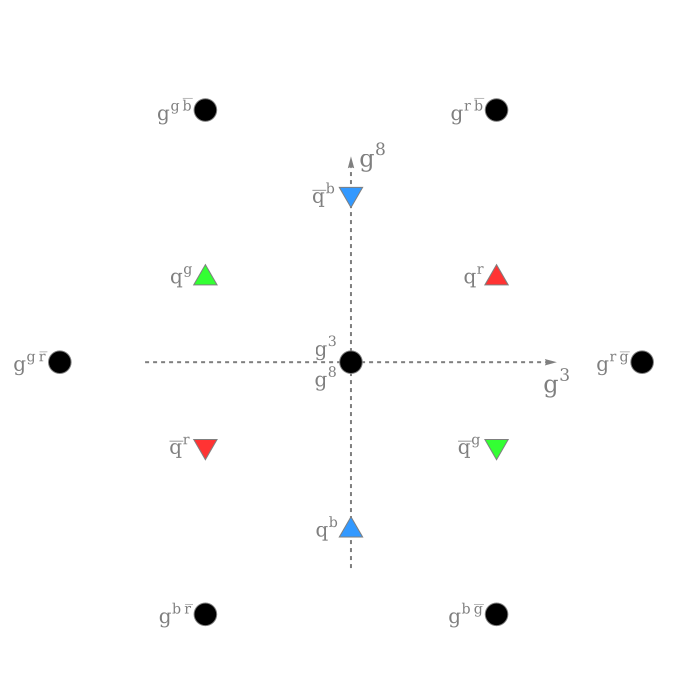
According to quantum chromodynamics (QCD), quarks possess a property called color charge. There are three types of color charge, arbitrarily labeled blue, green, and red.Despite its name, color charge is not related to the color spectrum of visible light. Each of them is complemented by an anticolor – antiblue, antigreen, and antired. Every quark carries a color, while every antiquark carries an anticolor. |access-date=2009-04-26
The system of attraction and repulsion between quarks charged with different combinations of the three colors is called strong interaction, which is mediated by force carrying particles known as gluons; this is discussed at length below. The theory that describes strong interactions is called quantum chromodynamics (QCD). A quark, which will have a single color value, can form a bound system with an antiquark carrying the corresponding anticolor. The result of two attracting quarks will be color neutrality: a quark with color charge ξ plus an antiquark with color charge −ξ will result in a color charge of 0 (or "white" color) and the formation of a meson. This is analogous to the additive color model in basic optics. Similarly, the combination of three quarks, each with different color charges, or three antiquarks, each with different anticolor charges, will result in the same "white" color charge and the formation of a baryon or antibaryon.
In modern particle physics, gauge symmetries – a kind of symmetry group – relate interactions between particles (see gauge theories). Color SU(3) (commonly abbreviated to SU(3)c) is the gauge symmetry that relates the color charge in quarks and is the defining symmetry for quantum chromodynamics.Part III of |url-access=registration |url-access=registration |url-access=limited |access-date=2009-05-12
Mass
Two terms are used in referring to a quark's mass: current quark mass refers to the mass of a quark by itself, while constituent quark mass refers to the current quark mass plus the mass of the gluon particle field surrounding the quark. |url-access=limited
Size
In QCD, quarks are considered to be point-like entities, with no structure. As of 2014, experimental evidence indicates they have no structure greater than 10−4 times the size of a proton, i.e. less than .
Table of properties
The following table summarizes the key properties of the six quarks. Flavor quantum numbers (isospin (I3), charm (C), strangeness (S, not to be confused with spin), topness (T), and bottomness (B′)) are assigned to certain quark flavors, and denote qualities of quark-based systems and hadrons. The baryon number (B) is + for all quarks, as baryons are made of three quarks. For antiquarks, the electric charge (Q) and all flavor quantum numbers (B, I3, C, S, T, and B′) are of opposite sign. Mass and total angular momentum (J; equal to spin for point particles) do not change sign for the antiquarks.
| Particle | Mass* | *J* | *B* | *Q* | *I*3 | *C* | *S* | *T* | *B′* | Antiparticle | Name | Symbol | Name | Symbol | |
|---|---|---|---|---|---|---|---|---|---|---|---|---|---|---|---|
| author1=K. A. Olive | display-authors=etal | collaboration=Particle Data Group | title=Review of Particle Physics | journal=Chinese Physics C | issue=9 | pages=1–708 | year=2014 | bibcode=2014ChPhC..38i0001O | pmid=10020536 | doi-access=free | arxiv=1412.1408 | ||||
| ***First generation*** | |||||||||||||||
| up | ± 0.5 | + | + | + | 0 | 0 | 0 | 0 | antiup | ||||||
| down | ± 0.3 | + | − | − | 0 | 0 | 0 | 0 | antidown | ||||||
| ***Second generation*** | |||||||||||||||
| charm | + | + | 0 | +1 | 0 | 0 | 0 | anticharm | |||||||
| strange | + | − | 0 | 0 | −1 | 0 | 0 | antistrange | |||||||
| ***Third generation*** | |||||||||||||||
| top | ± 710 * | + | + | 0 | 0 | 0 | +1 | 0 | antitop | ||||||
| bottom | + | − | 0 | 0 | 0 | 0 | −1 | antibottom |
Interacting quarks
As described by quantum chromodynamics, the strong interaction between quarks is mediated by gluons, massless vector gauge bosons. Each gluon carries one color charge and one anticolor charge. In the standard framework of particle interactions (part of a more general formulation known as perturbation theory), gluons are constantly exchanged between quarks through a virtual emission and absorption process. When a gluon is transferred between quarks, a color change occurs in both; for example, if a red quark emits a red–antigreen gluon, it becomes green, and if a green quark absorbs a red–antigreen gluon, it becomes red. Therefore, while each quark's color constantly changes, their strong interaction is preserved. |title-link=QED: The Strange Theory of Light and Matter |url-access=registration |url-access=limited
Since gluons carry color charge, they themselves are able to emit and absorb other gluons. This causes asymptotic freedom: as quarks come closer to each other, the chromodynamic binding force between them weakens. |url-access=registration |display-authors=et al.
Sea quarks
Hadrons contain, along with the valence quarks () that contribute to their quantum numbers, virtual quark–antiquark () pairs known as sea quarks (). Sea quarks form when a gluon of the hadron's color field splits; this process also works in reverse in that the annihilation of two sea quarks produces a gluon. The result is a constant flux of gluon splits and creations colloquially known as "the sea". |url-access=limited
Other phases of quark matter
Main article: QCD matter
Under sufficiently extreme conditions, quarks may become "deconfined" out of bound states and propagate as thermalized "free" excitations in the larger medium. In the course of asymptotic freedom, the strong interaction becomes weaker at increasing temperatures. Eventually, color confinement would be effectively lost in an extremely hot plasma of freely moving quarks and gluons. This theoretical phase of matter is called quark–gluon plasma.
The exact conditions needed to give rise to this state are unknown and have been the subject of a great deal of speculation and experimentation. An estimate puts the needed temperature at kelvin. |access-date = 2009-05-22 |archive-url = https://web.archive.org/web/20130415062818/http://www.bnl.gov/rhic/news2/news.asp?a=303&t=pr |archive-date = 2013-04-15
The quark–gluon plasma would be characterized by a great increase in the number of heavier quark pairs in relation to the number of up and down quark pairs. It is believed that in the period prior to 10−6 seconds after the Big Bang (the quark epoch), the universe was filled with quark–gluon plasma, as the temperature was too high for hadrons to be stable.
Given sufficiently high baryon densities and relatively low temperatures – possibly comparable to those found in neutron stars – quark matter is expected to degenerate into a Fermi liquid of weakly interacting quarks. This liquid would be characterized by a condensation of colored quark Cooper pairs, thereby breaking the local SU(3)c symmetry. Because quark Cooper pairs harbor color charge, such a phase of quark matter would be color superconductive; that is, color charge would be able to pass through it with no resistance. |url-access=limited
Explanatory notes
References
References
- W. B. Rolnick. (2003). "Remnants Of The Fall: Revelations Of Particle Secrets". [[World Scientific]].
- N. Mee. (2012). "Higgs Force: Cosmic Symmetry Shattered". Quantum Wave Publishing.
- P. Gooden. (2016). "May We Borrow Your Language?: How English Steals Words From All Over the World". Head of Zeus.
- (28 October 2014). "Smaller than Small: Looking for Something New With the LHC by Don Lincoln ''PBS Nova'' blog 28 October 2014".
This article was imported from Wikipedia and is available under the Creative Commons Attribution-ShareAlike 4.0 License. Content has been adapted to SurfDoc format. Original contributors can be found on the article history page.
Ask Mako anything about Quark — get instant answers, deeper analysis, and related topics.
Research with MakoFree with your Surf account
Create a free account to save articles, ask Mako questions, and organize your research.
Sign up freeThis content may have been generated or modified by AI. CloudSurf Software LLC is not responsible for the accuracy, completeness, or reliability of AI-generated content. Always verify important information from primary sources.
Report