From Surf Wiki (app.surf) — the open knowledge base
Quantum pendulum
The quantum pendulum is a theoretical model and experimental system that studies how a pendulum behaves under quantum mechanics. It is fundamental in understanding hindered internal rotations in chemistry, quantum features of scattering atoms, as well as numerous other quantum phenomena. Though a pendulum not subject to the small-angle approximation has an inherent nonlinearity, the Schrödinger equation for the quantized system can be solved relatively easily.
Schrödinger equation
Using Lagrangian mechanics, one can develop a Hamiltonian for the system. A simple pendulum has one generalized coordinate (the angular displacement \phi) and two constraints (the length of the string and the plane of motion). The kinetic and potential energies of the system can be found to be
:T = \frac{1}{2} m l^2 \dot{\phi}^2, :U = mgl (1 - \cos\phi).
This results in the Hamiltonian
:\hat{H} = \frac{\hat{p}^2}{2 m l^2} + mgl (1 - \cos\phi).
The time-dependent Schrödinger equation for the system is
:i \hbar \frac{d\Psi}{dt} = -\frac{\hbar^2}{2 m l^2} \frac{d^2 \Psi}{d \phi^2} + mgl (1 - \cos\phi) \Psi.
One must solve the time-independent Schrödinger equation to find the energy levels and corresponding eigenstates. This is best accomplished by changing the independent variable as follows:
:\eta = \phi + \pi, :\Psi = \psi e^{-iEt/\hbar}, :E \psi = -\frac{\hbar^2}{2 m l^2} \frac{d^2 \psi}{d \eta^2} + mgl (1 + \cos\eta) \psi.
This is simply Mathieu's differential equation
:\frac{d^2 \psi}{d \eta^2} + \left(\frac{2 m E l^2}{\hbar^2} - \frac{2 m^2 g l^3}{\hbar^2} - \frac{2 m^2 g l^3}{\hbar^2} \cos\eta\right) \psi = 0,
whose solutions are Mathieu functions.
Solutions
Energies
Given q, for countably many special values of a, called characteristic values, the Mathieu equation admits solutions that are periodic with period 2\pi. The characteristic values of the Mathieu cosine, sine functions respectively are written a_n(q), b_n(q), where n is a natural number. The periodic special cases of the Mathieu cosine and sine functions are often written CE(n,q,x), SE(n,q,x) respectively, although they are traditionally given a different normalization (namely, that their L^2norm equals \pi).
The boundary conditions in the quantum pendulum imply that a_n(q), b_n(q) are as follows for a given q:
: \frac{d^2 \psi}{d \eta^2} + \left(\frac{2 m E l^2}{\hbar^2} - \frac{2 m^2 g l^3}{\hbar^2} - \frac{2 m^2 g l^3}{\hbar^2} \cos\eta\right) \psi = 0,
:a_n(q), b_n(q) = \frac{2 m E l^2}{\hbar^2} - \frac{2 m^2 g l^3}{\hbar^2}.
The energies of the system, E = m g l + \frac{\hbar^2 a_n(q), b_n(q)}{2 m l^2} for even/odd solutions respectively, are quantized based on the characteristic values found by solving the Mathieu equation.
The effective potential depth can be defined as
:q = \frac{m^2 g l^3}{\hbar^2}.
A deep potential yields the dynamics of a particle in an independent potential. In contrast, in a shallow potential, Bloch waves, as well as quantum tunneling, become of importance.
General solution
The general solution of the above differential equation for a given value of a and q is a set of linearly independent Mathieu cosines and Mathieu sines, which are even and odd solutions respectively. In general, the Mathieu functions are aperiodic; however, for characteristic values of a_n(q), b_n(q), the Mathieu cosine and sine become periodic with a period of 2\pi.
Eigenstates
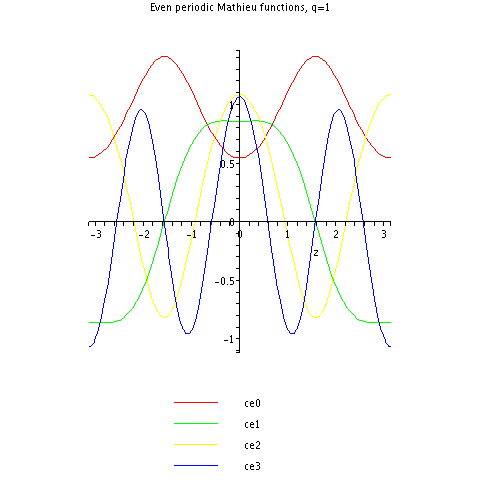
For positive values of q, the following is true: :C(a_n(q), q, x) = \frac{CE(n, q, x)}{CE(n, q, 0)}, :S(b_n(q), q, x) = \frac{SE(n, q, x)}{SE'(n, q, 0)}. Here are the first few periodic Mathieu cosine functions for q = 1.
Note that, for example, CE(1, 1, x) (green) resembles a cosine function, but with flatter hills and shallower valleys.
References
Bibliography
- Muhammad Ayub, Atom Optics Quantum Pendulum, 2011, Islamabad, Pakistan., https://arxiv.org/abs/1012.6011
References
- (2021-08-18). "Exploring quantum gravity—for whom the pendulum swings.". NIST.
- Ayub, Muhammad. (2009-05-01). "Atom optics quantum pendulum". Journal of Russian Laser Research.
This article was imported from Wikipedia and is available under the Creative Commons Attribution-ShareAlike 4.0 License. Content has been adapted to SurfDoc format. Original contributors can be found on the article history page.
Ask Mako anything about Quantum pendulum — get instant answers, deeper analysis, and related topics.
Research with MakoFree with your Surf account
Create a free account to save articles, ask Mako questions, and organize your research.
Sign up freeThis content may have been generated or modified by AI. CloudSurf Software LLC is not responsible for the accuracy, completeness, or reliability of AI-generated content. Always verify important information from primary sources.
Report