From Surf Wiki (app.surf) — the open knowledge base
Pyrite
Iron (II) disulfide mineral

Iron (II) disulfide mineral
| Field | Value |
|---|---|
| name | Pyrite |
| category | Sulfide mineral |
| image | Pyrite - Huanzala mine, Huallanca, Bolognesi, Ancash, Peru.jpg |
| imagesize | 260px |
| caption | Intergrowth of lustrous, cubic crystals of pyrite, with some surfaces showing characteristic striations, from Huanzala mine, Ancash, Peru. Specimen size: 7.0 × 5.0 × 2.5 cm |
| formula | FeS2 |
| IMAsymbol | Py |
| molweight | 119.98 g/mol |
| strunz | 2.EB.05a |
| dana | 2.12.1.1 |
| system | Cubic |
| class | Diploidal (m) |
| H-M symbol: (2/m ) | |
| symmetry | *P*a |
| unit cell | a = 5.417 Å, Z = 4 |
| color | Pale brass-yellow reflective; tarnishes darker and iridescent |
| habit | Cubic, faces may be striated, but also frequently octahedral and pyritohedral. Often inter-grown, massive, radiated, granular, globular, and stalactitic. |
| twinning | Penetration and contact twinning |
| cleavage | Indistinct on {001}; partings on {011} and {111} |
| fracture | Very uneven, sometimes conchoidal |
| tenacity | Brittle |
| mohs | 6–6.5 |
| luster | Metallic, glistening |
| streak | Greenish-black to brownish-black |
| gravity | 4.95–5.10 |
| density | 4.8–5 g/cm3 |
| fusibility | 2.5–3 to a magnetic globule |
| solubility | Insoluble in water |
| diaphaneity | Opaque |
| other | Diamagnetic to paramagnetic |
| A semiconductor with bandgap of 0.72 to 3.26 eV. | |
| references |
H-M symbol: (2/m ) A semiconductor with bandgap of 0.72 to 3.26 eV.
The mineral pyrite ( ), or iron pyrite, also known as fool's gold, is an iron sulfide with the chemical formula FeS2 (iron (II) disulfide). Pyrite is the most abundant sulfide mineral.
Pyrite's metallic luster and pale brass-yellow hue give it a superficial resemblance to gold, hence the well-known nickname of fool's gold. The color has also led to the nicknames brass, brazzle, and brazil, primarily used to refer to pyrite found in coal.
The name pyrite is derived from the Greek πυρίτης λίθος (pyritēs lithos), 'stone or mineral which strikes fire', in turn from πῦρ (pŷr), 'fire'. In ancient Roman times, this name was applied to several types of stone that would create sparks when struck against steel; Pliny the Elder described one of them as being brassy, almost certainly a reference to what is now called pyrite.
By Georgius Agricola's time, , the term had become a generic term for all of the sulfide minerals.
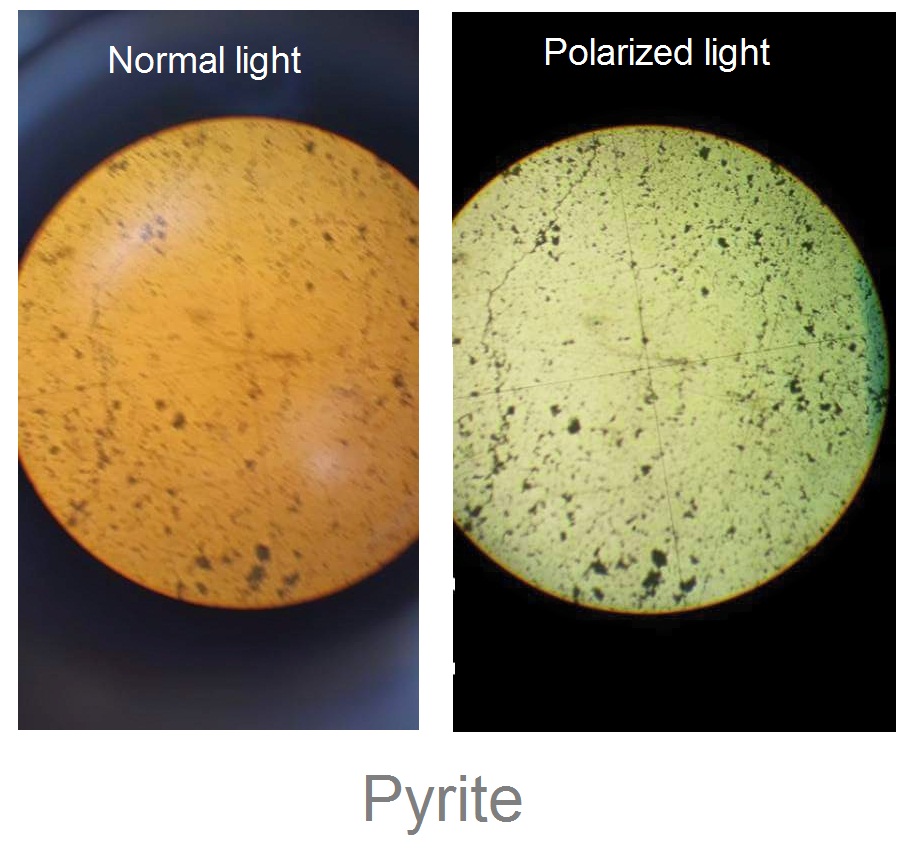
Pyrite is usually found associated with other sulfides or oxides in quartz veins, sedimentary rock, and metamorphic rock, as well as in coal beds and as a replacement mineral in fossils, but has also been identified in the sclerites of scaly-foot gastropods. Despite being nicknamed "fool's gold", pyrite is sometimes found in association with small quantities of gold. A substantial proportion of the gold is "invisible gold" incorporated into the pyrite. It has been suggested that the presence of both gold and arsenic is a case of coupled substitution but as of 1997 the chemical state of the gold remained controversial.
Uses
Pyrite gained a brief popularity in the 16th and 17th centuries as a source of ignition in early firearms, most notably the wheellock, where a sample of pyrite was placed against a circular file to strike the sparks needed to fire the gun.
The Kaurna people of South Australia use pyrite with flintstone and a form of tinder made of stringybark as a traditional method of starting fires.
Pyrite has been used since classical times to manufacture copperas (ferrous sulfate). Iron pyrite was heaped up and allowed to weather (an example of an early form of heap leaching). The acidic runoff from the heap was then boiled with iron to produce iron sulfate. In the 15th century, new methods of such leaching began to replace the burning of sulfur as a source of sulfuric acid. By the 19th century it had become the dominant method.
Pyrite remains in commercial use for the production of sulfur dioxide, for use in such applications as the paper industry, and in the manufacture of sulfuric acid. Thermal decomposition of pyrite into FeS (iron(II) sulfide) and elemental sulfur starts at 540 C; at around 700 C, pS2 is about 1 atm.
A newer commercial use for pyrite is as the cathode material in Energizer brand non-rechargeable lithium metal batteries.
Pyrite is a semiconductor material with a band gap of 0.95 eV. Pure pyrite is naturally n-type, in both crystal and thin-film forms, potentially due to sulfur vacancies in the pyrite crystal structure acting as n-dopants.
During the early years of the 20th century, pyrite was used as a mineral detector in radio receivers, and is still used by crystal radio hobbyists. Until the vacuum tube matured, the crystal detector was the most sensitive and dependable detector available—with considerable variation between mineral types and even individual samples within a particular type of mineral. Pyrite detectors occupied a midway point between galena detectors and the more mechanically complicated perikon mineral pairs. Pyrite detectors can be as sensitive as a modern 1N34A germanium diode detector.
Pyrite has been proposed as an abundant, non-toxic, inexpensive material in low-cost photovoltaic solar panels. Synthetic iron sulfide was used with copper sulfide to create the photovoltaic material. More recent efforts are working toward thin-film solar cells made entirely of pyrite.
Pyrite is used to make marcasite jewelry. Marcasite jewelry, using small faceted pieces of pyrite, often set in silver, has been made since ancient times and was popular in the Victorian era. At the time when the term became common in jewelry making, "marcasite" referred to all iron sulfides including pyrite, and not to the orthorhombic FeS2 mineral marcasite which is lighter in color, brittle and chemically unstable, and thus not suitable for jewelry making. Marcasite jewelry does not actually contain the mineral marcasite. The specimens of pyrite, when it appears as good quality crystals, are used in decoration. They are also very popular in mineral collecting. Among the sites that provide the best specimens are Soria and La Rioja provinces (Spain).
In value terms, China ($47 million) constitutes the largest market for imported unroasted iron pyrites worldwide, making up 65% of global imports. China is also the fastest growing in terms of the unroasted iron pyrites imports, with a CAGR of +27.8% from 2007 to 2016.
Research
In July 2020 scientists reported that they have observed a voltage-induced transformation of normally diamagnetic pyrite into a ferromagnetic material, which may lead to applications in devices such as solar cells or magnetic data storage.
Researchers at Trinity College Dublin, Ireland have demonstrated that FeS2 can be exfoliated into few-layers just like other two-dimensional layered materials such as graphene by a simple liquid-phase exfoliation route. This is the first study to demonstrate the production of non-layered 2D-platelets from 3D bulk FeS2. Furthermore, they have used these 2D-platelets with 20% single walled carbon-nanotube as an anode material in lithium-ion batteries, reaching a capacity of 1000 mAh/g close to the theoretical capacity of FeS2.
In 2021, a natural pyrite stone has been crushed and pre-treated followed by liquid-phase exfoliation into two-dimensional nanosheets, which has shown capacities of 1200 mAh/g as an anode in lithium-ion batteries.
Formal oxidation states for pyrite, marcasite, molybdenite and arsenopyrite
From the perspective of classical inorganic chemistry, which assigns formal oxidation states to each atom, pyrite and marcasite are probably best described as Fe2+[S2]2−. This formalism recognizes that the sulfur atoms in pyrite occur in pairs with clear S–S bonds. These persulfide [−S–S−] units can be viewed as derived from hydrogen disulfide, H2S2. Thus pyrite would be more descriptively called iron persulfide, not iron disulfide. In contrast, molybdenite, MoS2, features isolated sulfide S2− centers and the oxidation state of molybdenum is Mo4+. The mineral arsenopyrite has the formula FeAsS. Whereas pyrite has [S2]2− units, arsenopyrite has [AsS]3− units, formally derived from deprotonation of arsenothiol (H2AsSH). Analysis of classical oxidation states would recommend the description of arsenopyrite as Fe3+[AsS]3−.
Crystallography
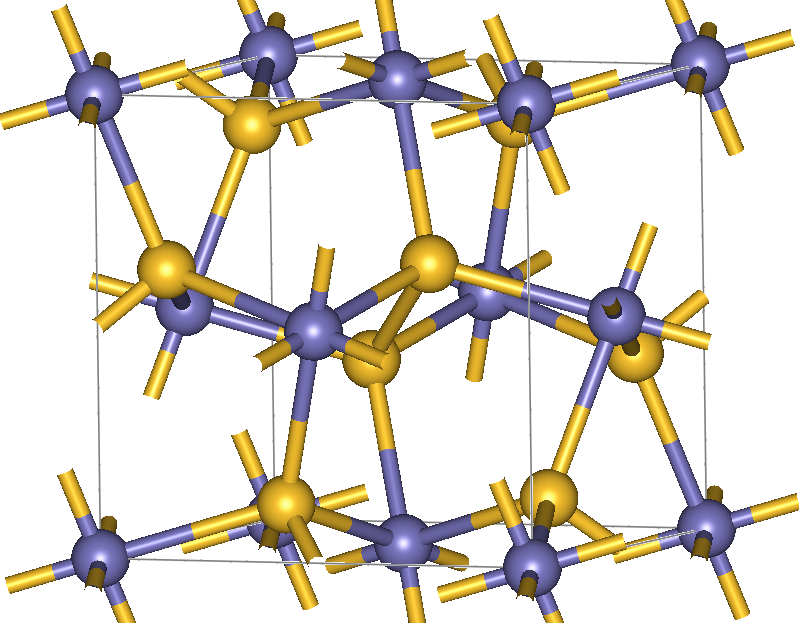
Iron-pyrite FeS2 represents the prototype compound of the crystallographic pyrite structure. The structure is cubic and was among the first crystal structures solved by X-ray diffraction. It belongs to the crystallographic space group Pa and is denoted by the Strukturbericht notation C2. Under thermodynamic standard conditions the lattice constant a of stoichiometric iron pyrite FeS2 amounts to 541.87 pm. The unit cell is composed of a Fe face-centered cubic sublattice into which the ions are embedded. (Note though that the iron atoms in the faces are not equivalent by translation alone to the iron atoms at the corners.) The pyrite structure is also seen in other MX2 compounds of transition metals M and chalcogens X = O, S, Se and Te. Certain dipnictides with X standing for P, As and Sb etc. are also known to adopt the pyrite structure.
The Fe atoms are bonded to six S atoms, giving a distorted octahedron. The material is a semiconductor. The Fe ions are usually considered to be low spin divalent state (as shown by Mössbauer spectroscopy as well as XPS). The material as a whole behaves as a Van Vleck paramagnet, despite its low-spin divalency.
The sulfur centers occur in pairs, described as . Reduction of pyrite with potassium gives potassium dithioferrate, KFeS2. This material features ferric ions and isolated sulfide (S2−) centers.
The S atoms are tetrahedral, being bonded to three Fe centers and one other S atom. The site symmetry at Fe and S positions is accounted for by point symmetry groups C3i and C3, respectively. The missing center of inversion at S lattice sites has important consequences for the crystallographic and physical properties of iron pyrite. These consequences derive from the crystal electric field active at the sulfur lattice site, which causes a polarization of S ions in the pyrite lattice. The polarisation can be calculated on the basis of higher-order Madelung constants and has to be included in the calculation of the lattice energy by using a generalised Born–Haber cycle. This reflects the fact that the covalent bond in the sulfur pair is inadequately accounted for by a strictly ionic treatment.
Arsenopyrite has a related structure with heteroatomic As–S pairs rather than S-S pairs. Marcasite also possesses homoatomic anion pairs, but the arrangement of the metal and diatomic anions differs from that of pyrite. Despite its name, chalcopyrite () does not contain dianion pairs, but single S2− sulfide anions.
Crystal habit
Pyrite usually forms cuboid crystals, sometimes forming in close association to form raspberry-shaped masses called framboids. However, under certain circumstances, it can form anastomosing filaments or T-shaped crystals. Pyrite can also form shapes almost the same as a regular dodecahedron, known as pyritohedra, and this suggests an explanation for the artificial geometrical models found in Europe as early as the 5th century BC.
Varieties
Cattierite (CoS2), vaesite (NiS2) and hauerite (MnS2), as well as sperrylite (PtAs2) are similar in their structure and belong also to the pyrite group.
**** is a nickel-cobalt bearing variety of pyrite, with 50% substitution of Ni2+ for Fe2+ within pyrite. Bravoite is not a formally recognised mineral, and is named after the Peruvian scientist Jose J. Bravo (1874–1928).
Distinguishing similar minerals
Pyrite is distinguishable from native gold by its hardness, brittleness and crystal form. Pyrite fractures are very uneven, sometimes conchoidal because it does not cleave along a preferential plane. Native gold nuggets, or glitters, do not break but deform in a ductile way. Pyrite is brittle, gold is malleable. Natural gold tends to be anhedral (irregularly shaped without well defined faces), whereas pyrite comes as either cubes or multifaceted crystals with well developed and sharp faces easy to recognise. Well crystallised pyrite crystals are euhedral (i.e., with nice faces). Pyrite can often be distinguished by the striations which, in many cases, can be seen on its surface.
Chalcopyrite () is brighter yellow with a greenish hue when wet and is softer (3.5–4 on Mohs' scale). Arsenopyrite (FeAsS) is silver white and does not become more yellow when wet.
Hazards

Iron pyrite is unstable when exposed to the oxidizing conditions prevailing at the Earth's surface: iron pyrite in contact with atmospheric oxygen and water, or damp, ultimately decomposes into iron oxyhydroxides (ferrihydrite, FeO(OH)) and sulfuric acid (). This process is accelerated by the action of Acidithiobacillus bacteria which oxidize pyrite to first produce ferrous ions (), sulfate ions (), and release protons (, or ). In a second step, the ferrous ions () are oxidized by into ferric ions () which hydrolyze also releasing ions and producing FeO(OH). These oxidation reactions occur more rapidly when pyrite is finely dispersed (framboidal crystals initially formed by sulfate reducing bacteria (SRB) in argillaceous sediments or dust from mining operations).
Pyrite oxidation and acid mine drainage
Main article: Acid mine drainage
Pyrite oxidation by atmospheric in the presence of moisture () initially produces ferrous ions () and sulfuric acid which dissociates into sulfate ions and protons, leading to acid mine drainage (AMD). An example of acid rock drainage caused by pyrite is the 2015 Gold King Mine waste water spill.
:
Dust explosions
Pyrite oxidation is sufficiently exothermic that underground coal mines in high-sulfur coal seams have occasionally had serious problems with spontaneous combustion. The solution is the use of buffer blasting and the use of various sealing or cladding agents to hermetically seal the mined-out areas to exclude oxygen.
In modern coal mines, limestone dust is sprayed onto the exposed coal surfaces to reduce the hazard of dust explosions. This has the secondary benefit of neutralizing the acid released by pyrite oxidation and therefore slowing the oxidation cycle described above, thus reducing the likelihood of spontaneous combustion. In the long term, however, oxidation continues, and the hydrated sulfates formed may exert crystallization pressure that can expand cracks in the rock and lead eventually to roof fall.
Weakened building materials
Main article: Concrete degradation, Sulfate attack in concrete and mortar
Building stone containing pyrite tends to stain brown as the pyrite oxidizes. This problem appears to be significantly worse if any marcasite is present. The presence of pyrite in the aggregate used to make concrete can lead to severe deterioration as pyrite oxidizes. In early 2009, problems with Chinese drywall imported into the United States after Hurricane Katrina were attributed to pyrite oxidation, followed by microbial sulfate reduction which released hydrogen sulfide gas (). These problems included a foul odor and corrosion of copper wiring. In the United States, in Canada, and more recently in Ireland, where it was used as underfloor infill, pyrite contamination has caused major structural damage. Concrete exposed to sulfate ions, or sulfuric acid, degrades by sulfate attack: the formation of expansive mineral phases, such as ettringite (small needle crystals exerting a huge crystallization pressure inside the concrete pores) and gypsum creates inner tensile forces in the concrete matrix which destroy the hardened cement paste, form cracks and fissures in concrete, and can lead to the ultimate ruin of the structure. Normalized tests for construction aggregate certify such materials as free of pyrite or marcasite.
Occurrence
Pyrite is the most common of sulfide minerals and is widespread in igneous, metamorphic, and sedimentary rocks. It is a common accessory mineral in igneous rocks, where it also occasionally occurs as larger masses arising from an immiscible sulfide phase in the original magma. It is found in metamorphic rocks as a product of contact metamorphism. It also forms as a high-temperature hydrothermal mineral, though it occasionally forms at lower temperatures.
Pyrite occurs both as a primary mineral, present in the original sediments, and as a secondary mineral, deposited during diagenesis. Pyrite and marcasite commonly occur as replacement pseudomorphs after fossils in black shale and other sedimentary rocks formed under reducing environmental conditions. Pyrite is common as an accessory mineral in shale, where it is formed by precipitation from anoxic seawater, and coal beds often contain significant pyrite.
Notable deposits are found as lenticular masses in Virginia, U.S., and in smaller quantities in many other locations. Large deposits are mined at Rio Tinto in Spain and elsewhere in the Iberian Peninsula.
Cultural beliefs
In the beliefs of the Thai people (especially those in the south), pyrite is known as Khao tok Phra Ruang, Khao khon bat Phra Ruang (ข้าวตอกพระร่วง, ข้าวก้นบาตรพระร่วง) or Phet na tang, Hin na tang (เพชรหน้าทั่ง, หินหน้าทั่ง). It is believed to be a sacred item that has the power to prevent evil, black magic or demons.
Gallery
File:Bullypyrite2.jpg|Pyrite as a replacement mineral in an ammonite from France File:Pyrite from Ampliación a Victoria Mine, Navajún, La Rioja, Spain 2.jpg|Pyrite from Ampliación a Victoria Mine, Navajún, La Rioja, Spain File:Pyrite-Tetrahedrite-Quartz-184642.jpg|Pyrite from the Sweet Home Mine, with golden striated cubes intergrown with minor tetrahedrite, on a bed of transparent quartz needles File:Pyrite-200582.jpg|Radiating form of pyrite File:Paraspirifer bownockeri.fond.jpg|Paraspirifer bownockeri in pyrite File:Fluorite-Pyrite-tmu38b.jpg|Pink fluorite perched between pyrite (left) and metallic galena (right) File:Pyrite in pyrrhotite SEM image.png|SEM image of intergrowth of pyrite cuboctahedral crystals (yellow) and pyrrhotite (pinkish yellow)
References
References
- Warr, L.N.. (2021). "IMA–CNMNC approved mineral symbols". Mineralogical Magazine.
- (1985). "Manual of Mineralogy". John Wiley and Sons.
- "Pyrite".
- "Pyrite".
- (1990). "Handbook of Mineralogy". Mineralogical Society of America.
- "Pyrite | meaning in the Cambridge English Dictionary".
- (1970). "Sulfide Deposits in the Coosa Valley Area, Georgia". Economic Development Administration, Technical Assistance Project, U.S. Department of Commerce.
- (2005). "Glossary of Geology". American Geological Institute.
- Fay, Albert H.. (1920). "A Glossary of the Mining and Mineral Industry". United States Bureau of Mines.
- {{LSJ. puri/ths1. πυρίτης. ref.
- {{LSJ. πῦρ. shortref.
- (1911). "Descriptive Mineralogy". Wiley.
- (1950). "De re metallica". Dover.
- "Armor-plated snail discovered in deep sea". National Geographic Society.
- (1997). "Gold-bearing arsenian pyrite and marcasite and arsenopyrite from Carlin Trend gold deposits and laboratory synthesis". American Mineralogist.
- Larson, Bruce. (2003). "An Interpretation of Firearms in the Archaeological Record in Virginia 1607-1625".
- Schultz, Chester. (22 October 2018). "Place Name Summary 6/23: Brukangga and Tindale's uses of the word bruki". [[University of Adelaide]].
- (1910-04-28). "Industrial England in the Middle of the Eighteenth Century". Nature.
- Rosenqvist, Terkel. (2004). "Principles of extractive metallurgy". Tapir Academic Press.
- (2017-09-19). "Lithium-Iron Disulfide (Li-FeS2)". Energizer Corporation.
- (2000-03-11). "Iron Disulfide (Pyrite) as Photovoltaic Material: Problems and Opportunities". Proceedings of the 12th Workshop on Quantum Solar Energy Conversion – (QUANTSOL 2000).
- (2017-06-19). "Potential resolution to the doping puzzle in iron pyrite: Carrier type determination by Hall effect and thermopower". Physical Review Materials.
- (1918). "The Principles Underlying Radio Communication".
- Thomas H. Lee. (2004). "The Design of Radio Frequency Integrated Circuits". Cambridge University Press.
- (2009). "Materials availability expands the opportunity for large-scale photovoltaics deployment". Environmental Science & Technology.
- Sanders, Robert. (17 February 2009). "Cheaper materials could be key to low-cost solar cells". University of California – Berkeley.
- Hesse, Rayner W.. (2007). "Jewelrymaking Through History: An Encyclopedia". [[Greenwood Publishing Group]].
- (1989). "Pyrite crystals from Soria and La Rioja provinces, Spain". The Mineralogical Record.
- "Which Country Imports the Most Unroasted Iron Pyrites in the World? – IndexBox".
- "'Fool's gold' may be valuable after all". phys.org.
- (1 July 2020). "Voltage-induced ferromagnetism in a diamagnet". Science Advances.
- (22 September 2020). "Production of Quasi-2D Platelets of Non-Layered Iron Pyrite (FeS2) by Liquid-Phase Exfoliation for High Performance Battery Electrodes". ACS Nano.
- (November 2021). "2D nanosheets from fool's gold by LPE:High performance lithium-ion battery anodes made from stone". FlatChem.
- (1978). "Mineral Chemistry of Metal Sulfides". Cambridge University Press.
- Bragg, W. L.. (1913). "The structure of some crystals as indicated by their diffraction of X-rays". [[Proceedings of the Royal Society A]].
- (1991). "Sulfur deficiency in iron pyrite (FeS2−x) and its consequences for band structure models". Physical Review B.
- (1994). "Bonding Trends in Pyrites and a Reinvestigation of the Structure of PdAs2, PdSb2, PtSb2 and PtBi2". Z. Anorg. Allg. Chem..
- (1977-04-01). "Magnetic susceptibility of iron pyrite (FeS2) between 4.2 and 620 K". Solid State Communications.
- (December 1963). "Electrical Properties of Pyrite-Type and Related Compounds with Zero Spin Moment". Nature.
- Birkholz, M.. (1992). "The crystal energy of pyrite". J. Phys.: Condens. Matter.
- (August 1962). "Madelung Constants for the Calcium Carbide and Pyrite Crystal Structures". The Journal of Chemical Physics.
- (2005). "Genesis of filamentary pyrite associated with calcite crystals". European Journal of Mineralogy.
- The pyritohedral form is described as a dodecahedron with [[pyritohedral symmetry]]; Dana J. et al., (1944), ''System of mineralogy'', New York, p 282
- [http://www.mindat.org/min-759.html Mindat – bravoite]. Mindat.org (2011-05-18). Retrieved on 2011-05-25.
- [http://www.minerals.net/mineral/sulfides/pyrite/pyrite.htm Pyrite on]. Minerals.net (2011-02-23). Retrieved on 2011-05-25.
- "Acid Mine Drainage".
- (December 2015). "Effects of pyrite on the spontaneous combustion of coal". International Journal of Coal Science & Technology.
- (17 November 2019). "A review of spontaneous combustion studies – South African context". International Journal of Mining, Reclamation and Environment.
- Zodrow, E. (2005). "Colliery and surface hazards through coal-pyrite oxidation (Pennsylvanian Sydney Coalfield, Nova Scotia, Canada)". International Journal of Coal Geology.
- Bowles, Oliver (1918) [https://books.google.com/books?id=OksMAAAAYAAJ&lpg=PA25&pg=PA25 The structural and ornamental stones of Minnesota]. Bulletin 663, United States Geological Survey, Washington. p. 25.
- (2005). "Internal deterioration of concrete by the oxidation of pyrrhotitic aggregates". Cement and Concrete Research.
- Angelo, William (28 January 2009) [http://www.enr.com/articles/2472-a-material-odor-mystery-over-foul-smelling-drywall A material odor mystery over foul-smelling drywall]. Engineering News-Record.
- "[https://acqc.ca/sites/default/files/pdf/pyrihouse.pdf Pyrite and your house, what home-owners should know] {{webarchive. link. (2012-01-06" – {{ISBN). 2-922677-01-X – Legal deposit – National Library of Canada, May 2000
- Shrimer, F. and Bromley, AV (2012) "Pyritic Heave in Ireland". ''Proceedings of the Euroseminar on Building Materials''. International Cement Microscopy Association (Halle Germany)
- [http://www.irishtimes.com/newspaper/ireland/2011/0611/1224298735366.html Homeowners in protest over pyrite damage to houses]. The Irish Times (11 June 2011
- Brennan, Michael (22 February 2010) [http://www.independent.ie/irish-news/devastating-pyrite-epidemic-hits-20000-newly-built-houses-26634603.html Devastating 'pyrite epidemic' hits 20,000 newly built houses]. ''Irish Independent''
- I.S. EN 13242:2002 [https://www.roadstone.ie/revision-s-r-21/ Aggregates for unbound and hydraulically bound materials for use in civil engineering work and road construction] {{webarchive. link. (2018-08-02)
- (1996-06-01). "Controls on the pyritization of exceptionally preserved fossils; an analysis of the Lower Devonian Hunsrueck Slate of Germany". American Journal of Science.
- Nesse, William D.. (2000). "Introduction to mineralogy". Oxford University Press.
- J.M. Leistel, E. Marcoux, D. Thiéblemont, C. Quesada, A. Sánchez, G.R. Almodóvar, E. Pascualand R. Sáez. (1997). "The volcanic-hosted massive sulphide deposits of the Iberian Pyrite Belt". Mineralium Deposita.
- (2019-10-11). "ไขข้อข้องใจ'เพชรหน้าทั่ง' สรรพคุณรองจาก'เหล็กไหล'". Daily News (Thailand).
- (2021-02-17). "ของดีหายาก "ข้าวตอกพระร่วง-ข้าวก้นบาตรพระร่วง" หินศักดิ์สิทธิ์แห่งกรุงสุโขทัย". Komchadluek.
This article was imported from Wikipedia and is available under the Creative Commons Attribution-ShareAlike 4.0 License. Content has been adapted to SurfDoc format. Original contributors can be found on the article history page.
Ask Mako anything about Pyrite — get instant answers, deeper analysis, and related topics.
Research with MakoFree with your Surf account
Create a free account to save articles, ask Mako questions, and organize your research.
Sign up freeThis content may have been generated or modified by AI. CloudSurf Software LLC is not responsible for the accuracy, completeness, or reliability of AI-generated content. Always verify important information from primary sources.
Report