From Surf Wiki (app.surf) — the open knowledge base
Punjab, Pakistan
Province of Pakistan
_region,_showing_the_various_doabs,_ca.1880.jpg)
Province of Pakistan
| Field | Value | ||||
|---|---|---|---|---|---|
| name | Punjab | ||||
| official_name | Province of Punjab | ||||
| native_name | |||||
| type | Province | ||||
| image_skyline | {{Multiple image | ||||
| border | infobox | ||||
| total_width | 280 | ||||
| image_style | border:1; | ||||
| perrow | 1/2/2 | ||||
| image1 | Royal mosque Lahore.jpg | ||||
| caption1 | Badshahi Mosque | ||||
| image2 | Derawar Fort, Bahawalpur I.jpg | ||||
| caption2 | Derawar Fort | ||||
| image3 | Lahore Fort view from Baradari.jpg | ||||
| caption3 | Lahore Fort | ||||
| image4 | Sakina sughra mosque jatoi.jpg | ||||
| caption4 | Jamia Sakeena-Tul-Sughra | ||||
| image5 | Shah Rukn-e-Alam Shrine.jpg | ||||
| caption5 | Tomb of Shah Rukn-e-Alam | ||||
| image6 | Khewra Salt Mines landscape IMG 3127.jpg | ||||
| caption6 | Khewra Salt Mines | ||||
| image_flag | Flag of Punjab.svg | ||||
| image_seal | Coat of arms of Punjab.svg | ||||
| etymology | Persian *panj āb* ('five waters') | ||||
| image_map | Punjab in Pakistan (claims hatched).svg | ||||
| map_caption | Location of Punjab within Pakistan | ||||
| coordinates | |||||
| subdivision_type | Country | ||||
| subdivision_name | Pakistan | ||||
| parts_type | Administrative Divisions | ||||
| parts_style | coll,para | ||||
| parts | 10 | ||||
| p1 | |||||
| established_title | Established | ||||
| established_date | |||||
| established_title1 | Before was | ||||
| established_date1 | Part of West Pakistan | ||||
| seat_type | Capital | ||||
| and largest city | |||||
| seat | Lahore | ||||
| blank_name_sec1 | Official languages | ||||
| blank_info_sec1 | |||||
| blank1_name_sec1 | Provincial language | ||||
| blank1_info_sec1 | Punjabi | ||||
| blank2_name_sec1 | Provincial sports teams | ||||
| blank2_info_sec1 | {{Collapsible list | ||||
| title | *List:* | ||||
| blank5_name_sec1 | HDI (2017) | ||||
| blank5_info_sec1 | 0.732 | ||||
| blank3_name_sec1 | Literacy rate (2023) | ||||
| blank3_info_sec1 | |||||
| blank4_name_sec1 | National Assembly seats | ||||
| blank4_info_sec1 | 183 | ||||
| blank_name_sec2 | Provincial Assembly seats | ||||
| blank_info_sec2 | 371 | ||||
| blank1_name_sec2 | Divisions | ||||
| blank1_info_sec2 | 10 | ||||
| blank2_name_sec2 | Districts | ||||
| blank2_info_sec2 | 41 | ||||
| blank3_name_sec2 | Tehsils | ||||
| blank3_info_sec2 | 148 | ||||
| blank4_name_sec2 | Union councils | ||||
| blank4_info_sec2 | 7602 | ||||
| demographics1_info1 | $225 billion (1st) | ||||
| population_demonym | Punjabi | ||||
| demographics_type1 | GDP (nominal) | ||||
| demographics1_title1 | Total (2022) | ||||
| demographics1_title2 | Per Capita | ||||
| demographics_type2 | GDP (PPP) | ||||
| demographics2_title1 | Total (2022) | ||||
| demographics2_info1 | $925 billion (1st){{efn | name=g | Punjab's contribution to national economy was 60.58%, or $925 billion (PPP) and $225 billion (nominal) in 2022.{{Cite web | url=https://kpbos.gov.pk/assets/docs/reports/NTL-PolicyBrief-Aug-1.pdf | title= |
| GDP OF KHYBER PUKHTUNKHWA'S DISTRICTS | website | kpbos.gov.pk}}}} | |||
| demographics1_title3 | Per Capita | ||||
| demographics1_info3 | $2,003 (2nd) | ||||
| demographics2_title2 | Per Capita | ||||
| demographics2_info2 | $8,027 (2nd) | ||||
| government_type | Self-governing province subject to the federal government | ||||
| governing_body | Government of Punjab | ||||
| leader_title | Governor | ||||
| leader_name | Sardar Saleem Haider Khan | ||||
| leader_title1 | Chief Minister | ||||
| leader_name1 | Maryam Nawaz | ||||
| leader_title2 | Chief Secretary | ||||
| leader_name2 | Zahid Akhtar Zaman | ||||
| leader_title3 | Legislature | ||||
| leader_name3 | Provincial Assembly | ||||
| leader_title4 | High Court | ||||
| leader_name4 | Lahore High Court | ||||
| unit_pref | Metric | ||||
| area_total_km2 | 205344 | ||||
| area_rank | 2nd | ||||
| population_footnotes | |||||
| population_total | 127,688,922 | ||||
| population_as_of | [2023 census](2023-census-of-pakistan) | ||||
| population_rural | 75,712,955 (59.29%) | ||||
| population_rank | 1st | ||||
| population_density_km2 | 622 | ||||
| population_urban | 51,975,967 (40.71%) | ||||
| timezone1 | PKT | ||||
| utc_offset1 | +05:00 | ||||
| website | |||||
| iso_code | PK-PB | ||||
| native_name_lang | pa | ||||
| flag_size | 125px | ||||
| seal_size | 105px |
the Pakistani province of Punjab
and largest city | Lahore Qalandars | Multan Sultans | Lahore Lions | Rawalpindi Rams | Sialkot Stallions | Bahawalpur Stags | Multan Tigers | Faisalabad Wolves | Central Punjab | Southern Punjab GDP OF KHYBER PUKHTUNKHWA'S DISTRICTS|website=kpbos.gov.pk}}}}
Punjab ( ; , ) is a province of Pakistan. With a population of over 127 million, it is the most populous province in Pakistan and the second most populous subnational polity in the world. Located in the central-eastern region of the country, it has the largest economy, contributing the most to national GDP in Pakistan. Lahore is the capital and largest city of the province. Other major cities include Faisalabad, Rawalpindi, Gujranwala and Multan.
It is bordered by the Pakistani provinces of Khyber Pakhtunkhwa to the north-west, Balochistan to the south-west and Sindh to the south, as well as Islamabad Capital Territory to the north-west and Azad Kashmir to the north. It shares an international border with the Indian states of Rajasthan and Punjab to the east and Indian-administered Kashmir to the north-east. Punjab is the most fertile province of the country as the Indus River and its four major tributaries Ravi, Jhelum, Chenab, and Sutlej flow through it.
The province forms the bulk of the transnational Punjab region, partitioned in 1947 between Pakistan and India. The province is represented in the federal parliament through 173, out of 336, seats in National Assembly, the lower house; and 23, out of 96, seats in Senate, the upper house.
Punjab is Pakistan's most industrialised province, with the industrial sector comprising 24 per cent of the province's gross domestic product. It is known for its relative prosperity, and has the lowest rate of poverty among all Pakistani provinces. However, a clear divide is present between the northern and southern regions of the province; with northern Punjab being relatively more developed than southern Punjab. Punjab is also one of the most urbanised regions of South Asia, with approximately 40 per cent of its population being concentrated in urban areas.
Punjabi Muslims form majority of the province. Their culture has been strongly influenced by Islamic culture and Sufism, with a number of Sufi shrines spread across the province. Guru Nanak, the founder of Sikhism, was born in the town of Nankana Sahib. Punjab hosts several of the UNESCO World Heritage Sites, including the Shalimar Gardens, the Lahore Fort, the archaeological excavations at Taxila, and the Rohtas Fort, among others.
Etymology
The name "Punjab" consists of two parts ( and ), of Persian origin which are cognates of the Sanskrit words ( and ). The word pañj-āb is the calque of Indo-Aryan pañca-áp and means "The Land of Five Waters", referring to the rivers Jhelum, Chenab, Ravi, Sutlej, and Beas. All are tributaries of the Indus River, the Sutlej being the largest. References to a land of five rivers are found in the Mahabharata, in which one of the regions is named as Panchanada (). The ancient Greeks referred to the region as Pentapotamía (), of the same meaning as that of Punjab.Lassen, Christian. 1827. *Commentatio Geographica atque Historica de Pentapotamia Indica * [A Geographical and Historical Commentary on Indian Pentapotamia]. Weber. p. 4:
"That part of India which today we call by the Persian name Penjab is named Panchanada in the sacred language of the Indians; either of which names may be rendered in Greek by Πενταποταμια. The Persian origin of the former name is not at all in doubt, although the words of which it is composed are both Indian and Persian.... But, in truth, that final word is never, to my knowledge, used by the Indians in proper names compounded in this way; on the other hand, there exist multiple Persian names which end with that word, e.g., Doab and Nilab. Therefore, it is likely that the name Penjab, which is now found in all geographical books, is of more recent origin and can be attributed to the Muslim kings of India, among whom the Persian language was predominantly in use. That the Indian name Panchanada is ancient and genuine is evident from the fact that it is already seen in the Ramayana and Mahabharata, the most ancient Indian poems, and that no other exists in addition to it among the Indians; for Panchála, which English translations of the Ramayana render with Penjab...is the name of another region, entirely distinct from Pentapotamia...." Earlier, Punjab was also known as Sapta Sindhu in the Rigveda and Hapta Hendu in the Avesta, translating into "The Land of Seven Rivers"; the other two being Indus and Kabul which are included in the greater Punjab region. The current name gained currency during the Mughal period.
History
Main article: History of Punjab
Ancient period
It is believed that the earliest evidence of human habitation in Punjab traces to the Soan Valley of the Pothohar, between the Indus and the Jhelum rivers, where Soanian culture developed between 774,000 BC and 11,700 BC. This period goes back to the first interglacial period in the second Ice Age, from which remnants of stone and flint tools have been found. The Punjab region was the site of one of the earliest cradle of civilisations, the Bronze Age Harrapan civilisation that flourished from about 3000 B.C. and declined rapidly 1,000 years later, following the Indo-Aryan migrations that overran the region in waves between 1500 and 500 B.C. The migrating Indo-Aryan tribes gave rise to the Iron Age Vedic civilisation, which lasted till 500 BC. During this era, the Rigveda was composed in Punjab, laying the foundation of Hinduism. Frequent intertribal wars in the post-Vedic period stimulated the growth of larger groupings ruled by chieftains and kings, who ruled local kingdoms known as Mahajanapadas. Achaemenid emperor Darius the Great, in 518 BCE crossed the Indus and annexe the regions up to the Jhelum River. Taxila is considered to be the site of one of the oldest education centre of South Asia and was part of the Achaemenid province of Hindush.
One of the early kings in Punjab was Porus, who fought the famous Battle of the Hydaspes against Alexander the Great. The battle is thought to have resulted in a decisive Greek victory; however, A. B. Bosworth warns against an uncritical reading of Greek sources who were obviously exaggerative. Porus refused to surrender and wandered about atop an elephant, until he was wounded and his force routed. When asked by Alexander how he wished to be treated, Porus replied "Treat me as a king would treat another king". Despite the apparently one-sided results, Alexander was impressed by Porus and chose to not depose him. Not only was his territory reinstated but also expanded with Alexander's forces annexing the territories of Glausaes, who ruled to the northeast of Porus' kingdom. The battle is historically significant because it resulted in the syncretism of ancient Greek political and cultural influences on the Indian subcontinent, yielding works such as Greco-Buddhist art, which continued to have an impact for the ensuing centuries.
Multan was the noted center of excellence of the region, which was attacked by the Greek army during the era of Alexander the Great. The Malli tribe, together with nearby tribes, gathered an army of 90,000-100,000 personnel to face the Greek army. This was perhaps the largest army faced by the Greeks in the entire Indian subcontinent. During the siege of the city's citadel, Alexander leaped into the inner area of the citadel, where he faced the Mallians' leader. Alexander was wounded by an arrow that had penetrated his lung, leaving him severely injured. The city was conquered after a fierce battle.
The region was then divided between the Maurya Empire and the Greco-Bactrian kingdom in 302 B.C.E. Menander I Soter conquered Punjab and made Sagala (present-day Sialkot) the capital of the Indo-Greek Kingdom. Menander is noted for becoming a patron and converting to Greco-Buddhism and he is widely regarded as the greatest of the Indo-Greek kings.
Medieval period
Following the Muslim conquests in the Indian subcontinent at the beginning of the 8th century, Arab armies of the Umayyad Caliphate penetrated South Asia, introducing Islam into the Punjab. First, Islam was introduced into the Southern Punjab in the opening decades of the eighth century. By the 16th century, Muslims were the majority in the region and an elaborate network of mosques and mausoleums marked the landscape. Local Punjabi Muslim converts constituted the majority of this Muslim community, and as far for the mechanisms of conversion, the sources of the period emphasise the recitation of the Islamic confession of faith (shahada), the performance of the circumcision, and the ingestion of cow-meat.
Islam emerged as the major power in Punjab after the Umayyad army led by Muhammad ibn al-Qasim conquered the region in 711 AD. The city of Multan became a centre of Islam. After the Umayyads conquered the key cities of Uch and Multan, they ruled the far areas of Punjab and included Kashmir. Islam spread rapidly.
According to local traditions, Baba Ratan Hindi was a trader from Punjab who was one of the non-Arab companions of Prophet Muhammad. He was reportedly a trader who used to take goods to Arabia. There is also a dargah named after him, the Haji Ratan Dargah, in Bathinda, where he settled after his conversion to Islam. Muslims who migrated to Pakistan during the partition of India in 1947 still venerate him as Baba Haji Ratan.
In the ninth century, the Hindu Shahi dynasty originating from the region of Oddiyana replaced the Taank kingdom in the Punjab, ruling much of Punjab along with eastern Afghanistan. In the 10th century, the tribe of the Gakhars/Khokhars, formed a large part of the Hindu Shahi army according to the Persian historian Firishta.
Ghaznavid
The Turkic Ghaznavids in the tenth century attacked the regions of Punjab. Multan and Uch were conquered after 3 attacks, and Multan's ruler, Abul Fateh Daud was defeated, famous Sun Temple was destroyed. Ghaznavids overthrew the Hindu Shahis and consequently ruled for 157 years, gradually declining as a power until the Ghurid conquests of key Punjab cities of Uch, Multan and Lahore by Muhammad of Ghor in 1186, deposing the last Ghaznavid ruler Khusrau Malik.
Following the death of Muhammad of Ghor in 1206, the Ghurid state fragmented and was replaced in northern India by the Delhi Sultanate, and for some time, independent sultanates ruled by various Sultans. The Delhi Sultanate ruled Punjab for the next three hundred years, led by five unrelated dynasties, the Mamluks, Khalajis, Tughlaqs, Sayyids and Lodis.
Delhi Sultanate
Tughlaqs
Ghiyath al-Din Tughlaq, the former governor of Multan and Dipalpur founded the Tughlaq dynasty in Delhi and ruled the subcontinent region. Earlier, he served as the governor of Multan and fought 28 battles against Mongols from there and saved Punjab and Sindh regions from the advances of Mongols and survived. After his death, his son Muhammad Tughlaq became the emperor.
Sayyid Dynasty
The 15th century saw the rise of many prominent Muslims from Punjab. Khizr Khan established the Sayyid dynasty, the fourth dynasty of the Delhi Sultanate, with four rulers ruling from 1414 to 1451 for 37 years.See:
- M. Reza Pirbha, Reconsidering Islam in a South Asian Context, , Brill
- The Islamic frontier in the east: Expansion into South Asia, Journal of South Asian Studies, 4(1), pp. 91–109
- Sookoohy M., Bhadreswar – Oldest Islamic Monuments in India, , Brill Academic; see discussion of earliest raids in Gujarat The first ruler of the dynasty, Khizr Khan, who was the Timurid vassal of Multan, conquered Delhi in 1414, while the rulers proclaimed themselves the Sultans of the Delhi Sultanate under Mubarak Shah, which succeeded the Tughlaq dynasty and ruled the Sultanate until they were displaced by the Lodi dynasty in 1451.
Khizr Khan was originally a noble in the Delhi Sultanate during the Tughlaq Dynasty and was the governor of Multan under Sultan Firuz Shah. He was expelled from the city by the Muin tribes under Sarang Khan who occupied Multan in 1395, an Indian Muslim and the brother of Mallu Iqbal Khan, who was the de facto ruler of Delhi. Sarang Khan was aided by the servants of Malik Mardan Bhatti, a former governor of Multan and the grandfather of Khizr Khan by adoption.
In 1398, Timur attacked the Punjab region. After his invasion, Khizr Khan established the fourth dynasty of the Delhi Sultanate. According to Richard M. Eaton, Khizr Khan was the son of a Punjabi chieftain. He was a Khokhar chieftain who travelled to Samarkand and profited from the contacts he made with the Timurid society.
Following Timur's 1398 Sack of Delhi, he appointed Khizr Khan as deputy of Multan (Punjab). He held Lahore, Dipalpur, Multan and Upper Sindh. Collecting his forces in Multan, Khizr Khan defeated and killed Mallu Iqbal Khan in Delhi in 1405. He then captured Delhi on 28 May 1414 thereby establishing the Sayyid dynasty. Khizr Khan did not take up the title of Sultan, but continued the fiction of his allegiance to Timur as Rayat-i-Ala (vassal) of the Timurids - initially that of Timur, and later his son Shah Rukh. After the accession of Khizr Khan, the Punjab, Uttar Pradesh and Sindh were reunited under the Delhi Sultanate, where he spent his time subduing rebellions.
Khizr Khan was succeeded by his son Sayyid Mubarak Shah after his death on 20 May 1421. Mubarak Shah referred to himself as Muizz-ud-Din Mubarak Shah on his coins, removing the Timurid name with the name of the Caliph, and declared himself a Shah. A detailed account of his reign is available in the Tarikh-i-Mubarak Shahi written by Yahya-bin-Ahmad Sirhindi. After the death of Mubarak Shah, his nephew, Muhammad Shah ascended the throne and styled himself as Sultan Muhammad Shah. Just before his death, he called his son Sayyid Ala-ud-Din Shah from Badaun, and nominated him as successor.
The last ruler of the Sayyids, Ala-ud-Din, voluntarily abdicated the throne of the Delhi Sultanate in favour of Bahlul Khan Lodi on 19 April 1451, and left for Badaun, where he died in 1478.[[File:Khizr_Khan_(4).jpg|thumb|180x180px|Silver copper coin of [[Khizr Khan]], founder of the [[Sayyid dynasty]].]]Langah Sultanate
In 1445, Sultan Qutbudin, chief of Langah tribe, established the Langah Sultanate in Multan. The Sultanate included regions of southern and central Punjab and some areas of present-day Khyber. A large number of Baloch settlers arrived and the towns of Dera Ghazi Khan and Dera Ismail Khan were founded.
During the most of 15th century, the Khokhars and Gakhars tribes were in general revolt in the Pothohar region. Jasrath Khokhar was one of their major chiefs who helped Sultan Zain Ul Abideen of Kashmir Sultanate to gain his throne and ruled over vast tracts of Jammu and North Punjab. He also conquered Delhi for a brief period in 1431 but was driven out by Mubarak Shah.
Modern period
Mughal Era
The Mughals came to power in the early sixteenth century and gradually expanded to control all of Punjab. During Mughal period Punjab region was divided into two provinces; Province of Multan and Province of Lahore. The Subah of Lahore was one of the three subahs (provinces) of the Mughal Empire in the Punjab region, alongside Multan and Delhi subahs, encompassing the northern, central and eastern Punjab. It was created as one of the original 12 Subahs of the Mughal Empire under the administrative reforms carried by Akbar in 1580. The province ceased to exist after the death of its last viceroy, Adina Beg in 1758, with large parts being incorporated into Durrani Empire. Collectively, Lahore and Multan subahs, and parts of Delhi subah, comprised Mughal Punjab.
During the Mughal era, Saadullah Khan, born into a family of Punjabi Muslim agriculturalist from Chiniot remained the Grand vizier and Vakil-i-Mutlaq of the Mughal Empire in the period 1645–1656, during the reign of Shah Jahan. Other prominent Muslims from Punjab who rose to nobility during the Mughal Era include Wazir Khan, Adina Beg Arain, and Shahbaz Khan Kamboh.
The Mughal Empire ruled the region until it was severely weakened in the eighteenth century. As Mughal power weakened, Afghan rulers of Durrani dynasty took control of the region.
The Sikh Empire ruled Punjab from 1799 until the British annexed it in 1849 following the First and Second Anglo-Sikh Wars.
18th Century Punjabi Muslim states
Chattha State (1750 - 1797)
The Chatthas under their leader Nur Muhammad Chattha declared independence from Mughal Empire in 1750 and formed the Chattha State.After Pir Muhammad Chattha's death his son Ghulam Muhammad Chattha inherited the Chattha state and the hatred of Sukerchakias. The rivalry was passed down to Mahan Singh and Ghulam Muhammad Chattha.
Under his leadership the Chathas gained several successes over the Sikhs,and it at one time looked as if the progress of the Sikh arms had been arrested and their dominion in the Doab annihilated.
Chattha State was annexed when Jan muhammad Chattha was killed in a siege led by Ranjit Singh when the latter recovered the lost Chattha state with Afghan aid.
Pakpattan state (1692–1810 CE)
Following the disintegration of the Mughal Empire, the shrine's Dīwān was able to forge a political independent state centered on Pakpattan. In 1757, Dīwān 'Abd as-Subḥān gathered an army of his Jat murīds, attacked the Raja of Bikaner, and thereby expanded the shrine's territorial holdings for the first time east of the Sutlej. Around 1776, the Dīwān, supported mainly by his Wattu murīds, successfully repelled an attack by the Sikh Nakai Misl, resulting in the death of the Nakai leader, Heera Singh Sandhu.
Sial State (1723 - 1816)
Sial state was established by the 13 Sial Chief Nawab Walidad Khan Sial in 1723. He gradually gained control of the lower Rachna doab, including the cities of Chiniot, Pindi Bhattian, Jhang and Mankera.
Next chief, Inayatullah Khan (r. 1747– 1787) was a successful general who won 22 battles against Bhangi Misl and the Multan chiefs.
Sikh Empire invaded Jhang multiple times from 1801 to 1816. Sial state was annexed by Sikh Empire and Ahmad Khan Sial was awarded a Jagir by Ranjit Singh.
British Rule
Most of the Punjabi homeland formed a province of British India, though a number of small princely states retained local rulers who recognised British authority. The Punjab with its rich farmlands became one of the most important colonial assets. Lahore was a noted center of learning and culture, and Rawalpindi became an important military installation.
Most Punjabis supported the British during World War I, providing men and resources to the war effort even though the Punjab remained a source of anti-colonial activities. Disturbances in the region increased as the war continued. At the end of the war, high casualty rates, heavy taxation, inflation, and a widespread influenza epidemic disrupted Punjabi society. In 1919 a British officer ordered his troops to fire on a crowd of demonstrators, mostly Sikhs in Amritsar. The Jallianwala massacre fuelled the Indian independence movement. Nationalists declared the independence of India from Lahore in 1930 but were quickly suppressed.
When the Second World War broke out, nationalism in British India had already divided into religious movements. Many Sikhs and other minorities supported the Hindus, who promised a secular multicultural and multireligious society, and Muslim leaders in Lahore passed a resolution to work for a Muslim Pakistan, making the Punjab region a center of growing conflict between Indian and Pakistani nationalists. At the end of the war, the British granted separate independence to India and Pakistan, setting off massive communal violence as Muslims fled to Pakistan and Hindu and Sikh Punjabis fled east to India.
The British Raj had major political, cultural, philosophical, and literary consequences in the Punjab, including the establishment of a new system of education. During the independence movement, many Punjabis played a significant role, including Madan Lal Dhingra, Sukhdev Thapar, Ajit Singh Sandhu, Bhagat Singh, Udham Singh, Kartar Singh Sarabha, Bhai Parmanand, Choudhry Rahmat Ali, and Lala Lajpat Rai.
After Independence
At the time of partition in 1947, the province was split into East and West Punjab. East Punjab (48%) became part of India, while West Punjab (52%) became part of Pakistan. The Punjab bore the brunt of the civil unrest following partition, with casualties estimated to be in the millions.
Another major consequence of partition was the sudden shift towards religious homogeneity that occurred in all districts across Punjab owing to the new international border that cut through the province. This rapid demographic shift was primarily due to wide-scale migration but also caused by large-scale religious cleansing riots which were witnessed across the region at the time. According to historical demographer Tim Dyson, in the eastern regions of Punjab that ultimately became Indian Punjab following independence, districts that were 66% Hindu in 1941 became 80% Hindu in 1951; those that were 20% Sikh became 50% Sikh in 1951. Conversely, in the western regions of Punjab that ultimately became Pakistani Punjab, all districts became almost exclusively Muslim by 1951.
Geography
Punjab is Pakistan's second largest province by area after Balochistan with an area of 205344 km2. It occupies 25.8% of the total landmass of Pakistan. Punjab province is bordered by Sindh to the south, the province of Balochistan to the southwest, the province of Khyber Pakhtunkhwa to the west, and the Islamabad Capital Territory and Azad Kashmir in the north. Punjab borders Jammu and Kashmir in the north, and the Indian states of Punjab and Rajasthan to the east.
The capital and largest city is Lahore which was the capital of the wider Punjab region since 17th century. Other important cities include Faisalabad, Rawalpindi, Gujranwala, Sargodha, Multan, Sialkot, Bahawalpur, Gujrat, Sheikhupura, Jhelum, Rahim Yar Khan and Sahiwal. The undivided Punjab region was home to six rivers, of which five flow through Pakistan's Punjab province. From west to east, the rivers are: the Indus, Jhelum, Chenab, Ravi and Sutlej. It is the nation's only province that touches every other province; it also surrounds the federal enclave of the national capital city of Islamabad.
Topography
Punjab's landscape mostly consists of fertile alluvial plains of the Indus River and its four major tributaries in Pakistan, the Jhelum, Chenab, Ravi, and Sutlej rivers which traverse Punjab north to south – the fifth of the "five waters" of Punjab, the Beas River, lies exclusively in the Indian state of Punjab. The landscape is amongst the most heavily irrigated on earth and canals can be found throughout the province. Punjab also includes several mountainous regions, including the Sulaiman Mountains in the southwest part of the province, the Margalla Hills in the north near Islamabad, and the Salt Range which divides the most northerly portion of Punjab, the Pothohar Plateau, from the rest of the province. Sparse deserts can be found in southern Punjab near the border with Rajasthan and the Sulaiman Range. Punjab also contains part of the Thal and Cholistan deserts. In the South, Punjab's elevation reaches 2327 m near the hill station of Fort Munro in Dera Ghazi Khan.
Climate

Most areas in Punjab experience extreme weather with foggy winters, often accompanied by rain. By mid-February the temperature begins to rise; springtime weather continues until mid-April, when the summer heat sets in. The onset of the southwest monsoon is anticipated to reach Punjab by May, but since the early 1970s, the weather pattern has been irregular. The spring monsoon has either skipped over the area or has caused it to rain so hard that floods have resulted. June and July are oppressively hot. Although official estimates rarely place the temperature above 46 °C, newspaper sources claim that it reaches 51 °C and regularly carry reports about people who have succumbed to the heat. Heat records were broken in Multan in June 1993, when the mercury was reported to have risen to 54 °C. In August the oppressive heat is punctuated by the rainy season, referred to as barsat, which brings relief in its wake. The hardest part of the summer is then over, but cooler weather does not come until late October.
In early 2007, the province experienced one of the coldest winters in the last 70 years.
Punjab's region temperature ranges from −2° to 45 °C, but can reach 50 °C (122 °F) in summer and can touch down to −10 °C in winter.
Climatically, Punjab has three major seasons:
- Hot weather (April to early June) when temperature rises as high as 123 °F.
- Rainy season (late June to September). Average annual rainfall ranges between 950 and 1300 mm sub-mountain region and 500–800 mm in the plains.
- Cold / Foggy / mild weather (October to March). Temperature goes down as low as 35.6 °F. Weather extremes are notable from the hot and barren south to the cool hills of the north. The foothills of the Himalayas are found in the extreme north as well, and feature a much cooler and wetter climate, with snowfall common at higher altitudes.
Demographics
| Historical population figures | Census | Population | Urban | Rural | ||
|---|---|---|---|---|---|---|
| 1881 | 7,942,399 | 881,955 | ||||
| 1891 | 8,895,342 | 893,610 | ||||
| 1901 | 10,427,765 | 994,626 | ||||
| 1911 | 11,104,585 | 1,012,324 | ||||
| 1921 | 11,888,985 | 1,179,439 | ||||
| 1931 | 14,040,798 | 1,714,641 | ||||
| 1941 | 17,350,103 | 2,591,313 | ||||
| 1951 | 20,540,762 | 3,568,076 | ||||
| 1961 | 25,463,974 | 5,475,922 | ||||
| 1972 | 37,607,423 | 9,182,695 | ||||
| 1981 | 47,292,441 | 13,051,646 | ||||
| 1998 | 73,621,290 | 23,019,025 | ||||
| 2017 | 110,012,615 | 40,401,164 | ||||
| 2023 | 127,688,922 | 51,975,967 |
Population
The province is home to over half the population of Pakistan, and is the world's second-most populous subnational entity, and the most populous outside of India and China.
As per a 2025 Dawn News report, based on data compiled by research organisation Population Council, UK Aid and the United Nations Population, Pakistan's Punjab had an annual growth rate of 2.53%. According to demographic projections, if the province’s current total fertility rate of 3.4 children per woman remains unchanged, Punjab’s population could more than double to approximately 253 million by 2050.
Languages
(2023 Census)
The major native language spoken in Punjab is Punjabi, representing the largest language spoken in the country. The Punjabi language is spoken in the form of many dialects across the province, including Majhi, Pothwari, Thali, Jhangvi, Dhanni, Shahpuri, and Doabi. In addition to Punjabi, other closely related languages such as Saraiki in the south (including Multani, Derawali, and Riasti dialects) and Hindko in the northwest (including Chachhi, Ghebi, and Awankari dialects) are also spoken widely. Both Saraiki and Hindko have been enumerated separately from Punjabi in the Pakistani censuses of 1981 and 2017.
Religions
According to the 2023 census, the population of Punjab, Pakistan was 127,688,922. With 124,462,897 adherents, Muslims comprise the largest religious group, with a Sunni Hanafi majority and a Shia Ithna 'ashariyah minority, forming approximately 97.75 per cent of the population. As of 2026, there were more than 80,000 mosques in the province.{{cite news
| Religious | ||||||||||||||||||||||||||||||||||||||||||||||||||||||||||||||||||||||||||||
|---|---|---|---|---|---|---|---|---|---|---|---|---|---|---|---|---|---|---|---|---|---|---|---|---|---|---|---|---|---|---|---|---|---|---|---|---|---|---|---|---|---|---|---|---|---|---|---|---|---|---|---|---|---|---|---|---|---|---|---|---|---|---|---|---|---|---|---|---|---|---|---|---|---|---|---|---|
| group | 1881 | 1891 | 1901 | 1911 | 1921 | 1931 | 1941 | 1951 | 1998 | 2017 | 2023 | Pop. | % | Pop. | % | Pop. | % | Pop. | % | Pop. | % | Pop. | % | Pop. | % | Pop. | % | Pop. | % | Pop. | % | Pop. | % | Islam [[File:Star and Crescent.svg | 15px]] | Hinduism [[File:Om.svg | 15px]] | Sikhism [[File:Khanda.svg | 15px]] | Christianity [[File:Christian cross.svg | 15px]] | Jainism [[File:Jain_Prateek_Chihna.svg | 15px]] | Zoroastrianism [[File:Faravahar.svg | 15px]] | Buddhism [[File:Dharma_Wheel_(2).svg | 15px]] | Judaism [[File:Star_of_David.svg | 15px]] | Ahmadiyya [[File:Liwa-e-Ahmadiyya_1-2.svg | 15px]] | Others | Total responses | 7,942,399 | 8,895,342 | 10,427,765 | 11,104,585 | 11,888,985 | 14,040,798 | 17,350,103 | 20,636,702 | 73,621,290 | 109,989,655 | 127,333,305 | Total population | 7,942,399 | 8,895,342 | 10,427,765 | 11,104,585 | 11,888,985 | 14,040,798 | 17,350,103 | 20,651,140 | 73,621,290 | 109,989,655 | 127,688,922 |
| 6,201,859 | 6,766,545 | 7,951,155 | 8,494,314 | 8,975,288 | 10,570,029 | 13,022,160 | 20,200,794 | 71,574,830 | 107,541,602 | 124,462,897 | ||||||||||||||||||||||||||||||||||||||||||||||||||||||||||||||||||
| 1,449,913 | 1,727,810 | 1,944,363 | 1,645,758 | 1,797,141 | 1,957,878 | 2,373,466 | 33,052 | 116,410 | 211,641 | 249,716 | ||||||||||||||||||||||||||||||||||||||||||||||||||||||||||||||||||
| 272,908 | 366,162 | 483,999 | 813,441 | 863,091 | 1,180,789 | 1,530,112 | 5,649 | |||||||||||||||||||||||||||||||||||||||||||||||||||||||||||||||||||||
| 12,992 | 30,168 | 42,371 | 144,514 | 247,030 | 324,730 | 395,311 | 402,617 | 1,699,843 | 2,063,063 | 2,458,924 | ||||||||||||||||||||||||||||||||||||||||||||||||||||||||||||||||||
| 4,352 | 4,408 | 5,562 | 5,977 | 5,930 | 6,921 | 9,520 | ||||||||||||||||||||||||||||||||||||||||||||||||||||||||||||||||||||||
| 354 | 215 | 300 | 377 | 309 | 413 | 312 | 195 | 358 | ||||||||||||||||||||||||||||||||||||||||||||||||||||||||||||||||||||
| 0 | 0 | 6 | 168 | 172 | 32 | 87 | 9 | |||||||||||||||||||||||||||||||||||||||||||||||||||||||||||||||||||||
| 17 | 9 | 36 | 16 | 6 | 7 | |||||||||||||||||||||||||||||||||||||||||||||||||||||||||||||||||||||||
| 181,428 | 158,021 | 140,512 | ||||||||||||||||||||||||||||||||||||||||||||||||||||||||||||||||||||||||||
| 21 | 17 | 0 | 0 | 8 | 0 | 19,534 | 35 | 48,779 | 15,328 | 15,249 |
Government and administration
Main article: Government of Punjab, Pakistan
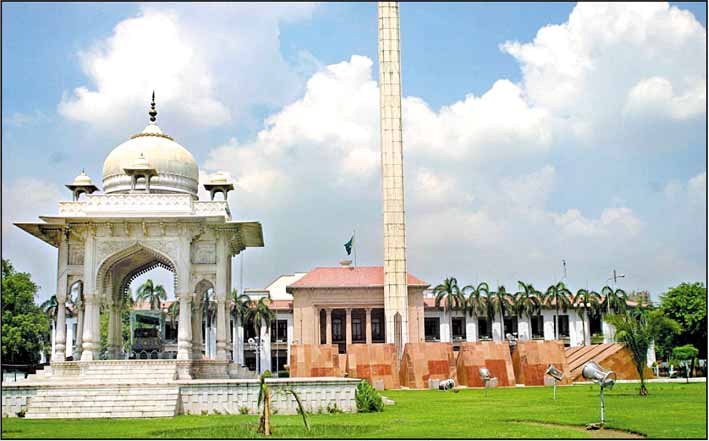
The Government of Punjab is a provincial government in the federal structure of Pakistan, is based in Lahore, the capital of the Punjab Province. The Chief Minister of Punjab (CM) is elected by the Provincial Assembly of the Punjab to serve as the head of the provincial government in Punjab, Pakistan. The current Chief Minister is Maryam Nawaz Sharif, who is also the first ever woman Chief Minister of any province in Pakistan. The Provincial Assembly of the Punjab is a unicameral legislature of elected representatives of the province of Punjab, which is located in Lahore in eastern Pakistan. The Assembly was established under Article 106 of the Constitution of Pakistan as having a total of 371 seats, with 66 seats reserved for women and eight reserved for non-Muslims.
There are 48 departments in Punjab government. Each Department is headed by a Provincial Minister (Politician) and a Provincial Secretary (A civil servant of usually BPS-20 or BPS-21). All Ministers report to the Chief Minister, who is the Chief Executive. All Secretaries report to the Chief Secretary of Punjab, who is usually a BPS-22 Civil Servant. The Chief Secretary in turn, reports to the Chief Minister. In addition to these departments, there are several Autonomous Bodies and Attached Departments that report directly to either the Secretaries or the Chief Secretary.
Divisions

Districts
Major cities
Main article: List of cities in Punjab (Pakistan), List of cities in Punjab, Pakistan by population
| **List of major cities in Punjab** | Rank | City | District | Population | Image | |
|---|---|---|---|---|---|---|
| 1 | **Lahore** | Lahore | 11,126,285 | [[File:Badshahi Mosquee, Lahore.jpg | 200px]] | |
| 2 | **Faisalabad** | Faisalabad | 3,204,726 | [[File:Clock Tower Faisalabad by Usman Nadeem.jpg | 200px]] | |
| 3 | **Rawalpindi** | Rawalpindi | 2,098,231 | [[File:Perspective view from main gate - Christ Church, Rawalpindi.jpg | 200px]] | |
| 4 | **Gujranwala** | Gujranwala | 2,027,001 | [[File:Nishan-E-Manzil Gujranwala 20140925.jpg | 200px]] | |
| 5 | **Multan** | Multan | 1,871,843 | [[File:Shah Rukn e Alam by M Ali Mir 03.jpg | 200px]] | |
| 6 | **Bahawalpur** | Bahawalpur | 762,111 | [[File:Front Elevation of Noor Mahal.jpg | 200px]] | |
| 7 | **Sargodha** | Sargodha | 659,862 | [[File:Central Library of University of Sargodha.jpg | 200px]] | |
| 8 | **Sialkot** | Sialkot | 655,852 | [[File:Clock Tower, Sialkot 21.jpg | 200px]] | |
| 9 | **Sheikhupura** | Sheikhupura | 473,129 | [[File:Hiran Minar- monument to Mansraj.jpg | 200px]] | |
| 10 | **Rahim Yar Khan** | Rahim Yar Khan | 420,419 | [[File:Bhong Mosaue Main Building.jpg | 200px]] | |
| 11 | **Jhang** | Jhang | 414,131 | [[File:Shrine of Sufi Saint Sultan Bahu, Jhang .jpg | 200px]] | |
| 12 | **Dera Ghazi Khan** | Dera Ghazi Khan | 399,064 | [[File:Statue of horses, D.G. Khan.jpg | 200px]] | |
| 13 | **Gujrat** | Gujrat | 390,533 | [[File:Mosque in Gujrat Pakistan.JPG | 200px]] | |
| 14 | **Sahiwal** | Sahiwal | 389,605 | [[File:Ravi bridge.jpg | 200px]] | |
| 15 | **Wah Cantonment** | Rawalpindi | 380,103 | [[File:Central Mosque (Markai Jamia Masjid), Wah Cantt.jpg | 200px]] | |
| **Source: pbscensus 2017** | ||||||
| **This is a list of city proper populations and does not indicate metro populations.** |
Economy

Punjab has the largest economy in Pakistan, contributing most to the national GDP. The province's economy has quadrupled since 1972. Its share of Pakistan's GDP was 54.7% in 2000 and 59% as of 2010. It is especially dominant in the service and agriculture sectors of Pakistan's economy. With its contribution ranging from 52.1% to 64.5% in the Service Sector and 56.1% to 61.5% in the agriculture sector. It is also a major manpower contributor because it has the largest pool of professionals and highly skilled (technically trained) manpower in Pakistan. It is also dominant in the manufacturing sector, though the dominance is not as huge, with historical contributions ranging from a low of 44% to a high of 52.6%. In 2007, Punjab achieved a growth rate of 7.8% and during the period 2002–03 to 2007–08, its economy grew at a rate of between 7% and 8% per year. and during 2008–09 grew at 6% against the total GDP growth of Pakistan at 4%.
Despite the lack of a coastline, Punjab is the most industrialised province of Pakistan; its manufacturing industries produce textiles, sports goods, heavy machinery, electrical appliances, surgical instruments, vehicles, auto parts, metals, sugar mill plants, aircraft, cement, agricultural machinery, bicycles and rickshaws, floor coverings, and processed foods. In 2003, the province manufactured 90% of the paper and paper boards, 71% of the fertilisers, 69% of the sugar and 40% of the cement of Pakistan.

Lahore and Gujranwala Divisions have the largest concentration of small light engineering units. The district of Sialkot excels in sports goods, surgical instruments and cutlery goods. Industrial estates are being developed by Punjab government to boost industrialisation in province, Quaid e Azam Business Park Sheikhupura is one of the industrial areas which is being developed near Sheikhupura on Lahore-Islamabad motorway.
Punjab has the lowest poverty rates in Pakistan, although a divide is present between the northern and southern parts of the province. Sialkot District in the prosperous northern part of the province has a poverty rate of 5.63%, while Rajanpur District in the poorer south has a poverty rate of 60.05%.
Education
The literacy rate has increased greatly over the last 40 years (see the table below). Punjab has the highest Human Development Index out of all of Pakistan's provinces at 0.550.
| Year | Literacy Rate | |
|---|---|---|
| 1972 | ||
| 1981 | ||
| 1998 | ||
| 2009 | ||
| 2021 |
Sources:
List of universities
List of medical colleges
Culture
Main article: Punjabi culture
The culture in Punjab grew out of the settlements along the five rivers, which served as an important route to the Near East as early as the ancient Indus Valley civilisation, dating back to 3000 BCE. Agriculture has been the major economic feature of the Punjab and has therefore formed the foundation of Punjabi culture, with one's social status being determined by landownership. Punjab emerged as an important agricultural region, especially following the Green Revolution during the mid-1960s to the mid-1970s, has been described as the "breadbasket of both India and Pakistan".
Fairs and festivals
Main article: Punjabi festivals (Pakistan)
The Islamic festivals are typically observed. Non-Islamic festivals include Lohri, Basant and Vaisakhi, which are usually celebrated as seasonal festivals. The Islamic festivals are set according to the lunar Islamic calendar (Hijri), and the date falls earlier by 10 to 13 days from year to year.
Some Islamic clerics and some politicians have attempted to ban the participation of non-Islamic festivals because of the religious basis, and they being declared haram (forbidden in Islam).
Tourism
Main article: Tourism in Punjab, Pakistan
Tourism in Punjab is regulated by the Tourism Development Corporation of Punjab. The province has a number of large cosmopolitan cities, including the provincial capital Lahore. Major visitor attractions there include Lahore Fort and Shalimar Gardens, which are now recognised World Heritage Sites. The Walled City of Lahore, Badshahi Mosque, Wazir Khan Mosque, Tomb of Jahangir and Nur Jahan, Tomb of Asaf Khan, Chauburji and other major sites are visited by tourists each year.
Murree is a famous hill station stop for tourists. The Pharwala Fort, which was built by an ancient Hindu civilisation, is on the outskirts of the city. The city of Sheikhupura also has a number of sites from the Mughal Empire, including the World Heritage-listed Rohtas Fort near Jhelum. The Katasraj temple in the city of Chakwal is a major destination for Hindu devotees. The Khewra Salt Mines is one of the oldest mines in South Asia. Faisalabad's clock tower and eight bazaars were designed to represent the Union Jack.
The province's southward is arid. Multan is known for its mausoleums of saints and Sufi pirs. The Multan Museum, Multan fort, DHA 360° zoo and Nuagaza tombs are significant attractions in the city. The city of Bahawalpur is located near the Cholistan and Thar deserts. Derawar Fort in the Cholistan Desert is the site for the annual Cholistan Jeep Rally. The city is also near the ancient site of Uch Sharif which was once a Delhi Sultanate stronghold. The Noor Mahal, Sadiq Ghar Palace, and Darbar Mall were built during the reign of the Nawabs. The Lal Suhanra National Park is a major zoological garden on the outskirts of the city.
Hafiz Saeed, chief of Jama'at-ud-Da'wah (JuD), has questioned Pakistan's decision to adopt Urdu as its national language in a country where majority of people speak Punjabi language, citing his interpretation of Islamic doctrine as encouraging education in the mother-tongue."Pakistan should have adopted Punjabi as national language: Hafiz Saeed" Zee News. 6 March 2016
Some of the organisations and activists that demand the promotion of the Punjabi language include:
- Cultural and research institutes: Punjabi Adabi Board, the Khoj Garh Research Centre, Punjabi Prachar, Institute for Peace and Secular Studies, Adbi Sangat, Khaaksaar Tehreek, Saanjh, Maan Boli Research Centre, Punjabi Sangat Pakistan, Punjabi Markaz, Sver International.
- Trade unions and youth groups: Punjabi Writers Forum, National Students Federation, Punjabi Union-Pakistan, Punjabi National Conference, National Youth Forum, Punjabi Writers Forum, National Students Federation, Punjabi Union, Pakistan, and the Punjabi National Conference.
- Notable activists include Tariq Jatala, Farhad Iqbal, Diep Saeeda, Khalil Ojla, Afzal Sahir, Jamil Ahmad Paul, Mazhar Tirmazi, Mushtaq Sufi, Biya Je, Tohid Ahmad Chattha and Bilal Shaker Kahaloon, Nazeer Kahut."Mind your language—The movement for the preservation of Punjabi". The Herald. 2 September 2106.
- "Punjabi in schools: Pro-Punjabi outfits in Pakistan threaten hunger strike". The Times of India. 4 October 2015.
"Rally for Ending the 150-year-old Ban on Education in Punjabi" The Nation. 21 February 2011.
Notable people
- List of people from Punjab, Pakistan, also includes people born in what is today Indian Punjab but moved to Pakistan after partition
- List of Punjabi people, also includes people of Punjabi ethnicity from India and elsewhere
Notes
References
Bibliography
References
- (2017). "Pakistan National Human Development Report 2017: Unleashing the Potential of a Young Pakistan". [[United Nations Development Programme]] Pakistan.
- "LITERACY RATE, ENROLMENT AND OUT OF SCHOOL POPULATION BY SEX AND RURAL/URBAN, CENSUS-2023". [[Pakistan Bureau Statistics]].
- "Provincial Assembly – Punjab".
- "Report for Selected Countries and Subjects".
- (5 August 2023). "Announcement of Results of 7th Population and Housing Census-2023 (Punjab province)".
- {{Cite Dictionary.com. Punjab
- (4 September 2023). "'Wrong number' couple fight India deportation".
- (March 2015). "PUNJAB GROWTH STRATEGY 2018 Accelerating Economic Growth and Improving Social Outcomes".
- (20 June 2016). "Northern Punjab, urban Sindh people more prosperous than rest of country: report".
- "Poverty Profile of Pakistan". Government of Pakistan.
- "Poverty Profile of Pakistan". Government of Pakistan.
- "Poverty Profile of Pakistan". Government of Pakistan.
- (March 2015). "PUNJAB GROWTH STRATEGY 2018 Accelerating Economic Growth and Improving Social Outcomes".
- "TABLE 9 – POPULATION BY SEX, RELIGION AND RURAL/URBAN".
- (1998). "Mihr-e-munīr: Biography of Ḥaḍrat Syed Pīr Meher Alī Shāh ( in English)".
- Chaudhary, M. Azam. "Barrī Imām".
- Nizami, K.A., "Farīd al-Dīn Masʿūd "Gand̲j̲-I-S̲h̲akar"", in: Encyclopaedia of Islam, Second Edition, Edited by: P. Bearman, Th. Bianquis, C.E. Bosworth, E. van Donzel, W.P. Heinrichs.
- (1988). "Empire and Islam: Punjab and the Making of Pakistan". University of California Press.
- Macauliffe, Max Arthur. (2004). "The Sikh Religion – Its Gurus, Sacred Writings and Authors". Low Price Publications.
- Singh, Khushwant. (2006). "The Illustrated History of the Sikhs". Oxford University Press.
- (2008). "The History of Pakistan". Greenwood Publishing Group.
- "Properties inscribed on the World Heritage List (Pakistan)".
- H K Manmohan Siṅgh. "The Punjab". [[Punjabi University]], Patiala.
- Gandhi, Rajmohan. (2013). "Punjab: A History from Aurangzeb to Mountbatten". Aleph Book Company.
- "Punjab." p. 107 in [[Encyclopædia Britannica, Ninth Edition. ''Encyclopædia Britannica'' (9th ed.)]], vol. 20.
- (2010). "The Geography of India: Sacred and Historic Places". Britannica Educational Publishing.
- Rajesh Bala. (2005). "Punjab History Conference, Thirty-seventh Session, March 18–20, 2005: Proceedings". Punjabi University.
- (1891). "History of the Panjáb from the Remotest Antiquity to the Present Time". Calcultta Central Press Company.
- (2015). "Lahore of Pre Historic Era". Journal of the Research Society of Pakistan.
- Grewal, J. S.. (2004). "Historical Geography of the Punjab". University of California, Santa Barbara.
- Canfield, Robert L. (1991). ''Persia in Historical Perspective''. [[Cambridge]], United Kingdom: Cambridge University Press. p. 1 ("Origins"). {{ISBN. 978-0-521-52291-5.
- Minahan, James. (2012). "Ethnic Groups of South Asia and the Pacific: An Encyclopedia". ABC-CLIO.
- André-Salvini, Béatrice. (2005). "Forgotten Empire: The World of Ancient Persia". University of California Press.
- Samad, Rafi U.. (2011). "The Grandeur of Gandhara: The Ancient Buddhist Civilization of the Swat, Peshawar, Kabul and Indus Valleys". Algora Publishing.
- Minahan, James. (30 August 2012). "Ethnic Groups of South Asia and the Pacific: An Encyclopedia". ABC-CLIO.
- Bosworth, Albert Brian. (1993). "Conquest and Empire: The Reign of Alexander the Great". Cambridge University Press.
- Bosworth, Albert Brian. (1993). "Conquest and Empire: The Reign of Alexander the Great". Cambridge University Press.
- Anson, Edward M.. (2013). "Alexander the Great: Themes and Issues". Bloomsbury.
- "Tareekh-e-Pakistan (Wasti Ahad)".
- "Arrian. Indica. English {{!}} The Online Books Page".
- Hazel, John. (2013). "Who's Who in the Greek World". Routledge.
- Ahir, D. C.. (1971). "Buddhism in the Punjab, Haryana, and Himachal Pradesh". Maha Bodhi Society of India.
- "Menander {{!}} Indo-Greek king".
- (6 March 2014). "The Oxford Handbook of Religious Conversion". Oxford University Press.
- Hudud, al-Alam. (1970). "Hudud Al-Alam, 'the Regions of the World': A Persian Geography, 327A.H. – 982A.D". Luzac.
- Suvorova, Anna. (22 July 2004). "Muslim Saints of South Asia: The Eleventh to Fifteenth Centuries". Routledge.
- Köprülü, Mehmet Fuat. (2006). "Early Mystics in Turkish Literature". Psychology Press.
- PARIHAR, SUBHASH. (2001). "The Dargāh of Bābā Ḥājī Ratan at Bhatinda". Islamic Studies.
- Snehi, Yogesh. (24 April 2019). "Spatializing Popular Sufi Shrines in Punjab: Dreams, Memories, Territoriality". Taylor & Francis.
- Rahman, Abdul. (2002). "New Light on the Khingal, Turk and the Hindu Sahis". Ancient Pakistan.
- Meister, Michael W.. (2005). "The Problem of Platform Extensions at Kafirkot North". Ancient Pakistan.
- MacLean, Derryl N.. (1989). "Religion and Society in Arab Sind". BRILL.
- Mehta, Jaswant Lal. (1979). "Advanced Study in the History of Medieval India". Sterling Publishers Pvt. Ltd.
- V. D. Mahajan. (2007). "History of Medieval India". S. Chand.
- Iqtidar Alam Khan. (2008). "Historical Dictionary of Medieval India". Scarecrow Press.
- (7 March 2013). "Expanding Frontiers in South Asian and World History: Essays in Honour of John F. Richards". Cambridge University Press.
- Singh, Surinder. (30 September 2019). "The Making of Medieval Panjab: Politics, Society and Culture c. 1000–c. 1500". Routledge.
- Richard M. Eaton. (2019). "India in the Persianate Age: 1000–1765". University of California Press.
- Orsini, Francesca. (2015). "After Timur left : culture and circulation in fifteenth-century North India". Oxford Univ. Press.
- Kenneth Pletcher. (2010). "The History of India". The Rosen Publishing Group.
- V. D. Mahajan. (2007). "History of Medieval India". S. Chand.
- Jaswant Lal Mehta. (1979). "Advanced Study in the History of Medieval India: Volume 2".
- (1995). "Proceedings:Volume 55". Indian History Congress.
- Mahajan, V.D. (1991, reprint 2007). ''History of Medieval India'', Part I, New Delhi: S. Chand, {{ISBN. 81-219-0364-5, p.237
- (1971). "Rajasthan [district Gazetteers] Bharatpur". Printed at Government Central Press.
- Nizami, Khaliq Ahmad. (1981). "Supplement to Elliot & Dowson's History of India: Ghaznavids & the Ghurids". Idarah-i Adabiyat-i Delli.
- Bosworth, Clifford Edmund. (1996). "The New Islamic Dynasties". Columbia University Press.
- Richard M. Eaton. (2019). "India in the Persianate Age: 1000–1765". University of California Press.
- Ahmed, Iftikhar. (1984). "Territorial Distribution of Jatt Castes in Punjab c. 1595 – c. 1881". Indian History Congress.
- (1891). "The Ain I Akbari". Asiatic Society of Bengal.
- Lambrick, H. T.. (1975). "Sind : a general introduction". Sindhi Adabi Board.
- History, Hourly. (June 2020). "Mughal Empire: A History from Beginning to End". Independently Published.
- Lally, Jagjeet. (1 April 2021). "Environment". [[Oxford University Press]].
- Wahi, Tripta. (2013). "Irrigation, State and Society in Pre-colonial India". Nehru Memorial Museum and Library.
- Hasan, Ibn. (1967). "The Central Structure of the Mughal Empire and Its Practical Working Up to the Year 1657". Pakistan branch, Oxford University Press.
- (15 February 2022). "Colonial Lahore: A History of the City and Beyond". Oxford University Press.
- Dhavan, Purnima. (2020). "The Oxford Handbook of the Mughal World". Oxford University Press.
- Islamic Thought and Movements in the Subcontinent, 711–1947, 1979, p 278, Syed Moinul Haq.
- (1998). "The Sikhs of the Punjab". Cambridge University Press.
- www.DiscoverSikhism.com. "The Encyclopedia Of Sikhism - Volume I A-D".
- Mirzā, Shafqat Tanvīr. (1992). "Resistance Themes in Punjabi Literature". Sang-e-Meel Publications.
- www.DiscoverSikhism.com. "History Of The Sikhs Vol. IV The Sikh Commonwealth Or Rise And Fall Of Sikh Misls".
- Metcalf, Barbara Daly. (1 January 1984). "Moral Conduct and Authority: The Place of Adab in South Asian Islam". University of California Press.
- Gilmartin, David. (14 April 2020). "Blood and Water: The Indus River Basin in Modern History". Univ of California Press.
- Punjab Government. (1883). "Gazetteer Of The Jhang District".
- Punjab Government. (1883). "Gazetteer Of The Jhang District".
- Punjab Government. (1883). "Gazetteer Of The Jhang District".
- Yasmin, Robina. (2022). "Muslims Under Sikh Rule in the Nineteenth Century: Maharaja Ranjit Singh and Religious Tolerance". I.B. Tauris.
- (1980). "The great mutiny: India 1857". Penguin Books.
- (3 October 2014). "Pakistan Geotagging: Partition of Punjab in 1947".
- (2009). "Partition of India: The Human Dimension". Cultural and Social History.
- D'Costa, Bina. (2011). "Nationbuilding, Gender and War Crimes in South Asia". Routledge.
- Butalia, Urvashi. (2000). "The Other Side of Silence: Voices From the Partition of India". Duke University Press.
- Sikand, Yoginder. (2004). "Muslims in India Since 1947: Islamic Perspectives on Inter-Faith Relations". Routledge.
- "Punjab". Small and Medium Enterprises Development Authority.
- Ali, Choudhary Rahmat. (28 January 1933). "Now or Never. Are we to live or perish forever?".
- S. M. Ikram. (1 January 1995). "Indian Muslims and partition of India". Atlantic Publishers & Dist.
- (6 January 2007). "Mercury drops to freezing point – Dawn Pakistan".
- "Welcome to Official Web site of Punjab, India".
- The figures for 1998 are from [http://www.statpak.gov.pk/depts/pco/statistics/pop_by_province/pop_by_province.html_Pages/statpak.gov.pk/depts/pco/statistics/pop_by_province/pop_by_province pop by province – statpak.gov.pk]{{dead link. (July 2018). link. (1 July 2012 . Thenews.com.pk. Retrieved on 12 July 2013.)
- (24 November 2025). "Pakistan’s population crisis: Nation expanding faster than survival capacity". DAWN News Desk.
- "TABLE 11 : POPULATION BY MOTHER TONGUE, SEX AND RURAL/URBAN, CENSUS-2023".
- "Population by Religion".
- (1881). "Census of India, 1881 Report on the Census of the Panjáb Taken on the 17th of February 1881, vol. I.".
- (1881). "Census of India, 1881 Report on the Census of the Panjáb Taken on the 17th of February 1881, vol. II.".
- (1881). "Census of India, 1881 Report on the Census of the Panjáb Taken on the 17th of February 1881, vol. III.".
- (1884). "Gazetteers Of Gurdaspur District, 1883-84".
- (1891). "Census of India, 1891 The Punjab and its feudatories, part I--The report on the census".
- (1891). "Census of India, 1891 The Punjab and its feudatories, part II--Imperial Tables and Supplementary Returns for the British Territory".
- (1891). "Census of India, 1891 The Punjab and its feudatories, part III--Imperial Tables and Supplementary Returns for the Native States, Together with a Caste Index".
- (1892). "Gazetteer of the Gurdaspur district, 1891-92".
- (1901). "Census of India 1901. [Vol. 17A]. Imperial tables, I-VIII, X-XV, XVII and XVIII for the Punjab, with the native states under the political control of the Punjab Government, and for the North-west Frontier Province.".
- (1913). "Punjab District Gazetteers Gurdaspur District Vol.21 Statistical Tables".
- (1911). "Census of India 1911. Vol. 14, Punjab. Pt. 2, Tables.".
- Kaul, Harikishan. (1911). "Census Of India 1911 Punjab Vol XIV Part II".
- (1921). "Census of India 1921. Vol. 15, Punjab and Delhi. Pt. 2, Tables.".
- (1931). "Census of India 1931. Vol. 17, Punjab. Pt. 2, Tables.".
- "Census of Pakistan, 1951 Population According to Religion Table 6".
- "Population Distribution by Religion, 1998 Census".
- "TABLE 9 – POPULATION BY SEX, RELIGION AND RURAL/URBAN".
- "SALIENT FEATURES OF FINAL RESULTS CENSUS-2017".
- "7th Population and Housing Census - Detailed Results Table-9 Population by sex, religion and rural/urban".
- "Religious Demographics of Pakistan".
- "DISTRICT WISE CENSUS RESULTS CENSUS 2017". www.pbscensus.gov.pk.
- "World Bank Document".
- (December 2020). "Provincial Accounts of Pakistan: Methodology and Estimates 1973–2000".
- "The News International: Latest, Breaking, Pakistan, Sports and Video News".
- A PricewaterhouseCoopers study released in 2009, surveying the 2008 GDP of the top cities in the world, calculated Faisalabad's GDP (PPP) at $35 billion. The city was third in Pakistan behind Karachi ($78 billion) and Lahore ($40 billion). Faisalabad's GDP is projected to rise to $37 billion in 2025 at a growth rate of 5.7%, higher than the growth rates of 5.5% and 5.6% predicted for Karachi and Lahore.[2][ "PricewaterhouseCoopers Media Centre". Ukmediacentre.pwc.com. 1 June 2005.][http://www.dawn.com/wps/wcm/connect/dawn-content-library/dawn/in-paper-magazine/economic-and-business/micro-credit,-income-distribution,-poverty-789 – Last Paragraph]{{Dead link. (December 2021)
- "Punjab Gateway".
- IKRAM, ZAHID. "Industrial Zone Punjab, Pakistan".
- "PIEDMC – Punjab Industrial Estate Development and Management Company".
- "Poverty Profile of Pakistan". Government of Pakistan.
- "Sub-national HDI – Subnational HDI – Table – Global Data Lab".
- (9 June 2022). "KP Achieves Highest Literacy Rate Growth Among All Provinces". Propakistani.
- "Pakistan: where and who are the world's illiterates?; Background paper for the Education for all global monitoring report 2006: literacy for life; 2005".
- (15 February 2011). "Rural women uphold Pakistan's literacy rate". The Express Tribune.
- Nayar, Kamala Elizabeth. (2012). "The Punjabis in British Columbia: Location, Labour, First Nations, and Multiculturalism". McGill-Queen's Press – MQUP.
- [http://www.schools.punjab.gov.pk/system/files/Notification_2.pdf Official Holidays 2016] {{Webarchive. link. (17 May 2017 , Government of Punjab – Pakistan (2016))
- link. (1 September 2018, Karachi Metropolitan, Sindh, Pakistan)
- [https://books.google.com/books?id=1O0eAQAAMAAJ&q=makara Census of India, 1961: Punjab. Manage of Publications]
- (2013). "Religious Traditions in Modern South Asia". Routledge.
- [https://www.dawn.com/news/1315376 The ban on fun], IRFAN HUSAIN, Dawn, 18 February 2017
- [http://www.tribuneindia.com/news/sunday-special/columns/the-barricaded-muslim-mind/286436.html The barricaded Muslim mind] {{Webarchive. link. (4 April 2023 , Saba Naqvi (28 August 2016), Quote: "Earlier, Muslim villagers would participate in Hindu festivals; now they think that would be haraam, so stay away. Visiting dargahs is also haraam")
- (9 April 2010). "Tourism Development Corporation of Punjab Official Website". Tdcp.gop.pk.
- "Ministry of Tourism: Punjab Attractions". Tourism.gov.pk.
- khalid. "Tourism in Punjab, Pakistan". Vista-tourism.com.
- (18 July 2022). "Lal Suhanra Park Bahawalpur".
- Sarah Veach, Katy Williamson, [http://languagemanuals.weebly.com/uploads/4/8/5/3/4853169/punjabi.pdf Punjabi Culture and Language Manual] {{webarchive. link. (4 March 2016 ([https://archive.org/stream/Punjabi-CultureAndLanguageManual#page/n0/mode/2up archived]), Texas State University, p. 6, retrieved 14 May 2016.)
- "Punjabis Without Punjabi". apnaorg.com.
- (4 May 2015). "Urdu-isation of Punjab – The Express Tribune". The Express Tribune.
- (21 February 2011). "Rally for ending 150-year-old 'ban on education in Punjabi".
- (26 August 2015). "Sufi poets can guarantee unity".
- (15 September 2015). "Supreme Court's Urdu verdict: No language can be imposed from above".
- (14 September 2015). "Two-member SC bench refers Punjabi language case to CJP".
This article was imported from Wikipedia and is available under the Creative Commons Attribution-ShareAlike 4.0 License. Content has been adapted to SurfDoc format. Original contributors can be found on the article history page.
Ask Mako anything about Punjab, Pakistan — get instant answers, deeper analysis, and related topics.
Research with MakoFree with your Surf account
Create a free account to save articles, ask Mako questions, and organize your research.
Sign up freeThis content may have been generated or modified by AI. CloudSurf Software LLC is not responsible for the accuracy, completeness, or reliability of AI-generated content. Always verify important information from primary sources.
Report
Social issues
In August 2015, the Pakistan Academy of Letters, International Writer's Council (IWC) and World Punjabi Congress (WPC) organised the Khawaja Farid Conference and demanded that a Punjabi-language university should be established in Lahore and that Punjabi language should be declared as the medium of instruction at the primary level. In September 2015, a case was filed in Supreme Court of Pakistan against Government of Punjab, Pakistan as it did not take any step to implement the Punjabi language in the province. Additionally, several thousand Punjabis gather in Lahore every year on International Mother Language Day.