From Surf Wiki (app.surf) — the open knowledge base
Pumpkin
Category of culinary winter Cucurbita squashes
Category of culinary winter Cucurbita squashes
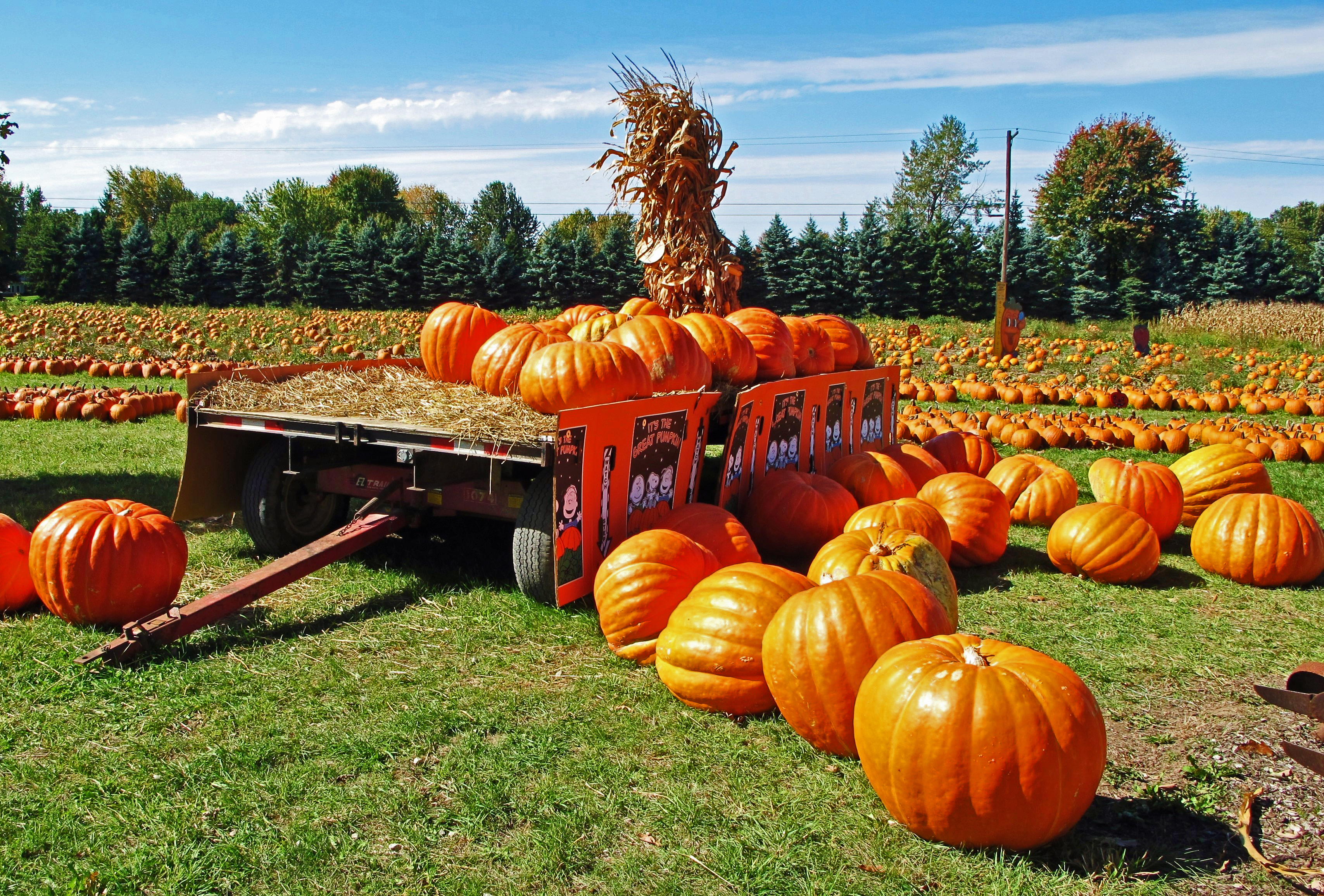
A pumpkin is a cultivated winter squash in the genus Cucurbita. The term is most commonly applied to round, orange-colored squash varieties, but does not possess a scientific definition. It may be used in reference to many different squashes of varied appearance and belonging to multiple species in the Cucurbita genus.
"Pumpkin" is sometimes used interchangeably with "squash" or "winter squash", and is commonly used for some cultivars of Cucurbita argyrosperma, Cucurbita ficifolia, Cucurbita maxima, Cucurbita moschata, and Cucurbita pepo.
C. pepo pumpkins are among the oldest known domesticated plants, with evidence of their cultivation dating to between 7000 BCE and 5500 BCE in Mesoamerica. Wild species of Cucurbita and the earliest domesticated species are native to North America (parts of present-day northeastern Mexico and the southern United States), but cultivars are now grown globally for culinary, decorative, and other culturally-specific purposes.
The pumpkin's thick shell encases edible seeds and pulp. Pumpkin pie is a traditional part of Thanksgiving meals in Canada and the United States and pumpkins are frequently used as autumnal seasonal decorations and carved as jack-o'-lanterns for decoration around Halloween. Commercially canned pumpkin purée and pie fillings are usually made of different pumpkin varieties from those intended for decorative use.
Etymology and terminology
According to the Oxford English Dictionary, the English word pumpkin is a 17th-century corruption of the earlier pompion, denoting any of various kinds of edible gourd. The latter ultimately derives, via French and Latin, from Greek πέπων (grc).
An alternative theory derives pumpkin from the Massachusett word pôhpukun, meaning "grows forth round". This term could have been used by the Wampanoag people (who speak the Wôpanâak dialect of Massachusett) when introducing pumpkins to English Pilgrims at Plymouth Colony, located in present-day Massachusetts. (The English word squash is derived from a Massachusett word, askꝏtasquash, or, in the closely related Narragansett language, askútasquash.)
Researchers have noted that the term pumpkin and related terms like ayote and calabaza are applied to a range of winter squash with varying size and shape. The term tropical pumpkin is sometimes used for pumpkin cultivars of the species Cucurbita moschata.
Description
Pumpkin fruits are a type of berry known as a pepo. Characteristics commonly used to define pumpkin include smooth and slightly ribbed skin and deep yellow to orange color, although white, green, and other pumpkin colors also exist.
While Cucurbita pepo pumpkins generally weigh between 6 and, giant pumpkins can exceed a tonne in mass. Most are varieties of C. maxima that were developed through the efforts of botanical societies and enthusiast farmers. The largest cultivars frequently reach weights of over 75 lb. In October 2023, the record for heaviest pumpkin was set at 1,246.9 kg (2,749 lbs.).
History
The oldest evidence of Cucurbita pepo is pumpkin fragments found in Mexico that are dated between 7,000 and 5,500 BC. Pumpkins and other squash species, alongside maize and beans, feature in the Three Sisters method of companion planting practiced by many North American indigenous societies. However, larger modern pumpkin cultivars are typically excluded, as their weight may damage the other crops. Within decades after Europeans began colonizing North America, illustrations of pumpkins similar to the modern cultivars Small Sugar pumpkin and Connecticut Field pumpkin were published in Europe.
Cultivation
Pumpkins are a warm-weather crop that is usually planted by early July in the Northern Hemisphere. Pumpkins require that soil temperatures 3 in deep are at least 15.5 C and that the soil holds water well. Pumpkin crops may suffer if there is a lack of water, because of temperatures below 65 F, or if grown in soils that become waterlogged. Within these conditions, pumpkins are considered hardy, and even if many leaves and portions of the vine are removed or damaged, the plant can quickly grow secondary vines to replace what was removed.
Pumpkins produce both a male and female flower, with fertilization usually performed by bees. In America, pumpkins have historically been pollinated by the native squash bee, Peponapis pruinosa, but that bee has declined, probably partly due to pesticide (imidacloprid) sensitivity. Ground-based bees, such as squash bees and the eastern bumblebee, are better suited to manage the larger pollen particles that pumpkins create. One hive per acre (0.4 hectares, or five hives per 2 hectares) is recommended by the U.S. Department of Agriculture. If there are inadequate bees for pollination, gardeners may have to hand pollinate. Inadequately pollinated pumpkins usually start growing but fail to develop.
Production
| Source: FAOSTAT |
|---|
| of the United Nations |
In 2022, world production of pumpkins (including squash and gourds) was 23 million tonnes, with China accounting for 32% of the total. Ukraine, Russia, and the United States each produced about one million tonnes.
In the United States
.jpg)
As one of the most popular crops in the United States, in 2017 over 1.5 e9lb of pumpkins were produced. The top pumpkin-producing states include Illinois, Indiana, Ohio, Pennsylvania, and California. Pumpkin is the state squash of Texas.
According to the Illinois Department of Agriculture, 95 percent of the U.S. crop intended for processing is grown in Illinois. Indeed, 41 percent of the overall pumpkin crop for all uses originates in the state, more than five times that of the nearest competitor, California, whose pumpkin industry is centered in the San Joaquin Valley; and the majority of that comes from five counties in the central part of the state. Nestlé, operating under the brand name Libby's, produces 85 percent of the processed pumpkin in the United States at their plant in Morton, Illinois.
In the fall of 2009, rain in Illinois devastated the Libby's pumpkin crop, which, combined with a relatively weak 2008 crop depleting that year's reserves, resulted in a shortage affecting the entire country during the Thanksgiving holiday season. Another shortage, somewhat less severe, affected the 2015 crop.
The pumpkin crop in the western United States, which constitutes approximately three to four percent of the national crop, is grown primarily for the organic market. Terry County, Texas, has a substantial pumpkin industry, centered largely on miniature pumpkins.
Nutrition
In a 100 g amount, raw pumpkin provides 26 kcal of food energy and is an excellent source (20% or more the Daily Value, DV) of provitamin A beta-carotene and vitamin A (47% DV) (table). Vitamin C is present in moderate content (10% DV), but no other micronutrients are in significant amounts (less than 10% DV, table). Pumpkin is 92% water, 6.5% carbohydrate, 0.1% fat and 1% protein (table).
Uses
Culinary

Most parts of the pumpkin plant are edible, including the fleshy shell, the seeds, the leaves, and the flowers. When ripe, the pumpkin can be boiled, steamed, or roasted.
Shell and flesh
In North America, pumpkins are part of the traditional autumn harvest, eaten roasted, as mashed pumpkin and in soups and pumpkin bread. Pumpkin pie is a traditional staple of the Canadian and American Thanksgiving holidays. Pumpkin purée is sometimes prepared and frozen for later use.
Flowers

In the southwestern United States and Mexico, pumpkin and squash flowers are a popular and widely available food item. They may be used to garnish dishes, or dredged in a batter then fried in oil.
Leaves
Pumpkin leaves are also eaten in Zambia, where they are called my and are boiled and cooked with groundnut paste as a side dish.
Seeds
Main article: Pumpkin seed
.jpg)
Pumpkin seeds, also known as pepitas, are edible and nutrient-rich. They are about 1.5 cm (0.5 in) long, flat, asymmetrically oval, light green in color and usually covered by a white husk, although some pumpkin varieties produce seeds without them. Pumpkin seeds are a popular snack that can be found hulled or semi-hulled at grocery stores. Per ounce serving, pumpkin seeds are a good source of protein, magnesium, copper and zinc.
Pumpkin seed oil
Main article: Pumpkin seed oil
Pumpkin seed oil is a thick oil pressed from roasted seeds that appears red or green in color. When used for cooking or as a salad dressing, pumpkin seed oil is generally mixed with other oils because of its robust flavor. Pumpkin seed oil contains fatty acids such as oleic acid and alpha-linolenic acid.
Animal feed
Pumpkin seed meal from Cucurbita maxima and Cucurbita moschata have been demonstrated to improve the nutrition of eggs for human consumption, and Cucurbita pepo seed has successfully been used in place of soybean in chicken feed.
Culture
Halloween
Main article: Jack o' lantern
In the United States, the carved pumpkin was first associated with the harvest season in general, long before it became an emblem of Halloween. The practice of carving produce for Halloween originated from an Irish myth about a man named "Stingy Jack". The practice of carving pumpkin jack-o'-lanterns for the Halloween season developed from a traditional practice in Ireland as well as Scotland and other parts of the United Kingdom of carving lanterns from the turnip, mangelwurzel, or swede (rutabaga). These vegetables continue to be popular choices today as carved lanterns in Scotland and Northern Ireland, although the British purchased a million pumpkins for Halloween in 2004 reflecting the spread of pumpkin carving in the United Kingdom.
Immigrants to North America began using the native pumpkins for carving, which are both readily available and much larger – making them easier to carve than turnips. Not until 1837 does jack-o'-lantern appear as a term for a carved vegetable lantern, and the carved pumpkin lantern association with Halloween is recorded in 1866.Daily News (Kingston, Ontario), November 1, 1866:
:The old time custom of keeping up Hallowe'en was not forgotten last night by the youngsters of the city. They had their maskings and their merry-makings, and perambulated the streets after dark in a way [that] was no doubt amusing to themselves. There was a great sacrifice of pumpkins from which to make transparent heads and face, lighted up by the unfailing two inches of tallow candle.
The traditional American pumpkin used for jack-o-lanterns is the Connecticut field variety. Kentucky field pumpkin is also among the pumpkin cultivars grown specifically for jack-o-lantern carving.
Chunking
Pumpkin chunking is a competitive activity in which teams build various mechanical devices designed to throw a pumpkin as far as possible. Catapults, trebuchets, ballistas and air cannons are the most common mechanisms.
Pumpkin festivals and competitions
Growers of giant pumpkins often compete to grow the most massive pumpkins. Festivals may be dedicated to the pumpkin and these competitions. In the United States, the town of Half Moon Bay, California, holds an annual Art and Pumpkin Festival, including the World Champion Pumpkin Weigh-Off.
The record for the world's heaviest pumpkin, 1247 kg, was most recently set in 2023.
A festival called Pumpkin Weeks (Kurpitsaviikot) is held every October in Salo, Finland, at which thousands of different-sized pumpkins and carved jack-o'-lanterns are presented to tourists.
Folk medicine
Pumpkins have been used as folk medicine by Native Americans to treat intestinal worms and urinary ailments, and this Native American remedy was adopted by American doctors in the early nineteenth century as an anthelmintic for the expulsion of worms. In Germany and southeastern Europe, seeds of C. pepo were also used as folk remedies to treat irritable bladder and benign prostatic hyperplasia.
In China, C. moschata seeds were also used in traditional Chinese medicine for the treatment of the parasitic disease schistosomiasis and for the expulsion of tape worms.
Folklore and fiction
There is a connection in folklore and popular culture between pumpkins and the supernatural, such as:
- The custom of carving jack-o-lanterns from pumpkins derives from folklore about a lost soul wandering the earth.
- In the fairy tale Cinderella, the fairy godmother turns a pumpkin into a carriage for the title character, but at midnight it reverts to a pumpkin.
- In some adaptations of Washington Irving's ghost story The Legend of Sleepy Hollow, the headless horseman is said to use a pumpkin as a substitute head.
- In the Oz books, Jack Pumpkinhead is a character made of tree limbs. A pumpkin serves as his head; the seeds function as brains. The 23rd Oz book is Jack Pumpkinhead of Oz.
In most folklore the carved pumpkin is meant to scare away evil spirits on All Hallows' Eve (that is, Halloween), when the dead were purported to walk the earth.
Music
Vegetable orchestras, such as the London Vegetable Orchestra use zucchini trumpets, butternut squash trombones, pumpkin drums and aubergine castanets. Other vegetables played include carrots, bell peppers, potatoes and parsnips.
Cultivars
The species and varieties include many economically important cultivars with a variety of different shapes, colors, and flavors that are grown for different purposes. Variety is used here interchangeably with cultivar, but not with species or taxonomic variety.
| Image | Name | Species | Origin | Description | |||||||||||||||||||||||
|---|---|---|---|---|---|---|---|---|---|---|---|---|---|---|---|---|---|---|---|---|---|---|---|---|---|---|---|
| Al Hachi | *Cucurbita moschata* | Kashmir | last=Sarkar | first=Sonia | date=September 16, 2019 | title=Kashmir, from A to Z: Children's book highlights region's culture | url=https://www.aljazeera.com/indepth/features/kashmir-children-book-highlights-region-culture-190915140353211.html | work=Al Jazeera | access-date=February 4, 2020}} | ||||||||||||||||||
| [[File:Big Max at Dutchess County Fair.JPG | 120px]] | Big Max | *Cucurbita maxima* | United States | Big Max can exceed 100 lb and 20 in in diameter under ideal growing conditions. The variety was hybridized for its size during the early 1960s. Individual fruits are round to slightly flattened. | ||||||||||||||||||||||
| [[File:Kalabasa (Calabaza) squash from the Philippines.jpg | 120px]] | Calabaza | *Cucurbita moschata* | Cuba and West Indies | last=Andres | first=T.C. | date=2019 | title=Diversity in tropical pumpkin (Cucurbita moschata): a review of infraspecific classifications | url=https://cucurbit.info/wp-content/uploads/2019/04/cuc2004proceedings.pdf#page=107 | journal=Progress in Cucurbit Genetics and Breeding Research}} | |||||||||||||||||
| [[File:Cucurbita moschata.jpg | 120px]] | Cheese pumpkin | *Cucurbita moschata* | last=Vestal | first=Paul A. | date=1938 | title=Cucurbita Moschata Found in Pre-Columbian Mounds in Guatemala | journal=Botanical Museum Leaflets, Harvard University | volume=6 | issue=4 | pages=65–69 | doi=10.5962/p.168392 | jstor=41762692 | s2cid=130017723 | issn=0006-8098 | doi-access=free }} | Duchesne]]'s 1786 botanical illustrations depicts a fruit that has been identified with the Cheese Pumpkin. | ||||||||||
| [[File:Connecticut Field cultivar of Cucurbita pepo.jpg | 120px]] | Connecticut field pumpkin | *Cucurbita pepo* | North America | title=Abenaki Heritage Garden | url=https://www.nrcs.usda.gov/Internet/FSE_DOCUMENTS/stelprdb1101651.pdf | publisher=USDA NRCS | access-date=December 4, 2022 | archive-date=June 9, 2017 | archive-url=https://web.archive.org/web/20170609150416/https://www.nrcs.usda.gov/Internet/FSE_DOCUMENTS/stelprdb1101651.pdf | url-status=dead }} Widely used for autumn decorations, either whole or as jack-o'-lanterns. | ||||||||||||||||
| Dickinson pumpkin | *Cucurbita moschata* | North America | date=2016-09-12 | title=The Truth About "Canned Pumpkin" – Mother Earth Gardener | url=https://www.motherearthgardener.com/profiles/canned-pumpkin-zmaz12fzfol/ | access-date=2022-12-12 | website=www.motherearthgardener.com | language=en-US}} Libby's Select is classified either as a selection from the Dickinson Pumpkin or a selection from the same parent lineage. | |||||||||||||||||||
| [[File:Howard Dill's Pumpkin Patch.jpg | 120px]] | Dill's Atlantic Giant | *Cucurbita maxima* | North America | Dill's Atlantic Giant was bred by Howard Dill from sources including the Mammoth Pumpkin variety. The variety were patented in 1979, who then went on to set the giant pumpkin in 1980 with a 459 lb record. | ||||||||||||||||||||||
| [[File:Cucurbita maxima - Courge galeuse d'Eysines01.jpg | 120px]] | Galeux d'Eysines | *Cucurbita maxima* | France | The Galeux d'Eysines is mentioned in the Vilmorin-Andrieux vegetable catalogue Les Plantes Potagères in 1883. It is noted for peanut-sized growths on its skin, caused by a buildup of sugar. Its name may have originally been *Brodé galeux d'Eysines*, translating to *embroidered with scabs, from Eysines.* Immature pumpkins can be etched with words or designs that become warts as it matures. Galeux d'Eysines was reportedly brought to the United States in 1996 from the Foire aux Potirons pumpkin festival in Tranzault, France, by author Amy Goldman. | ||||||||||||||||||||||
| [[File:Japanese Pie Pumpkin - detail from Hastings seeds - Spring 1912 catalogue (1912) (14802567053).jpg | 120px]] | Japanese pie pumpkin | *Cucurbita argyrosperma* | Pennsylvania | The Japanese pie pumpkin is so-called because its seeds become crazed, resembling to Americans the appearance of Chinese characters or Japanese kanji. This variety was introduced by Samuel Wilson of Pennsylvania in 1884. | ||||||||||||||||||||||
| [[File:Jarrahdale Pumpkin Vine.jpg | 120px]] | Jarrahdale pumpkin | *Cucurbita maxima* | Australia | url = https://homeguides.sfgate.com/growing-jarrahdale-35632.html | title = Growing Jarrahdale | last = Singleton | first = Bonnie | website = Home Guides | date = July 22, 2012 | publisher = SF Gate | access-date = December 2, 2020}} | |||||||||||||||
| title=Pumpkin: Cushaw White | url=https://gardenseedsandplants.com/pumpkin-cushaw-white/ | access-date=2022-12-12 | website=gardenseedsandplants.com}} | *Cucurbita argyrosperma* | melioration]] against the character of Brother Jonathan which was sometimes used as mocking personification of the United States by satirists in Europe. *Brother Jonathan* was also used within the United States either as characterizing the epitome of thrift and industriousness, or an unsophisticated bumpkin. | ||||||||||||||||||||||
| [[File:Kabocha.jpg | 120px]] | Kabocha | *Cucurbita maxima* | Japan | *Kabocha* is the general Japanese word for winter squashes. In English, the term "kabocha" is usually used for a green-skinned cultivar derived from buttercup squash. | ||||||||||||||||||||||
| Kentucky field pumpkin | *Cucurbita moschata* | Cuba, Mexico, or the United States | last=Damerow | first=Gail | author-link=Gail Damerow | url=http://archive.org/details/perfectpumpkin0000dame | title=The perfect pumpkin | date=1997 | publisher=Pownal, Vt. : Storey Pub. | others=Internet Archive | isbn=978-0-88266-993-9}} It has been classified as part of a group of *Cucurbita moschata* cultivars historically grown by the Seminole people of the United States southeast, as well as by farmers in Louisiana, Alabama, and Mississippi. Similar cultivars were identified in Cuba as well as coastal and southern Mexico. | ||||||||||||||||
| [[File:Musquee de Provence.jpg | 120px]] | Musquée de Provence, Moscata di Provenza or fairytale pumpkin | *Cucurbita moschata* | France | A large pumpkin from France with sweet, fragrant, deep-orange flesh often sold by the slice due to its size. | ||||||||||||||||||||||
| [[File:Seminole pumpkin fruit.jpg | 120px]] | Seminole pumpkin | *Cucurbita moschata* | Florida | last=Castetter | first=Edward F. | date=1930 | title=Species Crosses in the Genus Cucurbita | url=https://www.jstor.org/stable/2446379 | journal=American Journal of Botany | volume=17 | issue=1 | pages=41–57 | doi=10.2307/2446379 | jstor=2446379 | issn=0002-9122 | url-access=subscription }} | ||||||||||
| [[File:Cucurbita pepo var. styriaca05.jpg | 120px]] | Styrian pumpkin | *Cucurbita pepo* | Styria | last1 = Fürnkranz | first1 = Michael | last2 = Lukesch | first2 = Birgit | last3 = Müller | first3 = Henry | last4 = Huss | first4 = Herbert | last5 = Grube | first5 = Martin | last6 = Berg | first6 = Gabriele | year = 2012 | title = Microbial Diversity Inside Pumpkins: Microhabitat-Specific Communities Display a High Antagonistic Potential Against Phytopathogens | journal = Microbial Ecology | volume = 63 | issue = 2 | pages = 418–428 | jstor = 41412429 | doi = 10.1007/s00248-011-9942-4 | pmid = 21947430 | bibcode = 2012MicEc..63..418F | s2cid = 16454305 }} |
| [[File:Sugar Pumpkins.jpg | 120px]] | Sugar pumpkin | *Cucurbita pepo* | North America | The sugar pumpkin is one of the earliest varieties of pumpkin documented by European colonists upon arrival in North America. It has sweeter flesh than the similar but larger Connecticut Field pumpkin from which sugar pumpkins may have been selected. |
References
References
- United States Agricultural Research Service. Crops Research Division. (1969). ["Growing pumpkins and squashes Rev. June 1969". Washington, U.S. Govt. Print. Off.
- "Horticulture Questions and Answers". [[Missouri Botanical Garden]].
- (2008). "Pumpkins and More". University of Illinois Extension.
- (2003-09-12). "Handbook of Vegetable Preservation and Processing". CRC Press.
- {{cite OED. pumpkin. 8260450369
- "Fun With Words".
- Kelly, Nataly. (2012). "Found in Translation: How Language Shapes Our Lives and Transforms The World". Perigee.
- Trumbull, James Hammond. (1903). "Natick Dictionary". U.S. Government Printing Office.
- "Definition of Squash".
- (2008). "Vegetables I". Springer.
- Andres, T.C.. (2004). "Diversity in tropical pumpkin (Cucurbita moschata): cultivar origin and history". Progress in Cucurbit Genetics and Breeding Research.
- Goldman, Amy. (2004). "The Compleat Squash: A Passionate Grower's Guide to Pumpkins, Squash, and Gourds". Artisan.
- "Pumpkins in Florida". [[Institute of Food and Agricultural Sciences]].
- (October 26, 2005). "White Pumpkins Hit the Halloween Market". NBC News.
- Borrell, Brenda. (October 2011). "The Great Pumpkin". The Smithsonian Institution.
- Bruno Waterfield. (2021-10-01). "Belgian Mario Vangeel hopes to squash Italian's giant pumpkin record at world championship". [[The Times]].
- (2023-10-10). "Pumpkin weighing 2,749 pounds wins contest and sets world record for biggest gourd".
- (October 8, 2015). "Pick a Pumpkin from Massachusetts". Massachusetts Department of Agricultural Resources.
- Mt.Pleasant, Jane. (2016-11-10). "Food Yields and Nutrient Analyses of the Three Sisters: A Haudenosaunee Cropping System". Ethnobiology Letters.
- (26 May 2022). "Plant a Three Sisters Garden: Corn, Beans, and Squash {{!}} The Old Farmer's Almanac".
- Williams, Roger. (2009). "Effects of imidacloprid-based Insecticides on the Native Cucurbit Pollinator, ''Peponapis pruinosa''". US Interagency IPM Projects.
- (2000). "Importance of Conserving Alternative Pollinators: Assessing the Pollination Efficiency of the Squash Bee, ''Peponapis limitaris'' in ''Cucurbita moschata'' (Cucurbitaceae)". Journal of Insect Conservation.
- (April 1981). "The pollination efficiency of the squash bee (''Peponapis pruinosa'') and the honey bee (''Apis mellifera'') on summer squash (''Cucurbita pepo'')". Journal of the Kansas Entomological Society.
- (2024). "Pumpkin production in 2022 (includes squash and gourds), Crops/Regions/World list/Production Quantity (pick lists)". UN Food and Agriculture Organization, Corporate Statistical Database (FAOSTAT).
- (2018). "Pumpkins: Background & Statistics". United States Department of Agriculture Economic Research Service.
- (2022). "Texas Almanac 2022-2023". Texas State Historical Association.
- Illinois Department of Agriculture. (October 22, 2004). "Illinois Leads Nation in Pumpkin Production".
- Ramos, Elliot. (October 22, 2021). "Map: Where America's pumpkins come from". [[NBC News]].
- (November 18, 2009). "Pumpkin pie could become scarce after Thanksgiving". [[Los Angeles Times]].
- "News - Pumpkin shortage in the U.S. has Canada to the rescue - The Weather Network".
- "Here's What Happened to the Great Pumpkin Shortage of 2015".
- Severson, Kim. (November 17, 2009). "Libby's Warns of a Canned Pumpkin Shortage". The New York Times.
- (August 25, 2017). "Pumpkins: from decoration to delicacy". Produce Retailer.
- (March 4, 2017). "Elaine Reeves: For love of gourd". The Mercury.
- Stavely, Keith W.F. and Fitzgerald, Kathleen. ''America's Founding Food: The Story of New England Cooking.'' Chapel Hill, N.C.: University of North Carolina Press, 2004. {{ISBN. 0-8078-2894-7
- Hogan, C. Michael. (2011). "Thanksgiving". [[National Council for Science and the Environment]].
- Roberts, Tammy. "Many uses for pumpkin". University of Missouri Extension.
- "Pumpkin Leaves Chibwabwa". [[Food and Agriculture Organization]].
- "Nutrition facts for pumpkin seeds, whole, roasted, without salt". [[Condé Nast Publications]].
- (2007). "Physicochemical and physiological basis of dichromatic colour". Naturwissenschaften.
- (2006). "On the color of transparent substances, in Current Psychological Research in Austria". Proceedings of the 7th Scientific Conference of the Austrian Psychological Society (ÖGP).
- Tyler Herbst, Sharon. (May 2022). "The New Food Lover's Companion". Barron.
- (2007). "Oil Pumpkins: Niche for Organic Producers". Purdue University Agriculture, Horticulture and Landscape Architecture.
- (2021-06-24). "Effect of dietary pumpkin (Cucurbita moschata) seed meal on layer performance and egg quality characteristics". Animal Bioscience.
- [https://query.nytimes.com/gst/abstract.html?res=9800EEDC1139E033A25757C2A9679D94649ED7CF The Day We Celebrate: Thanksgiving Treated Gastronomically and Socially], ''The New York Times'', November 24, 1895, p. 27. "[https://query.nytimes.com/gst/abstract.html?res=9802E7D6173FE433A25752C2A9669D946197D6CF Odd Ornaments for Table]", ''The New York Times'', October 21, 1900, p. 12.
- Fowler, Julian. (October 28, 2005). "Turnip battles with pumpkin for Hallowe'en". [[BBC]].
- (2007). "The Oxford companion to American food and drink". Oxford University Press.
- (October 31, 2005). "Pumpkins Passions". [[BBC]].
- Hawthorne, Nathaniel. (1837). "Twice-Told Tales".
- Richardson, R. W.. "Squash and Pumpkin". United States Department of Agriculture, Agricultural Research Service, National Plant Germplasm System.
- Stephens, James M.. "Pumpkin — Cucurbita spp.". University of Florida.
- Baggett, J. R.. "Attempts to Cross ''Cucurbita moschata'' (Duch.) Poir. 'Butternut' and ''C. pepo'' L. 'Delicata'". North Carolina State University.
- (October 25, 2007). "How far will a pumpkin fly?". MSNBC.
- (2016). "Half Moon Bay Art & Pumpkin Festival: A Brief History". Miramar Events.
- "Pumpkin weighing as much as a hippo named the world's heaviest".
- "Kurpitsaviikot".
- (2011). "Environmental History of the Hudson River". State University of New York Press.
- (2004). "Rational Phytotherapy: A Reference Guide for Physicians and Pharmacists". Springer.
- "Pumpkin seed (Cucurbitae peponis semen)". Heilpflanzen-Welt Bibliothek.
- (2010). "Research and Development of Antischistosomal Drugs in the People's Republic of China a 60-year review". Advances in Parasitology.
- (1997). "Practical Therapeutics of Traditional Chinese Medicine". Paradigm Publications.
- Singh, Maanvi. (2016-05-27). "Check Out These Musicians Who Literally Play With Their Food". NPR.
- (2025-04-07). "Britain's King Charles joins vegetable orchestra in humorous Windsor Castle musical event".
- Sarkar, Sonia. (September 16, 2019). "Kashmir, from A to Z: Children's book highlights region's culture". [[Al Jazeera English.
- "Pumpkin Seed — Big Max Pumpkin". Gurney's Seed and Nursery Company.
- Earl Aronson. (January 11, 1964). "The Weeders Guide". The Hartford Courant.
- (May 22, 1964). ["Big Max Pumpkin is Monster"](https://news.google.com/newspapers?id=PZgSAAAAIBAJ&pg=7178,5315473}}{{Dead link). The Spokane Daily Chronicle.
- "Pumpkin". Aggie Horticulture.
- Andres, T.C.. (2019). "Diversity in tropical pumpkin (Cucurbita moschata): a review of infraspecific classifications". Progress in Cucurbit Genetics and Breeding Research.
- Vestal, Paul A.. (1938). "Cucurbita Moschata Found in Pre-Columbian Mounds in Guatemala". Botanical Museum Leaflets, Harvard University.
- "Abenaki Heritage Garden". USDA NRCS.
- "Gardening: Trick is to Plant Now for Halloween Treat". [[The L.A. Times]].
- (2016-09-12). "The Truth About "Canned Pumpkin" – Mother Earth Gardener".
- (2022-10-09). "Best Heirloom Pumpkin Varieties - Grit".
- Laliberte, Marissa. (2020-10-15). "What's Really in Canned Pumpkin, Anyway?".
- CooksInfo. "Libby's Select Dickinson Pumpkins".
- Splittstoesser, W. E.. (1990-03-31). "Vegetable Growing Handbook". Springer Science & Business Media.
- Janick, Jules. (2008). "Giant Pumpkins: Genetic and Cultural Breakthroughs". [[Chronica Horticulturae]].
- Andres, Thomas. (October 26, 2010). "Origin of the Giant Pumpkin". New York Botanical Garden.
- (2010-10-30). "Great Pumpkin: Secret to Growing Giant Gourds".
- "Galeux d'Eysines Squash".
- (2021-11-03). "Peanut pumpkins - truly unique".
- Singleton, Bonnie. (July 22, 2012). "Growing Jarrahdale". SF Gate.
- "Pumpkin: the complete guide". NewsLifeMedia.
- "Pumpkin: Cushaw White".
- Ott, Cindy. (2012-12-01). "Pumpkin: The Curious History of an American Icon". University of Washington Press.
- Finnegan, Mary. (2022-09-19). "Pumpkin Season, Explained".
- "Vegetable diagram (Kabocha)". Agriculture & Livestock Industries Corporation.
- "What is Kabocha Squash (Japanese Pumpkin)?". Cooking Light Magazine.
- Damerow, Gail. (1997). "The perfect pumpkin". Pownal, Vt. : Storey Pub..
- (1961). "History and Distribution of the Cultivated Cucurbits in the Americas". American Antiquity.
- (November 13, 2015). "Squash".
- Castetter, Edward F.. (1930). "Species Crosses in the Genus Cucurbita". American Journal of Botany.
- "Seminole Pumpkin".
- (2012). "Microbial Diversity Inside Pumpkins: Microhabitat-Specific Communities Display a High Antagonistic Potential Against Phytopathogens". Microbial Ecology.
- (August 2009). "Chemical Evaluation of Seeded Fruit Biomass of Oil Pumpkin (''Cucurbita pepo'' L. var. ''Styriaca'')". Chemical Papers.
This article was imported from Wikipedia and is available under the Creative Commons Attribution-ShareAlike 4.0 License. Content has been adapted to SurfDoc format. Original contributors can be found on the article history page.
Ask Mako anything about Pumpkin — get instant answers, deeper analysis, and related topics.
Research with MakoFree with your Surf account
Create a free account to save articles, ask Mako questions, and organize your research.
Sign up freeThis content may have been generated or modified by AI. CloudSurf Software LLC is not responsible for the accuracy, completeness, or reliability of AI-generated content. Always verify important information from primary sources.
Report