From Surf Wiki (app.surf) — the open knowledge base
Pulled rickshaw
Mode of human-powered transport
Mode of human-powered transport
| Field | Value |
|---|---|
| t | 人力車 |
| s | 人力车 |
| p | rénlìchē |
| w | jên2-li4-chʻê1 |
| kanji | 力車 |
| hiragana | りきしゃ |
| romaji | rikisha |
A pulled rickshaw (from Japanese ) is a mode of human-powered transport by which a runner draws a two-wheeled cart which seats one or two people.
In recent times the use of human-powered rickshaws has been discouraged or outlawed in many countries due to concern for the welfare of rickshaw workers. Pulled rickshaws have been replaced mainly by cycle rickshaws and auto rickshaws.
Overview
Main article: Rickshaw
Rickshaws are commonly believed to have been invented in Japan in the 1860s, at the beginning of a period of rapid technical advancement. In the 19th century, rickshaw pulling became an inexpensive, popular mode of transportation across Asia.
Peasants who migrated to large Asian cities often worked first as a rickshaw runner. It was "the deadliest occupation in the East, [and] the most degrading for human beings to pursue."
The rickshaw's popularity in Japan declined by the 1930s with the advent of automated forms of transportation, like automobiles and trains. In China, the rickshaw's popularity began to decline in the 1920s. In Singapore, the rickshaw's popularity increased into the 20th century. There were approximately 50,000 rickshaws in 1920 and that number doubled by 1930.
Description

The initial rickshaws rode on iron-shod wooden wheels and the passenger sat on hard, flat seats. In the late 19th century and early 20th century, rubber or pneumatic rubber tires, spring cushions, and backrests improved the passenger's comfort. Other features, such as lights, were also added.
In the city of Shanghai, public rickshaws were painted yellow to differentiate from the private vehicles of the wealthy citizens, which were described as:
... always shiny, were carefully maintained, and sported 'a spotless white upholstered double seat, a clean plaid for one's lap, and a wide protective tarpaulin to protect the passenger (or passengers, since sometimes up to three people rode together) against the rain.
The rickshaws were a convenient means of travel, able to traverse winding, narrow city streets. During monsoon season, passengers might be carried out of the carriage, above the flooded streets, to the door of their arrival. They offered door-to-door travel, unlike scheduled public bus and tram service.
Country overview
Africa
East Africa
In the 1920s, it was used in Bagamoyo and Tanga in Tanzania, and other areas of East Africa for short distances.
Madagascar
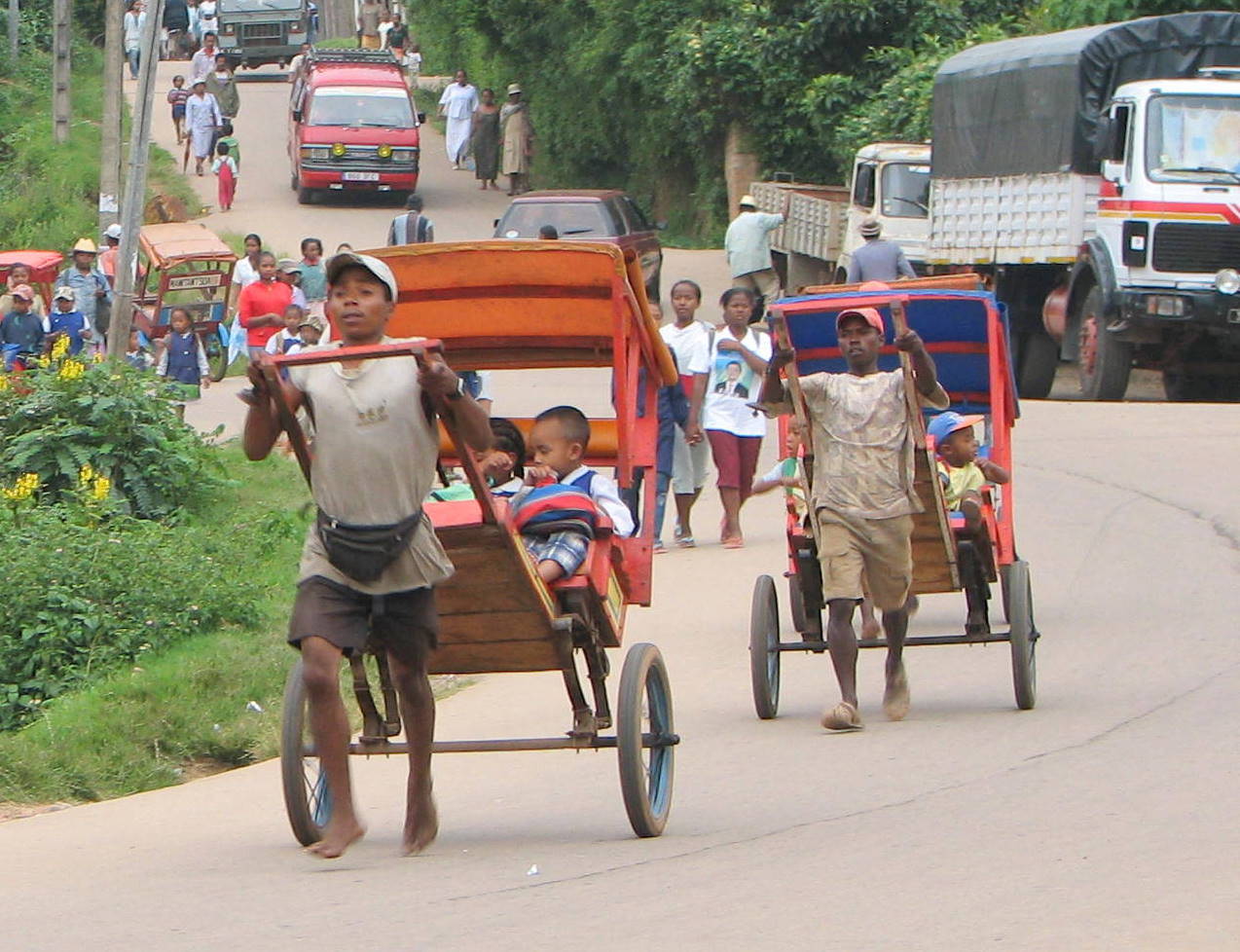
Rickshaws, known as pousse-pousse, were introduced by British missionaries. The intention was to eliminate the slavery-associated palanquin. Its name pousse-pousse, meaning push-push, is reportedly gained from the need to have a second person to push the back of the rickshaw on Madagascar's hilly roads. They are a common form of transport in a number of Malagasy cities, especially Antsirabe, but are not found in the towns or cities with very hilly roads. They are similar to Chinese rickshaws and are often brightly decorated.
Nairobi
Rickshaws operated in Nairobi in the beginning of the 20th century; pullers went on strike there in 1908.
South Africa
Durban is famous for its iconic Zulu rickshaw pullers navigating throughout the city. These colorful characters are famous for their giant, vibrant hats and costumes. They were introduced into Natal by Sir Marshall Campbell in the 1890s. There were about 2,000 registered men who pulled rickshaws in Durban in 1904. Since displaced by motorised transport, there are approximately 25 rickshaws left who mostly cater to tourists today.
Asia
China
In China, from the ancient times and until the 19th century, rich and important people, when traveling overland, were commonly transported in sedan chairs carried by bearers, rather than in wheeled vehicles. This was at least partly explained by road conditions.{{citation It is thought that it was from China (or East Asia in general) that sedan chair (a.k.a. "palanquin") designs were introduced into Western Europe in the 17th century.
In the 19th century, wheelbarrow is the most popular transportation for commoners. In the spring of 1873, the French merchant Menard introduced rickshaw from Japan. The original name is "Jinrikisha", meaning "man-power-vehicle" in Japanese. Most of the rickshaws were owned by foreign investors at the beginning, but in around the 1900s, rickshaws were owned mostly by Chinese companies. The official name for rickshaw is "renliche", meaning "man-power-vehicle" in Chinese, but it is more commonly called "dongyangche", meaning "east-foreign-vehicle", or "huangbaoche" in Shanghai, meaning "yellow carriage for rent".
Rickshaw transportation was an important element in urban development in 20th century China, as a mode of transportation, source of employment and facilitation of migration for workers. According to author David Strand:
Sixty thousand men took as many as a half million fares a day in a city of slightly more than one million. Sociologist Li Jinghan estimated that one out of six males in the city between the ages of sixteen and fifty was a puller. Rickshaw men and their dependents made up almost 20 percent of Beijing's population.
Most manual rickshaws – seen by many Maoists as a symbol of oppression of the working class – were eliminated in China after the founding of the People's Republic of China in 1949.
Shanghai
Shanghai's rickshaw industry began in 1874 with 1,000 rickshaws imported from Japan. By 1914 there were 9,718 vehicles. The pullers were a large group of the city's working poor: 100,000 men pulled rickshaws by the early 1940s, up from 62,000 in the mid-1920s.
In contrary to coolies in Beijing, those in Shanghai mostly come from rural areas out of the city. With the destitution of their land, they poured into the city with their family. As the number of coolies rose up sharply, however, the number of rickshaw remained at 20,000 in Shanghai. Except private coolies, those for public work had to take turns, and thus their average income diminished to $9 per month. Therefore, many coolies worked in the factory and ran the rickshaw after work. However, many coolies were optimistic about life. They were satisfied about their income and dreamed of purchasing their own rickshaws and sending their kids to schools. Due to this low income, many coolies would not give customers a clear idea of standard price and thus charge higher at any chance they had. In response to this phenomenon, hotels would provide the distance to various streets and the price charged.Darwent, Charles Ewart. Shanghai; a handbook for travellers and residents to the chief objects of interest in and around the foreign settlements and native city. Shanghai, Hongkong: Kelly and Walsh [date of publication not identified].
Hong Kong
Rickshaws were first imported to Hong Kong from Japan in 1880. They were a popular form of transport for many years, peaking at more than 3,000 in the 1920s. However, their popularity waned after World War II. No new licenses for rickshaws have been issued since 1975, and only a few old men—three as of 2017—still hold a license. It is reported that only one of them still offer rickshaw rides on The Peak, mainly for tourists. But he retired in 2020.
India
Around 1880, rickshaws appeared in India, first in Simla. At the turn of the century it was introduced in Kolkata (Calcutta), India and in 1914 was a conveyance for hire.
Service availability
Though most cities offer auto rickshaw service, hand-pulled rickshaws do exist in some areas, such as Kolkata, "the last bastion of human powered tana rickshaws". Hindu and Muslim pullers often share housing. Some pullers sleep in the streets in their rickshaws.
As of 2008, many of the Kolkata rickshaw pullers originate from Bihar, considered to be one of the poorest states in India.|group="nb"}} According to Trillin, most Kolkata rickshaws serve people "just a notch above poor" who tend to travel short distances. However, in a recent article by Hyrapiet and Greiner, the authors found that rickshaws also transport middle-class residents who use their services out of convenience and for short-distance trips to the local marketplace. Rickshaws are used to transport goods, shoppers, and school children. It is also used as a "24-hour ambulance service." Also according to Hyrapiet and Greiner, rickshaw pullers have acted as peer-educators for the Calcutta Samaritans providing critical information on HIV/AIDS because of their access to marginalized groups within Kolkata's red light districts.
Rickshaws are the most effective means of transportation through the flooded streets of the monsoon season.
The pullers live a life of poverty and many sleep under rickshaws. Rudrangshu Mukerjee, an academic, stated many people's ambivalent feelings about riding a rickshaw: he does not like being carried about in a rickshaw but does not like the idea of "taking away their livelihood".
Motor vehicles are banned in the Eco-sensitive zone area of Matheran, India, a tourist hill station near Mumbai so man-pulled rickshaws are still one of the major forms of transport there.
Legislation
In Tamil Nadu, in 1974, the Dravida Munnetra Kazhagam Government of M . Karunanidhi officially banned the operation of Hand Pulled Rickshaws in Tamil Nadu by replacing them with pedal Rickshaws .
In August 2005, the Communist government of West Bengal announced plans to completely ban pulled rickshaws, resulting in protests and strikes of the pullers. In 2006, the chief minister of West Bengal, Buddhadeb Bhattacharya, announced that pulled rickshaws would be banned and that rickshaw pullers would be rehabilitated.
in August 2025, Supreme Court of India officially banned pulled rickshaws.
Indonesia
Pulled rickshaws used to be in Indonesia a long time ago. Nowadays, they are replaced by Delman (the horse-drawn carriage) and Becak (cycle rickshaw/pedicab).
Japan
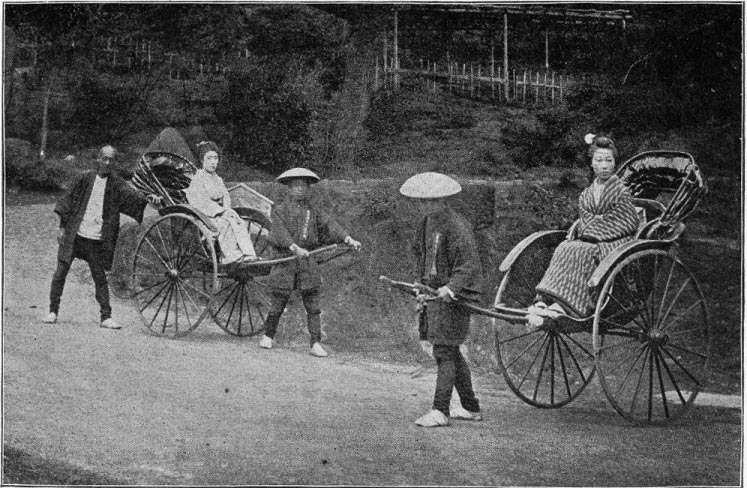
There are several theories about the invention of the rickshaw. Japan historian Seidensticker wrote of the theories:
Though the origins of the rickshaw are not entirely clear, they seem to be Japanese, and of Tokyo specifically. The most widely accepted theory offers the name of three inventors, and gives 1869 as the date of invention.
Starting in 1870, the Tokyo government issued a permission for Izumi Yosuke, Takayama Kosuke, and Suzuki Tokujiro to build and sell rickshaws. By 1872, they became the main mode of transportation in Japan, with about 40,000 rickshaws in service.
The rickshaw's popularity in Japan declined by the 1930s with the advent of automated forms of transportation, like automobiles and trains. After World War II, when gasoline and automobiles were scarce, they made a temporary come-back. The rickshaw tradition has stayed alive in Kyoto and Tokyo's geisha districts and the rickshaws became popular as a tourism resource in the 2000s. The modern rickshaw men are a kind of tourist guide, who take their clients to some tourist spots and explain about them. Many of them are part-time working students and athletes who like running or exchanging cultures.
Malaysia
Rickshaws were a common mode of transport in urban areas of Malaysia in the 19th and early 20th centuries until gradually replaced by cycle rickshaws.
Pakistan
Pulled and cycle rickshaw (qinqi) have been banned in Pakistan since April 1960. Prior to the introduction of auto rickshaws in cities, horse-drawn carriages (tongas) were a main source of public transportation.
Philippines
The pulled rickshaw never gained acceptance in the Philippines. Americans tried to introduce it to Manila in the early 20th century, but it was strongly opposed by local Filipinos who viewed it as an undignified mode of transport that turned humans into "beasts". The main mode of public and private transportation in the Philippines from the 18th to the early 20th centuries was the kalesa, a two-wheeled horse-drawn carriage.
Singapore
Singapore had received its first rickshaws in 1880 and soon after they were prolific, making a "noticeable change in the traffic on Singapore's streets." Bullock carts and gharries were used prior to the introduction of rickshaws.
Many of the poorest individuals in Singapore in the late nineteenth century were poor, unskilled people of Chinese ancestry. Sometimes called coolies, the hardworking men found pulling rickshaws was a new means of employment. Rickshaw pullers experienced "very poor" living conditions, poverty and long hours of hard work. Income remained unchanged from 1876 to 1926, about $.60 per day.
Rickshaws popularity increased into the 20th century. There were approximately 50,000 rickshaws in 1920 and that number doubled by 1930. In or after the 1920s a union was formed, called the Rickshaw Association, to protect the welfare of rickshaw workers.
North America
United States
From A History of the Los Angeles City Market (1930-1950), pulled rickshaws were operated in Los Angeles by high school teenagers during that time period.
Canada
Foot-driven rickshaws have enjoyed several decades of popularity in Halifax, Nova Scotia; in addition to providing tours of the historic Waterfront, rickshaws are also occasionally used for transportation by local residents. The city is home to the oldest rickshaw company in Canada.
Rickshaws are a popular mode of transportation in downtown Ottawa, Ontario, providing tours of historical Byward Market, in the summer. Ottawa's rickshaws stay true to the traditional foot-driven rickshaw model, but feature modern sound-systems.
Books, films, television, music and modern art

- An early Rudyard Kipling story has the title The Phantom Rickshaw (1885). In it a young Englishman has a romance aboard a ship bound for India. He ends the affair and becomes engaged to another woman, causing his original love to die of a broken heart. After that, on excursions around the city of Simla, he frequently sees the ghost of the deceased driving around in her yellow-panelled rickshaw, though nobody else seems to notice the phenomenon.
- The 1936 novel Rickshaw Boy is a novel by the Chinese author Lao She about the life of a fictional Beijing rickshaw man. The English version Rickshaw Boy became a U.S. bestseller in 1945. It was an unauthorized translation that added a happy ending to the story. In 1982, the original version was made into a film of the same title.
- In the 1940s, Eddy Howard recorded a song called The Rickety Rickshaw Man.
- The 1958 Japanese movie Muhomatsu no issho (Rickshaw Man) by Hiroshi Inagaki tells the story of a Matsugoro, a rickshaw man who becomes a surrogate father to the child of a recently widowed woman.
- The 1953 Bollywood film Do Bigha Zameen, directed by Bimal Roy, describes the fate of an impoverished farmer who becomes a rickshaw puller in Kolkata.
- In the 1992 film City of Joy (whose title refers to Kolkata), Om Puri plays a rickshaw puller, revealing the economic and emotional hardship that these underpaid workers face on a day-to-day basis.
- In Pearl S. Buck's 1931 novel The Good Earth, hero Wang Lung leaves his land to travel southward during a drought. He ends up in the city of Kiangsu (Jiangsu), where he becomes a rickshaw puller in order to support his family.
- In the 1998 Seinfeld episode "The Bookstore", Kramer and Newman decide to start a rickshaw business with homeless people being trained to carry passengers.
Notes
References
References
- James Francis Warren. (2003). "Rickshaw Coolie: A People's History of Singapore, 1880-1940". NUS Press.
- David Diefendorf. (2007). "Amazing . . . But False!: Hundreds of "Facts" You Thought Were True, But Aren't". Sterling Publishing Company.
- Leo Suryadinata. (1992). "Chinese Adaptation and Diversity: Essays on Society and Literature in Indonesia, Malaysia & Singapore". NUS Press.
- Hanchao Lu. (1999). "Beyond the Neon Lights: Everyday Shanghai in the Early Twentieth Century". University of California Press.
- Hanchao Lu. (1999). "Beyond the Neon Lights: Everyday Shanghai in the Early Twentieth Century". University of California Press.
- Werner Voigt. (1995). "60 Years in East Africa: The Life of a Settler". GeneralStore Publishing House.
- Hilary Bradt. (2011). "Madagascar". Bradt Travel Guides.
- (2008). "Madagascar, Volume 15 of Cultures of the World Cultures of the World - Group 15". Marshall Cavendish.
- (2012). "Madagascar Travel Guide". Lonely Planet.
- (1985). "Africa under colonial domination 1880–1935: 7". UNESCO.
- Joyce, Peter. (1989). "The South African family encyclopaedia". Cape Town : Struik Publishers.
- Romita Hanuman. "Zulu Rickshaws". Durban.gov.za.
- (2006). "South Africa: Lesotho & Swaziland". Lonely Planet.
- James Francis Warren. (2003). "Rickshaw Coolie: A People's History of Singapore, 1880-1940". NUS Press.
- Hanchao Lu. (1999). "Beyond the Neon Lights: Everyday Shanghai in the Early Twentieth Century". University of California Press.
- Hanchao Lu. (1999). "Beyond the Neon Lights: Everyday Shanghai in the Early Twentieth Century". University of California Press.
- David Strand. "Rickshaw Beijing: City People and Politics in the 1920".
- Hanchao Lu. (1999). "Beyond the Neon Lights: Everyday Shanghai in the Early Twentieth Century". University of California Press.
- Chu, Henry. (4 November 2005). "India Rickshaws Feeling the Pull of Modern Ways". [[Los Angeles Times]].
- Cernetig, Miro. (20 October 1999). "China's Rickshaws Bring Back Bad Memories". [[The New York Times]].
- Hanchao Lu. (1999). "Beyond the Neon Lights: Everyday Shanghai in the Early Twentieth Century". University of California Press.
- Hanchao Lu. (1999). "Beyond the Neon Lights: Everyday Shanghai in the Early Twentieth Century". University of California Press.
- Hongs & Homes, 1928: A complete directory of Shanghai. Shanghai: Millington, Ltd., 1929.
- [https://www.td.gov.hk/mini_site/atd/2018/en/section3_t_10.html] Vehicle Licensing during - 2008-2017
- [https://forgotten-transport.blogspot.com/2011/09/does-rickshaw-still-exist-in-hong-kong.html 被遺忘的公交 The Forgotten Transportation: Rickshaw ride in Hong Kong]
- Pamela Kanwar. (2003). "Imperial Simla: the political culture of the Raj". Oxford University Press.
- (18 February 2010). "Frommer's India". John Wiley and Sons.
- Trillin, Calvin. (April 2008). "Last Days of the Rickshaw".
- Trillin, Calvin. (April 2008). "Last Days of the Rickshaw".
- Trillin, Calvin. (April 2008). "Last Days of the Rickshaw".
- (October 2012). "Calcutta's Hand–Pulled Rickshaws: Cultural Politics and Place Making in a Globalizing City". Geographical Review.
- Joe Bindloss. (2009). "India". Lonely Planet.
- "Matheran: Smallest, peaceful & vehicle-free hill station". India Post.
- WebIndia, 2005.
- Trillin, Calvin. (April 2008). "Last Days of the Rickshaw".
- Trillin, Calvin. (April 2008). "Last Days of the Rickshaw".
- (7 August 2025). "Top court calls hand-pulled rickshaws 'inhuman', asks for pullers' rehabilitation".
- Hanchao Lu. (1999). "Beyond the Neon Lights: Everyday Shanghai in the Early Twentieth Century". University of California Press.
- Boye De Mente. (2010). "The Bizarre and the Wondrous from the Land of the Rising Sun!". Cultural-Insight Books.
- "Japanese rickshaw". Powerhouse Museum.
- Boye De Mente. (2010). "The Bizarre and the Wondrous from the Land of the Rising Sun!". Cultural-Insight Books.
- only for tourists as well as in other tourist places. The tradition completely disappeared once, but a few people revived jinrikisha (human-powered rickshaws) for tourists in the 1970s-1980s[http://yuufuutei.main.jp/kamakura/?page_id=2128 Jinrikisha in Kamakura] Youfuu-tei
- [http://39hida.com/jinriki/ Jinrikisha in Hidatakayama] Gokurak-sha
- [http://www.jnto.go.jp/eng/location/routes/rtp/northern_tohoku/day1.html 3-Day Model Trip Day1 / Kakunodate - Lake Tazawa-ko - Morioka] Japan National Tourism Organization, 31 January 2002
- [http://www.isfj.net/ronbun_backup/2009/k05.pdf 京都観光] {{Webarchive. link. (16 June 2015 ISFJ政策フォーラム2009発表論文 12 – 13 December 2009)
- [https://www.youtube.com/watch?v=a_9E9tHpDts Rickshaw] TV Show "Sekai Tsukai Densetsu" 2002-2003
- [https://www.youtube.com/watch?v=tvX48c9TKK8 Hataraku Ikemen] JoshiFuji Channel 2013/04/29
- Bradsheer, Harry S.. (4 November 1959). "Pakistan To Ban Rickshaws". Lakeland Ledger.
- (14 August 2014). "Rickshaws and Filipinos: Transnational Meanings of Technology and Labor in American-Occupied Manila". International Review of Social History.
- Suryadinata (1992). p. 39.
- James Alexander. (2006). "Malaysia, Brunei and Singapore". New Holland Publishers.
- Leo Suryadinata. (1992). "(same)".
- Suryadinata (1992). p. 45.
- Tara Fickle. "A History of The Los Angeles City Market: 1930-1950". Chinese Historical Society of Southern California (previously published: Gum Saan Journal, Volume 32, No. 1, 2010).
- Iris Chang. (2004). "The Chinese in America: A Narrative History". Penguin.
- (2013). "Halifax Rickshaw Tours".
- (2006). "Frommer's Canada: With the best hiking & outdoor adventures". John Wiley & Sons.
- "Downtown Ottawa Rickshaw Tours". Ottawa Rickshaws.
- "The Phantom Rickshaw". Online Literature.
- (2010). "Rickshaw Boy: A Novel". Harper Perennial Modern Chinese Classics.
- (25 January 1947). "Most Played Juke Box Records". Nielsen Business Media, Inc..
- Pearl S. Buck. (2004). "The Good Earth". Simon and Schuster.
This article was imported from Wikipedia and is available under the Creative Commons Attribution-ShareAlike 4.0 License. Content has been adapted to SurfDoc format. Original contributors can be found on the article history page.
Ask Mako anything about Pulled rickshaw — get instant answers, deeper analysis, and related topics.
Research with MakoFree with your Surf account
Create a free account to save articles, ask Mako questions, and organize your research.
Sign up freeThis content may have been generated or modified by AI. CloudSurf Software LLC is not responsible for the accuracy, completeness, or reliability of AI-generated content. Always verify important information from primary sources.
Report