From Surf Wiki (app.surf) — the open knowledge base
Puerto Princesa Subterranean River National Park
National park in the Philippines

National park in the Philippines
| Field | Value | |
|---|---|---|
| name | Puerto Princesa Subterranean River National Park | |
| iucn_category | III | |
| photo | Puerto-Princesa Subterranean River National Park-112012.jpg | |
| photo_caption | Entrance to the Puerto Princesa Underground River | |
| photo_width | 240 | |
| map | Palawan#Philippines | |
| relief | 1 | |
| map_width | 180 | |
| location | Palawan, Philippines | |
| nearest_city | Puerto Princesa | |
| embedded1 | {{designation list | embed=yes |
| designation1 | WHS | |
| designation1_date | 1999 (23rd session) | |
| designation1_type | Natural | |
| designation1_criteria | vii, x | |
| designation1_number | [652rev](https://whc.unesco.org/en/list/652rev) | |
| designation1_free1name | Region | |
| designation1_free1value | Asia-Pacific | |
| embed | yes | |
| designation1 | Ramsar | |
| designation1_date | June 30, 2012 | |
| designation1_number | 2084}} | |
| coords | ||
| area | 22202 ha | |
| established | November 12, 1999 | |
| governing_body | Department of Environment and Natural Resources | |
| City of Puerto Princesa |
City of Puerto Princesa
The Puerto Princesa Subterranean River National Park is a protected area in the Philippines.
The park is located in the Saint Paul Mountain Range on the western coast of the island of Palawan, about 80 km north of the city of Puerto Princesa, and contains the Puerto Princesa Subterranean River (also known as the Puerto Princesa Underground River or just Underground River). It has been managed by the Puerto Princesa city government since 1992.
It was listed as a UNESCO World Heritage Site in 1999, and voted as a New 7 Wonders of Nature in 2012. It also became a Ramsar Wetland Site in 2012.
A major tourist destination, it is mostly accessed through road trips to the seaside village of Sabang from where one of the many Bangkas (Kayaks) take visitors to the park.
History
In 2010, a group of environmentalists and geologists discovered that the underground river has a second floor, which means that there are small waterfalls inside the cave. They also found a cave dome measuring 300 m above the underground river, rock formations, large bats, a deep water hole in the river, more river channels, and another deep cave, as well as marine creatures and more. Deeper areas of the underground river are almost impossible to explore due to oxygen deprivation.
On November 11, 2011, Puerto Princesa Underground River was provisionally chosen as one of the New 7 Wonders of Nature. This selection was officially confirmed on January 28, 2012.
Geography
The park has a limestone karst mountain landscape. Within the park the St. Pauls Underground River Cave is more than 24 km long and contains an 8.2 km underground section of the Cabayugan River. The river winds through the cave before flowing directly into the South China Sea and is navigable by boat up to 4.3 km from the sea. The cave includes major formations of stalactites and stalagmites, and several large chambers, including the 360 m Italian's Chamber with approximate 2.5 million square meters volume. It is one of the largest cave rooms in the world. The lower portion of the river up to 6 km from the sea, is subject to tidal influences. Until the 2007 discovery of an underground river in Mexico's Yucatán Peninsula, the Puerto Princesa Subterranean River was reputed to be the world's longest underground river.
The area also represents a habitat for biodiversity conservation. The site contains a full mountain-to-the-sea ecosystem and has some of the most important forests in Asia. It was inscribed by UNESCO as a World Heritage Site on December 4, 1999.
Flora
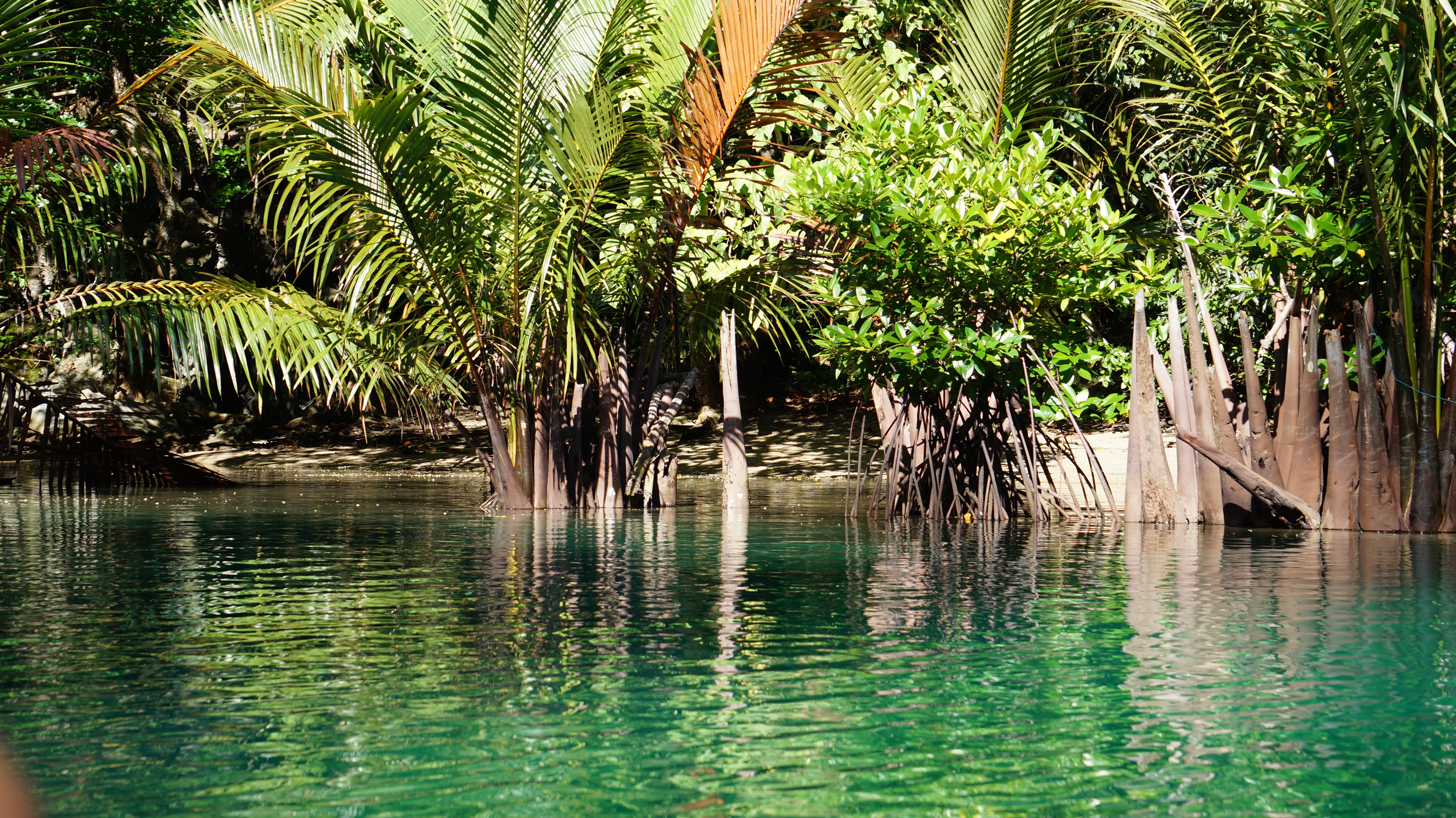
The park has a range of forest formations, the thirteen forest types found in tropical Asia, namely forest over ultramafic soils, forest over limestone soils, montane forest, freshwater swamp forest, lowland evergreen tropical rainforest, riverine forest, beach forest, and mangrove forest. Researchers have identified more than 800 plant species from 300 genera and 100 families. These include at least 295 trees dominated by the dipterocarp species. In the lowland forest, large trees including the dao (Dracontomelon dao), ipil (Intsia bijuga), dita (Alstonia scholaris), amugis (Koordersiodendron pinnatum), and apitong (Dipterocarpus gracilis) are common. Beach forest species include bitaog (Calophyllum inophyllum), Pongamia pinnata, and Erynthia orientalis. Other plant species include almaciga (Agathis philippinensis), kamagong (Diospyros pulganensis) pandan (Pandanus sp.) anibong, and rattan (Calamus sp.).
Fauna

Birds comprise the largest group of vertebrates found in the park. Of the 252 bird species known to occur in Palawan, a total of 165 species of birds were recorded in the park. This represents 67% of the total birds and all of the 15 endemic bird species of Palawan. Notable species seen in the park are the blue-naped parrot (Tanygnathus lucionensis), Tabon scrub fowl (Megapodius cumunigii), hill myna (Gracula religiosa), Palawan hornbill (Anthracoceros marchei), white breasted sea eagle (Haliaeetus leucogaster).
There are also some 30 mammal species that have been recorded. Most often observed in the forest canopy and along the shoreline feeding during low tide is the long-tailed macaque (Macaca fascicularis), the only primate found in the area. Other mammal species in the park are the Palawan bearded pig (Sus ahoenobarbus), bearcat (Arctictis binturong), Palawan stink badger (Mydaus marchei) and the Palawan porcupine (Hystrix pumila).
19 species of reptiles have been identified, eight of which are endemic. Common species in the area include large predators like the common reticulated python (Python reticulates), the monitor lizard (Varanus salvator) and the green crested lizard (Bronchocoela cristatella). Amphibian fauna include ten species. The Philippine woodland frog (Rana acanthi) is the most dominant and frequently encountered. One species, Barbourula busuangensis, endemic to Palawan was also observed in the area.
Nine species of bat, two species of swiftlet and whip spider (Stygophrynus sp.) are found in the cave, and the sea cow (Dugong dugon) and the hawksbill sea turtle (Chelonia mydas) feed in the coastal area of the park.
International reception
Puerto Princesa Underground River was entered as the Philippine entry – and topped the first round of voting – in the New 7 Wonders of Nature competition. On July 29, 2011, after the second round of voting, it was declared 1 of 28 finalists. Mayor Edward S. Hagedorn extended his gratitude to all those who supported and voted for the PPUR. On November 11, 2011, it was provisionally chosen as one of the New7Wonders, together with the Amazon rainforest, Halong Bay, Iguazu Falls, Jeju Island, Komodo Island, and Table Mountain.
On January 28, 2012, Malacañang expressed elation over the official inclusion of the Puerto Princesa Underground River (PPUR) in the world's New Seven Wonders of Nature. "Confirmation that the Puerto Princesa Underground River is one of the New Seven Wonders of Nature is welcome news indeed. Throughout the competition, Filipinos from all walks of life have given time, energy, and resources to this campaign," Presidential Spokesperson Edwin Lacierda said.
Department of Tourism spokesman and Assistant Secretary Benito Bengzon Jr. said the underground estuary made it into the world's New Seven Wonders of Nature after the validation process conducted by the New7Wonders Foundation last year. The voting was criticized, especially the Philippine voting. Nothing in the New7Wonders voting procedure prohibited repetitive voting, making the results subject to government and tourism industry campaigns to vote often for local sites with the financial incentive of increased tourism. Philippine President Benigno Simeon Aquino III, in his speech during the official proclamation launch of the Puerto Princesa Underground River as one of the 28 finalists, urged the country's 80 million cellphone subscribers to vote PPUR via text.
On June 30, 2019, Puerto Princesa underground river was celebrated with a Google Doodle.
References
References
- "Puerto Princesa Subterranean River National Park".
- (November 13, 2022). "The Underground River of Puerto Princesa".
- "Administrative Order No. 29, s. 2012". www.gov.ph.
- (February 14, 2012). "Puerto Princesa Subterranean River". Wondermondo.
- Roach, John. (March 5, 2007). "World's Longest Underground River Discovered in Mexico, Divers Say". [[National Geographic Society]].
- "Puerto-Princesa Subterranean River National Park".
- Madulid, 1998{{Verify source. (June 2013)
- (2017). "''Sus ahoenobarbus''".
- (November 17, 2011). "UR Declared As Official Finalist to the Search for the New 7 Wonders of Nature". Puerto Princesa Underground River.
- [http://www.vote7.com/n7w/nature Voting procedure for the New7Wonders of Nature] {{webarchive. link. (August 5, 2009 at vote7.com)
- Rosero, Earl Victor. (2012-01-28). "PHL preps for New7Wonders inauguration of Puerto Princesa Underground River".
- (2012-01-31). "The Presidential Spokesperson on the PPUR being declared one of the New7Wonders of Nature, January 28, 2012".
- Legaspi, Amita. (2011-06-06). "Aquino leads online voting for Puerto Princesa underground river".
- (June 30, 2019). "Celebrating Puerto Princesa Underground River". Google.
This article was imported from Wikipedia and is available under the Creative Commons Attribution-ShareAlike 4.0 License. Content has been adapted to SurfDoc format. Original contributors can be found on the article history page.
Ask Mako anything about Puerto Princesa Subterranean River National Park — get instant answers, deeper analysis, and related topics.
Research with MakoFree with your Surf account
Create a free account to save articles, ask Mako questions, and organize your research.
Sign up freeThis content may have been generated or modified by AI. CloudSurf Software LLC is not responsible for the accuracy, completeness, or reliability of AI-generated content. Always verify important information from primary sources.
Report