From Surf Wiki (app.surf) — the open knowledge base
Proclamation of Bangladeshi Independence
None
None
| Field | Value |
|---|---|
| document_name | Proclamation of Bangladeshi Independence |
| বাংলাদেশের স্বাধীনতার ঘোষণাপত্র | |
| image | Proclamation of Bangladeshi Independence.jpg |
| date_created | 26 March 1971 |
| date_ratified | 10 April 1971 |
| location_of_document | Liberation War Museum |
| Sher-e-Bangla Nagar, Dhaka, Bangladesh | |
| writer | 1st Declaration by Sheikh Mujibur Rahman |
| 2nd Declaration by Provisional Government of Bangladesh | |
| signers | Constituent Assembly of Bangladesh |
| purpose | Declaring East Pakistan's independence as Bangladesh with the establishment of its provisional government |
বাংলাদেশের স্বাধীনতার ঘোষণাপত্র Sher-e-Bangla Nagar, Dhaka, Bangladesh 2nd Declaration by Provisional Government of Bangladesh The Proclamation of Bangladeshi Independence (), refers to the declaration of independence of East Pakistan as Bangladesh on 26 March 1971, at the onset of the Bangladesh Liberation War by Sheikh Mujibur Rahman. On that day, Bangladesh Awami League leader M. A. Hannan, and the following day Major Ziaur Rahman, broadcast the message on radio on behalf of Sheikh Mujibur Rahman from the Swadhin Bangla Betar Kendra radio station in Kalurghat, Chattogram. On 10 April, the Provisional Government of Bangladesh issued a proclamation on the basis of the previous declaration and established an interim constitution for the independence movement.
First declarations
Abdul Hamid Khan Bhashani was the first ever Bengali to declare independence of East Pakistan in a massive public rally on 23 November 1970 but it was not officially recognized. In the first general election in Pakistan, in December 1970, the Bangladesh Awami League (BAL) won nearly every seat representing East Pakistan. That gave them an absolute majority in the National Assembly. President Yahya Khan, however, kept them from taking power by postponing the convening of the assembly indefinitely. Tensions mounted; by early March 1971, there was broad support in East Pakistan for independence, but the AL leadership thought ongoing negotiations with Yahya Khan might still reach a solution short of secession. Yahya Khan spun out talks with the AL through 25 March, on the night of which he unleashed a military crackdown.
In the evening of 25 March, Sheikh Mujibur Rahman, leader of the Awami League, convened a meeting of senior Bengali nationalist leaders, including Tajuddin Ahmad and Colonel M A G Osmani, at his residence in Dhanmondi. They were briefed by Bengali insiders within the military of an impending crackdown. They implored Mujib to declare independence but Mujib declined to do because he wanted independence in a bloodless systematic manner. Tajuddin Ahmed even brought all the recording instruments but had failed to convince Mujib to record independence declaration. Rather, Mujib ordered all the high ups to flee to India. However, Mujib decided to remain in Dhaka in hope of coming to a negotiated compromise with West Pakistan in becoming the Prime Minister of the whole Pakistan then it would have been easier to gain independence then.
On the night of 25 March, the Pakistan Armed Forces launched Operation Searchlight in the capital of East Pakistan. Tanks rolled out on the streets of Dhaka. The troops were said to have massacred students and intellectuals in Dhaka University, as well as many civilians in other parts of the city. It set major cities ablaze and crushed resistance from the police and the East Pakistan Rifles (present-day Border Guard Bangladesh).
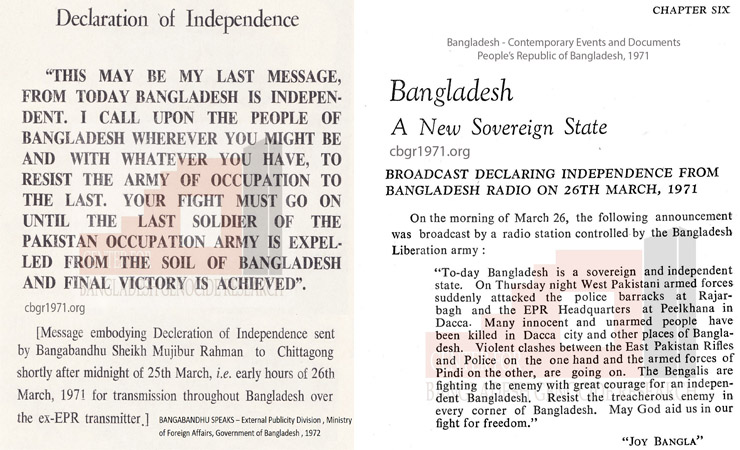
At 12.20 AM on 26 March from his house at Dhanmondi, Sheikh Mujibur Rahman sent a message about attacks on EPR and police barracks in Dhaka, and declared the independence of Bangladesh through a telegram. The telegram was sent to Chittagong, where AL leader M. A. Hannan and Major Ziaur Rahman of the East Bengal Regiment broadcast the message on radio on behalf of Mujib. The declaration of independence was widely reported in newspapers around the world. As per the sixth schedule of the Constitution of Bangladesh, the text of Mujib's telegram by Major Ziaur Rahman stated the following:
This may be my last message, from today Bangladesh is independent. I call upon the people of Bangladesh wherever you might be and with whatever you have, to resist the army of occupation to the last. Your fight must go on until the last soldier of the Pakistan occupation army is expelled from the soil of Bangladesh and final victory is achieved.
Mujib's telegram was widely reported on radio on 26 March 1971. M. A. Hannan, secretary of the BAL in Chittagong, read out the statement in Bengali at 2.30 pm and 7.40 pm from a radio station in Chittagong. The text of the Hannan's broadcast stated the following:
Today Bangladesh is a sovereign and independent country. On Thursday night [March 25, 1971], West Pakistan armed forces suddenly attacked the police barracks at Rajarbagh and the EPR headquarters at Pilkhana in Dhaka. Many innocent and unarmed have been killed in Dhaka city and other places of Bangladesh. Violent clashes between EPR and police on the one hand and the Armed Forces of Pakistan on the other are going on. The Bengalis are fighting the enemy with great courage for an independent Bangladesh. May Allah aid us in our fight for freedom. Joy Bangla.
On 27 March 1971, Major Ziaur Rahman broadcast Mujib's message in English which was drafted by Abul Kashem Khan. Zia's message stated the following:
This is Swadhin Bangla Betar Kendra. I, Major Ziaur Rahman, on behalf of Bangabandhu Sheikh Mujibur Rahman, hereby declare that the independent People's Republic of Bangladesh has been established. I call upon all Bengalis to rise against the attack by the West Pakistani Army. We shall fight to the last to free our motherland. By the grace of Allah, victory is ours.
On 10 April 1971, the Provisional Government of Bangladesh issued the Proclamation of Independence which confirmed Mujib's original declaration of independence. The proclamation also included the term Bangabandhu for the first time in a legal instrument. The proclamation stated the following:
Bangabandhu Sheikh Mujibur Rahman, the undisputed leader of the 75 million people of Bangladesh, in due fulfilment of the legitimate right of self-determination of the people of Bangladesh, duly made a declaration of independence at Dacca on 26 March 1971, and urged the people of Bangladesh to defend the honour and integrity of Bangladesh.
According to A. K. Khandker, who served as Deputy Chief of Staff of the Bangladesh Armed Forces during the Liberation War; Sheikh Mujib avoided a radio broadcast fearing that, it might be used as evidence of treason by the Pakistani military against him during his trial. This view is also supported in a book written by the daughter of Tajuddin Ahmed.
Constituent Assembly
On 10 April 1971, the Provisional Government of Bangladesh was formed in Mujibnagar. It converted the elected Bengali members of the national and provincial assemblies of Pakistan into the Constituent Assembly of Bangladesh. The constituent assembly issued a second proclamation of independence, which also served as the fundamental law of Bangladesh until the adoption of the constitution in 1972. This proclamation was drafted by Barrister M Amir-ul Islam and reviewed by Indian Barrister Subrata Roy Chowdhury. The text is given in the following:-
| Declaration by the Constituent Assembly |
|---|
| PROCLAMATION OF INDEPENDENCE |
Proclaimer controversy
Until 2010, there was a controversy between the two dominant parties of Bangladesh, Awami League (BAL) and Bangladesh Nationalist Party (BNP), over who had issued the proclamation: AL claimed Sheikh Mujibur Rahman and BNP claimed Ziaur Rahman. However, Bangabandhu is described as the proclaimer of the independence of Bangladesh in all diplomatic secret documents of the Richard Nixon administration, news, and other documents. In 2010, a ruling of the Supreme Court officially recognized Sheikh Mujibur Rahman as the promulgator, and denounced the views of BNP, calling it distortion of history.
Background
Since its establishment, the Bengali-majority of Pakistan wanted full political and cultural autonomy, which resulted in a rise of nationalist and pro-democratic movements in the country. The Awami League, established in 1949, became the leading and representative party of the Bengalis in Pakistan. In the 1970 Pakistani general election, the League won an absolute victory and emerged as the largest political party in the country, but the junta government of Yahya Khan refused to transfer power due to its pro-Bengali and secular stance. On 1 March 1971, Bangabandhu Sheikh Mujibur Rahman, then president of Awami League, declared civil disobedience movement in East Pakistan. On 7 March 1971, Bangabandhu delivered his famous speech, concluding with, "The struggle this time, is a struggle for our liberty. The struggle this time, is a struggle for our independence. Joy Bangla!" It's widely considered as the de facto declaration of Bangladeshi independence.
Controversy
Bangladesh Nationalist Party (BNP) strongly claimed Ziaur Rahman as the proclaimer of independence. The third volume of Bangladesh Independence War: Documents, published in 1978, recognized Zia as the proclaimer. Even some of the BNP leaders openly denounced Bangabandhu as the false proclaimer during Khaleda Zia’s premiership.
The controversy, lasted nearly two decades, led the country to a political and an ideological crisis. When a different party comes to power, they change the history books of Bangladesh to either prefer Sheikh Mujibur Rahman or Ziaur Rahman.
However, some minor controversies also involve around the broadcasting of the proclamation. According to A. K. Khandker Bir Uttom, a military officer during the liberation war and former planning minister of Bangladesh, on 26 March, a technician at Swadhin Bangla Betar Kendra read out the proclamation of independence first over the radio.
Controversial quote of A. K. Khandker
In 2014, A. K. Khandker claimed in his book 1971: Bhetore Baire (lit: "1971: Inside Out") that Bangabandhu did not make any proclamation about independence from 7 March until his arrest, nor did he leave any written notes or recorded voice messages and did not follow any predetermined directions. Additionally, he also controversially quoted that Bangabandhu cried Joy Pakistan ("Victory to Pakistan") alongside Joy Bangla in his speech on 7 March 1971. and the author withdrew the said part of the book and other related parts. Later he formally announced an apology for giving false informations in his book.
United States documents
According to South Asian crisis, 1971, a secret document published by the United States Department of State covering the Indo-Pakistan affairs that time, United States was observing the situations of Pakistan from March 1971. On 26 March 1971, just after the Operation Searchlight, US president Richard Nixon called an emergency meeting with then US Secretary of State Henry Kissinger, the Special Action Group Washington, the National Security Committee, and the CIA representatives at the White House, where it was said to have declared the independence of East Pakistan. Richard Helms, Director of the CIA, said on that meeting:
Supreme Court ruling
In 2010, the third volume of Bangladesh Independence War: Documents, published presenting Ziaur Rahman as the proclaimer, was declared null and void by the Supreme Court, and the volume was ordered to be confiscated and withdrawn from all places in the country and abroad. Directions given by the High Court Division:
References
References
- (27 March 2018). "March 27, 1971: Zia makes radio announcement on independence". The Daily Star.
- (10 December 2007). "Radio Interview".
- "Swadhin Bangla Betar Kendro and Bangladesh's Declaration of Independence". The Daily Star.
- {{Cite Banglapedia
- (29 September 2022). "Maulana Bhashani was the first to declare 'Independence' of East Pakistan - Sindh Courier".
- https://www.daily-sun.com/post/780477#:~:text=On%20that%20fateful%20day%2C%20Bhashani,government%20based%20in%20West%20Pakistan.
- (2005). "Sheikh Mujib: triumph and tragedy". [[The University Press Limited]].
- (2005). "Sheikh Mujib: triumph and tragedy". [[The University Press Limited]].
- (2005). "Sheikh Mujib: triumph and tragedy". [[The University Press Limited]].
- (2005). "Sheikh Mujib: triumph and tragedy". [[The University Press Limited]].
- (23 September 2017). "Special report: The Breakup of Pakistan 1969-1971". [[Dawn (newspaper).
- Bass, Gary Jonathan. (2014). "The Blood Telegram: Nixon, Kissinger, and a Forgotten Genocide". [[Vintage Books]].
- Bass, Gary Jonathan. (2014). "The Blood Telegram: Nixon, Kissinger, and a Forgotten Genocide". [[Vintage Books]].
- "Bangabandhu Shadhinota Ghoshonar Telegraphic Barta". [[BDNews24]].
- Loshak, David. (1971). "Pakistan Crisis". [[Heinemann (publisher).
- "Swadhin Bangla Betar Kendro and Bangladesh's Declaration of Independence". [[The Daily Star (Bangladesh).
- "First Schedule".
- "Ziaur Rahman (Shaheed General Zia) - Declaration of Independence, 1975 coup - biography of Muslim and Bengali".
- (7 April 2014). "Zia's declaration". The Daily Star.
- (24 March 2021). "Liberation War Timeline".
- "The Proclamation of Independence".
- (2019). "Crisis in Governance: Military Rule in Bangladesh during 2007–2008". Cambridge Scholars Publishing.
- (2014). Prathamā Prakāśan. Abdul Momin]] about this. He was also present at Bangabandhu's house on the night of 25 March. Abdul Momin said that when he was entering Bangabandhu's house, he saw Tajuddin Ahmed carrying files in his armpit with a very angry look. Abdul Momin took Tajuddin's hand and asked, "Why are you angry? Then Tajuddin Ahmed narrated the previous incident to him and said, 'Bangabandhu is not willing to take any risk. But one-after-one attacks are coming on us.'. link
- Ridwanul Hoque. (2021). "Constitutional foundings in South Asia". [[Hart Publishing]].
- link. . . sarabangla.net. (10 April 2019)
- Salik, Siddiq. "Witness to Surrender".
- Siddique. Abdul Kader. (1997). Anannya
- link. . . Samakal
- link. . . Ekushey TV
- "Historical Documents - Office of the Historian".
- (25 March 2012). "ABC News, 26 March, 1971".
- "Bangabandhur Shadhinota Ghoshonar Telegraphic Barta". [[BDNews24]].
- link. [[bdnews24.com]]
- (18 January 1972). "He Tells Full Story of Arrest and Detention (interview by Sydney H. Schanberg, Jan. 18, 1972)". [[The New York Times]].
- "মুক্তিযুদ্ধ বিষয়ক মন্ত্রণালয়".
- link. . . **
- Srivastava, Prabhat. (1 January 1972). "The Discovery of Bangla Desh". Sanjay Publications.
- (22 March 2013). "The Bangladesh Reader: History, Culture, Politics". Duke University Press.
- Furtado, Peter. (1 November 2011). "History's Daybook: A History of the World in 366 Quotations". Atlantic Books.
- Islam, Sirajul. (18 June 2021). "Declaration of Independence". [[Asiatic Society of Bangladesh]].
- According to [[Abdullah Abu Sayeed]], [[Ekushey Padak]] Medalist Swadhin Bangla Betar Kendra artist [[Abul Kashem Sandwip]] also read the proclamation before Ziaur Rahman.. Sayeed. Abdullah Abu
- (2014). Prathamā Prakāśan. Abdul Momin]] about this. He was also present at Bangabandhu's house on the night of 25 March. Abdul Momin said that when he was entering Bangabandhu's house, he saw Tajuddin Ahmed carrying files in his armpit with a very angry look. Abdul Momin took Tajuddin's hand and asked, "Why are you angry? Then Tajuddin Ahmed narrated the previous incident to him and said, 'Bangabandhu is not willing to take any risk. But one-after-one attacks are coming on us.'. link
- (6 September 2014). "AK Khandker revises his book". [[Dhaka Tribune]].
- link. [[Prothom Alo]]. (11 June 2019)
- "Minutes of Washington Special Actions Group Meeting {{!}} Foreign Relations of the United States, 1969–1976, Volume XI, South Asia Crisis, 1971". United States Department of State.
- "Foreign Relations of the United States, 1969–1976, Volume XI, South Asia Crisis, 1971". United States Department of State.
This article was imported from Wikipedia and is available under the Creative Commons Attribution-ShareAlike 4.0 License. Content has been adapted to SurfDoc format. Original contributors can be found on the article history page.
Ask Mako anything about Proclamation of Bangladeshi Independence — get instant answers, deeper analysis, and related topics.
Research with MakoFree with your Surf account
Create a free account to save articles, ask Mako questions, and organize your research.
Sign up freeThis content may have been generated or modified by AI. CloudSurf Software LLC is not responsible for the accuracy, completeness, or reliability of AI-generated content. Always verify important information from primary sources.
Report