From Surf Wiki (app.surf) — the open knowledge base
Primary somatosensory cortex
Region of the brain which processes touch
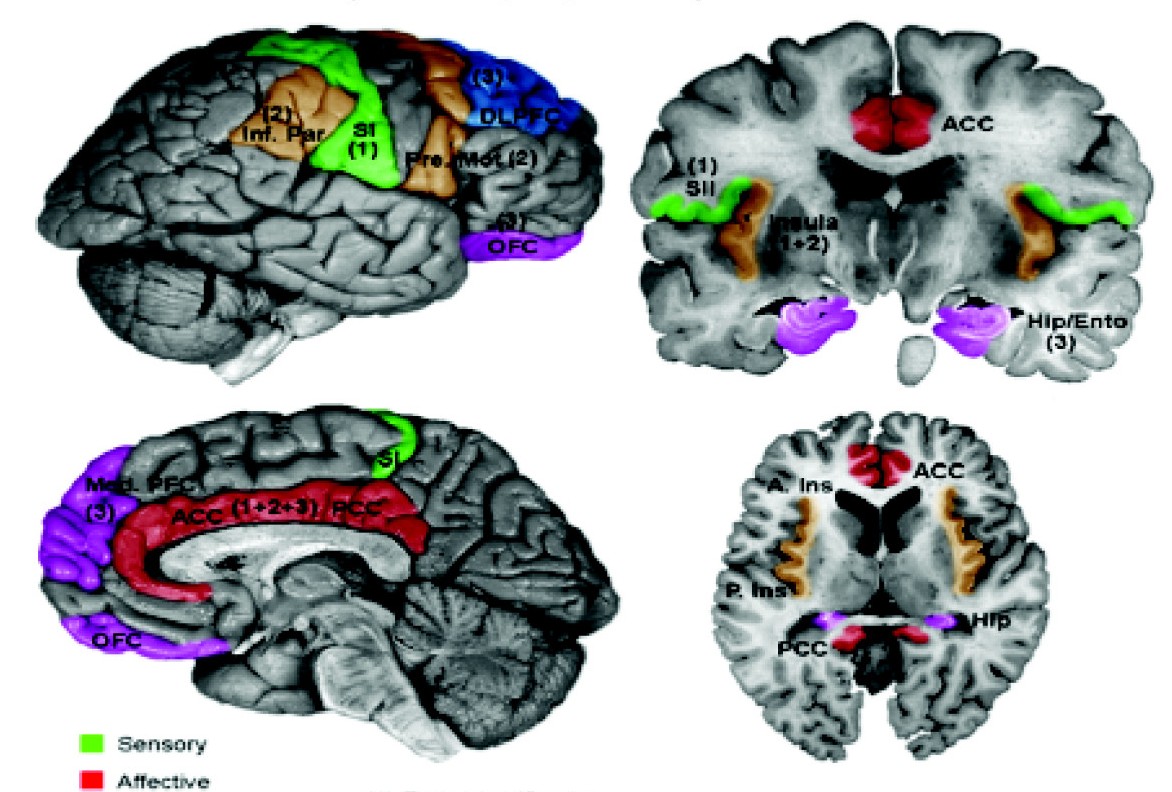
Region of the brain which processes touch
| Field | Value |
|---|---|
| Name | Primary somatosensory cortex |
| Image | Blausen 0103 Brain Sensory&Motor.png |
| Caption | Primary somatosensory cortex labeled in purple |
| Image2 | File:Cerebrum lobes.svg |
| Caption2 | Primary somatosensory cortex: second image. |
At the primary somatosensory cortex, tactile representation is orderly arranged (in an inverted fashion) from the toe (at the top of the cerebral hemisphere) to mouth (at the bottom). However, some body parts may be controlled by partially overlapping regions of cortex. Each cerebral hemisphere of the primary somatosensory cortex only contains a tactile representation of the opposite (contralateral) side of the body. The amount of primary somatosensory cortex devoted to a body part is not proportional to the absolute size of the body surface, but, instead, to the relative density of cutaneous tactile receptors located on that body part (sometimes pictures as a cortical homunculus). The density of cutaneous tactile receptors on a body part is generally indicative of the degree of sensitivity of tactile stimulation experienced at said body part. For this reason, the human lips and hands have a larger representation than other body parts.
Structure
Brodmann areas 3, 1, and 2
Brodmann areas 3, 1, and 2 make up the primary somatosensory cortex of the human brain (or S1). Because Brodmann sliced the brain somewhat obliquely, he encountered area 1 first; however, from anterior to posterior, the Brodmann designations are 3, 1, and 2, respectively.
Brodmann area (BA) 3 is subdivided into two cytoarchitectonic areas labeled as 3a and 3b.
Clinical significance
Lesions affecting the primary somatosensory cortex produce characteristic symptoms including: agraphesthesia, astereognosia, hemihypesthesia, and loss of vibration, proprioception and fine touch (because the third-order neuron of the medial-lemniscal pathway cannot synapse in the cortex). It can also produce hemineglect, if it affects the non-dominant hemisphere. Destruction of brodmann area 3, 1, and 2 results in contralateral hemihypesthesia and astereognosis.
It could also reduce nociception, thermoception, and crude touch, but, since information from the spinothalamic tract is interpreted mainly by other areas of the brain (see insular cortex and cingulate gyrus), it is not as relevant as the other symptoms.
References
References
- Viaene A.N.. (2011). "synaptic properties of thalamic input to layers 2/3 and 4 of primary somatosensory and auditory cortices". Journal of Neurophysiology.
- "Somatosensory Cortex".
- (2006). "Basic Neurosciences with Clinical Applications". Elsevier Health Sciences.
- (2012-11-07). "Within-Digit Functional Parcellation of Brodmann Areas of the Human Primary Somatosensory Cortex Using Functional Magnetic Resonance Imaging at 7 tesla". The Journal of Neuroscience.
This article was imported from Wikipedia and is available under the Creative Commons Attribution-ShareAlike 4.0 License. Content has been adapted to SurfDoc format. Original contributors can be found on the article history page.
Ask Mako anything about Primary somatosensory cortex — get instant answers, deeper analysis, and related topics.
Research with MakoFree with your Surf account
Create a free account to save articles, ask Mako questions, and organize your research.
Sign up freeThis content may have been generated or modified by AI. CloudSurf Software LLC is not responsible for the accuracy, completeness, or reliability of AI-generated content. Always verify important information from primary sources.
Report