From Surf Wiki (app.surf) — the open knowledge base
Preventable causes of death
Causes of death that could have been avoided
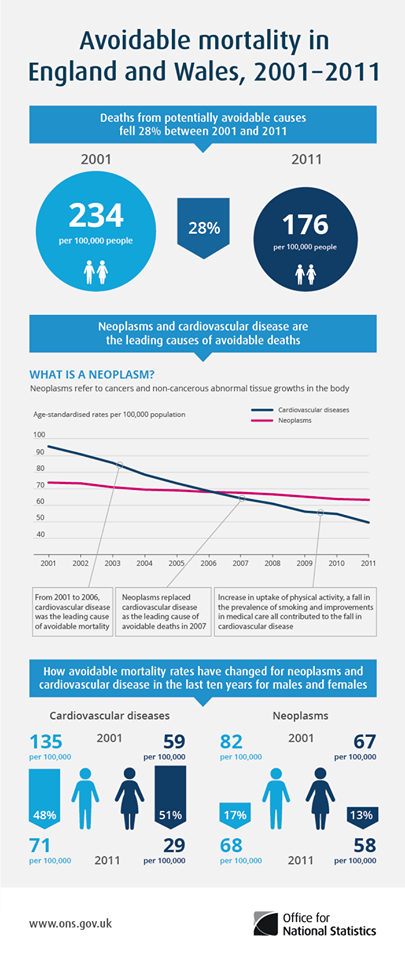
Causes of death that could have been avoided
Preventable causes of death are causes of death related to risk factors which could have been avoided. The World Health Organization has traditionally classified death according to the primary type of disease or injury. However, causes of death may also be classified in terms of preventable risk factors—such as smoking, unhealthy diet, sexual behavior, and reckless driving—which contribute to a number of different diseases. Such risk factors are usually not recorded directly on death certificates, although they are acknowledged in medical reports.
Worldwide
It is estimated that of the roughly 150,000 people who die each day across the globe, about two thirds—100,000 per day—die of age-related causes. In industrialized nations the proportion is much higher, reaching 90 percent. Thus, albeit indirectly, biological aging (senescence) is by far the leading cause of death. Whether senescence as a biological process itself can be slowed, halted, or even reversed is a subject of current scientific speculation and research.
2001 figures
Risk factors associated with the leading causes of preventable death worldwide as of the year 2001, according to researchers working with the Disease Control Priorities Network (DCPN):
| Cause | Number of deaths resulting |
|---|---|
| (millions per year) | |
| Hypertension | 7.8 |
| Smoking tobacco | 5.4 |
| Alcohol use disorder | 3.8 |
| Sexually transmitted infections | 3.0 |
| Poor diet | 2.8 |
| Overweight and obesity | 2.5 |
| Physical inactivity | 2.0 |
| Malnutrition | 1.9 |
| Indoor air pollution from solid fuels | 1.8 |
| Unsafe water and poor sanitation | 1.6 |
By contrast, the World Health Organization (WHO)'s 2008 statistics list only causes of death, and not the underlying risk factors.
In 2001, on average 29,000 children died of preventable causes each day (that is, about 20 deaths per minute). The authors provide the context:
Western societies
In 2017, The Lancet published a large study by Swiss epidemiologist Silvia Stringhini and her collaborators, analysing the impact of the most important causes of preventable death in Western societies. They estimated the number of years of life lost for each risk factor at the individual level and its contribution to preventable death at the societal level (PAF = Population Attributable Fraction).
The multicohort study and meta-analysis used individual-level data from 48 independent prospective cohort studies with information on socioeconomic status, high alcohol consumption, physical inactivity, current smoking, hypertension, diabetes and obesity, and mortality, for a total population of 1,751,479 from seven high-income WHO member countries.
A limitation of many studies of health risk factors is confounding bias: many risk factors are interrelated and cluster together in high-risk populations. For example, low physical activity and obesity go hand in hand. People who are physically inactive tend to gain weight, and people who are severely obese have difficulty exercising. The unique advantage of the huge amount of individual data in the Stringhini study is that it allows (estimation of) the relative contribution of each separate risk factor.
The following table shows that, at an individual level, smoking is the single greatest risk of avoidable death, followed by diabetes and high alcohol consumption. At the population level, diabetes and high alcohol consumption have a low prevalence. Physical inactivity, smoking and low socioeconomic status (SES) are then the top three preventable causes of early death. Smoking, physical inactivity and low SES account for almost two thirds of all avoidable deaths.
| Risk factor | Reference | Hazard ratio | Life years lost | ||
|---|---|---|---|---|---|
| between ages | |||||
| 40 and 85 | Prevalence | Percentage of | |||
| deaths which | |||||
| were premature | |||||
| (PAF) | |||||
| Physical inactivity | 1.59 | 2.30 | 43.7% | 24.5% | |
| Current smoking | Never smoking | 2.08 | 4.60 | 23.3% | 24.0% |
| Low Socio-Economic Status | High SES | 1.38 | 2.06 | 35.4% | 17.2% |
| Diabetes | 1.79 | 3.99 | 9.0% | 6.5% | |
| High alcohol | Moderate alcohol intake | 1.62 | 0.48 | 6.8% | 3.7% |
| Hypertension | 1.29 | 1.54 | 34.0% | 8.8% | |
| Obesity | Normal BMI | 1.11 | 0.68 | 20.9% | Small |
A puzzling finding is the small contribution of obesity as a cause of avoidable premature death. There are two reasons why obesity is not an important independent risk factor, as is often assumed.
- Being overweight is a risk for early death without correcting for confounding risk factors. Overweight is usually measured by the body mass index (BMI = kg/m2), which is much easier to measure than physical activity. Most studies only measured BMI, not physical activity, and did not correct for confounding.
- A major pitfall in many studies of weight and health is that "normal" and "healthy" are often confused. The WHO definition of "normal" adult BMI (between 18.5 and 24.9 kg/m2) is based on a normal weight and height distribution of US citizens in the 1960s, not on the associated risk of death in 2023. A meta-analysis of the association between BMI and mortality in 230 cohort studies with 3.74 million deaths among 30.3 million participants found that the risk of death in adults is not increased between 23 and 30 kg/m2 (see Figure 2). An adult BMI of 18.5 kg/m2, considered 'normal' by WHO criteria, is associated with a 30% increase in all-cause mortality. However, this is a measure of correlation, not causation, so it does not disprove previously held notions of the relationship between health and weight.

United States
The three risk factors most commonly leading to preventable death in the population of the United States are smoking, high blood pressure, and being overweight. Pollution from fossil fuel burning kills roughly 200,000 per year.https://academic.oup.com/cardiovascres/article/116/11/1910/5770885
File:Preventable causes of death.svg|alt=Leading preventable causes of death in the United States in the year 2000. Note: This data is outdated and has been significantly revised, especially for obesity-related deaths.|Figure 3: Leading preventable causes of death in the United States in the year 2000. Note: This data is outdated and has been significantly revised, especially for obesity-related deaths.
Accidental death
File:Causes of accidental death by age group.png|alt=Leading causes of accidental death in the United States by age group as of 2002[update].|Figure 4: Leading causes of accidental death in the United States by age group . File:Causes of accidental death by age group (percent).png|alt=Leading causes of accidental death in the United States as of 2002[update], as a percentage of deaths in each group.|Figure 5: Leading causes of accidental death in the United States , as a percentage of deaths in each group. annual_deaths_in_US
Annual number of deaths and causes
| Cause of death | Number of | ||||||||||||||||
|---|---|---|---|---|---|---|---|---|---|---|---|---|---|---|---|---|---|
| deaths | Percent of total | Notes | |||||||||||||||
| Smoking tobacco | vauthors=Mokdad AH, Marks JS, Stroup DF, Gerberding JL | title=Actual causes of death in the United States, 2000 | journal=JAMA | volume=291 | issue=10 | pages=1238–45 | date=March 2004 | pmid=15010446 | doi=10.1001/jama.291.10.1238 | bibcode=2004JAMA..291.1238M | url=http://www.csdp.org/research/1238.pdf | access-date=2008-08-28 | archive-date=2019-06-20 | archive-url=https://web.archive.org/web/20190620213829/http://www.csdp.org/research/1238.pdf | url-status=live }} | 18.1% | |
| Obesity | author=Flegal, K.M., B.I. Graubard, D.F. Williamson, and M.H. Gail. | title=Obesity | journal=Journal of the American Medical Association | volume=293 | issue=15 | pages=1861–67 | year=2005 | pmid=15840860 | doi=10.1001/jama.293.15.1861 | doi-access= }} | 4.6% | There was considerable debate about the differences in the numbers of obesity-related diseases. The value here reflects the death rate for obesity that has been found to be the most accurate of the debated values. Note, however, that being overweight but not obese was associated with fewer deaths (not more deaths) relative to being normal weight. | |||||
| Alcohol | 85,000 | 3.5% | |||||||||||||||
| Infectious diseases | 75,000 | 3.1% | |||||||||||||||
| Toxic agents including toxins, particulates and radon | 55,000 | 2.3% | |||||||||||||||
| Traffic collisions | 43,000 | 1.8% | |||||||||||||||
| Preventable colorectal cancers | 41,400 | 1.7% | Colorectal cancer (bowel cancer, colon cancer) caused 51,783 deaths in the US in 2011. About 80 percent of colorectal cancers begin as benign growths, commonly called polyps, which can be easily detected and removed during a colonoscopy. Accordingly, the tabulated figure assumes that 80 percent of the fatal cancers could have been prevented. | ||||||||||||||
| Firearms deaths | url=https://www.cdc.gov/nchs/data/nvsr/nvsr61/nvsr61_06.pdf | title=Deaths: Preliminary Data for 2011 | publisher=CDC | access-date=2014-02-21 | archive-date=2014-02-02 | archive-url=https://web.archive.org/web/20140202154454/http://www.cdc.gov/nchs/data/nvsr/nvsr61/nvsr61_06.pdf | url-status=live }} | 1.3% | Suicide: 19,766; homicide: 11,101; accidents: 852; unknown: 822. | ||||||||
| Sexually transmitted infections | 20,000 | 0.8% | |||||||||||||||
| Substance use disorder | date=August 2022}} | 0.7% |
Among children worldwide
Various injuries are the leading cause of death in children 9–17 years of age. In 2008, the top five worldwide unintentional injuries in children were as follows:
| Cause | Deaths |
|---|---|
| per year | |
| Traffic collision | 260,000 |
| Drowning | 175,000 |
| Viruses | 96,000 |
| Falls | 47,000 |
| Toxins | 45,000 |
References
References
- (2009-04-28). "The Preventable Causes of Death in the United States: Comparative Risk Assessment of Dietary, Lifestyle, and Metabolic Risk Factors". PLOS Medicine.
- Aubrey D.N.J, de Grey. (2007). "Life Span Extension Research and Public Debate: Societal Considerations". Studies in Ethics, Law, and Technology.
- "SENS Foundation".
- "DCP3".
- (May 2006). "Global and regional burden of disease and risk factors, 2001: systematic analysis of population health data". Lancet.
- (2017). "Socioeconomic status and the 25 × 25 risk factors as determinants of premature mortality: a multicohort study and meta-analysis of 1·7 million men and women.". The Lancet.
- (1972). "Indices of relative weight and obesity". Journal of Chronic Diseases.
- WHO – World Health Organization. (6 May 2010). "A healthy lifestyle - WHO recommendations".
- (4 May 2016). "BMI and all cause mortality: systematic review and non-linear dose-response meta-analysis of 230 cohort studies with 3.74 million deaths among 30.3 million participants". British Medical Journal.
- (2009). "The preventable causes of death in the United States: comparative risk assessment of dietary, lifestyle, and metabolic risk factors". PLOS Medicine.
- (May 5, 2019 }} as compiled at {{cite web). "Death Statistics Tables".
- (March 2004). "Actual causes of death in the United States, 2000". JAMA.
- Flegal, K.M., B.I. Graubard, D.F. Williamson, and M.H. Gail.. (2005). "Obesity". Journal of the American Medical Association.
- (2021). "The obesity wars and the education of a researcher: A personal account.". Progress in Cardiovascular Diseases.
- "Controversies in Obesity Mortality: A Tale of Two Studies". RTI International.
- Centers for Disease Control and Prevention. "Colorectal Cancer Statistics".
- "Colorectal Neoplasia". Cleveland Clinic.
- "Deaths: Preliminary Data for 2011". CDC.
- (December 10, 2008). "BBC News | Special Reports | UN raises child accidents alarm". BBC News.
This article was imported from Wikipedia and is available under the Creative Commons Attribution-ShareAlike 4.0 License. Content has been adapted to SurfDoc format. Original contributors can be found on the article history page.
Ask Mako anything about Preventable causes of death — get instant answers, deeper analysis, and related topics.
Research with MakoFree with your Surf account
Create a free account to save articles, ask Mako questions, and organize your research.
Sign up freeThis content may have been generated or modified by AI. CloudSurf Software LLC is not responsible for the accuracy, completeness, or reliability of AI-generated content. Always verify important information from primary sources.
Report