From Surf Wiki (app.surf) — the open knowledge base
Prevalence of tobacco use
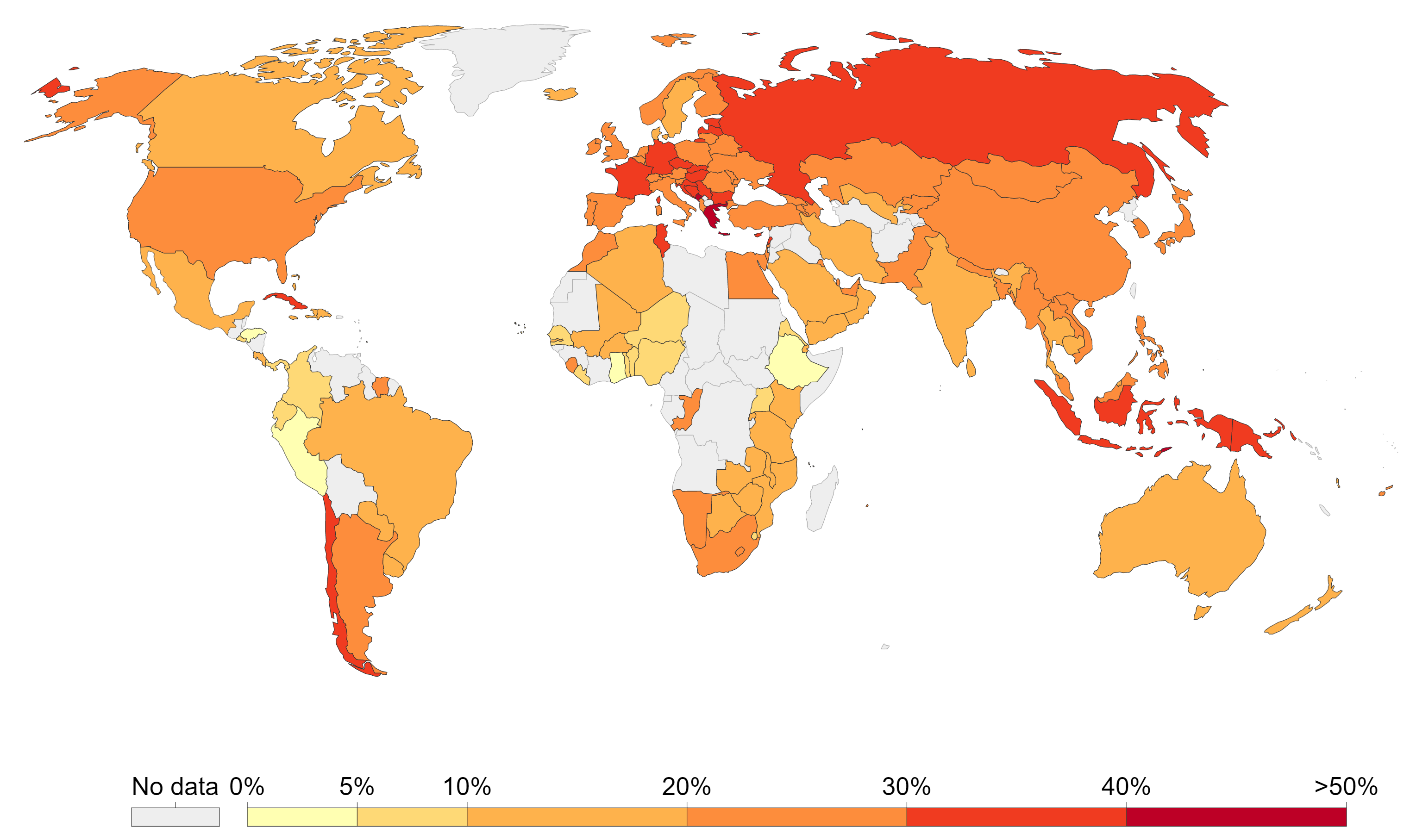
Percentage of population smoking tobacco
Percentage of population smoking tobacco
Prevalence of tobacco use is reported by the World Health Organization (WHO), which focuses on cigarette smoking due to reported data limitations. Smoking has therefore been studied more extensively than any other form of consumption.
Smoking is globally five times more prevalent among men than women; however, the gender gap is narrower in developed countries and in younger age groups. Among developed nations, smoking rates for both men and women have begun to decline. Smoking prevalence has changed little since the mid-1990s, before which time it declined in English-speaking countries due to the implementation of tobacco control. However, the number of smokers worldwide has increased from 721 million in 1980 to 967 million in 2012, and the number of cigarettes smoked increased from 4.96 trillion to 6.25 trillion due to population growth.
In Western countries, smoking is more prevalent among populations with mental health problems, with alcohol and drug problems, among criminals, among the working poor, and among the homeless. In 2002, about 20% of young teens (aged 13–15) smoked worldwide. 80,000 to 100,000 children begin smoking every day. Half of those who begin smoking in adolescent years are projected to go on to smoke for 15 to 20 years.
One of the targets of the Sustainable Development Goal 3 of the United Nations (to be achieved by 2030) is to "Strengthen the implementation of the World Health Organization Framework Convention on Tobacco Control in all countries, as appropriate." The indicator that is used to measure progress is the prevalence of tobacco use.
Background
WHO states that "Much of the disease burden and premature mortality attributable to tobacco use disproportionately affect the poor". Of the 1.22 billion smokers, 1 billion of them live in developing or transitional economies. Rates of smoking have leveled off or declined in the developed world. In the developing world, tobacco consumption is rising by 3.4% per year as of 2002.
The WHO in 2004 projected 58.8 million deaths to occur globally, of which 5.4 million were tobacco-attributed, and 4.9 million as of 2007. As of 2002, 70% of the deaths are in developing countries.
One of the targets of the Sustainable Development Goal 3 of the United Nations (to be achieved by 2030) is to "Strengthen the implementation of the World Health Organization Framework Convention on Tobacco Control in all countries, as appropriate." The indicator that is used to measure progress is the "age-standardized prevalence of current tobacco use among persons aged 15 years and older".
A 2017 study found that MPOWER policies were effective to reduce smoking prevalence and cigarette consumption.
Worldwide
| 2000 | 2005 | 2010 | 2015 | 2020 | 2022 |
|---|---|---|---|---|---|
| 34.3% | 30.8% | 27.6% | 24.9% | 22.6% | 21.7% |
Countries
The following is a list of countries by the percentage of age-standardized prevalence of tobacco use (including products such as snus) among persons 15 years and older as published by the World Health Organization.
| Country | 2000 | 2020 |
|---|---|---|
| Afghanistan | 36.9 | 23.3 |
| Albania | 35 | 22.4 |
| Algeria | 22.2 | 21 |
| Andorra | 35.9 | 31.8 |
| Argentina | 34 | 24.5 |
| Armenia | 32 | 25.5 |
| Australia | 24.4 | 13.6 |
| Austria | 52.3 | 26.4 |
| Azerbaijan | 28.7 | 24 |
| Bahamas | 10.7 | 10.6 |
| Bahrain | 22.2 | 14.9 |
| Bangladesh | 57.6 | 34.7 |
| Barbados | 10.2 | 8.5 |
| Belarus | 41.8 | 30.5 |
| Belgium | 33.4 | 23.4 |
| Belize | 15 | 8.5 |
| Benin | 16.7 | 6.9 |
| Bolivia | 32.1 | 12.7 |
| Bosnia and Herzegovina | 46.6 | 35 |
| Botswana | 33.2 | 19.4 |
| Brazil | 23.8 | 12.8 |
| Brunei | 16.7 | 16.2 |
| Bulgaria | 47.5 | 39 |
| Burkina Faso | 29.8 | 14.3 |
| Burundi | 24 | 11.8 |
| Cabo Verde | 20.6 | 11.4 |
| Cambodia | 42.3 | 21.1 |
| Cameroon | 12.8 | 7.3 |
| Canada | 28.4 | 13 |
| Chad | 13.9 | 8.3 |
| Chile | 46.9 | 29.2 |
| China | 26.7 | 25.6 |
| Colombia | 15.1 | 8.5 |
| Comoros | 39.5 | 20.3 |
| Republic of the Congo | 11.9 | 14.5 |
| Cook Islands | 44.3 | 24 |
| Costa Rica | 18 | 8.8 |
| Côte d'Ivoire | 18.7 | 9.4 |
| Croatia | 34.4 | 36.9 |
| Cuba | 40.8 | 17.9 |
| Cyprus | 40.9 | 35.1 |
| Czech Republic | 34.2 | 30.7 |
| Denmark | 37.3 | 17.5 |
| Dominican Republic | 18.7 | 10.6 |
| Democratic Republic of the Congo | 18.8 | 12.8 |
| Ecuador | 18.4 | 11.3 |
| Egypt | 24.3 | 24.3 |
| El Salvador | 15.9 | 7.9 |
| Eritrea | 13.3 | 7.5 |
| Estonia | 46 | 29.7 |
| Eswatini | 12.3 | 9.2 |
| Ethiopia | 6.8 | 5.1 |
| Fiji | 32.3 | 23.1 |
| Finland | 35.7 | 21.6 |
| France | 34.2 | 33.4 |
| Gambia | 22.5 | 11.1 |
| Georgia | 32.8 | 31.7 |
| Germany | 36.4 | 22 |
| Ghana | 7 | 3.5 |
| Greece | 54.9 | 33.5 |
| Guatemala | 14.3 | 10.9 |
| Guinea-Bissau | 18 | 9 |
| Guyana | 30.2 | 12.1 |
| Haiti | 12.3 | 7.7 |
| Hungary | 37.4 | 31.8 |
| Iceland | 30.2 | 12 |
| India | 54.5 | 27.2 |
| Indonesia | 35.4 | 37.6 |
| Iran | 21.5 | 13.6 |
| Iraq | 22 | 18.5 |
| Ireland | 35.6 | 20.8 |
| Israel | 31.7 | 21.2 |
| Italy | 26.2 | 23.1 |
| Jamaica | 17.4 | 9.4 |
| Japan | 33.3 | 20.1 |
| Jordan | 30.7 | 34.8 |
| Kazakhstan | 34.2 | 23.2 |
| Kenya | 19.3 | 11.1 |
| Kiribati | 68.5 | 40.6 |
| Kuwait | 20 | 17.9 |
| Kyrgyzstan | 31.4 | 25.4 |
| Laos | 52.5 | 31.8 |
| Latvia | 43.8 | 37 |
| Lebanon | 40.2 | 38.2 |
| Lesotho | 31.1 | 24.3 |
| Liberia | 16.3 | 8.2 |
| Lithuania | 41.4 | 32 |
| Luxembourg | 31 | 21.1 |
| Madagascar | 46.7 | 27.8 |
| Malawi | 24.1 | 10.8 |
| Malaysia | 29.5 | 22.5 |
| Maldives | 38.3 | 25.2 |
| Mali | 16.3 | 8.3 |
| Malta | 34.3 | 24 |
| Marshall Islands | 28.5 | 28.5 |
| Mauritania | 21.3 | 10.7 |
| Mauritius | 25.5 | 20.2 |
| Mexico | 24 | 13.1 |
| Moldova | 25.3 | 29 |
| Mongolia | 34.1 | 29.4 |
| Montenegro | 38.7 | 31.4 |
| Morocco | 22.5 | 14.5 |
| Mozambique | 29.4 | 14.3 |
| Myanmar | 66.9 | 44.1 |
| Namibia | 25.6 | 15.1 |
| Nauru | 63.4 | 48.5 |
| Nepal | 64.5 | 30.4 |
| Netherlands | 34.3 | 22.2 |
| New Zealand | 29.6 | 13.7 |
| Niger | 9.7 | 7.4 |
| Nigeria | 9.3 | 3.7 |
| North Korea | 19.8 | 18.8 |
| Norway | 44 | 16.2 |
| Oman | 7.6 | 8 |
| Pakistan | 37.5 | 20.2 |
| Palau | 26.1 | 17.6 |
| Panama | 13.4 | 5 |
| Papua New Guinea | 54.1 | 39.3 |
| Paraguay | 29.1 | 11.5 |
| Peru | 32.9 | 8.1 |
| Philippines | 34.9 | 22.9 |
| Poland | 39.6 | 24 |
| Portugal | 25.7 | 25.4 |
| Qatar | 13.5 | 11.8 |
| Romania | 35 | 28 |
| Russia | 33.3 | 26.8 |
| Rwanda | 24.8 | 13.7 |
| Samoa | 39 | 25.3 |
| São Tomé and Príncipe | 7.8 | 5.7 |
| Saudi Arabia | 14.2 | 14.3 |
| Senegal | 14.3 | 6.9 |
| Serbia | 45.1 | 39.8 |
| Seychelles | 28.7 | 20.2 |
| Sierra Leone | 43.7 | 13.5 |
| Singapore | 16.4 | 16.5 |
| Slovakia | 32 | 31.5 |
| Slovenia | 25.1 | 22 |
| Solomon Islands | 43.5 | 36.5 |
| South Africa | 23.5 | 20.3 |
| South Korea | 28.5 | 17.4 |
| Spain | 36.8 | 27.7 |
| Sri Lanka | 28.5 | 22 |
| Sweden | 43.8 | 24 |
| Switzerland | 28.3 | 25.5 |
| Tanzania | 27.8 | 8.7 |
| Thailand | 31.7 | 22.1 |
| Timor-Leste | 53.5 | 39.2 |
| Togo | 14.4 | 6.8 |
| Tonga | 33.5 | 31 |
| Tunisia | 34.3 | 24.6 |
| Turkey | 32.9 | 30.7 |
| Turkmenistan | 12 | 5.5 |
| Tuvalu | 48.8 | 35.6 |
| Uganda | 24.7 | 8.4 |
| Ukraine | 37.7 | 25.8 |
| United Arab Emirates | 19.4 | 18.2 |
| United Kingdom | 37.9 | 15.4 |
| United States | 33.8 | 23 |
| Uruguay | 35.3 | 21.5 |
| Uzbekistan | 24.9 | 17.6 |
| Vanuatu | 25.6 | 17.8 |
| Vietnam | 29.8 | 24.8 |
| Yemen | 27.3 | 20.3 |
| Zambia | 19.9 | 14.4 |
| Zimbabwe | 21 | 11.7 |



Australia
In the 20th century, smoking was common. There were social events like the smoke night which promoted the habit. In Australia the prevalence of smoking is in decline, with figures from the 2011-12 Australian Health Survey showing 18% of the population to be current smokers, a decline from 28% in 1989–90.
Among the indigenous population, the rate was much higher: 50% of men and 44% of women reported being current smokers in 2007–08.
People aged 25 to 34 were the most likely to smoke (24%), with a marked decline in smoking rates as age increased past 45 years in 2011–12.
In 2007–08, the prevalence of smoking was strongly associated with socioeconomic disadvantage: a greater proportion of men (33%) and women (26%) who live in the most disadvantaged 20% of areas were current smokers than those who live in the least disadvantaged 20% of areas (12% and 11% respectively).
In 2016, the daily smoking rate was less than 13%. By 2022, this number had fallen to 10.6% in Australian adults.
Canada
In December 2002, Statistics Canada published a report on smoking prevalence from 1985 to 2001. In that report, they found from 1985 to 1991, the prevalence of "current smoking" (which they defined as daily smokers and occasional smokers) declined overall, for both sexes and all age groups except for those aged 15 to 24. Even larger declines occurred from 1991 to 2001. While current smoking prevalence for youths did not significantly change from 1985 to 1994–1995, there was a significant decrease of 6 percentage points from 1994–1995 to 2001 (from 28.5% to 22.5%). Provincially, Newfoundland and Labrador, Nova Scotia, Quebec, Ontario, Saskatchewan, Alberta and British Columbia, experienced most of their declines in current smoking prevalence from 1994 to 1995 onwards. All provinces experienced some level of decline from 1985 to 2001. Declines in daily smoking prevalence occurred for both sexes and all age groups over the 17 years, although youth smoking did not start significantly declining until the mid-1990s. Overall, for daily cigarette consumption, smokers by 2001 had a significantly lower proportion of smoking 26 or more cigarettes daily compared with 1985 (14.0% to 5.8%). Most of the declines in the different sex or age groups occurred after 1991. At the same time, smokers in 2001 had a higher proportion of smoking 1 to 10 cigarettes daily compared with 1985 (18.6% to 31.1%). Most of the decline occurred after 1991. As of 2008 the rate was estimated to be 18%, and declining. A 2011 survey estimates that 17% of Canadians smoke.
Germany
In 2005, 27% of the population admitted to being current smokers. 23% were daily smokers (28% of men and 19% of women) while 4% smoked occasionally. The highest ratio of daily smokers was in the 20-24 age group: 38% of men and 30% of women. According to a 2010 study by University of Bielefeld, 9.9% of all 15-year-old males and 10.8% of 15-year-old females smoked daily, which showed a strong decline during the previous decade.
As in other industrial countries, the prevalence of smoking in Germany is lower among people with a higher education level.
A 2006 comparative study found that 25.1% of male and 20.6% of female medical students in Göttingen smoked, while in London the percentages were only 10.9% and 9.1%.
Germany had the largest number of cigarette vending machines per capita in the world: 1 per 102.5 people.
India
Main article: Smoking in India
Israel
In Israel, smoking prevalence among males had remained relatively constant at 30% in the years 1994–2004. Among females the prevalence has declined slightly from 25% in 1998 to 18% in 2003. For the youth, 14% smoked at least once per week, according to a 2001 publication.
In 2005, research has shown that Israeli youths have begun to use bidis and hookah, as alternative methods of tobacco use. In 1990, smoking was the cause of about 1,800 male deaths in Israel which was around 12% of all male deaths. Smoking is not significant cause of death among Israeli women. The average number of cigarettes smoked per Israeli stands at 2162 (6).
There are several anti-tobacco use legislations in effect. For instance, advertising is prohibited in youth publications and is forbidden on television and radio, in addition to substantial increases in tobacco taxes, although the prices are still among the lowest compared to all of the European countries. In addition, until 2004, there was no minimum age requirement for buying tobacco products in Israel; however, an amendment to the tobacco marketing and advertisement law that became effective at 2004 has limited the sale of tobacco to people above the age of 18.
According to Israel Central Bureau of Statistics, the smoking rate in the Israeli adult population in 2009 was 20.9%, down from 34% in 2000. A Ministry of Health nationwide survey conducted in 2011 found that 20.6% of the population aged 21 and older were smokers. The highest percentage of smokers was among Arab males, 44% percent of whom smoked, though this figure is down from 50% in 1996.
New Zealand
Tobacco consumption in New Zealand peaked in the mid-1970s when 60% of the population were smokers. By 2011, that number had fallen to 20% of the population, due to stringent tobacco control laws which are amongst the world's strictest. However, despite these laws, the number of smokers appears to be increasing as the global economy worsens and a recent spate of natural disasters has seen an increase in tobacco sales, and although more males smoke than females, this gap is slowly narrowing. Tobacco consumption by Māori remains disproportionately high despite having decreased over recent years, as a result of television, internet, radio, and print media anti-smoking advertising aimed at Māori. There has, however, been a correspondingly large increase in vaping, particularly among younger demographics.
Romania
According to the Romanian Ministry of Health, the smoking rate among the general population declined from 36% in 2004 to 26% in 2011. A report commissioned in 2012 revealed that 34.9% of men smoked daily, compared to 14.5% of women, and in the preceding 12 months, 37.8% of regular smokers had attempted to quit at least once. Despite a general decline in smoking prevalence, the rate among women nearly doubled from 1991 to 2011, with 55% of women smokers belonging to the 15–34 age group.
Russia
Main article: Smoking in Russia
Spain
According to the 2017 National Health Survey 22.1% of the population above the age of 15 reports smoking daily, 2.3% declares smoking occasionally, 24.9% reports being ex-smokers, and 50.7% never smoked. The survey also revealed that 25.6% of men smoked, compared to 18.8% of women. The historical data series shows that the rate in Spain has fallen more than 10 points from 1993 to 2017, from 44% to 25.6% for men and from 20.8% to 18.8% for women. However, since 2014, the trend has slowed, with just less than 1 point improvement, from 23% to 22.1%.
Sweden

The first research on smoking in Sweden was performed in 1946; it showed that 50% of men and 9% of women were smokers. In 1977 41% of men and 32% of women were smokers. By 2011, the use of smoking tobacco daily had decreased to only 12.5% among men and 14.3% among women. The use of snus, daily among men older than 15 years, was approximately 19.4% and only 3.0% for women.
United Kingdom
Main article: Smoking in the United Kingdom
The Health Survey for England in 2002 found a smoking rate of 26%. By 2007 the proportion of adult smokers in England had declined four percentage points to 22%. In 2015, it was reported smoking rates in England had fallen to 16.9%, a record low. The rate in England had fallen to 14.4% in 2018.
Overall, the number of smokers in the UK in 2007 was estimated at 13.7 million. In 2007 the rate of smoking amongst the most socioeconomically affluent patients was 14%, compared to 34% for the most deprived. Figures from 2013 show that the proportion of the British population (UK excluding Northern Ireland) who smoke has fallen to 19%.
United States
Main article: Tobacco in the United States

As of 2022, a total of 11.2% of U.S. adults (11.7% of men and 10.8% of women) were regular smokers. This was a considerable drop from 2005, when 23.9% of men and 18.1% of women were reported to be current smokers. Among racial and ethnic groups in 2005, Native Americans and Alaska Natives had the highest smoking rates, at 32.0%; they were followed by non-Hispanic whites at 21.9%, and non-Hispanic blacks at 21.5%. Hispanics at 16.2%, and Asians at 13.3%, had the lowest rates of smoking.
Based on educational level in 2005, the percentage of U.S. adult smokers was highest among those who had earned a high school diploma or its GED equivalent, at 43.2%. Among Americans with less education (9 to 11 years), the percentage of smokers was 32.6%. The prevalence of tobacco use was generally lower among those with higher levels of education. Excluding educational attainment, the highest prevalence of smoking in the U.S. was among adults aged 18–24 years (24.4%) and 25–44 years (24.1%). Rates of smoking were also higher among adults living below the U.S. federal poverty line (29.9%) than among those at or above the poverty line (20.6%).
In November 2015, a Centers for Disease Control and Prevention (CDC) report noted that "the percentage of U.S. adults who smoke cigarettes had already declined from 20.9 percent in 2005 to 16.8 percent in 2014. Cigarette smoking was significantly lower in 2014 (16.8 percent) than in 2013 (17.8 percent)." The CDC concluded this from data obtained by a survey of Americans. In 2017, researchers reported that they were unsure if products like e-cigarettes were in any way helpful in reducing smoking in the country. They added that some 4,000 minors in the U.S. start smoking every day.
References
References
- "Prevalence of current tobacco use among adults aged ≥ 15 years (percentage)". World Health Organization.
- "Mayo report on addressing the worldwide tobacco epidemic through effective, evidence-based treatment". World Health Organization.
- (2003). "Past, current and future trends in tobacco use". The International Bank for Reconstruction and Development / The World Bank.
- "Gender empowerment and female-to-male smoking prevalence ratios". World Health Organization.
- The World Health Organization, and the Institute for Global Tobacco Control, Johns Hopkins School of Public Health. (2001). "Women and the Tobacco Epidemic: Challenges for the 21st Century". World Health Organization.
- (2001). "Surgeon General's Report—Women and Smoking". Centers for Disease Control and Prevention.
- (2006). "Mortality from Smoking in Developed Countries 1950-2000: indirect estimates from national vital statistics". Oxford University Press.
- (Jan 8, 2014). "Smoking Prevalence and Cigarette Consumption in 187 Countries, 1980-2012". Journal of the American Medical Association.
- (2007). "Fast Facts: Smoking Cessation". Health Press Ltd..
- (2002-05-28). "WHO/WPRO-Smoking Statistics". World Health Organization Regional Office for the Western Pacific.
- United Nations (2017) Resolution adopted by the General Assembly on 6 July 2017, [[:File:A RES 71 313 E.pdf. Work of the Statistical Commission pertaining to the 2030 Agenda for Sustainable Development]] ([https://undocs.org/A/RES/71/313 A/RES/71/313] {{Webarchive. link. (2020-10-23 ))
- (2009). "Cigarette smoking among adults and trends in smoking cessation - United States, 2008". MMWR. Morbidity and Mortality Weekly Report.
- (2007-05-29). "WHO/WPRO-Tobacco Fact sheet". World Health Organization Regional Office for the Western Pacific.
- United Nations (2017) Resolution adopted by the General Assembly on 6 July 2017, [[:File:A RES 71 313 E.pdf. Work of the Statistical Commission pertaining to the 2030 Agenda for Sustainable Development]] ([https://undocs.org/A/RES/71/313 A/RES/71/313] {{Webarchive. link. (2020-10-23 ))
- (2017). "The effect of MPOWER scores on cigarette smoking prevalence and consumption". [[Preventive Medicine (journal).
- "Prevalence of current tobacco use (% of adults)".
- "Estimates of current tobacco use prevalence (%) {age-standardized rate)".
- "Share of people who smoke every day".
- "Share of adults who smoke".
- "Smoking in men vs. women".
- "Daily cigarette consumption per smoker".
- "Table 7: Smoker status by age and sex, Australia". Australian Bureau of Statistics.
- (2012-07-25). "Tobacco Smoking in Australia, 2007–08". Australian Bureau of Statistics.
- (2009-11-25). "Tobacco Smoking in Australia 2007-08 Table 2.1". Australian Bureau of Statistics.
- (2016-09-28). "Smoking rates at 'all-time lows' in Australia". ABC News.
- (2023-12-15). "Smoking and vaping, 2022 {{!}} Australian Bureau of Statistics".
- [http://www.statcan.gc.ca/pub/82f0077x/82f0077x2001001-eng.pdf Report on Smoking in Canada 1985 to 2001], [[Statistics Canada]], Health Statistics Division, December 2002 {{Pd-notice
- "Canadian Cancer Society".
- (2011-09-07). "Smoking rate falls to 17% in Canada". CBC News.
- (2005). "Leben in Deutschland. Haushalte, Familien und Gesundheit – Ergebnisse des Mikrozensus 2005". Statistisches Bundesamt.
- "German youth smoking less".
- Raupach, T. (2009). "smoking".
- "_Risikofaktor Nummer 1".
- (December 2021)
- (2004). "Multiethnic differences in smoking in Israel: pooled analysis from three national surveys". European Journal of Public Health.
- (2001). "Ethnic differences in cigarette smoking among adolescents: a comparison of Jews and Arabs in Jerusalem". Israel Medical Association Journal.
- [https://www.cdc.gov/tobacco/WHO/israel.htm Tobacco or Health: A Global Status Report] {{Webarchive. link. (2006-12-10 , [[Centers for Disease Control and Prevention]] (CDC), accessed July 13, 2005 (site now down))
- [http://www.euro.who.int/Document/E80607.pdf WHO European Country Profiles on Tobacco Control 2003] {{webarchive. link. (2010-05-16 , [[World Health Organization]], accessed November 24, 2005)
- [http://www.moital.gov.il/NR/exeres/E13924CA-0B10-42C0-9F50-76F33C5E01CC.htm] {{Webarchive. link. (2014-05-31 [[Ministry of Economy (Israel)). Israeli Ministry of Commerce and Industry]]
- "Israeli smoking rate for 2009 down to 20.9%".
- (31 May 2012). "A Record Number of Non-Smokers".
- [https://www.health.govt.nz/statistics-research/surveys/new-zealand-health-survey/publications/202324-survey-publications/trends-in-smoking-and-vaping Trends in smoking and vaping: New Zealand Health Survey 2023/24], New Zealand Ministry of Health
- (23 December 2014). "Sanatatea vrea taxa mai mare la tutun si alcool, pentru a-i convinge pe fumatori sa renunte la acest viciu. Tigarile s-ar putea scumpi iar".
- (5 March 2012). "Raport: 4,85 milioane de romani fumeaza zilnic sau ocazional. 70% dintre fumatori isi aprind prima tigara imediat dupa trezire".
- "Una din cinci romance este fumatoare".
- (26 June 2018). "Nota Técnica. Encuesta Nacional de Salud. España 2017.".
- "Scb.se".
- http://www.nicorette.se/sites/nicorette_se/files/publication/Fakta%20om%20tobaksbruk%20i%20Sverige.pdf{{Dead link. (February 2020)
- [http://www.ic.nhs.uk/statistics-and-data-collections/health-and-lifestyles-related-surveys/health-survey-for-england/health-survey-for-england-2007-latest-trends-%5Bns%5D Health Survey for England 2007: Latest Trends] {{Webarchive. link. (2009-12-14 , the [[Information Centre for Health and Social Care]], December 2008)
- (20 September 2016). "Smoking rates in England fall to lowest on record". BBC News.
- "Turning the tide on tobacco: Smoking in England hits a new low - Public health matters".
- (2010). "Trends in the epidemiology of smoking recorded in UK general practice". Br J Gen Pract.
- "Press Release: Opinions and Lifestyle Survey, Adult Smoking Habits in Great Britain, 2013".
- (2021). "Health, United States – Data Finder / Current cigarette smoking among adults aged 18 and over, by sex, race, and age: United States, selected years 1965-2019". National Center for Health Statistics, part of the U.S. Centers for Disease Control and Prevention (CDC).
- (2014). "Featured Datasets / Tobacco Use Among Adults By Age Group (National Adult Tobacco Survey, NATS)". Centers for Disease Control and Prevention.
- (2023). "Early Release of Selected Estimates Based on Data From the 2022 National Health Interview Survey".
- [https://www.cdc.gov/mmwr/preview/mmwrhtml/mm5542a1.htm Tobacco Use Among Adults: United States, 2005] {{Webarchive. link. (2017-09-26 , [[Centers for Disease Control and Prevention]], October 27, 2006 {{Pd-notice)
- (2017). "Tobacco Use and Smoke Exposure in Children: New Trends, Harm, and Strategies to Improve Health Outcomes". Current Allergy and Asthma Reports.
This article was imported from Wikipedia and is available under the Creative Commons Attribution-ShareAlike 4.0 License. Content has been adapted to SurfDoc format. Original contributors can be found on the article history page.
Ask Mako anything about Prevalence of tobacco use — get instant answers, deeper analysis, and related topics.
Research with MakoFree with your Surf account
Create a free account to save articles, ask Mako questions, and organize your research.
Sign up freeThis content may have been generated or modified by AI. CloudSurf Software LLC is not responsible for the accuracy, completeness, or reliability of AI-generated content. Always verify important information from primary sources.
Report