From Surf Wiki (app.surf) — the open knowledge base
Presidential Palace, Vilnius
Official Palace of the President of Lithuania
.jpg)
Official Palace of the President of Lithuania
| Field | Value | |
|---|---|---|
| image | {{multiple image | |
| align | center | |
| direction | vertical | |
| border | infobox | |
| total_width | 280 | |
| image_style | border:1; | |
| image1 | Vilnius presidential palace (cropped).jpg | |
| class1 | bg-transparent | |
| caption1 | Main façade from Daukanto Square | |
| image2 | President Palace courtyard (7932238026).jpg | |
| caption2 | Courtyard of the Palace | |
| name | Prezidentūra | |
| Presidential Palace | ||
| location_town | Vilnius | |
| location_country | Lithuania | |
| architect | Vasily Stasov, author of last major reconstruction | |
| start_date | 14th century | |
| completion_date | Last major reconstruction 1834 | |
| style | Empire, Classical Revival | |
| owner | Government of Lithuania | |
| website | ||
| mapframe-zoom | 15 | |
| mapframe-stroke-width | 1 | |
| footnotes | {{designation list | embed = yes |
| designation1 | WHS | |
| designation1_offname | Vilnius Old Town | |
| designation1_date | 1994 | |
| designation1_number | 541 | |
| designation1_criteria | (ii), (iv) | |
| designation1_type | Cultural | |
| designation1_free1name | UNESCO region | |
| designation1_free1value | Europe | |
| {{designation list | embed | yes |
| designation1 | LITHUANIA | |
| designation1_date | February 13 2008 | |
| designation1_number | 10629 | |
| designation1_type | National |
Presidential Palace | mapframe-zoom = 15 | mapframe-stroke-width = 1
The Presidential Palace () is the official residence and workplace of the president of Lithuania. Located in Vilnius Old Town, Lithuania. The palace dates back to the 14th century when it was first used as the residence of the Bishop of Vilnius. and during its history, it has undergone various reconstructions, supervised by prominent architects, including Laurynas Gucevičius and Vasily Stasov.
Throughout its history, the palace was used as a residence for prominent European leaders, including the monarchs of Polish-Lithuanian Commonwealth, the Kings and Emperors of France and the Emperors of Russia.
In 1997 the palace became the official seat of the president of Lithuania. The term "Prezidentūra" is also used as a metonym to refer to the Office of the President of Lithuania.
History
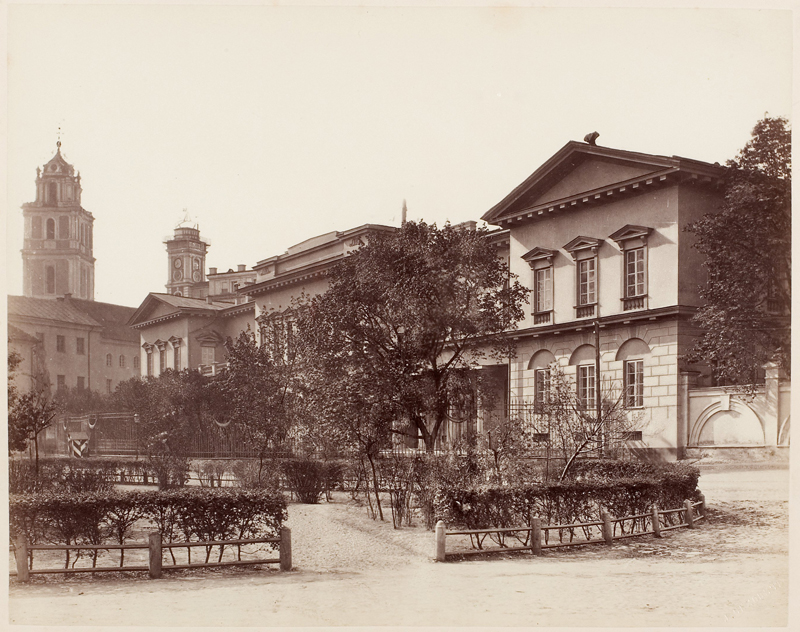
The palace traces its history back to the 14th century, when Jogaila, the grand duke of Lithuania, issued an edict donating land in the city to the Vilnius Diocese, for this reason the palace is sometimes referred to as the Bishops' Palace. Construction of the palace took place in the late 14th century under the auspices of the first Bishop of Vilnius, Andrzej Jastrzębiec, and over succeeding generations, the building was gradually enlarged and renovated. During the Renaissance, the palace was once again renovated, and parks and gardens surrounding the building were expanded.
As the 18th century unfolded, a number of dramatic events in the palace's history took place: the last Bishop of Vilnius lived in the palace, Lithuania was annexed by the Russian Empire, and the building itself was badly damaged by two major fires in 1737 and 1748. The palace was reconstructed in 1750 under the supervision of the architect Laurynas Gucevičius. After its reconstruction, the palace was used as a residence for emperors, kings and noblemen. During 1796, Tsar Paul I lived at the palace. During the course of the 19th century, the palace served as a residence for several Imperial Russian governors, such as Mikhail Muravyov, nicknamed "The Hangman". It was also visited by Louis XVIII, the future king of France, in 1804.
In 1812, both the Russian Tsar Alexander I and the French Emperor Napoleon used the palace as their residence. During Napoleon's invasion of Russia, he organized military operations and Lithuanian army units from this palace, including five regiments of infantry, four cavalry regiments, and the National Guard of Vilnius. He received Lithuanian noblemen, newly appointed officials of the administration, and other dignitaries in this palace as well. After Napoleon's defeat in 1812, the palace was used for ceremonial proposes; it was here that then-general Mikhail Kutuzov was awarded Russia's highest military award – the Order of St. George. During 1824–1834, the palace was reconstructed by the prominent St. Petersburg architect Vasily Stasov in the Empire style, under supervision of Karol Podczaszyński. Stasov's reconstruction of the palace has remained to this day.
After Lithuania regained its independence in 1918, the palace housed the Ministry of Foreign Affairs and the ELTA news agency until it ended up in Poland in 1920. It was restored in the 1930s by Stefan Narębski. After the Second World War, the palace served as the Military Officers Centre; later it housed various Lithuanian artists.
The palace was gradually adapted for use as a presidential office, and since 1997 it has served as the official office of the president of Lithuania. The first president to reside in the new Prezidentūra was Algirdas Mykolas Brazauskas. Before him, other presidents never occupied the palace and instead used the Presidential Palace in Kaunas which served as the temporary national capital for 19 years, from 1920 to 1939, while Vilnius was yet to be returned to Lithuania.
Currently, adaptations are underway to expand the palace's functions to also serve as the president's official residence. A flag displaying the coat of arms of the president is hoisted when the president is present in the palace or in the city.
Public access
Guided tours in Lithuanian and English are available for the general public. They are arranged on Saturdays and Sundays free of charge, but require advance registration. Presidential Palace is also open to the public during Open House Vilnius and other open door events.
There is a 1,5 ha gated park, surrounded by a 4-5 meter brick wall. The park is open to the general public outside the regular office hours, during evenings on weekdays and weekends.
Gallery
File:Presidential Palace in Vilnius 2019.jpg|Façade of the Palace in 2019 File:2009 m. Respublikos Prezidento inauguracija.jpg|Hoisting the presidential flag during the inauguration ceremony File:Valdas Adamkus and George W. Bush in Vilnius, Lithuania (2002).jpg|Lithuanian and American Presidents Valdas Adamkus and George W. Bush in the White Hall in 2002 File:100th anniversary of the restoration of statehood 07.jpg|The Commemoration Ceremony of the 100th Anniversary of the Act of Independence of Lithuania in front of the Palace in 2018 File:-i---i- (53040441170).jpg|Guests of the 2023 Vilnius Summit in the Courtyard of the Palace File:Prezidentura by Augustas Didzgalvis.jpg|Aerial view (green rooftops) File:President Biden visit the Presidential Palace in Vilnius before the NATO Summit (4).jpg|Inside the Courtyard of the Presidential Palace during the welcoming ceremony of American President Joe Biden in 2023 File:President Biden visit the Presidential Palace in Vilnius before the NATO Summit (1).jpg|American President Joe Biden signing in a guests book in the White Hall nearby Lithuanian President Gitanas Nausėda File:LRP White Hall 1 by Augustas Didzgalvis.jpg|The White Hall of the Palace (the main representative hall where guests are welcomed and events are held) File:LRP White Hall 2 by Augustas Didzgalvis.jpg|The White Hall of the Palace File:LRP Press Briefing Room 1 by Augustas Didzgalvis.jpg|The Press Room of the Palace File:LRP Staircase by Augustas Didzgalvis.jpg|Staircase inside the Palace
Notes
References
- Vilniaus architektūra. Vilnius, 1982
- Prezidento Rūmų istorija
- Virtual tour of the Palace
References
- "DĖL KULTŪROS PAVELDO OBJEKTŲ PASKELBIMO KULTŪROS PAMINKLAIS". Lietuvos Respublikos Seimo kanceliarija.
- (9 October 2021). "Vilniaus architektūra (įžanga)".
- "Pažintinė ekskursija LT Prezidentūroje".
- (2025-01-31). "Prezidentūra: energetikos objektų apsauga turės būti stiprinama". [[Lithuanian National Radio and Television]].
- [http://www.catholic-hierarchy.org/diocese/dviln.html Archdiocese of Vilnius]
- Adam B. Ulam. Prophets and Conspirators in Prerevolutionary Russia. Transaction Publishers, 1998. p.8
- Magdalena Bajer. (January 2000). "Narębscy". Forum Akademickie.
- "Prezidento rūmai".
- "Pažintinė ekskursija LT Prezidentūroje".
- (2023-05-31). "Lietuvos Respublikos Prezidento rūmai".
- (2019-04-01). "Prezidentūroje jubiliejaus proga – atvirų durų diena".
- (2019-04-04). "Šimtmetį mininti Prezidentūra atvėrė duris visuomenei".
- "Istorinis parkas ir vidinis kiemas".
- "Istorinis parkas ir vidinis kiemas".
This article was imported from Wikipedia and is available under the Creative Commons Attribution-ShareAlike 4.0 License. Content has been adapted to SurfDoc format. Original contributors can be found on the article history page.
Ask Mako anything about Presidential Palace, Vilnius — get instant answers, deeper analysis, and related topics.
Research with MakoFree with your Surf account
Create a free account to save articles, ask Mako questions, and organize your research.
Sign up freeThis content may have been generated or modified by AI. CloudSurf Software LLC is not responsible for the accuracy, completeness, or reliability of AI-generated content. Always verify important information from primary sources.
Report