From Surf Wiki (app.surf) — the open knowledge base
President of Greece
Head of state of Greece
Head of state of Greece
| Field | Value |
|---|---|
| post | President |
| body | the Hellenic Republic |
| native_name | Πρόεδρος της Ελληνικής Δημοκρατίας |
| flag | Flag of the President of Greece.svgborder |
| flagsize | 125px |
| flagcaption | Presidential standard |
| image | KonstantinosTasoulas (cropped).jpg |
| incumbent | Konstantinos Tasoulas |
| incumbentsince | 13 March 2025 |
| style | His Excellency |
| Mr. President (informal) | |
| seat | Presidential Mansion, Athens |
| nominator | Parliamentary groups |
| appointer | Hellenic Parliament |
| termlength | Five years, |
| termlength_qualified | renewable once |
| constituting_instrument | Constitution of Greece (1975) |
| inaugural | Michail Stasinopoulos (Third Republic) |
| formation | |
| deputy | President of the Hellenic Parliament |
| salary | €138,732 annually |
| status | Head of state |
| Commander-in-chief | |
| website |
Mr. President (informal) Commander-in-chief
The president of Greece, officially the president of the Hellenic Republic (), commonly referred to in Greek as the president of the Republic (, ΠτΔ), is the head of state of Greece. The president is elected by the Hellenic Parliament; the role has been mainly ceremonial since the 1986 constitutional reform. The office was formally established by the Constitution of Greece in 1975, but has antecedents in the Second Hellenic Republic of 1924–1935 and the Greek junta in 1973–1974 which predated the transition to the current Third Hellenic Republic.
Powers
The president is the nominal commander-in-chief of the Greek Armed Forces and occupies the first place in the country's order of precedence. Although the Greek Constitution of 1974 vested the presidency with considerable powers on paper, in practice presidents took a largely ceremonial role; the prime minister of Greece is the active chief executive of the Greek government and the country's leading political figure. The president's role was formally brought into line with practice by the 1986 constitutional amendment, which reduced the official powers.
Election
According to Article 32 of the Greek Constitution, the president is elected for a five-year term by the Hellenic Parliament in a special session at least a month before the incumbent's term expires. Voting takes place in up to five ballots, separated by no more than five days.
The first and second ballots require a supermajority of 200 out of the 300-person body, dropping to 180 on the third. The fourth ballot requires a simple majority of 151 votes. The fifth and last ballot is then decided by a relative majority.
Oath of office
Before taking office, the president must recite an oath in front of the Parliament according to the Article 33, paragraph 2 of the Greek Constitution:
Succession
According to the Constitution of Greece, in the event of a temporary absence of the president of Greece on account of illness, travel abroad or similar circumstances, the speaker of the parliament serves as acting president, and exercises the powers of the state president until the president resumes their functions, and in the event that the presidency falls vacant as a result of death or resignation or for any other reason, until the election of a new president. The most recent person to have served as Acting President was Ioannis Alevras, following the resignation of Konstantinos Karamanlis due to the constitutional crisis in 1985.
Official residence
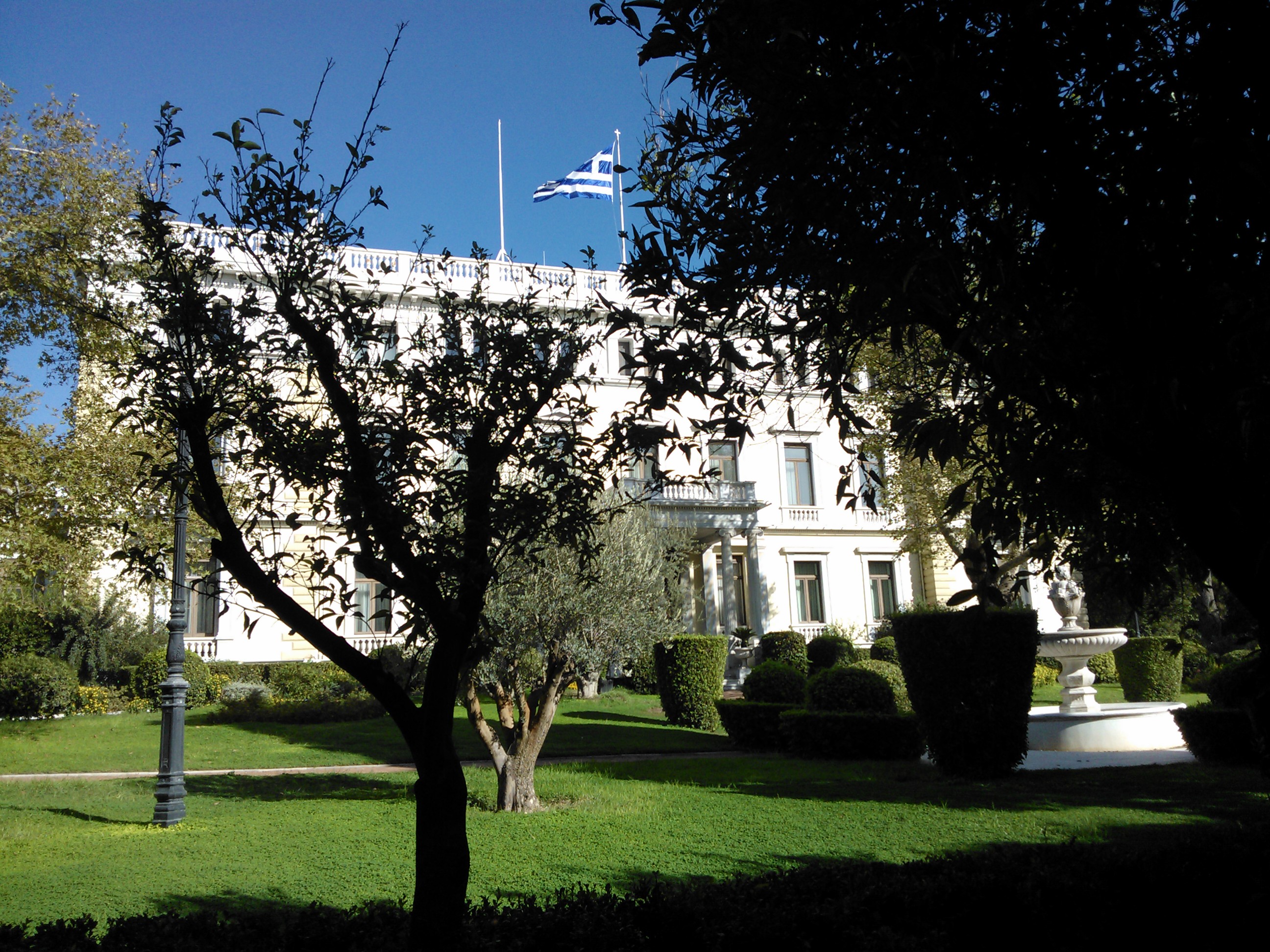
The official residence of the president of Greece is the Presidential Mansion, formerly the New Royal Palace, in central Athens.
History
The current Third Hellenic Republic () was established in 1974 during the period of metapolitefsi, after the end of the Greek junta which had controlled Greece since the coup d'état of 21 April 1967.
On 1 June 1973 the then leader of the military junta and regent for the exiled King Constantine II, Georgios Papadopoulos, abolished the Greek monarchy and proclaimed himself President of the Republic. A staged referendum on 29 July 1973 confirmed the regime change, and passed a new constitution which established a presidential republic. This attempt at controlled democratization was ended by Brigadier Dimitrios Ioannidis' overthrow of Papadopoulos on 25 November 1973. The republic and its symbols (but not the semi-presidential system) were formally maintained, but they were nothing more than a façade for the military regime. Lt. General Phaedon Gizikis was appointed President of the Republic, but power was in the hands of Ioannidis, who ruled behind the scenes.
After the fall of the junta and the return to civilian rule under Konstantinos Karamanlis in August 1974, the constitutional acts of the military regime were deemed invalid, and a new referendum was held on 8 December 1974, which confirmed the abolition of the monarchy. In the interim, Gizikis, remained in office as President. After the plebiscite, he was succeeded by the first elected president, Michail Stasinopoulos.
A new constitution, promulgated on 11 June 1975, declared Greece a presidential parliamentary democracy (or republic – the Greek δημοκρατία can be translated both ways). The first constitutional amendments were proposed by Andreas Papandreou in 1985, though dubious procedures triggering a constitutional crisis, and they reduced the presidential powers, which were acting as checks and balances against the powerful position of the prime minister. The constitution was further revised in 2001, 2008, and 2019, and is still in force today.
List of presidents of the Third Hellenic Republic
| President | Term of office | Political party | No. | Portrait | Name | ||||||||||||||||||||
|---|---|---|---|---|---|---|---|---|---|---|---|---|---|---|---|---|---|---|---|---|---|---|---|---|---|
| (Birth–Death) | Took office | Left office | Time in office | New Democracy (Greece)}}; color:white" | Stasinopoulos1 | New Democracy (Greece)}}; color:white" | Tsatsos2 | New Democracy (Greece)}}; color:white" | Karamanlis803 | PASOK}}; color:white" | Alevras– | Independent politician}}; black" | Sartzetakis4 | New Democracy (Greece)}}; color:white" | Karamanlis90(3) | Independent politician}}; black" | Stephanopoulos5 | PASOK}}; color:white" | Papoulias6 | New Democracy (Greece)}}; color:white" | Pavlopoulos7 | Independent politician}}; black" | Sakellaropoulou8 | New Democracy (Greece)}}; color:white" | Tasoulas9 |
| [[File:1974 Press Photo Michael Stasinopoulos sworn in at President of Greek Republic (cropped).png | 60px]] | **Michail Stasinopoulos** | |||||||||||||||||||||||
| Μιχαήλ Στασινόπουλος | |||||||||||||||||||||||||
| (1903–2002) | 18 December 1974 | 19 July 1975 | New Democracy | ||||||||||||||||||||||
| Writer and jurist, former President of the Council of State. Supported by New Democracy, he was [elected](1974-greek-presidential-election) unopposed by the ND-dominated Parliament resulting from the [17 November 1974 election](1974-greek-legislative-election) and following the definitive abolition of the Greek monarchy in the [8 December 1974 referendum](1974-greek-republic-referendum), with 206 votes on the first ballot. | |||||||||||||||||||||||||
| [[File:Portrait of Greek President Konstantinos Tsatsos circa 1978.jpg | 60px]] | **Konstantinos Tsatsos** | |||||||||||||||||||||||
| Κωνσταντίνος Τσάτσος | |||||||||||||||||||||||||
| (1899–1987) | 19 July 1975 | 10 May 1980 | New Democracy | ||||||||||||||||||||||
| Jurist and cabinet minister with the National Radical Union and New Democracy. [Elected](1975-greek-presidential-election) by the [1974 Parliament](1974-greek-legislative-election) on the first ballot with 210 votes against Panagiotis Kanellopoulos. | |||||||||||||||||||||||||
| [[File:Bezoek premier Karamanlis van Griekenland Van Agt in gesprek met Karamanlis, Bestanddeelnr 929-6548 (cropped).jpg | 60px]] | **Konstantinos Karamanlis** | |||||||||||||||||||||||
| Κωνσταντίνος Καραμανλής | |||||||||||||||||||||||||
| (1907–1998) | 10 May 1980 | 10 March 1985 | |||||||||||||||||||||||
| (*resigned*) | New Democracy | ||||||||||||||||||||||||
| Prime Minister as leader of the National Radical Union in 1955–1963 and again as leader of New Democracy from 1974. Supported by ND, the KODISO and KKE Interior, he was [elected](1980-greek-presidential-election) by the ND-dominated [1977 Parliament](1977-greek-legislative-election) on the third ballot with 183 votes against seven other candidates put forward by minor parties. Resigned before the end of his term due to his falling out with Andreas Papandreou and the PASOK's decision not to support him for a second term in 1985. | |||||||||||||||||||||||||
| [[File:President Ioannis Alevras.jpg | 60px]] | **Ioannis Alevras** | |||||||||||||||||||||||
| Ιωάννης Αλευράς | |||||||||||||||||||||||||
| (1912–1995) | 10 March 1985 | 30 March 1985 | PASOK | ||||||||||||||||||||||
| PASOK MP and Speaker of Parliament, he substituted for Karamanlis following his early resignation. | |||||||||||||||||||||||||
| [[File:Christos Sartzetakis (1989) cropped.jpg | 60px]] | **Christos Sartzetakis** | |||||||||||||||||||||||
| Χρήστος Σαρτζετάκης | |||||||||||||||||||||||||
| (1929–2022) | 30 March 1985 | 5 May 1990 | Independent | ||||||||||||||||||||||
| Jurist, famous for his role in investigating the Lambrakis assassination. He was supported by the PASOK and KKE. [Elected](1985-greek-presidential-election) unopposed by the PASOK-dominated [1981 Parliament](1981-greek-legislative-election) on the third ballot with 180 votes. | |||||||||||||||||||||||||
| [[File:Bezoek premier Karamanlis van Griekenland Van Agt in gesprek met Karamanlis, Bestanddeelnr 929-6548 (cropped).jpg | 60px]] | **Konstantinos Karamanlis** | |||||||||||||||||||||||
| Κωνσταντίνος Καραμανλής | |||||||||||||||||||||||||
| (1907–1998) | 5 May 1990 | 10 March 1995 | New Democracy | ||||||||||||||||||||||
| The November 1989 Parliament failed to elect a President after three ballots, with the votes of the PASOK being split between incumbent Christos Sartzetakis and Ioannis Alevras, leading to its dissolution and a [snap election](1990-greek-legislative-election). Karamanlis did not stand as a candidate during the first three ballots, but was put forward by New Democracy after the election. He was [elected](1990-greek-presidential-election) by the new 1990 Parliament on the fifth ballot with 153 votes, opposed by the PASOK-sponsored candidate Ioannis Alevras and Konstantinos Despotopoulos of Synaspismos. | |||||||||||||||||||||||||
| [[File:Konstantinos Stefanopoulos 2000.jpg | 60px]] | **Konstantinos Stephanopoulos** | |||||||||||||||||||||||
| Κωνσταντίνος Στεφανόπουλος | |||||||||||||||||||||||||
| (1926–2016) | 10 March 1995 | 12 March 2005 | Independent | ||||||||||||||||||||||
| [[File:Karolos Papoulias.jpg | 60px]] | **Karolos Papoulias** | |||||||||||||||||||||||
| Κάρολος Παπούλιας | |||||||||||||||||||||||||
| (1929–2021) | 12 March 2005 | 13 March 2015 | PASOK | ||||||||||||||||||||||
| PASOK MP and cabinet minister. He was [elected](2005-greek-presidential-election) unopposed for his first term by the New Democracy-dominated [2004 Parliament](2004-greek-legislative-election) as a joint candidate of ND and the PASOK on the first ballot with 279 votes. [Reelected](2010-greek-presidential-election) unopposed for a second term in 2010 by the PASOK-dominated [2009 Parliament](2009-greek-legislative-election) as a joint candidate of the PASOK, ND and the LAOS on the first ballot with 266 votes. | |||||||||||||||||||||||||
| [[File:Prokopis Pavlopoulos in March 2016.jpg | 60px]] | **Prokopis Pavlopoulos** | |||||||||||||||||||||||
| Προκόπης Παυλόπουλος | |||||||||||||||||||||||||
| (born 1950) | 13 March 2015 | 13 March 2020 | 5 years | New Democracy | |||||||||||||||||||||
| New Democracy MP and cabinet minister. The previous ND-PASOK coalition [failed to elect](2014-2015-greek-presidential-election) Stavros Dimas in the first three rounds, leading to a new election, which was won by Syriza. Supported by Syriza, ANEL and ND, Pavlopoulos was elected by the new 2015 Parliament on the fourth ballot with 233 votes, opposed by the candidate of The River and PASOK Nikos Alivizatos. | |||||||||||||||||||||||||
| [[File:Katerina Sakellaropoulou (head shot).jpg | 60px]] | **Katerina Sakellaropoulou** | |||||||||||||||||||||||
| Κατερίνα Σακελλαροπούλου | |||||||||||||||||||||||||
| (born 1956) | 13 March 2020 | 13 March 2025 | 5 years | Independent | |||||||||||||||||||||
| President of the Council of State from 2018 to 2020, she was [elected](2020-greek-presidential-election) on 22 January 2020, supported by New Democracy, Syriza and the KINAL. Upon her inauguration, she became the first woman to hold the office of President of Greece. | |||||||||||||||||||||||||
| [[File:KonstantinosTasoulas (cropped).jpg | 60px]] | **Konstantinos Tasoulas** | |||||||||||||||||||||||
| Κωνσταντίνος Τασούλας | |||||||||||||||||||||||||
| (born 1959) | 13 March 2025 | Incumbent | New Democracy | ||||||||||||||||||||||
| New Democracy MP, cabinet minister and President of the Hellenic Parliament from 2019 to 2025. He was [elected](2025-greek-presidential-election) on the fourth ballot, after winning 160 votes of New Democracy MPs and independents. |
References
Sources
References
- (2020-01-18). "Ποιός είναι ο μισθός του Προέδρου της Ελληνικής Δημοκρατίας".
- [[Hellenic Parliament]]. (24 June 1987). "Standing Orders of the Hellenic Parliament". [[Hellenic Parliament]].
- "President: Election of the President". Presidency of the Hellenic Republic.
This article was imported from Wikipedia and is available under the Creative Commons Attribution-ShareAlike 4.0 License. Content has been adapted to SurfDoc format. Original contributors can be found on the article history page.
Ask Mako anything about President of Greece — get instant answers, deeper analysis, and related topics.
Research with MakoFree with your Surf account
Create a free account to save articles, ask Mako questions, and organize your research.
Sign up freeThis content may have been generated or modified by AI. CloudSurf Software LLC is not responsible for the accuracy, completeness, or reliability of AI-generated content. Always verify important information from primary sources.
Report