From Surf Wiki (app.surf) — the open knowledge base
Pork pie hat
Style of headwear
Style of headwear
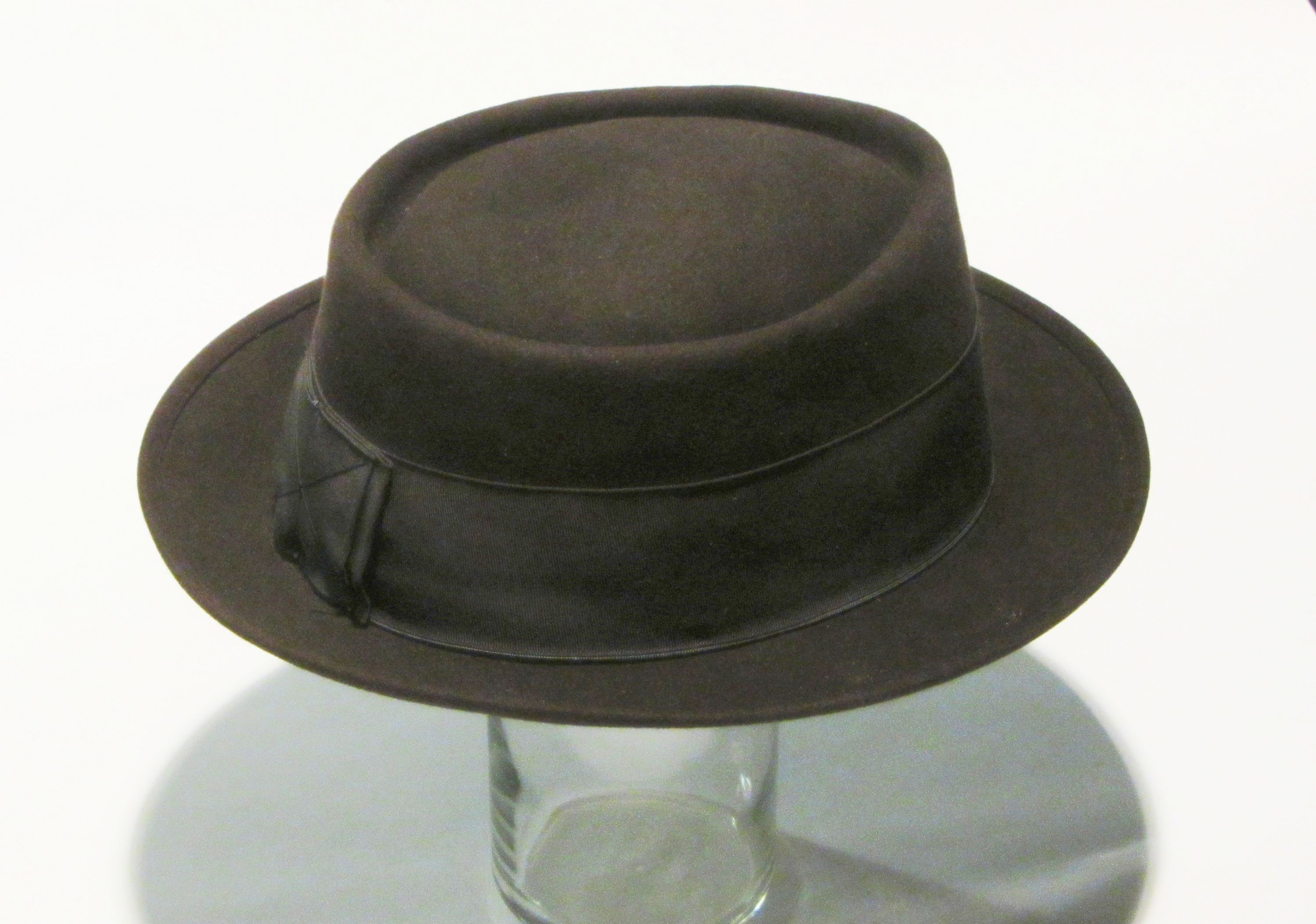
A pork pie hat is one of several different styles of hat that have been worn since the mid-19th century. The pork pie hat gained further popularity in the 20th century, being worn by famous actors and musicians. This style of hat features a flat crown that resembles a traditional pork pie, thus earning its name.
The pork pie hat in 19th-century fashion
The origins of the pork pie hat in Western fashion lay in the 1860s. Initially an item of women's wear, this accessory was identifiable through its shape, particularly the narrow brim which distinctively curled round towards the crown of the hat, which was flat, and usually made from straw or velvet in this period. The pork pie hat was small, and would be worn towards the front of the head to account for popular hairstyles of the era. The fashion for pork pie hats soon spread, also becoming a feature of menswear. As a men's accessory, the pork pie was larger, and could be fashioned with decorative ribbons to the back of the hat.
Buster Keaton and the 1920s
The pork pie began to gain further popularity in Britain as a man's hat not long after the turn of the 20th century in the fashion style of the man-about-town, with famous entertainers sporting this style regularly. Silent film actor Buster Keaton converted fedoras into straw boater-like felt pork pies by stiffening their brims with a dried sugar-water solution. This kind of pork pie had a very flat top and similar short flat brim.
1930s and 1940s
The heyday of the pork pie hat occurred during the Great Depression, following the straw boater era that peaked in the Roaring Twenties. In this incarnation, the pork pie regained its snap brim and increased slightly in height. Its dished crown became known among hatmakers as "telescopic crowns" or "tight telescopes" because when worn the top could be made to pop up slightly.{{Cite book A porkpie hat was a trademark of physicist Robert Oppenheimer, scientific director of the World WarII project that developed the atomic bomb.
In African American culture in the 1940s the pork pie—flashy, feathered, color-coordinated—became associated with the zoot suit. By 1944 the hat was even prevalent in New Guinea.
Post-1950s
After the end of World War II the pork pie's broad popularity declined somewhat, though as a result of the zoot suit connection it continued its association with African American music culture, particularly jazz, blues, and ska. In television between 1951 and 1955, Art Carney frequently wore one in his characterization of Ed Norton in The Honeymooners, and in Puerto Rico the actor Joaquín Monserrat, known as Pacheco, was the host of many children's 1950s TV shows and was known for his straw pork pie hat and bow tie—in this incarnation, the pork pie returned to its Buster Keaton style with rigidly flat brim and extremely low flat crown.
In the 1960s in Jamaica, the "rude boy" subculture popularized the pork-pie, as well as hats resembling tall trilby styles. Jamaican diaspora brought the pork pie hat back into style in the United Kingdom through the connecting of youth cultures. When migration to the United Kingdom increased following the end of the Second World War and government calls for post-war reconstruction (see Windrush generation, British Nationality Act), shared musical and style interests thereby influenced the appearance of garments such as the pork pie hat in the emergent youth mod and rave subculture.
The porkpie hat enjoyed a slight resurgence in exposure and popularity after Gene Hackman's character Jimmy "Popeye" Doyle wore one in the 1971 film The French Connection. Doyle was based on real-life policeman Eddie Egan, who played the captain in the film, and his exploits. Egan was famous all his life for wearing a pork pie hat. At about the same time, Robert De Niro wore a pork pie hat in the 1973 film Mean Streets (the same hat he wore when he auditioned for the film).{{Cite book
Further, the Two-Tone Ska revival of the 1970s also contributed to the revival of the pork pie hat in youth culture and fashion in the United Kingdom, where black and white tailored garments were coupled with this style of hat, as worn by members of bands The Specials and The Selecter, for example.
Contemporary associations
A frequent wearer of pork pie hats is Panamanian salsa singer and composer Ruben Blades. In the early 21st century, the wearing of a pork pie hat retained some of its 1930s and '40s associations. Fashion writer Glenn O'Brien says:{{Cite book |author-link=Glenn O'Brien
Bryan Cranston's character Walter White wears a pork pie hat in the AMC series Breaking Bad when he appears as his alter ego "Heisenberg", whose persona is associated with the hat. Sony Pictures Television donated "Heisenberg's" hat to the Smithsonian Institution.
References
References
- "pork-pie hat, n." OED Online. Oxford University Press, March 2022. Web. 13 May 2022.
- Cummings, Valerie. (2017). "The Dictionary of Fashion History". Bloomsbury Academic.
- "Porkpie {{!}} hat {{!}} Britannica".
- [http://www.busterkeaton.org/porkpie/ "How to Make a Porkpie Hat"] {{webarchive. link. (21 November 2022 . Buster Keaton, interviewed in 1964 at the Movieland Wax Museum. Henry Gris. Busterkeaton.com.)
- [http://www.appalachianhistory.net/2008/03/true-pork-pie-hat.html The true pork pie hat] {{webarchive. link. (15 January 2012 . Appalachian History (24 March 2008).)
- Bird, Kai. (2005). "American Prometheus: The Triumph and Tragedy of J. Robert Oppenheimer". Alfred A. Knopf.
- (1961). "Australia in the War of 1939–1945: Series 1. Army, Volume VI – The New Guinea Offensives". Australian War Memorial.
- (2021-10-06). "Rude boy / Mods / Ska".
- "The Story of Windrush".
- (1950s). "Porkpie hat".
- (2008-02-14). "The Windrush experience expressed in music - from 1948 to 2022".
- [http://www.britannica.com/EBchecked/topic/470642/porkpie porkpie (clothing)] – ''Britannica Encyclopedia''.
- Wilkins, Barbara. (10 November 1975) [http://www.people.com/people/archive/article/0,,20065832,00.html The Real Popeye Doyle, Eddie Egan, Cops a Comeback in Joe Forrester]. ''People''.
- Smithsonian. (10 November 2015). "10 #BreakingBad items join the @amhistorymuseum collection. Sorry #RoofPizza fans, it didn't make the cut.pic.twitter.com/v3c9NOOi7K".
This article was imported from Wikipedia and is available under the Creative Commons Attribution-ShareAlike 4.0 License. Content has been adapted to SurfDoc format. Original contributors can be found on the article history page.
Ask Mako anything about Pork pie hat — get instant answers, deeper analysis, and related topics.
Research with MakoFree with your Surf account
Create a free account to save articles, ask Mako questions, and organize your research.
Sign up freeThis content may have been generated or modified by AI. CloudSurf Software LLC is not responsible for the accuracy, completeness, or reliability of AI-generated content. Always verify important information from primary sources.
Report