From Surf Wiki (app.surf) — the open knowledge base
Ponzo illusion
Geometrical-optical illusion
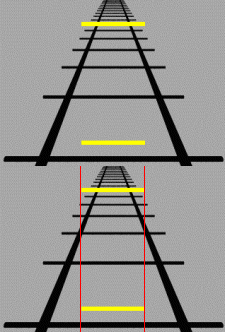
Geometrical-optical illusion
The Ponzo illusion is a geometrical-optical illusion that takes its name from the Italian psychologist Mario Ponzo (1882–1960).
Two identical horizontal lines placed on vertical converging lines, will appear to be of different lengths.

Ponzo never claimed to have discovered it, and it is indeed present in earlier work. Much confusion is present about this including many references to a paper that Ponzo published in 1910 on the Aristotle illusion. This is a tactile effect and it has nothing at all to do with what we now call the Ponzo illusion. The illusion can be demonstrated by drawing two identical lines across a pair of converging lines, similar to railway tracks, but the effect works also at different orientations.
One of the explanations for the Ponzo illusion is the "perspective hypothesis", which says that the perspective feature in the figure is produced by the converging lines ordinarily associated with distance; the two oblique lines appear to converge toward the horizon or a vanishing point. We interpret the upper line as though it were further away, so we see it as longer. A further object would have to be longer than a nearer one for both to produce retinal images of the same size.
Another explanation is the "framing-effects hypothesis", which says that the difference in the separation or gap of the horizontal lines from the framing converging lines may determine, or at least contribute to the magnitude of the distortion.
The Ponzo illusion is one possible explanation of the Moon illusion, as suggested by Ponzo in 1912. Objects appearing "far away" (because they are "on" the horizon) appear larger than objects "overhead". However, some have argued that explaining one perception ("appears far away") in terms of another ("appears bigger") is problematic scientifically, and there are probably complex internal processes behind these illusions.
The Ponzo illusion also occurs in touch and with an auditory-to-visual sensory-substitution device. However, prior visual experience seems to be a necessary component of perceiving it, as demonstrated by the fact that congenitally blind subjects are not sensitive to it.
The Ponzo illusion has been used to demonstrate a dissociation between vision-for-perception and vision-for-action . Thus, the scaling of grasping movements directed towards objects embedded within a Ponzo illusion is not subject to the size illusion. In other words, the opening between the index finger and thumb is scaled to the real not the apparent size of the target object as the grasping hand approaches it.
Cross-cultural differences in susceptibility to the Ponzo illusion have been noted, with non-Western and rural people showing less susceptibility. Other recent research suggests that an individual's receptivity to this illusion, as well as the Ebbinghaus illusion, may be inversely correlated with the size of the individual's primary visual cortex.{{Cite journal
References
References
- Ponzo, M. (1910). "Intorno ad alcune illusioni nel campo delle sensazioni tattili sull'illusione di Aristotele e fenomeni analoghi". Archiv für die Gesamte Psychologie.
- (2023). "Mario Ponzo (1928) on Perception of Numerosity: A Translation and Commentary". Perception.
- Ponzo, M. (1912). "Rapports entre quelques illusions visuelles de contraste angulaire et l'appréciation de grandeur des astres à l'horizon". Archives Italiennes de Biologie.
- "Why does the Sun appear larger on the horizon than overhead?". Astronomy Department at Cornell University.
- (2007). "Perceptual distance and the moon illusion.". Spatial Vision.
- (2008). "A double dissociation between action and perception in the context of visual illusions: opposite effects of real and illusory size.". Psychol. Sci..
- (2007). "Cross-Cultural Psychology". Pearson/Allyn and Bacon.
This article was imported from Wikipedia and is available under the Creative Commons Attribution-ShareAlike 4.0 License. Content has been adapted to SurfDoc format. Original contributors can be found on the article history page.
Ask Mako anything about Ponzo illusion — get instant answers, deeper analysis, and related topics.
Research with MakoFree with your Surf account
Create a free account to save articles, ask Mako questions, and organize your research.
Sign up freeThis content may have been generated or modified by AI. CloudSurf Software LLC is not responsible for the accuracy, completeness, or reliability of AI-generated content. Always verify important information from primary sources.
Report