From Surf Wiki (app.surf) — the open knowledge base
Pomodoro Technique
Time management method
Time management method
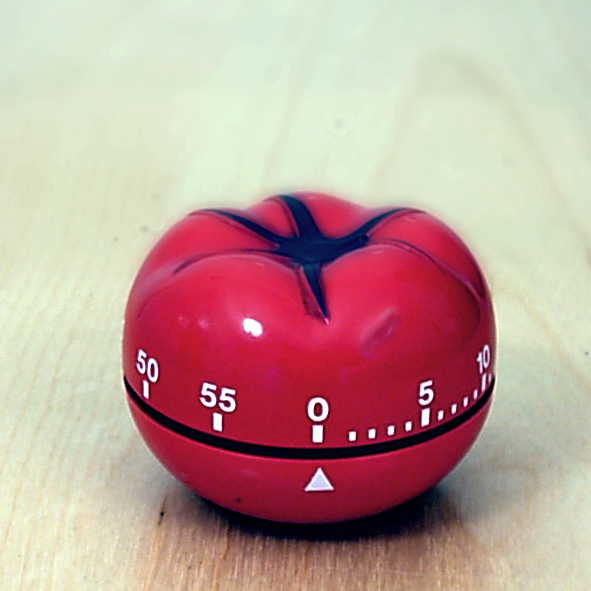
The Pomodoro Technique is a time management method developed by Francesco Cirillo in the late 1980s. It uses a kitchen timer to break work into intervals, typically 25 minutes in length, separated by short breaks. Each interval is known as a pomodoro, from the Italian word for tomato, after the tomato-shaped kitchen timer that Cirillo used while he was a university student.
Apps and websites providing timers and instructions have widely popularized the technique. Closely related to concepts such as timeboxing and iterative and incremental development used in software design, the method has been adopted in pair programming contexts.
Description
The original technique has six steps:
- Decide on the task to be done.
- Set the Pomodoro timer (typically for 25 minutes).
- Work on the task.
- End work when the timer rings and take a short break (typically 5–10 minutes).
- Go back to Step 2 and repeat until you complete four pomodori.
- After four pomodori are done, take a long break (typically 20 to 30 minutes) instead of a short break. Once the long break is finished, return to step 2.
For the purposes of the technique, a pomodoro is an interval of work time (and pomodori is the plural form).
A goal of the technique is to reduce the effect of internal and external interruptions of attention and flow. A pomodoro is indivisible; when interrupted during a Pomodoro, either the other activity must be recorded and postponed (using the inform — negotiate — schedule — call back strategy) or the pomodoro must be abandoned.
After task completion in a Pomodoro, any remaining time should be devoted to activities; for example:
- Review the work you just completed (optional)
- Review the activities from a learning point of view (example: What learning objective did you accomplish? What learning outcome did you accomplish? Did you fulfill your learning target, objective, or outcome for the task?)
- Review the list of upcoming tasks for the next planned pomodoro time blocks, and start reflecting on or updating them.
Cirillo suggests:
The stages of planning, tracking, recording, processing and visualizing are fundamental to the technique. In the planning phase, tasks are prioritized by recording them in a "To Do Today" list, enabling users to estimate the effort they will require. As pomodori are completed, they are recorded, adding to a sense of accomplishment and providing raw data for subsequent self-observation and improvement.
Tools
The creator and his proponents encourage a low-tech approach, using a mechanical timer, paper, and pencil. The physical act of winding the timer confirms the user's determination to start the task; ticking externalizes the desire to complete the task; ringing announces a break. Flow and focus become associated with these physical stimuli.
The technique has inspired application software for several platforms, with various programs available.
Research
A study investigated 25 students studying according to the Pomodoro technique (25 min work, 5 min break) and 35 students taking self-regulated breaks (control group). While students in the control group chose longer study sessions, this was associated with higher levels of fatigue and lower levels of concentration and motivation. This suggests that the structured breaks of the Pomodoro technique may indeed help to stay focused and motivated.
In 2025, a meta-analysis found that "Time-structured Pomodoro interventions consistently improved focus, reduced mental fatigue, and enhanced sustained task performance, outperforming self‑paced breaks".
References
References
- Cirillo, Francesco. "The Pomodoro Technique".
- Cummings, Tucker. (31 January 2011). "The Pomodoro Technique: Is It Right For You?".
- (19 September 2009). "For Writing Software, a Buddy System". [[The New York Times]].
- Cirillo, Francesco. "Get Started".
- (12 July 2019). "Productivity 101: An Introduction to The Pomodoro Technique".
- Nöteberg, Staffan. (2010). "Pomodoro Technique Illustrated". Pragmatic Bookshelf.
- Kaufman, Josh. (2011). "The Personal MBA: A World-Class Business Education in a Single Volume". Penguin UK.
- Sande, Steven. (28 November 2009). "The Pomodoro Technique, or how a tomato made me more productive".
- Pash, Adam. (2011). "Lifehacker the Guide to Working Smarter, Faster, and Better". Wiley.
- (August 2023). "Understanding effort regulation: Comparing 'Pomodoro' breaks and self-regulated breaks". British Journal of Educational Psychology.
- Ogut, Eren. (October 2025). "Assessing the efficacy of the Pomodoro technique in enhancing anatomy lesson retention during study sessions: a scoping review". BMC Medical Education.
This article was imported from Wikipedia and is available under the Creative Commons Attribution-ShareAlike 4.0 License. Content has been adapted to SurfDoc format. Original contributors can be found on the article history page.
Ask Mako anything about Pomodoro Technique — get instant answers, deeper analysis, and related topics.
Research with MakoFree with your Surf account
Create a free account to save articles, ask Mako questions, and organize your research.
Sign up freeThis content may have been generated or modified by AI. CloudSurf Software LLC is not responsible for the accuracy, completeness, or reliability of AI-generated content. Always verify important information from primary sources.
Report