From Surf Wiki (app.surf) — the open knowledge base
Pomegranate
Fruit-bearing deciduous shrub
Fruit-bearing deciduous shrub
| Granatum punicum | St.-Lag. | Punica florida | Salisb. | Punica grandiflora | hort. ex Steud. | Punica nana | L. | Punica spinosa | Lam. | Rhoea punica | St.-Lag.
The pomegranate (Punica granatum; Persian: انار anar) is a fruit-bearing, deciduous shrub in the family Lythraceae, subfamily Punicoideae, that grows to between 1.5 – tall. Rich in symbolic and mythological associations in many cultures, it originated from the Iranian plateau including Iran, the Caucasus, Turkmenistan, Afghanistan and Pakistan. Pomegranate was first domesticated by ancient Iranians in the Persian plateau and nearby regions about 5,000 years ago. It is extensively cultivated for its fruit.
Pomegranate was later introduced and exported from the Iranian plateau to other parts of Asia including Iraq, Turkey, India, Africa, and Europe. It was also introduced into Spanish America in the late 16th century and into California by Spanish settlers in 1769.
Although the pomegranate is indigenous to Iran and its nearby regions, it is also nowadays cultivated across the West Asia, South Asia, Central Asia, north and tropical Africa, the drier parts of Southeast Asia, the Mediterranean Basin, United States and Chile. The fruit is typically in season in the Northern Hemisphere from September to February, and in the Southern Hemisphere from March to May.
Pomegranate molasses is a key ingredient in traditional Persian cuisine, where it is used to add a rich sweet-sour flavour to dishes such as stews, sauces, and marinades, most notably in classic recipes like fesenjān, kabab torsh and zeytoon parvardeh. The pomegranate and its juice are variously used in baking, cooking, juice blends, garnishes, nonalcoholic drinks, and cocktails.
Etymology
The name pomegranate derives from medieval Latin pōmum, apple and grānātum, seeded. Possibly stemming from the old French word for the fruit, pomme-grenade, the pomegranate was known in early English as "apple of Granada", a term that today survives only in heraldic blazons.
Garnet derives from Old French grenat by metathesis, from Medieval Latin granatum as used in a different meaning "of a dark red colour". This derivation may have originated from pomum granatum, describing the colour of pomegranate pulp, or from granum, referring to red dye, cochineal.
The modern French term for pomegranate, grenade, has given its name to the military grenade.
Pomegranates were colloquially called wineapples or wine-apples in Ireland, although this term has fallen out of use. It still persists at the Moore Street open-air market in central Dublin.
Description
The pomegranate is a shrub or small tree growing 1.5 to high, with multiple spiny branches. It is long-lived, with some specimens in France surviving for 200 years. The leaves are opposite or subopposite, glossy, narrow oblong, entire, 1.9 – long, and 0.8 – broad.
The flowers are bright red or white, and 3 cm or more in diameter, with three to seven petals. Some fruitless cultivars are grown for the flowers alone. The flower's anthers close around the stigma until maturity, the ovaries are divided internally into special compartments or locules of many suspended ovules covered in septum.

Fruit


The pomegranate fruit husk is red-purple with an outer, hard pericarp, and an inner, spongy mesocarp (white "albedo"), which comprises the fruit's inner wall where seeds attach. Membranes of the mesocarp are organised as nonsymmetric chambers that contain seeds which are embedded without attachment to the mesocarp, also a result of fertilisation to the divided ovary. Pomegranate seeds are characterised by having sarcotesta, thick fleshy seed coats derived from the integuments or outer layers of the ovule's epidermal cells. The number of seeds in a pomegranate can vary from 200 to about 1,400.
Botanically, the fruit is a berry with edible seeds and pulp produced from the ovary of a single flower. The fruit is variable in size, from 2 – diameter in wild plants (to 12 cm in some cultivars) with a rounded shape and thick, reddish husk.
In mature fruit, the juice obtained by compressing the seeds yields a tart flavour due to low pH (4.4) and high contents of polyphenols, which may cause a red indelible stain on fabrics. The pigmentation of pomegranate juice primarily results from the presence of anthocyanins and ellagitannins.
Cultivation
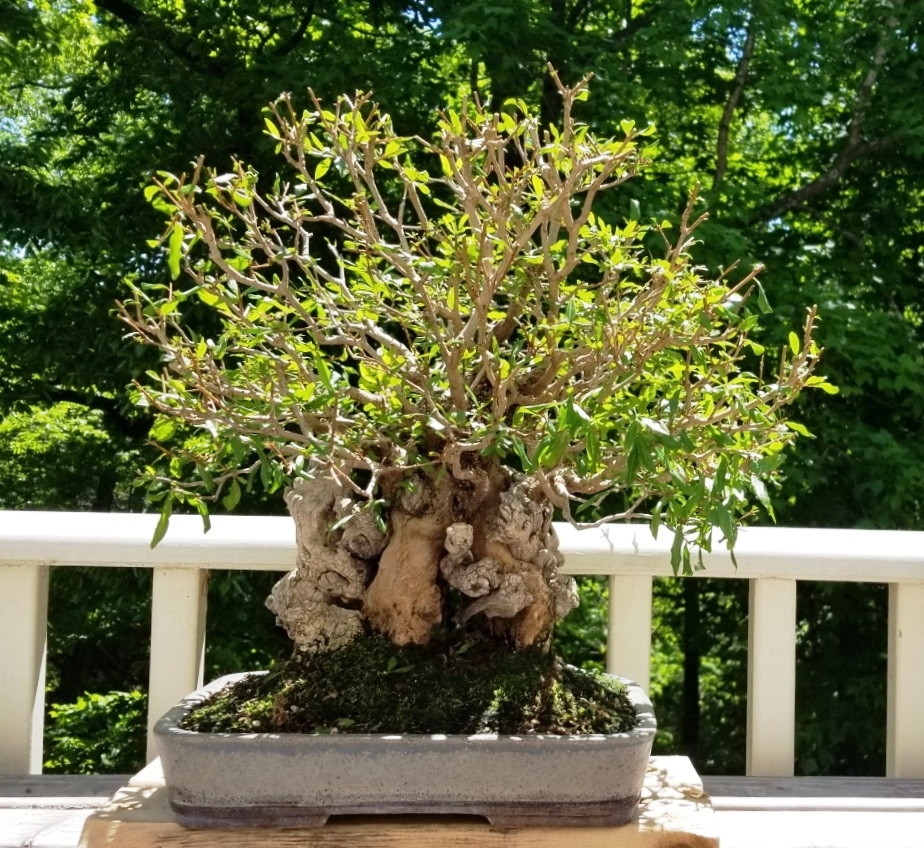
P. granatum is grown for its fruit crop, and as ornamental trees and shrubs in parks and gardens. Mature specimens can develop sculptural twisted bark, multiple trunks, and a distinctive overall form. Pomegranates are drought-tolerant, and can be grown in dry areas with either a Mediterranean winter rainfall climate or in summer rainfall climates. In wetter areas, they can be prone to root decay from fungal diseases. They can tolerate moderate frost, down to about -12 °C.
Insect pests of the pomegranate can include the butterflies Virachola isocrates, Iraota timoleon, and Deudorix epijarbas, and the leaf-footed bug Leptoglossus zonatus, and fruit flies and ants are attracted to unharvested ripe fruit.
Propagation
P. granatum reproduces sexually in nature, but can be propagated using asexual reproduction. Propagation methods include layering, hardwood cuttings, softwood cuttings, and tissue culture. Required conditions for rooting cuttings include warm temperatures within the 18–29 °C (65–85 °F) range and a semihumid environment. Rooting hormone increases rooting success rate, but is not required. Grafting is possible but impractical and tends to yield low success rates.
Varieties
P. granatum var. nana is a dwarf variety of P. granatum popularly planted as an ornamental plant in gardens and larger containers, and used as a bonsai specimen tree. It could well be a wild form with a distinct origin. It has gained the Royal Horticultural Society's Award of Garden Merit.
The only other species in the genus Punica is the Socotran pomegranate (P. protopunica), which is endemic to the Socotran archipelago of four islands located in the Arabian Sea, the largest island of which is also known as Socotra. The territory is part of Yemen. It differs in having pink (not red) flowers and smaller, less sweet fruit.
Cultivars

P. granatum has more than 500 named cultivars, but has considerable synonymy in which the same genotype is named differently across regions of the world.
Several characteristics between pomegranate genotypes vary for identification, consumer preference, preferred use, and marketing, the most important of which are fruit size, exocarp colour (ranging from yellow to purple, with pink and red most common), seed coat colour (ranging from white to red), the hardness of seed, maturity, juice content and its acidity, sweetness, and astringency.
Production and export
The leading producers globally are India and China, followed by Iran, Turkey, Afghanistan, the US, Iraq, Pakistan, Syria, and Spain. During 2019, Chile, Peru, Egypt, Israel, India, and Turkey supplied pomegranates to the European market. Chile was the main supplier to the United States market, which has a limited supply from Southern California. China was self-sufficient for its pomegranate supply in 2019, while other South Asia markets were supplied mainly by India. Pomegranate production and exports in South Africa competed with South American shipments in 2012–2018, with export destinations including Europe, the Middle East, the United Kingdom, and Russia. South Africa imports pomegranates mainly from Israel.
History
The pomegranate is native to the Persia and it was first domesticated by ancient Iranians in the Persian Plateau and nearby regions about 5,000 years ago. Archaeological and historical evidence shows that the pomegranate, especially its blossom (golnār), was a sacred and symbolic element in ancient Persian culture from prehistoric times through the Achaemenid period in about 500 BC, associated with fertility, abundance, royal authority, and the deities Mithra and Anahita. There is a petroglyph at Persepolis showing that a pomegranate flower in the hand of an Achaemenian king, highlighting its ritual and symbolic significance in imperial iconography. The pomegranate also played a ritual role in seasonal and ancient Iranian ceremonies such as Yalda Night, where it symbolised rebirth, light, and continuity in ancient Iranian belief systems.
In Pakistan, it grows wild between 1,000–2,000 metres altitude, mainly in the western part of the country. Pomegranates have been cultivated throughout the Middle East, India, and the Mediterranean region for several millennia, and it is also cultivated in the Central Valley of California and in Arizona. Pomegranates may have been domesticated as early as the fifth millennium BC, as they were one of the first fruit trees to be domesticated in the eastern Mediterranean region.
Remains of the fruit dating to the Neolithic period have been found at Gezer in Israel, and carbonised pomegranate exocarp has been recovered from early Bronze Age levels at Tell es-Sultan (Jericho) in the West Bank. Additional remains from this period have been found at Arad and Gezer in Israel. Evidence from the Late Bronze Age includes pomegranate remains at Hala Sultan Tekke in Cyprus and the site of Tiryns in Greece. A large, dry pomegranate was found in the tomb of Djehuty, the butler of Queen Hatshepsut in Egypt; Mesopotamian records written in cuneiform mention pomegranates from the mid-third millennium BC onwards.
Waterlogged pomegranate remains have been identified at the circa 14th century BC Uluburun shipwreck off the coast of Turkey. Other goods on the ship include perfume, ivory and gold jewelry, suggesting that pomegranates at this time may have been considered a luxury good. Other archaeological finds of pomegranate remains from the Late Bronze Age have been found primarily in elite residences, supporting this inference. During the Iron Age, the pomegranate was a frequent decorative motif in Israelite material culture, appearing on ancient artifacts.
It is also extensively grown in southern China and Southeast Asia, whether originally spread along the Silk Road route or brought by sea traders. Kandahar is famous in Afghanistan for its high-quality pomegranates.
Although not native to Korea or Japan, the pomegranate is widely grown there, and many cultivars have been developed. It is widely used for bonsai because of its flowers and for the unusual twisted bark the older specimens can attain. The term "balaustine" () is also used for a pomegranate-red colour.
.svg)
Spanish colonists later introduced the fruit to the Caribbean and America (Spanish America). However, in the English colonies, it was less at home: "Don't use the pomegranate inhospitably, a stranger that has come so far to pay his respects to thee", English Quaker Peter Collinson wrote to the botanist John Bartram in Philadelphia, 1762. "Plant it against the side of thy house, nail it close to the wall. In this manner it thrives wonderfully with us, and flowers beautifully, and bears fruit this hot year. I have twenty-four on one tree... Doctor Fothergill says, of all trees this is most salutiferous to mankind".
The pomegranate had been introduced as an exotic to England the previous century, by John Tradescant the Elder, but the disappointment that it did not set fruit there led to its repeated introduction to the American colonies, even New England. It succeeded in the South: Bartram received a barrel of pomegranates and oranges from a correspondent in Charleston, South Carolina, 1764. John Bartram partook of "delitious" pomegranates with Noble Jones at Wormsloe Plantation, near Savannah, Georgia, in September 1765. Thomas Jefferson planted pomegranates at Monticello in 1771; he had them from George Wythe of Williamsburg.
Use
Culinary

Pomegranate juice can be sweet or sour, but most fruit are moderate in taste, with sour notes from the acidic ellagitannins contained in the juice. Pomegranate juice has long been a common drink in Europe and the Middle East, and is distributed worldwide. Pomegranate juice is also used as a cooking ingredient. In Syria, it is added to intensify the flavour of some dishes such as kibbeh safarjaliyeh.
Grenadine syrup, commonly used in cocktails, originally consisted of thickened and sweetened pomegranate juice, but today is typically a syrup made just of sugar and commercially produced natural and artificial flavours, preservatives, and food colouring, or using substitute fruit such as berries.
Before tomatoes (a New World fruit) arrived in the Middle East, pomegranate juice, pomegranate molasses, and vinegar were widely used in many Iranian foods; this mixture is still found in traditional recipes such as fesenjān, a thick sauce made from pomegranate juice and ground walnuts, usually spooned over duck or other poultry and rice, and in ash-e anar (pomegranate soup).
Pomegranate seeds are used as a spice known as anar dana (from , pomegranate + seed), most notably in Indian and Pakistani cuisine. Dried whole seeds can often be obtained in ethnic Indian markets. These seeds are separated from the flesh, dried for 10–15 days, and used as an acidic agent for chutney and curry preparation. Ground anardana is also used, which results in deeper flavouring in dishes and prevents the seeds from getting stuck in teeth. Seeds of the wild pomegranate variety known as daru from the Himalayas are considered high-quality sources for this spice.
Dried pomegranate seeds, found in some natural specialty food markets, still contain some residual water, maintaining a natural sweet and tart flavour. Dried seeds can be used in several culinary applications, such as trail mix or granola bars, or as a topping for salad, yogurt, or ice cream.
In Turkey, pomegranate sauce () is used as a salad dressing, to marinate meat, or simply to drink straight. Pomegranate seeds are also used in salads and sometimes as garnish for desserts such as güllaç. Pomegranate syrup, also called pomegranate molasses, is used in muhammara, a roasted red pepper, walnut, and garlic spread popular in Syria and Turkey.
In Greece, pomegranate is used in many recipes, including kollivozoumi, a creamy broth made from boiled wheat, pomegranates, and raisins, legume salad with wheat and pomegranate, traditional Middle Eastern lamb kebabs with pomegranate glaze, pomegranate eggplant relish, and avocado-pomegranate dip. Pomegranate is also made into a liqueur, and as a popular fruit confectionery used as ice cream topping, mixed with yogurt, or spread as jam on toast.
In Mexico, pomegranate seeds are commonly used to adorn the traditional dish chiles en nogada, representing the red of the Mexican flag in the dish which evokes the green (poblano pepper), white (nogada sauce) and red (pomegranate seeds){{cite web |url= https://bcgusto.wordpress.com/2024/03/18/chiles-en-nogada-a-symbol-of-the-mexican-flag/|title= Chiles en nogada: A symbol of the mexican flag |archive-url=https://web.archive.org/web/20251012014819/https://bcgusto.wordpress.com/2024/03/18/chiles-en-nogada-a-symbol-of-the-mexican-flag/ |archive-date=12 October 2025 }} tricolor.
Other uses
Pomegranate peels may be used to stain wool and silk in the carpet industry.{{cite journal |title= Textiles Dyeing with Pomegranate (Punica granatum) Peel ExtractUsing Natural Mordant |article-number= 2282056 |doi-access= free
Nutrition
The edible portion of raw pomegranate is 78% water, 19% carbohydrates, 2% protein, and 1% fat (table). A 100 g serving of pomegranate sarcotesta provides 11% of the Daily Value (DV) for vitamin C, 14% DV for vitamin K, and 10% DV for folate (table), while the seeds are a rich source of dietary fibre (20% DV).
Research
Phytochemicals
Processing
The phenolic content of pomegranate juice is degraded by processing and pasteurisation techniques.
Juice
The most abundant phytochemicals in pomegranate juice are polyphenols, including the hydrolyzable tannins called ellagitannins formed when ellagic acid and gallic acid bind with a carbohydrate to form pomegranate ellagitannins, also known as punicalagins. The red colour of the juice is attributed to anthocyanins, such as delphinidin, cyanidin, and glycosides of pelargonidin. Generally, an increase in juice pigmentation occurs during fruit ripening.
Peel
Pomegranate peel contains high amount of polyphenols, condensed tannins, catechins, and prodelphinidins. The higher phenolic content of the peel yields extracts for use in dietary supplements and food preservatives.
Seed
Pomegranate seed oil contains punicic acid (65%), palmitic acid (5%), stearic acid (2%), oleic acid (6%), and linoleic acid (7%).
Health claims
Despite limited research data, manufacturers and marketers of pomegranate juice have liberally used results from preliminary research to promote products. In February 2010, the FDA issued a warning letter to one such manufacturer, POM Wonderful, for using published literature to make illegal claims of unproven antidisease effects.
In May 2016, the US Federal Trade Commission declared that POM Wonderful could not make health claims in its advertising, followed by a US Supreme Court ruling that declined a request by POM Wonderful to review the court ruling, upholding the FTC decision.
Symbolism
Ancient Assyria
The pomegranate was an important fruit in the culture and rituals of ancient Assyria. The Mesopotamian goddess of healing, Gula, was commonly depicted with a pomegranate in her hand, symbolising it as a means of protection and healing from sickness. Pomegranates were commonly used in ceremonies to promote agriculture and human reproduction, especially the seeds. It was believed that eating pomegranates would grant a long and prosperous life, as well as nourishment in the afterlife, due to the belief of the seeds representing eternal life.
Pomegranates were also commonly depicted in Assyrian art pieces to depict abundance and fruitfulness with the agricultural cycle, and in the Metropolitan Museum of Art is an ivory bead object titled Pomegranate carved in the round. Today, the pomegranate remains an important symbol in modern Assyrian culture.
Ancient Iran
Pomegranate, known as fa in Persian, is a symbol of fertility, blessing, and favour in Iranian belief. Pomegranates are sacred in the Zoroastrian religion and Zoroastrians used it in their religious rituals. The yellow colour of the pomegranate stamens symbolises the sun and light.
The pomegranate tree has been one of the most sacred and holy plants in Iran and is believed to be grown from places where the blood of Siavash, a legendary Iranian hero character who is known for his innocence, was spilled. It has been mentioned in Iranian Pahlavi scripts as a fruit of heaven. It is also believed that the invulnerability of Esfandiar, another Iranian legend, was related to pomegranate. The Zoroastrians of Iran believe that pomegranate is a blessed fruit; it is served in their festivals like Mehregan and Nowruz, and in their wedding ceremonies to wish for the newly married couple to have healthy children in the future. They also used to plant a pomegranate tree in each of their fire temples to use its leaves in their ceremonies.
During the Iranian tradition of Yalda Night, people come together on the winter solstice and eat pomegranate seeds to celebrate the victory of light over darkness.
In a relief from Persepolis, Darius the Great is holding a pomegranate flower with two buds. This Achaemenid king is accepting the representatives of all the subordinate lands of Greater Iran to his presence, while holding a large flower in his hand as a sign of peace and friendship.
Ancient Egypt

Ancient Egyptians regarded the pomegranate as a symbol of prosperity and ambition. It was referred to by the Semitic names of jnhm or nhm. According to the Ebers Papyrus, one of the oldest medical writings from around 1500 BC, Egyptians used the pomegranate for treatment of tapeworm and other infections.
Ancient and modern Greece
*obverse: a Crested Corinthian-helmeted bust of Athena right;
*reverse: a pomegranate fruit]]
A pomegranate is displayed on coins from Side, as Side was the name for pomegranate in the local language, which is the city's name.
- Side, Pamphylia, AE16. ca. 310-380 BC. Helmeted head of Athena right. / ΣIΔH, pomegranate on a stalk, caduceus to left. SNG France III 772; SNG Pfalz 487-488 cngcoins.com, auction 145, lot 108, Aug. 2006. The ancient Greek city of Side was in Pamphylia, a former region on the southern Mediterranean coast of Asia Minor (modern-day Antalya province, Turkey).

The Greeks were familiar with the fruit far before it was introduced to Rome via Carthage, and it figures in multiple myths and artworks. In Ancient Greek mythology, the pomegranate was known as the "fruit of the dead", and believed to have sprung from the blood of Adonis.
The myth of Persephone, the goddess of the underworld, prominently features her consumption of pomegranate seeds, requiring her to spend a certain number of months in the underworld every year. The number of seeds and therefore months vary. During the months that Persephone sits on the throne of the underworld beside her husband Hades, her mother Demeter mourns and no longer gives fertility to the earth. This was an ancient Greek explanation for the seasons.
According to Carl A. P. Ruck and Danny Staples, the chambered pomegranate is also a surrogate for the poppy's narcotic capsule, with its comparable shape and chambered interior.
In another Greek myth, a girl named Side ("pomegranate") killed herself on her mother's grave to avoid suffering rape at the hands of her own father Ictinus. Her blood transformed into a pomegranate tree. In a different myth, a Boeotian woman named Side was cast into the Underworld by Hera, with the pomegranate symbolising her descent.
In the fifth century BC, Polycleitus took ivory and gold to sculpt the seated Argive Hera in her temple. She held a scepter in one hand and offered a pomegranate, like a "royal orb", in the other. "About the pomegranate I must say nothing", whispered the traveller Pausanias in the second century, "for its story is somewhat of a holy mystery". The pomegranate has a calyx shaped like a crown. In Jewish tradition, it has been seen as the original "design" for the proper crown.
Within the Heraion at the mouth of the Sele, near Paestum, Magna Graecia, is a chapel devoted to the Madonna del Granato, "Our Lady of the Pomegranate", "who by virtue of her epithet and the attribute of a pomegranate must be the Christian successor of the ancient Greek goddess Hera", observes the excavator of the Heraion of Samos, Helmut Kyrieleis.
In modern times, the pomegranate still holds strong symbolic meanings for the Greeks. When one buys a new home, it is conventional for a house guest to bring as a first gift a pomegranate, which is placed under/near the ikonostasi (home altar) of the house, as a symbol of abundance, fertility, and good luck. When Greeks commemorate their dead, they make kollyva as offerings, which consist of boiled wheat, mixed with sugar and decorated with pomegranate. Pomegranate decorations for the home are very common in Greece and sold in most home goods stores.
{{anchor|Ancient Israel and Judaism}}Ancient Israel and Judaism
Hebrew Bible
Pomegranate is one of the Seven Species (Hebrew: שבעת המינים, Shiv'at Ha-Minim) of fruit and grains enumerated in the Hebrew Bible () as special products of the Land of Israel. The Song of Songs (also known as the Song of Solomon) mentions the pomegranate six times, often as a symbol of beauty and fertility. In one verse, the female lover is described: Your lips are like a crimson thread, and your mouth is lovely. Your cheeks are like halves of a pomegranate behind your veil" ().
Some Jewish scholars believe the pomegranate was the forbidden fruit in the Garden of Eden, as described in the Book of Genesis. The Book of Exodus describes the me'il ("robe of the ephod") worn by the Hebrew high priest as having pomegranates embroidered on the hem, alternating with golden bells, which could be heard as the high priest entered and left the Holy of Holies. In the Book of Numbers, pomegranates are listed among the fruit that the scouts brought to Moses to demonstrate the fertility of the "Promised Land". According to the Books of Kings, the capitals of the two pillars (Jachin and Boaz) that stood in front of Solomon's Temple in Jerusalem were engraved with pomegranates. Solomon is said to have designed his coronet based on the pomegranate's "crown" (calyx).
Historical and traditional use
The pomegranate appeared on the ancient coins of Judaea, see Hasmonean, Herodian and First Jewish Revolt coinage.
The handles of Torah scrolls, when not in use, are sometimes covered with decorative silver globes similar in shape to pomegranates (Torah rimmonim).
Consuming pomegranates on Rosh Hashana, the Jewish New Year, is traditional because, with its numerous seeds, it is a symbol of fruitfulness.
Talmud and Kabbalah
The pomegranate is said to have 613 seeds representing the 613 commandments of the Torah, but it is a misconception. There is no clear source for this claim, although it is used as a metaphor in the Talmud for numerous good deeds.
In European Christian motifs
In the earliest incontrovertible appearance of Christ in a mosaic, a fourth-century floor mosaic from Hinton St Mary, Dorset, now in the British Museum, the bust of Christ and the chi rho are flanked by pomegranates. Pomegranates continue to be a motif often found in Christian religious decoration. They are often woven into the fabric of vestments and liturgical hangings or wrought in metalwork. Pomegranates figure in many religious paintings by the likes of Sandro Botticelli and Leonardo da Vinci, often in the hands of the Virgin Mary or the infant Jesus. The fruit, broken or bursting open, is a symbol of the fullness of Jesus' suffering and resurrection.
In Islam
Chapter 55 of the Quran mentions the pomegranate as a "favour" among many to be offered to those fearful to the "Lord" in "two Gardens".
Armenia
The pomegranate is one of the main fruit in Armenian culture (alongside apricots and grapes). Its juice is used with Armenian food and wine. The pomegranate is a symbol in Armenia, representing fertility, abundance, and marriage. It is also a semireligious icon. For example, the fruit played an integral role in a wedding custom widely practiced in ancient Armenia; a bride was given a pomegranate fruit, which she threw against a wall, breaking it into pieces. Scattered pomegranate seeds ensured the bride's future children.
The Color of Pomegranates, a movie directed by Sergei Parajanov, is a biography of the Armenian* ashug* Sayat-Nova (King of Song) which attempts to reveal the poet's life visually and poetically rather than literally.
Azerbaijan
Main article: Goychay Pomegranate Festival
Every fall the Goychay Pomegranate Festival is held in the city of Goychay.
China
Introduced to China during the Han dynasty (206BC220AD), the pomegranate (), in older times, was considered an emblem of fertility and numerous progeny. Pictures of the ripe fruit with the seeds bursting forth were often hung in homes to bestow fertility and bless the dwelling with numerous offspring, an important facet of traditional Chinese culture.
In modern times, the pomegranate has been used to symbolise national cohesion and ethnic unity by General Secretary of the Chinese Communist Party Xi Jinping, urging the Chinese population to "stick together like pomegranate seeds".
India
In some Hindu traditions, the pomegranate () symbolises prosperity and fertility, and is associated with both Bhumi (the earth goddess) and Ganesha (the one fond of the many-seeded fruit).
Kurdish culture
The pomegranate is an important fruit and symbol in Kurdish culture. It is accepted as a symbol of abundance and a sacred fruit of ancient Kurdish religions. Pomegranate is used as a symbol of abundance in Kurdish carpets.
Palestinian culture
In Palestinian culture, the pomegranate symbolises fertility and is deeply embedded in folklore and traditions. A popular saying states, "The pomegranate fills the heart with faith", and it is believed that every seed should be eaten, as one [pomegranate seed] may have come from paradise.
Gallery
File:Shoku.JPG|Pomegranate blossom before petal fall File:Granatapfelblüte 3.jpg|Pomegranate sepals and drying stamens after fertilisation and petal fall File:Unripened pomegranate.jpg|Unripened pomegranate fruit
References
References
- Participants of the FFI/IUCN SSC Central Asian regional tree Red Listing workshop, Bishkek, Kyrgyzstan (11-13 July 2006). (2020). "''Punica granatum''".
- (2010). "''Punica granatum'' L., The Plant List, Version 1". Royal Botanic Gardens, Kew and Missouri Botanical Garden.
- (2022). "''Punica granatum'' L.". The World Flora Online Consortium.
- Chandra, Ram. (2010). "Origin, history and domestication of pomegranate.". Fruit, Vegetable and Cereal Science and Biotechnology.
- Stone, Damien. (2017). "Pomegranate: A global history". Reaktion Books.
- Zeynalova, A. M. (2017). "Origin, taxonomy and systematics of pomegranate". Proceedings of the Institute of Botany.
- Shi, Jiangli. (2024-12-09). "Botany and Taxonomy of Pomegranate". CRC Press.
- Abdollahi, Hamid. (2021). "An illustrated review on manifestation of pome fruit germplasm in the historic miniatures of ancient Persia". Genetic Resources and Crop Evolution 68.7.
- Mohammadi, Mehran. (2023). "Pomegranate: A review of the heavenly healer’s past, present, and future". Iranian journal of basic medical sciences.
- Liu, Chen. (2025-05-06). "Pomegranate: historical origins, nutritional composition, health functions and processing development research". Critical Reviews in Food Science and Nutrition.
- (September 2012). "Pomegranate peel and fruit extracts: A review of potential anti-inflammatory and anti-infective effects". Journal of Ethnopharmacology.
- Langley, Patricia. (4 November 2000). "Why a pomegranate?". BMJ: British Medical Journal.
- "5 things you didn't know about pomegranates {{!}} Kew".
- (2020-05-29). "''Punica granatum'' L.".
- "''Punica granatum'' in Flora of Pakistan".
- Morton, J. F.. (1987). "Pomegranate, ''Punica granatum'' L". Purdue New Crops Profile.
- Encyclopedia Britannica. "Pomegranate".
- (20 June 2012). "Handbook of Fruits and Fruit Processing". John Wiley & Sons.
- (2017). "Science and Technology of Fruit Wine Production".
- {{OEtymD. pomegranate
- (15 October 2012). "All hail the Pomegranate, official symbol of Granada".
- {{OEtymD. garnet
- {{OEtymD. grenade
- (2004). "Woman as Poet". Books Ireland.
- (2015). "Engendering Ireland: New Reflections on Modern History and Literature". Cambridge Scholars Publishing.
- "Pollination". University of California Agriculture and Natural Resources.
- (June 2011). "Characterization of Attributes Related to Fruit Size in Pomegranate". HortScience.
- (April 2025). "Microscopical Investigation of ''Punica granatum'' L. Flower: A Traditional Drug with Vivid Therapeutic Promise". Pharmacognosy Research.
- (2007). "The Pomegranate: A New Look at the Fruit of Paradise". HortScience.
- (1984). "The Order Myrtales: Circumscription, Variation, and Relationships". Annals of the Missouri Botanical Garden.
- (September 2025). "Does a larger pomegranate yield more seeds?". AquaPhoenix.
- (2009). "Horticultural Reviews".
- (2015). "Physicochemical Changes and Antioxidant Activity of Juice, Skin, Pellicle and Seed of Pomegranate (cv. Mollar de Elche) at Different Stages of Ripening". Food Technology and Biotechnology.
- Jorgensen, SuzAnne. (June 2005). "Pomegranates". Utah State University, Department of Food Safety.
- (2013). "Determination of the major phenolic compounds in pomegranate juices by HPLC−DAD−ESI-MS". Journal of Agricultural and Food Chemistry.
- (October 2018). "The Pomegranate". UF/IFAS Extension.
- (2007). "The Home Orchard: Growing Your Own Deciduous Fruit and Nut Trees". UCANR Publications.
- Center, UF/IFAS Citrus Research and Education. "Pomegranate Enterprise - Citrus Research and Education Center (CREC) - University of Florida, Institute of Food and Agricultural Sciences - UF/IFAS".
- (2024). "''Punica granatum'' var. ''nana''". Royal Horticultural Society.
- (March 2020). "AGM Plants - Ornamental". Royal Horticultural Society.
- "Punica granatum - the Drops of Blood from Garden of Eden". Top Tropicals.
- (1 March 2022). "New UNECE standard will boost international trade in pomegranate". United Nations Economic Commission for Europe.
- (13 September 2019). "Overview: Global pomegranate market". FreshPlaza.
- Marinda Louw. (2021). "Pomegranate production in South Africa". South Africa Online.
- Rafiei Dehaghani, Vahid. (2025). "The Ritual Role of Golnār – The Pomegranate Flower in Iranian Art and Culture". Journal of Art and Civilization of the Orient.
- Sedigh-Rahimabadi, Massih. (2016-07-08). "A Traditional Mouthwash (Punica granatum var pleniflora) for Controlling Gingivitis of Diabetic Patients". Journal of Evidence-Based Complementary & Alternative Medicine.
- Doijode, S. D.. (2001). "Seed storage of horticultural crops". Food Products Press.
- (1875). "The American cyclopaedia: a popular dictionary of general knowledge, Volume 13". Appleton.
- (2012). "Domestication of plants in the old world: The origin and spread of domesticated plants in south-west Asia". Oxford University Press.
- Still, D. W.. (2006). "Pomegranates: ancient roots to modern medicine". CRC Press.
- (2000). "Domestication of plants in the old world: the origin and spread of cultivated plants in West Asia, Europe, and the Nile Valley". Oxford University Press.
- Ward, Cheryl. (February 2003). "Pomegranates in eastern Mediterranean contexts during the Late Bronze Age". World Archaeology.
- Ward Haldane, Cheryl. (March 1990). "Shipwrecked plant remains". The Biblical Archaeologist.
- (2013). "Pomegranate — Afghan Agriculture". University of California at Davis, International Programs.
- (2003). "On Colours 1528: A Translation from Latin". Universal Publishers.
- Leighton, Ann. (1986). "American gardens in the eighteenth century: "for use or for delight"". University of Massachusetts Press.
- Tundel, Nikki. (20 April 2007). "The pomegranate hits the peak of popularity". Minnesota Public Radio.
- Favre, Joseph. (1905). "Dictionnaire Universel de Cuisine Pratique: Encyclopédie Illustrée D'Hygiène Alimentaire".
- (15 July 2008). "Iran". Lonely Planet.
- "Ash-e Anar".
- Akgün, Müge. (22 September 2006). "Güllaç, a dainty and light dessert". DYH.
- Malouf, Greg and Lucy. (2006). "Saha". Hardie Grant Books.
- (1 April 2019). "Nutrition data for raw pomegranate per 100 grams". NutritionData.com, Conde Nast; USDA FoodData Central.
- (2005). "Influence of processing and pasteurization on color values and total phenolic compounds of pomegranate juice". Journal of Food Processing and Preservation.
- (1999). "Evolution of juice anthocyanins during ripening of new selected pomegranate (''Punica granatum'') clones". European Food Research and Technology.
- (1996). "Quantitative determination of the polyphenolic content of pomegranate peel". Zeitschrift für Lebensmittel-Untersuchung und Forschung.
- (2002). "Antioxidant properties of gallocatechin and prodelphinidins from pomegranate peel". Redox Rep..
- (2006). "Evaluation of antioxidant properties of pomegranate peel extract in comparison with pomegranate pulp extract". Food Chemistry.
- (July 1999). "Antioxidant and eicosanoid enzyme inhibition properties of pomegranate seed oil and fermented juice flavonoids". Journal of Ethnopharmacology.
- (26 April 2018). "Pomegranate: superfood or fad?". UK National Health Service (NHS).
- "Pom Wonderful Warning Letter". U.S. Food and Drug Administration.
- "Understanding Front-of-Package Violations: Why Warning Letters Are Sent to Industry".
- Starling S. (3 March 2010). "FDA says Pom Wonderful antioxidant claims not so wonderful". NutraIngredients.com.
- (2 May 2016). "Statement of FTC Chairwoman Edith Ramirez Regarding Supreme Court's Decision Not to Review POM Wonderful Case". Bureau of Consumer Protection, US Federal Trade Commission.
- Sorvino, Chloe. (2 May 2016). "The Verdict: POM Wonderful Misled Its Customers, A Blow To Its Billionaire Owners".
- Collins, Paul. (January 2006). "An Assyrian-Style Ivory Plaque from Hasanlu, Iran". Metropolitan Museum Journal.
- "Openwork plaque with papyrus and pomegranates".
- "Pomegranate -The Persian fruit of heaven". packtoiran.com.
- "5 things you didn't know about pomegranates". kew.org.
- "Pomegranate". reshafim.org.il.
- Jayaprakasha, G. K.. (2006). "Pomegranates: ancient roots to modern medicine". CRC Press.
- Turkish Odyssey [http://www.turkishodyssey.com/places/medit/medit3.htm Perge-Aspendus-Side-Alanya] {{webarchive. link. (14 November 2006 "Side was founded by Aeolians of the Aegean region. The history of the town extends back to the 7C BC. "Side" meant "pomegranate" in the local language. Until the Roman Imperial period, pomegranate was the symbol used on the coins of Side. ")
- "Greek SIDE (Pamphylia) AE13. EF-. 1st century BC. Athena - Pomegranate.".
- "PAMPHYLIA, SIDE. AR Stater, circa 460-410 BC. Pomegranate / Athena".
- "Numismatica Ars Classica - Auction 96 Lot 1114".
- Sear, David R.. (1978). "Greek coins and their values". Seaby.
- Hodgson, Robert Williard. (1917). "The pomegranate; Issue 276 of Bulletin". California Agricultural Experiment Station.
- Graves, Robert. (1992). "The Greek Myths". Penguin Books.
- Ovid. "Metamorphoses".
- (1994). "The world of classical myth: gods and goddesses, heroines and heroes". Carolina Academic Press.
- (1990). "Metamorphosis in Greek Myths". Clarendon Press.
- (2004). "A Handbook of Greek Mythology". Routledge.
- "Pausanias, Description of Greece". Loeb Classical Library.
- [http://www.bj.org/parashat_hashavua/parashat_tetzaveh_5765.php ''Parashat Tetzaveh''] {{webarchive. link. (22 August 2006 , Commentary by Peninnah Schram, Congregation B'nai Jeshurun, New York)
- Kyrieleis, Helmut. "The Heraion at Samos" in ''Greek Sanctuaries: New Approaches'', [[Nanno Marinatos]] and Robin Hägg, eds. 1993, p. 143.
- [https://web.archive.org/web/20060111025311/http://www.christmasmagazine.com/en/spirit/xmas_greece.asp Christmas Traditions in Greece] by folklorist Thornton B. Edwards
- Shafer-Elliott, Cynthia. (2022). "Fruits, Nuts, Vegetables, and Legumes". T&T Clark.
- [http://www.beliefnet.com/story/179/story_17974_2.html "A Pomegranate for All Religions"] {{webarchive. link. (21 May 2008 by Nancy Haught, ''Religious News Service'')
- {{bibleverse-nb. Exodus. 28:33–34
- ''Why Hebrew Goes from Right to Left: 201 Things You Never Knew about Judaism'', Ronald H. Isaacs (Newark, 2008), page 129
- {{bibleverse-nb. 1. Kings. 7:13–22
- Mobley, Beth. (2009). "Ceremonial Objects from the Collection of Rabbi David A. Whiman".
- Seeram, Navindra P.. (2006). "Pomegranates: Ancient Roots to Modern Medicine". CRC Press.
- (5 June 2008). "What's the Truth about... Pomegranate Seeds?".
- (2010). "Constantine: Roman Emperor, Christian Victor". Abrams.
- "Al-Rahman verse 68".
- (18 May 2015). "Genealogy group propagandized pomegranate, symbol of Armenia, wealth and fertility at official opening of the 2015 Eurovision Song Contest". Armenpress.
- Violet Hudson. (19 January 2017). "Pomegranate: the fruit that myths are made of". The Spectator.
- Paley, Tony. (7 October 2014). "The colour of pomegranates: a chance to savour a poetic masterpiece". The Guardian.
- [http://iguide.travel/Goychay/Activities/Pomegranate_Festival iguide.travel] {{webarchive. link. (6 October 2011 Goychay Activities: Pomegranate Festival)
- (1914). "Researches into Chinese Superstitions, Vol V. (Translated)". Tusewei Press.
- Chik, Holly. (6 March 2022). "Xi Jinping calls for China's ethnic groups to 'stick together like pomegranate seeds'". South China Morning Post.
- Heyn, Birgit. (April 1990). "Ayurveda: The Indian Art of Natural Medicine and Life Extension". Inner Traditions / Bear & Co.
- Suresh Chandra. (1998). "Encyclopaedia of Hindu Gods and Goddesses". Sarup & Sons.
- Vijaya Kumar. (2006). "Thousand Names of Ganesha". Sterling Publishers.
- (December 2015). "A Study on Symbols Roles in Shaping Appearances and Forms in Hand-Wovens of Kurdistan Province, Iran". International Journal of Humanities and Cultural Studies.
- "Pomegranate".
This article was imported from Wikipedia and is available under the Creative Commons Attribution-ShareAlike 4.0 License. Content has been adapted to SurfDoc format. Original contributors can be found on the article history page.
Ask Mako anything about Pomegranate — get instant answers, deeper analysis, and related topics.
Research with MakoFree with your Surf account
Create a free account to save articles, ask Mako questions, and organize your research.
Sign up freeThis content may have been generated or modified by AI. CloudSurf Software LLC is not responsible for the accuracy, completeness, or reliability of AI-generated content. Always verify important information from primary sources.
Report