From Surf Wiki (app.surf) — the open knowledge base
Polyhalite
Sedimentary mineral
Sedimentary mineral
| Field | Value |
|---|---|
| name | Polyhalite |
| image | History museum of Truskavets 081.jpg |
| caption | Museum specimen of polyhalite and anhydrite |
| category | Sulfate mineral |
| formula | |
| IMAsymbol | Plhl |
| strunz | 7.CC.65 |
| system | Triclinic |
| class | Pinacoidal () |
| (same H-M symbol) | |
| symmetry | *F* |
| unit cell | a = 6.95 Å, b = 8.88 Å, |
| c = 6.95 Å; α = 104.06°, | |
| β = 113.94°, γ = 101.15°; Z = 4 | |
| color | Colorless, white, gray; often salmon-pink to brick-red from included iron oxide |
| habit | Typically fibrous, foliated, massive; rarely as tabular crystals; pseudo-orthorhombic |
| twinning | Characteristically polysynthetic on {010}, {100} |
| cleavage | Perfect on {10}; parting on {010} |
| fracture | Conchoidal |
| tenacity | Brittle |
| mohs | 3.5 |
| luster | Vitreous to resinous |
| streak | White |
| diaphaneity | Transparent |
| gravity | 2.78 |
| opticalprop | Biaxial (−) |
| refractive | nα = 1.546 – 1.548 nβ = 1.558 – 1.562 nγ = 1.567 |
| birefringence | δ = 0.021 |
| 2V | Measured: 60° to 62° |
| solubility | Soluble in water, with precipitation of gypsum and perhaps syngenite |
| references |
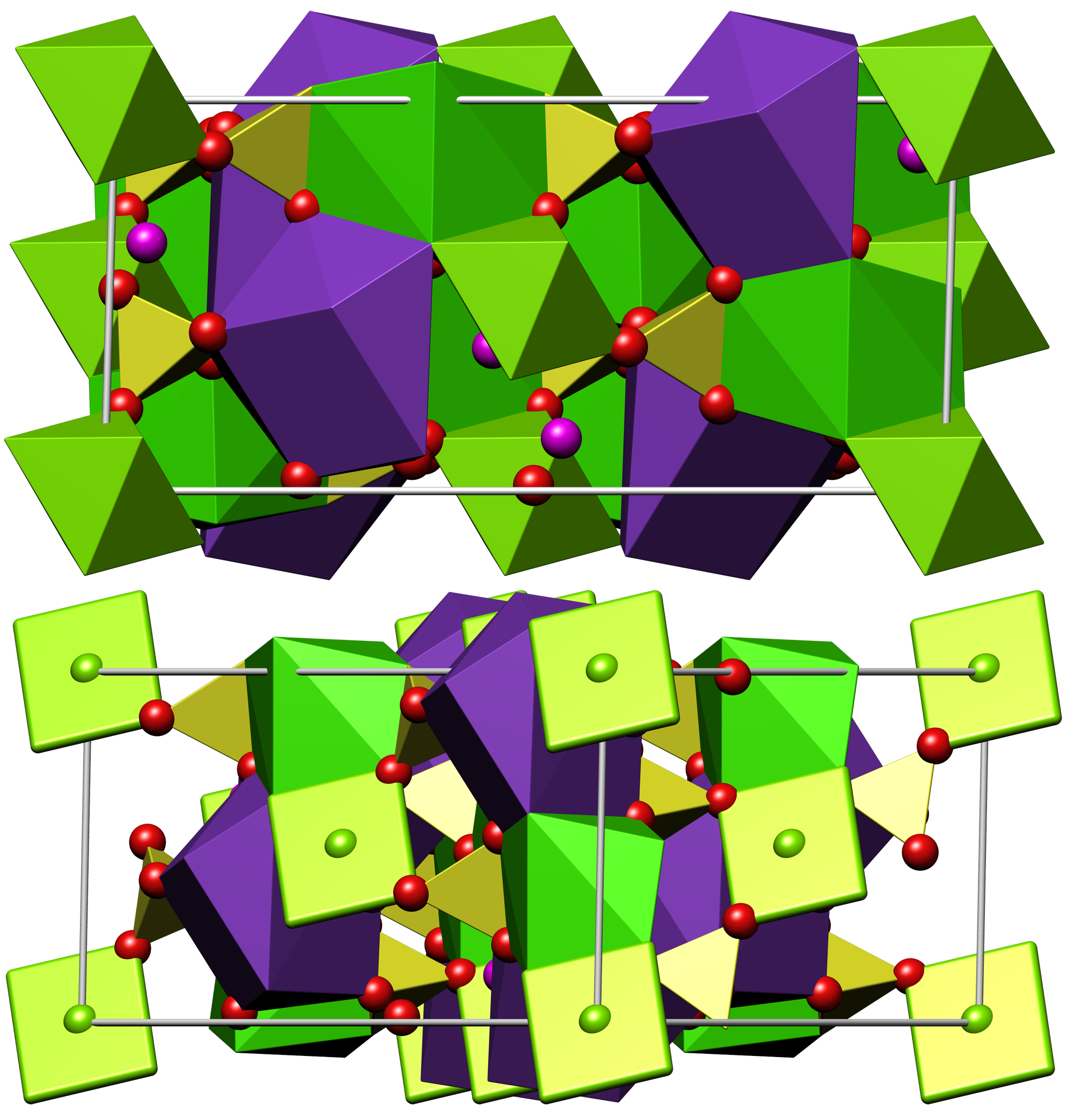
(same H-M symbol) c = 6.95 Å; α = 104.06°, β = 113.94°, γ = 101.15°; Z = 4 | length fast/slow = Polyhalite is an evaporite mineral, a hydrated sulfate of potassium, calcium and magnesium with formula: . Polyhalite crystallizes in the triclinic system, although crystals are very rare. The normal habit is massive to fibrous. It is typically colorless, white to gray, although it may be brick red due to iron oxide inclusions. It has a Mohs hardness of 3.5 and a specific gravity of 2.8. It is used as a valuable fertilizer.
Polyhalite was first described in 1818 for specimens from its type locality in Salzburg, Austria. It occurs in sedimentary marine evaporites and is a major potassium ore mineral in the Carlsbad deposits of New Mexico. It is also present as a 2–3% contaminant of Himalayan salt. The only deposit currently being mined lies under North Yorkshire, UK, extending under the adjacent North Sea.
Name
The name comes from the German Polyhalit, which comes from the Ancient Greek words (polys) and ** (hals), which mean "many" and "salt", and the German ending -it (which comes from the Latin ending -ites, which originally also came from Greek), which is used like the English ending -ite to form the names of certain chemical compounds.
Despite the similarity in names between polyhalite and halite (the naturally occurring form of table salt), their only connection is that both are evaporite minerals. The use of the Greek words for many and salt in polyhalite is due to polyhalite consisting of several metals that can form salts in the more general sense of the word salt used in chemistry.
Extraction
The only polyhalite mined in the world comes from a layer of rock over 1000 m below North Yorkshire and extending off the North Sea coast in the UK, deposited 260 million years ago.
In 2010, the first mining operations of this polyhalite mineral layer commenced at Boulby Mine, and the mine is in 2023 the only producer of polyhalite, marketed by ICL Group Ltd. as Polysulphate. In 2016, Sirius Minerals announced plans for the Woodsmith Mine in the area. In March 2020, the Woodsmith project was taken over by Anglo American plc and construction of two 1500 m shafts to reach the 70 m mineral seam was underway in 2015. These will reach a mineable area of around 25200 ha and Woodsmith Mine will be the deepest in Europe. The Woodsmith project was originally slated to begin production in 2027; development has since been slowed, and Anglo American now expects to ramp up construction from 2027, with a new first production date yet to be announced.
Composition and use
Polyhalite is used as a fertilizer since it contains four important nutrients and is low in chloride:
- 48% as sulfate
- 14% as from sulfate of potash
- 6% MgO as from magnesium sulfate
- 17% CaO as from calcium sulfate
Polyhalite has a variety of other uses, including:
Soil amendment: Polyhalite can help to improve the drainage and fertility of soil. It can also help to reduce the acidity of soil.
Water treatment additive: Polyhalite can help to remove impurities from water, such as sulfates and chlorides. It can also help to soften water and make it less corrosive.
Animal feed additive: Polyhalite can be added to animal feed to improve the nutritional value of the feed.
Industrial applications: Polyhale can be used in a variety of industrial applications, such as making glass, soap, and paper.
References
References
- Warr, L.N.. (2021). "IMA–CNMNC approved mineral symbols". Mineralogical Magazine.
- [http://www.mindat.org/min-3259.html Polyhalite on Mindat.org]
- [http://webmineral.com/data/Polyhalite.shtml Polyhalite data on Webmin]
- [http://rruff.info/doclib/hom/polyhalite.pdf Handbook of Mineralogy]
- "POLYHALITE {{!".
- (1 September 2016). "Banks backstop Sirius Minerals for $2.9B UK potash mine".
- "North York Moors potash mine gets £1.7bn go-ahead". The Guardian. 30 June 2015. Retrieved 3 February 2016.
- GeoResources. "Anglo American’s Woodsmith Mine expected to ‘ramp up’ from 2027". 2024. Accessed 14 January 2026. https://www.georesources.net/cms.php/en/news/2502/Anglo-American-s-Woodsmith-Mine-expected-to-ramp-up-from-2027
- New Ag International. "Anglo American eyeing final investment decision on UK polyhalite project by 2027". 2024. Accessed 14 January 2026. https://www.newaginternational.com/specialty-fertilizer/anglo-american-eyeing-final-investment-decision-on-uk-polyhalite-project-by-2027/
- The Guardian. "Anglo American takes further £1bn writedown on Yorkshire fertiliser mine". 25 July 2024. Accessed 14 January 2026. https://www.theguardian.com/business/article/2024/jul/25/anglo-american-takes-further-1bn-writedown-on-yorkshire-fertiliser-mine
This article was imported from Wikipedia and is available under the Creative Commons Attribution-ShareAlike 4.0 License. Content has been adapted to SurfDoc format. Original contributors can be found on the article history page.
Ask Mako anything about Polyhalite — get instant answers, deeper analysis, and related topics.
Research with MakoFree with your Surf account
Create a free account to save articles, ask Mako questions, and organize your research.
Sign up freeThis content may have been generated or modified by AI. CloudSurf Software LLC is not responsible for the accuracy, completeness, or reliability of AI-generated content. Always verify important information from primary sources.
Report