From Surf Wiki (app.surf) — the open knowledge base
Politics of Iran
none
none
| Field | Value |
|---|---|
| name | Politics of Iran |
| image | Emblem of Iran.svgclass=skin-invert |
| image_size | 150 |
| legislature | Islamic Consultative Assembly |
| legislature_type | Unicameral |
| legislature_place | Baharestan, Tehran |
| legislature_speaker | Mohammad Bagher Ghalibaf |
| legislature_speaker_title | Speaker |
| title_hosag | Supreme Leader |
| current_hosag | Ali Khamenei |
| appointer_hosag | Assembly of Experts |
| title_hog | President |
| current_hog | Masoud Pezeshkian |
| appointer_hog | Direct popular vote |
| cabinet | Cabinet of Iran |
| current_cabinet | Cabinet of Masoud Pezeshkian |
| cabinet_leader | President |
| cabinet_deputyleader | Vice President |
| cabinet_appointer | President |
| cabinet_hq | Presidential Administration of Iran, Sa'dabad Complex |
| cabinet_ministries | 19 |
| judiciary | Judicial system of the Islamic Republic of Iran |
| judiciary_head | Ebrahim Raisi |
| judiciary_head_title | Chief Justice |
| courts | Courts of Iran |
| court | Supreme Court |
| chief_judge | Gholam-Hossein Mohseni-Eje'i |
| court_seat | Courthouse of Tehran |
The politics of Iran takes place in the framework of an Islamic theocracy which was formed following the overthrow of Iran's millennia-long monarchy by the 1979 Revolution. Iran's system of government (nezam) was described by Juan José Linz in 2000 as combining "the ideological bent of totalitarianism with the limited pluralism of authoritarianism", Iran was evaluated as an electoral autocracy for year 2024 by V-Dem Institute according to Regimes of the World classification.
The December 1979 constitution of the Islamic Republic of Iran, declares that Shia Islam is Iran's state religion (around 90–95% of Iranians associate themselves with the Shia branch of Islam), and it combines elements of theocracy (Guardianship of the Islamic Jurist) with a presidential system in a religious democracy. Iran directly elects the president, parliament (Majles) and the Assembly of Experts. All candidates who run for these positions must be vetted by the Guardian Council (which disqualifies the overwhelming majority of the candidates) for their loyalty to the Islamic Republic's system of government. Indirectly elected are the government of the Islamic Republic of Iran, the Supreme Leader of Iran, and the Guardian Council, half of which is made up of Islamic jurists. In addition, there are representatives from appointed organizations, usually under the Supreme Leader's control, to "protect the state's Islamic character". The Supreme Leader is the head of state, above the president.
History and background
1979 Revolution
In 1979, Shah Mohammad Reza Pahlavi was overthrown by an Islamic Revolution in Iran, replacing its millennia-old monarchy with a theocratic republic. Shortly after, the leader of the Revolution, a senior Islamic jurist named Ayatollah Ruhollah Khomeini, also transliterated Khumaynî, successfully supported referendums to declare Iran an Islamic Republic in March 1979, and to approve a constitution in December 1979, whereby "the Islamic government" would be "based upon wilayat al-faqih", (Guardianship of the Islamic Jurist) "as proposed by Imam Khumaynî", quoting the preamble of the constitution.
The constitution (which was drafted by an assembly made up primarily by disciples of Khomeini), calls for a Vali-ye faqih (Guardian Islamic Jurist), to serve as the Supreme Leader of Iran, and for Islamic jurists to serve in other powerful institutions such as the Guardian Council and Assembly of Experts.
Establishment of guardianship of the jurist
Guardianship of the Jurist is a concept in Twelver Shia Islamic law, which holds that, in the absence of the "Infallible Imam", who, according to Twelver beliefs, is the religious and political leader of Islam and will reappear sometime before Judgement Day, righteous Shi'i jurists (faqīh) should administer "some" of the "religious and social affairs" of the Shi'i community. In its "absolute" form—the form advanced by the Ayatollah Ruhollah Khomeini and the basis of government in Islamic Republic of Iran—the state and society are ruled by an Islamic jurist. Khomeini served as the Guardian Jurist Supreme Leader of Iran until his death in 1989. His successor, Ali Khamenei, is still ruling as of mid 2025.
In a 1970 book on the subject circulated to his network of supporters, Khomeini argued that since Islamic sharia law contains everything needed to rule a state, whether ancient or modern, any other basis of governance will lead to injustice and sin. Thus Iran, the Muslim world and eventually the whole world, must be ruled according to sharia, and the person who should rule according to sharia, is an expert in that form of law.
These Guardians are deemed the true holders of both religious and political authority, who must be obeyed as "an expression of obedience to God", and whose rule has "precedence over all secondary ordinances in Islam such as prayer, fasting, and pilgrimage."
Post-revolutionary political conditions
The early days of the revolutionary government were characterized by political tumult. In November 1979, the US embassy was seized and its occupants taken hostage and kept captive for 444 days, because of US support for the Shah (monarch) of Iran. The eight-year Iran–Iraq War killed hundreds of thousands and cost the country billions of dollars. By the early 1980s, power struggles ended in leftists and nationalists eliminated from all governmental institutions, and the revolutionary leader Ayatollah Khomeini and his supporters firmly in control.
Iran's post-revolution challenges have included the imposition of economic sanctions and the suspension of diplomatic relations with Iran by the United States because of the hostage crisis, political support to Iraq and other acts of terrorism that the U.S. government and some others have accused Iran of sponsoring. Emigration from Iran has cost Iran millions of educated people, including entrepreneurs, professionals, technicians, and skilled craftspeople and their capital. Poverty rose by nearly 45% in absolute terms during the first 6 years of the Iran-Iraq War, and according to the World Bank, by the time the war ended in 1988, per capita income was a little more than half of what it had been in 1976, shortly before the revolution.
Human rights
Background
The alleged tyranny and brutality towards all opposition of the monarchy was one of the propaganda themes of the Islamic revolution, but the Islamic Republic has not tolerated opposition to its system of government, since, as mentioned above, it believes disobedience to it is disobedience to God. In 1984, Iran's representative to the United Nations, Saʿid Rajaʾie-Khorassani, declared the Universal Declaration of Human Rights to be representing a "secular understanding of the Judeo-Christian tradition", which did not "accord with the system of values recognized by the Islamic Republic of Iran" and whose provisions the IRI would "not hesitate to violate".
In reply to international criticism of repression, Iranian officials loyal to the Supreme Leader deny wrongdoing, maintaining its human rights record is better than western countries who criticize its record. In 2004, Judiciary chief Ayatollah Mahmoud Hashemi Shahroudi, denied that there were any political prisoners in Iran, saying "The world may consider certain cases, by their nature, political crimes, but because we do not have a law in this regard, these are considered ordinary offenses." In 2008, President Mahmoud Ahmadinejad replied to a question about human rights by stating that Iran has fewer prisoners than the US and "the human rights situation in Iran is relatively a good one, when compared ... with some European countries and the United States."
Whether the Islamic Republic goes well beyond what Sunni and many Shia Muslims consider Islamic exceptions to international human rights norms, is also an issue. Khomeini's January 1988 pronouncement "... that [Islamic] government is a branch of the Prophet's absolute Wilayat and one of the primary (first order) rules of Islam that has priority over all ordinances of the law even praying, fasting and Hajj…The Islamic State could prevent implementation of everything – devotional and non- devotional – that so long as it seems against Islam's interests", leads Ann Elizabeth Mayer to argue that this theory of velayat-e motlaqaye faqih ("the absolute authority of the jurist") "freed" the Islamic Republic "to do as it chose-even if this meant violating fundamental pillars of the religion ...", and that this doctrine, not sharia law, explained "the prevalence of torture and punishment of political dissent" in the Islamic Republic.
On the other hand, despite the vast popularity of Khomeini in Iran before and after the revolution, (approximately 10 million people are estimated to have participated in his funeral in a country of about 60 million), observers (Akbar Ganji, Arzoo Osanloo, Hooman Majd) have suggested there is no widespread support for violent crackdowns on dissent in contemporary Iran. "Notions of democracy and human rights" now have much deeper roots among Iranians than under the Shah, and in fact are "almost hegemonic" (Arzoo Osanloo), so that it is much harder to spread fear among them, even to the point that if Iranian intelligence services "were to arrest anyone who speaks ill of the government in private, they simply couldn't build cells fast enough to hold their prisoners", according to journalist Hooman Majd.
Situation
The Islamic Republic centralized and drastically expanded the prison system of the previous regime. In one early period (1981-1985) more than 7,900 people were executed. Somewhere between 3,000 and 30,000 political prisoners were executed between July and early September 1988 on orders of the Ayatollah Khomeini, causing a 2020 UN Special Rapporteurs to send a letter to the regime describing the killings as "crimes against humanity".
The Islamic Republic has been criticized both for restrictions and punishments that follow the Islamic Republic's constitution and law, but not international human rights norms (harsh penalties for crimes, punishment of victimless crimes, restrictions on freedom of speech and the press, restrictions on freedom of religion, etc.); and for "extrajudicial" actions that follow neither, such as firebombings of newspaper offices, and beatings, torture, rape, and killing without trial of political prisoners and dissidents/civilians.
Protests
While the Islamic Republic has been noted for its political stability, political protests against perceived corruption and injustice have become more severe and common in the twenty-first century. Nevertheless, at least one analyst, Seth G. Jones, believes that as of 2019, "the Iranian protest movement is ... too decentralized and Iranian security forces ... too strong" for the regime to be in danger of being overthrown by protesters. Some protests include:
- Iran student protests, July 1999: Protested the closure of the reformist newspaper (Salam), and violent attack on a student dormitory by riot police. Disappearance of more than seventy students, 1,200–1,400 arrested.
- 2009 Iranian presidential election protests: Protest against alleged voting fraud and irregularities during the 2009 election. An estimated 36 killed according to Iranian government, 72 killed according to opposition.
- 2011–12 Iranian protests: Protest against alleged electoral fraud during 2009 elections, violation of human rights, lack of freedom of speech, corruption.
- 2017–18 Iranian protests: Protest against economic hardships, government corruption, Iranian involvement in regional conflicts, the autocratic government of Ali Khamenei, human rights violations; 23-25 killed, 4,972 people arrested.
- 2018–2019 Iranian general strikes and protests: Protests against economic hardships, government corruption, Iranian involvement in regional conflicts. 300+ arrested.
- 2019–20 Iranian protests: Protest against government corruption, fuel price increases, human rights abuses, in favor of regime change. an estimated 1,500 killed, 7,000+ arrested.
- 2021–2022 Iranian protests: Protested the ongoing water shortages and blackouts of electricity all over Iran. An estimated 11 people killed, over 100 arrested.
- 2025–2026 Iranian protests: Beginning on 28 December 2025, the events have been described as the largest uprising since the 1979 Islamic Revolution. The ensuing crackdown resulted in the 2026 Iran massacres.
Leading figures and institutions
Current office holders
| Office | Name | Picture | Since | |
|---|---|---|---|---|
| Supreme Leader | Ali Khamenei | [[File:Portrait of Ali Khamenei, October 2016).jpg | 100x100px]] | |
| President | Masoud Pezeshkian | [[File:Masoud Pezeshkian 2024 (A) (cropped).jpg | 108x108px]] | |
| Speaker of Parliament | Mohammad Bagher Ghalibaf | [[File:Ghalibaf 1399032719532198420608744.jpg | 101x101px]] | |
| Chief Justice | Gholam-Hossein Mohseni-Eje'i | [[File:غلامحسین محسنی اژهای4.jpg | 103x103px]] |
Supreme Leader
Two very powerful, unelected posts/institutions unique to the Islamic Republic are the Supreme Leader and Guardian Council.
The Supreme Leader of Iran is the head of state and highest ranking political and religious authority (above the President). The armed forces, judicial system, state television, and other key governmental organizations such as the Guardian Council and Expediency Discernment Council are under the control of the Supreme Leader. According to article 110 of the constitution, the Supreme Leader delineates the general policies of the Islamic Republic. There have been only two Supreme Leaders since the founding of the Islamic Republic, and the current leader (Ali Khamenei), has been in power since 1989. His powers extend to issuing decrees and making final decisions on the economy, environment, foreign policy, education, national planning of population growth, the amount of transparency in elections in Iran, and who is to be fired and reinstated in the Presidential cabinet.
The Supreme Leader is appointed by the Assembly of Experts. All candidates to the Assembly of Experts, the President and the Majlis (Parliament), are selected by the Guardian Council, half of whose members are selected by the Supreme Leader of Iran. All directly elected members after the vetting process by the Guardian Council still have to be approved by the Supreme Leader.
Guardian Council
The Guardian Council is an appointed and constitutionally mandated 12-member council with considerable power. It approves or vetoes legislative bills from the Islamic Consultative Assembly (the Iranian Parliament), supervises elections, and approves or forbids candidates seeking office to the Assembly of Experts, the Presidency and the parliament. Six of its twelve members are Islamic faqihs (expert in Islamic Law) selected by the Supreme Leader of Iran. The other six are jurists nominated by the Head of the Judicial system (who is also appointed by the Supreme Leader), and approved by the Iranian Parliament.
Political parties, factions and elections
Political parties, organizations, pressure groups
After the revolution, the Islamic Republic Party was Iran's ruling and only legal political party until its dissolution in 1987. Its abolition has been attributed to Ayatollah Khomeini's well founded belief that leftist, monarchists and nationalists had been suppressed, and his network's place in power was secure. Supporters of the Islamic Republic Party reorganised themselves as "principalists", and along with the "reformists", became two of the major political factions in the country.
The Executives of Construction Party was formed in 1994 to run for the fifth parliamentary elections, made up mainly of executives in the government close to the then-president Akbar Hashemi-Rafsanjani. There are several other legal political parties or associations operating in Iran. Legal political groups, must support the Ayatollah Khomeini, his Islamic Revolution, and the Islamist political system (nezam) created by the revolution, the exclusion of “nonrevolutionary” and secular parties from political participation, and agree Iran's fundamental security interest is the survival and strengthening of the nezam.
Active student groups include the pro-reform "Office for Strengthening Unity" and "the Union of Islamic Student Societies". Groups that generally support the Islamic Republic include Ansar-e Hizballah, The Iranian Islamic Students Association, Muslim Students Following the Line of the Imam, Islam's Students, and the Islamic Coalition Association. The conservative power base has been said to be made up of a "web of Basiji militia members, families of war martyrs, some members of the Revolutionary Guard, some government employees, some members of the urban and rural poor, and conservative-linked foundations."
;Anti-government groups There are many nationalist, leftist and monarchist dissident parties and militias including National Front, the Constitutionalist Party, the Tudeh Party, People's Mujahedin Organization of Iran (MEK), Iranian People's Fedai Guerrillas (IPFG), Democratic Party of Iranian Kurdistan,and the Qashqai Freedom Path Party(QAYI).
Political factions
Iran's political parties/organizations are said to represent political factions in Iran, and according to at least one source, "factionalism has generally been more important than constitutional process in decision making", especially under Supreme Leader Ali Khamenei, i.e. after 1990, when "factional competition" grew "markedly in both intensity and influence".
Scholars such as Maziar Behrooz, Behzad Nabavi, Bahman Baktiari, Maaike Warnaar, Payam Mohseni, have given different formulations of them, varying in number, usually between three and five, the basic three being Principlists aka hard liners, Pragmatists and Reformists, and orientation (ideological purity vs. pragmatism; support for political and religious freedom vs. authoritarianism; support for regulation and intervention in the marketplace vs. laissez faire policies).
Elections
These are the most recent elections that have taken place:
President
Main article: 2024 Iranian presidential election
Islamic Consultative Assembly
Assembly of Experts
Local councils
Complexity of the system
According to the constitution, the Guardian Council oversees and approves electoral candidates for elections in Iran. The Guardian Council has 12 members: 6 clerics, appointed by the Supreme Leader and 6 jurists, elected by the Majlis from among the Muslim jurists nominated by the Head of the Judicial System, who is appointed by the Supreme Leader. According to the current law, the Guardian Council approves the Assembly of Experts candidates, who in turn elect the Supreme Leader. Indirect elections can reduce accountability and political efficacy. Iranian reformists, such as Mohammad-Ali Abtahi have considered this to be the core legal obstacle.
In 1998, the Guardian Council rejected Hadi Khamenei's candidacy for a seat in the Assembly of Experts for "insufficient theological qualifications".
Military
Main article: Military of Iran
Public finance and fiscal policy
Budget
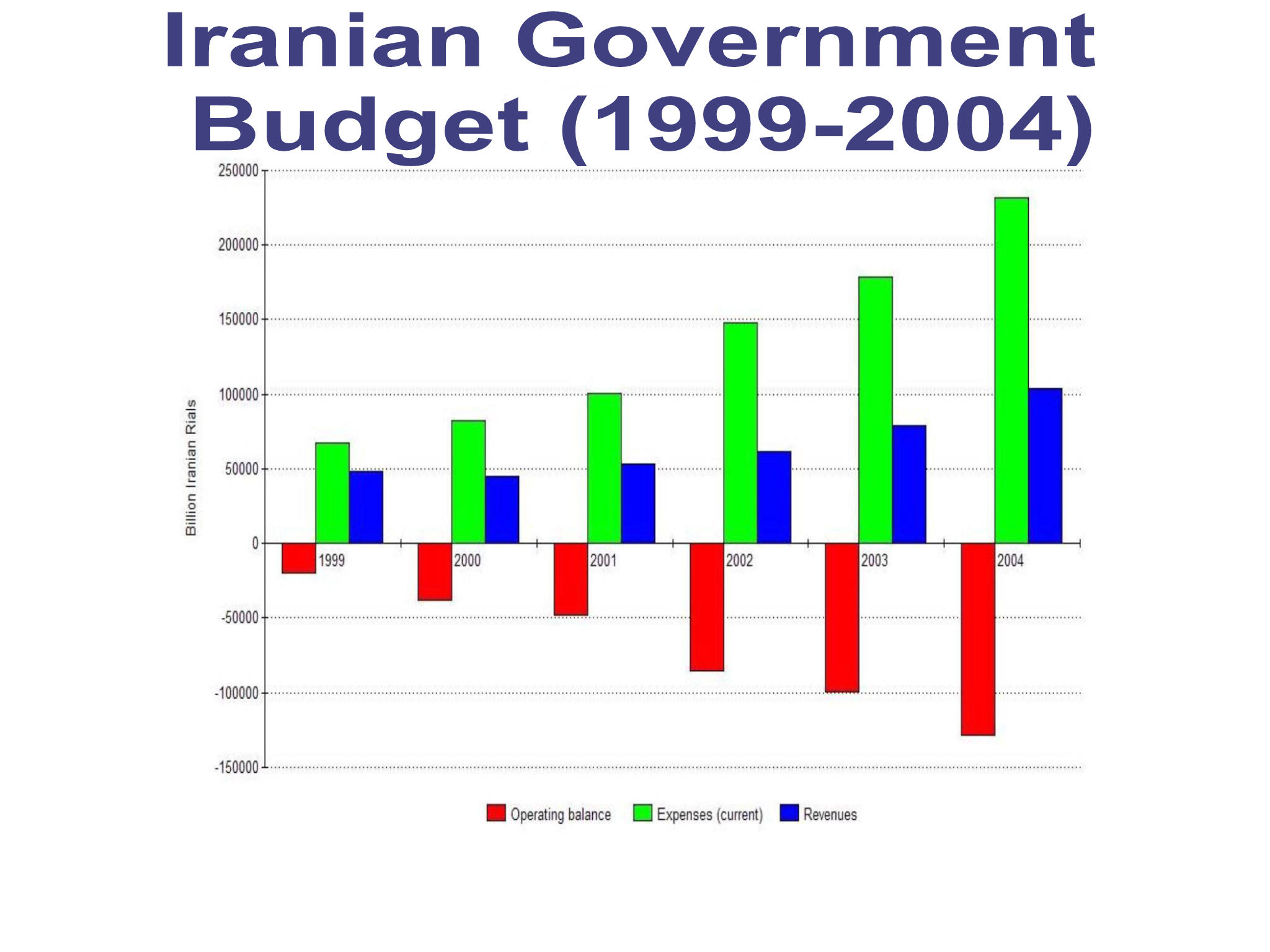
Iran's fiscal year (FY) goes from 21 to 20 March of the following year.
Iran has two types of budget:
- Public or "General" Government Budget
- Overall or "Total" Government Budget; which includes state-owned companies
Iran's budget is established by the Management and Planning Organization of Iran and then proposed by the government to the parliament/Majlis. Once approved by Majlis, the bill still needs to be ratified by the Guardian Council. The bill will be sent back to the parliament for amendments if it is voted down by the Guardian Council. The Expediency Council acts as final arbiter in any dispute.
Following annual approval of the government's budget by Majlis, the central bank presents a detailed monetary and credit policy to the Money and Credit Council (MCC) for approval. Thereafter, major elements of these policies are incorporated into the five-year economic development plan. The 5-year plan is part of "Vision 2025", a strategy for long-term sustainable growth.
A unique feature of Iran's economy is the large size of the religious foundations, called Bonyads, whose combined budgets make up more than 30% of that of the central government.
Setad, another organization worth more than $95 billion, has been described as "secretive" and "little known".
The National Development Fund of Iran (NDFI) does not depend on Iran's budget. But according to the Santiago Principles, NDFI must coordinate its investment decisions and actions with the macro-economic and monetary policies of the government of Iran.
Revenues

In 2004, about 45 percent of the government's budget came from exports of oil and natural gas revenues. This varies with the fluctuations in world petroleum markets. 31 percent of the budget came from taxes and fees. Overall, an estimated 50 percent of Iran's GDP was exempt from taxes in FY 2004.
In 2010, oil income accounted for 80% of Iran's foreign currency revenues and 60% of Iran's overall budget. Any surplus revenues from the sale of crude oil and gas are to be paid into the Oil Stabilization Fund (OSF). In 2010, the approved "total budget", including state owned commercial companies, was $295 billion.
The Government seeks to increase the share of tax revenue in the budget through the implementation of the economic reform plan, through more effective tax collection from businesses.
As of 2016, the formula set by law is that, for sales of oil at or below the budget's price assumption, 14.5% remains with the National Iranian Oil Company (NIOC), 20% goes to the National Development Fund (NDF), 2% goes to deprived and oil-producing provinces, and 63.5% goes to the government treasury.
Iran has not yet implemented the treasury single account system.
Expenditures
Because of changes in the classification of budgetary figures, comparison of categories among different years is not possible. However, since the Iranian Revolution, the government's general budget payments have averaged:
- 59 percent for social affairs,
- 17 percent for economic affairs,
- 15 percent for national defense, and
- 13 percent for general affairs.
Iran spent 22.5% of its 2003 national budget on social welfare programs, of which more than 50% covered pension costs.
For a breakdown of expenditures for social and economic purposes, see the attached chart.
In FY 2004, central government expenditures were divided as follows:
- current expenditures, 59 percent, and
- capital expenditures, 32 percent.
- Other items (earmarked expenditures, foreign-exchange losses, coverage of liabilities of letters of credit, and net lending) accounted for the remainder.
Among current expenditures, wages and salaries accounted for 36 percent; subsidies and transfers to households accounted for 22 percent (not including indirect subsidies). Earmarked expenditures totaled 13 percent of the central government total. Between FY 2000 and FY 2004, total expenditures and net lending accounted for about 26 percent of GDP. According to the Vice President for Parliamentary Affairs, Iran's subsidy reforms would save 20 percent of the country's budget.
According to the head of the Department of Statistics of Iran, if the rules of budgeting were observed in this structure, the government could save at least 30 to 35 percent on its expenses.
Contrary to the main objective and because of a lack in the implementation of the subsidy reform plan, the volume of Iranian subsidies given to its citizens on fossil fuel, which increased 42.2% in 2019, equals 15.3% of Iran's GDP and 16% of total global energy subsidies. As a direct consequence, Iranian taxpayers incur a loss of $3.3 billion annually because of fuel smuggling (& not including other smuggled oil derivatives), equivalent to the "development budget" of Iran.
Public debt
In 2014, Iran's banks and financial institutions total claims on the public sector (government and governmental institutions) amounted to 929 trillion IRR ($34.8 billion), which must be reduced according to the IMF. IMF estimates that public debt could be as high as 40% of GDP (or more) once government arrears to the private sector are recognized. These arrears are owed to banks (45%), private contractors (37%), and social security (18%) (FY 2016).
External debts
In 2013, Iran's external debts stood at $7.2 billion compared with $17.3 billion in 2012. Iran's external debt was $7.12 billion in April 2022. This is one of the lowest numbers internationally (~$90 per capita).
File:FLOW CHART (IRAN BUDGET).png|Money flow chart. File:IRANbalanceofpayment.jpg|Iran's balance of payment (2003-2007) File:Debt service-Iran.png|Iran's total debt service as percent of exports of goods services and income increased sixfold between 1990 and 1997 File:IRAN-GDP-real-growth.jpg|Iran's oil vs non-oil real GDP growth projections. File:Military expenditures-Iran.png|Military expenditures (% GDP) File:USD-IRR exchange rate.JPG|US dollar/Iranian rial exchange rate (2003-2014 est.) File:IRAN oil&gas production.jpg|Oil and gas production (1970-2030 est.) File:Iran Budget Process.png|Iranian budget process.
Financial situation of the government
| Year 1386 (2007–08) | % of nominal GDP | Year 1387 (2008–09) | Year 1387 (2008–09) | Year 1391 (2012–13) | Revenues and payments | ||||||
|---|---|---|---|---|---|---|---|---|---|---|---|
| 191,815.3 | 11.4% | 217,155 | 239,741.4 | 395,166.7 | Tax revenues (i.e. Income tax, Corporate tax, VAT, Customs fees etc.) | ||||||
| 106,387.8 | 121,598.1 | 139,597.1 | 173,036.5 | (+) Other revenues (i.e. Public corporations' dividend, Government services & other fees) | |||||||
| ***298,203.1*** | ***338,753.1*** | ***379,338.5*** | ***568,203.2*** | = ***Revenues*** | |||||||
| (-) 421,334.1 | 16.1% | (-) 621,126 | (-) 564,290.0 | (-) 889,993.2 | (–) Expenditure payments/current (i.e. Government wages) (see also: Iranian targeted subsidy plan) | ||||||
| ***-123,131*** | ***4.7%*** | ***-282,372.9*** | ***-184,951.5*** | ***-321,790.0*** | = (+/-) ***Operational balance**** | ||||||
| 173,519.1 | 298,865.6 | 215,650.3 | 425,526.5 | Sale of oil and oil products (see also: Ministry of Petroleum of Iran & National Iranian Oil Company) | |||||||
| 1,272.7 | 3,095 | 986.5 | 2,994.9 | (+) Others (Value of movable and immovable properties) | |||||||
| ***174,791.8*** | ***301,960.6*** | ***216,636.7*** | ***428,521.4*** | = ***Transfer of capital assets*** | |||||||
| - 147,715.8 (-157,215.8)(2) | 5.6% | (-) 251,573.8 | (-) 213,495.8 | (-) 152,277.4 | (–) [Acquisition of capital assets/development expenditures](http://www.cbi.ir/page/11992.aspx) (in Transport, Urban and Rural Development and Housing Provision Plans in the Framework of Welfare and Social Security System) | ||||||
| ***27,076.1*** ***(17,576.1)***(2) | ***50,386.8*** | ***3,140.9*** | ***276,244.0*** | = ***Net transfer of capital assets*** | |||||||
| -123,131 | 4.7% | -282,372.9 | -184,951.5 | -321,790.0 | + Operational balance (see above for details*) | ||||||
| **-96,054.9** **(-105,554.9)**(2) | **3.7%** | **-231,986.1** | **-181,810.6** | **-45,546.0** | **= Operational and capital balance** (*Operational balance* + *Net transfer of capital assets*) | ||||||
| 156,614.1 (166,114.0)(2) | 267,771.6 | 218,260.0 | 67,696.1 | Transfer of financial assets (i.e. Privatization proceeds, World Bank facilities, Sale of participation papers & Oil Stabilization Fund utilization) | |||||||
| (-) 60,559.2 | (-) 35,785.5 | (-) 36,449.4 | (-) 22,150.1 | (–) Acquisition of financial assets (i.e. Repayment of external debts and obligations) | |||||||
| **96,054.9** **(105,554.9)**(2) | **3.7%** | **231,986.1** | **181,810.6** | **45,546.0** | **= Net transfer of financial assets** (*Transfer of financial assets* – *Acquisition of financial assets*) |
Notes:
- Since 2002, the latest International Monetary Fund Guidelines on government financial statistics have been used as a model to prepare annual budgetary acts. Accordingly, revenues are classified into "taxes and other revenues", and "oil sales" which had earlier been classified as revenue are now referred to as "transfer of capital assets".
- In 2007/08, it includes budget supplement at Rls. 9,500 billion.
- The government budget does not include state revenues and expenses derived from state owned commercial enterprises.
- The government budget does not account for subsidies paid to state owned commercial enterprise. See also Subsidy reform plan.
- Excluding special revenues and expenditures and the figure for transparency in the price (subsidy) of energy bearers.
- For "Total Government Budget" (including state owned commercial companies), see Statistical Center of Iran.
- Hidden spending and liability not included.
Annual budgets
2009–10
In Iran's state budget for the Iranian calendar year 1388 (2009–2010), of the $102 billion earmarked for government spending,
- 53% will be funded through revenues from the sale of crude oil and gas,
- 28% will come from taxes and the remaining
- 19% from other sources such as the privatization program.
Oil revenues are calculated based on the average price of $37.50 per barrel at the US Dollar conversion rate of 9,500 Rials. Iran balances its external accounts around $75 per barrel.
2010–11
The budget for Iranian year 1389 (2010–2011), which starts on 21 March, amounts to $368.4bn, representing an increase of 31 per cent on the previous year and is based on a projected oil price of $60 a barrel compared with just $37.50 last year.
2011–12
The public budget was $165 billion (1,770 trillion rials) in Iranian year 2011–2012. The Iranian Parliament also approved a total budget of $508 billion (5,170 trillion rials) that factors in $54 billion from price hikes and subsidy cuts and aside from the government (or public budget) also includes spending for state-owned companies. The budget is based on an oil price of $81.5 per barrel. The value of the US dollar is estimated at IRR 10,500 for the same period. The 2011-12 total budget is 40 per cent bigger than previous year's (which stood at $368 billion) because of dropping subsidies on energy and food item.
2012–13
The proposed budget for 2011–2012 amounts to 5.1 quadrillion rials (approximately $416 billion). The funding for running the government has been decreased by 5.6 percent and the government's tax revenues have been envisaged to rise by 20 percent. The defense budget shows an increase of 127 percent. The government also is seeking higher sums for development, research, and health projects. Approved budget of 5,660 trillion Rials $477 billion is based on an oil price of $85 per barrel and the average value of the U.S. dollar for the fiscal year has been projected to be 12,260 rials, allowing the government to gain $53.8 billion from subsidy cut.
The approved total state budget figure shows an 11% increase in Rial terms, in comparison to the previous year's budget. Of this amount, $134 billion relates to the government's general budget and the remaining $343 billion relates to state-owned companies and organizations. Of the $134 billion for the government's general budget, $117 billion relates to operating expenditure and $17 billion is for infrastructure developments. The government's general budget for 2012–13 shows a 3.5% decline in comparison to the previous year, while the budget for state-owned companies and organisations has risen by 18.5%. Revenues from crude oil make up 37% of the state's total revenues in the budget. Revenues from taxes have been projected at 458 trillion Rials ($37 billion), which shows a 10% increase year-on-year. In the first half of 2012, Iran announced in Majlis that it has taken in only 25% of its budgeted annual revenue. According to Apicorp, Iran needs oil to average $127 a barrel in 2012 for its fiscal budget to break even.
2013–14
In May 2013, the Iranian parliament approved a 7.27-quadrillion-rial (about $593 billion) national budget bill for 2013–14. The new national budget has forecast a 40% drop in oil revenues compared to the previous year's projected figure. The bill has set the price of oil at $95 per barrel, based on the official exchange rate of 12,260 rials for a U.S. dollar, which has been fixed by the Central Bank of Iran. The budget law also includes income of 500 trillion Rials from the subsidies reform plan. Out of this amount, 410 trillion Rials is allocated for direct cash handouts to those eligible who have registered and for social funds.
2014–15
Iran's earmarked government spending for the year starting in March 2014 at $75 billion, calculated on an open-market exchange rate, with an overall/"total" budget ceiling estimated at $265 billion. The draft budget estimates oil exports at about 1.1 million barrels per day (bpd). The 2014 budget assumes an average oil price of $100 per barrel, inflation at 21%, GDP growth at 3% and the official USD/IRR exchange rate at 26,000 Iranian rials. The budget bill permits the government to use more than $35 billion in foreign finance. Capital expenditure is set to rise by 9.7%.
The administration has set the goal of 519 trillion rials, (about $20.9 billion) government's income from implementation of the subsidy reform plan in budget bill and will be likely forced to double fuel prices. In February 2014, Parliament approved a total budget bill worth 7,930 trillion rials ($319 billion at the official exchange rate). The International Monetary Fund has estimated Iran needs an oil price above $130 a barrel to balance its 2015-state budget; Brent crude was below $80 a barrel in November 2014. The IMF estimated in October 2014 that Iran would run a general government deficit of $8.6 billion in 2015, at the official exchange rate, to be compensated by drawing on the National Development Fund.
2015–16
Iran's 2015 proposed budget is nearly $300 billion. The overall/"total" budget shows a 4% growth compared with the 2014 budget. The budget assumes that the country exports 1 million barrels per day of crude oil and 0.3 million barrels per day of gas condensates at an average price of $72 per barrel of crude. The official exchange rate is projected to be on average US$28,500/IRR.
An average oil price of $50 for the coming year would result in a deficit of $7.5 billion. The government can lower this deficit by increasing the official exchange rate but this will trigger higher inflation. The proposed expenses are $58 billion including $39 billion is salary and pension payments to government employees. Proposed development expenditure amounts to $17 billion. and industry-driven R&D is almost non‑existent.
2016–17
Proposed government budget is 9.52-quadrillion Iranian rials (about 262 billion US dollars).
According to the sixth five-year development plan (2016-2021), the subsidy reform plan is to continue until 2021.
An amendment to the budget was passed in August 2016. This amendment allows the government to issue debt based instruments and the use of forex reserves in an attempt to clear its debt to the private sector, including contractors, banks and insurers.
2024–25
Main article: 2024–25 Iranian national budget
References
References
- link. (2020-07-26 .)
- "Democracy Report 2025, 25 Years of Autocratization – Democracy Trumped?".
- (19 March 2018). "Regimes of the World (RoW): Opening New Avenues for the Comparative Study of Political Regimes". Cogitatio.
- "The World Factbook".
- (2000-01-12). "Khamenei's brother attacks reformist purge". [[BBC News]].
- [http://meria.idc.ac.il/journal/1997/issue3/jv1n3a4.html IRAN: POLITICS, THE MILITARY AND GULF SECURITY] {{Webarchive. link. (15 January 2010 by Darius Bazargan, v.1, n.3, September 1997)
- "Iranian Revolution {{!}} Summary, Causes, Effects, & Facts {{!}} Britannica". Encyclopedia Britannica.
- "Iran (Islamic Republic of)'s Constitution of 1979 with Amendments through 1989. Preamble. Islamic Government".
- [[#KEA1993. Abrahamian, ''Khomeinism'', 1993]]: p.33-36
- [http://www.law.harvard.edu/programs/ilsp/publications/buchta.pdf Taking Stock of a Quarter Century of the Islamic Republic of Iran] {{Webarchive. link. (27 February 2008 , Wilfried Buchta, Harvard Law School, June 2005, p.5–6)
- [http://www.iranonline.com/iran/iran-info/Government/constitution-8.html Constitution of the Islamic Republic of Iran, section 8] {{webarchive. link. (23 November 2010 Article 109 states an essential qualification of "the Leader" is "scholarship, as required for performing the functions of mufti in different fields of fiqh")
- (July–September 1991). "Review by Hossein Modarressi, by THE JUST RULER OR THE GUARDIAN JURIST: AN ATTEMPT TO LINK TWO DIFFERENT SHICITE CONCEPTS by Abdulaziz Abdulhussein Sachedina". Journal of the American Oriental Society.
- "VELAYAT-E FAQIH Theory of governance in Shiʿite Islam.".
- [[#IaR1981. Khomeini, ''Islamic Government'', 1981]]: p.137-8
- [[#IaR1981. Khomeini, ''Islamic Government'', 1981]]: p.31-33
- Abrahamian, Ervand, ''Khomeinism : Essays on the Islamic Republic'' by Ervand Abrahamian, p.34-5
- [https://web.archive.org/web/20031206165617/http://www.wandea.org.pl/khomeini-pdf/hukumat-i-islami.pdf Islamic Government] ''Islam and Revolution I, Writings and declarations of Imam Khomeini'', 1981, p.91
- Hamid Algar,
Development of the Concept of velayat-i faqih since the Islamic Revolution in Iran,paper presented at London Conference on wilayat al-faqih, in June, 1988] [p.135-8]. Also ''Ressalat'', Tehran, 7 January 1988, online] - Turani, Behrouz. (2024-11-03). "What became of the students who seized the US embassy in Tehran".
- Moin, ''Khomeini'' (2001), p.21-234
- Arjomand, Said Amir, The Turban for the Crown : The Islamic Revolution in Iran, Oxford University Press, c1988, p.144
- Bakhash, Shaul, Reign of the Ayatollahs : Iran and the Islamic Revolution by Shaul, Bakhash, Basic Books, c1984 p.158-9
- "Iran's Economic Morass".
- Harrison, Frances. (8 January 2007). "Huge cost of Iranian brain drain By Frances Harrison". BBC News.
- Based on the government's own Planning and Budget Organization statistics, from: Jahangir Amuzegar, 'The Iranian Economy before and after the Revolution,' ''Middle East Journal'' 46, n.3 (summer 1992): 421)
- "According to World Bank figures, which take 1974 as 100, per capita GDP went from a high of 115 in 1976 to a low of 60 in 1988, the year war with Iraq ended ..." (Keddie, ''Modern Iran'', 2003, p.274)
- Low reached in 1995, from: Mackey, ''Iranians'', 1996, p. 366.
- United Nations General Assembly. 39th Session. Third Committee. 65th meeting, held on 7 December 1984 at 3 pm New York. A/C.3/39/SR.65. quoted by Luiza Maria Gontowska, ''[http://digitalcommons.pace.edu/cgi/viewcontent.cgi?article=1010&context=honorscollege_theses Human Rights Violations Under the Sharia'a, A Comparative Study of the Kingdom of Saudi Arabia and the Islamic Republic of Iran],'' May 2005, p. 4
- (1996). "Islamic Rights or Human Rights: An Iranian Dilemma". Iranian Studies.
- (5 March 2008). "Tehran Times".
- "Iranian President Mahmoud Ahmadinejad on the Threat of US Attack and International Criticism of Iran's Human Rights Record". Democracy Now!.
- John Pike. (3 May 2004). "Iran Report, A Weekly Review of Developments in and Pertaining to Iran, 3 May 2004". Globalsecurity.org.
- (2004). "Shia Political Thought".
- (2009). "Revisiting Ayatollah Khomeini's Doctrine of Wilayat al-Faqıh (Velayat-e Faqıh)". Orient.
- Pendle, George. (2018-08-29). "Which Famous Figure Had the Biggest Public Funeral?".
- (2015-01-19). "The ten largest gatherings in human history".
- "The Latter-Day Sultan, Power and Politics in Iran" by Akbar Ganji, ''Foreign Affairs'', November/December 2008
- Sally E. Merry, New York University, writing about [http://press.princeton.edu/titles/8918.html ''The Politics of Women's Rights in Iran'' by Arzoo Osanloo] accessed 30-June-2009
- Majd, ''The Ayatollah Begs to Differ'', 2008, p.183
- source: Anonymous "Prison and Imprisonment", ''Mojahed'', 174–256 (20 October 1983{{snd8 August 1985).
- (3 September 2020). "Mandates of the Working Group on Enforced or Involuntary Disappearances; ...".
- Ehsan Zarrokh (Ehsan and Gaeini, M. Rahman). "Iranian Legal System and Human Rights Protection" The Islamic Law and Law of the Muslim World e-journal, New York law school 3.2 (2009).
- (20 September 2008). "Rights Crisis Escalates Faces and Cases from Ahmadinejad's Crackdown, 20 September 2008". Iranhumanrights.org.
- (November 8, 2019). "Iran's Protests and the Threat to Domestic Stability".
- (1 February 2013). "New Arrests and "Disappearances" of Iranian Students". Human Rights Watch.
- (10 September 2009). "Iran official says 36 killed in post-vote unrest".
- BBCPersianTV. (8 June 2012). "BBCPersian: The cases of the victims of the 2009 election". BBC.
- (21 June 2009). "Chaos prevails as protesters, police clash in Iranian capital". CNN.
- "١۵٠ ایرانیانی که از خرداد ١٣۸۸ تا تیر ١٣۸۹ به دست رژیم کشته شده اند | انقلاب اسلامی در هجرت". Sarbaz01.
- (25 February 2011). "Iran's Karroubi isolated but determined". Google News.
- (26 September 2011). "Iran: Freedom of expression denied".
- "Iran limits the freedoms of speech, press, and the right of assembly; denies the right of personal freedom; and prevents the freedom of religion. The following explains the constant abuses of the human rights by giving some examples".
- "Archived copy".
- "Here's why the Iran protests are significant". CNN.
- Erdbrink, Thomas. (30 December 2017). "Iran Confronts 3rd Day of Protests, With Calls for Khamenei to Quit". The New York Times.
- (2 January 2018). "Iranian protesters attack police stations, raise stakes in unrest". Reuters.
- Kim Senqupta. (2018-01-02). "Iran protests latest: Grand Ayatollah accuses foreign powers of meddling as protest death toll rises to 22". Independent.
- Səid Kəmali Dəğan və Culiyan Borqer. (2018-01-02). "Iran's enemies to blame for unrest, says supreme leader, as death toll rises". [[The Guardian]].
- (2018-01-14). "Iran: le bilan officiel des manifestations monte à 25 morts". Le Monde with AFP.
- Con Qambrell. (2018-01-09). "Iran lawmaker says some 3,700 arrested amid protests, unrest". ABC News.
- (23 December 2019). "Special Report: Iran's leader ordered crackdown on unrest – 'Do whatever it takes to end it'".
- (27 November 2019). "Iran arrests 7,000 fuel protesters in one week".
- (November 26, 2021). "Iranian police clash with protesters after water shortage rallies". Reuters.
- (2026-01-13). "Khamenei ordered killings with approval of top state bodies, sources say".
- Article 89-91, Iranian Constitution
- "Iran's Khamenei hits out at Rafsanjani in rare public rebuke". Middle East Eye.
- "Khamenei says Iran must go green - Al-Monitor: the Pulse of the Middle East". Al-Monitor.
- Louis Charbonneau and Parisa Hafezi. (16 May 2014). "Exclusive: Iran pursues ballistic missile work, complicating nuclear talks".
- "IranWire - Asking for a Miracle: Khamenei's Economic Plan".
- "Khamenei outlines 14-point plan to increase population".
- "Iran: Executive, legislative branch officials endorse privatization plan".
- (8 May 2017). "Khamenei slams Rouhani as Iran's regime adopted UN education agenda".
- (15 October 2016). "Leader outlines elections guidelines, calls for transparency".
- "St. Albert Gazette".
- (25 July 2009). "BBC NEWS - Middle East - Iranian vice-president 'sacked'".
- (14 December 2015). "Rafsanjani breaks taboo over selection of Iran's next supreme leader".
- (see Article 108 of the constitution)
- (30 November 2001). "ICL - Iran - Constitution".
- Article 99 of the constitution
- "خانه ملت".
- "Iranian Government Constitution, English Text".
- [[#NSPAN2011. Nader, ''Next Supreme Leader'', 2011]]: p.12
- Molavi, Afshin, ''The Soul of Iran'', Norton, (2005), p.353
- Sherrill, Clifton. (2011). "After Khamenei: Who Will Succeed Iran's Supreme Leader?". Orbis.
- Thaler. (2010). "Mullahs, Guards, and Bonyads: An Exploration of Iranian Leadership Dynamics". [[RAND Corporation]].
- [[#NSPAN2011. Nader, ''Next Supreme Leader'', 2011]]: p.11
- [[#NSPAN2011. Nader, ''Next Supreme Leader'', 2011]]: p.18
- Rogers, Steven. (2012). "The Responsiveness of Direct and Indirect Elections". Legislative Studies Quarterly.
- (8 October 2006). "Mohammad Ali Abtahi - Weblog".
- (13 November 2006). "Mohammad Ali Abtahi - Weblog".
- (7 September 2005). "Mohammad Ali Abtahi - Weblog".
- "Mohammad Ali Abtahi - Media - Articles".
- (11 January 2004). "Mohammad Ali Abtahi - Weblog".
- A. William Samii. (2000-01-17). "Candidates rejected and Guardians Criticized". Radio Free Europe/Radio Liberty Iran Report.
- "Iranian Elections, 1997-2001". [[Public Broadcasting Service.
- "Iran - MSN Encarta>".
- (April 2008). "Iran, a country study". [[Library of Congress]].
- (January 2013). "The Business Year 2013: Iran". The Business Year.
- ''Economist'', 18 January 2003
- Pike, John. "Mostazafan and Janbazan (Oppressed and Disabled Veterans) Foundation (MJF)".
- Abrahamian, ''History of Modern Iran'', (2008), p. 178
- Steve Stecklow. (11 November 2013). "Khamenei controls massive financial empire built on property seizures, (part 1)". Reuters.
- (11 July 2014). "National Development Fund of Iran an overview of activities". [[YouTube]].
- "About this Collection". The Library of Congress.
- "Iran's 'Frozen' Assets: Exaggeration on Both Sides of the Debate".
- "Why the Iranian government must modernize its cash management system - Al-Monitor: The Pulse of the Middle East".
- (December 2009). "Annual Review". [[Central Bank of Iran]].
- (3 September 2011). "PUBLICATIONS INFORMATION BASE Statistical Centre of Iran".
- (20 March 2010). "Ten Million Iranians Under 'Absolute Poverty Line'".
- (16 July 2019). "Iran: Largest Fuel Subsidizer in 2018".
- "Why the Rouhani administration must eliminate energy subsidies - Al-Monitor: The Pulse of the Middle East".
- (21 February 2019). "Why Fuel is Smuggled Out of Iran and Why No One Stops It".
- IMF. "Selected Issues" Report, Islamic Republic of Iran, March 2018.
- [https://web.archive.org/web/20150212195654/http://www.turquoisepartners.com/iraninvestment/November%202014.pdf Iran Investment Monthly]. [[Turquoise Partners]], November 2014. Retrieved 1 October 2015.
- [https://www.ft.com/content/a432dd30-6510-11e5-9846-de406ccb37f2 Iran to test investor confidence with debt issue] {{Webarchive. link. (2 January 2016 . ''[[Financial Times]]''. Retrieved 1 October 2015.)
- "IMF: Iran accord to lift Mideast economy".
- "Iran: Concluding Statement of an IMF Staff Visit".
- [http://www.payvand.com/news/13/may/1206.html Iran's external debts cut by $10b, hit $7.2b: Central Bank Chief] {{Webarchive. link. (16 June 2018 . ''Tehran Times'', 27 May 2013. Retrieved 24 August 2013.)
- (13 April 2022). "Iran among world's top countries with lowest foreign debt".
- "The Memorandum of The Foreign Trade Regime of The Islamic Republic of Iran".
- "سازمان توسعه تجارت ایران".
- "Islamic Republic of Iran: 2009 Article IV Consultation—Staff Report; Staff Supplement; Public Information Notice on the Executive Board Discussion; and Statement by the Executive Director for Iran".
- "Archived copy".
- (1 December 2009). "Annual Review" for 1387(2008/09)".
- (13 November 2009). "Statistical Centre of Iran".
- (May 2009). "Iran Investment monthly".
- Bozorgmehr, Najmeh. (24 January 2010). "Ahmadi-Nejad unveils expansionary Iran budget". Financial Times.
- [https://www.pbs.org/wgbh/pages/frontline/tehranbureau/2010/10/iran-primer-the-oil-and-gas-industry.html PBS - Iran Primer: The Oil and Gas Industry] {{Webarchive. link. (26 July 2018 . Pbs.org, Retrieved 27 October 2010)
- Nasseri, Ladane. (27 April 2011). "Iran Parliament Cut Budget 2.25% Before Approval, Donya Reports". Bloomberg.
- "More subsidy cuts in Iran budget".
- "Archived copy".
- "Global Legal Monitor: Iran: Criticism of Newly Proposed Budget - Global Legal Monitor - Law Library of Congress - Library of Congress".
- "Iran parliament approves reduced sanction-hit budget - Yahoo! News".
- (May 2012). "Iran Investment monthly".
- "Iranian Government Facing Budget Shortfall".
- Bloomberg. "Iran needs oil at $127 to balance budget".
- "Iranian Parliament passes $593 billion national budget bill".
- (June 2013). "Iran Investment monthly".
- "Irandaily - No. 4671 - Front page. p. 1".
- (8 December 2013). "Iran's president: Nuclear deal has helped economy". Yahoo News.
- (29 January 2014). "Iran's 2014 Budget Taking Shape". VOA.
- (29 January 2014). "Iran's next year budget bill sees economic growth at 3%, inflation at 21%". Trend.
- "Irandaily - No. 4680 - Front page. p. 1".
- (May 2014). "Iran Investment monthly".
- AzerNews. (29 January 2014). "Iranian government likely forced to double fuel prices". AzerNews.
- (10 February 2014). "Iranian Parliament Passes Budget in Win for Rouhani". VOA.
- (15 November 2014). "Iran to draw on sovereign fund to withstand oil price slide". Yahoo Finance.
- [http://www.turquoisepartners.com/iraninvestment/IIM-Jan15.pdf Iran Investment Monthly (January 2015)] {{Webarchive. link. (3 March 2016 . Turquoise Partners. Retrieved 25 February 2015.)
- (July 2021}} The plan is to increase [[Taxation in Iran). "Iran's Neoliberal Austerity-Security Budget".
- [http://www.turquoisepartners.com/iraninvestment/IIM-Dec14.pdf Iran Investment Monthly (December 2014)] {{Webarchive. link. (26 February 2015 . Turquoise Partners. Retrieved 25 February 2015.)
- [http://www.turquoisepartners.com/iraninvestment/IIM-Jan15.pdf Iran Investment Monthly (January 2015)] {{Webarchive. link. (3 March 2016 . Turquoise Partners. Retrieved 26 February 2015.)
- (November 2009). "Memorandum of the foreign trade regime of Iran". [[Ministry of Commerce (Iran).
- (29 July 2015). "Govt. favors weaning research from national budget".
- (18 January 2016). "Rouhani presents $262b budget bill to Majlis". Tehran Times.
- (October 2016). "Iran Investment monthly".
This article was imported from Wikipedia and is available under the Creative Commons Attribution-ShareAlike 4.0 License. Content has been adapted to SurfDoc format. Original contributors can be found on the article history page.
Ask Mako anything about Politics of Iran — get instant answers, deeper analysis, and related topics.
Research with MakoFree with your Surf account
Create a free account to save articles, ask Mako questions, and organize your research.
Sign up freeThis content may have been generated or modified by AI. CloudSurf Software LLC is not responsible for the accuracy, completeness, or reliability of AI-generated content. Always verify important information from primary sources.
Report