From Surf Wiki (app.surf) — the open knowledge base
Polish decrees

Polish decrees, Polish directives or decrees on Poles () were the decrees of the Nazi Germany government announced on 8 March 1940 during World War II to regulate the working and living conditions of the Polish workers (Zivilarbeiter) used during World War II as forced laborers in Germany. The regulation intentionally supported and even created anti-Polish racism and discrimination on the grounds of ethnicity and racial background.
Purpose
_Gauverband_Danzig_Westpreußen_(Association_of_the_“shire_or_county”,_Gdansk,_West_Prussia).png)

The decrees were an important step towards codifying Nazi Germany policies and laws on foreign forced labor. They were meant to provide a legal basis for discriminating against Poles, fulfilling at the same time Nazi ideology and the needs of the Nazi economy. The racist notion of the inferiority of the forced laborers and prisoners of war from Poland when compared with the German master race was a prominent feature of the orders. The decrees, which recommended that examples of severe punishment be demonstrated to workers early on, were also aiming at clearly distinguishing the new conditions from pre-war voluntary seasonal labor.
Specific content
Polish workers were required to wear a clearly visible letter "P" badge, in addition to a work permit with a photo. Mobility of workers, housed as far away as possible from Germans, was to be restricted, hence they were barred from using public transportation. They were also affected by after dark curfew. Wages paid to Polish workers, in the minority of cases where they were paid at all, were much lower than those paid to the German workers, even through they had to work longer hours. Polish workers were also to receive substandard nutrition. They were not allowed certain types of possessions (bicycles, cameras). They often were denied holidays and had to work seven days a week. They could not enter a marriage without permission. Births were discouraged, and children were sometimes taken away from their families (see kidnapping of Polish children by Nazi Germany).
Punishments for disobedience for Polish workers included being sent to a concentration camp and the death penalty. Germans who disobeyed those laws by helping or sympathizing with the workers were to be punished as well, in extreme cases, by being sent to concentration camps.
Application
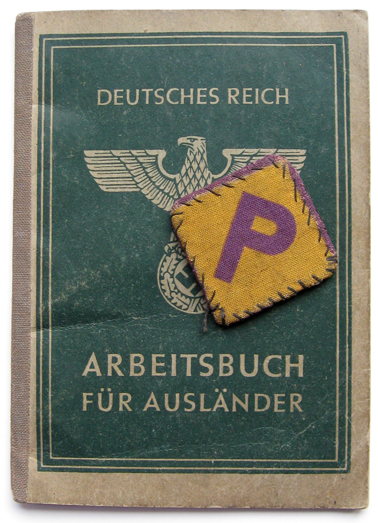
After the invasion of Poland, Poles over the age of 14 living in the General Government were subject to compulsory labor. In 1939 there were about 300,000 prisoners from Poland working in Germany; Already in 1944 there were about 2,8 m Polish Zivilarbeiters in Germany (approximately 10% of Generalgouvernement workforce) and a similar number of workers in this category from other countries. Forced laborers worked in agriculture, but also manufacturing.
Where voluntary recruitment failed to yield a required number of workers, penalties were issued on communities that failed to provide workers (confiscation of property, fines); later, manhunts were organized (see łapanka).
Workers' lives were almost totally regimented.
In December 1941 the decrees were supplemented by Polish Criminal Regulation (Polenstrafrechtsverordnung), which introduced shortened trials for Poles in criminal cases. In February 1942 Eastern decrees (Ostarbeitererlasse) were issued concerning the OST-Arbeiter (workers from territories taken from Soviet Union); based on the Polish decrees.
Notes
tags--
References
- Ulrich Herbert. (1997). "Hitler's Foreign Workers: Enforced Foreign Labor in Germany Under the Third Reich". Cambridge University Press.
- (March 2019}} They should also be kept away from German "cultural life" and "places of amusement" (this included churches and restaurants).{{rp). "Poles: Victims of the Nazi Era". United States Holocaust Memorial Museum.
- Ulrich Herbert. (1997). "Hitler's Foreign Workers: Enforced Foreign Labor in Germany Under the Third Reich". Cambridge University Press.
- Diemut Majer. (2003). ""Non-Germans" Under the Third Reich: The Nazi Judicial and Administrative System in Germany and Occupied Eastern Europe with Special Regard to Occupied Poland, 1939–1945". JHU Press.
- John C. Beyer. "Forced Labor under Third Reich - Part 1". Nathan Associates Inc..
- A. Paczkowski, Historia Powszechna/Historia Polski, Wydawnictwo Naukowe PWN, Warszawa 2008, tom 16, p. 28
- Reinhold Billstein. (1 January 2004). "Working for the Enemy: Ford, General Motors, and Forced Labor in Germany During the Second World War". Berghahn Books.
- M. L. Bush. (2 November 2000). "Servitude in Modern Times". Wiley.
- Ulrich Herbert. (1997). "Hitler's Foreign Workers: Enforced Foreign Labor in Germany Under the Third Reich". Cambridge University Press.
This article was imported from Wikipedia and is available under the Creative Commons Attribution-ShareAlike 4.0 License. Content has been adapted to SurfDoc format. Original contributors can be found on the article history page.
Ask Mako anything about Polish decrees — get instant answers, deeper analysis, and related topics.
Research with MakoFree with your Surf account
Create a free account to save articles, ask Mako questions, and organize your research.
Sign up freeThis content may have been generated or modified by AI. CloudSurf Software LLC is not responsible for the accuracy, completeness, or reliability of AI-generated content. Always verify important information from primary sources.
Report