From Surf Wiki (app.surf) — the open knowledge base
Platycladus
Genus of conifers
Genus of conifers
- Thuja orientalis L.
- Biota orientalis (L.) Endl.
- and dozens more in Cupressus, Thuja, Platycladus, Biota, Chamaecyparis, Juniperus, Retinispora, Widdringtonia
Platycladus is a monotypic genus of evergreen coniferous trees in the cypress family Cupressaceae, containing only one species, Platycladus orientalis, also known as Chinese thuja, Oriental arborvitae, Chinese arborvitae, biota or Oriental thuja. It is native to northeastern parts of East Asia and North Asia, but is also now naturalised as an introduced species in other regions of the Asian continent.
Description
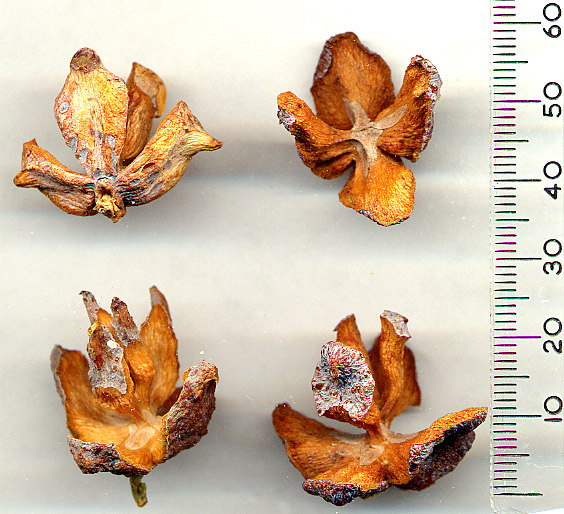
A monoecious tree, it is small, slow-growing, reaching 15–20 m and 0.5 m trunk diameter (exceptionally to 30 m tall and 2 m diameter in very old trees). The foliage forms in flat sprays with scale-like leaves 2–4 mm long, which are bright green in colour but may turn brownish or coppery orange in winter. The cones are 1.5–2.5 cm long, green ripening brown in about eight months from pollination, and have 6–12 thick scales arranged in opposite pairs. The seeds are 4–6 mm long, with no wing.
The branches are relatively short, loosely arranged and, usually, sharply directed upwards, and the bark, brownish, is detached in narrow vertical strips. The twigs are compressed and are arranged in vertical planes. The leaves, arranged in four rows, fleshy, opposite, decussate, truncated, imbricated as adults, somewhat curved inwards, of uniform green color and with a resiniferous gland on the underside. The female cones, of pink-salmon color and later bluish-greenish when immature, centimetric and of annual maturation, are oval with 6-8 flattened, thick scales, coriaceous and provided with an apical hook.
Taxonomy
Although generally accepted as the only member of its genus, it has been suggested that the closely related species Microbiota decussata could be included in Platycladus, but this is not widely followed. Other fairly close relatives are Juniperus and Cupressus, both of these genera being graft-compatible with Platycladus. In older texts, Platycladus was often included in Thuja, which is reflected in one of its common names, "oriental thuja". But it is only distantly related to the genus Thuja. Differences include its distinct cones, wingless seeds, and its almost scentless foliage.
Etymology
The binomial Platycladus means 'with broad or flattened shoots' deriving from Greek πλατύς platys 'broad, flat, level' and κλάδος klados 'branch, shoot of a tree'. The qualifier orientalis refers to its native habitat in China.
Distribution
It is native to northwestern China, but it is difficult to distinguish the areas where they are native safely from those where they have been introduced. It is distributed in Manchuria, Russian Far East (Amur and Khabarovsk), and now it is naturalised in Korea, Japan, India, Florida and Iran as well. It is also cultivated in many parts of the world in parks, gardens, home yards, cemeteries and for hedges.
Uses
Resistant to drought, it is very often used as an ornamental tree, both in its homeland, where it is associated with long life and vitality, and very widely elsewhere in temperate climates. It is suitable for form cuts and year-round opaque hedges, but also forms impressive slender solitary trees. Several cultivars have been selected, of which 'Aurea Nana' has gained the Royal Horticultural Society's Award of Garden Merit.
The wood is used in Buddhist temples both for (lavairos) construction work, and chipped, for incense burning. Its twigs and leaves contain 0.12% essential oil containing pinene and probably caryophyllene. Its use as a memorial tree dates back to the Zhou dynasty in China, where it was the official memorial tree of princes.
Gallery
|File:PlatycladusOrientalis2.jpg|Habit of young plant |File:Platycladus orientalis.jpg|Platycladus orientalis, Morton Arboretum acc. 168-53#3 |File:BiotaOrientalis6.jpg|Mature trees |File:BiotaOrientalis5.jpg|Mature tree |File:Platycladus orientalis 20070330 3.jpg|Very young female cones |File:Platycladus orientalis, Parque Ana Tutor, Madrid 1.jpg|Immature seed cones |File:Platycladus1.jpg|Mature cones, with seeds visible |File:Platycladus_orientalis_cones.jpg|Mature cones |File:P.orientalis'Rosedalisr'.jpg|P. orientalis 'Rosedalis' |File:P.orientalis%27Rosedalisr%27closeup.jpg|P. orientalis 'Rosedalis' leaf |File:Platycladus orientalis-japan201601.jpg|P. orientalis 'Semperaurea' in winter
References
General references
References
- Farjon, A.. (2013). "''Platycladus orientalis''".
- "''Platycladus orientalis''".
- {{GRIN
- (2022-05-06). "WSCP, the last web-archive snapshot before migration to POWO (Archive copy)".
- {{BSBI 2007
- {{PLANTS
- "Platycladus orientalis".
- (2022-10-15). "WSCP, the last web-archive snapshot before migration to POWO (Archive copy)".
- {{eFloras. 2. 200005428. Platycladus orientalis
- Kremer BP, Trees, Editorial Blume, Barcelona, 1986, Thuja orientalis L., p. 78
- {{LSJ. platu/s. πλατύς, {{LSJ. kla/dos. κλάδος. ref.
- Harrison, Lorraine. (2012). "RHS Latin for gardeners". Mitchell Beazley.
- Armin Jagel, Veit Martin Doerken: Morphology and morphogenesis of the seed cones of the Cupressaceae - part II: Cupressoideae. Bull. CCP 4 (2), 2015, pp. 51-78
- "RHS Plant Selector - ''Platycladus orientalis'' 'Aurea Nana'".
- (July 2017). "AGM Plants - Ornamental". Royal Horticultural Society.
- Armin Jagel, Thomas Stützel: Studies on the morphology and morphogenesis of the seed cones of Platycladus orientalis (L.) Franco (= Thuja orientalis L.) and Microbiota decussata Kom. (Cupressaceae) . Bot. Year syst. Bd. 123, 2001, pp. 337-404.
- Li, Hui-Lin. (1974). "The Origin and Cultivation of Shade and Ornamental Trees". [[University of Pennsylvania Press]].
- Cirrus Digital: [http://www.cirrusimage.com/tree_oriental_arborvitae.htm ''Platycladus orientalis''] [[Morton Arboretum]] accession 168-53#3
This article was imported from Wikipedia and is available under the Creative Commons Attribution-ShareAlike 4.0 License. Content has been adapted to SurfDoc format. Original contributors can be found on the article history page.
Ask Mako anything about Platycladus — get instant answers, deeper analysis, and related topics.
Research with MakoFree with your Surf account
Create a free account to save articles, ask Mako questions, and organize your research.
Sign up freeThis content may have been generated or modified by AI. CloudSurf Software LLC is not responsible for the accuracy, completeness, or reliability of AI-generated content. Always verify important information from primary sources.
Report