From Surf Wiki (app.surf) — the open knowledge base
Pig toilet
Outhouse mounted over a pigsty
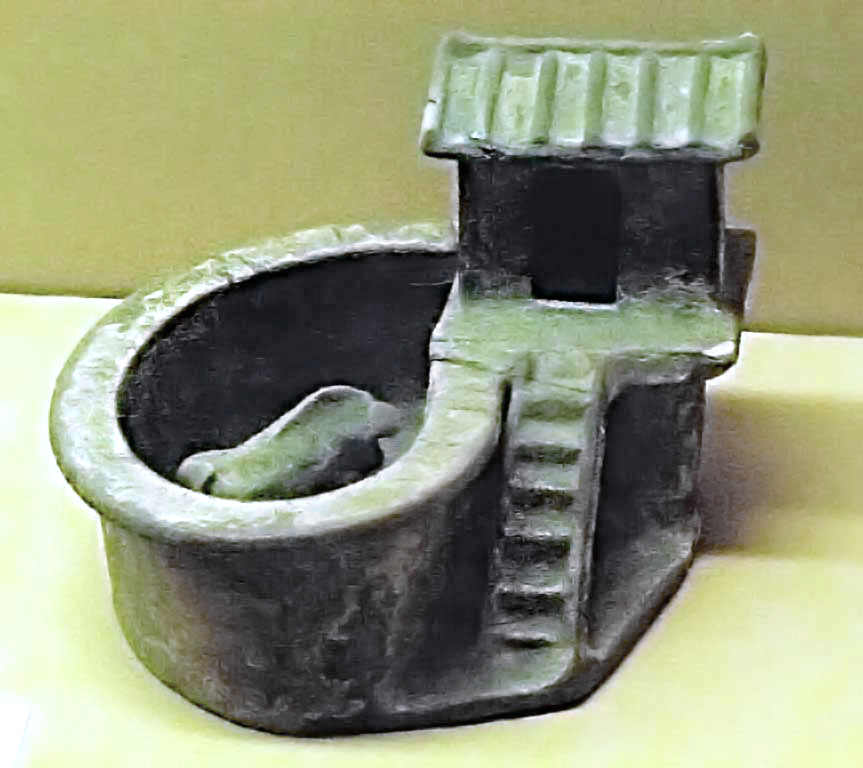
Outhouse mounted over a pigsty
A pig toilet ( zhūjuànmáokēng, sometimes called a "pig sty latrine") is a simple type of dry toilet consisting of an outhouse mounted over a pigsty, with a chute or hole connecting the two. The pigs consume the feces of the users of the toilet, as well as other food.
The pigs raised on human excrement are subsequently used as a food source, which can raise health concerns.
History
Pig toilets were once common in rural China, where a single Chinese character () signifies both "pigsty" and "privy". Funerary models of pig toilets from the Han dynasty (206 BC to AD 220) prove that it was an ancient custom. These arrangements have been strongly discouraged by the Chinese authorities in recent years, although as late as 2005 they could still be found in remote northern provinces.
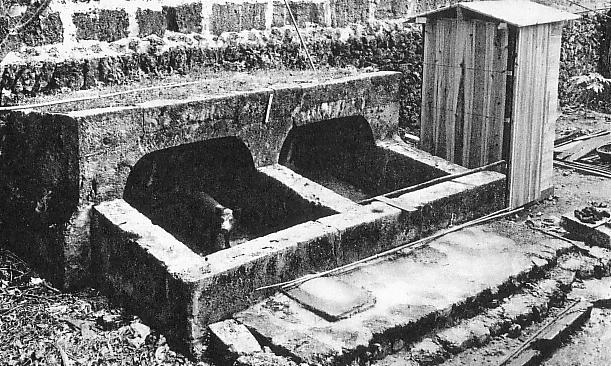
Chinese influence may have spread the use of pig toilets to Okinawa (Okinawan: ふーる (fūru) / 風呂) before World War II, and also to the Manchu people during the Qing dynasty period.
Pig toilets were also used in parts of India such as Goa. A 2005 survey of sanitary arrangements in Goa and Kerala found that 22.7% of the population still used pig toilets. More recent surveys show significant decline in unsanitary latrine usage, with only 2% of Kerala still using non-flushing toilets, and unsanitary pig rearing being broadly banned in Goa.
On Jejudo, a volcanic island of South Korea that is home to a breed of black pig, the pig toilets were known as dottongsi (). These pigsty toilets were still in use in the 1960s.
Fishpond toilet
In China, "Family dwellings are commonly built close to the fish pond with toilets overhanging the pond to facilitate fertilization. ... Some pigsties as well as latrines for humans are built on the adjacent dike so as to overhang the pond." But by 1988, these fish pond toilets were falling out of favour, as the farmers found it more useful to ferment human and pig excrement together, and apply it to the aquaculture ponds as needed.
In Vietnam, the traditional fish pond toilet, which was described as "widespread" as recently as 2008, polluted the waterways, but was perceived as more hygienic (less odorous) than various modern alternatives that the government was pressing on the villagers.
File:Pig toilet2.jpg|Pig toilet in Goa, India (1999) File:Pig toilet1.jpg|Pig toilet in Ryukyu (1800s)
In popular culture
The anime JoJo's Bizarre Adventure features a pig toilet in a Calcutta restaurant in Season 2 episode 10: The Emperor and the Hanged Man, Part 1.
References
References
- (1 February 2007). "Environmental History of Water". IWA Publishing.
- [https://books.google.com/books?id=N5dN_A29v58C&pg=PA16 Ancestors for the Pigs: Pigs in Prehistory, Sarah M Nelson, University of Pennsylvania Museum of Archeology and Anthropology, Museum Applied Science Center for Archaeology, 1998, ISSN 1048-5325 (p.16)]
- [http://www.artsmia.org/viewer/detail.php?id=4793&v=2&t=1&n=1&keyword=Pig%20Sty Minneapolis Institute of Art: Han Dynasty Pig Sty-Latrine]
- [http://www.watersanitationhygiene.org/References/EH_KEY_REFERENCES/SANITATION/Latrine%20Design%20and%20Construction/Sanitation%20Without%20Water%20(Winblad%20Kitama).pdf Sanitation Without Water, Uno Winblad and Wen Kilama, MacMillan 1985] {{ISBN. 0-333-39140-3 (p.13)
- [http://www.chemeng.lth.se/vva030/Arkiv/Lecture_SanSyst-Lund-0911.pdf Appropriate Sanitation Systems in Developing Countries, Technical University of Denmark (p.9 of 10)] {{webarchive. link. (2012-04-25)
- [http://oki-park.jp/kyoudo/en/study/minka.html Native Okinawan Village Official Site: Unique Features of an Okinawan Home] {{webarchive. link. (2012-04-06)
- Shirokogorov, Sergeĭ Mikhaĭlovich. (1924). "Social Organization of the Manchus: A Study of the Manchu Clan Organization". Royal Asiatic Society.
- 1-74059-139-9 (p. 197)
- (February 2007). "Community-Led Total Sanitation in Rural Areas: An Approach that Works". Water and Sanitation Program - South Asia.
- (May 2024). "Home-grown feasts: How Goans once raised pigs & prepared them for festivals".
- (December 2012). "Report On NSS Socio-Economic Survey 69th Round".
- "JEJU TOURISM ORGANIZATION {{!}} Stories about Jeju > Food, Lodging and Clothing".
- [http://joongangdaily.joins.com/article/view.asp?aid=2872445 "Jeju's black pig still tasty on the table"] @ [http://joongangdaily.joins.com/ ''JoongAng Daily''], February 15, 2007.
- (1988). "Integrated Agriculture-Aquaculture in South China: The Dike-Pond System of the Zhujiang Delta". Cambridge.
- (12 January 2016). "The Political Economy of Microfinance: Financializing Poverty". Springer.
- Inglese. (9 June 2014). "JoJo’s Bizarre Adventure: Stardust Crusaders Episode 10 Impressions".
This article was imported from Wikipedia and is available under the Creative Commons Attribution-ShareAlike 4.0 License. Content has been adapted to SurfDoc format. Original contributors can be found on the article history page.
Ask Mako anything about Pig toilet — get instant answers, deeper analysis, and related topics.
Research with MakoFree with your Surf account
Create a free account to save articles, ask Mako questions, and organize your research.
Sign up freeThis content may have been generated or modified by AI. CloudSurf Software LLC is not responsible for the accuracy, completeness, or reliability of AI-generated content. Always verify important information from primary sources.
Report