From Surf Wiki (app.surf) — the open knowledge base
Piedfort
Coin
Coin
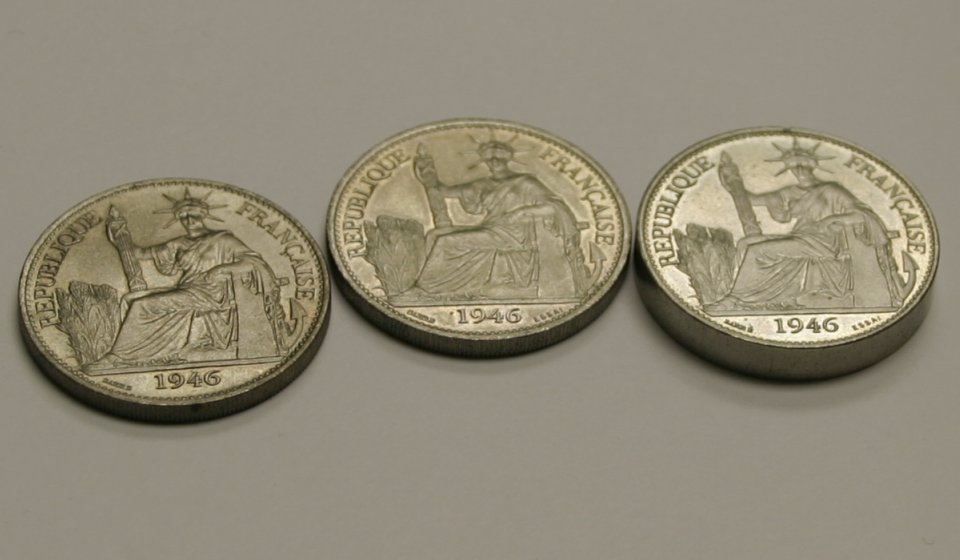
A piedfort (, ; ) is an unusually thick coin, often exactly twice the normal weight and thickness of other coins of the same diameter and pattern. Piedforts are not normally circulated, and are only struck for presentation purposes by mint officials (such as patterns), or for collectors, dignitaries and other VIPs. Piedfort is less commonly spelled "piefort".
History

Piedfort coins were first recorded in France and Great Britain during the Middle Ages, with the first French piedforts appearing in the 12th century. The reason the coins were minted in piedfort form was probably to prevent them from being lost among normal circulating coins. Theories for the original purpose of the earliest piedfort coins are:
- As patterns for administrative approval.
- As patterns to show engravers in different mints what an approved design should look like.
- As reckoning counters or jetons for mint officials, akin to a simple milestone or the beads on a more complex abacus.
Later, the higher rarity of piedfort versions of a nation's coinage led to them being used as prestigious diplomatic gifts to kings, nobility, dignitaries and other VIPs. Note that coin collecting has traditionally been called "the hobby of kings". The demand for piedforts from politically influential coin collectors resulted in such routine production that a droit de pied fort, or "right of piedfort", was instituted as a formal code of rules defining who was entitled to a piedfort version of a new coin design. Edicts of such rules date back to at least 1355 in France.
The first British piedforts were silver pennies minted during the reign of Edward I (1272 to 1307). Britain stopped routinely minting piedforts in 1588, but France continued to mint them for at least another 150 years before also ceasing production. The routine production of piedforts began again in France in 1890, and Britain began to produce piedforts available to the public for the first time in 1982. Since then, Britain's Royal Mint has become well-known for creating many commemorative piedfort coins. China produced piedforts for collectors in 1988.
Etymology
Piedfort is a compound of the French words "pied" (foot), and "fort" (strong, great, heavy). It literally means "heavy foot", but the idiomatic meaning is "heavy weight". 18th century encyclopedic French dictionaries record it in the form of two separate words, as "pied fort" (1774):
PIED FORT, terms of currency, this word is said of a coin of gold, silver, or other metal, that is thicker than ordinary currency...
The modern form of "piedfort" appears in English by 1802 in a Sotheby's auction catalog, by which time the term was already in wide use.
Misspelling
Impropriety of the piefort misspelling is attested to 1917, when the error had become common enough to warrant a mention in an early numismatic jargon dictionary:
Piefort, or more properly, Piedfort, means literally any coin struck on an unusually thick planchet as a trial piece or essay.
The piefort misspelling appears in English as early as 1893, where the author and citing authors give false etymologies of the word relating to the weight (not thickness) of a coin, the depiction of human legs on a coin, and a corruption of the name of the Belgian city of Liège ("Luik" in Dutch) as "Leg".
The influential Krause and Mishler Standard Catalog of World Coins has used both piedfort and piefort interchangeably for at least the prior 3 decades, as of 2012.
The piefort misspelling has crept back into the French language as piéfort.
References
References
- [https://www.merriam-webster.com/dictionary/piedfort Merriam-Webster Dictionary]
- [https://web.archive.org/web/20180314042826/https://en.oxforddictionaries.com/definition/piedfort Oxford Living Dictionaries]
- [https://www.collinsdictionary.com/dictionary/english/piedfort Collins Dictionary]
- [https://www.infoplease.com/dictionary/piedfort Random House Dictionary]
- {{langx. fr. pied-fort or ''piéfort''[http://www.cnrtl.fr/definition/piéfort Trésor de la langue française informatisé]
- "The Piedfort Coin – A Rare Collector's Item". The Royal Mint.
- [http://www.anythinganywhere.com/info/a2z/azfrance.htm France: coinage survey]
- "Brass reckoning counter, Rechenmeister type". British Museum.
- [http://www.mernick.org.uk/lnc/jetton/jetton.htm Jettons at mernick.org.uk]
- [http://www.sacra-moneta.com/Mots-generaux-Techniques-de-fabrication/Piefort-Piedfort-Pieds-Forts-Essais.html Piéfort – Piedfort – Pieds-Forts – Essais]
- Simon Fournival. (1672). "Recueil général des titres: concernant les fonctions rangs ... des présidens, trésoriers de France".
- "2009 Countdown to London £5 Silver Piedfort Proof Coin". World Mint Coins.
- CCT720: [https://www.coincompendium.com/w/index.php/CCT720 1988 to 1999 1 oz silver lunar proof piedfort 12 coin set]
- [http://www.collinsdictionary.com/dictionary/french-english/pied?showCookiePolicy=true "pied"], ''Collins French Dictionary''
- [http://www.collinsdictionary.com/dictionary/french-english/fort?showCookiePolicy=true "fort"], ''Collins French Dictionary''
- Hanisco, Ray. "Piedfort". BellaOnline.
- M. De Felice. (1774). "Encyclopedie ou dictionnaire universel raisonne des connoissances humaines mis en ordre". Fortuné Barthélemy de Félice, Denis Diderot.
- (1802). "A Catalogue of the very valuable and extensive collection of ancient and modern coins and medals of the late Samuel Tyssen, Esq. F.A.S.". Sotheby's.
- Albert Romer Frey. (1917}}
- {{cite web). "A Dictionary of Numismatic Names: Their Official and Popular Designations". [[American Numismatic Society]]. - William Carew Hazlitt. (1893}}
- {{cite book). "The Coinage of the European Continent: With an Introduction and Catalogues of Mints Denominations and Rulers". Scottish History Society. - [http://www.ma-shop.de/cdma/item.php5?id=54271&curr=EUR&lang=fr Vème République, 50 Francs Hercule, Piéfort]
This article was imported from Wikipedia and is available under the Creative Commons Attribution-ShareAlike 4.0 License. Content has been adapted to SurfDoc format. Original contributors can be found on the article history page.
Ask Mako anything about Piedfort — get instant answers, deeper analysis, and related topics.
Research with MakoFree with your Surf account
Create a free account to save articles, ask Mako questions, and organize your research.
Sign up freeThis content may have been generated or modified by AI. CloudSurf Software LLC is not responsible for the accuracy, completeness, or reliability of AI-generated content. Always verify important information from primary sources.
Report